Posts Tagged ‘research’
May 11, 2015
On Tuesday the 5th May CAHR [Centre for Applied Human Rights at the University of York, UK] hosted a one-day workshop on Risk and Protection.

from left to right, Jamshid Gaziyev (Office of the UN Special Rapporteur on HRDs); James Savage (Amnesty International UK); Andrew Anderson (Frontline Defenders); and Alice Nah (CAHR).
The workshop examined the lessons, synergies and tensions that emerge when considering the approaches to protection that have been taken by human rights, development and humanitarian actors. The workshop sought to address how actors from adjacent fields could work together, and learn from each other, to build safe and enabling environments for HRDs and broader communities at-risk.
The workshop brought together practitioners, academics and donors from across fields. Speakers included representatives from the office of the Special Rapporteur on Human Rights Defenders, Amnesty International, Frontline, Global Witness, the Business and Human Rights Resource Centre and the Overseas Development Institute (Humanitarian Policy Group). It was supported by a grant from the Open Society Foundations Human Rights Initiative. The learnings for the workshop will be written up as an article and will feed into CAHR’s ongoing work on HRDs.
via HRD protection workshop 2015 – Centre for Applied Human Rights, The University of York.
Posted in AI, Front Line, human rights, Human Rights Defenders, OHCHR | Leave a Comment »
Tags: Alice Nah, Andrew Anderson, CAHR, Centre for Applied Human Rights, Centre for Applied Human Rights at York University, Human Rights Defenders, protection, research, York university
September 28, 2014
On September 25, in an event held at the School of Oriental and African Studies in London, the Cairo Institute for Human Rights Studies [CIHRS ] launched a new three-year academic research project on political Islam and human rights. Read the rest of this entry »
Posted in CIHRS, human rights, Human Rights Defenders | Leave a Comment »
Tags: academic research project, Arab region, Arab world, Cairo Institute for Human Rights Studies, human rights, islamic fundamentalists, Islamism, political islam, political Islam and human rights, research, universality
September 26, 2013
 The Scholars at Risk Network invites submissions for the Winter 2013 edition of University Values: a global bulletin on academic freedom, and the first of its kind around the world. Previous editions of the bulletin can be viewed at: http://www.scholarsatrisk.nyu.edu/Workshop/bulletin.php
University Values is an electronic bulletin featuring articles, essays, opinion pieces and announcements promoting discussion and understanding of university values, including values of access, accountability, academic freedom, autonomy and social responsibility.
Submission Requirements
Length: short articles of 500-700 words maximum.
Topic: on an academic freedom related issue of your choice. The article could, alternatively, contain news on important events, situations emerging in your region or specific countries or urgent appeals for scholars or universities in distress.
Deadline: November 11, 2013.
Contact: submit articles by email to scholarsatrisk@nyu.edu. Enter “University Values Submission” in the subject line of your email.
The University Values Editing Committee will select up to six articles for publication in the bulletin. For more information about Scholars at Risk visit http://scholarsatrisk.nyu.edu.
Posted in human rights | Leave a Comment »
Tags: Academic freedom, American Association of University Professors, Colleges and Universities, Education, electronic bulletin, Higher education, opinion pieces, politics, research, Scholars at Risk, science, Social Sciences, submission requirements, University Values
September 18, 2013
Hailey Colwell on 18 September describes how: Read the rest of this entry »
Posted in human rights, Human Rights Defenders | Leave a Comment »
Tags: Antioquia, Colombia, environmental issues, human rights, Human Rights Defenders, Law, Minnesota Daily, research, schooling, training course, University of Medellín, University of Minnesota, USA
August 30, 2013
For the fifth time the Dutch Lawyers Committee for Human Rights (NJCM) will issue the Thoolen NJCM-Scriptieprijs for the best master thesis. Any student who has followed university level education – at least partly – in the Netherlands is allowed to participate as long as the paper was written between 2011 and 2013. The winning paper will be published by the Foundation NJCM-Boekerij. The deadline is 1 november 2013. Four copies of the paper – in English or Dutch – have to be sent to: NJCM, Steenschuur 25, 2311 ES Leiden. Former winners of the award are:
– Laura Henderson, Tortured reality. How media framing of waterboarding affects judicial independence
– Erik van de Sandt, A child’s story for global peace and justice. Best practices for a child-friendly environment during the statement- and testimony-period in respect of the Rome Statute and the International Criminal Code
– Shekufeh Jalali Manesh, het recht van het kind op behoorlijke huisvesting en het BLOEM-model
– Janine de Vries, Sexual violence against women in Congo. Obstacles and remedies for judicial assistance .
via NJCM – Nederlands Juristen Comité voor de Mensenrechten.
Posted in books, human rights | Leave a Comment »
Tags: Advocacy Organizations, awards, Dutch Lawyers Committee for Human Rights, Human right, Human Rights and Liberties, lawyers committee for human rights, Leiden, master thesis, Netherlands, NJCM, research, Thesis, Thoolen NJCM prijs, university level education
August 1, 2013
 launched two innovative legal databases: the Sexual Orientation & Gender Identity (SOGI) UN Database and the SOGI Legislative Database. Read the rest of this entry »
Posted in human rights, HURIDOCS, ICJ | Leave a Comment »
Tags: databases, HURIDOCS, ICJ, International Commission of Jurists, Law, legal databases, legal profession, legislation, LGBT, lgbt human rights, research, sexual identity, Sexual orientation, UN Compilation, United Nations, university of toronto faculty
June 4, 2013
The Women Human Rights Defenders International Coalition (WHRD IC) is looking to recruit an editor for the Manual on Documenting Violations against Women Human Rights Defenders. The editor will work closely with members of the WHRD IC’s Documentation Manual Working Group to complete the manual. Read the rest of this entry »
Posted in human rights, Human Rights Defenders | Leave a Comment »
Tags: Advocacy Organizations, climate, consultant, digital security, Human right, Human Rights and Liberties, Human Rights Defenders, human rights documentation, human rights organization, job opportunity, manual, Non-governmental organization, recruitment, research, women human rights defenders, Women's rights, Working Group
April 17, 2013
According to the ‘24.kg news agency‘ [only] 394 brides have been kidnapped in Kyrgyzstan in 2012. Ombudsman Tursunbek Akun said this at a meeting of the parliament Committee for Human Rights. He said that the number used to be much larger: “But the Ombudsman’s Institute, human rights defenders, journalists, and us – we all are working on it. We can see positive changes. Rate of brides kidnapping for forced marriage has decreased. A man who kidnapped a bride has been sentenced to 6 years with our assistance”.
However in the related article mentioned below from June 2012 number estimates are much higher: ” Since it often goes unreported, the actual number of bride kidnappings is unknown although Kyrgyzstan Ombudsman Tursunbek Akun estimates that more than 8,000 young women are kidnapped each year.”
http://eng.24.kg/community/2013/04/16/26656.html
Posted in human rights, Human Rights Defenders | Leave a Comment »
Tags: Bishkek, bride kidnappings, human rights, Human Rights and Liberties, Human rights defender, Human Rights Defenders, human rights of women, kidnapping, Kyrgyzstan, Ombudsman, Ombudsman Tursunbek Akun, research, traditional practices, wedding
January 31, 2013
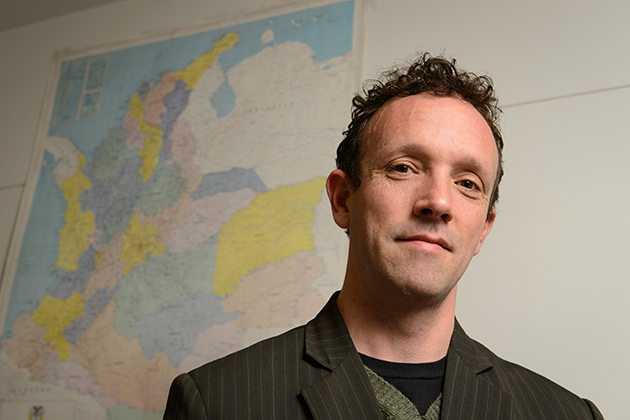
When writing about individual Human Rights Defenders the tendency is to give attention to those in the front line who are in immediate trouble. This time I want to refer to a HRD teaching at the University of Connecticut based on a blog post by Kenneth Best of 30 January 2013. It concerns Luis van Isschot, an assistant professor of history, who specializes in the study of human rights in Latin America ( photo by Peter Morenus/UConn Photo).

Conversation around the dinner table in the van Isschot home in Montreal was a bit different than in most Canadian homes. Growing up with a Spanish, Peruvian, and Dutch family heritage, Luis van Isschot listened to discussions about Latin American history and politics led by his father, a physician who treated families in a clinic based in Montreal’s Latino community…….
…His path to a doctoral degree developed from his volunteer work in Guatemala and later in Colombia, where he served as a human rights observer. It was during his time in Colombia that a friend who was a university professor and a historian told him that one of the most important books of Colombian history was written by a professor from his hometown of Montreal, Catherine Le Grand at McGill University, and that he should look her up. He did, and it led to his enrollment in the doctoral program. “She made it seem that you could be a wonderful teacher, a cutting-edge scholar, and have a balanced life of engagement in your community, and that the Ph.D. was a way of doing that,” van Isschot says. “The university is central to the community, not apart from it. That makes sense to me.”
He later became involved with MEA Laureate 2001 Peace Brigades International, a nonpartisan organization that sends international volunteers to areas of conflict to provide protective accompaniment to human rights defenders threatened by political violence in 11 nations, including in Asia, Africa, and Latin America. In addition to serving as a human rights observer in Colombia, he also traveled to the Great Lakes Region of Africa, doing research in the Democratic Republic of Congo, Rwanda, and Burundi.
“It was a really important experience for me to go somewhere where the language of human rights and social justice and the understanding of history really enriched my own understanding of what I was working on in Latin America,” he says. His experience in Colombia led him to focus his doctoral studies on human rights activities in that nation’s oil capital, Barrancabermeja, where he lived for a year. The city was the center of a major urban war between Colombian paramilitary groups and leftist guerillas. Between 1998 and 2002, in a city of 300,000 there were about 2,000 violent murders. “It was a devastating period. The relationships I made with Colombian human rights activists, teachers, and scholars convinced me that I needed to find some place to explore the issues,” he says.
His book, The Social Origins of Human Rights: Protesting Political Violence in Columbia’s Oil Capital, 1919-2010, is near completion, and scheduled to be published in early 2014. His new research project is titled “When the Courts Make History: the Impact of the Inter American Court of Human Rights in Latin America’s Conflict Zones,” and examines the historical changes set in motion by the pursuit of justice across borders.
http://today.uconn.edu/blog/2013/01/focusing-on-human-rights-with-a-latin-american-perspective/
Posted in human rights, Human Rights Defenders | Leave a Comment »
Tags: Africa, Canada, Colombia, Democratic Republic of Congo, Human rights defender, human rights education, human rights teaching, Latin America, Luis van Isschot, McGill University, PBI, Peace Brigades International, research, University of Connecticut, USA
December 10, 2012
The Oak Institute for the Study of International Human Rights draws again attention to its call for nominations for the 2013 Oak Human Rights Fellowship, sponsored by the Oak Institute for the Study of International Human Rights at Colby College in Waterville, Maine. The fellowship is a one-semester appointment as a scholar-in-residence. It is designed to provide human rights practitioners doing “on-the-ground” work at some level of personal risk a respite from front-line duties to enable them to reflect, write, and communicate their work to our campus community. The focus of this year’s search is on the protection of the human rights of interned or displaced persons. We are particularly looking for those human rights practitioners involved in international legal rights and basic needs of prisoners of war, civilians detained during occupation or as the result of political violence or states of emergency, and refugees and internally displaced persons fleeing from civil violence, political repression or economic dislocation. The appointment is for mid-August through mid- December 2013. The College provides a stipend of $32,500, plus transportation, housing, health care coverage, and other fringe benefits. We encourage the fellow to bring family with limited financial support for their travel as well. The deadline for completed applications is December 15, 2012 (but first contact the OAK institute with a very good candidate as the first deadline has passed already and forms have to be filled out). Leah Breen Student Assistant, Oak Institute for the Study of International Human Rights oakhr@colby.edu
Posted in human rights | 1 Comment »
Tags: Colby College, fellowship, human rights, Human Rights and Liberties, Human rights defender, OAK, research
 Hans Thoolen on Human Rights Defenders and their awards