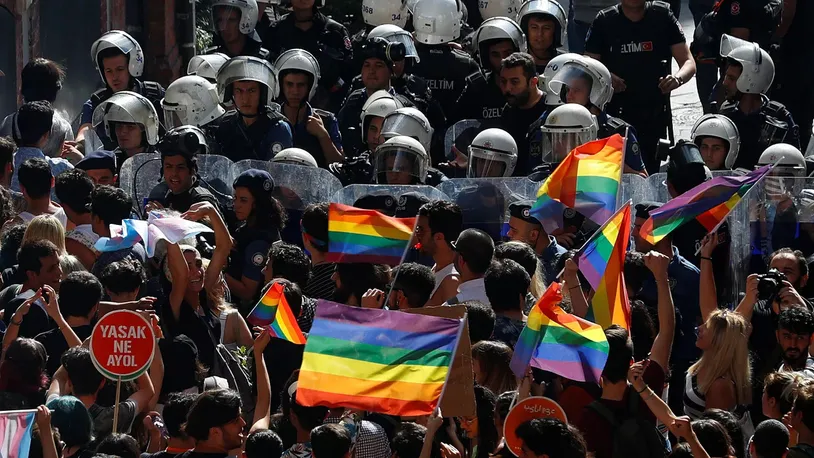
More than 450 civil society organizations from 65 countries have called on Turkey to end what they described as the criminalization of the LGBTI+ movement and release people detained solely for human rights work.
In a joint statement on 22 September 2026 titled “Stop the Criminalisation of the LGBTI+ Movement in Turkey,” the groups said human rights advocacy, publishing, organizing, membership, donations, fundraising and lawful domestic or international funding should not be treated as evidence of criminal activity and called for an end to raids and online restrictions targeting LGBTI+ organizations and human rights defenders.
The statement, published by Turkey-based Women for Women’s Human Rights (WWHR), was signed by organizations including the Association for Women’s Rights in Development (AWID), CIVICUS, the International Planned Parenthood Federation (IPPF), the International Women’s Development Agency (IWDA), PEN Norway and the World Organisation Against Torture (OMCT). CIVICUS is a global alliance of civil society organizations and activists.
The groups objected to what they described as the use of organized-crime provisions and broadly defined concepts such as “obscenity,” “morality” and “family” to criminalize LGBTI+ identities, visibility and advocacy.
The appeal follows a nationwide operation that began September 13 with police raids on LGBTI+ organizations, activists’ homes, gay bars and nightclubs, a day after Turkish authorities restricted access to social media accounts belonging to more than a dozen groups.
Organizations targeted in the investigations include the Kaos Gay and Lesbian Cultural Research and Solidarity Association (Kaos GL), the Families and Friends of LGBTI+ People Association (LİSTAG) and the Social Policy, Gender Identity and Sexual Orientation Studies Association (SPoD), as well as several other LGBTI+ and HIV-related groups.
According to Turkish media, 116 people had been detained in the raids and 82 were jailed pending trial. The cases include LGBTI+ activists and members of rights organizations as well as people accused of prostitution, drug offenses and other crimes, meaning not everyone detained or jailed in the operation was accused of activity connected to LGBTI+ advocacy.
The Carr Center’s Global LGBTQI+ Human Rights Program is excited to announce the launch of the Global LGBTQI+ Changemakers Network, which will serve as a hub for learning, research, and collaboration on global LGBTQI+ challenges.
The global network is a community of activists and professionals dedicated to advancing LGBTQI+ rights in 142 countries around the world, with the goal to create a vibrant space where ideas, knowledge, and opportunities are shared to strengthen and support one another in this crucial work at such a critical time.
The network will offer educational opportunities, including exclusive online and in-person webinars and workshops to highlight cutting-edge research and global success stories; research collaborations that will partner participants with Harvard students, faculty, and fellow advocates on impactful research projects; and creative partnerships with affiliates of the Carr Center’s Global LGBTQI+ Human Rights Program. The three core parts of the network’s offerings include:
The Global LGBTQI+ Changemakers Network: As referenced above, members of this network will receive access to a regular series of online trainings on a broad range of topics of interest to the movement. These will be available exclusively to this network, and by invitation, to a broader audience.
Foundational Curriculum Track: Sixty participants, selected by application, will take part in a series of in-depth, interactive online courses running from February to August 2025. This program is designed to work in tandem with the other offerings in this network.
The Global LGBTQI+ Changemakers Network is launched by the team at the Carr Center’s Global LGBTQI+ Human Rights Program, including:
Diego Garcia Blum, Program Director;
Timothy Patrick McCarthy, Program Faculty Chair; and
Jean Freedberg, Founding Practitioner Affiliate
The first Changemakers Network event will take place on Thursday, January 30, 2025. This webinar, “Illiberal Playbooks: Preparing for Attacks on LGBTQI+ Rights in the U.S.,” will explore lessons learned from Hungary, Poland, and Bulgaria on the Illiberal Playbook, and how these tactics may be employed in the United States. Registration is still open for the event by clicking the link. For members of the Changemakers Network, a follow-up workshop and discussion session in the style of classes at Harvard will follow, and Changemakers will be notified how to attend.
Through the Changemakers Network, we can learn from each other, sharpen our strategies, and push forward in the fight for dignity and justice. The movement needs all of us, and none of us can do it alone.
Rasha Younes Researcher, Lesbian, Gay, Bisexual, and Transgender Rights, describes how Lebanon is losing is status as a safe haven for human rights defedners in the Middle East.
Lebanon used to be known as a port in a storm for human rights defenders from the Arabic-speaking world – especially those working on gender and sexuality – to organize freely and without censorship. A major space for this was the annual NEDWA conference, hosted by the Arab Foundation for Freedoms and Equality (AFE).
Even as lesbian, gay, bisexual, and transgender (LGBT) people faced grave human rights violations over the years ranging from murders in Iraq, to jail time and forced anal examinations in Egypt, to rigid censorship of LGBT content in Qatar, Lebanon was a haven where embattled activists could meet at NEDWA to cultivate their movements’ resilience, tactics, and communal healing in the face of adversity. That safe haven in the Middle East no longer exists.
Amid a targeted crackdown against free expression and assembly around gender and sexuality in Lebanon, resulting in an unlawful raid by General Security on the 2018 NEDWA conference and a discriminatory entry ban imposed on non-Lebanese participants, AFE was forced to move its conference outside the Middle East and North Africa region for the first time.
The activists adapted. 200 human rights defenders, artists, and academics from the region gathered in another country. They discussed health, human rights, and movement building. Queer and trans artists from Palestine, Lebanon, and Egypt inspired the conference attendees with performances that reconfigured the meaning of resistance, embodying creative ways to combat state-sponsored repression. Instead of safeguarding much-needed platforms such as NEDWA and celebrating these activists, the Lebanese government chose to forego its international obligations by claiming that the conference “disrupts the security and stability of society,” and collectively sanctioning its participants.
Lebanon’s suppression of LGBT activism is part of a larger crackdown on free speech in the country. Hamed Sinno, the lead singer of the indie band Mashrou’ Leila, whom the Lebanese government censored in July, spoke at this year’s NEDWA conference, condemning Lebanon’s decline as a center for art and tolerance, while reassuring activists that the fight continues. Lebanon should take note: intimidation and threats will not silence the voices of resilient activists who will continue to fight for their right to live and love. By closing its doors on activism, Lebanon is divesting its image as the hub for freedom and diversity in the region.
Khoi is an independent artist who is shaping public discourse in Vietnam. She reached stardom in 2010, when she won the highest award for songwriting in Vietnam. As a celebrity, Mai advocated for women’s rights, LGBT rights, and to end violence against women. More recently, she became the focal point of public discourse after nominating herself to run in the 2016 parliamentary elections. Her pro-democracy campaign sparked a nationwide debate about political participation and ultimately led to a meeting with then-U.S. President Barack Obama. Since running for parliament, Mai has had her concerts raided, has been evicted from her house twice, and is effectively banned from singing in Vietnam. In March 2018, she was detained at Hanoi airport on suspicion of “terrorism” after returning from a European tour.
Despite this harassment, Mai continues to find creative ways to spark conversation on art, human rights, and democracy. In February 2018, she released a new album, “Mai Khoi Chem Gio – Dissent.” In a review of the album, The Economist commented, “If music alone could break chains, this would be the music to do it.” Mai’s work aims to counter the authoritarian ways of thinking that justify social control. She is currently the subject of a feature-length documentary that is scheduled to air on Netflix in 2019.
“Mai Khoi is outstanding in her commitment to human rights,” said Havel Prize Committee Chairman Thor Halvorssen. “Through her music and her campaigns, she has put civil liberties and democracy on the forefront of public conversation in Vietnam.”
The Havel Prize ceremony will be broadcast live at oslofreedomforum.com at 3:00 p.m. Oslo time (GMT+2) on Wednesday, May 30.
Yuli Rustinawati is the founder and chair of Arus Pelangi, one of Indonesia’s leading LGBT organizations. Photo: www.stonewall25.org.uk
Yuli Rustinawati, 40, is a lesbian who is the founder and chair of Arus Pelangi, one of Indonesia‘s leading LGBT organizations. The award comes amidst a rash on anti-gay rhetoric by political leaders in Indonesia in recent months. During the past three months Indonesian politicians have vowed to criminalize homosexuality; ban LGBT people from receiving education, employment, access to health care, and housing; called for the removal of gay characters on popular TV shows; and called upon tech companies to remove same-sex emojis from smart phone apps and social media. Rustinawati is setting up a foundation for sexual orientation and gender variant human rights defenders that will provide an emergency assistance program for its safe house, relocation assistance, a network with other human rights organizations, and an information and referral hotline. The foundation is also launching “You Are Not Alone,” a campaign to educate people about LGBTs and encourage more gay people to be visible.
On 5 May 2016 the Bay Area Reporter Online (Heather Cassel) published the news that Indonesian LGBT human rights defender Yuli Rustinawati will receive the Felipa De Souza Award2016 at OutRight’s Celebration of Courage Gala on16 May. Bisexual actor Alan Cumming will host the event and the awards will be presented by celebrity stylist Carson Kressley.
On 14 May the blogger APaper Bird posted an interesting set of slides that can be used in training human rights defenders. The author also sets a good example by letting them be shared freely:
“One thing I do with some frequency is trainings. These powerpoints reflect a session I worked on recently with the Egyptian LGBT group Bedayaa. The first (download the English version here) deals with issues in human rights documentation in general terms. The second (download English here) deals more specifically with strategies for interviews. I’m posting them here in the hope that they may be useful to activists who weren’t able to attend the workshop, and to people elsewhere as well. Some of the material is specific to Egypt, some is not….. [the slides also exist in Arabic – see original post)
These aren’t copyrighted; I’m not sure how you would copyright a basic skills set. (Actually, late capitalism can copyright anything. What I mean is, I don’t want to know.) However, if you find them interesting enough to adapt or reuse, I ask that you let me know, and cite me as the author.”
On 12 April Dan Harrison, in the Australian newspaper ‘Daily Life”, recalls how the famous Toonen case – decided 20 years ago – had a tremendous impact: “The fax arrived from Geneva on a Saturday almost exactly 20 years ago. The message on United Nations letterhead that landed on the fax machine at the Tasmanian Gay and Lesbian Rights Groups office in Hobart’s Battery Point would change the lives of millions. It carried the UN Human Rights Committees finding that Tasmanian laws, which made consenting sex between adult men in private a criminal offence punishable by up to 21 years jail, were in violation of Australia’s international obligations.”Read the rest of this entry »
Rolando Jiménez Perez,Chilean human rights defender, is given the floor in the newsletter of the International Service for Human Rights [ISHR] of February 2014. Here are some of the most quotable statements but the whole interview with Camille Marquis is worth reading:
‘I wanted to fight for human rights in order to help lesbians, gays, bisexuals and transsexuals and to put an end to any brutality for reasons of sexual orientation and gender identity. During the dictatorship of Augusto Pinochet, Rolando Jiménez Pérez was a member of the Communist Party driven, along with his fellow party workers, by the goal of restoring democracy. His sexuality was used by the party as a means to belittle him. This brought home to Rolando just how strong a role a person’s sexual orientation could play and he made up his mind that once the dictatorship was over he would turn his attention entirely to human rights and in particular towards lesbian, gay, bisexual and transgender (LGBT) people.
On 16 February 2014 Faith Karimi and Neda Farshbaf wrote for CNN how pop star Rihanna is adding major star power to the campaign for gay rights in Russia. The singer behind hits such as “Disturbia” and “SOS” tweeted a photo of herself wearing a hat emblazoned with P6, short for Principle 6. This campaign speaks out against Russia’s anti-gay propaganda law as the nation hosts the Winter Olympics. And Rihanna has 34 million followers on Twitter! The photo links to her Instagram account, which has about 12 million followers. In subsequent tweets, she posted links to other articles highlighting the issue.
This is a long but excellent to piece to read over the weekend by Stefania Kulaeva of the remarkable NGO Memorial in Russia:
AT THE TIME of the Olympic Winter Games in Sochi it is important to remember the human rights abuse of minorities and their defenders in Russia. This is a question for gay people but also for Roma, immigrant workers and members of other ethnic communities.Read the rest of this entry »