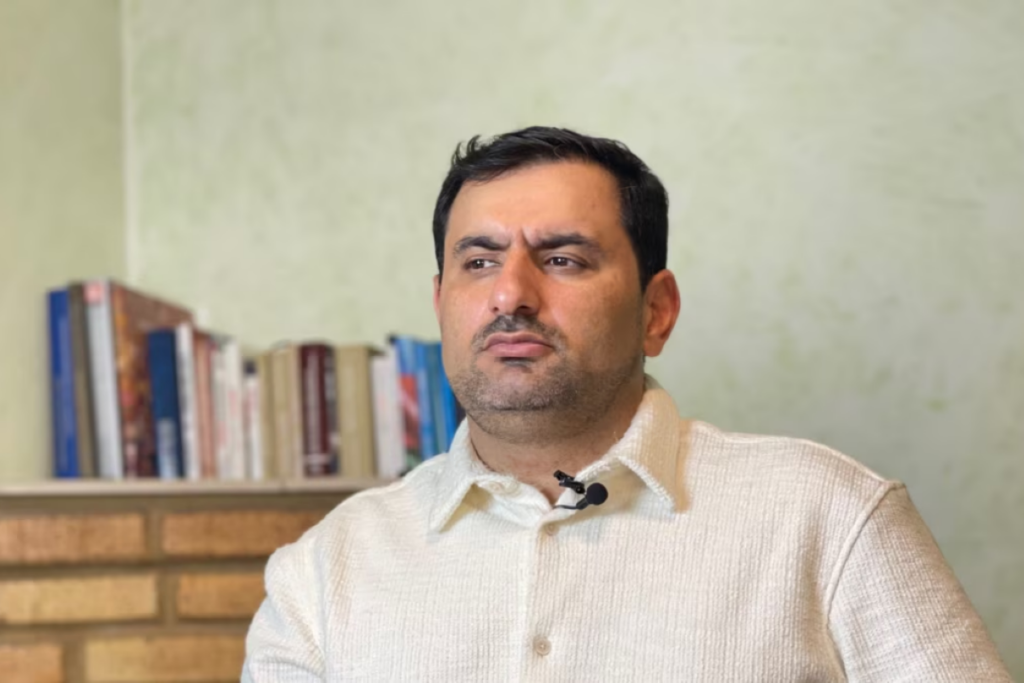
On 4 December 2024, Aytan Farhadova in OC media reported that human rights defender Rufat Safarov was detained in Azerbaijan a week before he was set to be awarded the Human Rights Defender of the Year award by US State Secretary Antony Blinken. That day, Safarov’s lawyer, Elchin Sadigov, posted on Facebook that Safarov was accused of hooliganism and fraud resulting in major damage.
Sadigov later posted a message written by Safarov, in which he explained that he was planning to visit the US two days after receiving his visa in order to accept the Global Human Rights Defender Award from Blinken. [not totally clear which award is referred to – ed]
‘So I was awarded as a strong human rights defender of the year. Because the United States initially nominated me, I express my deep gratitude to [Mark] Libby, the US Ambassador in Azerbaijan, and Mr Blinken, US Secretary of State, who supported my candidacy.’
State Department’s Deputy Spokesperson, Vedant Patel, during a press briefing on Tuesday, said: We’re deeply concerned by reports that human rights defender Rufat Safarov has been detained in Azerbaijan’, Patel said, adding that they were ‘closely monitoring the case.’
Frank Schwabe, the head of the German delegation of the Parliamentary Assembly of the Council of Europe (PACE), criticised Safaravo’s arrest, saying that PACE will ‘respond to this in January’.
Safarov, a former prosecutor’s office official who spoke out against human rights abuses by the government, was sentenced to nine years in prison on charges of bribery, fraud, and human rights violations in 2016. He was released from prison alongside almost 400 others after Azerbaijani President Ilham Aliyev issued an amnesty to mark Novruz in 2019.
The undersigned human rights organisations, which together represent the Jury for the Martin Ennals Award for Human Rights Defenders, condemn the continued harassment against 2021 Martin Ennals Award Finalist and woman human rights defender from Turkmenistan, Soltan Achilova. This morning, Soltan Achilova and her daughter were once again prevented from travelling to Geneva. As in 2023, Soltan Achilova was set to be recognized for her valuable contributions to the documentation of human rights violations in Turkmenistan by the Martin Ennals Foundation.
Soltan Achilova is a woman human rights defender and journalist, who continues to work in Turkmenistan, one of the most repressive and isolated countries in the world, ranking 176th out of 180 countries in terms of press freedom and working conditions for journalists. She has been reporting about her country for over a decade. Her pictures of daily life are one of the few sources of documentation of human rights violations occurring in Turkmenistan. As a result of this work, she remains under constant surveillance by Turkmen authorities and has suffered numerous incidents of harassment, intimidation, and threats. Despite the challenges, Soltan Achilova persists in her human rights work, regularly sending information and pictures outside the country so that government authorities can be held accountable. [see: https://humanrightsdefenders.blog/tag/soltan-achilova/]
On the morning of 20 November 2024, Soltan Achilova and her daughter Maya Achilova were scheduled to travel from Ashgabat to Geneva, to participate in the Martin Ennals Award ceremony. At 6:30 a.m. local time, according to the information received by the Martin Ennals Foundation, a group of law enforcement officers pushed Soltan Achilova, her daughter and her daughter’s husband into an ambulance and brought them to the specialised hospital “Infectious Disease Control Centre” in the Choganly neighbourhood of Ashgabat, located near the Ashgabat International Airport. Maya Achilova reported to the Foundation that her husband, her mother and herself are being retained at the medical facility, guarded by the security forces, and that one of the security service agents is in possession of the keys to Soltan Achilova’s apartment. Thereby, Turkmen authorities have once again prevented Soltan Achilova from travelling to Geneva, Switzerland, where she would finally be recognized as a Finalist of the 2021 Martin Ennals Award for her documentation of land grabs and forced evictions of ordinary citizens in Ashgabat.
Turkmen authorities have prevented woman human rights defender Soltan Achilova from traveling freely outside of her country on several occasions; the latest occurring as recently as November 2023. In the early hours of 18 November 2023, Soltan Achilova and her daughter were stopped by Turkmen government officials from boarding their flight to Switzerland. A customs official took their passports, wet them with a damp rag and declared the passports to be ruined, preventing Soltan and Maya Achilova from boarding the plane. Despite receiving assurances at high-level from Turkmen authorities that Soltan Achilova would not be prevented from traveling once again, the authorities continue to harass the woman human rights defender with travel restrictions and arbitrary detention.
The human rights organisations that make up the Jury of the Martin Ennals Award, as well as the Martin Ennals Foundation, once again condemn Turkmen authorities for their continued harassment of woman human rights defender and photojournalist Soltan Achilova and her family members and call for their immediate release. The organisations jointly call upon the Turkmen authorities to provide all the necessary assistance to enable her travel outside of Turkmenistan. Finally, the organisations renew their calls for Turkmenistan to fully implement their human rights obligations, including, inter alia, allowing human rights defenders and journalists to conduct their work without fear of reprisals.
Following the writing of this statement, an article containing further details was published by the Chronicles of Turkmenistan, an online publication of the Turkmen Initiative for Human Rights, which, according to its author, has also been in contact with Soltan Achilova’s family.
Front Line Defenders call for the Pakistani authorities to be held accountable for their mistreatment and abuse of prominent Baloch woman human rights defender Dr. Mahrang Baloch and other human rights defenders accompanying her in Karachi, on 8 October 2024. The woman human rights defender was attacked by Sindh police while she was returning from the Karachi’s Jinnah international airport after immigration authorities denied her permission to leave the country.
Dr. Mahrang Baloch is a woman human rights defender and a staunch advocate for the rights of the ethnic Baloch community in Pakistan. She has campaigned peacefully against systemic violations including extra judicial killings, enforced disappearances, arbitrary detentions and custodial torture in Balochistan. Human rights defenders speaking out against state violence, especially seeking to hold the military and intelligence agencies accountable, undertake significant risks – against themselves and their families.
On 7 October 2024, Pakistani authorities prevented Dr. Mahrang Baloch from leaving the country. The woman human rights defender was to attend an event in New York organized by TIME which had named her in the TIME100 Next 2024 List recognizing her human rights work. Unfortunately immigration officers at the Karachi airport withheld her passport for several hours and denied her permission to board her flight without any legal basis or reasoning. Dr. Mahrang Baloch finally left the airport at around midnight after she recovered her passport. Shortly after, her vehicle was intercepted by a group of officers from the Sindh police on the old airport road in close proximity to the airport. Police brutally beat and abused Dr. Mahrang Baloch and several other human rights defenders including Sammi Deen Baloch. Police illegally seized Dr. Mahrang’s passport and mobile phone. They also took the vehicle keys, leaving the human rights defenders stranded on a deserted road at late hours in the night.
Reprisals including restrictions on travel are common in Pakistan, especially for those who speak out against state repression. In August 2024, Sammi Deen Baloch, the Front Line Defenders award winner for 2024 was prevented from traveling to Geneva for an advocacy mission to highlight human rights issues in Balochistan. The attack on Dr. Mahrang Baloch is not an isolated incident. It spotlights what many human rights defenders in Pakistan face as punishment for their work. Human rights defenders from oppressed communities such as the Baloch are especially targeted. State response to peaceful campaigns by the Baloch Yakjehti Committee (Baloch Solidarity Committee) has been to suppress protests and campaigns with brute force and repressive measures including criminalization.
Hossam Bahgat is demanding an apology and remedy after a travel ban and freeze on his assets was reversed on 20 March 2024 (AFP/Mada Masr/file photo)
On 22 March 2024 MEE reported on a very interesting development in Egypt, where dozens of rights defenders have been affected by travel bans and asset freezes for over decade in a ‘politically motivated’ case [see also: https://humanrightsdefenders.blog/tag/hossam-bahgat/].
Egypt has announced the closure of a 13-year landmark case in which human rights defenders were accused of receiving illicit foreign funding – but those affected by the allegations are demanding justice. An investigative judge on Wednesday declared the closure of case 173/2011, known in the media as the “foreign funding case”, due to what he described as “insufficient evidence”.
The case has been widely denounced as a politically-motivated attack on Egypt’s civil society. Judge Ahmed Abdel Aziz Qatlan’s decision marks the end of a probe against 85 organisations. It also means an end to asset freezes and travel bans imposed on members of these organisations, he added.
Before the decision on Wednesday, accusations against most of the organisations implicated had already been dropped and this week’s decision only affects five organisations.
These were the Egyptian Initiative for Personal Rights (EIPR); the Arabic Network for Human Rights Information (ANHRI); the Arab Penal Reform Organisation; the Cairo Institute For Human Rights Studies; and Al-Nadeem Center for Rehabilitation of Victims of Violence.
Rights groups and human rights defenders have called for an apology and compensation for the defendants. Hussein Baoumi, foreign policy advocacy officer at Amnesty International, who had previously monitored the case as Amnesty’s Egypt researcher, said the closure of the case is a welcome step but is “long overdue”.
“The government must issue a public apology and compensate the human rights defenders for years of smearing and punitive measures, merely because they defended the rights of millions of people,” he told Middle East Eye.
Baoumi expressed cautious optimism about the government’s respect for the court decision. “It is too early to say if this marks a serious shift in the government’s crackdown on civil society,” he said. “Closing case 173 must be followed by lifting all travel bans and asset freezes against human rights defenders, all those arbitrarily detained must be released and the NGO law must be amended to bring it in line with Egypt’s obligations.”
Hossam Bahgat, director of the EIPR, has been under a travel ban and barred from accessing his bank account for eight years. Following the closure of the case, he said he felt “vindicated but not relieved”.
He demanded “an official and public apology and restitution for the psychological and material damage resulting from this bogus case”. Gamal Eid, the founder of the ANHRI, welcomed the decision to lift his travel ban but said he still hopes for “the return of all the innocent and oppressed people to their families and loved ones”, referring to the estimated 65,000 political prisoners still languishing in Egyptian jails.
The Cairo Institute for Human Rights (CIHRs) said on Friday: “The decision does not remedy the injustices suffered by the dozens of human rights defenders targeted by the case over the course of the previous decade. Egyptian authorities must issue a formal apology to the victims of this persecution and compensate them for the losses and hardship they have been forced to endure.“
Bahey eldin Hassan, CIHRs director, has been sentenced to 18 years in jail in absentia and his sentence remains in effect, the group said. Hassan and dozens of other human rights defenders are currently living in exile because they fear arrest if they return to Egypt.
CIHR also called on Egypt to put an end to its ongoing crackdown on civil society and human rights defenders, including Ibrahim Metwally, Ezzat Ghoneim, and Hoda Abdelmoniem, who are still behind bars in connection with their work.
CIHR is calling for a review of Egypt’s counter-terrorism legislation and penal code to safeguard the freedom of human rights defenders to carry out their jobs without fear of reprisals.
“Only through a comprehensive review of repressive Egyptian legislation, the releasing of the tens of thousands of peaceful political prisoners, and a genuine opening of public space, can Egyptian authorities demonstrate genuine political will to reform,” it said.
Ms Amini’s parents and brother were stopped from boarding their flight and had their passports confiscated, their lawyer said. They were banned from leaving despite having valid visas.
Speaking to the AFP news agency, the family’s lawyer, Chirinne Ardakani, said Ms Amini’s mother, father and brother had been “prohibited from boarding the flight that was to take them to France for the presentation of the Sakharov Prize”.
The president of the European Parliament, Roberta Metsola, called on Iran to “retract the decision” to ban the family from travelling. “Their place next Tuesday is at the European Parliament in Strasbourg to receive the Sakharov Prize, with the brave women of Iran,” she said on social media. “The truth cannot be silenced.”
A large group of civil society organizations, condemn the three-year prison sentence handed down to human rights researcher at the Egyptian Initiative for Personal Rights (EIPR) and academic Patrick George Zaki for his writings highlighting the hardship and discrimination faced by Coptic Christians in Egypt, such as himself.
On July 18, 2023, following a trial rife with due process violations, an Egyptian emergency state security court handed down a three-year prison sentence to Patrick on trumped up charges of spreading false news. Patrick, who was a graduate student at the University of Bologna at the time, was arrested by Egyptian authorities on February 7, 2020, while at the Cairo Airport during a visit home to see his family. In custody, he was held incommunicado for a 24-hour period; he was beaten, stripped, electrocuted, verbally abused, and threatened. He was initially accused of joining a terrorist organization and spreading false news. In September 2021, lawyers learned that he had been referred to emergency state security court on false news charges for a 2019 article that he authored for independent digital media outlet Daraj on his experience as a Coptic Christian religious minority, titled, “Displacement, Killing & Harassment: A Week in the Diaries of Egypt’s Copts.” On December 7, 2021, following 22 months behind bars, he was ordered released from detention pending trial, and placed on travel ban. His trial continued until the July 2023 verdict, following which he was taken back into custody today.
Verdicts handed down by an emergency court are not subject to legal appeal, only to ratification by the President. The President also has the authority to commute the sentence or to quash the verdict. Furthermore, under Circular No. 10 of 2017 governing emergency state security courts, “If the accused is brought to trial while not in custody and sentenced to a prison penalty, he must be released immediately without executing the penalty pending the decision of the ratifying authority.” Per this provision, Patrick must legally be free while the President considers ratification; for Egyptian authorities to have taken him into custody constitutes a clear violation of this circular.
The targeting, arrest, prosecution, and sentencing of Patrick Zaki for writing about his experiences as a Coptic Christian is an egregious measure by Egyptian authorities that is indicative of a larger failure by the state to protect religious minorities. Instead, the authorities target Copts for merely expressing themselves and bringing attention to the discrimination they regularly endure. This sentence occurs in violation of Egypt’s domestic laws and international legal commitments, and sends a clear message that the Egyptian government is not serious about implementing its national human rights strategy or carrying out a meaningful national dialogue. At a time during which Egyptian authorities should be addressing the dire economic crisis, this step raises severe questions on the trajectory of the country.
The undersigned civil society organizations, call on Egyptian President Abdel Fattah El-Sisi not to ratify the verdict handed down to Patrick Zaki and instead to quash it in its entirety. We call on Egyptian authorities to immediately release Patrick Zaki from custody, to drop all charges and close all cases brought against him in their entirety, and to lift the travel ban brought against him. We urge all of Egypt’s international, multilateral, and government partners to press the Egyptian government to immediately release Patrick and cease persecuting him for his legally protected speech and vital human rights work.
The Iranian director Mohammad Rasoulof has been prevented from leaving his home country.
This comes shortly after fellow Iranian director Jafar Panahi could leave Iran after a travel ban against him was lifted.
Both have repeatedly gotten into conflict with the Iranian authorities, had their passports confiscated and been jailed. Last year, the Iranian authorities arrested Mohammad Rasoulof and Mostafa Al-Ahmad over an appeal they posted on social media speaking out against the disproportionate repression of civil protestors. Jafar Panahi was then arrested as he was protesting the detention of his colleagues. Now one can travel, the other not. The the International Coalition for Filmmakers at Risk was founded by the International Documentary Film Festival Amsterdam, International Film Festival Rotterdam and the European Film Academy. The ICFR’s mission is to advocate for and to act in solidarity with filmmakers at risk.
The ICFR calls on the Iranian authorities to drop the travel ban against Mohammad Rasoulof and we encourage all film and culture institutions around the world to do the same.
On 26.July 2020 Jam News comes the interesting news that the Azerbaijani investigative journalist Khadija ismayilovahas been offered a $250,000 cash award from Qatar’s Rule of Law and Anti-Corruption Centre. After looking into the activities of the centre and discovering the fund was created by the emir of Qatar, who had closed the center for investigative journalism in Qatar, Khadija Ismail declined the award.
Khadija Ismail
The journalist also added that the reason why the foundation wants to give her the prize is to keep famous journalists under its influence with this award: “Why me? They have been distributing the prize for three years, not a single famous person has yet agreed to receive the prize. It is the famous winners who legitimize such initiatives. I don’t want to sound immodest, but a friend explained to me that they need my name.
“I answered them. I said, thank you, I investigated the issue and do not believe in your sincerity, and I do not sell my reputation for money.”
By the decision of the European Court of Human Rights, in this case, the rights of the journalist, protected by Articles 5 (liberty and security of person), 6 (fair trial), 10 (freedom of expression) and 18 (limits on the use of restrictions on rights) of the European Convention were violated.For these violations, the Azerbaijani government as a whole must pay the journalist compensation to the amount of 25,000 euros, but the journalist says that she has not yet received this money.
Cuban human rights defenders who participated to the project of presenting a report on EU’s agreement with Cuba. [Civil Rights Defenders]
The EU needs to change strategy if it wishes to stand for democracy in Cuba by opening up to independent civil society, write Anders L. Petersson and Erik Jennische (of the NGO Civil Rights Defenders) on 4 February 2020. On Saturday 1 February. five Cuban democracy activists were stopped at the airport in Havana as they were on their way to Brussels to speak at the European Parliament today. They were banned from leaving the country by the Cuban authorities. Instead, the seminar at the European Parliament was held with Cuban activists based outside the country, and five empty chairs – a vivid reminder of the current strategy’s shortcomings. [Instituto Patmos has shown that at least 226 activists were banned from travelling abroad during 2019]. The five democracy activists were supposed to present their ideas on what the EU could do to promote respect for human rights and democratisation in the country. Their proposals form part of a report by Civil Rights Defenders – a total 30 letters from Cuban democracy activists and organisations – as a contribution to the EU’s policy development.
Although the EU and Cuba in their Agreement recall “their commitment to the recognised principles of democracy”, Civil Rights Defenders regrets that the EU remained silent on the sham elections and the transfer of power that followed. Apparently, it was all acceptable under the new Agreement…..When Federica Mogherini visited Cuba for the last time as High Representative for Foreign Affairs in September 2019, she rather perplexingly concluded that “after completing its generational transition and adopting a new Constitution, Cuba now faces major challenges in carrying out its economic modernization”.
….Reflecting on the stories of harassed and imprisoned activists in Cuba, we cannot afford to make such surrender again. The EU needs to change strategy if it wishes to stand for democracy in Cuba. It needs to build a formal and open dialogue with Cuba’s independent civil society. Since the negotiations began on the Agreement in the spring of 2014, the EU has not invited civil society to a single formal discussion on the content of the Agreement or its implementation. When the EU and Cuba held its human rights dialogue in October 2019, the Cuban government took the liberty to decide which European and Cuban organisations could participate. The papers in the report of CRD hold a great number of proposals and ideas – the two core messages being:
That both European and Cuban civil societies need to be recognised as formal partners to the EU in its relations to Cuba.
That the EU needs to speak out on the absence of democracy in Cuba and denounce all human rights violations.
The EU can never contribute to positive change in Cuba via a dialogue with the Cuban government. The only way is to give legitimacy and support to the civil society that openly and peacefully supports democratisation. It is time for the EU to include civil society in its relations with Cuba.
One of the award-winning Cuban dissident who was detained this week announced that he has been released without charge but barred from a planned trip to Europe for a meeting on human rights. Guillermo Farinas, a 58-year-old psychologist, is a leading voice in the opposition to Cuba’s communist government and won the European Parliament’s Sakharov human rights prize in 2010. Farinas was arrested Tuesday in the central city of Santa Clara, where he lives, as he planned to go to the Spanish Embassy in Havana to pick up travel documents. He had been due to take part in a meeting of the human rights commission of the European Parliament. “The main reason for my arrest was to keep me from traveling to Europe,” Farinas told AFP.
Rasha Younes Researcher, Lesbian, Gay, Bisexual, and Transgender Rights, describes how Lebanon is losing is status as a safe haven for human rights defedners in the Middle East.
Lebanon used to be known as a port in a storm for human rights defenders from the Arabic-speaking world – especially those working on gender and sexuality – to organize freely and without censorship. A major space for this was the annual NEDWA conference, hosted by the Arab Foundation for Freedoms and Equality (AFE).
Even as lesbian, gay, bisexual, and transgender (LGBT) people faced grave human rights violations over the years ranging from murders in Iraq, to jail time and forced anal examinations in Egypt, to rigid censorship of LGBT content in Qatar, Lebanon was a haven where embattled activists could meet at NEDWA to cultivate their movements’ resilience, tactics, and communal healing in the face of adversity. That safe haven in the Middle East no longer exists.
Amid a targeted crackdown against free expression and assembly around gender and sexuality in Lebanon, resulting in an unlawful raid by General Security on the 2018 NEDWA conference and a discriminatory entry ban imposed on non-Lebanese participants, AFE was forced to move its conference outside the Middle East and North Africa region for the first time.
The activists adapted. 200 human rights defenders, artists, and academics from the region gathered in another country. They discussed health, human rights, and movement building. Queer and trans artists from Palestine, Lebanon, and Egypt inspired the conference attendees with performances that reconfigured the meaning of resistance, embodying creative ways to combat state-sponsored repression. Instead of safeguarding much-needed platforms such as NEDWA and celebrating these activists, the Lebanese government chose to forego its international obligations by claiming that the conference “disrupts the security and stability of society,” and collectively sanctioning its participants.
Lebanon’s suppression of LGBT activism is part of a larger crackdown on free speech in the country. Hamed Sinno, the lead singer of the indie band Mashrou’ Leila, whom the Lebanese government censored in July, spoke at this year’s NEDWA conference, condemning Lebanon’s decline as a center for art and tolerance, while reassuring activists that the fight continues. Lebanon should take note: intimidation and threats will not silence the voices of resilient activists who will continue to fight for their right to live and love. By closing its doors on activism, Lebanon is divesting its image as the hub for freedom and diversity in the region.