The Freedom Prize invites young people aged 15 to 25 from France and around the world to nominate an inspiring person or organisation whose work represents an exemplary commitment to freedom. The initiative gives young people an active role in recognising individuals and organisations that promote freedom, peace, human rights, and positive change.Deadline: 12-Jan-2027
Ruth Schöffl reported from Vienna, on 08 July 2022 how a Syrian refugee game developer, an Austrian company and UNHCR teamed up to create a video game that reveals the life-or-death decisions that refugees face.
Jack Gutmann was never one of those children whose parents badgered him to limit his screen time and go outside and play. On the contrary, they encouraged Jack and his four brothers to spend as much time as possible absorbed in computer games so they would stay indoors, safe from the conflict raging on the streets outside their home.
“I was scared, and I tried to escape reality,” says Jack, named Abdullah at birth and brought up in Hama, Syria’s fourth-largest city. “I didn’t want to see the war and I did not want to hear it.” When there was electricity, he played video games. When the electricity went out, he played on his laptop. When the laptop battery died, he designed on paper.
He never dreamed that years later – safe in Austria – his passion for computer design would equip him to produce an award-winning video game. A teaching edition of Path Out was re-launched by UNHCR for World Refugee Day (20 June 2022) this year to help schoolchildren in Austria and elsewhere stand in the shoes of a refugee, making life-and-death decisions along a hazardous journey to safety.
Jack, who took a new name when he forged a new life in Austria, began drawing and colouring digitally as a child and mastered the graphics programme Photoshop by the time he was fourteen.
“Digital art and computer games were the window to the world for me, out of my room in Syria, away from the war into a diverse world with very different people,” he says, reflecting on the crisis that broke out in March 2011, the same month he turned 15.
Since the start of the crisis in 2011, millions of Syrians have been forced to flee their homes. Today some 6.8 million Syrians have fled abroad as refugees, and almost as many – 6.9 million – are displaced within the country.
At 18, facing the danger of being drafted into the army, Jack fled his homeland – a dangerous and circuitous journey to Turkey and then across a number of countries until he reached Austria in the heart of Europe. This was the first place he truly felt safe.
“I didn’t plan to stay in Austria,” he freely admits. “But when I arrived here with my brother, we were really shocked because so many people helped us – positively shocked.”
Shortly after arriving, Jack met Georg Hobmeier, head of Causa Creations, a Vienna-based game-design company that sees video games not only as entertainment but, in the words of its website, as “meaningful, enriching experiences that can connect us, challenge our perceptions, and give insights into the world around us.” They’ve worked on issues such as migration, climate change and nuclear energy.
Jack, eager to turn his passion into a profession, teamed up with Causa Creations on a joint project. The result was Path Out, in which the player replicates Jack’s surreptitious trek from Syria, sometimes in the hands of people smugglers.
“We decided that Jack himself would be the main character of the game,” says Georg, adding that it was particularly important to show that behind every refugee statistic there are complex stories and complex personalities.
In the Japanese game style they chose, the cute characters contrast with the harsh reality of the journey. Jack – the designer and the character – are dressed throughout in the yellow shirt he actually wore on his odyssey, which now has sentimental value to him.
From a box in the corner of the screen, real Jack comments on the players’ moves in Youtuber style, often with humour. “You just killed me, man,” he exclaims when the player makes the wrong move. “In reality I wasn’t as clumsy as you.”
Originally released as a two-hour game in 2017, Path Out has won international and Austrian awards for “its effort to shed light on a serious issue.”
The new version Causa and UNHCR developed for schools takes no longer than one lesson and helps pupils who might never meet real refugees learn that Jack led a life much like theirs until his world was turned upside down and he had to leave everything behind. It was rolled out in German and English for World Refugee Day; other language versions are to follow.
Jack the designer is still writing his own happy ending. He felt safe as soon as he reached Austria, but it took time for the country to become his true artistic and emotional home.
“It took five years until I felt my journey was over, until I really felt relieved,” he says. Now 26, he speaks nearly flawless German and English. He completed vocational training, worked for a few years in a game development company, and now is training further in 3D modelling and animation to become an even better game developer and designer.
He met an Austrian woman who also plays video games – though not by profession – and they married last year.
And he maintains his sense of humour, a trait he considers essential both in real life and in his game, Path Out. “The story of flight and war is bad enough; one needs humour to be able to cope with it,” he says. Since the game reflects his reality, “it’s funny at the same time. After all, computer games are supposed to be fun.”
Human Rights Careers carried an unattributed post: “What Are Human Rights Cities?” I reproduce it here in full as it gives some interesting points:
Urbanization is on the rise. According to the United Nations Population Fund, more than half of the world’s population lives in towns or cities. By 2030, that number could reach 5 billion people. This is significant because inequality often slices cities into divisions of wealth and poverty. A human rights approach can address this problem and promote cities as spaces of equality, inclusion, and empowerment. When different stakeholders in a city – the local government, civil society, and private sector – come together to adopt human rights principles and laws, a human rights city is born.
The history of human rights cities
The impact of cities on human rights is not new considering how cities can be home to high levels of poverty, inequality, environmental decay, and so on. The organization the People’s Movement for Human Rights Learning (formerly known as the People’s Decade for Human Rights Education and still known by the abbreviation PDHRE) launched the more formal understanding of human rights cities. It was just after the 1993 World Conference on Human Rights in Vienna, Austria, which represented a reinvigorated commitment to implement human rights instruments. The PDHRE’S Human Rights Cities initiative sought to mobilize communities to engage in dialogue and take action on improving life and security for people based on a human rights standard.
The first Human Rights City
Rosario is the biggest city in the central Argentinian province of Sante Fe and the third-most populous city in the country. Tourists are drawn to its centuries-old architecture in the neoclassical, Art Nouveau, and Art Deco styles, as well as its many museums. Football legend Lionel Messi is from Rosario. In June of 1997, more than 100 people, including groups representing women, children, the academic community, and indigenous people, met with the municipality at City Hall. The executive director of PDHRE was there, too. The groups signed a proclamation committing to turn Rosario into a “human rights sensitive city” that would promote equity, peace, and respect for human rights.
Rosario drew up plans to implement the proclamation. All sectors of society were represented on a Citizen’s Committee, which began analyzing how human rights violations were connected and initiating neighborhood dialogues about a human rights framework. A sub-committee looked at the government’s obligations under international law and solutions to poverty, violence against women and the LGBTQ community, police brutality, poor education, and more. Human rights experts, educators, lawyers, and media members made a supporting volunteer group while trainings were held for and by police, judges, business people, teachers, and others. Specific principles guided the process: transparency, participation, accountability, reciprocity, and a commitment to eliminate poverty.
Other Human Rights Cities
Other areas embraced the concept of human rights cities. In 2000, Saint-Denis in France adopted the European Charter for the Safe Guarding of Human Rights in the City. In 2009, Gwangju in South Korea established a human rights municipality and in 2011, held the 1st World Human Rights Cities Forum. The event is held annually and is an essential gathering for the human rights cities movement. The forum defined human rights cities as “both a local community and a socio-political process in a local context where human rights play a key role as fundamental values and guiding principles.”
There are currently human rights cities in Asia, Africa, Europe, Canada, the United States, and Latin America. Examples include Timbuktu, Mali; Nagpur, India; Nuremberg, Germany; Madrid, Spain; Seattle, United States; and Winnipeg, Canada.
How do cities become “human rights cities?”
There is no standardized process for a city to become a “human rights city.” According to the Human Rights Cities Network, an online platform that promotes the development of human rights cities, there are two processes: an informal one and a formal one. The informal process is when a city promotes human rights at a local government level without officially labeling itself a “human rights city.” These cities embrace concepts like sustainability (“going green”), welcoming refugees, being inclusive to all genders and sexualities, and so on. The success of these cities varies widely; cities often make big promises they don’t keep. Some cities have embraced human rights agendas and implemented norms, but haven’t adopted broader declarations. Chicago, Illinois is one example. The City Council passed a resolution in 2009 supporting the UN Convention on the Rights of the Child.
For the formal process, a city announces itself as a “Human Rights City” and makes an official commitment. They often adopt the Universal Declaration of Human Rights as their norm of governance and establish a process where the community and municipality cooperate on implementing a human rights approach. Implementing a specific human rights framework for governance sets true human rights cities apart from cities that enjoy a human rights label, but aren’t going to take real action. Every city’s process looks a bit different based on relevant issues, government structure, and so on. The key is that policies and governance center residents’ human rights as described in the UDHR.
When taken seriously, human rights cities rely on a framework based on human rights principles like equality, participation, transparency, and accountability. This framework is essential because it guides decision-making on every level, ensuring a systemic shift in how cities conduct business. We can see these principles in the Gwangju Guiding Principles for a Human Rights City (2014):
Non-discrimination and affirmative action
Social inclusion and cultural diversity
Social justice, solidarity, and sustainability
Effective institutions and policy coordination
Human rights education and training
Participatory democracy and accountable governance
Let’s consider that last principle more closely: participatory democracy and accountable governance. Democracy, which is a structure that gives power to the people either directly or through elected representatives, creates the best environment for human rights to flourish. Why? Governance guided by a democratic human rights approach doesn’t allow an elite group to call the shots with no participation or accountability from the rest of the community. All city residents – not just a few – are involved in public policy-making and given the space to voice their interests and ideas. If the government fails in its responsibilities, mechanisms allow people to hold them accountable and prioritize (and empower) the most vulnerable. That’s an essential benefit to human rights cities.
Challenges that face human rights cities
Enforcing a human rights approach is arguably the biggest challenge facing human rights cities. It’s a problem consistent with human rights law and practice in general. While the United Nations represents the closest thing to a global enforcer, its powers are severely limited. The institution can draw attention to human rights progress and violations, but its ability to hold States and abusers accountable has earned the UN much criticism. There’s even less oversight of private actors like multinational corporations. Most enforcement falls to individual States and local governments, which often have scant resources or weak political will for strong human rights policies.
The lack of a standardized definition for human rights cities (an issue that Deklerck Jasmien discusses in their thesis Human Rights Cities: “Walking the Walk” or “Talking the Talk”) also makes enforcement a very tricky prospect. There aren’t clear measurements that determine whether human cities are successful. These limitations make it difficult to hold human rights cities responsible for their actions (or lack of actions) regarding human rights. This isn’t to say all human rights cities are doomed to fail. Some cities are better than others at establishing monitoring procedures and enforcement mechanisms, but again, without a clear definition and recognized standards, human rights cities won’t achieve the level of success supporters hope for.
Are human rights cities worth it?
While the values behind human rights cities aren’t new, the implementation is fairly recent. Is it worth the effort? Are the cities working? Let’s look at the city of Gwangju for a case study. Gwangju, South Korea has a history of oppressive governments. In 1980, government troops attacked university students demonstrating against the martial law government. A group of citizens armed themselves in what became known as the Gwangju Uprising. The event is recognized as a symbol of resistance against authoritarianism. Given the area’s history and track record of democratic movements, making Gwangju a human rights city made sense to many progressive residents. Human rights ordinances were established in 2007 and 2009. In 2010, the government established a human rights department. In 2011, the first World Human Rights Cities Forum took place.
According to a 2019 conference paper, human rights indicators show a steady improvement in the city’s human rights levels. Achievements in human rights education (which includes HRE for all government officials) are considered the city’s biggest wins. Issues remain, especially in housing, public safety, and school violence. The paper also points out problems with collaboration between the government’s different departments.
Gwangju has a blend of successes and limitations. That’s likely true for all human rights cities. Is the idea of the “human rights city” worth attempting? It is if it’s taken seriously. Human rights principles like democracy and accountability are essential to the long-term health and success of cities, which are home to billions. The Sustainable Development Goals can’t be achieved without cities, but cities first need to embrace a human rights approach.
Just beginning to take shape, the field of business and human rights (BHR) promises to become an important element of teaching and research at leading business schools. As part of the effort to accelerate the evolution of this area, the Global Network of Business Schools was founded in 2017 by the Center for Business and Human Rights at New York University’s Stern School of Business, the Alliance Manchester Business School at the University of Manchester, and the Geneva School of Economics and Management at the University of Geneva. This network now comprises 39 business schools. More information about the network’s annual meeting and activities can be found here: https://bhr.stern.nyu.edu/global-busi-ness-school-network. On a parallel track, the larger Global Business School Network (GBSN), which connects more than 100 leading business schools from 50 countries to improve access to quality and locally relevant management education for the developing world, is an essential partner in this effort. Many of the schools in the GBSN orbit are located in the global South, where many human rights issues are playing out in real time. Adding human rights to the business school curriculum provides an exciting opportunity for new forms of collaboration among these schools and their counterparts in Europe and North America. GBSN is well-positioned to serve as a resource and community for schools implementing recommendations in this toolkit
About this tool kit edited by Dorothée Baumann-Pauly, Michael Posner and Dan LeClair: Representatives from a number of business school, both professors and administrators, have worked jointly to assemble this tool kit. It includes information and resources explaining the increasing relevance of human rights in a business school context and provides resources that can be helpful to those in other business schools who wish to become involved. Specifically, this document provides an overview of readily available teaching resources, research outlets, and various ways of institutionalizing human rights at business schools. It includes contributions from representatives of schools that are already including human rights in classes, public programs, and research. These testimonies highlight some of the key building blocks for successfully integrating human rights into the business curriculum. The appendix provides a list of contacts at key business schools that stand ready to offer you further advice on how to initiate a human rights program at schools.
On 29 October 2020, Amnesty International launched Amnesty Academy, a free human rights learning app which aims to educate the next generation of human rights defenders on a host of topics including freedom of expression, digital security, and Indigenous Peoples’ rights.
Learners around the world will be able to access courses ranging from 15 minutes to 15 hours in over 20 languages, including Urdu, Bangla, Hungarian, Korean, Russian, Thai, Czech and Turkish. All courses can be downloaded within the app, which is available on iOS and Android devices, allowing for offline learning.
“This app has been designed to empower and encourage everyone everywhere to learn about human rights. Sharing knowledge is a vital way to help us stand up for our own and for each other’s rights, and to struggle for justice and equality all over the world,” said Julie Verhaar, Amnesty International’s Acting Secretary General. This app has been designed to empower and encourage everyone everywhere to learn about human rights. Sharing knowledge is a vital way to help us stand up for our own and for each other’s rights, and to struggle for justice and equality all over the world.
Among Amnesty Academy’s key features is a flexible self-paced approach to learning, allowing users to start courses as and when it suits them. Learners who complete some of the longer courses will be awarded an official certificate signed by Amnesty International’s Secretary General.
The courses available on Amnesty Academy have been developed and fine-tuned over the past three years as part of Amnesty International’s human rights learning website. They have now been optimized for mobile use, making human rights learning more accessible than ever.
“Human rights education is the foundation of Amnesty’s work. Our overall goal is to ensure that people worldwide know and can claim their human rights. The Amnesty Academy app brings us closer to this goal by providing a simple and accessible platform for millions of people to access quality human rights education,” said Krittika Vishwanath, Head of Human Rights Education at Amnesty International.
Amnesty Academy will be regularly updated to accommodate learning in many more languages and with new course offerings in the months and years to come.
An Iranian-born animator has won a top prize for her film about the importance of freedom of religion. Maral Karaee’s “District 18” tells the story of a little girl who lives in a world where people, animals of object of different colours – red, blue, green and yellow – are not allowed to mix. It won the Grand Prize in the Animation category in the Short Film Competition at the Empower Women Media and the Religious Freedom & Business Foundation. When the girl accidentally breaks the rules, she is fired from her job and made an outcast.
Rabbi Moshe David Hacohen and Imam Salahuddin Barakat from Amanah are awarded Malmo’s City Prize on December 19, 2019. (photo credit: MUBARIK ABDIRAHMAN)
The Swedish city of Malmö has bestowed its Human Rights Award on a rabbi and an imam who have been working together to bridge the gap between the city’s large Muslim population, the Jewish community and the general society. Rosella Tercatin reports on 25 December in the Jerusalem Post that Rabbi Moshe David Hacohen and Imam Salahuddin Barakat established Amanah (“The Jewish-Muslim Faith and Trust Project”) in 2017. Since then, they have been working together relentlessly organizing joint projects as well as touring Malmö’s schools and addressing the students.
Malmö, where about a third of the 300,000 residents is Muslim, is considered one of the most problematic cities in Europe for lack of integration. About 1,200 Jews live in the city. Working against discrimination and racism, specifically antisemitism and Islamophobia, is one of the organization goals. The rabbi and the imam were awarded the prize, that entails funding $5,300 by the mayor of Malmö Katrin Jammeh Stjernfeldt in a ceremony that took place on Thursday 19 December.
Promoting human rights, tolerance and non-discrimination: role of education
Monday 16 December 2019, 18:30 – 20:00
Auditorium A2 | Maison de la paix, Geneva
Slurs and stereotypes are not only hurtful, but also symptomize ignorance and misunderstanding. Ideologies anchored in hate and prejudice threaten the realization of all peoples’ human rights and attack our common humanity. Technological changes are making it easier for extremists to disseminate their hate and discriminatory propaganda. This has a profound impact on society in a number of ways that are pertinent for education.
Panelists:
• Kate Gilmore, Deputy High Commissioner for the Office of the High Commissioner for Human Rights
• Ahmed Shaheed, United Nations Special Rapporteur on Freedom of Religion or Belief
• Herbert Winter, President of Swiss Federation of Jewish Communities and World Jewish Congress Vice PresidentModerator:
• Davide Rodogno, Professor of International History and Faculty Affiliate of the Albert Hirschman Centre on Democracy, Graduate Institute, Geneva
For those who think that human rights education work is done only in developing countries, here some information from the Council of Europe. The 2019 call for COMPASS National and Regional Training Courses in Human Rights Education for young people generated 45 projects proposals submitted by youth NGOs from 24 Council of Europe member states. The 2019 programme of Compass courses includes activities in Azerbaijan, Greece, Ireland, Italy, Lithuania, the Republic of Moldova and Serbia (see list below). Proposals from Norway, Slovenia and Portugal are on a reserve list pending further availability of funds.
2016 Bessie Award-winning choreographer Joya Powell brings her Movement of the People Dance Company to the premiere International Human Rights Art Festival, New York City‘s first arts-advocacy festival of its kind. The Festival, presented by The Institute of Prophetic Activist Art, co-sponsored and housed at Dixon Place (161A Chrystie St, NYC), will take place 3-5 March, 2017. As part of the Dance portion of the festival, Jessica Chen of J Chen Dance project is working with three additional dance companies to create human rights-oriented dance. Jacqueline Dugal will also create a piece incorporating human rights texts.
Tickets are $10-25 and are now available online with full schedule and participant information at www.dixonplace.org.
“Dance can help translate unspoken fears and emotions…” noted Jessica Chen, of the J CHEN PROJECT, “the nuances of a leg held up, a body launched into space, a gesture of yearning is immensely powerful. For this festival, we will use movement and choreography to enhance the conversation about critical human rights issues.”
J CHEN PROJECT Commissions: Jessica Chen of JChen Dance Project comissioned works will be based in and incorporate a specific textual inspiration, ranging from the words of great human rights defenders (such as MLK Jr. or Gandhi) to a bland recitation of statistics on refugees, civilian war deaths, famine due to autocratic governments etc. The four pieces, comprising an hour of dance, will run both Saturday and Sunday, and be previewed at the opening festivities. Saturday, March 4, at 10:00 pm; Sunday, March 5, at 4 pm (see below for full lineup)…
The International Human Rights Art Festival will bring together more than 70 artists producing more than 40 events, all of them oriented toward advocacy. Artistic media will include theatre, performance, dance, spoken word, painting, photography, music, literary arts, workshops, panel discussions, a kidsfest (hands-on activities to introduce children to using art for socially-transformative purpose), film and others. Rigorously curated for quality as well as content, the event includes some of New York’s most passionate rising artist-activists. It will raise social, cultural and political issues, as well as offering gentle, positive responses through thoughtful beauty and political and social thinking.
ABOUT THE ARTISTS:
Producer Tom Block, a 20-year activist painter, author, playwright and arts producer, as well as creator of the Amnesty International Human Rights Art Festival (MD, 2010) is bringing the concept to NYC, with the 2017 International Human Rights Art Festival. The event is part of the growing number of initiatives of the Institute of Prophetic Activist Art, which Mr. Block founded last year to teach, learn from, and work with New York’s activist artist community. www.tomblock.com

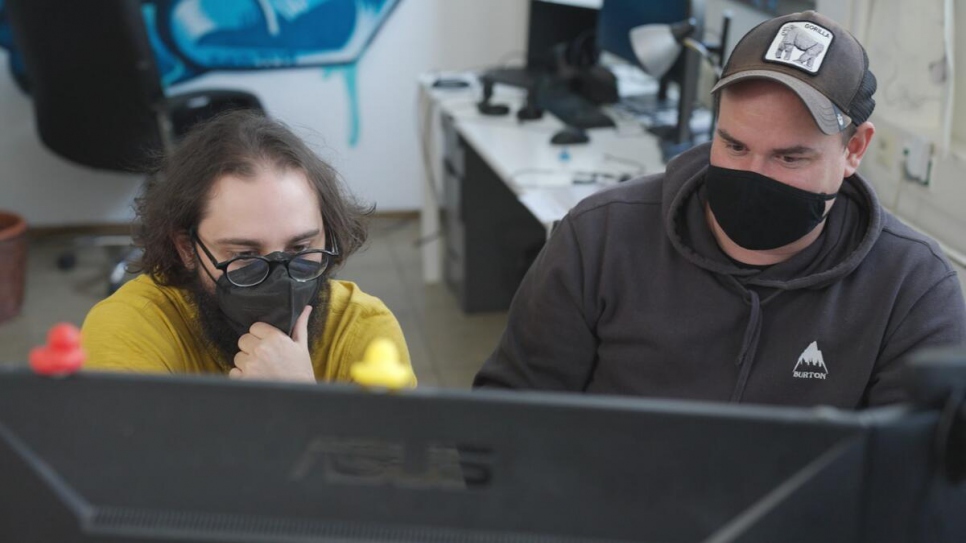 Game designer Jack Gutmann (left) sits alongside Georg Hobmeier, head of Causa Creations, at their offices in Vienna, Austria. © UNHCR/Simon Casetti