Archive for the 'human rights' Category

Environmental Defenders threatened inspite of their positive but undervalued role in climate defence

April 27, 2026

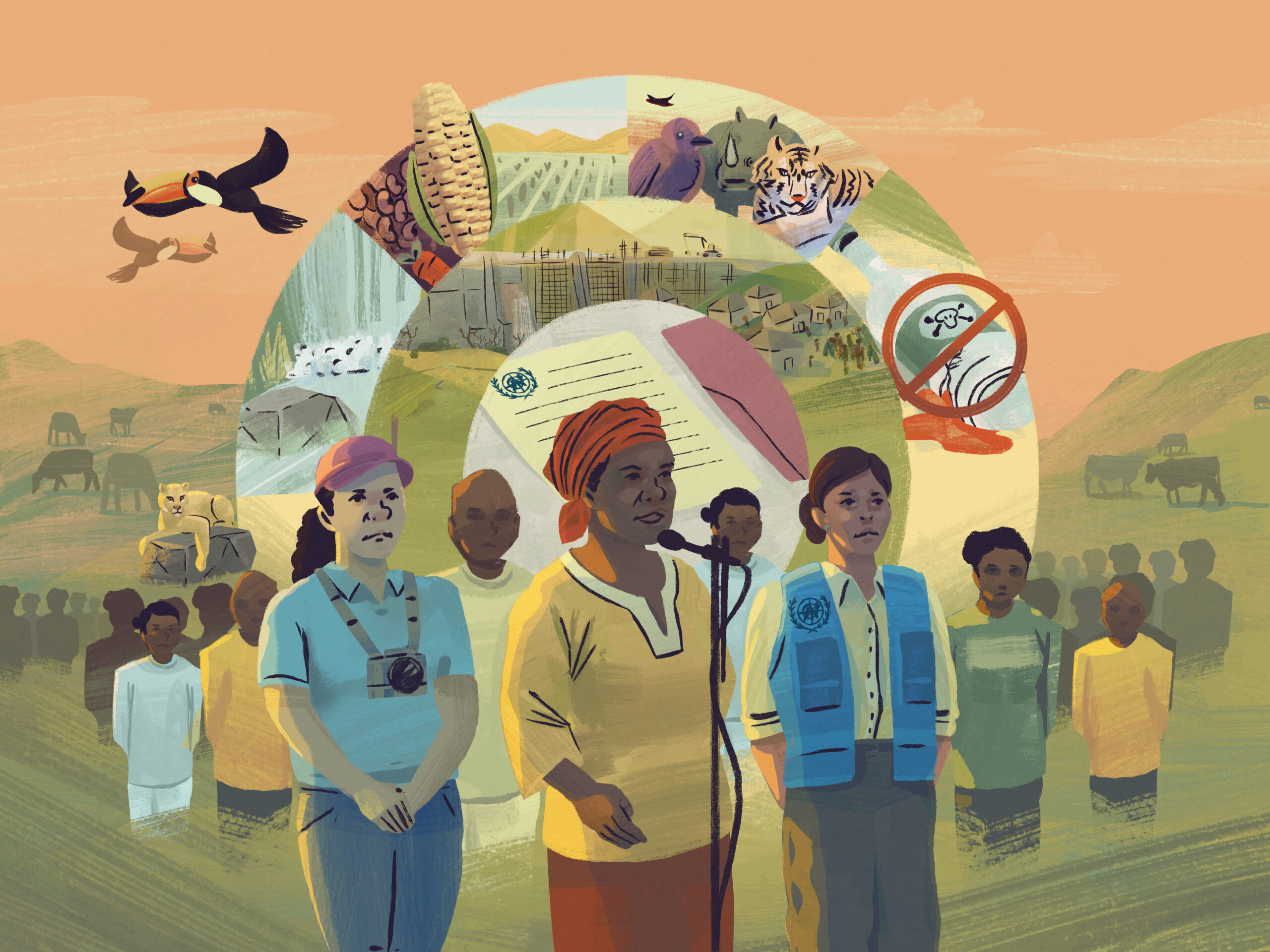
On 23 April 2026 Anamaría Martinez and Elizabeth Moses for WRI explain how environmental defenders help prevent deforestation and protect ecosystems critical to climate stability. Yet many face severe and sometimes lethal threats while remaining underrecognized in climate policies that often depend on their work but fail to protect them.

Village on the Congo Basin rainforest in the Democratic Republic of the Congo

Image by VaLife/Shutterstock

Benitha Bompendju grew up in Tshuapa province in the Democratic Republic of the Congo, surrounded by the dense rainforests of the Congo Basin. The world’s second-largest tropical forest, it plays a critical role in regulating the global climate, conserving biodiversity and sustaining local communities like Benitha’s. Yet when she was growing up, industrial logging was constant.

Concessionaires licensed by the government to harvest timber promised to bring benefits like schools and health centers. But these projects often did not materialize, and local authorities rarely got involved. Instead, companies stripped trees from the land and left local communities — who have long stewarded and relied on the rainforest — with little in return.

“As children, we watched the concessionaires leave with the wood and our parents received nothing,” Benitha recalls. “That was injustice.” This experience shaped Benitha’s future work. In 2016, she began monitoring forest-use contracts and documenting violations, working with partner organizations and government agencies to hold violators accountable. Since then, these joint efforts have helped curb illegal logging, enforce environmental regulations and deliver promised investments to communities.

Yet this critical work can be dangerous — lethally so. Benitha and other environmental defenders like her are often caught in the crosshairs of commercial interests and corruption. Many face threats, intimidation, physical assault, kidnapping and deadly violence. Global Witness documented 146 defenders killed or missing in 2024. The total number killed or missing from 2012 to 2024 is over 2,200 — and because many cases go unreported, the true toll is likely higher.

Research consistently shows that forests managed by Indigenous Peoples and local communities have lower deforestation rates and greater carbon sequestration than those managed under other regimes, making their contribution a measurable climate outcome. But without necessary protections — from access to climate justice to the systems and law enforcement needed to prevent threats and tragic loss of life — environmental defenders can’t safeguard vital ecosystems. And such protections can’t materialize or become institutionalized if environmental defenders aren’t accurately recognized and reflected in climate and nature policies.

The UN defines environmental human rights defenders as “individuals and groups who, in their personal or professional capacity and in a peaceful manner, strive to protect and promote human rights relating to the environment, including water, air, land, flora and fauna.” This includes those who defend the collective right to a safe, clean, healthy and sustainable environment, as well as traditional lands and livelihoods, through actions ranging from community organizing and legal advocacy to protesting, public campaigning and journalism. Many come from Indigenous and tribal groups with deep ancestral ties to the land.

Our research focuses specifically on frontline environmental defenders — those who live in, and defend, resource-rich areas experiencing what the UN Environment Programme describes as “abuse of environmental rights which affects a growing number of people in many parts of the world.”

To understand how defenders are represented in the gray (unpublished) and peer-reviewed literature on climate change under the UNFCCC, we examined 170 peer-reviewed documents from 2015 to 2025, including journal articles, books and reports, to map how defenders’ actions and contributions are reflected. The literature we surveyed both reflects trends in policymaking and serves as a source decision-makers might draw on to develop global and national climate and nature policies. Download

We found that groups such as Indigenous Peoples, women, local communities and youth are increasingly acknowledged as “agents of change” with decision-making capacity, rather than portrayed as victims or passive recipients of project benefits.

However, only 5% of the literature explicitly identifies members of these groups as “defenders” working to protect ecosystems and resources. This represents a crucial gap. Climate literature (and wider climate governance frameworks) tends to recognize who these people are — such as Indigenous Peoples, women-led organizations and youth activists — but without recognizing what they do, such as monitor deforestation and challenge extractive industries, or the risks they face as a result.

How environmental defenders are represented in climate literature.

This difference may seem subtle, but is crucial. Recognizing someone’s identity alone doesn’t necessarily translate into protection or funding for the stewardship and advocacy these groups engage in. Not all identity groups (for example, Indigenous Peoples) are environmental defenders, and not all defenders belong to these groups, even if there is often an overlap. Recognizing defenders’ on the ground contributions, on the other hand, is important because it highlights their role in delivering concrete climate actions — and the need for institutional support and protection, not just their inclusion as stakeholders.

Protection can include early-warning and rapid-response systems that trigger protective action when defenders report threats or surveillance. It also means access to legal aid and judicial remedies, such as fast-track investigations, special counsel and public defenders trained in environmental and land-rights cases.

Meanwhile, governments are missing out on more effective and equitable climate solutions. Defenders bring unique perspectives, knowledge and lived experience — from agroforestry practices rooted in local traditions to stronger data collection and monitoring for more accurate NDC reporting — and help ensure policies are carried out more effectively. Yet threats to defenders weaken both national and global climate action by deterring those who risk their lives to safeguard ecosystems and enforce laws and policies.

Climate outcomes to which frontline defenders contribute, by category

What Would It Take to Support Environmental Defenders?

Frameworks like the Paris Agreement and the Local Communities and Indigenous Peoples Platform (LCIPP) under the UNFCCC already aim to integrate rights-based climate action into national and global goals. But they lack clear definitions and guidance on how defenders should be recognized and supported. To truly support environmental defenders, they must be incorporated into climate policy, reporting and finance.

Here are three ways this can happen: 

1) Defining ‘Defenders’

The first step is defining what defenders are — not by identities, but by the concrete actions they take for climate protection and community resilience. Many don’t self-identify as “defenders.” They are individuals and communities that contribute to climate action and environmental protection. This would capture these de facto roles.

Adopting a practice-based definition in national and multilateral policymaking, alongside indicators that track defenders’ contributions to climate action, would allow policymakers to systematically recognize the people protecting ecosystems on the ground. Indicators could include community monitoring results, forest protection metrics or the number of co-designed adaptation plans.

This formalization would have three practical implications: First, recognizing defenders as a group would allow implementation of protection measures by identifying and addressing the risks they take. Second, it could enable governments to allocate budget to support defender-led initiatives. Third, it could strengthen their participation in decision-making at national and international levels by giving them space to share their knowledge on climate action and local ecosystems.

2) Protecting Defenders

Without safety guarantees, defenders cannot participate or contribute effectively. Protection requires two key elements: physical safety and legal resources.

Physical safety includes strengthening safeguards to reduce social and environmental risks and exploitation, for example, when concessionaires undertake projects in resource-rich areas. One way this can be supported is by creating early warning systems that allow defenders to report threats to the authorities and receive support, ensuring formal grievance mechanisms exist to ensure defender safety (with international backing, if needed). Another is by integrating defender protection requirements into climate funding, including zero-tolerance policies for violent reprisals.

Legal protection includes access to resources and courts. However, many defenders lack access due to prohibitive costs, limited connections and a poor understanding of the system. Where corruption is entrenched and governance weak, domestic legal systems can be used against defenders, leading to their criminalization as a way to silence them and stop their work. International accountability mechanisms — including UN human rights bodies, transnational legal networks and climate finance conditions tied to defender safety — can create external pressure where national systems fail. But they can only function if defenders are formally recognized. Without this, accountability is nearly impossible to demand.

Some progress has been made in different parts of the world. The Aarhus Convention, adopted in 1998, requires parties to “ensure that individuals exercising their rights to environmental information, participation and justice are not penalized, persecuted or harassed.” And Article 9 of the Escazú Agreement, adopted in 2018, calls for “a safe and enabling environment for persons, groups and organizations that promote and defend human rights in environmental matters.” 

At the national level, climate justice laws and policies in Colombia, Mexico, Indonesia and the Philippines enshrine protection mechanisms that cover defenders and their work, while aiming to provide access to legal support. 

A guide walks through an old-growth forest in the Democratic Republic of the Congo
Environmental defenders can include anyone that protects human rights related to the environment, including rights to a safe, clean and sustainable environment. They often face threats to their well-being and lack access to legal systems that could help support them. Photo by Eric Isselee/Shutterstock

However, significant implementation gaps remain.

Colombia’s law has stalled due to limited accessibility, the absence of a clear definition of who constitutes a human rights defender and a reshuffling of funds during the COVID-19 pandemic. In Mexico, a backlog caused in part by insufficient staffing prevents cases from being addressed in a timely manner, and protection measures are not always adequately implemented.

Indonesia recognizes defenders explicitly, but in practice, continued criminalization and intimidation prevent them from accessing the legal protection the mechanism provides. In the Philippines, financial and cultural barriers to filing cases, limited legal knowledge among defenders and slow processing times hinder the widespread implementation of legal framework protecting them.

Yet when defenders can access justice, legal action can drive accountability and tangible outcomes. In 2018, 25 Colombian youth aged seven to 26 years old filed a lawsuit against the government, alleging that climate change and failure to reduce deforestation threatened their fundamental rights. While a lower court initially ruled against them, Colombia’s Supreme Court overturned the decision and ordered the government to devise and implement action plans to address deforestation in the Amazon.

Defenders need legal support and safe, inclusive access to the processes behind these laws and regulations. Rights-based climate cases and stronger rule of law systems provide essential recourse when other accountability channels fail.

3) Integrating Defenders into Climate Plans

Protecting Defenders Is Essential for Climate Action

Protecting environmental defenders is a question of safeguarding human rights and life, ensuring climate justice and strengthening climate action.

People like Benitha, who put their lives on the line to defend the forests and other ecosystems that sustain them and the world, should not face these high-stake risks alone. Governments, multilateral institutions and finance bodies share the responsibility of formally recognizing and protecting environmental defenders within climate, nature and other policies.

Doing so is a matter of equity — and a climate imperative. When defenders are safe and supported, forests stay standing, emissions stay out of the atmosphere and frontline communities can continue building resilience for their own futures and the world’s. 

https://www.wri.org/insights/defenders-in-climate-policy

Meet Our Members: a series by Liberties – a European umbrella network – here Polish Zuzanna Nowicka

April 24, 2026
Mette Meyknecht on 21 April, 2026, makes us meet up Zuzanna Nowicka Lawyer (Freedom of Expression Programme) at the Polish Helsinki Foundation For Human Rights.

Meet Our Members is a series where Liberties introduces you to our network of human rights defenders. We hear the stories of the people behind the organisations and why they do the work they do. Liberties is an umbrella network which coordinates campaigns with its expanding network of national civil liberties NGOs in 18 EU Member States. 

Zuzanna speaks about her work with quiet defiance. No grand declarations or sweeping ideals, but with persistence in the daily decision, to keep going. “I just think it’s important,” she says simply. “I couldn’t imagine doing something that is not for the public good.”

Zuzanna is a lawyer at the Helsinki Foundation for Human Rights in Poland, where she focuses on freedom of expression and strategic litigation. But her path into human rights law wasn’t linear. After studying law and working in various law firms, she realised something wasn’t quite right. “I was simply not feeling it,” she recalls. “I did not find myself comfortable working in those conditions.”

Despite early exposure to human rights work through internships, NGO roles, and advocacy campaigns, it took time to fully embrace it as a career. A formative moment came after graduating, when, uncertain about her next steps, a position at the Helsinki Foundation appeared unexpectedly. Her interview, she admits with a laugh, did not go well. “The internet connection was really bad… I couldn’t hear half of the things,” she says. “But for some reason, they trusted me, and I got hired.”

That was four years ago. She has been there ever since.

Zuzanna’s work today, defending freedom of expression, is deeply personal. She grew up surrounded by journalists: her parents, grandparents, and extended family all worked in the media. She explains that, from an early age, “I was a direct witness of the worsening situation in the media.” Although she initially wanted to study journalism, her parents encouraged her to pursue law instead. Today, her work spans litigation before national courts and the European Court of Human Rights, legal advocacy, training, and public engagement. She drafts opinions on legislation, contributes to coalitions, and even hosts a podcast discussing pressing issues in Poland. It’s everything,” she says of her role. “Litigation, advocacy, writing, training – all of it.”

When asked about her proudest achievement, Zuzanna does not point to a specific case. Instead, she speaks about endurance. “I think what I’m most proud of is the persistence,” she says. “I just keep going.” It is a job that demands constant adaptation, from juggling multiple areas of law, responding to rapidly changing political developments, and managing a heavy workload. At any given time, she may be handling around 20 ongoing cases, alongside urgent advocacy work.

meetourmembers

https://www.liberties.eu/en/stories/meet-our-members-poland/45671

ANNUAL reports on Human Rights: AI, CoE, HRF, IACHR

April 23, 2026

Several organisations came out with annual reports, including

  • Predatory attacks on multilateralism, international law and civil society marked 2025
  • The alternative on offer is a racist, patriarchal, unequal and anti-rights world order
  • Protesters, activists and global bodies are working to resist, disrupt and transform

The world is on the brink of a perilous new era Amnesty International warned on 21 April 2026 with the launch of its annual report, The State of the World’s Human Rights. The organisation called on governments, including Australia, to reject the politics of appeasement and collectively resist attacks on multilateralism, international law and civil society, before this emerging order takes hold.

In its assessment of the human rights situation across 144 countries, the report documents widespread violations by governments and other actors throughout 2025, alongside persistent failures of accountability, with only limited areas of progress. Many of these patterns have continued into 2026, as the international rules-based order faces sustained and coordinated pressure.

“We are confronting the most challenging moment of our age. Humanity is under attack from transnational anti-rights movements and predatory governments determined to assert their dominance through unlawful wars and brazen economic blackmail,” said Agnès Callamard, Secretary General of Amnesty International. 

World leaders have been far too submissive in the face of attacks on international law and the multilateral system. Their silence and inaction are inexcusable.”Agnès Callamard, Secretary General of Amnesty International

“The vast majority of states have been unwilling or unable to consistently denounce predatory acts by the USA, Russia, Israel or China, or to chisel out diplomatic solutions.

“World leaders have been far too submissive in the face of attacks on international law and the multilateral system. Their silence and inaction are inexcusable. It is morally bankrupt and will bring nothing but retreat, defeat and the erasure of decades of hard-fought human rights gains.

“To appease aggressors is to pour fuel on a fire that will burn us all and scorch the future for generations to come,” said Agnès Callamard…

“For the sake of humanity, the time to make history is now.”Agnès Callamard

ANNUAL REPORT: THE STATE OF THE WORLD’S HUMAN RIGHTS

The Inter-American Commission on Human Rights (IACHR) presents its Annual Report 2025, documenting the work it has done in compliance with the mandate to promote and protect human rights in the Americas. The report—showing, over six chapters, the results attained by IACHR mechanisms—is an instrument for institutional transparency and a reference for States, civil society, and regional and international organizations.

In a year that was full of challenges including weaknesses in democratic institutions, violence in various national contexts, the effects of climate change, and issues concerning vulnerable individuals and groups, among others, the IACHR strengthened its mechanisms and each of those mechanisms has achieved concrete results.

Annual Report 2025

Our country is facing a grave threat as those in power leverage bias and disinformation to push rights-restricting legislation through at the state and federal levels. Our communities, schools, libraries, elections, and individual freedoms are being placed at risk by escalating assaults on our rights. In response, Human Rights First launched Democracy Watch in 2025, to track and expose legislative trends that endanger our civil and human rights and undermine democratic processes and institutions. Since its launch, we have tracked a proliferation of authoritarian tactics targeting our states and hurting our communities. This year we saw a wide range of legislative strategies, including rollbacks on reproductive freedom, immigrant and refugee rights, free speech, LGBTQ+ equality, voting rights, and public education.

Council of Europe:

In the midst of a

Presenting his 2025 Annual Activity Report to the Parliamentary Assembly of the Council of Europe today, the Council of Europe Commissioner for Human Rights, Michael O’Flaherty, warned that Europe, and the rest of the world, is no longer merely in an “era of change” but is experiencing a profound “change of era” that threatens the very foundations of human rights law and practice.

“We are living in a context where our stable cultural framework is being shattered by rapid social and technological advances that surpass our capacity to grasp them,” the Commissioner stated. Highlighting the impact of artificial intelligence, the triple planetary crisis, and worsening inequality, he noted a widespread diminishment of trust between citizens and the state, as well as between generations and an increasing pressure on institutions and civil society across the continent. “Unimaginably, we risk losing our invaluable acquis of human rights law. This is the duty of our generation: to act and ensure these rights survive this transition intact”.

https://rm.coe.int/annual-activity-report-2025-by-michael-o-flaherty-council-of-europe-co/48802b5894

Interview with Zaira Navas – a Salvadoran Woman Human Rights Defender in Exile

April 20, 2026

Zaira Navas woman human rights defender from El Salvador

Zaira Navas, woman human rights defender from El Salvador.

In recent years, civic space has significantly reduced in El Salvador, under a state of exception, a state of emergency that suspended several constitutional rights. Human rights defenders have faced increasing threats and criminalisation, forcing many into silence or exile. Zaira Navas is a lawyer and human rights defender at Cristosal, partner of OMCT and the SOS-Torture Network. She is also a member of OMCT’s Latin America litigators’ group, part of four regional litigators’ groups that bring together lawyers and human rights defenders working at the front lines of the fight against torture and ill-treatment. Last year, Zaira Navas was pushed to flee El Salvador, after her colleague, Ruth López, prominent Salvadoran activist, was arrested. In Geneva to attend the Human Rights Council, she tells us about her experience being a woman human rights defender in exile, and where she still finds hope in her work.

What was it like to make the decision to leave El Salvador?

I am currently in exile due to repression under the state of exception in El Salvador imposed by President Nayib Bukele, which intensified in 2025. In May, my colleague Ruth López was detained on absurd corruption charges. That same week, I learned I could also be arrested. Our organisation, Cristosal, asked us to protect ourselves. There was no time to think about it. We left the country believing we would return in 15 days, but I have now been outside El Salvador for nine months.

How has exile affected you, as a woman and as a human rights defender?

The first months were filled with uncertainty. Violence and aggression against defenders increased, and our organisation was forced to close its operations in the country. There was no turning back.

There was a period when I felt depressed. Not only for being away from my country, but because I thought I could not continue my work. I am now separated from my family, but I am working, and that is a very important source of encouragement….

What actions should the international community take to ensure a safe environment for defending human rights in El Salvador?

The international community must closely monitor human rights violations in El Salvador and must pay close attention to what is happening in our country, questioning the anti-democratic methods and internal policies. International cooperation allows us to keep working. It is important that organisations that support human rights groups look for new ways to cooperate so that the work can continue from outside the country.

https://www.omct.org/en/resources/blog/it-is-my-way-of-life-and-my-legacy-interview-with-a-salvadoran-woman-human-rights-defender-in-exile

Cuba: Human Rights Watch claims none of those released were political prisoners

April 18, 2026
Havana, Cuba
Havana, Cuba Creative Commons

Human Rights Watch said on 9 April 2026 that Cuba‘s recent pardon of more than 2,000 inmates did not include political prisoners, reinforcing earlier concerns raised by other rights groups that the measure would exclude detainees jailed for dissent.

The Cuban government announced during Holy Week that it would pardon 2,010 prisoners, describing the move as a “humanitarian and sovereign gesture” tied to religious observances. Officials said the release would prioritize groups such as young people, older adults, women and foreigners, based on criteria including health conditions and time served, but did not disclose the identities of those freed.

Human Rights Watch’s assessment, reported by Bloomberg, confirmed that none of those released were among the more than 1,200 political prisoners documented on the island. The finding adds weight to reports published days earlier by organizations including the Cuban Observatory for Human Rights, Prisoners Defenders and Cubalex, which had already said they found no evidence that political detainees were included in the pardon.

Those groups had warned that the measure appeared to benefit common prisoners while leaving untouched cases tied to political repression. “It’s a propaganda exercise,” Javier Larrondo, president of Prisoners Defenders, said at the time, arguing that Cuban authorities have historically used releases of common inmates to inflate figures associated with political concessions.

https://www.latintimes.com/human-rights-watchdog-confirms-political-prisoners-excluded-cubas-2000-inmate-pardon-596470

At the same time Human Rights Organizations Call on Congress: Do Not Send Cubans Fleeing Impacts of the U.S. Fuel Blockade to Guantánamo

Published April 10, 2026

The “Italian Protection Hub” Recognized as a European Model for the Protection of Human Rights Defenders

April 17, 2026

At the inaugural meeting of the Community of Practice (CoP) for the protection of human rights defenders (HRDs) in Europe, held in Brussels on March 25–26, 2025, and co-organized by the EU Agency for Fundamental Rights (FRA) and the Office of the United Nations High Commissioner for Human Rights (UN-OHCHR), the Italian “Protection Hub” was cited as an example of innovative practice and excellence within the European landscape.

The Italian experience was recognized as a model for a national protection ecosystem, capable of integrating practical support, advocacy, and monitoring of civic space, with a multi-stakeholder approach rooted locally yet connected to international networks. The “In Difesa Di” initiative was also mentioned among the national reference models.

The CoP serves as a space for strategic coordination to strengthen national hubs, improve coordination between protection and advocacy, and promote joint advocacy on upcoming EU funding cycles—in particular the Multiannual Financial Framework (MFF) and the Agora program.

On this occasion, the FRA launched a survey for the 2025 Civic Space Consultation, aimed at civil society organizations active in EU Member States and observer countries (Deadline: May 10, 2026).

https://unipd-centrodirittiumani.it/en/news/human-rights-defenders-the-italian-protection-hub-recognized-as-a-european-model-for-the-protection-of-human-rights-defenders

Women Human Rights Defenders on Ukraine’s Frontline

April 16, 2026

Women human rights defenders (WHRDS) are taking enormous daily risks to help vulnerable people living on the frontline of Russia’s war on Ukraine. Some deliver humanitarian aid to those in desperate need of food and clothes, while others evacuate elderly and infirm residents from communities under fire. Some do this work full-time, others join these efforts when they can. Few had any experience of activism before Russia’s full-scale invasion in February 2022.

Human Rights First has regularly worked alongside women activists around the northeastern region of Kharkiv, and sometimes in the Donetsk region further south, and has seen firsthand the lifesaving work they do, and the risks involved.

Across the world, women – including women activists – experience war differently from men. In a 2023 report, the UN Special Rapporteur on the situation of human rights defenders described these environments as the “hypermasculinized context of war”. In these contexts, the role of WHRDs becomes more essential even as they face additional challenges “because of [their] work and because of who they are.”

WHRDs often face the same risks as their male counterparts, including restrictions on their rights, but also face additional and distinct risks shaped by entrenched stereotypes and expectations about women’s roles. They are stigmatized and criticized for actions for which men are praised, frequently stereotyped not as agents of change, but as vulnerable individuals in need of protection.

These are not new prejudices. A 2019 report by the UN Special Rapporteur on Human Rights Defenders also found that women defenders working in conflict and post-conflict are “particularly exposed to gender-based violence, including sexual violence,” and are “more directly affected by breakdowns in health-care services.” Their legitimacy as defenders continues to be challenged and they remain largely excluded from decision-making.

In Ukraine, WHRDs evacuate civilians, deliver humanitarian assistance, and document war crimes, often at significant physical and mental risk. Yet, they are excluded from effective decision-making spaces. In March 2022, UN special procedure mandate holders drew attention to the absence of Ukrainian women from peace negotiations, despite their central role in the humanitarian response.

Human Rights First is part of the Women Human Rights Defenders International Coalition a global network supporting WHRDs facing harassment, threats, surveillance, arbitrary detention and other forms of retaliation. Through this coalition and our own Human Rights Defenders program, we promote the work of WHRDs and work toward their protection. [https://whrdic.org/]

In 2022, Human Rights First supported the production of a guide for journalists on responsibly reporting war-related sexual violence, authored by three Ukrainian women experts in gender issues.

Human Rights First has worked alongside WHRDs in Ukraine since the Russian invasion of 2014. Since the full-scale invasion in 2022, the organization has made dozens of visits to the front-line region of Kharkiv. This has involved assisting WHRDs with evacuations from frontline areas, documenting war crimes, and reporting on the work of local activists providing humanitarian aid, countering corruption and disinformation, and those responding to the mental health crisis.

This report (by Brian Dooley and Suchita Uppal) draws on interviews with WHRDs working in frontline areas of northeastern Ukraine, highlighting their work during the conflict, the risks they face, and the critical role they have played in sustaining communities under fire. Published on April 10, 2026

Strategy 2030: ISHR’s new Strategic Framework

April 16, 2026

For over 40 years ISHR has worked with human rights defenders to promote freedom, dignity, equality and justice. We have partnered with them to strengthen human rights laws, systems, networks and narratives. Over the next decade the work of defenders, supported by ISHR, will be critical to reverse rising authoritarianism, combat the accelerating climate crisis, prevent regress in the areas of women’s rights and the rights of LGBTIQ+ people, address systemic racism and discrimination, adequately regulate new and emerging technologies, and promote accountability for widespread atrocity crimes, among other challenges.

This Strategic Framework is designed to ensure that human rights defenders and the international human rights movement and system are equipped to respond to these challenges. It will ensure that ISHR’s work is relevant, responsive, effective, efficient, impactful and sustainable, and that our partnerships are equitable, powerful and influential.

In developing this Framework, we consulted more than 800 human rights defenders working in diverse contexts and on diverse issues. The strategy is also informed by key intelligence and insights gathered over the period 2021-25 from 5 staff strategy retreats, 9 Board and expert panel discussions, over 10 programme and campaign evaluations, a 40th anniversary survey with key stakeholders, and an intensive 3-month process of internal and external reflection on 12 key strategic questions.

file:///Users/mlr/Downloads/ISHR%20Strategic%20Framework%202030%20overview.pdf

https://ishr.ch/defenders-toolbox/resources/ishr-strategy-2030

Frank Jennings Fellowship 2026–2027: Human Rights Opportunity in Dublin and Geneva

April 15, 2026

The Frank Jennings Fellowship 2026–2027, offered by Front Line Defenders, is a prestigious early-career opportunity designed for individuals seeking practical experience in the human rights sector. This 12.5-month fellowship combines training, field exposure, and institutional engagement across Dublin, Ireland, and Geneva, Switzerland.

The programme is structured to provide hands-on experience working with human rights defenders (HRDs) and international human rights mechanisms, particularly within the United Nations system.


Programme Structure and Learning Experience

The fellowship is divided into three distinct phases, offering a blend of training and applied experience:

  • Initial Phase (3.5 months in Dublin)
    Fellows begin at the headquarters of Front Line Defenders, where they receive training on:
    • Human rights defenders and their protection needs
    • The UN Declaration on Human Rights Defenders
    • The mandate of the UN Special Rapporteur
    • International protection mechanisms and advocacy strategies
  • International Placement (6 months in Geneva)
    Fellows transition to an internship with Office of the United Nations High Commissioner for Human Rights, gaining direct exposure to UN processes and global human rights monitoring systems.
  • Final Phase (3 months in Dublin)
    Fellows return to Dublin to consolidate learning and contribute to ongoing organisational work.

This structure ensures a comprehensive understanding of both grassroots advocacy and high-level international human rights systems.


Fellows will undertake a variety of responsibilities depending on their placement phase.

While in Dublin

  • Supporting Protection Coordinators in communication with human rights defenders
  • Assisting in drafting urgent appeals on behalf of at-risk individuals
  • Maintaining and updating internal databases
  • Contributing to reports, briefings, and documentation
  • Supporting follow-up on ongoing human rights cases

While in Geneva (OHCHR)

  • Monitoring global human rights situations, especially concerning defenders
  • Drafting communications and urgent appeals to governments
  • Analysing government responses to human rights allegations
  • Supporting preparation of reports for the Human Rights Council and General Assembly
  • Assisting in preparations for official missions of the UN Special Rapporteur
  • Liaising with NGOs and civil society organisations

This dual exposure enables fellows to develop both operational and analytical expertise.


Benefits and Compensation

The fellowship offers a competitive and supportive package designed to enable full participation:

  • Annual stipend of €30,629
  • 13 days of annual leave during the Dublin phase
  • Flights between Dublin and Geneva
  • Health and travel insurance coverage
  • Access to an Employee Assistance Programme
  • Monthly well-being support while in Dublin

During the Geneva placement, conditions are governed by OHCHR internship regulations.


Eligibility Criteria

Applicants must meet strict academic, professional, and language requirements.

Academic and Professional Requirements

  • Recent graduates or candidates within one year of completing a degree
  • Fields of study include:
    • Human rights
    • Social sciences
    • Development studies
    • Humanitarian studies or related disciplines

Skills and Competencies

  • Strong written and verbal communication skills
  • Excellent drafting and analytical abilities
  • Ability to synthesise complex information into concise outputs
  • Solid administrative and organisational skills
  • Computer literacy

Language Requirements

  • Native or near-native English proficiency
  • Fluency in either Spanish or French (mandatory)

Additional Requirements

  • Basic knowledge of the UN system and international human rights law
  • Legal eligibility to work in both Ireland and Switzerland for the full duration of the fellowship

Application Process and Deadline

Interested candidates must submit:

  • A detailed Curriculum Vitae (CV)
  • A tailored cover letter

Applications must be submitted via the official recruitment platform of Front Line Defenders.

Key deadline:

  • 14 April 2026 (midnight Irish time)

Late or incomplete applications will not be considered, and candidates are encouraged to apply as early as possible due to the competitive nature of the programme.


VISIT OFFICIAL WEBSITE TO APPLY

Syrian Human Rights Defenders to help torture survivors

April 6, 2026

CVT’s healing programs in offices in Amman and Zarqa, Jordan, touched the lives of thousands of refugee survivors of torture from the MENA region. Over the years, a large community of Syrian survivors came to CVT’s Jordan clinics, numbering in the thousands over time. As survivors participated in healing programs, CVT clinicians heard about the need for justice and accountability as the Assad regime continued its deadly systems of violence and torture. This led CVT to establish an Amman-based regional office where clinical teams could support Syrian civil society with a focus on detainees, torture survivors and their families.

In 2016, CVT formed a partnership with Syrian civil society organizations and started the Survivors of Torture Initiative (SOTI) or “my voice” (يتوص). The team began its work to strengthen Syrian civil society, advance justice and heal trauma.

SOTI brings together Syrian trauma rehabilitation experts, psychosocial service providers, human rights defenders, journalists, legal advocates, and others fighting for healing and justice in order to promote collaboration and address shared needs.

Read more here about CVT’s support for Syrians.

https://www.indiablooms.com/phoenix/public/world/un-rights-experts-welcome-release-of-syrian-human-rights-defenders/details