Posts Tagged ‘technology’

Digital services alternatives on APC’s community network; better not bigger

May 21, 2026

On 20 May 2026 , Maja Romano wrote a long piece “Better not bigger: Digital services alternatives across our network“.

A recent article in The Guardian highlighted the growing public interest in moving away from dominant corporate platforms such as Amazon, Google, Meta, Apple and X to more rights-respecting and sustainable alternatives, mentioning APC member GreenNet as one example of an ethical internet service provider. The article reflects an increasingly common concern: dependence on a concentrated number of big tech companies leaves communities vulnerable to surveillance, control, political interference and environmental harm. Yet much of the debate in the Global North still frames the issue primarily through market competition, for example, how Europe can reduce dependence on American technology giants by supporting European companies instead.

For many members and partners in the APC network, the challenge runs much deeper than replacing one corporate provider with another and is not as simple as assessing whether technology is headquartered in the United States, Europe or elsewhere, nor is it simply a matter of creating alternatives for individual personal choices. It is about who controls digital infrastructure and services, whose interests it serves, and whether communities have meaningful power and agency over the technologies they use. It means fostering an environment that encourages the development of diverse technologies, grounded in lived experiences, which can reinforce rights rather than undermine them.

Across APC’s network, there are member organisations who have spent years building community-centred and rights-respecting alternatives rooted in social and environmental justice alongside collective care. Their work offers a different vision of the digital future, one where infrastructure is seen not as a profit-driven extractivist commodity, but as a commons. Within this article we connect with several members and APC’s own tech team for their reflections on alternatives to big tech services.

read more on: https://www.apc.org/en/news/better-not-bigger-digital-services-alternatives-across-our-network

First European Forum on Environmental Human Rights Defenders 3-4 June 2026

May 12, 2026

The First European Forum on Environmental Human Rights Defenders (EHRDs) invites individuals and organizations committed to the promotion, protection, and respect of environmental and human rights across Europe to express their interest in participation. This landmark Forum represents a significant opportunity for Environmental Human Rights Defenders, civil society organizations, institutions, policymakers, and advocates to engage in meaningful dialogue, collaboration, and knowledge exchange on pressing environmental and human rights challenges affecting the European region.

The Forum will be held on 3–4 June 2026 at the headquarters of the Council of Europe in Strasbourg. The event is jointly organized by the Council of Europe, the Office of the United Nations High Commissioner for Human Rights, the European Union Agency for Fundamental Rights, and the mandate of the Special Rapporteur on Environmental Defenders under the Aarhus Convention. Additional collaboration is provided by the UNECE Aarhus Convention Secretariat, several Human Rights Council Special Procedure mandate holders, and a range of civil society organizations actively working throughout Europe.

Purpose of the Forum

The Forum aims to strengthen networks among Environmental Human Rights Defenders and supporting organizations while fostering regional cooperation and advocacy. Participants will have the opportunity to:

  • Share experiences and best practices
  • Discuss emerging environmental and human rights issues
  • Explore strategies for protection and advocacy
  • Build partnerships across sectors and countries
  • Contribute to discussions on policy and accountability mechanisms

The gathering is expected to attract a diverse range of participants from across the Council of Europe member states, including grassroots defenders, activists, indigenous representatives, youth leaders, academics, legal experts, international organizations, and civil society actors.

Event Format and Languages

The Forum will be conducted exclusively as an in-person event. Online participation or virtual attendance options will not be available. Participants are therefore encouraged to prepare for travel and related logistical arrangements should their participation be approved.

Registration and Selection Process

Submitting an Expression of Interest does not automatically guarantee participation in the Forum. All applications will undergo a comprehensive review and selection process conducted by the organizers. Applicants whose participation is approved will receive an official registration confirmation letter. The review process will take place on a rolling basis to allow selected participants sufficient time to make necessary arrangements, including:

  • Visa applications
  • Travel planning
  • Accommodation bookings
  • Administrative preparations

Interested individuals are therefore strongly encouraged to submit their applications as early as possible.

Funding and Financial Support

Due to limited available resources, the organizers will only be able to provide financial support to a select number of Environmental Human Rights Defenders. Funding decisions will be based on several factors, including:

  • Resource availability
  • Geographic diversity
  • Gender balance
  • Inclusion and representation criteria
  • Nature of environmental and human rights work

Applicants who meet the general participation criteria but are not selected for financial support may still receive an invitation to attend the Forum through self-funded participation.

The organizers anticipate that the majority of participants will need to finance their own attendance. Institutions, donor organizations, and networks that support Environmental Human Rights Defenders are encouraged to assist participants financially where possible.

Applications are now open for the 2027 Marianne Initiative for Human Rights Defenders. Deadline 4 MAY!

May 2, 2026
marianne-initiative-2023

Application Deadline: May 4, 2026

Applications are now open for the 2027 Marianne Initiative for Human Rights Defenders. Each year, a group of about fifteen human rights defenders, distinguished by their exemplary work in the fight for fundamental rights in their countries of origin, are welcomed to France. The laureates are selected from among several hundred candidates by a committee of independent experts.

The personalized program includes networking with key actors involved in the field of human rights (State, local authorities, non-governmental organizations, independent judicial and administrative authorities, representatives of international organizations), as well as support for the development of their activist project, aimed at strengthening the effectiveness of their action.

Benefits

  • The program offers a unique platform for international exposure and professional growth.
  • Participants gain access to a broad network of human rights professionals and European institutions, fostering connections that last long after the program ends.
  • The core benefit of the initiative lies in the specialized skill-building workshops provided during the stay in France.
  • This immersive experience aims to expand the operational capacity and strategic networks of frontline defenders.

Eligibility

  • To be eligible, candidates must demonstrate a proven and distinguished commitment to promoting fundamental rights within their local communities.
  • The initiative specifically looks for individuals who have already distinguished themselves through concrete actions on the ground.
  • Prospective applicants should be motivated to expand their professional skills and be willing to collaborate with international peers.
  • The program serves as a vital bridge between local grassroots activism and global human rights standards.

Benefits

The winners follow a comprehensive program consisting of:

  • Training courses to strengthen cross-cutting skills to implement their projects: negotiation, leadership, advocacy, project engineering, association management, etc.;
  • Training to improve working conditions in the country of origin: security, mechanisms for the protection of human rights defenders, etc.;
  • Courses to consolidate their theoretical knowledge: transitional justice, international law, etc.;
  • Meetings and networking with individuals and partner organizations committed to human rights and development issues;
  • Conferences and cultural activities;
  • Individual interviews to support the activist project;
  • Visits to international institutions and organizations;
  • Exchanges with the Marianne Alumni network of the program, within the framework of the mentoring program between laureates of the different cohorts.

For More Information:

Visit the Official Webpage of the Marianne Initiative for Human Rights Defenders

Frank Jennings Fellowship 2026–2027: Human Rights Opportunity in Dublin and Geneva

April 15, 2026

The Frank Jennings Fellowship 2026–2027, offered by Front Line Defenders, is a prestigious early-career opportunity designed for individuals seeking practical experience in the human rights sector. This 12.5-month fellowship combines training, field exposure, and institutional engagement across Dublin, Ireland, and Geneva, Switzerland.

The programme is structured to provide hands-on experience working with human rights defenders (HRDs) and international human rights mechanisms, particularly within the United Nations system.


Programme Structure and Learning Experience

The fellowship is divided into three distinct phases, offering a blend of training and applied experience:

  • Initial Phase (3.5 months in Dublin)
    Fellows begin at the headquarters of Front Line Defenders, where they receive training on:
    • Human rights defenders and their protection needs
    • The UN Declaration on Human Rights Defenders
    • The mandate of the UN Special Rapporteur
    • International protection mechanisms and advocacy strategies
  • International Placement (6 months in Geneva)
    Fellows transition to an internship with Office of the United Nations High Commissioner for Human Rights, gaining direct exposure to UN processes and global human rights monitoring systems.
  • Final Phase (3 months in Dublin)
    Fellows return to Dublin to consolidate learning and contribute to ongoing organisational work.

This structure ensures a comprehensive understanding of both grassroots advocacy and high-level international human rights systems.


Fellows will undertake a variety of responsibilities depending on their placement phase.

While in Dublin

  • Supporting Protection Coordinators in communication with human rights defenders
  • Assisting in drafting urgent appeals on behalf of at-risk individuals
  • Maintaining and updating internal databases
  • Contributing to reports, briefings, and documentation
  • Supporting follow-up on ongoing human rights cases

While in Geneva (OHCHR)

  • Monitoring global human rights situations, especially concerning defenders
  • Drafting communications and urgent appeals to governments
  • Analysing government responses to human rights allegations
  • Supporting preparation of reports for the Human Rights Council and General Assembly
  • Assisting in preparations for official missions of the UN Special Rapporteur
  • Liaising with NGOs and civil society organisations

This dual exposure enables fellows to develop both operational and analytical expertise.


Benefits and Compensation

The fellowship offers a competitive and supportive package designed to enable full participation:

  • Annual stipend of €30,629
  • 13 days of annual leave during the Dublin phase
  • Flights between Dublin and Geneva
  • Health and travel insurance coverage
  • Access to an Employee Assistance Programme
  • Monthly well-being support while in Dublin

During the Geneva placement, conditions are governed by OHCHR internship regulations.


Eligibility Criteria

Applicants must meet strict academic, professional, and language requirements.

Academic and Professional Requirements

  • Recent graduates or candidates within one year of completing a degree
  • Fields of study include:
    • Human rights
    • Social sciences
    • Development studies
    • Humanitarian studies or related disciplines

Skills and Competencies

  • Strong written and verbal communication skills
  • Excellent drafting and analytical abilities
  • Ability to synthesise complex information into concise outputs
  • Solid administrative and organisational skills
  • Computer literacy

Language Requirements

  • Native or near-native English proficiency
  • Fluency in either Spanish or French (mandatory)

Additional Requirements

  • Basic knowledge of the UN system and international human rights law
  • Legal eligibility to work in both Ireland and Switzerland for the full duration of the fellowship

Application Process and Deadline

Interested candidates must submit:

  • A detailed Curriculum Vitae (CV)
  • A tailored cover letter

Applications must be submitted via the official recruitment platform of Front Line Defenders.

Key deadline:

  • 14 April 2026 (midnight Irish time)

Late or incomplete applications will not be considered, and candidates are encouraged to apply as early as possible due to the competitive nature of the programme.


VISIT OFFICIAL WEBSITE TO APPLY

Two new interactive tools to strengthen diplomatic initiatives to support human rights defenders

March 13, 2026

ISHR is launching two new interactive tools to strengthen diplomatic initiatives to support human rights defenders.

  • one tool designed for diplomats and
  • the other for defenders;

The resources provide practical guidance on how to enhance diplomatic support for defenders to prevent risks, respond to threats and better protect those working to promote and defend human rights. The tools will be available in English, French and Spanish.

Human rights defenders (HRDs) play a vital role in promoting accountability and advancing justice. Yet defenders around the world increasingly face harassment, criminalisation, surveillance, detention and reprisals because of their work. Diplomatic missions can play an important role in the overall protection strategy for defenders, including by addressing risks, monitoring cases, engaging authorities, or providing emergency support when defenders face serious threats. Some countries or region have adopted specific ‘Diplomatic Guidelines’ on the protection of human rights defenders (HRDs), including Switzerland, Canada, the European Union, Norway, Finland, and the UK.

[See e.g. : https://humanrightsdefenders.blog/2019/09/01/ngos-call-canadas-revised-guidelines-on-human-rights-defenders-a-step-in-the-right-direction/

https://humanrightsdefenders.blog/2014/11/02/swiss-guidelines-on-human-rights-defenders-analyzed-by-civil-society/

also: https://humanrightsdefenders.blog/2014/06/11/osce-publishes-guidelines-on-the-protection-of-human-rights-defenders/

https://www.government.nl/topics/human-rights/human-rights-worldwide/supporting-human-rights-defenders

To help strengthen the effective use of diplomatic protection measures, ISHR has developed two new interactive tools aimed at two complementary audiences: diplomats and human rights defenders themselves. 

The first tool provides practical guidance for diplomatic and permanent missions on how to better provide quality, consistent and targeted support and protection to defenders including through the implementation of existing ‘diplomatic guidelines’ (40 minutes to complete).  It outlines key principles for diplomatic engagement, including applying a “do no harm” approach, consulting closely with defenders, and adopting flexible and context-specific responses. It also highlights forms of diplomatic support, from regular engagement with defenders to trial observation, public advocacy, and emergency measures such as facilitating visas or temporary relocation. 

The second tool is designed for human rights defenders and civil society organisations (20 minutes to complete). It is intended to help defenders better leverage diplomatic support by developing understanding of diplomatic guidelines, how they work, and what defenders should consider to safely engage with embassies and diplomatic missions. It also outlines the types of support that may be available, from meetings with diplomats and public advocacy to targeted or emergency assistance in situations of risk. 

The content is grounded in the needs and lived experiences of HRDs, as documented by ISHR and other international organisations, and is informed by international human rights norms and standards. It draws in particular from the UN Declaration on Human Rights Defenders and its recent supplement, the Declaration+25

By enhancing understanding of diplomatic initiatives and making them more accessible, ISHR aims to strengthen collaboration between diplomats and defenders and help ensure that defenders can continue their essential work in safer conditions. We also hope these tools may serve to catalyse action by States that have not yet adopted specific diplomatic guidelines. 

The two interactive tools are available on the ISHR Academy in EnglishFrench and Spanish

If you want more information or provide feedback on those initiatives, please contact us at: training@ishr.ch  

https://ishr.ch/latest-updates/new-tools-strengthening-the-protection-of-human-rights-defenders-with-diplomatic-guidelines

https://academy.ishr.ch/learn/diplomatic-support-for-human-rights-defenders/interactive-tool-1

HURIDOCS looking for a Global Repository Coordinator

February 9, 2026

HURIDOCS is recruiting a 👉 Global Repository Coordinator 👈 , a fixed-term role focused on a project that’s been in the works here for a long time. This Global Repository is where so many threads finally come together. Years of work on machine learning, documentation, and human rights data, all coming into one shared “playground” to help unlock judgments, decisions, and human rights information at scale.

We’re building this together with partners, including the The Patrick J. McGovern Foundation and the Oxford Institute of Technology and Justice ( supported by the Clooney Foundation for Justice). This short video from Oxford gives a glimpse of the vision (at min 2:17).

https://lnkd.in/gmQaxxad

Because this is such an exciting and ambitious role, we’re looking for someone who’s dynamic, independent, and a great problem-solver. Someone who knows how to push things forward and also when to when to slow down and consult, with communities, partners, donors, and more. Someone comfortable with the international human rights ecosystem and committed to leveraging technology for justice.

Often when we’re recruiting for roles like this we talk about looking for a unicorn, but this time that doesn’t quite work. I think we’re really looking for a tiger. Someone who can help us actually make this thing real. 🐯


📣HURIDOCS is looking for a Project Coordinator to play a key role in building the Global Repository of Human Rights.


Applications sent by email or direct message will not be considered. Please apply via the form provided in the job description.

hashtag#NGOJobs hashtag#ProjectCoordinator hashtag#RemoteJobs

Apply for ISHR’s 2026 training for defenders

January 7, 2026

Are you a human rights defender working on democratic backsliding and/or racial justice, keen to use the UN to push for change at home? If so, apply for the 2026 edition of ISHR’s flagship training, the Human Rights Defender Advocacy Programme (HRDAP)!

After a successful edition in 2025, ISHR is pleased to launch the new call for applications for the 2026 Human Rights Defender Advocacy Programme (HRDAP26), which will take place both remotely and in Geneva and will be focused on thematic and context area! Below are some important dates to consider before applying:

  • Mandatory distance learning course: 13 April – 8 June 2026 (part time)
  • In-person course in Geneva: 10- 20 June 2026 (full time)
  • Deadline to apply: 15 January 2026, midnight CET (Geneva Time)
  • Programme description with all related information can be downloaded here.
  • Application form can be found here.

What’s new for HRDAP 2026?

For the last 10 years, this flagship training has equipped human rights defenders with the knowledge and skills to integrate the UN human rights system into their existing work at the national level in a strategic manner. 

Following an external review of the programme in 2024, as well as to maximise impact and enhance follow-up, for 2026 the HRDAP selection criteria are evolving: they are based on 2 themes focused on context area and thematic advocacy, according to ISHR’ strategic priorities and opportunities at the UN: democratic backsliding and racial justice. The HRDAP themes will change annually (see the criteria below and the programme description for more details).[see: https://humanrightsdefenders.blog/2024/11/27/ishrs-training-for-human-rights-defenders-2025/]

12 participants will be selected for the 2026 edition of HRDAP.

What are HRDAP objectives?

By participating in the programme, defenders will:

  1. gain knowledge and tools, which they can use to ensure their voice is central in international human rights decision-making
  2. explore and compare the benefits of engagement with the Human Rights Council, the Special Procedures, the OHCHR, the Universal Periodic Review and the Treaty Bodies, and examine how they can use them to bolster their work at the national level
  3. develop networks, strategies and advocacy techniques to increase the potential of their national and regional advocacy work.

How is HRDAP organised?

HRDAP topics

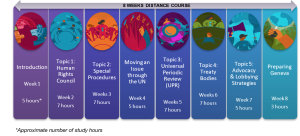
Defenders will complete a 10-week hybrid learning programme through a participatory approach, which will include:

  • accessing the HRDAP Platform, where they can complete e-learning courses on each key UN human rights mechanism and on advocacy strategies, and access interactive learning materials and case studies on the ISHR Academy
  • taking part in live Q&A sessions with human rights experts
  • receiving continuous advocacy support and personalised coaching in order to develop concrete advocacy objectives to make strategic use of the international human rights system
  • building networks around the world, and learning from peers from a range of regions working on a range of human rights issues
  • applying their knowledge to case-studies scenarios and enhancing their advocacy toolbox according to their specific needs
  • receiving support and advocacy accompaniment to conduct activities during the 62nd and 63rd Human Rights Council sessions and other relevant opportunities.

Participants will have the unique opportunity to apply their knowledge and skills while being in Geneva as well as to meet and share with their peers and experts. The blended format of the course allows defenders to continue their vital work on the ground, while diving into the inner workings of each key UN human rights mechanism and gaining first-hand experience from advocates and UN staff on how civil society can strategically engage in the international human rights space.  

What are the criteria and themes for selection?

This programme is directed at experienced human rights defenders working in non-governmental organisations, with existing advocacy experience at the national level and some prior knowledge of the international human rights system. In 2026, we will select human rights defenders working on democratic backsliding and racial justice.

Defenders working in contexts of democratic backsliding 

This theme is for human rights defenders working in democratic countries where authoritarian practices are gaining ground

We particularly welcome applications from defenders who are: 

  • pushing back against repressive laws, attacks on free expression, or restrictions on the freedom of peaceful assembly and association 
  • documenting abuses linked to police and military violence, arbitrary arrests, surveillance, or harassment 
  • fighting for justice, transparency, and the rule of law, and refusing to let democratic institutions be dismantled without accountability. 

Defenders working on racial justice 

This thematic is for defenders working to dismantle systemic racism and build societies rooted in equality and dignity. We will select applications from defenders focusing on anti-racism, exclusion and police violence, including anti-Black racism as experienced through legacies of colonialism and the Transatlantic Trade in Enslaved Africans, Indigenous (including Afro-Indigenous) communities working on historical injustice and reparations, as well as defenders of migrants and asylum seekers. We also welcome applications from mothers working for accountability for their children, victims of police violence. 

Please read the programme description for more information on the criteria.

https://ishr.ch/latest-updates/hrdap-2026-apply-for-ishrs-training-for-defenders-working-on-democratic-backsliding-and-racial-justice

https://ishr.ch/latest-updates/hrdap-2026-apply-for-ishrs-training-for-defenders-working-on-democratic-backsliding-and-racial-justice

New report: a retrospective on the Business frameworks and actions to support defenders

August 10, 2025

ISHR launched a new report  that summarises and assesses progress and challenges over the past decade in relation to initiatives to protect human rights defenders in the context of business frameworks, guidance, initiatives and tools that have emerged at local, national and regional levels. The protection of human rights defenders in relation to business activities is vital.

Defenders play a crucial role in safeguarding human rights and environmental standards against adverse impacts of business operations globally. Despite their essential work, defenders frequently face severe risks, including threats, surveillance, legal and judicial harassment, and violence.  

According to the Business and Human Rights Resource Centre (BHRRC), more than 6,400 attacks on defenders linked to business activities have been documented over the past decade, emphasising the urgency of addressing these challenges.  While this situation is not new, and civil society organisations have constantly pushed for accountability for and prevention of these attacks, public awareness of the issue increased with early efforts to raise the visibility of defenders at the Human Rights Council and the adoption of key thematic resolutions, as well as raising defenders’ voices at other foras like the UN Forum on Business and Human Rights. 

The report ‘Business Frameworks and Actions to Support Human Rights Defenders: a Retrospective and Recommendations’ takes stock of the frameworks, tools, and advocacy developed over the last decade to protect and support human rights defenders in the context of business activities and operations.

The report examines how various standards have been operationalised through company policies, investor guidance, multi-stakeholder initiatives, legal reforms, and sector-specific commitments. At the same time, it highlights how despite these advancements, the actual implementation by businesses remains inadequate. Effective corporate action remains insufficient, highlighting a critical gap that must be urgently addressed to ensure defenders can safely carry out their vital work protecting human rights and environmental justice. In order to address this, drawing on case studies, civil society tracking tools, and policy analysis, the report identifies key barriers to effective protection and proposes targeted recommendations
Download the report

Justice & Peace Netherlands is launching a new call for applications for human rights defenders at risk to participate in Shelter City Netherlands

July 29, 2025
Call for applications is now open!
Photos by Maria Diaz
Justice & Peace Netherlands is launching a new call for applications for human rights defenders at risk to participate in Shelter City Netherlands. The deadline for applications is 10 August 2025 at 23:59 CEST (Central European Summer Time). Help us reach more human rights defenders at risk and in need of temporary relocation to a safer space by sharing this call with your network.­Shelter City is a global movement of cities, organizations and people who stand side by side with human rights defenders at risk. Shelter City provides temporary safe and inspiring spaces for human rights defenders at risk where they re-energize, receive tailormade support and engage with allies. The term ‘human rights defender’ is intended to refer to the broad range of activists, journalists and independent media professionals, scholars, writers, artists, lawyers, civil and political rights defenders, civil society members, and others working to advance human rights and democracy around the world in a peaceful manner.  From March 2026 onwards, 14 cities in the Netherlands will receive human rights defenders for a period of three months. At the end of their stay in the Netherlands, participants are expected to return with new tools and energy to carry out their work at home.
Asser Institute Fellowship 
(only available for English accompaniment beginning in September 2026)Justice & Peace and the Asser Institute have established a collaborative relationship to strengthen and support the capacity of local human rights defenders worldwide. In the context of the Institute’s Visiting Researchers Programme, the Asser Institute hosts one Fellow per year within the framework of the Shelter City initiative by Justice & Peace. The fellowship will take place in September 2026.The selected Fellow will carry out a research project during the three-month period and take part in other relevant human rights (research) activities of the Asser Institute. In line with these activities, closer to the end of the three-month period, the Fellow will have to present the relevant research findings in a public or closed event. The Fellow may also participate in other (public) events like lectures or (panel) discussions.
To be eligible for Shelter City Netherlands, human rights defenders should meet the following conditions:They implement a non-violent approach in their work;They are threatened or otherwise under pressure due to their work or activism;They are willing and able to return to their country of origin after 3 months;They are willing to speak publicly about their experience or about human rights in their country to the extent that their security situation allows; They have a conversational level* of English;They have a valid passport (with no less than 18 months of validity at the time of applying) or are willing to carry out the procedures necessary for its issuance. Justice & Peace covers the costs of issuing a passport and/or visa (if applicable);They are not subject to any measure or judicial prohibition to leave the country;They are willing to begin their stay in the Netherlands around March 2026.
 *By conversational English, we mean that participants’ level of English allows them to actively participate in training, speak about their work, communicate with the host city, etc.  Note that additional factors will be taken into consideration in the final round of selection, such as the added value of a stay in the Netherlands as well as gender, geographic, and thematic balance. Please note that only under exceptional circumstances are we able to accept human rights defenders currently residing in a third country.Apply nowApplication forms must be submitted by 10 August 2025 at 23:59 CEST (Central European Summer Time). An independent commission will select the participants.­Apply now!­Note that selected human rights defenders will not automatically participate in Shelter City as Justice & Peace is not in control of issuing the required visas to enter the Netherlands. For more information, please contact us at info@sheltercity.org

Common Good Cyber Fund Launched

June 30, 2025

The Internet Society (ISOC) and Global Cyber Alliance (GCA), on behalf of the Common Good Cyber secretariat, today announced on 23 June 2025 the launch of the Common Good Cyber Fund, an initiative to strengthen global cybersecurity by supporting nonprofits that deliver core cybersecurity services that protect civil society actors and the Internet as a whole.

This first-of-its-kind effort to fund cybersecurity for the common good—for everyone, including those at the greatest risk—has the potential to fundamentally improve cybersecurity for billions of people around the world. The Common Good Cyber secretariat members working to address this challenge are: Global Cyber Alliance, Cyber Threat Alliance, CyberPeace Institute, Forum of Incident Response and Security Teams, Global Forum on Cyber Expertise, Institute for Security and Technology, and Shadowserver Foundation.

In a Joint Statement Between the Prime Minister of the United Kingdom and the Prime Minister of Canada on 15 June, 2025, the Prime Ministers announced that they would both invest in the Joint Canada-UK Common Good Cyber Fund. On 17 June, during the G7 Leaders’ Summit in Alberta, Canada, all the G7 Leaders announced that they would support initiatives like the Canada-UK Common Good Cyber Fund to aid members of civil society who are actively working to counter the threat of transnational repression. See G7 Leaders’ Statement on Transnational Repression.

The Fund is a milestone in advancing Common Good Cyber, a global initiative led by the Global Cyber Alliance, to create sustainable funding models for the organizations and individuals working to keep the Internet safe. 

Despite serving as a critical frontline defense for the security of the Internet, cybersecurity nonprofits remain severely underfunded—exposing millions of users, including journalists, human rights defenders, and other civil society groups. This underfunding also leaves the wider public exposed to increasingly frequent and sophisticated cyber threats.

Common Good Cyber represents a pivotal step toward a stronger, more inclusive cybersecurity ecosystem. By increasing the resilience and long-term sustainability of nonprofits working in cybersecurity, improving access to trusted services for civil society organizations and human rights defenders, and encouraging greater adoption of best practices and security-by-design principles, the Common Good Cyber Fund ultimately helps protect and empower all Internet users.”Philip Reitinger, President and CEO, Global Cyber Alliance

The fund will support nonprofits that:

  • Maintain and secure core digital infrastructure, including DNS, routing, and threat intelligence systems for the public good;
  • Deliver cybersecurity assistance to high-risk actors through training, rapid incident response, and free-to-use tools

These future beneficiaries support the Internet by enabling secure operations and supplying global threat intelligence. They shield civil society from cyber threats through direct, expert intervention and elevate the security baseline for the entire ecosystem by supporting the “invisible infrastructure” on which civil society depends.

The Fund will operate through a collaborative structure. The Internet Society will manage the fund, and a representative and expert advisory board will provide strategic guidance.. Acting on behalf of the Common Good Cyber Secretariat, the Global Cyber Alliance will lead the Fund’s Strategic Advisory Committee and, with the other Secretariat members, engage in educational advocacy and outreach within the broader cybersecurity ecosystem.

The Common Good Cyber Fund is a global commitment to safeguard the digital frontlines, enabling local resilience and long-term digital sustainability. By supporting nonprofits advancing cybersecurity through tools, solutions, and platforms, the Fund builds a safer Internet that works for everyone, everywhere.

The Internet Society and the Global Cyber Alliance are finalizing the Fund’s legal and logistical framework. More information about the funding will be shared in the coming months.