Posts Tagged ‘on line conversation’

Call for Applications to Sister-to-Sister Program 2026

June 10, 2026
Nobel Women's Initiative - Home

On 8 June 2026 the Nobel Women’s Initiative (NWI) invited applications for the 2026 Sister-to-Sister Young Feminist Leadership Program. DEADLINE 26 June, 2026 

For over a decade, the Sister-to-Sister Young Feminist Leadership Program has been a cornerstone of NWI’s strategy to foster a world where feminist peace and security prevail. 

The Sister-to-Sister program brings together young feminist leaders — sisters — in an intensive virtual program which fosters crucial solidarity, support, sisterhood, and skills-building to better equip activists for the challenges ahead. This year’s program theme is:

“Peace in the Age of AI: Building Feminist Futures.” 

Artificial intelligence is reshaping how power and violence are exercised — from AI-driven disinformation, deepfakes and coordinated online harassment used to silence women in public life, to the rise of autonomous weapons systems transforming the future of conflict. The information ecosystem is a critical site of power, and it is deeply gendered. Women are both on its frontlines and leading efforts to reshape it. 

Women journalists, peacebuilders, content creators, communicators, and human rights defenders are increasingly targeted at the intersection of these threats, where narrative warfare online and AI-enabled security risks converge. These technologies are not neutral — they reflect and amplify existing inequalities and feminist leadership in shaping how they are governed has never been more urgent. 

Building on the work of NWI Nobel Laureates — particularly Maria Ressa, whose journalism and advocacy have been at the forefront of defending truth, accountability and democratic space in the digital age — the 2026 Sister-to-Sister cohort will move from analysis to action. 

We at NWI know first-hand that when young women are grounded in their histories, communities and lived realities, they rise with courage, clarity and fierce commitment to equality for all. Guided by the lived experiences of NWI’s Nobel laureates and inspired by Maria Ressa’s visionary leadership, this year’s program reflects our commitment to cultivating the next generation of feminist leaders equipped to navigate, challenge and reshape the digital world.  

Twenty five young, feminist activists will take part in a 6-week intensive virtual learning program from 24 August to 28 September 2026. The program is designed to: 

  • Broaden understanding of how artificial intelligence is reshaping power, conflict, peace — and the specific ways these technologies impact women and feminist movements. 
  • Build knowledge and critical analysis of AI-driven disinformation, digital security threats, autonomous weapons, and the gendered dimensions of emerging technology. 
  • Strengthen tools and strategies for navigating the digital information ecosystem, including digital safety, counter-disinformation tactics and adaptive feminist leadership. 
  • Explore how AI can be leveraged to advance feminist peacebuilding — from amplifying women-led movements, to strengthening early warning systems and expanding access to justice. 
  • Enhance collective learning and peer exchange by deepening mutual trust, sisterhood, and solidarity among young women activists confronting intersecting challenges. 
  • Deepen feminist networks for support and collective action and through this network build resilience and long-term capacity for change.  

To ensure selected Sisters are able to fully participate, an honorarium will be provided to selected participants at the end of the program. This honorarium is intended to contribute to internet access, work space, transportation, care responsibilities and other potential barriers to participation. 

To be considered, candidate applications are due before 11:59pm ET, on 26 June, 2026. Applications should include: 

  • A personal letter or video (max 2 minutes or 1 page) outlining how the candidate has been contributing to feminist peace, digital rights, social and/or environmental justice; the primary challenges in their context (contextually / personally / professionally); and how they hope the program will benefit them and their work. 
  • Current resume, with up to date, detailed experience (paid, volunteer, academic). 
  • Reference letter from a feminist peace, social or digital rights activist or organization, with contact details for follow up. 

The full application form is available here.

https://www.nobelwomensinitiative.org/sister-to-sister-applications-2026

New ISHR online course for environmental human rights defenders

June 3, 2026

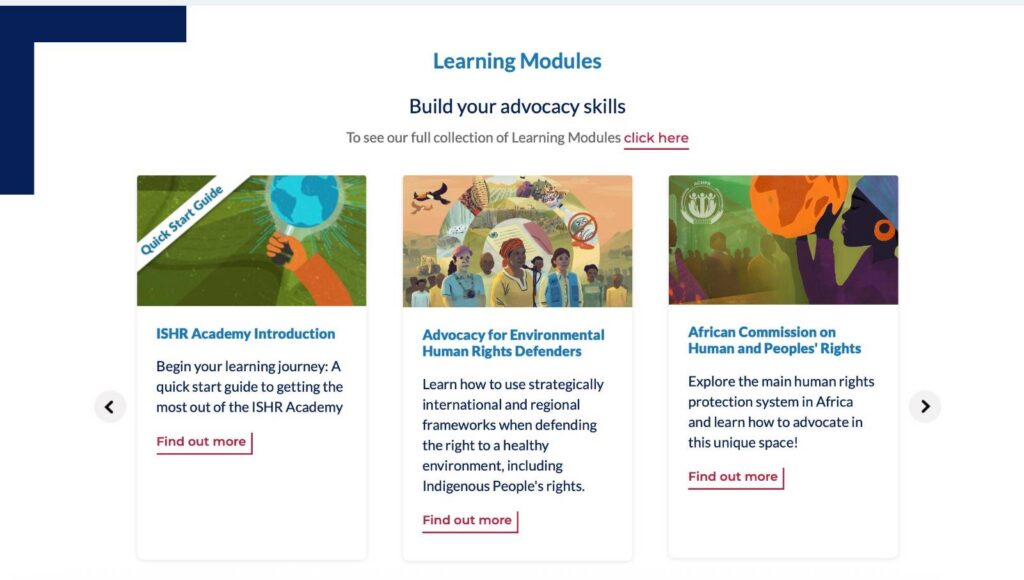
ISHR introduces a new on-line course on advocacy for environmental human rights defenders, a practical, self-paced resource for activists, community leaders, and allies to defend the right to a clean, healthy and sustainable environment using UN and regional mechanisms.

On World Environment Day, and in parallel to the 1st European Forum on Environmental Human Rights Defenders, ISHR is introducing its new online course entitled ‘Advocacy for environmental human rights defenders: a pathway’. A conceptual, legal, and strategic resource to help environmental human rights defenders and their allies translate local environmental struggles into coordinated international and regional advocacy. [https://humanrightsdefenders.blog/2026/05/12/first-european-forum-on-environmental-human-rights-defenders-3-4-june-2026/]

Environmental human rights defenders are those who protect our planet and defend the right to a clean, healthy and sustainable environment. They are Indigenous Peoples, farmers, scientists, journalists and young activists from all over the world.

Despite their vital role, more than 2,253 of them were killed, harassed, or persecuted between 2012 and 2024 according to Global Witness. More recently, the Business and Human Rights Centre found that the most dangerous sectors in which to pursue activism to defend rights are mining, agribusiness and fossil fuels.

Behind those numbers are stories of resistance and solidarity.
Why a new course for environmental human rights defenders?

The past few years saw an increased number of positive developments for the protection of the environment and environmental human rights defenders.

This includes the recognition of the right to a clean, healthy and sustainable environment, the Human Rights Council’s Resolution 40/11 recognising the role of environmental defenders, the Escazú Agreement enshrining the latter’s rights in Latin America and the Caribbean, and the creation of the Special Rapporteur on Environmental Defenders under the Aarhus Convention. All these developments also require defenders to understand how and when to use these mechanisms. 

I became an environmental human rights defender by coincidence. I need practical tools like this to help me navigate spaces for my advocacy. The ISHR Academy is really a useful one! Christopher Opio, Uganda 

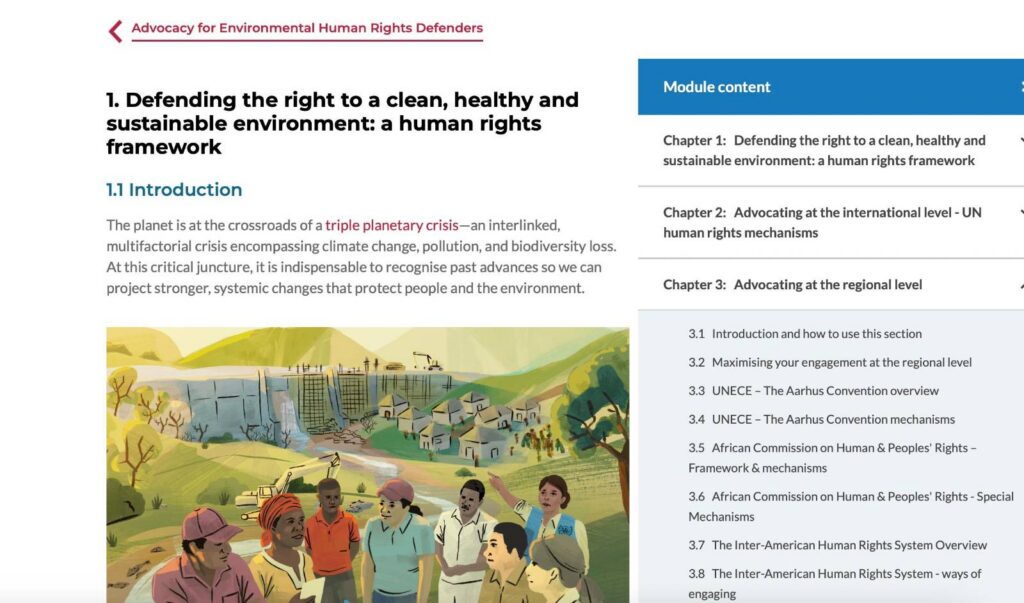
The pathway is divided into three independent chapters
Module content on the ISHR Academy

Chapter 1 examines the legal and conceptual foundations of the right to a clean, healthy and sustainable environment, the role of environmental human rights defenders in addressing the triple planetary crisis, including accountability of States and non-State actors.

Chapter 2 provides strategic and practical guidance to advance environmental justice through UN human rights mechanisms like the Human Rights Council, the Special Procedures, the Treaty Bodies or the Expert Mechanism on the Rights of Indigenous Peoples, and translate local defence into international advocacy.

Chapter 3 dives into regional mechanisms and other tools, in particular, for the protection of environmental human rights defenders. This includes rapid response mechanisms in Europe and Latin America, and other options designed for African and Asia-Pacific defenders through regional institutions and tools. 

Free, self-paced, modular and flexible, each chapter can be taken independently, enriched with case studies, videos, and additional resources. You set the pace according to your needs.

How do I know if this is for me? 

You know that bringing international attention could create pressure for change, but you don’t know where to start? You have an idea of who the Special Rapporteur on climate change is, the International Covenant of Economic, Social and Cultural Rights does, but don’t know the steps to engage with them?

The pathway walks you through exactly this.

Whether you are a community leader facing displacement, an environmental lawyer seeking international leverage, a representative of a grassroots organisation whose government has stopped listening, a young advocate learning to navigate international spaces, or an NGO supporting defenders on the frontline — this pathway was built for you.

Environmental human rights defenders are often the first to raise the alarm. I often meet people who face pressure or harassment for defending environmental rights and without knowing that international tools can support them. In this module, I will explain what my mandate can do and how defenders can engage with it.

Astrid Puentes Riaño, UN Special Rapporteur on the right to a healthy environment

By the end of this pathway, you will be able to:

  • Understand who environmental human rights defenders are, the contexts they operate in, and the legal frameworks for their protection
  • Identify international and regional advocacy avenues, within the UN and beyond, to advance the right to a clean, healthy environment
  • Plan strategic engagement with mechanisms based on your context, and hold governments and non-State actors accountable.

Start learning now at the ISHR Academy!

ISHR warmly thanks all the human rights defenders, experts, Special Rapporteurs and UN staff who supported us in building this course.

https://ishr.ch/latest-updates/new-online-course-for-environmental-human-rights-defenders-on-the-ishr-academy

Online roundtable discussion about the next Special Rapporteur on human rights defenders

January 29, 2026

The mandate of the United Nations Special Rapporteur on the situation of Human Rights Defenders plays a critical role in promoting the protection of individuals and groups who peacefully work to advance human rights worldwide. As the current mandate-holder, Mary Lawlor, approaches the end of her tenure (March 2026), the UN Human Rights Council is in the process of appointing a successor. 

Together with partner organisations, ISHR is campaigning for the appointment of a mandate holder who is independent, impartial, highly competent, and whose backgrounds reflect the diversity of our world. Such appointments are essential to ensuring a strong and effective system of Special Procedures, which is fundamental to the proper functioning of the Human Rights Council.

As the appointment process for the next Special Rapporteur reaches its final stages, the ISHR would like to create a space for meaningful exchange between shortlisted candidates and civil society organisations and human rights defenders. 

In this context, there will be an online roundtable with the shortlisted candidates:

Ms Andrea BOLANOS VARGAS (Colombia)

Mr Onesmo OLE NGURUMWA (Tanzania) 

Ms Sarah Leah WHITSON (United States of America) [see https://humanrightsdefenders.blog/tag/sarah-leah-whitson/]

The discussion aims to provide shortlisted candidates with an opportunity to present their background, experience, and vision for the mandate Facilitate a safe and inclusive space for dialogue between candidates, civil society organisations, and human rights defenders Enable human rights defenders to share priorities, concerns, and expectations regarding the future direction of the mandate

The roundtable will take place on 10 February, from 3:00 to 5:00 PM (CET). Interpretation will be available in English and Spanish.

Confirm your participation by 9 February EOD using this form. A link to the meeting will be shared later.  Important: At the end of the form, there is a section where you can write any questions you would like the candidates to answer. The organisers will review these questions and choose some of them in advance, and those selected questions will be asked during the meeting. Because many people are expected to attend, participants will not be able to ask their own questions directly to the candidates during the meeting. We very much look forward to your participation., ISHR Team

Amnesty International Australia starts on-line course for Human Rights Defenders skills

June 4, 2025

👋 New to Activism? You’re in the Right Place. 

You don’t need experience to make a difference. You just need the belief that things can be better – and the courage to take that first step. At Amnesty, we’ll support you to get involved in a way that works for you. Whether you’ve got five minutes or a few hours a month, there’s a place for you in our movement. 

….

🌈 Ready to Take Action? Sign up Today. 

Once you sign up, we’ll guide you through a short online induction module that introduces you to who we are, what we do, and how you can help. From there, you’ll be connected with the right support to help you  

https://www.amnesty.org.au/skill-up-2/

Should HRDs worry about Artificial Intelligence?

April 12, 2023

Towards Life 3.0: Ethics and Technology in the 21st Century is a talk series organized and facilitated by Dr. Mathias Risse, Director of the Carr Center for Human Rights Policy, and Berthold Beitz Professor in Human Rights, Global Affairs, and Philosophy. Drawing inspiration from the title of Max Tegmark’s book, Life 3.0: Being Human in the Age of Artificial Intelligence, the series draws upon a range of scholars, technology leaders, and public interest technologists to address the ethical aspects of the long-term impact of artificial intelligence on society and human life.

On 20 April you can join for 45 minutes with WITNESS’ new Executive Director Sam Gregory [see: https://humanrightsdefenders.blog/2023/04/05/sam-gregory-finally-in-the-lead-at-witness/]o n how AI is changing the media and information landscape; the creative opportunities for activists and threats to truth created by synthetic image, video, and audio; and the people and places being impacted but left out of the current conversation.

Sam says “Don’t let the hype-cycle around ChatGPT and Midjourney pull you into panic, WITNESS has been preparing for this moment for the past decade with foundational research and global advocacy on synthetic and manipulated media. Through structured work with human rights defenders, journalists, and technologists on four continents, we’ve identified the most pressing concerns posed by these emerging technologies and concrete recommendations on what we must do now.

We have been listening to critical voices around the globe to anticipate and design thoughtful responses to the impact of deepfakes and generative AI on our ability to discern the truth. WITNESS has proactively worked on responsible practices for synthetic media as a part of the Partnership on AI and helped develop technical standards to understand media origins and edits with the C2PA. We have directly influenced standards for authenticity infrastructure and continue to forcefully advocate for centering equity and human rights concerns in the development of detection technologies. We are convening with the people in our communities who have most to gain and lose from these technologies to hear what they want and need, most recently in Kenya at the #GenAIAfrica convening”.

 Register here: wit.to/AI-webinar 

9 November Webinar on reprisals in the European diaspora

November 5, 2021

On 9 November 2021 at 2pm CET, the Unrepresented Nations and Peoples Organization (UNPO) will be co-organizing with MEPs an event in the European Parliament presenting its report on third country reprisals against human rights defenders in Europe. With growing threats from China, Russia, Iran and Pakistan on European soil, UNPO wants greater action taken against their reprisals on minority rights diaspora in Europe. Our report can be found here. [see also: https://humanrightsdefenders.blog/2021/04/22/unpo-reprisals-on-the-rise/]

Event information :

Format : Webinar, with Presentation of report and testimonies

Date : Tueday, November 9

Time : 14.00 CET

Stream link : https://youtu.be/_WPgpYCuNrI

Event description :

UNPO has been working hard to expose the difficulties activists for self-determination and minority rights face due to reprisals by state actors. These can range from intimidation and threats to murder. As part of our broad Compromised Spaces campaign we wanted

Schedule and Panelists :

Moderator : Shima Silavi, Program Officer, UNPO

Hosts as MEPs : Jordi Sole MEP, Heidi Hautala MEP, Ignazio Castaldo MEP, David Lega MEP.

14.00 Opening Remarks

14.20-14.40 Presenting the Report : “Compromised Space: Foreign State Reprisals against Unrepresented Diplomats in Europe” Shima Silavi.

14:40 – 14:55 Ahwazi Arab Witness – Iran. Hawra Nissi, Daughter of Ahmad Mola Nissi, an Ahwazi Arab political activist who was shot dead in front of his home in the Hague in 2017

14:50 – 15:10 Uyghur Witness – China, Dolkun Isa, President of the World Uyghur Congress

15:10 – 15:25 Crimean Tatar Witness- Russia. Ayla Bakkalli, Representative of the World Congress of Crimean Tatars, Mejlis of Crimean Tatars People – UN Permanent Forum on Indigenous Issues

15: 25 – 15:40 Expert – Oxford University Dr. Fiona McConnell, Associate Professor in Human Geography. Fellow and Tutor at St. Catherine’s College, Oxford, recipient of the Philip Leverhulme Prize for Geography in 2019.

https://unpo.org/article/22170

4 June 2020 Webinar on business and human rights in the context of COVID-19

May 27, 2020

Having just posted a report on the prolifiration of intergovernmental responses to the Corona virus pandemic [https://wp.me/pQKto-4ob], it perhaps good to point to the webinar that Business & human rights is organising on 4 June 2020 on Risks and Protection of Human Rights Defenders.

This webinar will have a focus on the risks and protection of HRDs, particularly labour rights and land/environmental defenders and ensuring their participation in the post-pandemic recovery.

Date & Time: 4 June, 4.15 – 5.15 (ICT) / 10.15 – 11.15 (BST)

It will have two parts: a closed and an open session. The closed session – happening on Jitsi – will be a safe space for civil society organisations, human rights defenders, including labour rights and land and environmental defenders, labour unions, and journalists to jointly define practical recommendations on what governments and companies can do to address human rights situation, particularly of labour, land, environmental defenders and civic freedoms, in the context of COVID-19. This part of the webinar is invite-only.

The second part – happening on Zoom – will be an open session, will be an opportunity for civil society, defenders, and journalists to interact with government and business representatives and discuss how companies, governments and civil society can work together to ensure all stakeholders are able to shape recovery efforts, and make sure they are human rights compliant. Anyone is free to join us in the public session by RSVP-ing below.

Fundamental Rights Agency (Europe): human rights defenders and COVID-19; 17 April on-line

April 12, 2020

https://fra.europa.eu/en/event/2020/discussing-impact-covid-19-measures-human-rights-defenders

https://fra.europa.eu/en/news/2020/international-organisations-discuss-how-support-human-rights-defenders-during-covid

International Women’s Day 2020: Dad, a digital warrior in Pakistan

March 9, 2020

With her “Hack the patriarchy” laptop stickers, Nighat Dad is a digital warrior. But this human rights award winner and founder of Pakistan”s first cyber-harassment helpline still tears up as she describes receiving calls from women afraid of being killed by male relatives for using the internet. Nighat Dad established the help line in 2016 with prize money (100,000 euros) from the Dutch human rights award, the Tulip

Much of Pakistani society lives under the patriarchal, outdated code of so-called “honour” that systemises the oppression of women by preventing them from, for example, choosing their own husband or working outside the home. Activists have denounced pervasive, sometimes deadly violence by men — usually male relatives — against women who break those taboos. The situation is dire enough in the offline world.

But Pakistan is only just beginning to grapple with what violent notions of honour mean for women online, in a country where internet penetration is at 22 percent and growing, but digital literacy is low.

Much of the work the helpline does is to explain to women what recourse they have. Social media companies are playing ball, Dad says — some have even agreed to establish “escalation channels” for getting content off the internet quickly when a woman”s life is in immediate danger. But she warns that community guidelines developed by such companies, usually US-based, are not appropriate in Pakistan. “I think they need to do more,” Dad says. More than three years on, the Tulip money has run out. Now the helpline survives only by the grace of small grants from groups such as the Netherlands-based Digital Defenders Partnership, which supports rights activists.

…. She cites last year”s International Women”s Day march in Pakistan, which saw women turn out in unprecedented numbers loudly celebrating divorce and periods, among other things. The response was swift and shocking in its intensity, with Dad describing mullahs making rape and death threats against the march organisers in videos widely distributed online. The 2016 murder of social media star Qandeel Baloch has also impacted her, she says. Baloch divided Pakistan with her videos and selfies, tame by Western standards but provocative in Pakistan. She was strangled by her brother in 2016 in what has been called the country”s most high-profile “honour” killing.

She was a hero for me… she did what she wanted to do, and not every woman can do this in Pakistan,” Dad says.

Dad says she cannot help but see the similarities between herself and Baloch. They are from similar backgrounds, both left abusive marriages, and both have gained fame by loudly challenging social taboos online — though admittedly not in quite the same way. Her murder “shook me badly,” she tells AFP. “It was enough to shake us all.”

……

https://www.outlookindia.com/newsscroll/nighat-dad-pakistans-digital-warrior-battling-the-patriarchy/1755905

https://www.rferl.org/a/pakistani-lawyer-fights-abuse-of-women-who-dare-to-go-online/30469845.html

24 January, Day of the Endangered Lawye: ABA focuses on Pakistan

January 17, 2020
Pakistan is the focus of this year’s Day of the Endangered Lawyer (January 24) and the American Bar Association is organising a teleconference, in which panelists will provide a report of the current state of attacks on the judiciary, bar and other human rights defenders in Pakistan, as well as offering suggestions for how the ABA and other outside organizations can lend support. [see also: https://humanrightsdefenders.blog/2018/01/22/24-january-2018-day-of-the-endangered-lawyer-focus-on-egypt/]

Moderator:

  • Sara Sandford, Immediate Past Co-Chair, International Human Rights Committee

Speakers:

  • Jalila Haider, Founder of We the Humans
  • Farahnaz Ispahani, Senior Fellow, Religious Freedom Institute; Global Fellow, Woodrow Wilson International Center for Scholars
  • Hussain Haqqani, Former Ambassador to US
  • Raza Rumi, Director of the Park Center for Independent Media, Ithaca College; Visiting Faculty at Cornell Institute for Public Affairs; and Editor of Daily Times