Posts Tagged ‘World Environment Day’

New ISHR online course for environmental human rights defenders

June 3, 2026

ISHR introduces a new on-line course on advocacy for environmental human rights defenders, a practical, self-paced resource for activists, community leaders, and allies to defend the right to a clean, healthy and sustainable environment using UN and regional mechanisms.

On World Environment Day, and in parallel to the 1st European Forum on Environmental Human Rights Defenders, ISHR is introducing its new online course entitled ‘Advocacy for environmental human rights defenders: a pathway’. A conceptual, legal, and strategic resource to help environmental human rights defenders and their allies translate local environmental struggles into coordinated international and regional advocacy. [https://humanrightsdefenders.blog/2026/05/12/first-european-forum-on-environmental-human-rights-defenders-3-4-june-2026/]

Environmental human rights defenders are those who protect our planet and defend the right to a clean, healthy and sustainable environment. They are Indigenous Peoples, farmers, scientists, journalists and young activists from all over the world.

Despite their vital role, more than 2,253 of them were killed, harassed, or persecuted between 2012 and 2024 according to Global Witness. More recently, the Business and Human Rights Centre found that the most dangerous sectors in which to pursue activism to defend rights are mining, agribusiness and fossil fuels.

Behind those numbers are stories of resistance and solidarity.

Why a new course for environmental human rights defenders?

The past few years saw an increased number of positive developments for the protection of the environment and environmental human rights defenders.

This includes the recognition of the right to a clean, healthy and sustainable environment, the Human Rights Council’s Resolution 40/11 recognising the role of environmental defenders, the Escazú Agreement enshrining the latter’s rights in Latin America and the Caribbean, and the creation of the Special Rapporteur on Environmental Defenders under the Aarhus Convention. All these developments also require defenders to understand how and when to use these mechanisms. 

I became an environmental human rights defender by coincidence. I need practical tools like this to help me navigate spaces for my advocacy. The ISHR Academy is really a useful one! Christopher Opio, Uganda 

The pathway is divided into three independent chapters
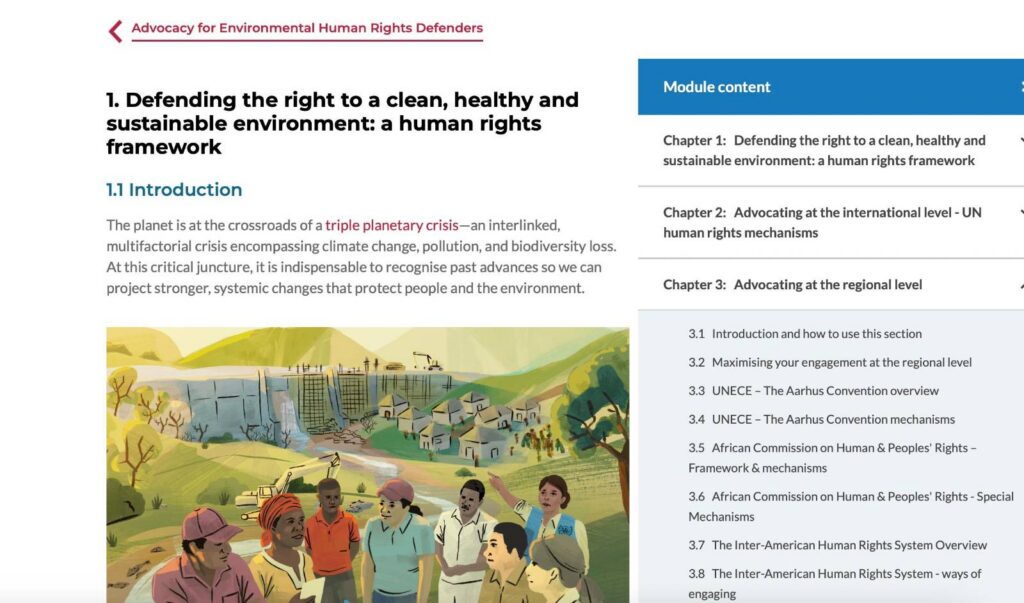
Module content on the ISHR Academy

Chapter 1 examines the legal and conceptual foundations of the right to a clean, healthy and sustainable environment, the role of environmental human rights defenders in addressing the triple planetary crisis, including accountability of States and non-State actors.

Chapter 2 provides strategic and practical guidance to advance environmental justice through UN human rights mechanisms like the Human Rights Council, the Special Procedures, the Treaty Bodies or the Expert Mechanism on the Rights of Indigenous Peoples, and translate local defence into international advocacy.

Chapter 3 dives into regional mechanisms and other tools, in particular, for the protection of environmental human rights defenders. This includes rapid response mechanisms in Europe and Latin America, and other options designed for African and Asia-Pacific defenders through regional institutions and tools. 

Free, self-paced, modular and flexible, each chapter can be taken independently, enriched with case studies, videos, and additional resources. You set the pace according to your needs.

How do I know if this is for me? 

You know that bringing international attention could create pressure for change, but you don’t know where to start? You have an idea of who the Special Rapporteur on climate change is, the International Covenant of Economic, Social and Cultural Rights does, but don’t know the steps to engage with them?

The pathway walks you through exactly this.

Whether you are a community leader facing displacement, an environmental lawyer seeking international leverage, a representative of a grassroots organisation whose government has stopped listening, a young advocate learning to navigate international spaces, or an NGO supporting defenders on the frontline — this pathway was built for you.

Environmental human rights defenders are often the first to raise the alarm. I often meet people who face pressure or harassment for defending environmental rights and without knowing that international tools can support them. In this module, I will explain what my mandate can do and how defenders can engage with it.

Astrid Puentes Riaño, UN Special Rapporteur on the right to a healthy environment

By the end of this pathway, you will be able to:

  • Understand who environmental human rights defenders are, the contexts they operate in, and the legal frameworks for their protection
  • Identify international and regional advocacy avenues, within the UN and beyond, to advance the right to a clean, healthy environment
  • Plan strategic engagement with mechanisms based on your context, and hold governments and non-State actors accountable.

Start learning now at the ISHR Academy!

ISHR warmly thanks all the human rights defenders, experts, Special Rapporteurs and UN staff who supported us in building this course.
https://ishr.ch/latest-updates/new-online-course-for-environmental-human-rights-defenders-on-the-ishr-academy

Global summit on climate change and human rights announced for June 2025

April 12, 2025

“Right Here, Right Now” a global dialogue on climate change and human rights are held at Oxford University and universities around the world 4-7 June 2025

In June 2025 UN Human Rights is co-hosting a global summit on climate change and human rights in partnership with the University of Oxford, the Right Here, Right Now Global Climate Alliance, the International Universities Climate Alliance, and co-host universities across the world.

The 2025 Summit aims to advance human rights-based solutions to the climate crisis, amplify environmental human rights defenders’ voices, reinforce the global climate justice movement, and inspire people, particularly students, as advocates and leaders for human rights-based climate action.

Other university partners include the University of the South Pacific, the University of Colorado Boulder, the University of Cape Town, UNSW Sydney, Monash University, the University of Nairobi, the African Climate and Development Initiative, and the University of São Paulo.

The cornerstone of the summit is a hybrid global event on World Environment Day, 5 June 2005. The Summit will bring together leading thinkers and practitioners at the intersection of climate change and human rights for a 24-hour global plenary, which will be broadcast live across time zones. Co-created and co-delivered by universities across the world, the plenary will follow the sun as we pass the baton between different regions.

The High Commissioner will open the Summit at the University of Oxford on 4 June 2025.  Meanwhile, partner universities worldwide will host local activities on climate justice.

More information and registrationhttps://www.ohchr.org/en/events/events/2025/right-here-right-now-global-climate-summit

https://www.ohchr.org/en/events/events/2025/right-here-right-now-global-climate-summit

World Environment Day: seven stories of human rights defenders

June 9, 2019

Amnesty International marked 5 June – World Environment Day – by focusing on environmental human rights defenders, who often face the gravest risks to protect their homes and communities. Being an environmental human rights defender has deadly consequences, making it among the deadliest types of activism. According to the NGO Global Witness, in 2017 almost four environmental defenders were killed each week for protecting their land, wildlife and natural resources. In 2017, 207 environmental activists were killed. The vast majority of them hailed from South America, making it the most dangerous region in the world. [see: https://humanrightsdefenders.blog/2019/01/09/global-witness-report-2018-on-environmental-defenders-bad-but-2017-was-worse/]

Amnesty highlights the stories of seven environmental activists from the Americas who remind us of why we need to stand up for Earth’s defenders.

BERTA CÁCERES, COPINH (HONDURAS)

Berta Cáceres cofounded the National Council of Popular and Indigenous Organizations of Honduras (Consejo Cívico de Organizaciones Populares e Indígenas de Honduras, COPINH) in 1993 to address the growing threats posed to the territorial rights of the Lenca communities and improve their livelihoods. For more on her case see: https://humanrightsdefenders.blog/tag/berta-caceres/

JULIÁN CARRILLO AND THE COLORADAS DE LA VIRGEN COMMUNITY (MÉXICO)

Julián Carrillo was a leader of the Coloradas de la Virgen community. His job was to take care of the territory, the water, the forest and the wildlife. He had publicly denounced logging and mining by landlords in their ancestral land, as well as violence by criminal armed groups against his community. See also: https://humanrightsdefenders.blog/2018/11/07/reprehensible-says-un-about-mexican-killing-of-human-rights-defender/%5D

PARAGUAY: AMADA MARTÍNEZ, INDIGENOUS DEFENDER OF THE ENVIRONMENT AND TERRITORY

Amada is an Avá Guaraní Indigenous environment defender from the Tekoha Sauce community.

In the 1970s, the construction of the Itaipú Binational hydroelectric plant, in the border between Paraguay and Brazil, forcibly displaced her community from its ancestral territory, putting their survival at risk. Since then, she has defended the right of her community to have a territory in which they can thrive in harmony with nature and has denounced the serious impacts of hydroelectric projects on nature and Indigenous Peoples’ lives. On 8 August 2018, a group of armed men threatened to kill her. Amada was leaving the community in a taxi along with his seven-year-old son, his sister and two young nephews, when the vehicle in which they were traveling was intercepted by a pickup truck with the logo of the hydroelectric plant. Amada Martínez believes that the threat against her was due to her work defending Indigenous Peoples rights and the environment.

PATRICIA GUALINGA, INDIGENOUS DEFENDER OF THE ENVIRONMENT AND TERRITORY

“We are united and we will continue our struggle to defend Mother Earth.”

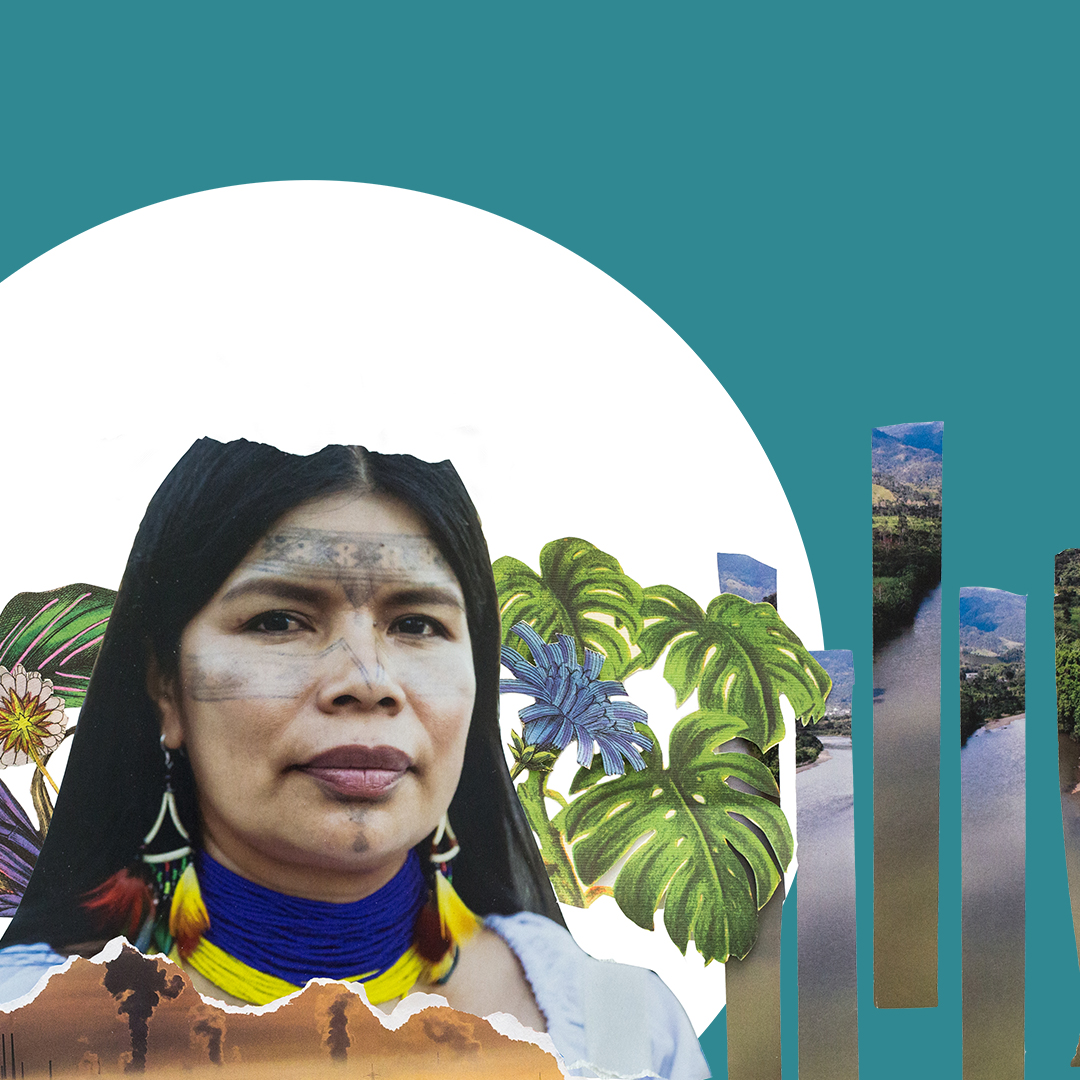
Patricia is an Indigenous leader of the Kichwa people of Sarayaku community. She defends her people’s rights to their territory and to live in a healthy environment in the face of damaging oil activities there. Patricia is also protecting the Amazonian environment and promoting sustainable development. In 2012, the Indigenous Sarayaku community achieved a historic victory for Indigenous Peoples against the Ecuador government after reporting an oil concession that had installed explosives on their territory without consulting them. In the early hours of 5 January 2018, an unknown man made death threats to Patricia and attacked her at her home in Puyo, in the east of Ecuador., The man shouted, “Next time we’ll kill you, bitch!” before fleeing. Patricia and her family had to leave their home after the attack because the property owner “was terrified that something would happen to her.”

NEMA GREFA, INDIGENOUS DEFENDER OF THE ENVIRONMENT AND TERRITORY


Nema is defending the Amazon environment and her people’s right to protect their territory from the possible negative effects of oil activity. After being legally recognized as President of the Sápara nationality of Ecuador in January 2018, her appointment was challenged by a group of people who Nema says are supportive of oil activities on the Sápara territory. Nema’s appointment was revoked in April 2018 as a result. Later that month a video was shared on social media featuring a man armed with a spear, identified by Nema as belonging to the group who had challenged her appointment, issuing her with a death threat: “Those present here are united in rejecting her and are thus going to kill Nema Grefa; she has no territory.” One year on, the Attorney’s Office has yet to open in investigation into the death threat. On 19 October 2018 Nema was finally recognized as president but still faces serious threats to her life. In April this year, despite the Ecuadorian authorities’ promises to protect her and her family, unknown individuals forcibly broke into her home to steal two computers containing sensitive information on her human rights work.

SALOMÉ ARANDA, INDIGENOUS ENVIRONMENTAL AND WOMEN’S RIGHTS DEFENDER

Salomé is an Indigenous leader from the Kichwa people who is defending the Amazonian environment and the right of women in her community to live in a healthy environment, free from sexual violence. Salomé is the Women and Family Leader in Moretecocha commune, Pastaza province. Salomé has publicly denounced the possible environmental impacts of oil operations in the Villano River basin, Pastaza province, and the sexual abuse of Indigenous women that have occurred in this context. In the early hours of 13 May 2018, a number of unidentified individuals attacked and threatened her and her family at home. Despite making a formal complaint, the Pastaza Provincial Attorney’s Office has yet to make any significant progress in this investigation. The authorities have not even offered her protection measures to address the risk facing her and her family.

MARGOTH ESCOBAR, ENVIRONMENTAL AND INDIGENOUS PEOPLES’ RIGHTS DEFENDER

Margoth has devoted her life to defending the environment and Indigenous Peoples’ rights. In August 2015, Margoth was physically attacked by police officers at a protest and national strike called by the social and Indigenous movements in Puyo, Pastaza province. She was held on pre-trial detention for more than a week despite poor health caused by her injuries. She was charged with “attack and resistance”, which she was eventually acquitted of. In September last year Margoth’s house was set on fire, destroying all her belongings. On 1 October 2018, the Puyo Fire Brigade Commander stated that the fire at Margoth’s house had been intentional. Margoth lodged a criminal complaint with the Pastaza Provincial Attorney’s Office to investigate the attack, yet no progress has been made in her case. Margoth refused to join the country’s witness protection program because of her previous experience at the hands of the police: “I didn’t want to join the victim and witness protection system because I have no faith in the current government, I have no faith in the independence of the legal system in Ecuador, nor in the military or police forces.”

https://www.amnesty.org/en/latest/campaigns/2019/06/why-we-need-to-stand-up-for-earth-defenders-this-world-environment-day/


World Environment Day cannot do without Human Rights Defenders

June 6, 2013

In the Huffington Post of 6 June 2013 there is an excellent post by Jane Cohen, researcher at Human Rights Watch about the link between the protection of the environment and that of human rights defenders. The whole piece is worth reading but here is the essential message: Read the rest of this entry »