The Inter-American Court’s climate Opinion requires States across Latin America and the Caribbean to apply the standards of the Escazú Agreement—even if they have not yet ratified the treaty.
In a Blog Post Published on 2 july, 2026Luisa Gómez, Senior Attorney at the Center for International Environmental Law, explains that one year after the Inter-American Court of Human Rights’ Advisory Opinion on the Climate Emergency, the debate is no longer whether countries across Latin America and the Caribbean must protect environmental defenders. That question has already been answered. The Court confirmed that all Member States of the Organization of American States (OAS)—to which the Advisory Opinion directly applies—must implement the highest standards of protection for those defending the environment.
To define those standards, the Court drew extensively on the Escazú Agreement, the first legally binding regional treaty promoting environmental democracy. In doing so, it reinforced the treaty’s significance, even in countries that have not yet ratified it, including Peru, Guatemala, and Costa Rica. The implication is clear: these States can no longer treat Escazú’s standards as external, optional, or irrelevant.….
The incorporation of Escazú’s standards into the Inter-American corpus juris marks an important step toward strengthening access rights and protections for environmental defenders in the context of the climate crisis.
But no Advisory Opinion changes reality on its own. These decisions generate change when they are used in litigation, legislative reform, public debate, and collective organizing to ensure that human rights standards addressing the climate crisis translate into concrete protections for those defending the environment.
Recently, in the Province of Mendoza, Argentina, a significant development unfolded regarding criminal charges against environmental defenders protesting against mining activities. Public authorities, citing the Advisory Opinion of the Inter-American Court of Human Rights, requested the suspension of the prosecution. They argued that continuing with the charges would be unconstitutional and could criminalize social protest and environmental advocacy.
One year later, the true measure of the Advisory Opinion’s impact will not be found in its pages, but in how judges, legislators, communities, and environmental defenders use it to strengthen protections for both the environment and the people who defend it.
Click here to dive deeper into the practical uses of the Inter-American Court of Human Rights Advisory Opinion on the climate emergency.
Indigenous environmental human rights defenders (IEHRDs) across Latin America face disproportionate levels of violence for protecting land, water, and territory. Of the 146 environmental defenders killed or disappeared in 2024, approximately one-third were Indigenous. This overrepresentation reveals the structural risks faced by Indigenous Peoples at the forefront of environmental defense.
A study by Nefeli Poulopati, Ezihe Chikwere and Paulina Macías Ortega for Kennedy Human Rights Centre published on 30 April 2026 explores who IEHRDs are, the legal protections available to them, the challenges they face, and cases that reflect their ongoing resistance and struggle across Latin America.
The study looks at Legal Frameworks, Violence against IEHRDs, Impacts of Extractivism, and looks Ahead: A Differentiated Approach…
States must adopt an intersectional approach in all measures taken to protect the rights of IEHRDs. A differentiated, preventive, and collective approach to protecting IEHRDs requires applying a gender, ethno-racial, and cultural perspective when determining the level of risk faced by an IEHRD. The ethnic reality of the territory and the traditional ways of Indigenous peoples need to be taken into account when designing protection schemes, to ensure they align with these communities’ practices. The special relationship of Indigenous Peoples to the land reinforces States’ obligation to protect IEDHRs.
One way to fulfill this obligation is to decide on protective measures for IEHRDs in consultation with Indigenous communities, a practice that is often not followed by States. It is particularly important for governments to consider the heightened risk that IEHRDs face when they oppose development megaprojects. States should adopt the necessary measures to establish or strengthen systems to monitor and control these practices in a manner consistent with their legal obligations.
However, as the cases above illustrate, formal recognition does not equal protection. Instead, it is the first step to rethink the colonial origins of the extractivist system that perpetuates power imbalances, thereby weakening safeguards at the regional and local levels.
To learn more about this work, visit the Civic Space Case Tracker, which maps leading ongoing judicial cases litigated by local organizations and lawyers in Asia, Africa, and the Americas.
On 23 April 2026 Anamaría Martinez and Elizabeth Moses for WRI explain how environmental defenders help prevent deforestation and protect ecosystems critical to climate stability. Yet many face severe and sometimes lethal threats while remaining underrecognized in climate policies that often depend on their work but fail to protect them.
Image by VaLife/Shutterstock
Benitha Bompendju grew up in Tshuapa province in the Democratic Republic of the Congo, surrounded by the dense rainforests of the Congo Basin. The world’s second-largest tropical forest, it plays a critical role in regulating the global climate, conserving biodiversity and sustaining local communities like Benitha’s. Yet when she was growing up, industrial logging was constant.
Concessionaires licensed by the government to harvest timber promised to bring benefits like schools and health centers. But these projects often did not materialize, and local authorities rarely got involved. Instead, companies stripped trees from the land and left local communities — who have long stewarded and relied on the rainforest — with little in return.
“As children, we watched the concessionaires leave with the wood and our parents received nothing,” Benitha recalls. “That was injustice.” This experience shaped Benitha’s future work. In 2016, she began monitoring forest-use contracts and documenting violations, working with partner organizations and government agencies to hold violators accountable. Since then, these joint efforts have helped curb illegal logging, enforce environmental regulations and deliver promised investments to communities.
Yet this critical work can be dangerous — lethally so. Benitha and other environmental defenders like her are often caught in the crosshairs of commercial interests and corruption. Many face threats, intimidation, physical assault, kidnapping and deadly violence. Global Witness documented 146 defenders killed or missing in 2024. The total number killed or missing from 2012 to 2024 is over 2,200 — and because many cases go unreported, the true toll is likely higher.
Research consistently shows that forests managed by Indigenous Peoples and local communities have lower deforestation rates and greater carbon sequestration than those managed under other regimes, making their contribution a measurable climate outcome. But without necessary protections — from access to climate justice to the systems and law enforcement needed to prevent threats and tragic loss of life — environmental defenders can’t safeguard vital ecosystems. And such protections can’t materialize or become institutionalized if environmental defenders aren’t accurately recognized and reflected in climate and nature policies.
The UN defines environmental human rights defenders as “individuals and groups who, in their personal or professional capacity and in a peaceful manner, strive to protect and promote human rights relating to the environment, including water, air, land, flora and fauna.” This includes those who defend the collective right to a safe, clean, healthy and sustainable environment, as well as traditional lands and livelihoods, through actions ranging from community organizing and legal advocacy to protesting, public campaigning and journalism. Many come from Indigenous and tribal groups with deep ancestral ties to the land.
Our research focuses specifically on frontline environmental defenders — those who live in, and defend, resource-rich areas experiencing what the UN Environment Programme describes as “abuse of environmental rights which affects a growing number of people in many parts of the world.”
To understand how defenders are represented in the gray (unpublished) and peer-reviewed literature on climate change under the UNFCCC, we examined 170 peer-reviewed documents from 2015 to 2025, including journal articles, books and reports, to map how defenders’ actions and contributions are reflected. The literature we surveyed both reflects trends in policymaking and serves as a source decision-makers might draw on to develop global and national climate and nature policies. Download
We found that groups such as Indigenous Peoples, women, local communities and youth are increasingly acknowledged as “agents of change” with decision-making capacity, rather than portrayed as victims or passive recipients of project benefits.
However, only 5% of the literature explicitly identifies members of these groups as “defenders” working to protect ecosystems and resources. This represents a crucial gap. Climate literature (and wider climate governance frameworks) tends to recognize who these people are — such as Indigenous Peoples, women-led organizations and youth activists — but without recognizing what they do, such as monitor deforestation and challenge extractive industries, or the risks they face as a result.
This difference may seem subtle, but is crucial. Recognizing someone’s identity alone doesn’t necessarily translate into protection or funding for the stewardship and advocacy these groups engage in. Not all identity groups (for example, Indigenous Peoples) are environmental defenders, and not all defenders belong to these groups, even if there is often an overlap. Recognizing defenders’ on the ground contributions, on the other hand, is important because it highlights their role in delivering concrete climate actions — and the need for institutional support and protection, not just their inclusion as stakeholders.
Protection can include early-warning and rapid-response systems that trigger protective action when defenders report threats or surveillance. It also means access to legal aid and judicial remedies, such as fast-track investigations, special counsel and public defenders trained in environmental and land-rights cases.
Meanwhile, governments are missing out on more effective and equitable climate solutions. Defenders bring unique perspectives, knowledge and lived experience — from agroforestry practices rooted in local traditions to stronger data collection and monitoring for more accurate NDC reporting — and help ensure policies are carried out more effectively. Yet threats to defenders weaken both national and global climate action by deterring those who risk their lives to safeguard ecosystems and enforce laws and policies.
What Would It Take to Support Environmental Defenders?
Frameworks like the Paris Agreement and the Local Communities and Indigenous Peoples Platform (LCIPP) under the UNFCCC already aim to integrate rights-based climate action into national and global goals. But they lack clear definitions and guidance on how defenders should be recognized and supported. To truly support environmental defenders, they must be incorporated into climate policy, reporting and finance.
Here are three ways this can happen:
1) Defining ‘Defenders’
The first step is defining what defenders are — not by identities, but by the concrete actions they take for climate protection and community resilience. Many don’t self-identify as “defenders.” They are individuals and communities that contribute to climate action and environmental protection. This would capture these de facto roles.
Adopting a practice-based definition in national and multilateral policymaking, alongside indicators that track defenders’ contributions to climate action, would allow policymakers to systematically recognize the people protecting ecosystems on the ground. Indicators could include community monitoring results, forest protection metrics or the number of co-designed adaptation plans.
This formalization would have three practical implications: First, recognizing defenders as a group would allow implementation of protection measures by identifying and addressing the risks they take. Second, it could enable governments to allocate budget to support defender-led initiatives. Third, it could strengthen their participation in decision-making at national and international levels by giving them space to share their knowledge on climate action and local ecosystems.
2) Protecting Defenders
Without safety guarantees, defenders cannot participate or contribute effectively. Protection requires two key elements: physical safety and legal resources.
Physical safety includes strengthening safeguards to reduce social and environmental risks and exploitation, for example, when concessionaires undertake projects in resource-rich areas. One way this can be supported is by creating early warning systems that allow defenders to report threats to the authorities and receive support, ensuring formal grievance mechanisms exist to ensure defender safety (with international backing, if needed). Another is by integrating defender protection requirements into climate funding, including zero-tolerance policies for violent reprisals.
Legal protection includes access to resources and courts. However, many defenders lack access due to prohibitive costs, limited connections and a poor understanding of the system. Where corruption is entrenched and governance weak, domestic legal systems can be used against defenders, leading to their criminalization as a way to silence them and stop their work. International accountability mechanisms — including UN human rights bodies, transnational legal networks and climate finance conditions tied to defender safety — can create external pressure where national systems fail. But they can only function if defenders are formally recognized. Without this, accountability is nearly impossible to demand.
Some progress has been made in different parts of the world. The Aarhus Convention, adopted in 1998, requires parties to “ensure that individuals exercising their rights to environmental information, participation and justice are not penalized, persecuted or harassed.” And Article 9 of the Escazú Agreement, adopted in 2018, calls for “a safe and enabling environment for persons, groups and organizations that promote and defend human rights in environmental matters.”
At the national level, climate justice laws and policies in Colombia, Mexico, Indonesia and the Philippines enshrine protection mechanisms that cover defenders and their work, while aiming to provide access to legal support.
Environmental defenders can include anyone that protects human rights related to the environment, including rights to a safe, clean and sustainable environment. They often face threats to their well-being and lack access to legal systems that could help support them. Photo by Eric Isselee/Shutterstock
However, significant implementation gaps remain.
Colombia’s law has stalled due to limited accessibility, the absence of a clear definition of who constitutes a human rights defender and a reshuffling of funds during the COVID-19 pandemic. In Mexico, a backlog caused in part by insufficient staffing prevents cases from being addressed in a timely manner, and protection measures are not always adequately implemented.
Indonesia recognizes defenders explicitly, but in practice, continued criminalization and intimidation prevent them from accessing the legal protection the mechanism provides. In the Philippines, financial and cultural barriers to filing cases, limited legal knowledge among defenders and slow processing times hinder the widespread implementation of legal framework protecting them.
Yet when defenders can access justice, legal action can drive accountability and tangible outcomes. In 2018, 25 Colombian youth aged seven to 26 years old filed a lawsuit against the government, alleging that climate change and failure to reduce deforestation threatened their fundamental rights. While a lower court initially ruled against them, Colombia’s Supreme Court overturned the decision and ordered the government to devise and implement action plans to address deforestation in the Amazon.
Defenders need legal support and safe, inclusive access to the processes behind these laws and regulations. Rights-based climate cases and stronger rule of law systems provide essential recourse when other accountability channels fail.
3) Integrating Defenders into Climate Plans
Protecting Defenders Is Essential for Climate Action
Protecting environmental defenders is a question of safeguarding human rights and life, ensuring climate justice and strengthening climate action.
People like Benitha, who put their lives on the line to defend the forests and other ecosystems that sustain them and the world, should not face these high-stake risks alone. Governments, multilateral institutions and finance bodies share the responsibility of formally recognizing and protecting environmental defenders within climate, nature and other policies.
Doing so is a matter of equity — and a climate imperative. When defenders are safe and supported, forests stay standing, emissions stay out of the atmosphere and frontline communities can continue building resilience for their own futures and the world’s.
On 5 November, 2025Camilla Pollera, Human Rights and Climate Change Program Associate at the Center for International Environmental Law published a blog post about the upcoming COP30 and the role of human rights defenders:
There is no climate justice in a climate of fear. As governments prepare to meet in Belém, Brazil for, COP30, attention turns to a country where defending nature still comes at a high cost. Deep-rooted and intertwined impunity and violence against environmental human rights defenders (EHRDs) — including Indigenous defenders, Afro-descendent communities, women, and defenders from LGBTQIA+ —persist in Brazil.
COP30 decisions must recognize the efforts of those protecting the planet, in Brazil and beyond, and ensure that they can do so safely, freely, and without fear.
Around the world, EHRDs are on the frontlines of the climate crisis — protecting land, water, communities, and their rights, often at great personal risk. Faced with an escalating climate crisis and the inaction of governments, a growing number of people are stepping up to defend their rights, the rights of future generations and the right to a clean, healthy and sustainable environment, exercising their fundamental freedoms of expression, peaceful assembly, and association, guaranteed under international human rights law.
…The violence and repression faced by defenders are intensified by intersecting forms of marginalization, especially affecting women defending the environment, who often suffer gender-based violence that rarely appears in the data, including sexual violence, harassment, and rejection within their families and communities. They are targeted not only as defenders of rights and natural resources but also as women, in all their diversity, challenging discriminatory societal norms, a combination that makes their work particularly dangerous and invisible. …The persistent violence and lack of effective guarantees for human rights protection are a stark reminder of what is at stake as COP30 comes to Belém.
The Advisory Opinion of the Inter-American Court of Human Rights on the climate emergency and human rights made it clear: States must take proactive steps to ensure the effective protection of environmental defenders — including for those such as Indigenous and women EHRDs who are most at risk of retaliation. The Court recognized EHRDs are “allies of democracy”, whose work takes on even greater importance amid the urgency and complexity of the climate emergency. It reaffirmed the right to defend human rights as an autonomous right and declared that States have a special duty of protection toward those who exercise it, and recognized the double layer of risk faced by women environmental defenders, requiring an even higher duty of care. The Court also formulated very concrete recommendations on what this means at the national level.
The Escazú Agreement and the Aarhus Convention both enshrine explicit provisions on the protection of EHRDs, setting legal and institutional frameworks to operationalize these duties. Recent work under these instruments has provided concrete guidance for States and businesses to uphold their obligations, safeguard civic space, and ensure defenders are protected and not penalized. The recent Action Plan under Escazú and the ad hoc rapid response mechanism under Aarhus are just a few examples marking concrete advances in protecting those facing threats.
At COP30, Parties can no longer ignore their human rights obligations. They have a duty to ensure that the UN Framework Convention on Climate Change (UNFCCC)—the central forum for global cooperation on climate action—and its outcomes align with legal standards. Rightsholders have been obstructed from participating and silenced the climate talks, a process that is deciding on their future. Restrictions on the rights to freedom of expression and assembly, lack of transparency in the host country agreements, persistent visa barriers and financial burdens, continue to limit access. In recent COPs, civic space has continued to shrink, with obstruction often led by the very States hosting the negotiations.
Brazil has a chance to do things differently, by making civic space at COP30 and the protection of environmental defenders a true priority. This includes guaranteeing safe conditions for the meaningful participation before, during, and after COP30 and beyond. And it also means taking steps domestically, starting with the urgent ratification of the Escazú Agreement. Brazil has a key role to play in building upon its legacy of international environmental leadership and steering negotiations at the COP towards rights-based outcomes.
COP30 indeed offers a crucial moment to enhance the protection of defenders through critical decisions expected in Belém: the Just Transition Work Programme (JTWP) and the Gender Action Plan (GAP).
As highlighted by the recent report of the UN Special Rapporteur on Human Rights Defenders, Mary Lawlor, a just transition should be grounded in the protection of those who defend rights and call out false climate solutions, from Indigenous Peoples and land defenders opposing harmful mining projects to workers’ advocates demanding fair and equitable transitions. All decisions, measures, and mechanisms designed to enable a just transition from the fossil fuel economy must protect a safe and enabling civic space, and ensure the meaningful participation of EHRDs.
..
There is no climate justice without human rights and without protecting those on the frontlines. EHRDs step in to protect what governments have neglected, and their courage exposes States’ failure to meet their climate and human rights obligations. Despite the risk, around the world, defenders continue to organize, resist, and demand climate justice, leading the way forward. In their resistance lies the chance of a just and sustainable future.
Since 1989, CIEL has used the power of law to protect the environment, promote human rights, and ensure a just and sustainable society.
With offices in Washington, DC, and Geneva, Switzerland, CIEL’s team of attorneys, policy experts, and support staff works to provide legal counsel and advocacy, policy research, and capacity building across our four program areas: Climate & Energy, Environmental Health, Fossil Economy, and People, Land & Resources.
On 5 November 2025 Amnesty international endorsed this kind of view under the title “What is COP and why is this year’s meeting in Brazil so important?”
The Committee on Economic, Social and Cultural Rights (CESCR) recently published its General Comment on the environmental dimension of sustainable development. In addition to recognising human rights defenders, the Comment clarifies State obligations towards marginalized communities and notes the importance of transitioning away from fossil fuels. It also outlines States’ extraterritorial obligations.
ISHR provided two written inputs to the draft of this General Comment earlier this year – a standalone submission regarding the recognition and protection of environmental human rights defenders (EHRDs) based on the Declaration+25, a supplement to the UN Declaration on Human Rights Defenders, and a joint submission in partnership with the Center for International Environmental Law, Earthjustice, FIAN International, the Global Initiative for Economic, Social and Cultural Rights, Human Rights Watch and Oxfam.
‘States parties should respect, protect, and promote the work of environmental and indigenous human rights defenders, as well as other civil society actors who support people in marginalized and disadvantaged situations in realizing their Covenant rights.’ States parties should take all necessary measures to ensure that environmental human rights defenders and journalists can carry out their work, without fear of harassment, intimidation or violence, including by protecting them from harm by third parties.’
ISHR welcomes that priorities from the joint NGO submission to the CESCR are reflected in the General Comment, in particular Indigenous Peoples’ right to ‘free, prior and informed consent’ and the need to transition away from fossil fuels (including by reducing ineffective subsidies).
However, we regret that the Comment does not more explicitly acknowledge the critical role of EHRDs in promoting sustainable development or strategic lawsuits against public participation (SLAPPs) as an obstacle to their engagement. The CESCR has previously noted the risks faced by HRDs and provided guidance on their recognition and protection in the context of land issues in General Comment No. 26 and it should have extended this analysis to EHRDs in the context of sustainable development. The use of SLAPPs to silence HRDs has been acknowledged by other UN bodies, including in the most recent report of the Special Rapporteur on the Situation of Human Rights Defenders, Ms. Mary Lawlor, to the Third Committee of the General Assembly.
Some additional highlights from the General Comment are set out below.
The Committee found that ‘[t]he full realization of Covenant rights demands a just transition towards a sustainable economy that centres human rights and the well-being of the planet’.
States should supervise commercial activity, establish a legal obligation for businesses in respect of environment and human rights due diligence, and ensure that victims of human rights violations stemming from businesses have redress.
States have obligations to conduct human rights and environmental impact assessments, which are to be undertaken with ‘meaningful public participation’.
States have an extraterritorial obligation to ensure that any activities within the State or in areas under its control do not substantially adversely affect the environment in another country. This also extends to preventing businesses in the State from causing such harm in another jurisdiction. Even though the CESCR does not expressly mention it in the Comment, this should also apply to cases of attacks against EHRDs.
The CESCR also clarifies States’ obligations towards marginalized communities, spotlighting the concept of intersectionality. It also explicitly notes that equal exercise of economic, social and cultural rights by women and men is a prerequisite for sustainable development, encouraging States to redistribute the unpaid domestic work undertaken by women and girls.
Environment-related obligations have also been set out for States in the context of specific Covenant rights, for example, the right to self-determination , right to freely utilize natural resources , right to work , right to an adequate standard of living, right to the highest attainable standard of physical and mental health, right to education and other economic, social and cultural rights.
The General Comment recognises that certain communities are particularly vulnerable to the effects of environmental degradation – it calls on States to identify and protect those at risk. The CESCR focuses particularly on children (specifically calling for child rights defenders to be recognised and protected and for their participation in climate action to be facilitated), Indigenous Peoples, peasants, pastoralists, fishers and others in rural areas, and displaced persons.
‘Environmental degradation, including climate change, intensifies the vulnerabilities of individuals and groups who have historically experienced and/or experience marginalization. These vulnerabilities are shaped by intersecting factors such as socioeconomic status, race, ethnicity, gender, disability, age, migratory status, sexual orientation, and gender identity.’
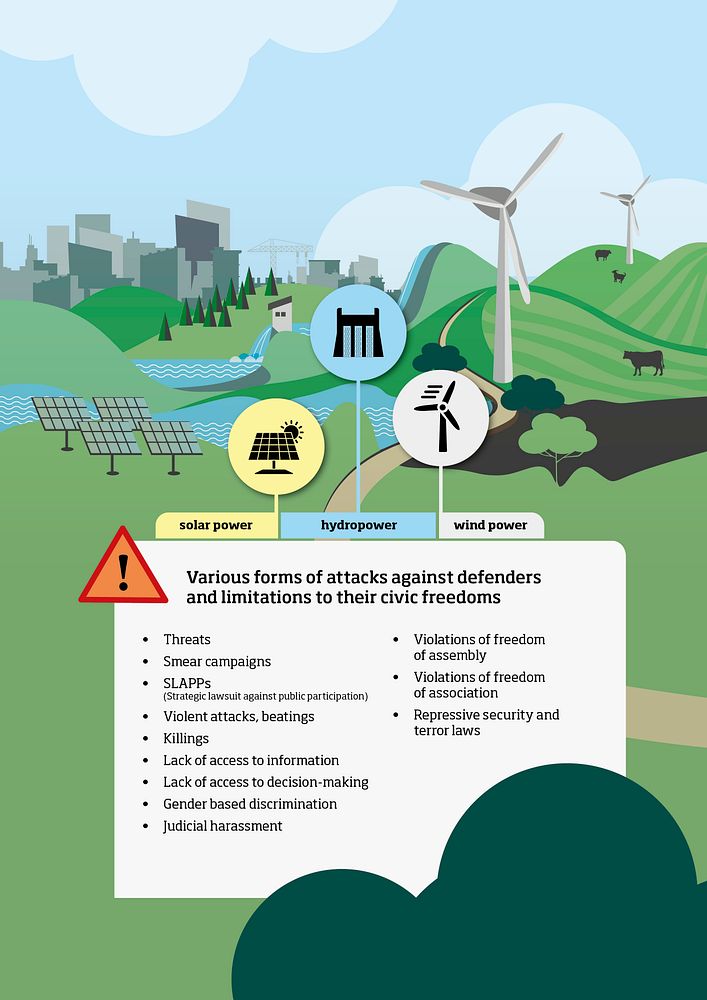
A new report by the research organization Swedwatch of 29 April 2025 highlights critical human rights risks associated with the global transition to renewable energy. The report reveals that human rights and environmental defenders face serious threats and reprisals in countries where renewable energy projects are being rapidly developed.
More than half of the world’s total prospective wind farm capacity, and more than two thirds of the prospective solar farm capacity, is estimated to take place in countries with obstructed, repressed or closed civic space.
While scaling up wind, solar, and hydropower is essential to limiting global warming to 1.5°C, this growth must not come at the expense of human rights.
–We cannot build a green future on the backs of those who are silenced or displaced. The renewable energy transition must not come at the cost of human rights. Defenders are not obstacles – they are essential allies in ensuring that this is just, equitable, and sustainable, says Alice Blondel, Director Swedwatch.
Renewable energy projects require large land areas, often affecting local communities, ecosystems, and livelihoods. Swedwatch’s analysis shows that the renewable energy transition will largely take place in countries with restricted civic space and poor human rights protections, where defenders who raise concerns often face harassment, legal persecution and at times even deadly violence.
The report Renewables and Reprisals – Defenders at risk in the green energy transition in Brazil, Honduras, Mozambique, and the Philippines is based on a global mapping of such high-risk areas for defenders, where civic space is restricted and where renewable energy expansion is projected to accelerate. Additionally, the report presents four case studies from Mozambique, Honduras, Brazil, and the Philippines, where defenders and affected community members describe restrictions and reprisals of defenders linked to renewable energy projects.
-The report underscores the urgent need for stronger protections for defenders, transparent consultation processes, and corporate accountability. Without immediate action, the rapid expansion of renewables risk repeating the same human rights abuses seen in industries such as mining and agribusiness, rather than fostering a truly just energy transition, says Alice Blondel.
Expansion of renewables in countries with high risks for defenders Swedwatch’s findings indicate that a large share of the expansion of renewable energy is taking place in countries where civic space is restricted, and defenders are at significant risk.
Case studies: Defenders under threat In the four case studies, defenders from Mozambique, Honduras, Brazil and the Philippines described restrictions of basic civic freedoms and risks of verbal, legal or violent physical attacks when reporting about impacts of renewable energy projects.
Mozambique: According to interviews in the report, the planning of the Mphanda Nkuwa hydropower project has been marred by inadequate social and environmental impact assessments, lack of transparency, and suppression of civic engagement. Defenders reported threats, violation of freedom of assembly, and an overall disregard for their right to participate in decision-making processes.
Honduras: Human rights defenders have faced legal intimidation through SLAPPs (Strategic Lawsuits Against Public Participation) for their criticism of the Los Prados solar power project, according to a group of women human rights lawyers. Community members involved in protests have allegedly been surveilled and subjected to repressive actions by security forces. Defenders also reported smear campaigns in the media, further restricting their ability to voice concerns.
Brazil: In Brazil, the wind power project Bons Ventos failed to properly include impacted communities, including marginalized groups, traditional fishing, and quilombola communities, in consultations, according to interviews. Defenders decided to remain anonymous in the interviews out of fear of reprisals, citing increasing threats and violence against defenders in the past years.
The Philippines: Indigenous defenders from the Tumandok communities were allegedly threatened, harassed, and killed when the national police and the armed forces raided their communities after community leaders criticized the Jalaur River Multipurpose project, according to a CSO operating in the area. Defenders reporting on the dam project outlined persecution, surveillance and red-tagging – terror-labelling by the government accusing defenders of being communist insurgents, creating an environment of fear and impunity.
Swedwatch´s recommendations As the world races to meet climate targets, a just transition must include the voices of those most affected by energy projects, and defenders are essential in ensuring that renewable energy projects respect human rights and the environment.
-Governments, businesses, and financial institutions must work together to ensure that human rights are protected, and that defenders can operate without fear of repression or violence. Engaging with defenders as valuable partners rather than as adversaries can help governments and businesses ensure renewable energy projects’ alignment with international human rights obligations, mitigate conflicts, and promote sustainable development, says Jessica Johansson.
Detailed recommendations to different actors can be found in the report, below the main ones are summarized:
Recommendations for governments:
Adopt legislation on mandatory human rights due diligence (HRDD) for companies, highlighting risks to defenders and meaningful consultation with defenders.
Adopt laws on company transparency laws and access to information.
Establish and enforce protections for defenders, ensuring they can operate without fear of retaliation, and provide effective legal remedies for those affected by violations.
Recommendations for companies and investors:
Strengthening their HRDD processes by integrating civic space risks and ensuring meaningful stakeholder engagement with defenders.
Adopt and enforce a zero-tolerance policy against reprisals targeting defenders (and affected communities).
Take appropriate action when business partners or third parties commit violations in relation to their business activities.
“Right Here, Right Now” a global dialogue on climate change and human rights are held at Oxford University and universities around the world 4-7 June 2025
The 2025 Summit aims to advance human rights-based solutions to the climate crisis, amplify environmental human rights defenders’ voices, reinforce the global climate justice movement, and inspire people, particularly students, as advocates and leaders for human rights-based climate action.
Other university partners include the University of the South Pacific, the University of Colorado Boulder, the University of Cape Town, UNSW Sydney, Monash University, the University of Nairobi, the African Climate and Development Initiative, and the University of São Paulo.
The cornerstone of the summit is a hybrid global event on World Environment Day, 5 June 2005. The Summit will bring together leading thinkers and practitioners at the intersection of climate change and human rights for a 24-hour global plenary, which will be broadcast live across time zones. Co-created and co-delivered by universities across the world, the plenary will follow the sun as we pass the baton between different regions.
The High Commissioner will open the Summit at the University of Oxford on 4 June 2025. Meanwhile, partner universities worldwide will host local activities on climate justice.