Posts Tagged ‘Congo’

Environmental Defenders threatened inspite of their positive but undervalued role in climate defence

April 27, 2026

On 23 April 2026 Anamaría Martinez and Elizabeth Moses for WRI explain how environmental defenders help prevent deforestation and protect ecosystems critical to climate stability. Yet many face severe and sometimes lethal threats while remaining underrecognized in climate policies that often depend on their work but fail to protect them.

Village on the Congo Basin rainforest in the Democratic Republic of the Congo

Image by VaLife/Shutterstock

Benitha Bompendju grew up in Tshuapa province in the Democratic Republic of the Congo, surrounded by the dense rainforests of the Congo Basin. The world’s second-largest tropical forest, it plays a critical role in regulating the global climate, conserving biodiversity and sustaining local communities like Benitha’s. Yet when she was growing up, industrial logging was constant.

Concessionaires licensed by the government to harvest timber promised to bring benefits like schools and health centers. But these projects often did not materialize, and local authorities rarely got involved. Instead, companies stripped trees from the land and left local communities — who have long stewarded and relied on the rainforest — with little in return.

“As children, we watched the concessionaires leave with the wood and our parents received nothing,” Benitha recalls. “That was injustice.” This experience shaped Benitha’s future work. In 2016, she began monitoring forest-use contracts and documenting violations, working with partner organizations and government agencies to hold violators accountable. Since then, these joint efforts have helped curb illegal logging, enforce environmental regulations and deliver promised investments to communities.

Yet this critical work can be dangerous — lethally so. Benitha and other environmental defenders like her are often caught in the crosshairs of commercial interests and corruption. Many face threats, intimidation, physical assault, kidnapping and deadly violence. Global Witness documented 146 defenders killed or missing in 2024. The total number killed or missing from 2012 to 2024 is over 2,200 — and because many cases go unreported, the true toll is likely higher.

Research consistently shows that forests managed by Indigenous Peoples and local communities have lower deforestation rates and greater carbon sequestration than those managed under other regimes, making their contribution a measurable climate outcome. But without necessary protections — from access to climate justice to the systems and law enforcement needed to prevent threats and tragic loss of life — environmental defenders can’t safeguard vital ecosystems. And such protections can’t materialize or become institutionalized if environmental defenders aren’t accurately recognized and reflected in climate and nature policies.

The UN defines environmental human rights defenders as “individuals and groups who, in their personal or professional capacity and in a peaceful manner, strive to protect and promote human rights relating to the environment, including water, air, land, flora and fauna.” This includes those who defend the collective right to a safe, clean, healthy and sustainable environment, as well as traditional lands and livelihoods, through actions ranging from community organizing and legal advocacy to protesting, public campaigning and journalism. Many come from Indigenous and tribal groups with deep ancestral ties to the land.

Our research focuses specifically on frontline environmental defenders — those who live in, and defend, resource-rich areas experiencing what the UN Environment Programme describes as “abuse of environmental rights which affects a growing number of people in many parts of the world.”

To understand how defenders are represented in the gray (unpublished) and peer-reviewed literature on climate change under the UNFCCC, we examined 170 peer-reviewed documents from 2015 to 2025, including journal articles, books and reports, to map how defenders’ actions and contributions are reflected. The literature we surveyed both reflects trends in policymaking and serves as a source decision-makers might draw on to develop global and national climate and nature policies. Download

We found that groups such as Indigenous Peoples, women, local communities and youth are increasingly acknowledged as “agents of change” with decision-making capacity, rather than portrayed as victims or passive recipients of project benefits.

However, only 5% of the literature explicitly identifies members of these groups as “defenders” working to protect ecosystems and resources. This represents a crucial gap. Climate literature (and wider climate governance frameworks) tends to recognize who these people are — such as Indigenous Peoples, women-led organizations and youth activists — but without recognizing what they do, such as monitor deforestation and challenge extractive industries, or the risks they face as a result.

How environmental defenders are represented in climate literature.

This difference may seem subtle, but is crucial. Recognizing someone’s identity alone doesn’t necessarily translate into protection or funding for the stewardship and advocacy these groups engage in. Not all identity groups (for example, Indigenous Peoples) are environmental defenders, and not all defenders belong to these groups, even if there is often an overlap. Recognizing defenders’ on the ground contributions, on the other hand, is important because it highlights their role in delivering concrete climate actions — and the need for institutional support and protection, not just their inclusion as stakeholders.

Protection can include early-warning and rapid-response systems that trigger protective action when defenders report threats or surveillance. It also means access to legal aid and judicial remedies, such as fast-track investigations, special counsel and public defenders trained in environmental and land-rights cases.

Meanwhile, governments are missing out on more effective and equitable climate solutions. Defenders bring unique perspectives, knowledge and lived experience — from agroforestry practices rooted in local traditions to stronger data collection and monitoring for more accurate NDC reporting — and help ensure policies are carried out more effectively. Yet threats to defenders weaken both national and global climate action by deterring those who risk their lives to safeguard ecosystems and enforce laws and policies.

Climate outcomes to which frontline defenders contribute, by category

What Would It Take to Support Environmental Defenders?

Frameworks like the Paris Agreement and the Local Communities and Indigenous Peoples Platform (LCIPP) under the UNFCCC already aim to integrate rights-based climate action into national and global goals. But they lack clear definitions and guidance on how defenders should be recognized and supported. To truly support environmental defenders, they must be incorporated into climate policy, reporting and finance.

Here are three ways this can happen: 

1) Defining ‘Defenders’

The first step is defining what defenders are — not by identities, but by the concrete actions they take for climate protection and community resilience. Many don’t self-identify as “defenders.” They are individuals and communities that contribute to climate action and environmental protection. This would capture these de facto roles.

Adopting a practice-based definition in national and multilateral policymaking, alongside indicators that track defenders’ contributions to climate action, would allow policymakers to systematically recognize the people protecting ecosystems on the ground. Indicators could include community monitoring results, forest protection metrics or the number of co-designed adaptation plans.

This formalization would have three practical implications: First, recognizing defenders as a group would allow implementation of protection measures by identifying and addressing the risks they take. Second, it could enable governments to allocate budget to support defender-led initiatives. Third, it could strengthen their participation in decision-making at national and international levels by giving them space to share their knowledge on climate action and local ecosystems.

2) Protecting Defenders

Without safety guarantees, defenders cannot participate or contribute effectively. Protection requires two key elements: physical safety and legal resources.

Physical safety includes strengthening safeguards to reduce social and environmental risks and exploitation, for example, when concessionaires undertake projects in resource-rich areas. One way this can be supported is by creating early warning systems that allow defenders to report threats to the authorities and receive support, ensuring formal grievance mechanisms exist to ensure defender safety (with international backing, if needed). Another is by integrating defender protection requirements into climate funding, including zero-tolerance policies for violent reprisals.

Legal protection includes access to resources and courts. However, many defenders lack access due to prohibitive costs, limited connections and a poor understanding of the system. Where corruption is entrenched and governance weak, domestic legal systems can be used against defenders, leading to their criminalization as a way to silence them and stop their work. International accountability mechanisms — including UN human rights bodies, transnational legal networks and climate finance conditions tied to defender safety — can create external pressure where national systems fail. But they can only function if defenders are formally recognized. Without this, accountability is nearly impossible to demand.

Some progress has been made in different parts of the world. The Aarhus Convention, adopted in 1998, requires parties to “ensure that individuals exercising their rights to environmental information, participation and justice are not penalized, persecuted or harassed.” And Article 9 of the Escazú Agreement, adopted in 2018, calls for “a safe and enabling environment for persons, groups and organizations that promote and defend human rights in environmental matters.” 

At the national level, climate justice laws and policies in Colombia, Mexico, Indonesia and the Philippines enshrine protection mechanisms that cover defenders and their work, while aiming to provide access to legal support. 

A guide walks through an old-growth forest in the Democratic Republic of the Congo
Environmental defenders can include anyone that protects human rights related to the environment, including rights to a safe, clean and sustainable environment. They often face threats to their well-being and lack access to legal systems that could help support them. Photo by Eric Isselee/Shutterstock

However, significant implementation gaps remain.

Colombia’s law has stalled due to limited accessibility, the absence of a clear definition of who constitutes a human rights defender and a reshuffling of funds during the COVID-19 pandemic. In Mexico, a backlog caused in part by insufficient staffing prevents cases from being addressed in a timely manner, and protection measures are not always adequately implemented.

Indonesia recognizes defenders explicitly, but in practice, continued criminalization and intimidation prevent them from accessing the legal protection the mechanism provides. In the Philippines, financial and cultural barriers to filing cases, limited legal knowledge among defenders and slow processing times hinder the widespread implementation of legal framework protecting them.

Yet when defenders can access justice, legal action can drive accountability and tangible outcomes. In 2018, 25 Colombian youth aged seven to 26 years old filed a lawsuit against the government, alleging that climate change and failure to reduce deforestation threatened their fundamental rights. While a lower court initially ruled against them, Colombia’s Supreme Court overturned the decision and ordered the government to devise and implement action plans to address deforestation in the Amazon.

Defenders need legal support and safe, inclusive access to the processes behind these laws and regulations. Rights-based climate cases and stronger rule of law systems provide essential recourse when other accountability channels fail.

3) Integrating Defenders into Climate Plans

Protecting Defenders Is Essential for Climate Action

Protecting environmental defenders is a question of safeguarding human rights and life, ensuring climate justice and strengthening climate action.

People like Benitha, who put their lives on the line to defend the forests and other ecosystems that sustain them and the world, should not face these high-stake risks alone. Governments, multilateral institutions and finance bodies share the responsibility of formally recognizing and protecting environmental defenders within climate, nature and other policies.

Doing so is a matter of equity — and a climate imperative. When defenders are safe and supported, forests stay standing, emissions stay out of the atmosphere and frontline communities can continue building resilience for their own futures and the world’s. 
https://www.wri.org/insights/defenders-in-climate-policy

Lawlor: more than 400 human rights defenders, journalists in DRC targeted within a year

June 22, 2024

On 19 June 2024, Mary Lawlor, Special Rapporteur on the situation of human rights defenders expressed alarm at increasing targeting of human rights defenders in the Democratic Republic of Congo (DRC), particularly in villages and provinces in the east of the country, as the armed conflict intensifies.

Attacks, intimidation and killings of human rights defenders continue on a daily basis in the Democratic Republic of Congo, despite repeated calls for authorities to step up efforts to investigate human rights violations in the country and arrest and bring perpetrators to justice,” she said

From June 2023 to April 2024, the United Nations Joint Human Rights Office in the DRC documented incidents of intimidation, threats of physical violence, attacks and acts of reprisals targeting 387 human rights defenders and 67 journalists, perpetrated by both State agents and armed groups.

Lawlor noted that two women human rights defenders, members of the Youth Movement for Change (LUCHA), had been facing violence and death threats from Twigwaneho armed group since November 2023.

“When LUCHA organised public protests against recent attacks on their village in the South Kivu province, the rebel group sent armed forces to arrest them, forcing them to flee and go into hiding. To this day, they continue to receive death threats and live in hiding,” the expert said. One of the women’s mothers was abducted by the same rebel group in February 2024 and reportedly executed for not revealing her daughter’s whereabouts.

Obedi Karafuru, a human rights defender and head of the workers’ committee, was shot dead by unidentified men in his home village in rebel-held Rutshuru territory in North Kivu province. The Special Rapporteur noted that he had been working to secure fair compensation for former workers on a logging project and had been complaining to authorities for the past four years about death threats against him and his colleagues. “No investigation has been opened into the murder,” Lawlor said.

A human rights defender received death threats in February 2022 when he questioned the effectiveness of the Government’s state of emergency in North Kivu, stating that authorities had failed to guarantee the safety of the population. “The death threats forced him into hiding, as State authorities never responded to his call for protection,” the expert said. Four women human rights defenders from the women-led organisation Tous pour la Paix et la Cohésion Sociale, have been victims of kidnapping and violence following activities they organised around women’s rights.

The expert noted that the DRC adopted a law on the protection of human rights defenders in 2023, which meets the minimum international standards, and ensures special protection for women human rights defenders as well as physical protection of human rights defenders and their families.

“Many executions of human rights defenders are preceded by death threats,” Lawlor said, referring to the report she presented to the Human Rights Council in 2021. “Unless the physical integrity of human rights defenders is guaranteed, they will not be able to fully contribute to the construction of a just society that respects human rights,” she said.

“I call on authorities in the DRC to take all necessary measures to ensure a safe working space and protection for human rights defenders, as well as to guarantee the exercise of their rights to freedom of peaceful assembly and association and to effectively and reliably investigate all cases of executions in accordance with international standards, including the Minnesota Protocol, and bring those responsible to justice,” Lawlor said.

This statement is endorsed by Gina Romero, Special Rapporteur on the rights to freedom of peaceful assembly and of association; Morris Tidball-Binz, Special Rapporteur on extrajudicial, summary or arbitrary executions.

Distributed by APO Group on behalf of Office of the UN High Commissioner for Human Rights (OHCHR).

see also: https://humanrightsdefenders.blog/2022/05/13/floribert-chebeya-dr-congo-policeman-sentenced-to-death-for-murder/

https://www.news24.com/news24/africa/news/war-on-activists-more-than-400-human-rights-defenders-journalists-in-drc-targeted-within-a-year-20240620

Breaking News: see which other awards the 2018 Nobel Peace Prize Laureates won already

October 5, 2018
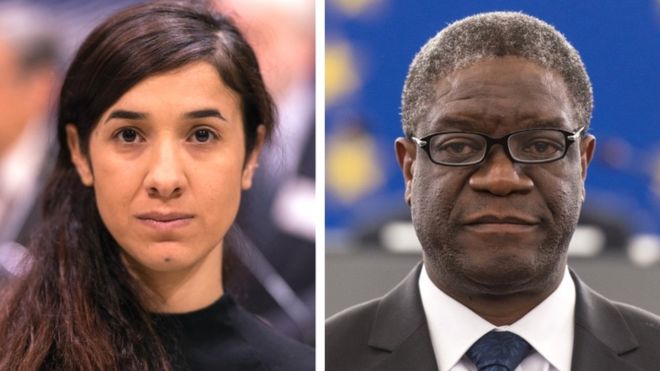
The Nobel Prize for Peace 2018 winners: Yazidi survivor Nadia Mural (L) and Denis Mukwege
Nobel Peace Prize for anti-rape activists Nadia Murad and Denis Mukwege – Image copyright EPA

You do not have it hear it through me as most mainstream media carry the news (here the BBC with elaborate information) that the 2018 Nobel Peace Prize has gone to campaigners against rape in warfare, Nadia Murad and Denis Mukwege. After the controversy created around some of the recent laureates, these two are safe bets as both have been recognized widely:

Ms Murad is an Iraqi Yazidi who was tortured and raped by Islamic State militants and later became the face of a campaign to free the Yazidi people. She found recognition from at least two earlier awards:

Dr Mukwege is a Congolese gynaecologist who, along with his colleagues, has treated tens of thousands of victims. He received wide recognition with 8 international human rights awards:

  • 2008   United Nations Prizes in the Field of Human Rights
  • 2009   Olof Palme Prize
  • 2010   Wallenberg Medal (University of Michigan)
  • 2011   King Baudouin International Development Prize
  • 2013   Civil Courage Prize
  • 2013   Human Rights First Award
  • 2013   Right Livelihood Award
  • 2014   Sakharov Prize for Freedom of Thought

See also: https://humanrightsdefenders.blog/2016/04/12/profile-denis-mukwege-democratic-republic-of-congo-courageous-doctor-rape-women/

Ms Murad, 25, dedicated the award to her mother, who was killed by the Islamic State (IS) militants who overran their home in 2014. Ms Murad described her escape in a BBC interview in 2016, detailing how the women who were held captive were treated by IS.

Dr Mukwege was operating at his hospital when he heard he had won the prize. He dedicated his award to all women affected by sexual violence. He lives under the permanent protection of UN peacekeepers at his hospital and has also previously called for a tougher line on rape as a weapon of war.

https://www.bbc.com/news/world-europe-45759221


see also: https://dansmithsblog.com/2018/10/08/the-nobel-peace-prize-and-sexual-violence-in-war/

Indictment in Senegal a breakthrough in the Congolese Chebeya-Bazana case?

January 13, 2015
Paul Mwilambwe, a major suspect in the Congolese Chebeya-Bazana case was indicted by a Senegalese court and placed under judicial supervision in Dakar on 8 January 2015. This decision was taken following a criminal complaint based on universal jurisdiction filed on 2 June 2014 by lawyers of the FIDH Litigation Action Group (LAG) and the families of Floribert Chebeya and Fidèle Bazana, the two Congolese human rights defenders who were assassinated in June 2010. FIDH hopes that these efforts of the Senegalese judicial authorities contribute to identifying the persons responsible for these assassinations and the disappearance of these two human rights defenders.logo FIDH_seul

That Paul Mwilanbwe has been indicted and heard by an independent investigative judge is a fundamental step on the road to truth and, we hope, to the justice which has not been available to the victims’ families in DRC” , said Patrick Baudouin, FIDH Honorary President. “This is the first time since the Hissène Habré case that a case based on extra-territorial jurisdiction is being tried in Senegal, a step which sends a strong, positive signal showing that the Senegalese judiciary intends to play an active role in the fight against impunity for the most serious crimes committed in Africa”.

Since the Democratic Republic of Congo did not provide for equitable judicial proceedings, we initiated the proceedings in Senegal to ensure that an impartial and independent investigation would be carried out and that full information would be obtained on the murder and the enforced disappearance of the victims, Floribert Chebeya and Fidèle Bazana. We wanted an independent judge to hear Paul Mwilambe, an actor in this tragedy, and this has happened today,” said Assane Dioma Ndiaye, a lawyer for the FIDH LAG and for the Chebeya and Bazana families.

Paul Mwilambwe, a major in the Congolese National Police force (PNC), was in charge of security for the office of General John Numbi, Head of the PNC at the time of the events, in the premises where Floribert Chebeya and Fidèle Bazana were killed. Shortly after these killings, Paul Mwilambwe fled to a country somewhere in Africa before going to Senegal. In a filmed interview with France 24 (in French), whilst still on the run, Mwilambwe testified and denounced his own participation and the role and involvement of senior members of the Congolese police, including General John Numbi in the enforced disappearance and murder of the two human rights defenders.

“For us, this indictment gives us great hope to obtain the truth and justice that was refused to us in Congo where the justice system is bogged down. I want to know where my husband was buried. I want someone to tell me where he is. And I want to be able to bury him with dignity” , said Marie-José Bazana, the wife of Fidèle Bazana whose body has still not been found.

https://thoolen.wordpress.com/2013/06/10/death-of-floribert-chebeya-and-fidele-bazana-in-drc-still-unresolved-after-3-years/

[Background: On 2 June 2010, Floribert Chebeya, Executive Director of the NGO Voix des sans Voix (Voice of the Voiceless – VSV), was found dead in his car in a suburb of Kinshasa. His close associate Fidele Bazana was reported missing. The day before, the two human rights defenders had shown up at PNC headquarters to meet with its Director, the Inspector-General, and General John Numbi. They did not emerge from this meeting alive. Faced with the public outcry triggered by the murder of Mr. Chebeya and disappearance of Mr. Bazana, the Congolese authorities were obliged to open an investigation. This investigation culminated in the precautionary suspension of General John Numbi and the imposition of murder indictments for eight police officers, including Paul Mwilambwe, who fled.

On 23 June 2011, following a trial marked by numerous incidents the military court on 23 June 2011 in Kinshasa acknowledged the civil responsibility of the Congolese state for the murder of Mr. Chebeya, as well as in the abduction and illegal detention of Mr. Bazana by several of its officers. The court convicted five of the eight police officers accused. Four were sentenced to death and one to life imprisonment. Three of those condemned to death are still on the run, and three of the police officers found to have played a role in the disappearance of Mr. Bazana, have since been acquitted. On 7 May 2013, the Military High Court, sitting as a court of appeal, declared itself incompetent to investigate the procedural issues in the case and decided to turn the proceedings over to the Supreme Court, operating as a constitutional court. In practice, this decision suspended the appeal proceedings, which remain deadlocked in DRC to date. In addition, Congolese authorities have never instituted proceedings to investigate the role played by General John Numbi, who has since been replaced as Head of the PNC, despite evidence and the complaints filed by the families of the two human rights defenders.]

The Chebeya-Bazana case: indictment of Paul Mwilambwe in (…).

DRC: Human Rights Defender shot and NGO office closed

May 30, 2014

The Democratic Republic of Congo remains a terrible place for human rights defenders. These two recent events reported by Front Line make it abundantly clear:

1. Attempted murder of human rights defender Mr Leonard Lusimba 

On 22 May 2014, human rights defender Mr Leonard Lusimba was shot in an attempted killing by a member of the Forces Armées de la République Démocratique du Congo – FARDC (Armed Forces of the Democratic Republic of Congo). He underwent surgery on 25 May, and a second operation will be necessary in the coming days. Leonard Lusimba is the regional representative of Collectif d’Actions pour la Défense des Droits de l’Homme – CADDHOM, an organisation which, since the 1990s, has worked to promote human rights and peace education in different regions of the DRC, in particular in the Eastern provinces of the country where a number of armed groups are still active.

[Over recent years, numerous Congolese human rights defenders have been killed as a result of targeted attacks. In the rare cases where serious investigations have been undertaken, they have often failed to lead to results, favouring impunity.]

2. Closure of the office of human rights organisation Solidarity for Social Advancement and Peace 

On 21 May 2014, the Congolese human rights organisation Solidarité pour la Promotion Sociale et la Paix – SOPROP (Solidarity for Social Development and Peace) was closed by the Direction Générale des Impôts – DGI in relation to an investigation into allegations of tax fraud. The DGI declared that it needed time to reach a compromise with SOPROP, and proposed a settlement to SOPROP of 20% of the amount it allegedly owed in unpaid taxes. SOPROP rejected the proposal on the grounds that there was no basis for the amount originally demanded. The same day, SOPROP brought a complaint to the local Prosecutor’s Office, which identified irregularities in the procedure and ordered that the medical centre be reopened. The office, however, remains sealed, and it is unknown when it will be reopened

[SOPROP is an organisation which, since its foundation in 1994, has supported victims of torture and other violence through medical, social and legal assistance. The organisation is also known for its activities in human rights education, particularly in schools, as well as for its investigations into human rights violations and corruption. In 2011, SOPROP had published a report on the corrupt practices of state companies in Kinshasa, which highlighted agencies of the DGI, amongst others.]

For previous posts on DRC: https://thoolen.wordpress.com/tag/congo-drc/

Congo Rebels Execute Human-Rights Worker in Katanga

August 14, 2013

Business Week reports on 14 August that rebels in the Democratic Republic of Congo’s Katanga province murdered a human-rights investigator who criticized their movement for committing abuses against civilians. Armed men from the secessionist Kata Katanga group [whose name means “cut out Katanga” in the Swahili language] forced their way into the victim’s house on 7 August  before killing him,  according to Scott Campbell, the director of the UN’s joint human-rights office in Congo. The UN mission, known as Monusco, wouldn’t release the victim’s name or organization for security reasons, Campbell said. “Monusco is gravely concerned by the arbitrary execution” of the activist, it said in a separate e-mailed statement that also called on Congolese authorities to protect human-rights defenders and their families.  Almost 370,000 people have been displaced in the province as of July, mainly because of the violence, according to the UN’s Office for the Coordination of Humanitarian Affairs.

via Congo Rebels Execute Human-Rights Worker in Katanga Province – Businessweek.


Death of Floribert Chebeya and Fidèle Bazana in DRC still unresolved after 3 years

June 10, 2013

It has been 3 years since Floribert Chebeya and Fidèle Bazana were killed at the hands of the Police of the Democratic Republic of Congo, after been summoned by the Head of the Police, General John Protection Int'I_logo_final_vertical_72dpiNumbi. To date, the Congolese Military Justice, who deals with this matter, has refused to prosecute General Numbi and has merely judged his accomplices even though it knows the truth, thereby showing total allegiance to the political and military regime. Specific and detailed revelations of one of the protagonists on this case, Commander Paul Mwilambwe, leaves no doubt about on the subject. Read the rest of this entry »

Short video with summary portraits of the winners of the Tulip award

January 11, 2013

A short documentary about the five winners of the Human Rights Tulip Award, the award of the Dutch government for human rights defenders. The winners are from Honduras, Congo, Iran, China and India. The films were done by the True Heroes Foundation (THF).


preview of the documentary The Negotiators

January 10, 2011

Ross Mountain was, for five years, the Deputy Special Representative for the Secretary-General in the UN Mission in the DR Congo. He strove to end the cycle of violence that has gripped the country for over a decade. A Human Rights Defender at high UN level. You can see him at work in the preview of the film The Negotiators on http://vimeo.com/18283149