Archive for the 'Human Rights Defenders' Category

New ISHR online course for environmental human rights defenders

June 3, 2026

ISHR introduces a new on-line course on advocacy for environmental human rights defenders, a practical, self-paced resource for activists, community leaders, and allies to defend the right to a clean, healthy and sustainable environment using UN and regional mechanisms.

On World Environment Day, and in parallel to the 1st European Forum on Environmental Human Rights Defenders, ISHR is introducing its new online course entitled ‘Advocacy for environmental human rights defenders: a pathway’. A conceptual, legal, and strategic resource to help environmental human rights defenders and their allies translate local environmental struggles into coordinated international and regional advocacy. [https://humanrightsdefenders.blog/2026/05/12/first-european-forum-on-environmental-human-rights-defenders-3-4-june-2026/]

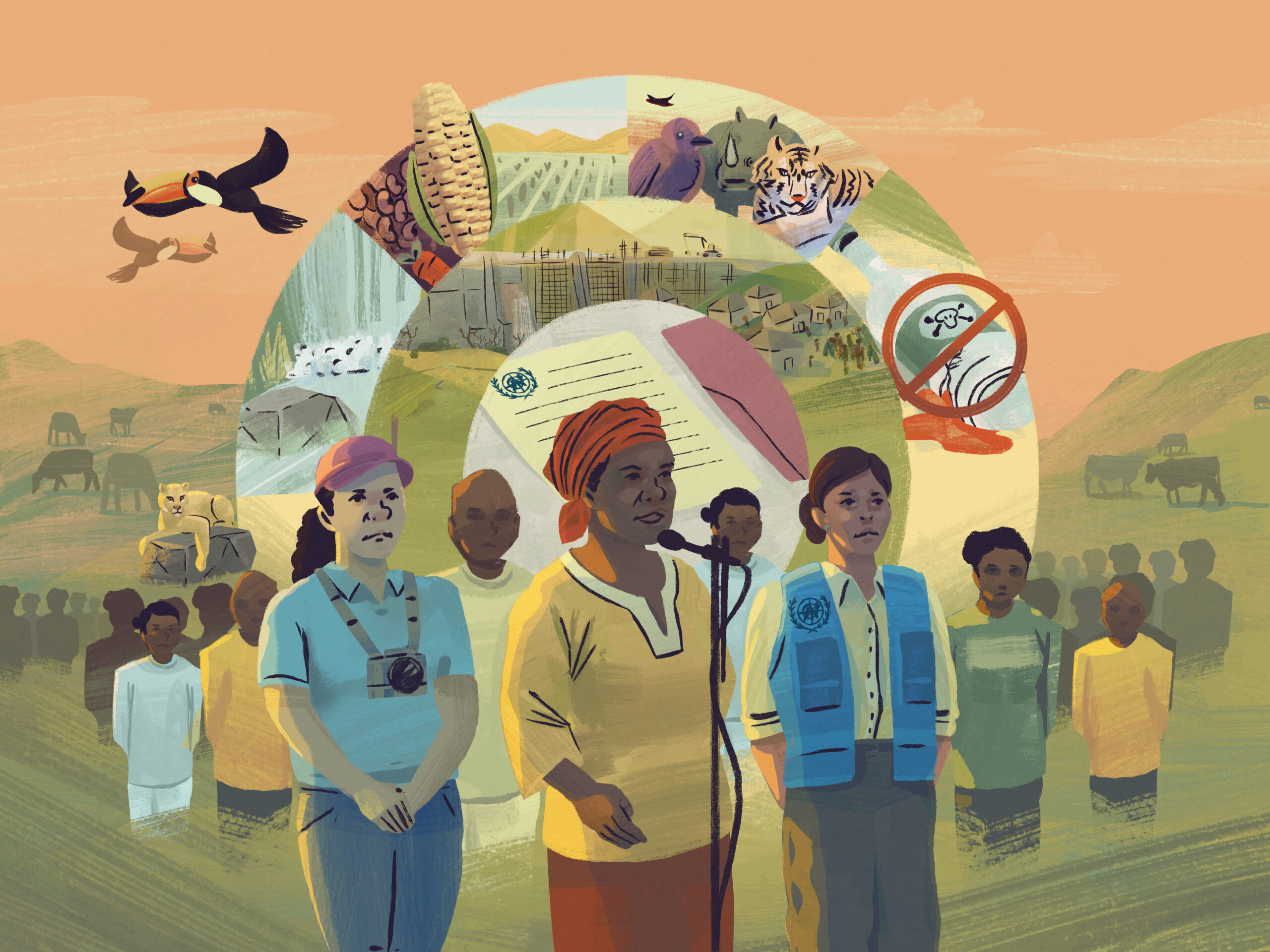
Environmental human rights defenders are those who protect our planet and defend the right to a clean, healthy and sustainable environment. They are Indigenous Peoples, farmers, scientists, journalists and young activists from all over the world.

Despite their vital role, more than 2,253 of them were killed, harassed, or persecuted between 2012 and 2024 according to Global Witness. More recently, the Business and Human Rights Centre found that the most dangerous sectors in which to pursue activism to defend rights are mining, agribusiness and fossil fuels.

Behind those numbers are stories of resistance and solidarity.

Why a new course for environmental human rights defenders?

The past few years saw an increased number of positive developments for the protection of the environment and environmental human rights defenders.

This includes the recognition of the right to a clean, healthy and sustainable environment, the Human Rights Council’s Resolution 40/11 recognising the role of environmental defenders, the Escazú Agreement enshrining the latter’s rights in Latin America and the Caribbean, and the creation of the Special Rapporteur on Environmental Defenders under the Aarhus Convention. All these developments also require defenders to understand how and when to use these mechanisms. 

I became an environmental human rights defender by coincidence. I need practical tools like this to help me navigate spaces for my advocacy. The ISHR Academy is really a useful one! Christopher Opio, Uganda 

The pathway is divided into three independent chapters

Module content on the ISHR Academy

Chapter 1 examines the legal and conceptual foundations of the right to a clean, healthy and sustainable environment, the role of environmental human rights defenders in addressing the triple planetary crisis, including accountability of States and non-State actors.

Chapter 2 provides strategic and practical guidance to advance environmental justice through UN human rights mechanisms like the Human Rights Council, the Special Procedures, the Treaty Bodies or the Expert Mechanism on the Rights of Indigenous Peoples, and translate local defence into international advocacy.

Chapter 3 dives into regional mechanisms and other tools, in particular, for the protection of environmental human rights defenders. This includes rapid response mechanisms in Europe and Latin America, and other options designed for African and Asia-Pacific defenders through regional institutions and tools. 

Free, self-paced, modular and flexible, each chapter can be taken independently, enriched with case studies, videos, and additional resources. You set the pace according to your needs.

How do I know if this is for me? 

You know that bringing international attention could create pressure for change, but you don’t know where to start? You have an idea of who the Special Rapporteur on climate change is, the International Covenant of Economic, Social and Cultural Rights does, but don’t know the steps to engage with them?

The pathway walks you through exactly this.

Whether you are a community leader facing displacement, an environmental lawyer seeking international leverage, a representative of a grassroots organisation whose government has stopped listening, a young advocate learning to navigate international spaces, or an NGO supporting defenders on the frontline — this pathway was built for you.

Environmental human rights defenders are often the first to raise the alarm. I often meet people who face pressure or harassment for defending environmental rights and without knowing that international tools can support them. In this module, I will explain what my mandate can do and how defenders can engage with it.

Astrid Puentes Riaño, UN Special Rapporteur on the right to a healthy environment

By the end of this pathway, you will be able to:

  • Understand who environmental human rights defenders are, the contexts they operate in, and the legal frameworks for their protection
  • Identify international and regional advocacy avenues, within the UN and beyond, to advance the right to a clean, healthy environment
  • Plan strategic engagement with mechanisms based on your context, and hold governments and non-State actors accountable.

Start learning now at the ISHR Academy!

ISHR warmly thanks all the human rights defenders, experts, Special Rapporteurs and UN staff who supported us in building this course.

https://ishr.ch/latest-updates/new-online-course-for-environmental-human-rights-defenders-on-the-ishr-academy

Arbitrarily detained lawyer Cedomir Stojkovic in Serbia must be released says ICJ

May 30, 2026
thumbs_b_c_204653ef9478122a144c404305d9fb48 (1)

On 15 April 2026 The ICJ condemned the continued deprivation of liberty of Serbian lawyer Cedomir Stojkovic and the criminal proceedings against him on charges of incitement to violent overthrow of the constitutional order and disclosure of official secrets, which appear to constitute reprisals for the exercise of his right to freedom of expression. On 4 April 2026, Serbia’s Bar Association (Advokatska komora Srbije) expressed concern that the political nature of the charges against him and the three-year period covered by the indictment “give rise to the suspicion that his detention, along with other measures imposed against attorney Stojkovic, are being used as a means of coercion, rather than as a means of ensuring the unobstructed conduct of criminal proceedings.” The Bar Association demanded that Stojkovic be released pending trial.

The prosecution of a lawyer for social media posts expressing criticism of the authorities is incompatible with Serbia’s obligations under international human rights law and standards,” said Temur Shakirov, ICJ Europe and Central Asia Programme Director. “The Serbian authorities must release Stojkovic and ensure that lawyers can exercise their right to freedom of expression without fear of reprisal.”

The political nature of the charges, the breadth of the indictment covering social media posts over a three-year period, and the severity of the restrictive measures imposed on him, including pre-trial detention, house arrest and a prohibition on posting on social media and on participating in public life, give rise to serious concern that he is being prosecuted to punish him for his public criticism of the Serbian authorities.

Stojkovic was arrested on 29 December 2025 and held in pre-trial detention for 30 days before being transferred to house arrest on 27 March 2026. He remains subject to restrictive measures, including a prohibition on posting on social media and on participating in public life. The charges relate to 17 social media posts published over approximately three years, which the Higher Public Prosecutor’s Office in Belgrade has characterized as incitement to violent overthrow of the constitutional order and disclosure of official secrets.

On 24 March 2026, the UN Special Rapporteur on the independence of judges and lawyers addressed a communication to the Serbian Government expressing concern that several provisions of a series of amendments and newly adopted laws relating to the judiciary and the prosecution authorities “may not be in line with international human rights standards related to the independence of the judiciary and the right to a fair trial, including: the impartiality of the prosecution service, the separation of powers, and the ability of judges and prosecutors to perform their functions free from undue influence, pressure or interference.”

https://www.icj.org/serbia-arbitrarily-detained-lawyer-cedomir-stojkovic-must-be-released

Journalist Halim Naim found safety through Canada’s Human Rights Defenders program and continues the fight for the truth

May 29, 2026

On 3 May 2026, UNHCR published “I am addicted to the truth”: A Venezuelan journalist finds safety and purpose in Canada“, written by Zeba Tasci in Ottawa.

© Halim Naim

For more than 15 years, Venezuelan journalist Halim Naim built his career on one principle: telling the truth.  “I am addicted to the truth,” he says. However, that commitment came at a cost. Reporting in a country where freedom of expression was steadily eroding, Halim faced threats, censorship, and detention. As his visibility grew, so did the risks.  Despite the danger, he continued his work—leading political coverage, interviewing senior public and political figures, reporting national events, and defending the public’s right to be informed. But the pressure intensified. After speaking about contested elections and giving a platform to opposition voices, threats extended beyond him to his family. 

“I separated from my family to protect them,” he recalls.  Soon after, Halim fled Venezuela. He sought refuge in Colombia, where he continued advocating for human rights and supporting fellow Venezuelan refugees. But life remained uncertain. Without secure legal status and amid ongoing safety concerns, he struggled to rebuild. “I felt like I was working in hiding.”  

In 2025, after years living in exile, he was identified by UNHCR as a journalist at risk and was referred to Canada’s Human Rights Defenders resettlement program.  The program is designed to protect individuals who face threats because of their work defending human rights—journalists, activists, and community leaders whose voices are often targeted. For many, it offers a rare and urgent lifeline: a safe pathway out of danger and a chance to continue their human rights work in freedom. 

For Halim, the process moved quickly. Within months, he and his family arrived in Canada.  “Canada saved me,” he says simply.   Beyond safety, the program also provided recognition. “I never felt like a number. I felt like a professional who could contribute.” 

By offering a pathway to safety and a supportive resettlement process, the program allows human rights defenders not only to escape persecution, but to rebuild their lives with dignity and purpose. It also enables them to continue contributing their expertise, whether through journalism or advocacy, in their new communities. 

Canada’s Human Rights Defenders program offers safety to people defending human rights and face serious risk because of their work. These individuals may be journalists, lawyers, activists, environmental defenders, people working in women’s rights, LGBTQI+ activists, and community leaders. In 2025, UNHCR identified over 100 cases to be recommended for the program. 

Halim hopes to use his experience to contribute both to Canada, and one day, Venezuela. His goal remains the same: telling the truth to defend human rights.  For Halim, the program that brought him to safety represents something larger than his own story: a commitment to protecting those who speak out against injustice, and ensuring voices are not lost. 

“Exile did not silence us. Exile ignited voices, made them stronger, made them more solid, more secure.” 

https://www.unhcr.ca/news/i-am-addicted-to-the-truth-a-venezuelan-journalist-finds-safety-and-purpose-in-canada

ProtectDefenders.eu Annual Report 2024–2025: 10 Years of Protection

May 28, 2026
EU Flag

On 28 May 2026, an important milestone was reached: ten years since the creation of ProtectDefenders.eu. Over the past decade, the EU Human Rights Defenders Mechanism has supported more than 97,000 defenders worldwide and become one of the most comprehensive international protection initiatives for human rights defenders at risk.

The anniversary comes at a challenging moment. Across all regions, defenders face escalating repression, shrinking civic space, conflict, transnational repression, digital surveillance and increasing restrictions on fundamental freedoms. At the same time, funding ecosystems supporting civil society and human rights work are under unprecedented pressure, while protection needs continue to grow.

Together, they send a strong and timely political signal: human rights defenders are essential to democratic and resilient societies; protecting them is a shared responsibility; and continued political and financial support for the EU Human Rights Defenders mechanism remains critical at a time when demand for protection far exceeds available resources. Their contributions also reaffirm the importance of ensuring the continuity and future strengthening of the Mechanism as part of the EU’s broader commitment to human rights worldwide.

Despite an increasingly difficult environment, ProtectDefenders.eu directly supported more than 10,460 human rights defenders in over 110 countries during the reporting period through emergency assistance, temporary relocation, advocacy, legal and psychosocial support, digital protection and organisational resilience initiatives. Yet the report also highlights a stark reality: current resources allow the Mechanism to respond to only a fraction of the legitimate requests for support received.

As the report makes clear, this is not the time to scale back protection efforts. It is a moment to reinforce collective commitment, strengthen protection systems and invest in the resilience of those who defend rights and freedoms around the world.

Click to see full PDF document

https://www.eeas.europa.eu/delegations/albania/protectdefenderseu-annual-report-2024%E2%80%932025-10-years-protection-impact-and-solidarity_en

ISHR submits 66 cases of reprisals across 24 States to UN

May 28, 2026

In response to the annual call for inputs from the UN Secretary-General, ISHR, on 28 May 2026, has submitted 66 cases of intimidation and reprisals against human rights defenders engaging with the UN from 24 countries.

ISHR’s submission shows that reprisals against people engaging with the United Nations remain widespread and increasingly sophisticated. Human rights defenders continue to face travel bans, arbitrary detention, surveillance, online harassment, attacks on family members, and misuse of national security laws aimed at silencing cooperation with UN human rights mechanisms.

Key trends highlighted in the report include the growing recognition of transnational repression as a form of retaliation, increasing self-censorship among defenders, and the expanding use of digital surveillance and legal restrictions to intimidate civil society. At the same time, the report notes stronger international attention to reprisals within the Human Rights Council, General Assembly, and Treaty Bodies, alongside continued gaps in accountability and protection for those targeted.

ISHR also submitted information and followed-up on numerous cases, including in Algeria,  Bahrain, Belarus, Burundi, Cameroon, China, Djibouti, Egypt, France, Guatemala, India, Israel & United Sates of America, Morocco, Nicaragua, Peru, Russia, Rwanda, Saudi Arabia, Sudan, Thailand, Venezuela, Vietnam and Yemen. 

Downloads pdf English

More than 110 Nobel laureates call on Iran to release Narges Mohammadi

May 26, 2026
guardian.org

On Tuesday 12 May 2026 the Guardian reported that more than 110 Nobel laureates have called for the immediate and unconditional release of Narges Mohammadi, the imprisoned Iranian human rights activist and Nobel peace prize laureate, after she was transferred to hospital amid concerns over her rapidly deteriorating health

In a statement 112 Nobel laureates urged the Iranian authorities and the international community to act “without delay” to secure Mohammadi’s release and ensure her continued access to medical treatment.

Mohammadi, who was awarded the 2023 Nobel peace prize for decades of campaigning for women’s rights in Iran was transferred by ambulance in a critical medical condition to Tehran’s Pars hospital on 10 May for specialised treatment. [https://humanrightsdefenders.blog/2023/10/06/jailed-iranian-human-rights-defender-narges-mohammadi-wins-nobel-peace-prize-2023/]

The human rights activist has experienced severe weight loss, unstable blood pressure and serious cardiac symptoms while in detention, and was found unconscious in her cell after a possible heart attack. Mohammadi’s transfer to hospital is only a temporary respite and her representatives fear she will be returned to prison if her condition improves.

The signatories included 26 Nobel laureates in chemistry, 12 in economics, five in literature, 29 in medicine, 11 peace laureates and 29 in physics, and include the authors Annie Ernaux and JM Coetzee.

Mohammadi has been repeatedly detained by Iranian authorities for her activism since first being arrested in 1998, including her campaigns against the death penalty and Iran’s mandatory hijab laws. She has been sentenced to more than 44 years in prison and 154 lashes over multiple sentences. [https://humanrightsdefenders.blog/2026/01/16/many-ngos-raise-alarm-over-situation-of-detained-human-rights-defenders-in-iran-and-urge-un-human-rights-council-to-convene-a-special-session/]

Iranian human rights activist and 2023 Nobel Peace Prize laureate Narges Mohammadi has returned to her home after being discharged from hospital, her foundation said.

Mohammadi, 54, was released from Pars Hospital in Tehran on Sunday 17 May 2026 the Narges Foundation said on Monday. She was transferred from prison to a hospital in early May after she had two episodes of loss of consciousness and a severe cardiac crisis. [https://www.aljazeera.com/news/2026/5/18/iranian-nobel-laureate-narges-mohammadi-returns-home-after-hospital-release]

https://www.theguardian.com/global-development/2026/may/12/nobel-laureates-call-iran-release-gravely-ill-activist-human-rights-activist-narges-mohammadi

Human rights defenders to benefit from new protection hub in Kenya

May 26, 2026
Defenders Coalition executive director Kamau Ngugi during the launch of the organisation’s 2026 Strategic Plan at a Nairobi hotel/HANDOUT

An ambitious initiative aimed at strengthening the protection and capacity of human rights defenders in Kenya has been unveiled amid growing concerns over shrinking civic space and rising threats against activists.

Defenders Coalition, a national organisation that works primarily to protect Human Rights Defenders (HRDs) in Kenya, announced plans to establish Haki Village, a resource hub designed to offer safety, training and support to those championing justice and accountability across the country.

Speaking during the launch, Defenders Coalition Executive Director Kamau Ngugi said the initiative would serve as a safe haven for activists and civil society actors operating in increasingly difficult environments. “It will be a safe space for research, wellness, training and protection,” Ngugi said. The launch comes at a time when concerns are growing over the safety of individuals and groups who speak against injustices, corruption and abuse of power, especially as political activities ahead of the 2027 elections begin to intensify.

Kenya National Commission on Human Rights (KNCHR) chairperson Claris Ogangah, who was the chief guest at the event, welcomed the initiative, saying it comes at a critical moment when many human rights defenders require protection and institutional support. “Anybody who speaks against injustice needs to be protected,” Ogangah said.

She noted that the establishment of Haki Village complements the work already being undertaken by KNCHR and various civil society organisations seeking to safeguard civic space and uphold democratic freedoms in the country. Ogangah warned that the period leading to the 2027 General Election is likely to witness increased political activity, including campaign rallies and demonstrations that may at times turn violent.

Ngugi said the initiative forms part of the organisation’s broader 2026 Strategic Plan, which will guide interventions over the next five years.

According to him, the civic space in Kenya continues to face increasing pressure and could deteriorate further as the country approaches the next General Election.

“The civic space in Kenya is repressed and may narrow towards closed status as we head to the 2027 General Elections and beyond,” he said.

Ngugi observed that threats against human rights defenders are becoming more complex and sophisticated even as both global and local environments for activism grow increasingly uncertain.

He further argued that many countries, including Kenya, often fail to fully recognise and protect the important role played by human rights defenders, exposing them to intimidation,

https://www.the-star.co.ke/news/2026-05-21-human-rights-defenders-to-benefit-from-new-protection-hub

Surfshark joins forces with Amnesty International to train digital human rights defenders

May 23, 2026

Surfshark is supporting the Digital Forensics Fellowship of Amnesty International to help activists and journalists combat advanced mobile threats worldwide.

Surfshark VPN app on mobile phone
(Image credit: Surfshark)

As the threat of state-sponsored spyware and digital tracking continues to escalate, one of the VPN providers on the market is supporting efforts to protect the world’s most vulnerable internet users. Surfshark has officially announced it has become a supporting partner of Amnesty International’s Digital Forensics Fellowship (DFF). Run by Amnesty International’s Security Lab, the DFF is a highly specialized training program designed to teach human rights defenders how to conduct advanced mobile device analysis.

For the everyday user, a virtual private network acts as a shield against casual snooping and data harvesting. However, for journalists, activists, and civil society organizations, the threats are often more targeted and sophisticated. This partnership is geared toward equipping these individuals with hands-on skills in threat research, malware traffic analysis, and device forensics.

Ultimately, this initiative matters because it helps decentralize digital security. By teaching regional activists how to detect digital surveillance on their devices, Amnesty and Surfshark are helping to build a global network of experts capable of exposing human rights abuses without relying entirely on Western tech hubs for forensic analysis.

The DFF was born out of necessity following explosive revelations about global surveillance. Instead of just teaching theoretical cybersecurity, the program provides practical, hands-on experience in analyzing both Android and iOS environments. “The Digital Forensics Fellowship, or DFF, is a training program geared toward upskilling human rights defender-technologists in mobile device forensics.” A key pillar of the fellowship is its reliance on “consensual” forensics. This means that the analysis is only conducted with the informed consent of the individual or organization that has been targeted, putting the victims back in the driver’s seat.

“Our team is focused on consensual mobile device forensics, which refers to analysis and research that is done with a person or an organization,” Cyr told Surfshark. This model allows those targeted by highly sophisticated tools to understand exactly what compromised their devices, empowering them to decide on the best course of action.

While Surfshark is best known for its consumer VPN and antivirus products, the company does not build or sell digital forensics tools. However, the provider views the partnership as a necessary step in securing the broader digital ecosystem.

The reality is that securing the most at-risk internet users eventually benefits the everyday consumer. When organizations research and expose sophisticated campaigns targeting activists, it forces the broader tech industry to adopt higher security standards, increasing awareness and accountability for everyone online.

https://www.techradar.com/vpn/vpn-privacy-security/surfshark-joins-forces-with-amnesty-international-to-train-digital-human-rights-defenders

Digital services alternatives on APC’s community network; better not bigger

May 21, 2026

On 20 May 2026 , Maja Romano wrote a long piece “Better not bigger: Digital services alternatives across our network“.

A recent article in The Guardian highlighted the growing public interest in moving away from dominant corporate platforms such as Amazon, Google, Meta, Apple and X to more rights-respecting and sustainable alternatives, mentioning APC member GreenNet as one example of an ethical internet service provider. The article reflects an increasingly common concern: dependence on a concentrated number of big tech companies leaves communities vulnerable to surveillance, control, political interference and environmental harm. Yet much of the debate in the Global North still frames the issue primarily through market competition, for example, how Europe can reduce dependence on American technology giants by supporting European companies instead.

For many members and partners in the APC network, the challenge runs much deeper than replacing one corporate provider with another and is not as simple as assessing whether technology is headquartered in the United States, Europe or elsewhere, nor is it simply a matter of creating alternatives for individual personal choices. It is about who controls digital infrastructure and services, whose interests it serves, and whether communities have meaningful power and agency over the technologies they use. It means fostering an environment that encourages the development of diverse technologies, grounded in lived experiences, which can reinforce rights rather than undermine them.

Across APC’s network, there are member organisations who have spent years building community-centred and rights-respecting alternatives rooted in social and environmental justice alongside collective care. Their work offers a different vision of the digital future, one where infrastructure is seen not as a profit-driven extractivist commodity, but as a commons. Within this article we connect with several members and APC’s own tech team for their reflections on alternatives to big tech services.

read more on: https://www.apc.org/en/news/better-not-bigger-digital-services-alternatives-across-our-network

2 June 2026 film screening and discussion: “Water for Life” and the struggle of Berta Cáceres

May 21, 2026

On 23 November 2022 I posted:

and now – 3 years later – there is another film, shown on 02 June 2026, also in Geneva:

Ten years after the murder of Honduran human rights defender Berta Cáceres, ISHR and PBI Switzerland invite you to a special film screening and discussion featuring an edited version of the film “Water for Life “, followed by a discussion with Roxanna Altholz, Camilo Bermúdez (COPINH) and director Will Parrinello. Free admission upon registration.

For more on Carceres, see: https://humanrightsdefenders.blog/tag/caceres/ as well as https://www.trueheroesfilms.org/thedigest/laureates/2AD0CEE4-80CB-3234-04B4-F2ED7ACBE6C5

As part of a European advocacy tour organised by Peace Brigades International, Roxanna Altholz and Camilo Bermúdez will be stopping off in Switzerland to discuss the fight for truth and justice in the Berta Cáceres case.

The screening will be followed by a discussion with:

  • Roxanna Altholz, a human rights lawyer, associate director of the Human Rights Clinic at Berkeley Law and co-author of the independent report on the murder of Berta Cáceres
  • Camilo Bermúdez, a human rights defender and legal adviser to COPINH, a Honduran organisation founded by Berta Cáceres and supported by PBI in Honduras
  • Will Parrinello, director and producer of the film Water for Life.

The discussion will be moderated by Txell Bonet, a Catalan journalist.

2 June 2026 7:30 PM – 9:30 PM. Address: Fonction cinéma Maison des Arts du Grütli Rue du Général-Dufour 16 1204 Genève Event language(s) French/Spanish RSVP Needed: yes

https://ishr.ch/events/film-screening-and-discussion-water-for-life-and-the-struggle-of-berta-caceres