Posts Tagged ‘freedom of the press’

Thailand: New FIDH report details more than a decade of lèse-majesté abuse

September 4, 2026

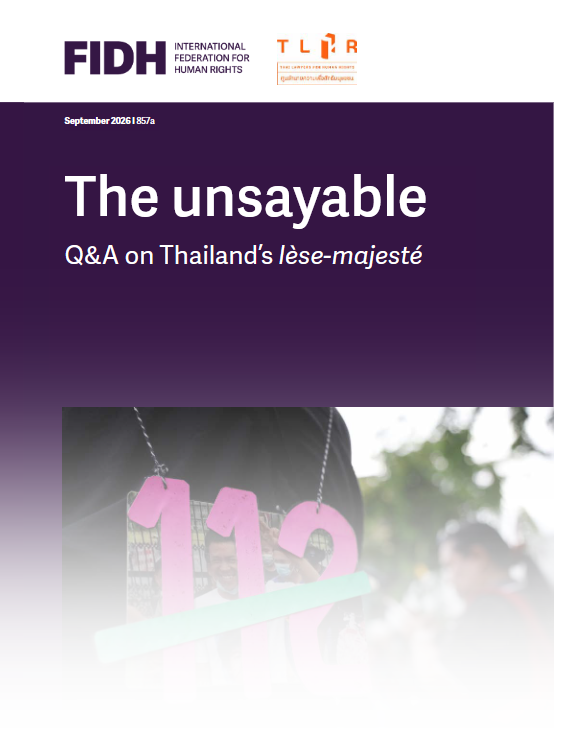
A new report published on 2 September 2026 by the International Federation for Human Rights (FIDH) and its member organisation Thai Lawyers for Human Rights (TLHR) sheds light on the severe human rights impacts of the enforcement of Article 112 of Thailand’s Criminal Code (lèse-majesté) since the country’s latest military coup in May 2014.

The report, titled “The unsayable – Q&A on Thailand’s lèse-majesté”, answers 15 frequently asked questions about Article 112 and its implications for human rights, civic space, the media, and democratic development in Thailand.

The evidence of the serious human rights violation linked to the enforcement of Article 112 is overwhelming and causes great damage to Thailand’s international standing. Reform of Article 112 is long overdue and efforts by Thai civil society to peacefully campaign for such changes should be commended and protected,” said FIDH Vice-President Teppei Ono.

Statistics about lèse-majesté reflect the severity and scope of the human rights violations linked to the enforcement of Article 112. Between May 2014 and July 2026, at least 461 individuals were prosecuted under Article 112, with at least 199 receiving prison sentences. The 10 longest prison sentences imposed under Article 112 averaged approximately 30 years and six months, with the longest sentence reaching 50 years. At least 21 children were prosecuted under Article 112, with the youngest one aged 14.

As of July 2026, 29 individuals remained detained under Article 112. Of these, 12 were detained pending trial or appeal, while the judgments for the remaining 17 had become final. Among those behind bars is prominent pro-democracy activist and human rights lawyer Arnon Nampa, who has accumulated a prison term of over 31 years stemming from 11 lèse-majesté convictions for his speeches and online posts that called for monarchy reform. Three additional lèse-majesté cases remain pending.

At the international level, all the relevant key United Nations (UN) human rights mechanisms have consistently expressed their concerns over various aspects of the enforcement of Article 112 and declared it incompatible with Thailand’s human rights obligations under international law…

FIDH and TLHR call on states to use Thailand’s fourth UPR to raise their concerns over the ongoing abuse of Article 112 and make recommendations to the Thai government to bring this provision into line with international law. FIDH and TLHR also urge Thai authorities to establish a moratorium on new lèse-majesté prosecutions and to immediately release all those who are being deprived of their liberty under Article 112.

The unsayable – Q&A on Thailand’s lese majeste

10 Organisations Demand The Dropping Of Charges Against Journalist Nguyen Lan Thang in Viet Nam

April 13, 2023

On 11 April 2023 10 NGOs demanded the dropping of charges against journalist Nguyen Lan Thang and a fair trial by admitting observation.

Dear President Võ Văn Thưởng,

We are writing to express our concern about the ongoing persecution of Mr Nguyen Lan Thang, a journalist, and we demand that he be released immediately, and all charges dropped against him. Mr Nguyen Lan Thang is a victim of persecution by the Vietnamese government and has been criminally charged due to his work as a journalist. Mr Nguyen Lan Thang is one of many journalists and activists throughout the country who is facing ongoing persecution for reporting of the government of Viet Nam in a critical manner.

On 5 July 2022, Mr. Thang was arrested for “making, storing, distributing, or disseminating information, documents, and items against the State” under article 117 of the 2015 Criminal Code. He has been held in incommunicado detention in Hanoi’s Detention Centre No. 1 for more than seven months, during which time he was prohibited from meeting with his family members and legal counsel. After being arrested in July 2022, he did not meet his lawyer for the first time until 16 February 2023.

According to his lawyers, Mr. Thang will be tried on 12 April 2023 at a closed hearing at Hanoi’s People’s Court. Failing the dropping of charges and release of Mr Nguyen Lan Thang before the trial commences, we demand that his right to a fair trial be upheld, at least in part, by ensuring that media and the public may observe it, as is the obligation of the state of Viet Nam under the International Covenant on Civil and Political Rights (ICCPR).

The right to a public trial is guaranteed under Article 14 of the ICCPR with few exceptions. We understand that Mr Nguyen Lan Thang has been denied this human right. According to Article 14 of the ICCPR:

“the press and the public may be excluded from all or part of a trial for reasons of morals, public order (order public) or national security in a democratic society, or when the interest of the private lives of the parties so requires, or to the extent strictly necessary in the opinion of the court in special circumstances where publicity would prejudice the interests of justice; but any judgment rendered in a criminal case or in a suit at law shall be made public except where the interest of juvenile persons otherwise requires or the proceedings concern matrimonial disputes or the guardianship of children.”

Paragraph 28 of General Comment No 32 of the Human Rights Committee clarifies that the importance of public hearings “ensures the transparency of proceedings and thus provides an important safeguard for the interest of the individual and of society at large”. The Committee has made clear in paragraph 29 that the special circumstances that allow exclusion of the press and public from a trial are “exceptional circumstances”, and otherwise a trial must be open to ensure transparency and assist in guaranteeing the human right to a fair trial.

Despite efforts to obtain further information on the charges and the rationale the court has adopted in excluding the press and public from the trial of Mr Nguyen Lan Thang, there is no information that we possess that indicates any exceptional circumstances exist that would allow the closed nature of this trial under international human rights law.

Accordingly, we demand that the right to fair trial is respected and that members of the public, the press, the United Nations, and the diplomatic community be allowed to monitor the proceedings. We call on the government of Viet Nam, including its courts, to uphold their international obligations and ensure the human rights of those within the justice system.

Yours sincerely,

  • Access Now
  • Amnesty International
  • ARTICLE 19
  • Asian Forum for Human Rights and Development (FORUM-ASIA)
    CIVICUS: World Alliance for Citizen Participation
  • Front Line Defenders
  • Human Rights Watch
    People In Need
  • The Project 88
  • Vietnamese Advocates for Change

See also: https://humanrightsdefenders.blog/2023/03/29/vietnam-should-drop-charges-against-human-rights-defender-truong-van-dung/

Deutsche Welle Freedom of Speech Award 2022 to two Ukrainian journalists

May 10, 2022

DW Freedom of Speech Award 2022

Ukrainian visual journalist and novelist Mstyslav Chernov and photojournalist Evgeniy Maloletka are this year’s DW Freedom of Speech Award laureates. For more on this and other awards for press freedom, see: https://www.trueheroesfilms.org/thedigest/awards/b9e2c660-8e41-11ea-b31d-31ce896d8282

Mstyslav Chernov and Evgeniy Maloletka have a way of reporting that is painful to read and watch, but what really hurts is the truth that their reporting conveys: Russia brutally attacking Ukraine, and thereby Ukrainian civilians, under a fabricated pretense. While there are nuances to every story, there is no way facts can be negotiated. This is exactly what the Kremlin is doing: Distorting facts, spreading misinformation,” said DW Director General Peter Limbourg. “

The journalists, who both remain in Ukraine to continue their coverage of the war, welcomed the news about receiving the DW Freedom of Speech Award as an acknowledgment of their work. The award ceremony will be held on June 20 as part of the DW Global Media Forum.

AP journalist and novelist Mstyslav Chernov and freelance photojournalist Evgeniy Maloletka are both from eastern Ukraine. Previously, their reports and footage from the conflicts in Crimea and eastern Ukraine have been published in various international media, including BBC, Deutsche Welle, The New York Times, Washington Post, Der Spiegel and others. As a war reporter in several conflict zones such as Iraq or Syria, Chernov has been wounded multiple times. Before the war, Maloletka had also been working on a project about the Hutsul community in western Ukraine, their traditions and daily life, and on the impact of the conflict in the Donbas. Evgeniy Maloletka is a freelance photojournalist based in Kyiv.

The report “20 days in Mariupol: The team that documented city’s agony” offers a unique account of Mariupol under Russian siege, with Chernov and Maloletka being the last journalists in the city before their evacuation. They documented the city’s first deaths at the city hospital of Mariupol and the attack on the maternity ward with pregnant women and children in it, as well as numerous bombings. During this work, the journalists themselves were under constant attack and took great risks only to find a steady connection to upload their footage of the siege, bringing it to the attention of the international community. They were evacuated by Ukrainian soldiers to avoid them falling into the hands of Russians, who had been hunting them down.

AP Senior Vice President and Executive Editor Julie Pace: “Mstyslav and Evgeniy were the world’s eyes and ears in Mariupol, producing courageous and compelling reporting as the only international journalists inside the besieged city. The harrowing realities of Russia’s war would have remained unseen without their bravery. We are extremely proud of their work.

See also: https://www.aljazeera.com/news/2022/5/9/pulitzer-prize-board-honours-courage-of-ukrainian-journalists

https://www.dw.com/en/dw-freedom-of-speech-award-2022-goes-to-ukrainian-journalists-mstyslav-chernov-and-evgeniy-maloletka/a-61638608

EU finally moves on law to protect media from legal abuse (SLAPPs)

April 28, 2022

I have devoted posts to this important issue before [see: https://humanrightsdefenders.blog/tag/strategic-lawsuits-against-public-participation-slapps/]. Let us not forget that Daphne Caruana Galizia was facing 40 lawsuits when she was murdered. See: https://www.trueheroesfilms.org/thedigest/laureates/70b0bee4-9af2-40c6-a11e-5b9ad159b96f

Andrew Rettman writing in the EUObserver of 27 April 2022

Independent media should have less to fear in future from malicious lawsuits, after the EU Commission put forward a new law to shield them.

Billionaires, big corporations, and autocrats have, in recent years, resorted ever more frequently to so-called strategic lawsuits against public participation (SLAPPs) in order to try to gag adversaries.

But if EU states and MEPs back the commission’s proposed anti-SLAPP directive, then judges will soon get a fresh mandate to throw out bogus cases — and compensate their victims.

With these measures we are helping to protect those who take risks and speak up when the public interest is at stake,” EU values commissioner Věra Jourová said in Brussels.

We promised to defend better journalists and human rights defenders,” she said. “The new law does that,” Jourová said.

The directive lists criteria which individual judges can, using their discretion on a case-by-case basis, use to decide whether litigation is genuine or abusive.

These include seeking disproportionately huge financial damages or launching multiple cases at the same time, for instance.

The anti-SLAPP law applies to non-EU or “third” countries, giving European judges leeway to annul vexatious judgments against EU nationals if they are doled out in London, for example.

It is delimited to civil cases “with cross-border implication”. This is because EU competences do not cover national and criminal media laws in member states under the terms of Europe’s treaties. It means a Polish journalist or LGBTI rights activist, for example, who is sued by a Polish entity would normally not be covered.

But the “cross-border” element has been drafted by Jourová’s lawyers in a canny way so that if their case arguably had relevance beyond their national borders then the EU law would kick in.

EUobserver has faced three lawsuits in the past three years that were designated as SLAPPs by leading pro-free media NGOs.

The first saw a Luxembourg-based firm sue us in Belgium about an article on disinformation in Malta — an archetypal example of a “cross-border” lawsuit falling under the directive.

The second saw a Belgian firm sue EUobserver in Belgium, but as the story covered VIP-jet leasing security for EU and Nato heads of state from all over Europe this would also be covered under the cross-border clause.

The final one, which is ongoing, involves a Belarusian firm suing EUobserver in Belgium over an article about alleged money-laundering in Cyprus, but this would also likely fall under both the “third-country” and “cross-border” provisions, NGO experts told this website Wednesday in a flash analysis.

The commission “did the best it could do”, given its jurisdiction, Julie Majerczak, from the Paris-based NGO Reporters Without Borders, said. “It’s not perfect, but it’s a big step forward — two years ago we were nowhere on this,” she added…

There were at least 438 SLAPP cases in 24 member states in 2021 targeting 978 people or entities, the commission noted. Journalists in Bulgaria, Croatia, Poland, and Slovenia were being routinely targeted, Reporters Without Borders said. Journalists in Italy and environmental activists in France and Spain were also notable victims, it added.

https://euobserver.com/rule-of-law/154815

https://www.maltatoday.com.mt/news/europe/116496/brussels_unveils_groundbreaking_proposal_to_prevent_and_penalise_slapp_lawsuits_#.Ymqx_5LP1TZ

https://eutoday.net/news/human-rights/2022/slapps-european-commission-seeks-to-tackle-abusive-lawsuits-against-journalists-and-human-rights-defenders

Journalism Under Fire – A Global Surge in Violations Against Journalists

October 16, 2020

On 14 Aya Wietzorrek posted a good overview piece on freedom of the press in the Organization for World Peace

…..Functioning as a “watch-dog” of these freedoms, journalism can be considered a public good, as it serves to inform citizens on political, economic, and social issues and ensures governance is transparent and accountable.

Acknowledging the many challenges journalism is currently facing…the focus of this article is on the everyday violations against journalists. This September, the UN Educational, Scientific and Cultural Agency (UNESCO) published a report with findings revealing a “wider upward trend” in the use of unlawful violence by police and security forces against journalists over the last five years. Attacks were reported across 65 countries, and many of the tactics used, violate international laws and norms. Globally, journalists are facing censorship, surveillance, detention and physical attacks by law enforcement. The reported abuses against journalists include harassment, intimidation, beatings, being shot with non-lethal as well as lethal ammunition, sometimes even resulting in death.

The UN High Commissioner for Human Rights, Michelle Bachelet, commented that around 1,000 journalists have been killed in the last decade – and that 9 in 10 cases “are unresolved”. The murders of journalists Daphne Caruana Galizia in 2017 in Malta, Jamal Khashoggi in 2018 in Turkey and Francisco Romero Díaz in 2019 in Mexico are only a few examples. Horrified by the fates of their colleagues, these events have deterring effects for other journalists. Besides the attacks on journalists being a deeply concerning issue in their own right, such attacks thus also constitute a direct threat to civil society and democracy. In democratic states, with separate legislative, executive and judiciary branches, a free press is often considered to be the 4th pillar of democracy. According to Freedom House, however, elected leaders in many democracies have made direct attempts to silence critical media voices and strengthen ones that provide favourable coverage. The trend is linked to a global decline in democracy itself: The erosion of press freedom is both a symptom of and a contributor to the breakdown of other democratic institutions and principles….

To intercept this upward trend of unlawful violence reported by UNESCO, and to ensure that journalists can serve society and do their job, we can improve and implement the following. Firstly, in terms of prevention, developing standard operating protocols and increasing training for law enforcement on the freedom of expression and appropriate behaviour in dealing with journalists – respecting their special status as ‘watch-dogs’ – is vital. Such training would include dialogues between law enforcement and journalists, to establish working relationship between the two groups, respecting the roles of each in society. It is imperative that national legal frameworks for police use of force align with the international standards of necessity and proportionality. Secondly, in terms of protection, countries should renew their international human rights pledges, review relevant domestic laws and practice and revise them as necessary, to ensure conformity with states’ obligations under the UDHR and ICCPR. These legislative frameworks should be subject to periodic review by independent expert bodies, such as Human Rights Watch for instance. Thirdly, as the Committee to Protect Journalists has pointed out in its “Global Campaign Against Impunity”, murder is the ultimate form of censorship and the statistic that justice is not served in 9 out of 10 murders, highlights that urgent action is needed on this front. In terms of prosecution, appointing national ombudsmen to hold police accountable for the unlawful use of force against journalists is key. The implementation of such ombudsmen and the strengthening of criminal law provisions should also operate to deter offences against journalists. Internationally, the freedom of press is only implicitly protected by Article 19.2 of the International Covenant on Civil and Political Rights and deserves to be explicitly mentioned and protected. The appointment of a Special Representative of the UN Secretary-General for the Safety of Journalists, as proposed by Reporters Without Border and 70 media groups and freedom of expression NGOs, would be a valuable appointment. This proposal was officially rejected in 2019 by UN Secretary-General António Guterres. The creation of such a position would however help prevent resolutions and treaties from being largely empty words and would have the political weight, the capacity to move quickly and the legitimacy to coordinate with all UN bodies to implement change.

….. The international community has repeatedly stated the need for a more effective implementation of existing international and regional standards, yet the work still lies ahead of us. Governments should pro-actively (re-)establish their commitment to a free press and the protection of journalists as it is imperative that civil societies across the globe continue to defend right to freedom of expression. This is necessary for the enhancement of people’s lives and for the creation and maintenance of stable and healthy democratic societies.

Aya Wietzorrek

Aya Wietzorrek is a graduate in International Development from The University of Manchester and is currently a research intern in the Governance and Inclusive Development Group at the Amsterdam Institute of Social Science Research.

See also: https://humanrightsdefenders.blog/2020/04/21/2020-world-press-freedom-index-is-out/

https://humanrightsdefenders.blog/2020/05/03/world-press-freedom-day-2020-a-small-selection-of-cases/ and

https://humanrightsdefenders.blog/2020/05/04/world-press-freedom-day-2020-a-few-more-links/

.https://theowp.org/reports/journalism-under-fire-a-global-surge-in-unlawful-violations-against-journalists/

8 UN experts join in letter to Algeria about Khaled Drareni

September 18, 2020

A journalist jailed for his coverage of mass protests in Algeria must be released, United Nations independent experts said on Wednesday. Khaled Drareni was jailed for two years on Tuesday as a crackdown on dissent intensifies after a year of anti-government demonstrations. He was jailed for his coverage of the protest movement that toppled the North African country’s longtime president Abdelaziz Bouteflika last year. Drareni was initially handed three years but his sentence was reduced by a year on appeal. However, his lawyers were shocked that he was not handed a more lenient judgment or an acquittal.

See also: https://humanrightsdefenders.blog/2020/05/03/world-press-freedom-day-2020-a-small-selection-of-cases/

We condemn in the strongest possible terms this two-year prison sentence imposed on a journalist who was simply doing his job, and call on the Algerian authorities to reverse it and set Mr Drareni free,” the experts said. The experts do not speak for the UN but report their findings to it. Although his sentence was reduced, “it is still grossly inappropriate because the charges brought against him are a blatant violation of freedom of expression, peaceful assembly and of association”, they said.

The eight signatories included the special rapporteurs on peaceful assembly, freedom of opinion and human rights defenders, along with members of the UN working group on arbitrary detention. They said they were alarmed that the Algerian authorities were increasingly using national security laws to prosecute people who were exercising their rights. “Drareni, and all the others currently in prison, or awaiting trial simply for doing their job and defending human rights must be immediately released and protected,” they said.

http://north-africa.com/2020/09/algeria-united-nations-independent-experts-pressuring-algeria-to-release-wrongly-jailed-journalist/

European MPs want EU to become serious about linking Corona virus payments to human rights

August 27, 2020
Political leaders in the European Parliament will insist that the EU’s massive budget payouts be dependent on countries meeting human rights and media freedom standards, they said on Wednesday.26 August 2020.  Targeted, but not named, were Hungary and Poland, countries that receive massive subsidies from the EU budget, but flout calls by Brussels to meet commitments on fundamental freedoms.

The time has come to accelerate the fight against the erosion of democracy, the rule of law and fundamental rights in the very heart of the EU,” said the letter, signed by leaders from the centre-right, centre-left, centrist and green parties.

The letter was addressed to Chancellor Angela Merkel of Germany, which currently holds the EU’s rotating presidency, as well as Ursula von der Leyen, the head of the commission, the EU’s executive arm that hands out the cash. Unless there are changes, the European Parliament has already vowed to veto the multi-year, one-trillion-euro budget — along with a massive pandemic recovery fund — that was thrashed out between heads of government at a summit in July.

Parliament members are due to sit down with representatives from the member states on Thursday to seek a compromise, with MEPs insisting on stricter conditions around civil rights.  The summit deal in July was seen by some as not putting enough pressure on countries to respect core EU values, especially after Hungarian Prime Minister Viktor Orban hailed a “huge victory” against conditionality after the talks.

In their letter on Wednesday, the MEPs insisted that EU member states approve a parliament proposal from April 2019 which would firmly link EU spending to the rule of law, which they vetoed at the time. Without its formal approval, “it will be impossible for us to move forward” on the EU budget, the group leaders said.

The EU budget is deeply intertwined with the 750 billion euro post-virus recovery fund, that parliament does not have a say over.  But given the historic recession afflicting Europe, member states are under huge pressure to implement the plan and the budget as soon as possible, hopefully by the end of the year.

Recent events in Hungary and Poland suggest the countries have little intention of addressing EU concerns over attacks on media freedom, LGBTI rights and the independence of the courts. A day after the summit in July, the editor of Hungary’s top independent news site was fired, seen as another sign of the Orban government’s attacks on opposition media. In Poland, the UN’s AIDS programme this month voiced deep concern about the “intensifying persecution” of LGBTI people, as well as crackdowns on human rights defenders.

https://www.macaubusiness.com/top-euro-mps-to-merkel-no-eu-budget-without-rule-of-law/

Killing of journalists in Mexico: Juan Carlos Morrugares the latest victim

August 24, 2020

The BBC reported on 23 August that a man in Mexico has been given a 50-year prison sentence for ordering the killing of a prominent journalist, Miroslava Breach, who covered drugs violence and corruption in the country and was one of 11 journalists murdered in 2017 in Mexico. [see https://humanrightsdefenders.blog/2019/12/30/in-depth-investigative-report-on-journalist-miroslava-in-mexico/]. See also: https://humanrightsdefenders.blog/2018/03/24/new-national-award-to-honor-slain-mexican-journalists/

Prosecutors said the lengthy prison term for Juan Carlos Moreno set a precedent in cases involving crimes against free expression. This “good news” comes amidst continuing killings of journalists also in this year. Reporter Pablo Morrugares was shot and killed in the city of Iguala in early hours of 2 August 2020, according to news reports and officials.

Pablo Morrugares was the fifth journalist to be killed in Mexico this year, in attacks which are increasingly also killing police guards assigned to the victims. More than 140 journalists have been killed over the past 20 years.

We are dismayed that Mexican journalists are being killed while supposedly under federal protection,” said Jan-Albert Hootsen, CPJ’s Mexico representative. “Authorities must do everything in their power to curb this impunity in attacks on the press, bring the culprits in Pablo Morrugares’ murder to justice, and guarantee the safety of reporters it has committed to protect.

Morrugares, the founder and editor of news website PM Noticias, was attacked shortly before 1:00 a.m. on August 2 in a restaurant in Iguala, some 120 miles south of Mexico City in the state of Guerrero Two heavily armed men entered the restaurant and fired more than 50 rounds at Morrugares, who died instantly. A police officer assigned to Morrugares as part of a federal protection program also died in the attack. The gunmen left the scene immediately after.

Before founding PM Noticias, Morrugares worked as a spokesperson for the Iguala municipal government during the administration of José Luis Abarca. The former mayor was arrested on November 4, 2014, for his alleged involvement in the mass abduction and suspected assassination of 43 students from a Guerrero rural teachers’ college on September 26 of that year. In 2016, Morrugares and his wife were targets of an attack by unidentified gunmen in Iguala, according to news reports. Following the attack, the reporter was placed in a protection program overseen by the Federal Mechanism for the Protection of Human Rights Defenders and Journalists, which operates under the auspices of the federal Interior Secretariat (Segob). An official of the Mechanism, who asked to remain anonymous as he is not authorized to speak on the matter, told CPJ today that his institution relocated the journalist to a safe house at an undisclosed location in 2018, where he stayed under federal protection until the end of 2019. The official said that Morrugares returned to Iguala at his own request in January of this year and was assigned two state police officers as bodyguards, one of whom died in this week’s attack.

https://cpj.org/2020/08/mexican-journalist-pablo-morrugares-killed-in-iguala/

https://www.bbc.com/news/world-latin-america-53880211

Ressa’s ‘cyber libel’ conviction in the Philippines shocks

June 15, 2020

Several international and national outlets (here Christia Marie Ramos in INQUIRER.net of 15 June 2020) have reported with dismay on the conviction of Rappler CEO Maria Ressa and former research-writer Reynaldo Santos Jr. in a cyber libel case in the Philippines. [see also: https://humanrightsdefenders.blog/2019/04/16/pulitzer-prizes-for-courageous-journalists-in-myanmar-and-philippines/

In a statement, Senator Francis Pangilinan said “The silencing of critics and the attacks on the media has been going on for three years now,” he said. “And unless we stand up, speak out, and vigorously oppose the tyranny in our midst, their conviction will not be the last” he added… Ressa and Santos are the first journalists to be found guilty of cyber libel.

In this context ABS-CBN was forced off the air after its television and radio broadcast operations nationwide were ordered shut a day after its 25-year-franchise expired.

Detained Senator Leila de Lima joined her colleagues in condemning Ressa and Santos’ conviction, saying it was “another demonstration” of the Duterte administration’s “weaponization of law against those who dare speak truth to power.” “Jailing me for over three years now is only one of the thousand sinister ways they are causing fear in the hearts of Filipinos who fight for what is just and right,” the senator said in a dispatch from Camp Crame. [see also: https://humanrightsdefenders.blog/2018/07/30/senator-de-lima-in-detention-in-philippines-receives-her-award/]

Meanwhile, former Senator Antonio Trillanes IV said the guilty verdict against the Rappler CEO was an “obvious attack” against press freedom and an “attack against our democracy itself.” “We are now but a few steps away from Martial Law,” Trillanes, who has been critical of the Duterte administration, said in a statement.

Meanwhile in June 2020 a film on Maria Ressa won a film award:

http://Maria Ressa Film ‘A Thousand Cuts’ Wins Top Prize at New Zealand’s Doc Edge Festival

—-
Read more: https://newsinfo.inquirer.net/1291753/pangilinan-hontiveros-slam-ressas-libel-conviction-urge-people-to-speak-out#ixzz6PQEJOfS1
Follow us: @inquirerdotnet on Twitter | inquirerdotnet on Facebook

Call for nominations for Samir Kassir Award for Freedom of the Press goes ahead in MENA region

February 28, 2020
The European Union launched a call for nominations for the “Samir Kassir Award for Freedom of the Press” at the Delegation of the European Union to Lebanon. During the press conference, Ambassador Ralph Tarraf reaffirmed the European Union’s commitment to pursue Samir Kassir’s struggle for free speech and an independent free press. [for more on this and many other awards relating to freedom of the press, see: http://www.trueheroesfilms.org/thedigest/awards/samir-kassir-award-for-freedom-of-the-press]
The contest is open to candidates from North Africa, the Middle East, and the Gulf until 1 April, 2020, and three awards will be granted for: the best opinion article, investigative article, and audiovisual news report. The contributions must be centered on subjects relating to rule of law, human rights, good governance, fight against corruption, freedom of expression, democratic development and citizen participation. The jury will be composed of seven voting members from Arab and European media and one observer representing the European Union. The names of the jury members will be communicated during the prize-awarding ceremony, which will take place on 2 June 2020 in Beirut, marking the 15th memorial of Samir Kassir’s assassination.

https://en.annahar.com/article/1131572-european-union-launches-the-15th-editionon-of-the-samir-kassir-award-for-freedom