Women Human Right Defenders (WHRDs) from around the world will be gathering in Geneva from 21 to 25 September, to learn about the UN Human Rights Council, advocate for their rights and amplify their own stories.
The week-long training, known as the Women Human Rights Advocacy Week, is co-organized by nine human rights organizations including Amnesty International (see below for full list). It is aimed at providing participants with practical tools to understand the Human Rights Council, while offering guidance on how to engage with it strategically and advocate for change in their communities.
“The women attending are risking their lives every day to protect their communities from climate change, greedy corporations and land theft,” said Lisa Maracani, Amnesty International’s researcher on human rights defenders. “Their knowledge is crucial to ensuring bodies such as the Human Rights Council remain effective, while the WHRD Advocacy Week is designed to provide these women with the tools and strategies to advance their advocacy on this global stage.”
The women attending [this meeting] are risking their lives every day to protect their communities from climate change, greedy corporations and land theft.Lisa Maracani, Amnesty International’s researcher on human rights defenders
Participants attending are WHRDs working at the nexus of gender, climate and conflict, and includes activists protecting the environment, the rights of women migrant workers, Indigenous land rights, as well as the rights of communities impacted by businesses activities.
The training aims to facilitate participation for activists who face multiple barriers to accessing the UN, to equip participants with a broad knowledge of the human rights system, to foster networks among them as well as between them and human rights experts, and to amplify their voices and calls for international accountability.
Participants will be able to speak before the Human Rights Council, and meet with, lobby and inform UN officials, diplomats and Council-mandated independent experts. Several participating defenders will also speak at a public event at the UN headquarters on Thursday 24 September alongside the UN Special Rapporteur on the human right to a clean, healthy and sustainable environment.
“The UN human rights system must be open to and informed by those who have most to contribute to it: human rights defenders,” said Fabiana Leibl, programme manager for the International Service for Human Rights. “With this training, we seek to make sure the perspectives of women human rights defenders are effectively represented at the Human Rights Council’s and across its key mechanisms.”
This event has been organized by: Amnesty International, Asia Pacific Forum on Women (APWLD), Front Line Defenders Rights, International Service for Human (ISHR), Peace Brigade International (PBI), The Association for Women’s Rights in Development (AWID), Women Human Rights Defenders International Coalition (WHRDIC), WHRD Middle East and North Africa Coalition (WHRD MENA Coalition), Urgent Action Fund for Feminist Activism (UAF).
As Taliban rule in Afghanistan continues, UN experts and many others warned that normalisation continues despite increasing restrictions imposed on the population, including women and girls, over the past year. They urged States to accelerate steps towards accountability.
“Five years may be a short period in the life of a country, but it is a long one in a child’s life,” the experts said. “A generation of girls has now been denied secondary education. A girl who was in grade six when the ban began is reaching adulthood without another day in school.”
Over the past year, the Taliban have further entrenched their institutionalised gender-based repression. The experts reiterated that the Taliban’s intentional and targeted gender-based deprivation of fundamental rights amounts to the crime against humanity of persecution on gender grounds. As this repression forms part of an institutionalised system of gender-based discrimination, oppression and domination, the experts said it can also be characterised as gender apartheid. They urged States to actively support the codification of gender apartheid as a distinct crime against humanity…
Enforcement measures, some involving cruel and inhuman punishment, have also intensified, the experts said. In 2025 alone, more people were publicly flogged than in all the previous years of Taliban rule combined.
“Women have been turned away from hospitals on account of their attire or for lacking a male guardian, denying them their right to access health care. In June 2026, at least 30 women and girls were jailed in Herat for allegedly violating the Taliban’s dress code. When residents protested, security forces opened fire, killing at least two people, including a boy.”
They called for strengthened support for the International Criminal Court, warning that “the newly mandated Independent Investigative Mechanism for Afghanistan must not remain only an achievement on paper; it must also be properly and swiftly resourced.”
“Afghanistan is not a safe country: mass returns and forced deportations in violation of the obligation of non-refoulement must stop, particularly for those who face heightened protection risks, including religious or ethnic minorities and LGBT persons,” the experts said.
“There should be no moves to normalise the Taliban de facto authorities, including by accepting diplomats or holding meetings in capitals, without demonstrated, measurable progress against human rights benchmarks, particularly for women and girls,” the experts said. “For five years, Afghans’ human rights have been systematically violated, yet many continue to strive bravely and against the odds to restore them. The international community must not let them down again.”
Women human rights and environmental defenders face escalating repression simply because of their gender and need stronger international protections to continue their work, Right Livelihood Laureates warned at a United Nations side event last week.
The event, organised by Right Livelihood as part of the Women Laureates Hub and Exile Project programmes during the 62nd session of the UN Human Rights Council, brought together Laureates and international experts to examine the specific threats and challenges faced by women activists solely because of their gender.
“Gender apartheid” in Afghanistan
“Human rights defenders in general are the core or the most important element of a democratic society,” said Dr Sima Samar, a 2012 Laureate and former Minister for Women’s Affairs of Afghanistan. “Among them, women human rights defenders are the main ingredient of democracy. We cannot say that ‘There’s democracy, but women should be at home,’ like the Taliban does in Afghanistan.” In her country, a total of 160 laws, decrees and orders have been passed to suppress women’s rights. Those include a ban on women working outside the home and on girls receiving an education beyond 6th grade.
“It is a crime against humanity – that is why we call it gender apartheid,” Samar said, calling for the codification of gender apartheid in the Convention on Crimes Against Humanity. She also warned that some European countries are beginning to normalise the Taliban’s restrictions by framing them as cultural or religious practices. “It’s not our religion, it’s not our culture,” Samar said. “Please, do not use the excuse of respecting the culture and religion in Afghanistan.”
Women environmental defenders also face heightened risks compared to their male counterparts, warned Diana Nabiruma, Programmes and Communications Manager at 2022 Laureate organisation Africa Institute for Energy Governance (AFIEGO).
“In Uganda today, unfortunately, what we see is that laws are used to repress not only environmental and human rights defenders but women in particular,” Nabiruma said. Uganda currently has five laws restricting civic freedoms and activist work, including a recently passed law on foreign funding.
Nabiruma has observed stark differences in how men and women environmental defenders are treated, especially by authorities. “Women do not speak up; women are more repressed than men are,” she said. “When they protest, they are asked, ‘Who will marry you? You’re a terrible person!’ There’s a lot of anti-gender rhetoric, which forces women to become silenced, so they don’t demand their rights to be protected.”
A “problem for democracy,” not just for women
Eva Zillen, Senior Adviser at the Kvinna till Kvinna Foundation, a Swedish organisation that received the 2002 Right Livelihood Award, said that their 2026 report on the situation of women and queer rights activists in conflict-affected countries confirmed many of the trends her fellow Laureates were witnessing on the ground. One striking finding: for the first time since 2008, fewer activists reported feeling threatened. This isn’t progress, the organisation said, just an indication that digital hate speech has become so normalised that it’s no longer recognised as a threat. “A lot of activists are withdrawing: self-silencing has become a form of self-protection, and they are leaving social media,” Zillen said. “This is not a problem for the women’s movement; this is a problem for democracy.”
The report identified governments and state authorities as the leading source of threats against women human rights defenders, alongside traditional and community leaders, religious actors and anti-gender movements. “These four are working together, and they are using the anti-gender narrative,” Zillen said. “It has to do with gaining power or sustaining power, and this is a narrative that has proven to be very successful.”
Olivia Ekobe, Human Rights Officer at the World Organisation Against Torture (OMCT), said her organisation documented over 60 cases of women human rights defenders facing risks last year alone, underscoring the need for gender-sensitive monitoring.
Ekobe outlined three recommendations: civil society organisations must increase visibility around the criminalisation of women human rights defenders and the protections available to them; states must end this criminalisation and adopt adequate legal frameworks; and donors must increase funding for women-led local organisations. “We have a responsibility to help create an environment where women HRDs can carry out their work without fear,” she added.
The side event was held as the culmination of a week-long workshop in Geneva for women Right Livelihood Laureates and fellows of the Exile Project, a programme in collaboration with the Global Campus of Human Rights.
The recommendations include practical actions that states can take to protect women human rights defenders and provide guidance on how to engage with other states on the matter.
Every 10 hours, a human rights defender, journalist or trade unionist is killed or disappeared. Every hour, a child dies in armed conflict. One in five people have experienced discrimination in the past year. These stark figures emerge from new data released by UN Human Rights. The human rights indicators offer a global snapshot of the state of human rights under four key Sustainable Development Goal (SDG) indicators linked to SDG16 and SDG10.
“Behind every data point is a real life lived — or lost,” said UN High Commissioner for Human Rights Volker Türk. “These new global human rights data show that discrimination, violence and exclusion are systemic and continue to affect those already at the margins.”
Violence against human rights defenders has reached record levels, with at least 5,995 killed since 2015. Discrimination remains widespread and deeply structured, with persons with disabilities facing a high burden at nearly one in three affected, alongside elevated gender-based discrimination against and, for the first time analyzed by our Office, sexual and gender minorities reporting two to three times higher rates than the general population.
Civilian deaths in armed conflict, while declining by 23 per cent in 2025 from an unprecedented peak in 2024, remain catastrophic. Despite these alarming trends, progress in data collection is expanding: discrimination data are now available in 124 countries, up from 15 in 2015, and with a growing range of population groups and grounds of discrimination covered. However, progress in establishing national human rights institutions that comply fully with international standards has stalled, with no overall increase in 2025, signalling that visibility and accountability mechanisms have not kept pace with the scale of the crisis.
A blog post by Matilde Da Luz on 18 March 2026 of Columbia University is not directly related to human rights defenders but so interesting that it is reproduced here in full:
By now, most women recognize the script. Raise a point about sexism, feminism, or gender equality and the response is often predictable. You are “angry.” You are “too woke.” You have, somehow, made things awkward. The figure of the angry feminist woman has become so familiar that it no longer feels like an accusation so much as a reflex – a shorthand for dismissing political discomfort without engaging it. You become labelled, often unconsciously, as the “killjoy.”
What is striking is that this stereotype persists at a moment when anger is hardly in short supply. Much of it belongs to men, and is increasingly confident, public, and political. It circulates online, where terms like incel and manosphere emerge in everyday vocabulary. It is surfacing in dating culture, classrooms, and family conversations, where feminism is framed less as a demand for equality than as a provocation. And it is showing up in electoral politics.
According to a recent study that analyzed the 2024 European Parliament elections, more than 21 percent of young men aged 18–29 voted for far-right parties, compared to around 14 percent of young women. This marks one of the clearest gender gaps in far-right support among younger voters across Europe. The more interesting question, then, is not why women continue to be frustrated by patriarchy, but why so many young men appear increasingly angry – and why that anger seems to be so easily mobilized by populist language.
These questions matter since they sit at the intersection of two developments that have often been discussed separately: the rise of far-right populism and the growing difficulty of human rights discourse in reaching young men. Analysts tend to explain young men’s support for the far right through conditions such as economic anxiety, cultural backlash, or online radicalization. However, while these explanations are not wrong, they often miss something central. Far-right populism offers, very compellingly, a way of making grievance feel politically intelligible. At the same time, the language of human rights, which is ostensibly universal, egalitarian, and moral, consistently fails to resonate with this same group. Why is that?
Put differently: why do young men gravitate toward far-right populism, and why does human rights language so often fail to reach them? In truth, populism’s success and human rights’ struggle with this demographic turn out to be two sides of the same affective and gendered coin.
Far-right populism works, in part, because it is emotionally economical. It is successful in offering a pretty clear story about who has been wronged and who is to blame. So-called “ordinary people” are portrayed as betrayed by the elites and threatened by outsiders, which usually results in a moral landscape drawn in bold lines. Hence, politics becomes a struggle between betrayal and redemption, insiders and outsiders, rescue and decline. Interestingly enough, the subject at the center of this story is often presented as implicitly masculine: the sidelined worker, the disrespected citizen, the young man who feels displaced by feminism, multiculturalism, or economic change.
The appeal here, instead of ideological, is primarily affective. Populist narratives do not ask people to manage resentment, or to adapt their anger into appropriate language or tone. Instead, they expertly validate it. Woundedness is treated as evidence that something is wrong, and the emotion can no longer be overcome. Consequently, anger becomes legible, even reasonable.
The manosphere provides the perfect illustration of how this emotional logic can take shape well before it reaches the ballot box. These online spaces are frequented by men who successfully reframe their personal frustrations into a collective grievance of sorts. Incel culture, in particular, offers men a way to interpret loneliness, rejection, or economic insecurity as structural and systemic injustices that are, in turn, blamed on women and feminism. The appeal lies, then, in the comfort of certainty – the reassurance that their frustrations have an identifiable cause.
This anger, however, is also material. Masculinity has long been bound up with material arrangements that once offered stability and recognition, especially waged labor. As these arrangements erode, insecurity is no longer experienced only as an economic loss. Rather, it becomes existential. When economic institutions no longer sustain the forms of masculine authority they once did, insecurity is lived as a disruption of gendered meaning which, in turn, produces an affective opening for populist recruitment. Loss demands explanation, and far-right populism is efficient at providing one.
Human rights discourse, on the other hand, speaks in a very different register. It tends to be careful, professionalized, and abstract, emphasizing universality, dignity, and legal principle. It often assumes a rational subject – someone capable of setting aside their own personal grievances in favor of universal principles. In fact, contemporary human rights talk has increasingly framed itself as a project of restraint, focused on preventing the worst harms rather than focusing on articulating a substantive vision of justice.
Arguably, human rights language can be emotionally compelling for those already disposed toward empathy. The difficulty is that, in a political moment marked by an erosion of empathy and an intensification of hostility – increasingly directed at women and feminism – this association can have the opposite effect. In truth, human rights discourse is often perceived by young men as “feminized”, not because of its commitments to gender equality, but because of its association to empathy, vulnerability, protection and care – traits that patriarchal orders frequently characterize as feminine. This can further alienate young men who already feel dismissed, blamed, or morally lectured.
The contrast is, therefore, stark. At the same time that populism validates and valorizes woundedness, human rights seek to neutralize it. In this sense, populism animates emotional life, whereas human rights assume a rational subject who is willing to rise above it. For young men whose political identities are boomingly shaped by feelings of loss and displacement, far-right populism feels personal. Human rights feel procedural.
This does not mean that human rights lack emotional appeal. Contrarily, humanitarian campaigns have long relied on images of suffering to mobilize concern. But these appeals typically work through pity rather than grievance, and compassion rather than anger. They usually frame people as victims in need of protection, not as political subjects whose injuries demand some sort of structural change, much like populists do. In a political moment increasingly organized around resentment, this framing can feel misaligned.
This dynamic essentially reshapes the terrain of political identification itself. As grievance grows more consistently recognized and organized through populist frames, hostility toward feminism is structurally reinforced, and, at the same time, equality is emergently experienced by young men as loss. In this context, human rights struggles to appear as a credible site of recognition in a political scene where belonging is produced through exclusionary ideologies.
Within these circumstances, deeper questions arise. If contemporary politics is increasingly organized through fear, anger, and the pleasures of moral certainty, what kind of ethical and political subject can human rights still presume, and cultivate? In other words, in a world where resentment so efficiently creates “the people,” how can empathy win without becoming naïve, moralizing, or politically empty?
On 15 December 2025 Emma Woollacott, in Forbes, referred to a new study that shows that 7 in 10 women human rights defenders, activists and journalists have experienced online violence in the course of their work. Produced through the UN Women’s ACT to End Violence against Women program and supported by the European Commission, “Tipping point: The chilling escalation of violence against women in the public sphere” draws on a global survey of women from 119 countries.
Along with online threats and harassment, more than 4 in 10 have experienced offline harm linked to online abuse — more than twice as many as in 2020, the researchers found. This can range from verbal harassment right up to physical assault, stalking and swatting.
“These figures confirm that digital violence is not virtual — it’s real violence with real-world consequences,” said Sarah Hendricks, director of policy, programme and intergovernmental division at UN Women.
“Women who speak up for our human rights, report the news or lead social movements are being targeted with abuse designed to shame, silence and push them out of public debate. Increasingly, those attacks do not stop at the screen — they end at women’s front doors. We cannot allow online spaces to become platforms for intimidation that silence women and undermine democracy.”
And AI is only making things worse, with almost 1 in 4 women human rights defenders, activists and journalists having experienced AI-assisted online violence, such as deepfake imagery and manipulated content. This is most often the case for writers and public communicators who focus on human rights issues, such as social media content creators and influencers, for whom the figure reaches 30%.
“Gender-based online violence is not a new phenomenon, but its scale certainly is,” said report co-author Lea Hellmueller, associate professor in journalism at City St George’s and associate dean for research in the School of Communication and Creativity.
“AI tools enable the production of cheaper and faster abusive content, which is detrimental to women in public life — and beyond,” Hellmueller added.
Tech firms are partly responsible, the researchers said, with the report calling for better tools to identify, monitor, report and fend off AI-assisted online violence. The researchers also want to see more legal and regulatory mechanisms to force tech firms to prevent their technologies being deployed against women in the public sphere.
“Our next steps include publishing data from the survey about the opportunities for, and barriers to, law enforcement and legal redress for survivors of online violence,” said Julie Posetti, chair of the Centre for Journalism and Democracy at City St George’s, University of London, one of the authors of the report. “We will also focus on creative efforts to counter gender-based online violence and policy recommendations to help hold the Big Tech facilitators of this dangerous phenomenon accountable.”
Patricia Egessa, Director of Global Communications, published this NGO assessment:
Looking back at the year 2000 from a gender justice perspective is sobering. The previous decade had famously been declared as ‘the end of history’ by Western male political pundits. But women knew better. As conflicts continued to rage with devastating and disproportionate impacts on women and families, gender justice activists decided history still had some way to go and demanded a central role in peacebuilding. Their efforts galvanized the adoption of the pathbreaking UN Resolution 1325, which established the Women, Peace and Security (WPS) agenda.
As the WPS agenda marks its 25th anniversary, civil society organizations are uniting to reaffirm the importance of women’s full and meaningful participation and leadership in global processes. The NGO Working Group on Women, Peace and Security has released its annual Open Letter calling on the international community to defend the core values of the WPS agenda amid growing threats to women’s rights globally. We cite just a part of that letter as a statement of our shared concern:
Yet, when we should be paying tribute to the hard-fought achievements of these feminist movements, we are instead confronting an alarming backlash against women’s autonomy and rights, and against those who advocate for them, at a time when the consequences of armed conflict and crises on the lives of women and girls could not be more devastating. The very term gender—a core concept in international human rights law mobilized by feminist movements for decades to challenge the systematic oppression of women and LGBTQIA+ people—is today being blatantly undermined by anti-gender movements globally, including at the United Nations (UN). Civil society and human rights defenders around the world, especially those defending gender equality, women’s rights, sexual and reproductive rights, and LGBTQIA+ rights, are being targeted for who they are and the work they do. Combined with rising militarism, erosion of respect for international law, capitalist exploitation and slashing of funding for gender equality and women’s rights organizations, these attacks have thrown our work and our movements into crisis, even as the vision of the WPS agenda is more necessary than ever.
ICRW has proudly signed on to this collective statement precisely for the reason so clearly articulated in this letter: to remain silent as the WPS agenda and those who advocate for it are attacked not only undermines decades of progress but jeopardizes peace and security for everyone. Twenty-five years after the adoption of the UN resolution, our work is unfinished. We join over 600 organizations worldwide in ensuring that our unified voice reaches the UN Security Council, governments, and the world’s citizens who understand and support a more peaceful world for our children.
On 14 March 2025, IDRC announced that it is funding research to uphold fundamental democratic freedoms and address rising threats to peoples’ rights. The CAD4.13 million investment supports six projects across five regions:
Demonstrators in Kampala, Uganda, march in 2018 to draw attention to the murders, kidnappings and, activists claim, a lack of action by the police in response. Frederic Noy/Panos Pictures
The freedom to associate, participate in decision-making and express views is fundamental to democracy. Yet, in many countries around the world, these hard-won political and civil rights are being questioned and eroded through physical attacks, online intimidation, smear campaigns, digital surveillance and the lack of response from authorities when attacks occur. Legal and policy restrictions limit individual rights such as same-sex unions and reproductive health services while, increasingly, obstacles like funding bans and censorship are reducing the ability of people and organizations to contest these measures.
Research is needed to inform the strategies and actions of organizations, groups and movements that advocate for the respect for human rights. Research institutions, networks, and women’s rights and LGBTI+ organizations are leading IDRC-supported research to:
understand what drives the erosion of rights in each context
analyze the strategies used to counter these trends
explore how to strengthen rights defenders, for example through alliance-building and cross-movement solidarity
generate policy recommendations to safeguard rights
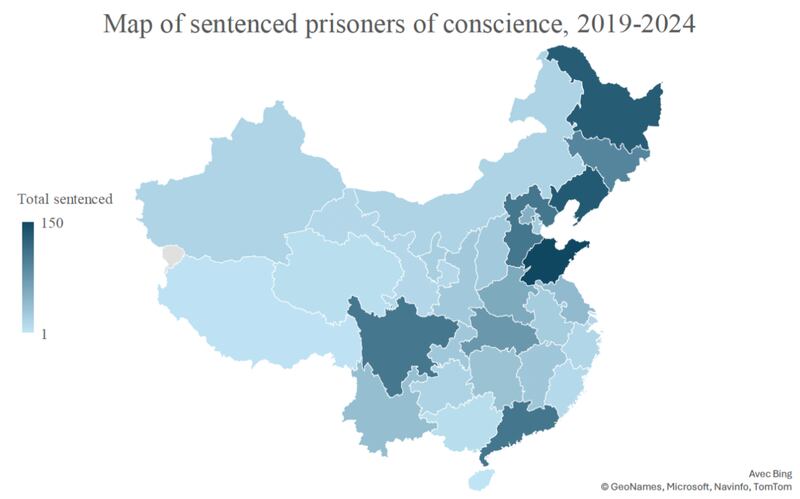
Alan Lu for RFA on 5 March 2025 refers to a a new report which shows the extent of Beijing’s arbitrary detentions, with severe sentences for prisoners of conscience.
Chinese authorities have arbitrarily detained thousands of people for peacefully defending or exercising their rights over the past six years and convicted 1,545 prisoners of conscience, a rights group said on Wednesday.
Chinese Human Rights Defenders, or CHRD, a non-government organization of domestic and overseas Chinese rights activists, said the scope and scale of wrongful detention by Chinese authorities may constitute crimes against humanity.
“They were sentenced and imprisoned on charges that stem from laws that are not in conformity with the Chinese government’s domestic and international human rights obligations,” the group said in a report.
“Their cases proceeded through the full criminal justice system, with police, prosecutors, and courts arbitrarily depriving them of their liberty in violation of their human rights.”
Prisoners of conscience have faced severe penalties, with an average sentence of six years, increasing to seven for national security charges.
Three people, identified as Tashpolat Tiyip, Sattar Sawut and Yang Hengjun, were sentenced to death, while two, Rahile Dawut and Abdurazaq Sayim, received life sentences, the group said, adding that 48 were jailed for at least a decade.
Map of sentenced prisoners of conscience in mainland China, excluding Hong Kong and Macao. (CHRD)
Among the convicted, women activists and marginalized groups, including ethnic Tibetans and Uyghurs, were disproportionately represented among those wrongfully detained, the group said.
Out of all the prisoners of conscience aged 60 or older, two-thirds were women, it added.
“Human rights experts and international experts have raised that people over the age of 60 should generally not be held in custody due to the effects on their physical and mental health,” Angeli Datt, research consultant with CHRD, told journalists in a press briefing Wednesday.
“That two-thirds of them are women was really shocking to me,” she said.
“Worse still, the impunity Chinese government officials enjoy at home emboldens them to commit abuses abroad,” the group said.
China dismissed a Swiss report last month alleging that it pressures Tibetans and Uyghurs in Switzerland to spy on their communities.
‘Endangering national security’
The CHRD said that under Chinese leader Xi Jinping, the scope and scale of the use of arbitrary detention to silence critics and punish human rights personnel had grown.
The organization documented a total of 58 individuals known to have been convicted of “endangering national security.”
“The overall average prison sentence for a national security crime is 6.72 years, though this figure excludes those sentenced to death with a two-year reprieve or life imprisonment,” it said.
In Hong Kong, more people were convicted of “subversion” and “inciting subversion” — terms that the U.N. describes as “broad and imprecise, making them prone to misapplication and misuse.”
In one 2024 case, authorities convicted 45 people for participating in a primary election, an act fully protected under both domestic and international law. Subversion charges accounted for 37% of all prisoners of conscience sentenced in Hong Kong during this period.
One in four countries report backlash on women’s rights in 2024
Women’s and girls’ rights are facing unprecedented growing threats worldwide, from higher levels of discrimination to weaker legal protections, and less funding for programmes and institutions that support and protect women.
Despite important progress, only 87 countries have ever been led by a woman, and a woman or girl is killed every 10 minutes by a partner or member of her own family. Digital technology and artificial intelligence spread harmful stereotypes, while the digital gender gap limits women’s opportunities.
In the past decade, the world registered a disturbing 50 percent increase in the number of women and girls living in conflict, and women’s rights defenders confront daily harassment, personal attacks and even death. Recent global crises—like COVID-19, the climate emergency, soaring food and fuel prices—are only increasing the urgency to respond.
“UN Women is committed to ensuring that ALL Women and Girls, everywhere, can fully enjoy their rights and freedoms,” affirmed UN Women Executive Director Sima Bahous. “Complex challenges stand in the way of gender equality and women’s empowerment, but we remain steadfast, pushing forward with ambition and resolve. Women and girls are demanding change—and they deserve nothing less.”…
Today’s report also features the new Beijing+30 Action Agenda, a courageous roadmap to complete our unfinished business by focusing on:
A digital revolution for all women and girls: We must ensure equal access to technology, equip women and girls to lead in AI and digital innovation, and guarantee their online safety and privacy.
Freedom from poverty: Investments in comprehensive social protection, universal health coverage, education, and robust care services are needed for women and girls to thrive and can create millions of green and decent jobs.
Zero violence: Countries must adopt and implement legislation to end violence against women and girls, in all its forms, with well-resourced plans that include support for community-based organizations on the front lines of response and prevention.
Full and equal decision-making power: Temporary special measures like gender quotas have proven their effectiveness in rapidly increasing women’s participation.
Peace and security: Fully finance national plans on women, peace and security and gender-responsive humanitarian aid are essential. Frontline women’s organizations, so often the first responders to crisis, must receive dedicated, sustained funding to build lasting peace.
Climate justice: We must prioritize women’s and girls’ rights in climate adaptation, center their leadership and knowledge, and ensure they benefit from new green jobs.
Across these six Actions, putting young women and girls at the heart of our efforts is the best way to guarantee success, both today and tomorrow. These six plus one actions have the potential to unleash progress on women’s rights and put us back on track for 2030.
The Beijing+30 commemoration and the forthcoming UN Commission on the Status of Women (CSW69) are clear opportunities to enshrine this Action Agenda into national policies, regional strategies, and global agreements.
In a pivotal year for women and girls, that is also a year of pushback and crises like no other, let us push women’s rights forward to create a world where all women and girls enjoy equal rights and equal opportunities. We can be the first generation that can live in an equal world.
Ahead of International Women’s Day, Amnesty International’s Secretary General, Agnès Callamard, said:
“The significance of International Women’s Day 2025 cannot be overstated. It is no longer a case of addressing unfinished business on the gender justice front, but one of bracing ourselves to resist active regression and a mounting assault on our rights.
“Thirty years ago, 189 governments came together at the Fourth World Conference on Women to adopt the Beijing Declaration and Platform for Action, a groundbreaking blueprint for strengthening women’s rights endorsed by thousands of activists. Despite significant progress since then, the world has failed to fully deliver on all the promises. From rape and femicide to coercion, control and assaults on our reproductive rights, violence against women and girls still threatens their safety, happiness and very existence in a multitude of ways.
“And crucially, we are now going backwards. The aggressive patriarchal crusade led by President Trump and other powerful leaders against the rights and bodily autonomy of women and gender-diverse people has already had devasting consequences not just in the United States but all over the world. By dismantling domestic efforts to tackle gender-based, racial and other forms of discrimination, erasing recognition of transgender identity, and ending international funding for abortion counselling or referrals, the US administration is shamefully erasing years of hard-fought gains.
“Let us be clear, this trend has deeper roots than President Trump’s recent election. For several years now, brazen anti-rights movements have conspired to turn back the clock to an age when patriarchal oppression was the norm. We cannot afford to be complacent in the face of this gathering storm, for women, girls and LGBTQI+ people are under attack the world over.
“Amnesty International calls on states and non-state actors who believe in universal values and a rule-based international order to resist this accelerated and well-resourced attack against women’s rights. We call on them to strengthen protections of women, girls, LGBTQI+ people and other marginalized groups against gender-based violence. We urge them to recognize and support the vital work of all women human rights defenders and all those on the frontlines of the fight for sexual and reproductive rights, and to implement concrete measures to protect and empower them.
“We appeal to all to respect sexual and reproductive rights and prevent rollbacks, including by revoking any laws that criminalize or punish people for exercising these rights, as well as fully decriminalizing, providing and funding universal access to abortion.
“Finally, this International Women’s Day, Amnesty International reiterates its call on states to recognize gender apartheid under international law as a crime against humanity. Doing so would fill a major gap in the global legal framework and help to combat institutionalized and systematic domination and oppression on the basis of gender, no matter where it occurs.
“Despite suffering setbacks and facing countless attempts to block, divide and undermine us throughout history, feminist, LGBTI+ and grassroots movements keep marching forward. We may be walking a rocky path, but we will never stop fighting for a world where women, girls and gender-diverse people are free to enjoy the full range of human rights without discrimination or fear of reprisal.”
On 7 March 2025 SaferWorld carried a post “Still standing: The resilience of women peacebuilders in a time of crisis”
As we mark International Women’s Day 2025, women’s rights organisations (WROs) and frontline activists in crisis and conflict settings are standing strong despite immense challenges. ..Yet, while their work is more critical than ever, the harsh reality is that many are being forced to operate with dwindling resources, due to global funding cuts and shifting donor priorities towards militarisation, over a genuine investment in long-term peace, security and gender justice.
At a time when conflict, displacement and violence against women are escalating, and misogyny is a core pillar of the far-right agenda, these cuts will only deepen existing inequalities and undermine efforts to build sustainable peace and security globally. The reduction in funding for gender equality and Women, Peace and Security (WPS) initiatives threatens to reverse decades of progress and compounds the global rollback on women’s equality, safety and security. For example, cuts to the UK official development assistance (ODA) budget in 2021 led to a 30 per cent reduction in funding to programming with a focus on gender equality and to a 66% reduction in funding to WROs compared to 2017. WROs and women-led organisations – many of which are small community groups – often struggle to access direct, flexible and long-term funding, despite being the first responders in humanitarian crises and leading conflict prevention and peace efforts. When funding disappears, so do vital services, safe spaces for survivors of gender-based violence and conflict-related sexual violence, safe spaces for women peacebuilders to re-mobilise, legal aid for women and girls who have been displaced, and advocacy that ensures women’s voices are central in peace processes. But despite these constraints, WROs and women peacebuilders are still standing. Their resilience is evident in their ability to adapt, mobilise local resources and continue working in the most difficult circumstances. But resilience alone is not enough – they need meaningful and sustained support.
As the world commemorates International Women’s Day and gathers at the United Nations Commission on the Status of Women (CSW) to discuss gender equality and sustainable development, we reaffirm our commitment to ensuring that women and girls play a central role in peacebuilding and conflict prevention efforts around the world.
The international community, donors, funders and philanthropists will need to act urgently to ensure that WROs are not just surviving but thriving. This means:
Increasing direct, flexible and long-term funding and shifting power to local women-led organisations, women activists and women’s groups – we have seen the value in our work of providing sustained core funding to WROs, moving beyond short-term, project-based grants to ensure continuity of their critical efforts in conflict prevention, peacebuilding and humanitarian response. To make this shift meaningful, international organisations and donors should prioritise direct and flexible funding to frontline WROs rather than channelling resources through large intermediaries. This will ensure that funding reaches those who are best placed to drive lasting change within their communities.
Ensuring women’s leadership in conflict prevention, peace and humanitarian processes – women from all backgrounds and marginalised communities must have a seat at decision-making tables, not just as implementers but as equal partners in shaping policies and solutions that affect their lives.
Standing up for gender equality and women’s rights – urgently pushing back against reversals in women’s rights and gender equality, especially in fragile and conflict-affected contexts, where regressive policies and shrinking civic space are eroding hard-won gains. Women peacebuilders, human rights defenders and frontline activists are already standing up to these challenges, demanding that women’s voices remain central. Their leadership must be protected, amplified and meaningfully supported to sustain progress and counteract the global rollback on gender equality.
Protecting and supporting women human rights defenders and peacebuilding organisations – governments and international actors must recognise and safeguard the work of women human rights defenders and peacebuilding organisations in conflict zones, ensuring they can operate without fear of reprisals.
Strengthening accountability mechanisms – governments and multilateral bodies must hold themselves accountable to their commitments to the WPS agenda and support localisation of the UN Security Council Resolution 1325 on WPS.
Women’s rights organisations are the backbone of peace and resilience in crisis and conflict settings. This International Women’s Day, we celebrate their unwavering commitment – but celebration is not enough. The global community must act with urgency to fund, support and protect these organisations so they can continue to drive meaningful change.