Posts Tagged ‘Margaret Satterthwaite’

UN report on SLAPPs: the lawsuits that silence those who speak out

September 24, 2026

A journalist exposes corruption. An Indigenous leader defends their community’s land. An environmental activist raises the alarm on devastating pollution. Then comes a lawsuit. Strategic lawsuits against public participation (SLAPPs) are designed to intimidate, exhaust and silence people who speak out on issues that matter to society. On 16 September, UN Human Rights presented a report during the 63rd session of the Human Rights Council in Geneva, Switzerland, examining their impact on human rights.

The report was prepared following a request from the Council in Resolution 56/7 and draws on discussions held during an expert workshop organized on 28 May 2025.

At the expert workshop, a representative of UN Human Rights held that the use of SLAPPs constitutes an abusive instrumentalization of judicial systems. They not only distort the purpose of legal proceedings; they transform courts from instruments of justice into tools of repression.

see: https://humanrightsdefenders.blog/tag/strategic-lawsuits-against-public-participation-slapps/

In their first session of the workshop, centered on the impact of these strategic lawsuits on journalists, journalist Clare Rewcastle Brown spoke from her personal experience. Brown said that she had been the target of multiple strategic lawsuits against public participation, regarding her work on the 1Malaysia Development Berhad scandal.

The scandal involved theft and laundering of more than 4.5 billion US dollars from wealth fund 1Malaysia Development Berhad into American financial institutions. The brave reporting led to the conviction of former Malaysian Prime Minister Najib Razak on money laundering and abuse of power charges in 2022.

Unfortunately, the case also had consequences for the reporters. Two Malaysian business publications were suspended for three months, and two Australian journalists were detained and deported from Malaysia.

She was subject to intimidation by letters which alleged that her reporting amounted to libel, defamation, and an invasion of privacy. In 2017, a lawsuit on her reporting on a Malaysian political party led to lengthy proceedings ultimately depleted her pension and put her family at financial risk. 

Protesters hold placards, banners and shout slogans to protest in Kuala Lumpur, Malaysia, 08 August 2015. © EPA/AHMAD YUSNI

Her case is a clear example of the use of SLAPPs to suppress the work of investigative journalists, the tense relationship between litigants and media freedoms, and emphasizes a need for reform. Brown was interviewed by UN Human Rights in May 2024, on her experience reporting on environmental violations and corruptions in Malaysia.

Irene Khan, the former Special Rapporteur on promotion and protection of right to freedom of opinion and expression, said these lawsuits occur frequently because they are a subtle form of repression than overt physical attacks. In many cases, they are effective at silencing dissent and often succeed to bankrupt or deter defendants.

Margaret Satterthwaite, the UN Special Rapporteur on the independence of judges and lawyers, agreed that this is a misuse of the legal system predominantly by large corporations: 474 lawsuits have been initiated by private actors since 2015, and 68 percent involved criminal charges.

Satterthwaite outlined recommendations to put an end to this abuse of legislation: Judges must be trained to identify and discuss these lawsuits properly. Bar associations must develop ethical guidance to sanction lawyers who misuse the legal system. States must enact legislation to counter the use of such lawsuits and decriminalize defamation where appropriate.

The expert workshop also examined ways to counter SLAPPs.

Nikhil Dutta, Senior Legal Advisor at the International Center for Not-For-Profit Law, noted that responses designed to counter such lawsuits had been enacted in numerous jurisdictions, including Australia, Canada, Colombia, Indonesia, Ireland, the Philippines, Thailand, the United Kingdom and the United States, as well as the European Union.

Other approaches to solve these blatant human rights violations outlined in the expert workshop include enacting protections for public participation through legislation, empowering courts to dismiss abusive proceedings, establishing public funds for defense against SLAPPs, and establishing punitive damages on entities that file these lawsuits.

UN Human Rights has released a briefer on SLAPPs, a comprehensive summary of the report and the impact of these lawsuits on human rights, civic space, and victims. It suggests measures that States should take to tackle SLAPPs, including the decriminalization of defamation; the adoption of anti-SLAPPs laws; the possibility for courts to dismiss SLAPPs early; and the need to compensate victims and penalize abusive claimants.

The message is clear: states and others need to make it easy for people to speak up, to influence decisions that affect them, and to hold state institutions accountable. They must do what is in their power to ensure people do not face legal intimidation for defending human rights.

Freedom of expression and opinion is a precious good critical for protecting all human rights, and the law must not become a weapon to silence those who speak out.

https://www.ohchr.org/en/stories/2026/09/lawsuits-silence-those-who-speak-out

Side event ISHR on Guatemala: 7 March 2024

March 4, 2024


In recent years, Guatemala has witnessed a concerning erosion of its State institutions. The co-optation of the judicial system has resulted in the persecution of human rights defenders and justice operators, many of whom have had to flee the country. Despite the election of President Bernardo Arévalo, who led a campaign promising to re-establish the rule of law and fight corruption, the international community must continue to monitor the human rights situation in the country.

A side event – Human rights situation in Guatemala: From Rescuing Democracy to Guaranteeing Justice – aims to shed light on the recent socio-political developments in Guatemala, with a particular focus on the 2023 presidential elections and the dynamics of peaceful protest. It will explore the fragile state of the rule of law in the country and the significant human rights challenges it faces. A critical discussion will centre on the co-optation of the judicial system by criminal groups, which has led to the persistent criminalisation of justice operators and human rights defenders.

Additionally, the event will address the pressing crisis of forced evictions in Indigenous communities. These evictions, often driven by the interests of non-State actors like extractive companies and large-scale development projects, represent a form of cruel, inhuman, and degrading treatment, amounting to torture.

Speakers:

Clément Nyaletsossi Voule, UN Special Rapporteur on freedom of peaceful assembly and of association (TBC)

Lourdes Gómez Willis, Q’eqchi’-afrodescendant professor working on issues of Indigenous women defenders and the impacts of palm oil production

Bernardo Caal Xol, Mayan Q’eqchi community leader, teacher and environmental and land rights activist [see also: https://www.trueheroesfilms.org/thedigest/laureates/dff0ef4a-af52-4d2f-8ca3-be6d31968453]

Luis Haroldo Pacheco Gutiérrez, Ex-President of the Council of Communal Mayors of the 48 cantons of Totonicapán With the participation of

Margaret Satterthwaite, Special Rapporteur on the independence of judges and lawyers

Sponsors: Centre for Civil and Political Rights, Franciscans International, Impunity Watch, ISHR, Protection international Mesoamérica, and Peace Brigades International.

Thursday 7 March, 14:00 – 15:00 (CET), Room XXV, Palais des Nations – Geneva
Language: English / Spanish


Download the flyer here

Meet lawyer Dennis Muñoz, human rights defender in El Salvador

October 31, 2023

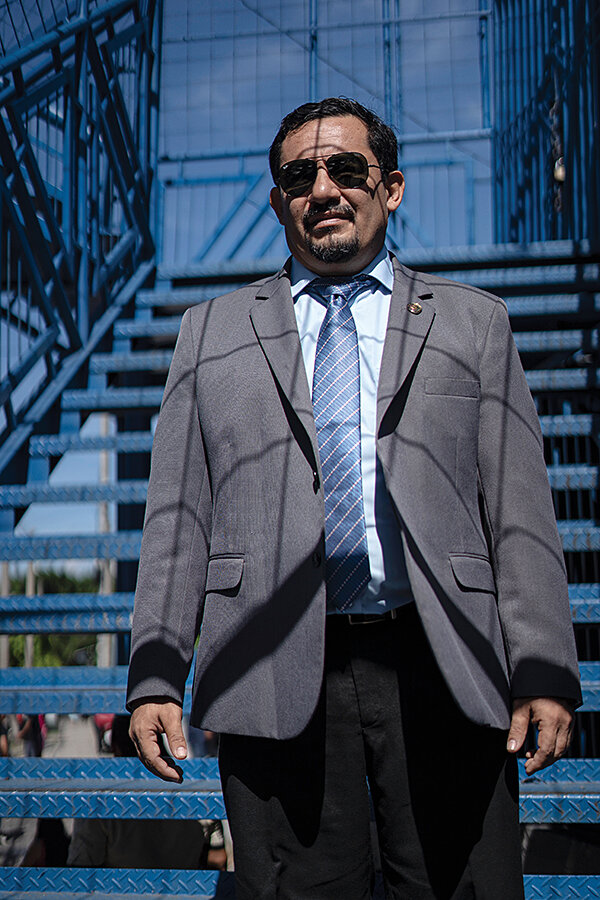
The Christian Science Monitor of 30 October 2023, tells the story of attorney Dennis Muñoz who seeks to uphold human rights in El Salvador, despite increasingly difficult and dangerous odds.

Víctor Peña/Special to The Christian Science Monitor

Mr. Muñoz found a way to channel his deep-seated desire for justice by becoming a lawyer in 2005. But he doesn’t work with just anyone – he goes for the tough cases of human rights abuses. He has defended multiple women who suffered miscarriages but were accused of murder in a nation where abortion is banned without exception. He has fought arbitrary arrests of environmentalists, activists, and average citizens. He could be called a defender of lost causes.

There’s no shortage of demand for Mr. Muñoz’s work in El Salvador, which has the highest incarceration rate in the world. And these days the risks of his work are almost as high as the demand for it.

In March 2022, a monthlong “state of exception” was enacted in response to extreme gang violence. The order suspended basic constitutional rights for those arrested under it. Securing a court warrant before searching private communications was no longer required, for example, and arrestees were barred from their right to a defense attorney and their right to see a judge within 72 hours. 

But what started as an emergency measure has become ordinary practice. The state of exception has been extended every month for more than a year and a half now, with no end in sight. Violence has declined dramatically, but critics say the order’s extreme powers are seeping far beyond the gang-related arrests they were meant to address. Even those detained outside of the state-of-
exception category are having their rights suspended. 

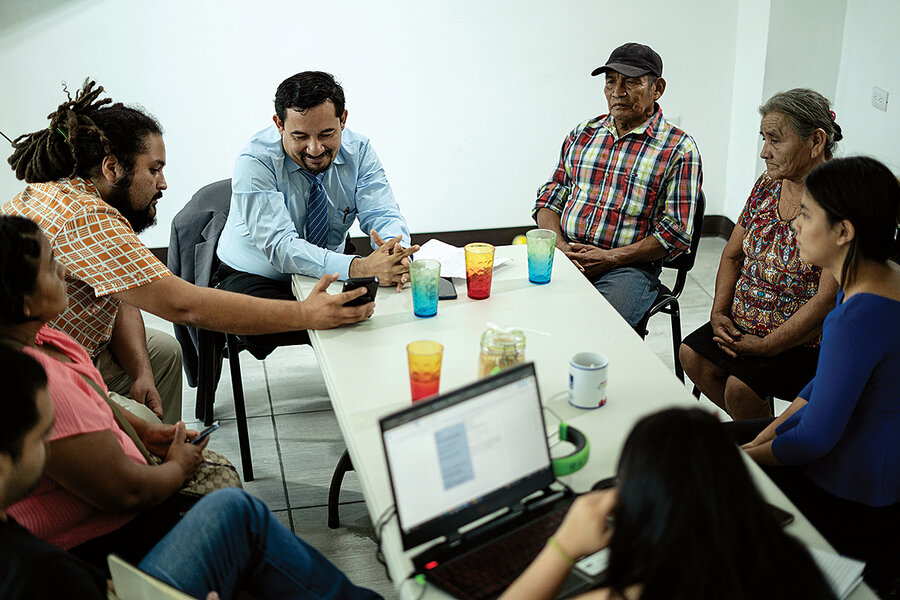
That’s the group Mr. Muñoz focuses on. While he has taken a few state-of-exception cases, he primarily works on human rights violations, with the added burden now of his clients getting caught in the emergency order’s crosshairs. Despite death threats and intimidation, he’s not slowing down. Instead, fellow lawyers doing similarly risky work ask him to be on call if – or, perhaps more likely, when – they themselves are arrested. 

… Despite quashing constitutional rights, the move has been overwhelmingly popular for providing a long-elusive sense of calm. 

“A tired society, fed up with a lack of answers to the chronic problem of violence, is willing to accept short-term answers,” says Verónica Reyna, director of human rights for the Passionist Social Service, a nongovernmental organization focused on local violence prevention and support of human rights. 

Gustavo Villatoro, minister of justice and public security, acknowledges that the state of exception is affecting more than gang members. Over 7,000 innocent people have been arrested, Mr. Villatoro said in August, noting that some degree of error is inevitable. But the consequences of those errors can be grave. Even if a case has nothing to do with gang activity, lawyers can be blocked from visiting their clients in detention, and court hearings can be suspended. Over 71,000 Salvadorans have been arrested under state-of-exception rules. With 6 million people in El Salvador, close to 2% of the adult population is currently behind bars. And many of them, even those not under the emergency order, lack access to a lawyer and may be tried en masse.

Margaret Satterthwaite, the United Nations special rapporteur on the independence of judges and lawyers, tweeted in May that in El Salvador, “public defenders reportedly have 3-4 minutes to present the cases of 400 to 500 detainees.” She warned that “fair trial rights must not be trampled in the name of public safety.” 

In the last week of July, Salvadoran lawmakers eliminated a previous two-year limit on pretrial detentions and passed reforms to allow mass trials that could bring together 1,000 individuals in a single appearance before a judge.

“Maybe they won’t let us be lawyers anymore,” says Mr. Muñoz, “at least not private attorneys with independent criteria.”

“The reforms have disrupted the whole system and have turned innocence into an exception,” says Ursula Indacochea, program director at the Due Process of Law Foundation, based in Washington. “Presumption of innocence is disappearing because the roles have shifted. The state no longer has to prove I’m guilty, but now I’m guilty and have to prove I’m innocent,” Ms. Indacochea said in a Sept. 7 radio interview in El Salvador. 

Of the 35,000 authorized lawyers registered in El Salvador, Mr. Muñoz stands out for almost exclusively taking cases of human rights violations.

“Things aren’t easy right now,” he says, describing the justice system as “made to convict.” The government is “criminalizing the job of lawyers,” he adds.

Yet Mr. Muñoz looked anything but cautious at a press conference in early July, where he was the only person wearing a suit at the San Salvador offices of the Christian Committee for Displaced People in El Salvador, a wartime human rights organization. He headed to the podium in the ample room, sparsely decorated with pictures of St. Óscar Romero, the archbishop of San Salvador murdered by right-wing death squads in 1980. 

Mr. Muñoz discussed openly a forbidden topic. Five environmentalists were arrested in January over the alleged 1989 murder of a Salvadoran woman during the war. The case was under a court-issued gag order.  

“It’s very serious that environmentalists are being unjustly accused, bending [what are considered] the rules of due process anywhere in the world,” Mr. Muñoz said, staring into the cameras.

His clients in this case are former guerrilla members, and two of the accused are part of the Association of Economic and Social Development Santa Marta, known as ADES. One of the country’s oldest environmental organizations, ADES was key in achieving the total ban on mining here in 2017. In a country where almost the entirety of war crimes remain unresolved and defendants in active cases are rarely imprisoned, the arrest of these men was an outlier, apparently due to their vocal criticism of the government. The U.N. called for the activists’ immediate release. 

“Dare I say there are crimes being committed against these environmentalists,” Mr. Muñoz said before the media. “It’s nefarious that things like this happen in a country that calls itself democratic but really has a criminal injustice system in place.” 

Víctor Peña/Special to The Christian Science Monitor

By late August, Mr. Muñoz had successfully convinced a judge to grant an order for his clients’ release. “It’s a crumb of justice, but we shouldn’t celebrate until there’s a dismissal of proceedings,” he said at a later press conference.

It’s hard to reconcile this image of seeming fearlessness with Mr. Muñoz’s request when the Monitor approached him for an interview: Could the piece leave out his last name? The question reflects a sense of fear that has built up over many years of doing this work. 

Mr. Muñoz downplays receiving death threats, normalizing the culture of violence he’s lived under for most of his professional life. “They say they wish that I was extorted or killed because of the people I’ve defended,” he says about the social media threats. He thinks he’s been able to stay off the political radar by censoring his opinions. “I issue legal and technical opinions,” he explains. “Other colleagues have entered the political arena and expose themselves more to attacks.” 

https://www.csmonitor.com/World/Americas/2023/1030/Meet-Dennis-Munoz-defender-of-lost-causes-in-El-Salvador