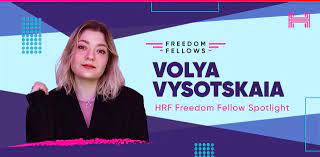
Meet HRF Freedom Fellow Volya Vysotskaia, a Belarusian human rights activist who exposes repression and torture by state officials.
Vysotskaia is currently part of the 2022 Freedom Fellowship, a programme of the Human Rights Foundation, a one-year program that provides hands-on, expert mentorship across seven critical areas: leadership, movement-building, organizing, fundraising, media, mental health, and digital security.
On September 27, the Investigative Committee of the Republic of Belarus announced that five people would be tried in absentia — Vysotskaia is one of them. She has since been denied information about the trial, and her request to appear virtually was rejected. Should she return to Belarus, a country where torture and inhuman treatment is routine, officials will likely detain her.
Learn more about Vysotskaia’s case.
Q: Can you tell us about your activism protecting democracy in Belarus?
A: From August 2020 to October 2021, I was an editor of the Telegram channel, the “Black Book of Belarus.” Our work “de-anonymized” or identified law enforcement officers and other government authorities who committed human rights violations, hiding behind their high-power statuses. We published the pictures and personal data of riot police officers, prosecutors, judges, and other officials to hold them accountable for their repression of Belarusian citizens demanding democracy and freedom.
Q: What led to the criminalization of the Black Book of Belarus’ editors and readers?
A: In October 2020, a special service agent infiltrated our team and leaked information about members. Previously, he was part of the special operation that hijacked a Ryanair flight in May 2021 to imprison Sofia Sapega, another team member. After we uncovered the agent, my team and I were chased down in Vilnius, and dozens of people in the Telegram group were also imprisoned.
Q: What is unique about your criminal case?
A: The case brought against my four colleagues and me is the first trial in absentia in the country’s history. We have been accused of “exasperation of enmity” and “social disagreement,” as well as illegal actions relating to private life and personal data. The Belarusian KGB has also added us to the list of individuals engaging in “extremist activities.” Belarusian courts recognize almost all civil society organizations as extremists, but we will be the first to be tried and sentenced without the opportunity to defend ourselves.
Belarusian authorities are undoubtedly denying us the right to a fair trial. Notably, I was denied access to information about my criminal case, and I never met the lawyer assigned to me, nor did the lawyer ever respond to my calls.
Q: What is the scope of legal harassment against Belarusian pro-democracy activists in exile?
A: The Lukashenko government changed the criminal procedural law back in July and invented a special proceeding for trying in absentia those who are engaged in “anti-state activities,” and living in exile. The addendum of this new procedural law provides that defendants are no longer aware of the content of their cases. It is sufficient for the legislative body to post this information on official websites, which clearly violates Article 14 of the International Covenant on Civil and Political Rights (ICCPR).
Q: What should the international community learn from your case?
A: The violations of the right to a fair trial, among other rights, didn’t start in Belarus with our case. It just brings back the attention of the international community to the fact that the repressions in Belarus haven’t stopped. They continue every day. The power, the judicial system, and the independence of Belarus with Lukashenko are fake. The regime represses and scares the Belarusians inside the country, and while the international community doesn’t react to the severe violations of human rights, the regime spreads its attention to those living in exile. Because silence allows them to do that.
The international community has to learn that there have to be efficient mechanisms for bringing perpetrators to trial until they destroy whole nations, as well as to guarantee the defense for the victims of violations. International justice can’t be built on the international ignorance of injustice. Being concerned doesn’t stop dictators.Repression in Belarus. HRF condemns the actions of Alexander Lukashenko’s regime and stands with Volya and all Belarusians who speak truth to power, even when their lives are at risk
The Freedom Fellowship is a one-year program that gives human rights advocates, social entrepreneurs, and nonprofit leaders from challenging political environments the opportunity to increase the impact of their work. Through mentorship and hands-on training sessions, fellows develop critical skills and join a growing community of human rights activists.
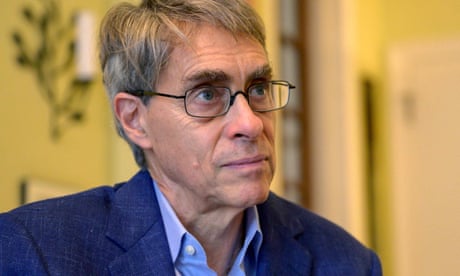
Kenneth Roth wrote in the Guardian of 10 January 2023 “I once ran Human Rights Watch. Harvard blocked my fellowship over Israel. I was told that my fellowship at the Kennedy School was vetoed over my and Human Rights Watch’s criticism of Israel”.
. ..If any academic institution can afford to abide by principle, to refuse to compromise academic freedom under real or presumed donor pressure, it is Harvard, the world’s richest university. Yet the Kennedy School’s dean, Douglas Elmendorf, vetoed a human rights fellowship that had been offered to me because of my criticism of Israel. As best we can tell, donor reaction was his concern.
.. in anticipation of my stay at the school, I reached out to the dean to introduce myself. We had a pleasant half-hour conversation. The only hint of a problem came at the end. He asked me whether I had any enemies.
It was an odd question. I explained that of course I had enemies. Many of them. That is a hazard of the trade as a human rights defender.
I explained that the Chinese and Russian governments had personally sanctioned me – a badge of honor, in my view. I mentioned that a range of governments, including Rwanda’s and Saudi Arabia’s, hate me. But I had a hunch what he was driving at, so I also noted that the Israeli government undoubtedly detests me, too.
That turned out to be the kiss of death. Two weeks later, the Carr Center called me up to say sheepishly that Elmendorf had vetoed my fellowship. He told Professor Kathryn Sikkink, a highly respected human rights scholar affiliated with the Kennedy School, that the reason was my, and Human Rights Watch’s, criticism of Israel.
That is a shocking revelation. How can an institution that purports to address foreign policy – that even hosts a human rights policy center – avoid criticism of Israel. Elmendorf has not publicly defended his decision, so we can only surmise what happened. He is not known to have taken public positions on Israel’s human rights record, so it is hard to imagine that his personal views were the problem.
But as the Nation showed in its exposé about my case, several major donors to the Kennedy School are big supporters of Israel. Did Elmendorf consult with these donors or assume that they would object to my appointment? We don’t know. But that is the only plausible explanation that I have heard for his decision. The Kennedy School spokesperson has not denied it.
Some defenders of the Israeli government have claimed that Elmendorf’s rejection of my fellowship was because Human Rights Watch, or I, devote too much attention to Israel. The accusation of “bias” is rich coming from people who themselves never criticize Israel and, typically using neutral sounding organizational names, attack anyone who criticizes Israel.
Moreover, Israel is one of 100 countries whose human rights record Human Rights Watch regularly addresses. Israel is a tiny percentage of its work. And within the Israeli-Palestinian context, Human Rights Watch addresses not only Israeli repression but also abuses by the Palestinian Authority, Hamas and Hezbollah.
In any event, it is doubtful that these critics would be satisfied if Human Rights Watch published slightly fewer reports on Israel, or if I issued less frequent tweets. They don’t want less criticism of Israel. They want no criticism of Israel.
The other argument that defenders of Israel have been advancing is that Human Rights Watch, and I, “demonize” Israel, or that we try to “evoke repulsion and disgust”. Usually this is a prelude to charging that we are “antisemitic”.
The issue at Harvard is far more than my own academic fellowship. I recognized that, as an established figure in the human rights movement, I am in a privileged position. Being denied this fellowship will not significantly impede my future. But I worry about younger academics who are less known. If I can be canceled because of my criticism of Israel, will they risk taking the issue on?
The ultimate question here is about donor-driven censorship. Why should any academic institution allow the perception that donor preferences, whether expressed or assumed, can restrict academic inquiry and publication? Regardless of what happened in my case, wealthy Harvard should take the lead here.
To clarify its commitment to academic freedom, Harvard should announce that it will accept no contributions from donors who try to use their financial influence to censor academic work, and that no administrator will be permitted to censor academics because of presumed donor concerns. That would transform this deeply disappointing episode into something positive.
I have been paying attention to the phenomenon of sports washing on several occasions in the past. See e.g. https://humanrightsdefenders.blog/tag/sports-washing/. It pleases me to see that the Economist on 19 November 2022 underpinned this concern by showing that over the last years autocratic regimes have increased their share of the pie.
According to data compiled by Adam Scharpf, of the University of Copenhagen, and two colleagues, the share of international sporting events hosted by autocracies fell from 36% in 1945-88 to 15% in 1989-2012. Since then, it has rebounded to 37%. Although the total number of democracies in the world has also declined from the post-cold-war high, only a few recent autocratic hosts are lapsed democracies.
Ironically, this trend stems largely from democratic decision-making. Studies have shown that big sporting events tend to be bad deals for host countries. Cities have to build costly stadiums that are rarely used afterwards, and that fail to spark economic development in surrounding areas. As a result, governments accountable to their taxpayers have become less enthusiastic about being the host. This year’s Winter Olympics wound up in Beijing almost by default, after all four cities in democratic countries that had bid backed out. The only alternative was Almaty, Kazakhstan.
Autocrats, in contrast, are free to squander public funds. The main threat they face as hosts is that protesters or the press will highlight human-rights violations. But rather than encouraging reform, the international spotlight seems to lead such regimes to become even more repressive in the run-up to sporting events.
Using “repression scores” calculated by other scholars that measure how much violence states inflict on their citizens, Mr Scharpf has shown that hosts of the Olympics and football tournaments tend to crack down two years before opening ceremonies. Once the world starts watching, they ease off. All this is illustrated by graphics.
The International Service for Human Rights in Geneva (ISHR) calls for applications for a new hybrid version of the Human Rights Defender Advocacy Programme (HRDAP). This intensive course will take place remotely between 17 April and 7 June and will be followed by an in-person training from 14 to 24 June 2023 in Geneva. The course equips human rights defenders with the knowledge and skills to integrate the UN human rights system into their existing work at the national level in a strategic manner. It also provides an opportunity for participants to prepare for and engage in lobbying and advocacy activities at the UN with the aim to create change back home. Find out why you should join HRDAP23 from Bonnie, one of our HRDAP 2022 Alumni:
So if you are a human rights defender keen to use the UN to push for change at home, get a taste of the programme here and apply before 10 January 2023!
A candidate should be active in the struggle for the ideals and principles underlying the United Nations Universal Declaration of Human Rights.
A candidate’s struggle for human rights should represent a non-violent perspective.
A candidate may be a person or an organization, and two or more candidates may share the prize.
Who can nominate?
Anyone with an interest in and knowledge about human rights is welcome to nominate candidates. Candidates nominated by themselves or by their staff or by honorary officers will not be taken into consideration.
Deadline for nominations: 1 February. Nominations received after 1 February will be taken into consideration for the Rafto Prize the following year.
Each year we announce the recipient of the Rafto Prize in the end of September at a press conference at the Rafto House in Bergen. The announcement is live streamed on our website and on Facebook.
For questions regarding nominations, please contact the Secretary of the Committee, Liv Unni Stuhaug, livunni.stuhaug@rafto.no
It seems bold to be so optimistic, but lets not forget that the assertion starts from a very low base: 2022 was probably one of the worst years with the Ukrainian war, further repression in Russia, death sentences for protesters in Iran and no let up in China.
I think we have to start with where we are with the world and we are at a very peculiar moment. We have all lived through these multiple crises. We have seen the geopolitics, the divisions, the fragmentation, and all these things that have preoccupied us at a time when you would hope that the international community would come together and craft something that would respond to the big challenges that we face.
So for me, human rights is the force that comes in and unifies us. Because it brings us back to human dignity and to what makes us all connected with each other. Let’s not forget that the Universal Declaration of Human Rights emerged out of the ashes of the Second World War. It provided the inspiration and the motivation that the world needed at that time. So, I think we need to almost counter intuitively go back to the basics of what this unifying force – this concentration on the human being – was. We need to regain the universality and the indivisibility of the human rights regime.
Secondly, we also need to look at human rights in the 21st century, for example in the digital transformation that we’re seeing. Take the letter I wrote to Twitter’s Elon Musk, for instance. Social media platforms play a very important role. We know the role Facebook played in Myanmar, for example, when the Rohinga crisis happened, in allowing disinformation and hatred to spread. So, human rights needs to look at the type of issues that we face today.
And the third area that I hope we can achieve next year, is we have to look at the human rights ecosystem as a whole. So, what is the role of the treaty bodies, of the special procedures mandate-holders, of the Human Rights Council, Universal Periodic Review process, and of my own office too – and how do we strategically deal with different situations?
Freedom House took the occasion to consider that Political prisoners and the victims of human rights abuses have taken a back seat when global summits and events occur. But it is exactly because of those events that we should be giving the victims of such abuses our full attention...
Symbolic dates like International Human Rights Day offer space to reflect on and advocate for the rights of the brave people who have been imprisoned or experienced retaliation for standing up to repressive, authoritarian rule. But political prisoners and others fighting for freedom deserve our attention for more than one day of the year. We cannot allow their plight to be sidelined because it is inconvenient to think about them during an event like the World Cup.
The World Cup is one of several events in recent months that has drawn criticism for the human rights controversies surrounding it. In what was meant to be a historic summit to discuss the imminent threats posed by climate change, the latest United Nations Climate Change Conference (COP27), held in Egypt in early November, instead became a spotlight on the host country’s abysmal human rights record. The large number of human rights defenders and activists currently detained or imprisoned in Egypt was difficult to ignore, and one case in particular stood out for its perilously high stakes. British-Egyptian democracy activist Alaa Abdel Fattah, imprisoned for his activism, endured a six-month hunger strike, now over, which resulted in the Egyptian authorities denying his family the ability to contact him as the conference took place. They desperately pleaded with the authorities for proof he was alive, and his sister Sanaa took the stage at official summit events to advocate for her brother’s release. She faced threats from Egyptian officials who accused her of calling on foreign entities to intervene in the country’s internal affairs.
Participating governments could have added to this pressure and set the stage for the release of Abdel Fattah and numerous other political prisoners, by conditioning Egypt’s hosting role on freeing political prisoners ahead of COP27. Instead, the conference’s setting appeared hypocritical, as climate justice depends in large part on respect for democracy and human rights.
Similarly, this fall’s G20 summit saw leaders of multiple countries that hold political prisoners convene for strategic discussions. The lives and freedoms of imprisoned human rights defenders, journalists, and prodemocracy activists in Saudi Arabia, China, Turkey, Russia, Mexico, India, and even the host state Indonesia, were superseded by “other priorities.” In Indonesia, human rights defender Victor Yeimo, who has spoken out on the rights abuses occurring in West Papua, was arrested in May 2021, reportedly due to his involvement in antiracism and self-determination protests two years prior. Charged with crimes including treason, he remained in detention while the G20 met. His case and others across the various member states should have been highlighted, as respect for international human rights principles and commitment to strong democracies are key to long-term national and global security and economic stability.
Scott Walker, a Researcher at the Castan Centre for Human Rights Law, a and a Research Assistant within the Faculty of Law, Monash University.decided to draw attention to an important case concerning climate justice; On 10 December 2022 the world marks Human Rights Day commemorating the adoption of the Universal Declaration of Human Rights(UDHR) in 1948. This year’s theme is dignity, freedom, and justice for all, in anticipation of the 75thanniversary of the UDHR in 2023. It gives us cause to reflect on the mobilising force that the UDHR has become in the struggle for human rights across the world. Yet, there is always more work to be done to truly achieve a world in which dignity, freedom, and justice is a lived reality for all. To do so we must utilise human rights both as a guidepost for advocacy and a tool for concrete, on the ground change to address some of the most pressing and ongoing challenges facing our world; including the immediate and catastrophic impacts of climate change.
Here in Australia, the path to domestic enshrinement of human rights has been a meandering one: only two States (Victoria and Queensland) and one Territory (the Australian Capital Territory) have Human Rights Acts. Yet, the capacity of these Human Rights Acts to achieve real and meaningful change in people’s lives is profound. Increasingly, people on the frontline of the climate crisis are also turning towards human rights to achieve justice. The potential impact of human rights-based climate litigation was recently demonstrated in the decision of the Land Court of Queensland in Warratah Coal Pty Ltd v Youth Verdict Ltd. In this case, the Court recommend against the grant of a mining lease and environmental authority to allow Warratah Coal to mine thermal coal in Queensland’s Gallilee Basin. This case deserves closer examination to illustrate the way in which human rights enshrined in law can be mobilised in claims for climate justice.
On 10 December 2022, the Human Rights Campaign Foundation (HRCF), the educational arm of the nation’s largest lesbian, gay, bisexual, transgender and queer (LGBTQ+) civil rights organization, announced this year’s recipients of 20 Global Innovation Small Grants as a part of the organization’s Global Partnerships Program. The grants range from $1,000 to $5,000 and are awarded to organizations around the world working to improve the lives of LGBTQ+ people in these countries. This announcement coincides with International Human Rights Day, which is celebrated annually around the world, marks the December 10 anniversary of the United Nations adoption of the Universal Declaration of Human Rights in 1948. The declaration was the first of its kind and recognized that “every human being is born free and equal in rights and dignity.” The grants support members of of HRC’s growing global alumni network, which now consists of some 200 LGBTQ+ advocates in close to 100 countries. All of them have participated in one of the HRC Foundation’s global programs, including the flagship annual Innovative Advocacy Summit.
The Network of Chinese Human Rights Defenders, December 9, 2022 Ahead of International Human Rights Day on December 10, CHRD celebrated the courage and bravery of human rights advocates and calls on the Chinese government to stop violating its obligations to protect human rights and free those detained for exercising their human rights. We urge the international community to keep hope alive and continue supporting defenders on the forefront.
In recent years. Xi Jinping, the General Secretary of the Chinese Communist Party, has suffocated civil society and space for free expression, jailed COVID whistleblowers, journalists, lawyers, labor organizers and feminists, LGBTQ+ activists and religious practitioners. Yet we are encouraged by the glimmers of hope that have emerged in the recent protests. The protests demanding political changes began with spontaneous gatherings to pay tribute to Uyghur victims in the Urumqi Fire. The rapidly spreading protests, led by youth, likely proved to be the last straw in forcing the Chinese Party-State to reverse course on its draconian “zero-COVID” measures.
Reasons for hope: Young people have brought new vitality to the fight for human rights
The scope of this short-lived wave of protests in cities across China was enormous, comparatively speaking. Thus far, there have been at least 68 protests across 31 cities since November 25, according to the Australia Strategic Policy Institute (ASPI). And it has largely been young people who have led the protests. The Urumqi apartment complex fire, which took the lives of at least ten Uyghur women and children, as rescue was obstructed by barriers thought to be erected for COVID lockdown but likely for “counter-terror” measures, brought people into the streets to mourn the loss of lives, to assemble and speak out against the devastating zero-COVID control and the political system that made such control possible.
Members of the United Nations voted to remove Iran from the Commission on the Status of Women, a body overseen by the Economic and Social Council. | Pool photo by Eduardo Munoz
On 14 December 2022 Politico reported on another setback for Iran in the diplomatic area: A U.S.-led effort to push Iran off a United Nations panel that promotes women’s rights succeeded on Wednesday, the latest move in a broader Western campaign to punish Iran for its crackdown on widespread protests.
The resolution to oust Iran from the Commission on the Status of Women passed with 29 votes in favor and eight against. Yet of the 54 countries eligible to vote, at least 16 abstained — a sign of the wariness about setting a precedent of the U.S. dictating who’s deserving of U.N. panel memberships. Some countries had also questioned why Iran was singled out when other past and present panel members have spotty records on women’s rights.
Iran received vocal support from coiuntries such as Russia and China, some of which noted that there were no formal procedures to push Iran off the commission. Abstainers included countries such as India, the Solomon Islands and Indonesia. Many did not make public statements during the debate.
The vote was held by the U.N.’s Economic and Social Council, which oversees the women’s rights commission. The commission was established in 1946, and its past activities include laying the groundwork for a landmark treaty that has served as an international bill of rights for women. It also urges countries to update their legal frameworks to provide equal rights for women.
Wednesday’s vote followed a campaign by women’s rights activists, including many in the Iranian diaspora, to get Iran off the commission as it has tried to suppress protests. Hundreds have been killed in the crackdown. Iran also has begun executing protesters as part of its attempt to end the demonstrations, which have often been led by young people and women.
Tanya Lokshina, Associate Director, Europe and Central Asia Division, reported on 21 December 2022 on how the Moscow Helsinki Group MHG), Russia’s oldest Human Rights Group, faces ‘Liquidation’
Last week, Russia’s Justice Ministry filed a petition with the Moscow City Court seeking “liquidation” of the Moscow Helsinki Group (MHG), a leading Russian human rights organization.
On 12 May Tanya Lokshina received one of MHG’s annual awards for contributions to human rights and the Russian human rights movement. She writes: “By then, in the aftermath of Russia’s full-scale invasion of Ukraine, the authorities had shut down Human Rights Watch’s Moscow office, along with the offices of 14 other foreign nongovernmental organizations. I had already left the country with the rest of our team, and my 9-year-old son received the beautifully framed award on my behalf. I first saw it several weeks later, when he joined me in Tbilisi, Georgia, where I had relocated to continue my work. I generally don’t display awards and diplomas, but receiving one from MHG was so special that it now hangs on my wall.”
MHG was founded in 1976 by Soviet dissidents to expose governmental repression. It lasted nine months before the government jailed or forced practically all its members into exile. After the USSR’s collapse, the group revived in the 1990’s under the leadership of Lyudmilla Alexeeva, a legendary human rights defender, and has been working tirelessly to expose abuses, build up a country-wide human rights movement in Russia, and advocate for the rule of law. [see also: https://humanrightsdefenders.blog/2018/12/10/russian-human-rights-defender-ludmila-mikhailovna-alexeeva-is-no-longer/]
The liquidation lawsuit is based on the Justice Ministry’s ad hoc inspection of MHG. The liquidation petition cites several supposed violations of Russia’s stifling legislation on nongovernmental organizations, including the group being registered in Moscow but operating elsewhere in Russia, and the group’s charter lacking information on the location of its executive body. These are obviously bureaucratic pretexts that could not justify such a drastic move.
The urgent human rights issues in the Eastern Europe and Central Asia region are hugely varied and demand creative campaigns that are well-researched, well-planned and well-managed despite the time pressures that surround them.
JOB PURPOSE: To lead the identification, development, implementation and evaluation of Amnesty International’s campaigning and advocacy strategies on human rights violations in the Eastern Europe and Central Asia region, to deliver impact in relation to agreed priorities, utilizing political judgment and analytical, communication and representational skills.
ABOUT YOU
Lead the development and implementation of campaign strategies, ensuring campaigns result in measurable change.
Advise on, coordinate and review the contribution to relevant campaigns by regional colleagues and other programmes.
Coordinate action planning and ensure consistency with campaigning standards and optimal use of resources.
Assess opportunities for action, identifying creative and effective campaigning tactics.
Provide advice to sections and structures and external partners on the development and implementation of campaign strategies.
Responsible for ensuring there is effective communication between relevant IS teams, sections and structures and partners about projects.
Draft, review and advise on campaign materials for internal and external use, ensuring products are coherent within the campaign strategy.
Communicate AI’s concerns, positions and messages to external and internal audiences.
Contribute to planning, execution and evaluation stages of campaign projects; develop and share campaigning best practice.
SKILLS AND EXPERIENCE
The ability to adapt to fast-changing political situations in, and related to, Eastern Europe and Central Asia.
Experience of leading and implementing campaigns at the national & international level and the ability to lead innovation and creative approaches to campaigning.
Knowledge of working on, and in, the region and a specialist knowledge in relation to specific countries or other geographical areas in the region.
Digitally competent, with experience of digital campaigning and keeping up to date with digital trends and campaigning methodologies.
Experience of working with colleagues and partners based around the world.
Excellent communications skills in English and Russian in a fluent, clear and concise way. Knowledge of another regional language desirable
Experience of leading project teams and the ability to engage and inspire team members.
Experience of managing conflicting demands, meeting deadlines and adjusting priorities
Ability to undertake research to gather information relevant to the development of campaign strategies.
Ability to evaluate campaigns and projects and to report progress against stated objectives; experience of managing budgets and reporting against expenditure.
Amnesty International is committed to creating and sustaining a working environment in which everyone has an equal opportunity to fulfill their potential and we welcome applications from suitably qualified people from all sections of the community. For further information on our benefits, please visit https://www.amnesty.org/en/careers/benefits/



 Hans Thoolen on Human Rights Defenders and their awards