Posts Tagged ‘Volker Turk’

Hope and defiance abound as Dublin event hosts 100 human rights defenders

October 27, 2024

At a time of unprecedented backlash against them, dozens of the most at-risk human rights defenders (HRDs) from all regions of the world will come together with dignitaries and civil society leaders in Dublin for three days from 23-25 October at Front Line Defenders’ flagship event, the Dublin Platform. This is Front Line Defenders’ 12th Platform, bringing together around 100 HRDs from close to 100 different countries.

First held in 2002, previous Dublin Platforms have given HRDs from almost every country the opportunity to share strategies for advocacy and protection, build solidarity with colleagues around the world, and network with high-level decision makers.

Human rights defenders represent the best of the human spirit. They steadfastly champion the human rights of others, often at great personal risk, to push for fairer, more just societies,” said Alan Glasgow, Executive Director of Front Line Defenders.

“But the challenges they face are enormous. For their courageous work, human rights defenders are often targeted with the worst forms of violence, surveillance, criminalisation and other repression.

The dignitaries addressing this year’s Platform will include: Volker Türk, UN High Commissioner for Human Rights; Mary Lawlor, UN Special Rapporteur on the situation of human rights defenders; Michael O’Flaherty, Commissioner for Human Rights of the Council of Europe; and Seán Fleming, Minister of State in Ireland’s Department of Foreign Affairs. https://www.ohchr.org/en/statements-and-speeches/2024/10/human-rights-defenders-are-oxygen-human-rights-ecosystem

Among the HRDs attending the Dublin Platform are LGBTIQ+ rights defenders; Indigenous, land and environmental rights defenders; women human rights defenders; journalists facing threats and persecution; those fighting against corruption and corporate abuse, and those working on a range of other issues.

The HRDs taking part in the Platform face a wide range of risks, from digital surveillance and online harassment, to death threats and violent attacks, to criminalisation and vilification through smear campaigns. Some work in extremely challenging circumstances amid armed conflicts, crackdowns and other large-scale crises. Front Line Defenders documents the wide array of risks faced by HRDs in its Global Analysis, published annually.

The HRDs in attendance will also attend a special tribute at the HRD Memorial monument in Dublin’s Iveagh Gardens, to commemorate the hundreds of their colleagues around the world who are killed every year for their peaceful work. According to the HRD Memorial initiative – which Front Line Defenders coordinates – at least 300 HRDs across 28 countries were killed in 2023

https://www.frontlinedefenders.org/en/statement-report/hope-and-defiance-abound-dublin-event-hosts-around-100-human-rights-defenders

Athletes ‘human rights defenders’ need protection says Volker Turk

July 1, 2024
Athletes who are ‘human rights defenders’ need protection, says UN

(REUTERS)

On 1 July 2024 Arab News reported that Volker Turk, the UN High Commissioner for Human Rights stated rhat “when athletes use their voice to promote equality in sport, they are human rights defenders”.
They often speak out at great risk to themselves and to their careers, in a context that has not always been open to criticism from the inside. Because — as in other areas — power dynamics are still very much at play in the sporting world, and more is needed to dismantle them.”
Turk, who did not name any athletes, said those who use their voice to address issues in their sport or in society should be protected and given “avenues to speak out and seek redress, safely and without fear of reprisals.”
Turk was speaking at the UN Human Rights Council in Geneva on a panel alongside Thomas Bach, the president of the International Olympic Committee (IOC), on human rights and the Olympics ahead of the Paris Summer Games.

https://www.arabnews.com/node/2541151/world

UN High Commissioner on National Human Rights Institutions

May 16, 2024

On 08 May 2024 the OHCHR published the address by Volker Türk, UN High Commissioner for Human Rights, to the 2024 Global Alliance of National Human Rights Institutions Annual Conference:

…The role that National Human Rights Institutions (NHRIs) can play in this era of global crises is more crucial than ever. An era of deepening divisions between our human family, where inequalities are widening, where poverty is at levels not witnessed in a generation.

…It implies that everyone can – and must – be a partner in the human rights movement. Including the private sector. This conference will address some of the big questions on the impacts – both negative and positive – that business can have on human rights.

On climate change, how can business avoid and avert harm, and instead innovate and adapt to be part of the solution?

On civic space, particularly in the online world, how can business live up to their responsibilities to enable and nourish freedom of expression and at the same time protect the human rights defenders bravely demanding change? More broadly, how can regulatory and policy measures on human rights work best for business, and how can we guarantee the necessary protection and support for affected individuals and communities?

And of course, ultimately, how can NHRIs leverage their unique mandate to guide and support businesses in addressing these issues?

The private sector is a key piece of the architecture needed to rebuild trust, and to restore faith in the unifying power of human rights. The landmark Edinburgh Declaration provides a robust framework to help NHRIs in these efforts.

And NHRIs are also playing a crucial role in ensuring governments live up to their responsibilities to implement effective remedies for the individuals and communities harmed by business-related activities.

As you well know, the United Nations Guiding Principles on Business and Human Rights were developed to protect against human rights abuse by business activity. The gold standard to ensure that business is held accountable. That business keeps on enhancing and adapting their practices to put human rights front and centre. And that victims of abuse have access to remedy.

Over the past thirty years, my Office has worked closely with Member States and their NHRIs to better promote and protect all human rights at the national level. A growing interest from countries in not only establishing NHRIs, but ensuring that they are independent, and that they are effective…

To date, 120 NHRIs have been accredited by the Global Alliance in an internationally legitimate process serviced by my Office. Eighty-eight of those have received ‘A’ status for their full compliance with the Paris Principles, the standards which all NHRIs must meet.

At the international level, too, my Office has supported NHRIs and their regional and global networks to engage with the UN human rights mechanisms, including the treaty bodies and the Human Rights Council, its Universal Periodic Review and the Special Procedures…

https://www.ohchr.org/en/statements/2024/05/high-commissioner-addresses-global-alliance-national-human-rights-institutions

see also: https://www.thehindu.com/news/national/why-nhrc-international-accreditation-is-under-review-explainer/article68141899.ece

UN Human Rights Office alarmed over repression of student protests in USA

May 2, 2024

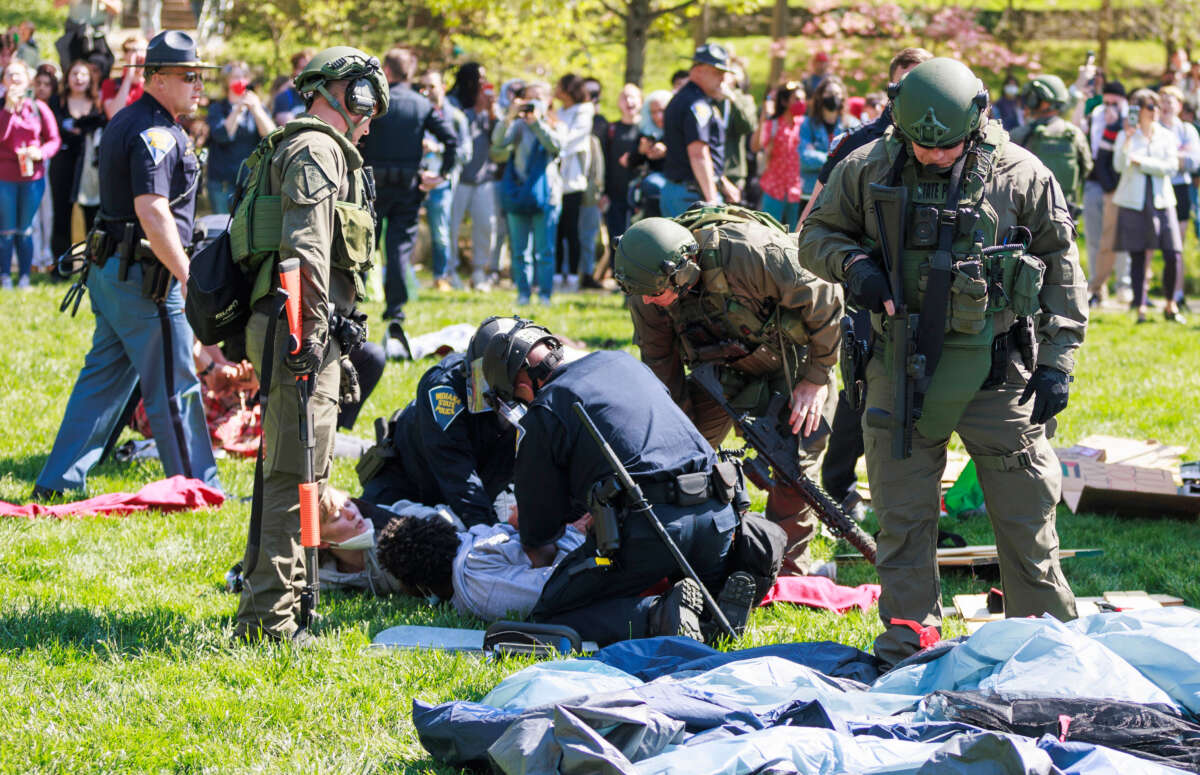
Dozens of people are arrested by the Indiana State Police riot squad during a pro-Palestinian protest on campus in Bloomington, Indiana, on April 25, 2024.

UN human rights officials are expressing alarm over the recent wave of violent repression by university administrators against the student protests for Palestinian liberation that have swept the U.S., raising concerns that protesters’ rights to free speech and assembly are being violated.

A statement on Tuesday said that UN High Commissioner for Human Rights Volker Türk, the UN’s top human rights officer, is “troubled” over a “series of heavy-handed steps taken to disperse and dismantle protests” across U.S. college campuses.

Freedom of expression and the right to peaceful assembly are fundamental to society — particularly when there is sharp disagreement on major issues, as there are in relation to the conflict in the Occupied Palestinian Territory and Israel,” said Türk. “I am concerned that some of the law enforcement actions across a series of universities appear disproportionate in their impacts.

Over the last two weeks, over 1,200 protesters have been arrested across dozens of campuses after university administrators enlisted police to crack down on encampments and other demonstrations set up by students calling for their schools to divest from Israel and supporting corporations, among other demands. At some universities, administrators even allowed law enforcement officers to aim sniper rifles at their students for their peaceful acts of protest.

UN Special Rapporteur on Human Rights Defenders Mary Lawlor said that universities’ crackdowns are an obvious violation of students’ rights.

https://www.ohchr.org/en/statements/2024/02/israelopt-enabling-human-rights-defenders-and-peaceful-protests-vital-achieving

https://www.ohchr.org/en/press-releases/2024/04/united-states-america-un-human-rights-chief-troubled-law-enforcement-actions

see also: the Economist of 30 April: Escalating protests expose three fault lines on American campuses

Excerpts from Türk’s global update to the Human Rights Council

March 4, 2024
UN Human Rights Chief Volker Türk at the 55th session of the UN Human Rights Council, OHCHR/Pierre Albouy

At the 55th session of the Human Rights Council, Volker Türk – UN High Commissioner for Human Rights – made his overview statement on 4 march 2024. Here some highlights:

….Around the world, 55 conflicts are flaring. Widespread violations of international humanitarian and human rights law are generating devastating impact on millions of civilians. Displacement and humanitarian crises have already reached an unprecedented scale. And all of these conflicts have regional and global impact.

Overlapping emergencies make the spectre of spillover conflict very real. The war in Gaza has explosive impact across the Middle East. Conflicts in other regions – including in the Horn of Africa, Sudan and the Sahel – could also escalate sharply. Increasing militarisation on the Korean Peninsula raises threat levels. The deteriorating security c risis in the eastern provinces of the Democratic Republic of the Congo, which the Council will address on 3 April, is alarming. In the Red Sea, as well as the Black Sea, attacks are creating shock-waves for the global transport of goods, adding to the economic pain inflicted on less developed countries…..

In Latin America and the Caribbean, the prevalence and violence of gangs and organized crime have severe impact on the lives and rights of millions of people, including in Ecuador, Haiti, Honduras and Mexico. Punitive and militarized responses have in some cases led to grave human rights violations, potentially further fuelling violence. Only policies grounded in human rights can provide effective and sustainable solutions. Corruption, impunity, poor governance and the structural root causes of violence – such as discrimination and failure to uphold economic, social and cultural rights – must be tackled, with the full participation of civil society and affected communities. International cooperation needs to be enhanced, to address the illegal arms trade and ensure accountability for transnational crimes…

Fear is fragmenting societies across the world, unleashing fury and hatred. They are also fuelled by a winner-take-all attitude that frames elections as the spoils of conquest.

..Good governance requires constant oversight and accountability, via independent checks and balances to the exercise of power, meaning that it is strongly underpinned by the rule of law, including independent justice systems. Fundamental freedoms – the rights to freedom of opinion, expression, peaceful assembly and association – are also essential.

I am profoundly concerned by the prospect of intense disinformation campaigns in the context of elections, fuelled by generative artificial intelligence. There is an acute need for robust regulatory frameworks to ensure responsible use of generative AI, and my Office is doing its utmost to advance them…

Autocracy and military coups are the negation of democracy. Every election – even an imperfect one – constitutes an effort to at least formally acknowledge the universal aspiratio n to democracy However, in a so-called ‘illiberal democracy’ – or, as the Prime Minister of Hungary referred to his country, an ‘illiberal State’ – the formal structure of election is maintained, civic freedoms are restricted, the media’s scrutiny of governance is eroded by installing government control over key media outlets, and independent oversight and justice institutions are deeply undermined, concentrating power in the executive branch.

It is important to recognise that in many cases, this year’s electoral processes will ensure a smooth transfer of power, free of hatred; and that the governance structures that result will broadly achieve their main function of representing the many voices of the people, and advancing their rights.

But in other cases, I have serious concerns about the human rights context in which several elections are taking place.

In the Russian Federation, the authorities have further intensified their repression of dissenting voices prior to this month’s Presidential election. Several candidates have been prevented from running, due to alleged administrative irregularities. The death in prison of opposition leader Alexei Navalny adds to my serious concerns about his persecution. Since the onset of Russia’s war on Ukraine, t housands of politicians, journalists, human rights defenders, lawyers and people who have simply spoken their minds on social media have faced administrative and criminal charges, and this trend appears to have worsened in recent months, with many cultural figures targeted. Last month, a new bill passed into law that further punishes people convicted of distributing information deemed to be false about Russia’s armed forces, as well as people who seek to implement decisions by international organizations that the Russian Federation “does not take part in”. I urge a swift and comprehensive review of all cases of deprivation of liberty that result from the exercise of fundamental freedoms; as well as an immediate end to the repression of independent voices and the legal professionals who represent them. The future of the country depends on an open space.

Iran’s legislative election three days ago was Iranians’ first opportunity to vote since the “Women, Life, Freedom” protests of 2022 and 2023. It took place in a country that has been deeply divided by the Government’s repression of the rights of women and girls. People who participated in the protests have been persecuted, imprisoned on long sentences and in some cases, put to death. The draft Bill on “Supporting the Family by Promoting the Culture of Chastity and Hijab”, if adopted, would impose severe punishments for acts that should not be deemed criminal in any country. In my ongoing engagement with the Iranian authorities, I have urged immediate reforms to uphold the rights of all Iranians, including the right of women to make their own choices, and an immediate moratorium on the death penalty….

In the United States of America, in this electoral year, it is particularly important for authorities at all levels to implement recent recommendations by the UN Human Rights Committee to ensure that suffrage is non-discriminatory, equal and universal. A 2021 Presidential executive order acknowledges that disproportionate and discriminatory policies and other obstacles have restricted the right to vote for people of African descent, and emphasises the need to overturn them. Yet according to the Brennan Center for Justice , at least 14 states have passed laws in 2023 that have the effect of making voting more difficult. In a context of intense political polarisation, it is important to emphasise equal rights, and the equal value of every citizen’s vote…

In Afghanistan, I deplore continuing and systematic violations of human rights, particularly the comprehensive violations of the rights of women and girls, which exclude them from every aspect of public life, including secondary and tertiary education; employment; and movement. Advancing the rights of women and girls must be the highest priority for all who work on and in Afghanistan. The civic freedoms and media freedoms of all Afghans are profoundly curtailed, with many women human rights defenders and journalists suffering arbitrary detentions. The resumption of public executions is horrific. I remain concerned about forced expulsion of Afghans from neighbouring countries, particularly for those who face a risk of persecution, torture or other irreparable harm in Afghanistan.

In the United Arab Emirates, another mass trial is underway based on counter-terrorism legislation that contravenes human rights law. In December, new charges were brought against 84 people, including human rights defenders, journalists and others who were already in prison. Several were nearing the end of their sentence or have been arbitrarily held in detention after completion of their sentence. Their joint prosecution constitutes the second-largest mass trial in the UAE’s history, after the so-called “UAE94” case in 2021, and includes many of the same defendants. I remain concerned about broader patterns of suppression of dissent and the civic space in the country, and I urge the Government to review domestic laws in line with international human rights recommendations.

Dialogue between China and my Office continues in areas such as counterterrorism policies, gender equality, minority protection, civic space, and economic, social and cultural rights. As we move forward, it is important that this dialogue yield concrete results, notably in respect of the policy areas raised during the Universal Periodic Review. I recognise China’s advances in alleviating poverty and advancing development, and I have urged that these advances be accompanied by reforms to align relevant laws and policies with international human rights standards. During the UPR, China announced plans to adopt 30 new measures for human rights protection, including amendments to the Criminal Law, and revisions of the Criminal Procedure Law. My Office looks forward to engaging with China on this; I particularly encourage revision of the vague offence of “picking quarrels and making trouble” in Article 293 of the Criminal Law, and I urge the release of human rights defenders, lawyers and others detained under such legislation. I also call on the Government to implement the recommendations made by my Office and other human rights bodies in relation to laws, policies and practises that violate fundamental rights, including in the Xinjiang and Tibet regions. I am engaging with the Hong Kong authorities on continuing concerns about national security laws…

In many countries, including in Europe and North America, I am concerned by the apparently growing influence of so-called “great replacement” conspiracy theories, based on the false notion that Jews, Muslims, non-white people and migrants seek to “replace” or suppress countries’ cultures and peoples. These delusional and deeply racist ideas have directly influenced many perpetrators of violence. Together with the so called “war on woke,” which is really a war on inclusion, these ideas aim to exclude racial minorities – particularly women from racial minorities – and LGBTQ+ people from full equality. Multiculturalism is not a threat: it is the history of humanity, and deeply beneficial to us all.

Peace, like development, is built and nourished through rights. It is by upholding and advancing the full spectrum of human rights, including the right to development and the right to a clean, healthy and sustainable environment, that States can craft solutions that are durable – because they respond to the universal truth of our equality and the inextinguishable desire for freedom and justice.

History is a record of humanity’s capacity to surmount the worst challenges. Among the greatest achievements of humanity over the past 75 years has been the recognition that addressing human rights in every country– all human rights; it is not an à la carte menu – is a matter of international concern.

See also: https://humanrightsdefenders.blog/2024/02/26/human-rights-defenders-issues-at-the-55th-session-of-the-human-rights-council/

For the ful text, see:

https://www.ohchr.org/en/statements-and-speeches/2024/03/turks-global-update-human-rights-council

Türk tells students in Geneva: Human rights are the solution

November 22, 2023

On 21 November 2023 Volker Türk, UN High Commissioner for Human Rights spoke at the Université de Genève. [see also: https://humanrightsdefenders.blog/2022/09/15/new-high-commissioner-for-human-rights-volker-turk-the-man-for-an-impossible-job/] Here some extracts:

First: war. One quarter of humanity is living today in places affected by conflict. At the end of last year, the Peace Institute in Oslo, which works closely with my Office, found that the intensity, length and number of conflicts worldwide are at their highest levels since the Cold War: 55 conflicts, lasting on average between 8 and 11 years.

In Ukraine, in Sudan, in Ethiopia, in Myanmar and across the Sahel – to take just a few examples – the level of atrocities and suffering is devastating. The armed conflict in the Occupied Palestinian Territory and Israel, after just five weeks, has seen over 11,500 people killed, including more than 4500 children – and I want to emphasise that the Gaza Ministry of Health has not been lable to update those numbers since 15 November. The war has lit a firestorm of hate speech across the Middle East and the entire world. The level of Antisemitic and Islamophobic attacks, in real life and online, is deeply shocking….

Time and again, we look back and see that conflict could have been prevented. In the Occupied Palestinian Territory, for example, my Office has repeatedly issued reports that recommend practical, feasible steps towards de-escalation of tensions and overcoming human rights violations. Injustice; discrimination; oppression; extreme inequalities; a lack of accountability for human rights violations: these are among the factors that will sadly make violence more likely.

Before I took up my mandate as the UN’s High Commissioner for Human Rights, I worked for 30 years in situations of failed prevention. I was working with and for refugees –in places where conflict had erupted, with dramatic impact on civilians; or where long years of discrimination metastasized into ethnic cleansing; or where deprivation had become so overwhelming that people were massively compelled to flee. Now, I feel my utmost priority has to be prevention – and solutions. Because that is what human rights bring. They state clearly what every human being is entitled to – a life that is free from fear and from the deprivation of certain essential resources – and in advancing those rights, they bring solutions to the root causes of preventable suffering…

Harsh restriction of civic space is the Achilles heel – the fatal weakness – of governance. If there is one message that I deliver again and again to Ambassadors and Heads of State or Government, it is this: ensuring that people can speak freely – and critically – and that they can fully and meaningfully participate in decisions will build more effective policy…

These are all measures that help to prevent conflict. They are also among the steps that can de-escalate conflict, by resolving some of its root causes; and they contribute to making a peace that is real and which can endure, with development that is sustainable because it is inclusive.

They are also key guidelines for addressing challenges as crucial and complex as climate change, runaway pollution and the obliteration of biodiversity. Acting to limit the triple planetary crisis, and upholding our right to a clean, healthy and sustainable environment, are the defining struggles of our generation.

This spiralling damage is a human rights emergency. Worldwide, climate change is pushing millions of people into hunger. It is destroying hopes, opportunities, homes and lives. In the Sahel region, a recent report by my Office outlines the profound impact of climate change-related soil degradation and declining food production on income, health, resource competition, conflict, and displacement – a vicious cycle that now spins deeper with every planting season. Temperatures in the Sahel are rising much faster than the global average; even if the global temperature rise is kept to an unlikely 1.5 degrees, the impact on the people of the Sahel will be permanent and devastating.

Across the Sahel, we can see very clearly how climate change, conflict, poverty, discrimination and lack of accountability feed into each other – creating a vast knot of issues that strangle the lives and rights of people.  But this is the case everywhere, as the climate crisis continues to generate profound and increasing threats to human rights. The dignity and the very survival of communities, of nations – and ultimately, all of humanity – is at stake.

So, again, how do we prevent this? Where are the solutions?

Notably, of course, we need global solutions. The governments and people of the Sahel, and many other regions that are experiencing extreme harm, did not contribute significantly to climate change. 

In a few days, global climate negotiations will resume in Dubai. It is absolutely essential that they lead to decisive and equitable action to prevent the worst impacts of climate change, and to remedy the impacts that can no longer be prevented. We have to ensure that Governments, businesses and individuals prioritise the interests of humanity over their short-term, narrowly defined self-interest. The fact is, the COP talks have to date fallen far short of what is needed to stop climate change and remedy its worst impacts. The world is dangerously off-track to meet the promises made in the Paris Agreement. Recent discussions on loss and damage are an example of  this. The climate justice movement, and many of the countries most vulnerable to climate change, struggled for years  for an agreement to establish a new loss and damage fund, finally achieving this objective at COP27. But the recommendations that have been sent to COP28 for operationalization of that fund do not satisfy the demands of those most affected by climate change. 

A strong governance framework that is grounded in human rights. Environmental and social safeguards. An inclusive and participatory Board. And a fair funding mechanism. These should be viewed as essentials – not a point of contention, or of trade-offs in negotiation.

Point one: We must protect civic space.

On the climate and environmental issues that affect us all, key decisions continue to be made behind closed doors – and are often influenced by fossil fuel lobbies. Environmental human rights defenders working to protect communities and land from environmental harm are often vilified, attacked and even killed. Their rights to participation, freedom of expression, and access to information and to justice must be secured. We must ensure the free, meaningful and safe participation in all climate discussions of all those most affected by climate change, including women and Indigenous Peoples.

Point two: climate action must advance equality and equity.

Adaptation strategies and all other measures need to prioritize the situation of people most affected by climate change. Funding must go first to the people who need it most.

Point three: We need to ensure access to effective remedy, and accountability, for climate-related harm.

Point four: we need resources for a rapid and just transition that advances human rights, including the right to a healthy environment...

In every country, we also need to see full participation and consultation on environmental laws and measures – notably for those who are most at risk – and protection of people who raise concerns about environmental harm and the policies that produce them.  Bashing climate protests; designing laws that unfairly restrict activities that call the public’s attention to climate harms; and allowing attacks on activists to go unpunished: these are tactics that ultimately harm all States and all human beings. We need to fix this urgently. [see also: https://humanrightsdefenders.blog/2023/10/15/climate-human-rights-defenders-increasingly-seen-as-eco-terrorists/]

So: Conflict. Discrimination. Poverty. The suffocation of civic space. The triple planetary crisis. These are five immense challenges that threaten our rights and our world, and they fuel each other. We face the compounding effects of all of them – while also confronting a surge of new human rights challenges, notably in the digital realm, including artificial intelligence and surveillance.

……

Over the past 75 years, the Universal Declaration of Human Rights has guided tremendous progress in countries across the world. It has inspired vibrant, creative, powerful activism and solidarity, empowering people to claim their rights and to engage actively in their communities and societies.

How could such a simple text guide such profound transformation? Because “recognition of the inherent dignity and of the equal and inalienable rights of all members of the human family is the foundation of freedom, justice and peace.” Greater respect for human rights – all human rights, building on each other ­– constructs more sustainable development. More enduring peace. A safer future.

This is an extraordinarily powerful truth…

Economies and societies that are inclusive and participative; in which opportunities, resources and services are equitably shared; and where governance is accountable, deliver justice, opportunities and hope…

And it is precisely in our era of rising storms that the 75th anniversary of the Universal Declaration of Human Rights can help us navigate to safety. Its essential values, which connect all of humanity, were set out to ward off horror and destruction, and they have been tried and tested. They embody the power of unity of purpose and the potential for transformative action – both within societies, and globally.

It is absolutely critical, now – precisely in this time of terrible crisis – that we rekindle the spirit, impulse and vitality that led to the adoption of the Universal Declaration of Human Rights, so that we can rebuild trust in each other, and move forward, united.

https://www.ohchr.org/en/speeches/2023/11/our-utmost-priority-solutions-turk-tells-students

see also: https://www.opportunitiesforafricans.com/office-of-the-high-commissioner-for-human-rights-un-ohchr-minorities-fellowship-programme-2024/

2023: it can only get better for human rights

January 3, 2023

It seems bold to be so optimistic, but lets not forget that the assertion starts from a very low base: 2022 was probably one of the worst years with the Ukrainian war, further repression in Russia, death sentences for protesters in Iran and no let up in China.

Also remarkable wss the relatively poor observance of internatioanl Human Rights Day on 10 December 2022. Usually I make selection of events (e.g. https://humanrightsdefenders.blog/2021/12/10/human-rights-day-2021/ and https://humanrightsdefenders.blog/2019/12/17/human-rights-day-2019-anthology-part-ii/), but this year there was little to report. Just these:

In an interview with Global Solutions of 9 December the “new” High Commissioner for Human Rights, Volker Turk, [see also:https://humanrightsdefenders.blog/2022/09/15/new-high-commissioner-for-human-rights-volker-turk-the-man-for-an-impossible-job/] gives an answer to the question: 10 December marks Human Rights Day; With this milestone – and your new role – in mind, what’s your vision for human rights?

I think we have to start with where we are with the world and we are at a very peculiar moment.  We have all lived through these multiple crises. We have seen the geopolitics, the divisions, the fragmentation, and all these things that have preoccupied us at a time when you would hope that the international community would come together and craft something that would respond to the big challenges that we face.

So for me, human rights is the force that comes in and unifies us.  Because it brings us back to human dignity and to what makes us all connected with each other. Let’s not forget that the Universal Declaration of Human Rights emerged out of the ashes of the Second World War.  It provided the inspiration and the motivation that the world needed at that time.  So, I think we need to almost counter intuitively go back to the basics of what this unifying force – this concentration on the human being – was.  We need to regain the universality and the indivisibility of the human rights regime.

Secondly, we also need to look at human rights in the 21st century, for example in the digital transformation that we’re seeing. Take the letter I wrote to Twitter’s Elon Musk, for instance. Social media platforms play a very important role. We know the role Facebook played in Myanmar, for example, when the Rohinga crisis happened, in allowing disinformation and hatred to spread. So, human rights needs to look at the type of issues that we face today.

And the third area that I hope we can achieve next year, is we have to look at the human rights ecosystem as a whole. So, what is the role of the treaty bodies, of the special procedures mandate-holders, of the Human Rights Council, Universal Periodic Review process, and of my own office too – and how do we strategically deal with different situations?

Freedom House took the occasion to consider that Political prisoners and the victims of human rights abuses have taken a back seat when global summits and events occur. But it is exactly because of those events that we should be giving the victims of such abuses our full attention...

Symbolic dates like International Human Rights Day offer space to reflect on and advocate for the rights of the brave people who have been imprisoned or experienced retaliation for standing up to repressive, authoritarian rule. But political prisoners and others fighting for freedom deserve our attention for more than one day of the year. We cannot allow their plight to be sidelined because it is inconvenient to think about them during an event like the World Cup.

The World Cup is one of several events in recent months that has drawn criticism for the human rights controversies surrounding it. In what was meant to be a historic summit to discuss the imminent threats posed by climate change, the latest United Nations Climate Change Conference (COP27), held in Egypt in early November, instead became a spotlight on the host country’s abysmal human rights record. The large number of human rights defenders and activists currently detained or imprisoned in Egypt was difficult to ignore, and one case in particular stood out for its perilously high stakes. British-Egyptian democracy activist Alaa Abdel Fattah, imprisoned for his activism, endured a six-month hunger strike, now over, which resulted in the Egyptian authorities denying his family the ability to contact him as the conference took place. They desperately pleaded with the authorities for proof he was alive, and his sister Sanaa took the stage at official summit events to advocate for her brother’s release. She faced threats from Egyptian officials who accused her of calling on foreign entities to intervene in the country’s internal affairs.

Participating governments could have added to this pressure and set the stage for the release of Abdel Fattah and numerous other political prisoners, by conditioning Egypt’s hosting role on freeing political prisoners ahead of COP27. Instead, the conference’s setting appeared hypocritical, as climate justice depends in large part on respect for democracy and human rights.

Similarly, this fall’s G20 summit saw leaders of multiple countries that hold political prisoners convene for strategic discussions. The lives and freedoms of imprisoned human rights defenders, journalists, and prodemocracy activists in Saudi Arabia, China, Turkey, Russia, Mexico, India, and even the host state Indonesia, were superseded by “other priorities.” In Indonesia, human rights defender Victor Yeimo, who has spoken out on the rights abuses occurring in West Papua, was arrested in May 2021, reportedly due to his involvement in antiracism and self-determination protests two years prior. Charged with crimes including treason, he remained in detention while the G20 met. His case and others across the various member states should have been highlighted, as respect for international human rights principles and commitment to strong democracies are key to long-term national and global security and economic stability.

Scott Walker, a Researcher at the Castan Centre for Human Rights Law, a and a Research Assistant within the Faculty of Law, Monash University.decided to draw attention to an important case concerning climate justice; On 10 December 2022 the world marks Human Rights Day commemorating the adoption of the Universal Declaration of Human Rights(UDHR) in 1948.  This year’s theme is dignity, freedom, and justice for all, in anticipation of the 75thanniversary of the UDHR in 2023. It gives us cause to reflect on the mobilising force that the UDHR has become in the struggle for human rights across the world. Yet, there is always more work to be done to truly achieve a world in which dignity, freedom, and justice is a lived reality for all. To do so we must utilise human rights both as a guidepost for advocacy and a tool for concrete, on the ground change to address some of the most pressing and ongoing challenges facing our world; including the immediate and catastrophic impacts of climate change

Here in Australia, the path to domestic enshrinement of human rights has been a meandering one: only two States (Victoria and Queensland) and one Territory (the Australian Capital Territory) have Human Rights Acts. Yet, the capacity of these Human Rights Acts to achieve real and meaningful change in people’s lives is profound. Increasingly, people on the frontline of the climate crisis are also turning towards human rights to achieve justice. The potential impact of human rights-based climate litigation was recently demonstrated in the decision of the Land Court of Queensland in Warratah Coal Pty Ltd v Youth Verdict Ltd. In this case, the Court recommend against the grant of a mining lease and environmental authority to allow Warratah Coal to mine thermal coal in Queensland’s Gallilee Basin.  This case deserves closer examination to illustrate the way in which human rights enshrined in law can be mobilised in claims for climate justice.  

On 10 December 2022, the Human Rights Campaign Foundation (HRCF), the educational arm of the nation’s largest lesbian, gay, bisexual, transgender and queer (LGBTQ+) civil rights organization, announced this year’s recipients of 20 Global Innovation Small Grants as a part of the organization’s Global Partnerships Program. The grants range from $1,000 to $5,000 and are awarded to organizations around the world working to improve the lives of LGBTQ+ people in these countries. This announcement coincides with International Human Rights Day, which is celebrated annually around the world, marks the December 10 anniversary of the United Nations adoption of the Universal Declaration of Human Rights in 1948. The declaration was the first of its kind and recognized that “every human being is born free and equal in rights and dignity.” The grants support members of of HRC’s growing global alumni network, which now consists of some 200 LGBTQ+ advocates in close to 100 countries. All of them have participated in one of the HRC Foundation’s global programs, including the flagship annual Innovative Advocacy Summit.


The Network of Chinese Human Rights Defenders, December 9, 2022 Ahead of International Human Rights Day on December 10, CHRD celebrated the courage and bravery of human rights advocates and calls on the Chinese government to stop violating its obligations to protect human rights and free those detained for exercising their human rights. We urge the international community to keep hope alive and continue supporting defenders on the forefront. 

In recent years. Xi Jinping, the General Secretary of the Chinese Communist Party, has suffocated civil society and space for free expression, jailed COVID whistleblowers, journalists, lawyers, labor organizers and feminists, LGBTQ+ activists and religious practitioners. Yet we are encouraged by the glimmers of hope that have emerged in the recent protests. The protests demanding political changes began with spontaneous gatherings to pay tribute to Uyghur victims in the Urumqi FireThe rapidly spreading protests, led by youth, likely proved to be the last straw in forcing the Chinese Party-State to reverse course on its draconian “zero-COVID” measures. 

Reasons for hope: Young people have brought new vitality to the fight for human rights

The scope of this short-lived wave of protests in cities across China was enormous, comparatively speaking. Thus far, there have been at least 68 protests across 31 cities since November 25according to the Australia Strategic Policy Institute (ASPI). And it has largely been young people who have led the protests. The Urumqi apartment complex fire, which took the lives of at least ten Uyghur women and children, as rescue was obstructed by barriers thought to be erected for COVID lockdown but likely for  “counter-terror” measures, brought people into the streets to mourn the loss of lives, to assemble and speak out against the devastating zero-COVID control and the political system that made such control possible.   

https://freedomhouse.org/article/imprisoned-not-forgotten-rights-abuses-and-global-events-hide-th

https://genevasolutions.news/human-rights/volker-turk-it-s-my-duty-to-be-the-voice-of-human-rights

Short message from the new High Commissioner for Human Rights: Volker Turk

October 18, 2022

On 17 October 2022 Volker Türk begun his mandate as the 8th UN High Commissioner for Human Rights.

See also: https://humanrightsdefenders.blog/2022/09/15/new-high-commissioner-for-human-rights-volker-turk-the-man-for-an-impossible-job/

New High Commissioner for Human Rights Volker Turk – the man for an impossible job?

September 15, 2022

On 23 June 2022 Marc Limon, Executive Director of the Universal Rights Group posted a Blog: “Time to ask again: is being the UN High Commissioner for Human Rights an impossible job?”

In February 2018, he published a blog on the early departure of the previous High Commissioner for Human Rights, Zeid Ra’ad Al Hussein. The blog responded to David Petrasek’s article in OpenGlobaRights, entitled ‘Another one bites the dust’ (8 February 2018).

Limon argues that the High Commissioner position is, in fact, several jobs rolled into one. The mandate of the High Commissioner and his/her Office comprises inter alia:

  • Monitoring and speaking out about human rights violations around the world – ‘preventing the continuation of human rights violations throughout the world,’ (OP4f of GA resolution 48/141 of 7 January 1994).
  • Acting as the Secretariat to the ‘competent bodies of the United Nations system in the field of human rights and [making] recommendations to them,’ (OP4b of GA res. 48/141).
  • Providing capacity building, advisory services and technical assistance, at the request of the State concerned, ‘with a view to supporting actions and programs in the field of human rights,’ (OP4d, GA res. 48/141).
  • Engaging in human rights diplomacy (‘dialogue’) with governments and ‘enhanc[ing] international cooperation,’ in order to promote the implementation of international human rights obligations and commitments, and respect for human rights, (OP4g, OP5h, GA res. 48/141).
  • Coordinating human rights mainstreaming across the UN system, (OP4i, GA res. 48/141).
  • Making recommendations and driving efforts to ‘rationalize, adapt, strengthen and streamline the United Nations machinery in the field of human rights with a view to improving its efficiency and effectiveness,’ (OP4j, GA res. 48/141).

It is clear that, when held in the hands of a single human being, these different parts of the High Commissioner’s overall mandate operate in tension and are, perhaps, even mutually incompatible…

Is it possible for one person to wear all these hats at the same time? Can a single person publicly criticise States in one breath, then in the next reach out to them to forge agreement on reform of the UN human rights system or to provide human rights technical assistance?

Petrasek has made no secret of his belief (apparently shared by the UN Secretary-General, Antonio Guterres) that Zeid over-prioritised human rights monitoring and public advocacy, to the detriment of almost all other parts of his mandate. Yet for many other civil society representatives in Geneva and for many Western diplomats, this singlemindedness (together with Zeid’s natural eloquence) made the former High Commissioner something of a cult hero and the perfect High Commissioner,

Fast forward four and a half years and Zeid replacement as High Commissioner, the former President of Chile Michelle Bachelet, has also fallen on her sword – yet for precisely the opposite reasons as Zeid.

Bachelet was handpicked by Guterres to mark a clear break from Zeid by pursuing a more holistic and balanced approach to the role and mandate of the High Commissioner. In addition to public advocacy Bachelet tried to emphasise human rights diplomacy, international cooperation, support for the international human rights machinery, a focus on emerging thematic human rights concerns (e.g., climate change, the right to a healthy environment, prevention, digital technology), and the on-the-ground delivery of technical assistance and capacity-building support.

See: https://humanrightsdefenders.blog/2022/06/09/disappointment-with-un-high-commissioners-visit-to-xinjiang-boils-over/ and

In truth, the world needs a High Commissioner Zeid and a High Commissioner Bachelet. The question is: is that possible? Maybe other solutions might be considered? Might, perhaps, the High Commissioner focus on public advocacy, and the Deputy High Commissioner on the more cooperation-orientated aspects of the mandate? Maybe different Deputies could be appointed for each of the main ‘baskets’ of the High Commissioner’s overall mandate? Or maybe the parts of the mandate related to the human rights machinery could be ‘spun off’ – for example, into a new position of secretary-general of the Human Rights Council and its mechanisms, and of the Treaty Bodies?

These are difficult and sensitive questions, and yet it is surely important that they be asked and considered now rather than later. Perhaps today, as the Secretary-General ponders the appointment of the next High Commissioner, is an opportune moment to do so?

On September 7, 2022, the UN announced Secretary-General António Guterres’ decision to appoint Volker Türk, an Austrian national, to replace Michelle Bachelet.

Reactions were swift, most of them expressing the need for action, e.g. “The new UN high commissioner for human rights should neither seek nor expect a honeymoon period from UN member states,” said Tirana Hassan, interim executive director of Human Rights Watch on 8 September “What’s needed by the millions of people around the world whose rights are being violated every day is an advocate in their corner who will take on abusive governments large and small without fear and without hesitation.”

Yoni Ish-Hurwitz, Executive Director of Human Rights Likeminded Office was invited by the Universal Human Rights Group on 12 September, 2022, to contribute a Blog `’Who is Volker Türk?’:

Opinions have already begun forming about Volker Türk in the short time since the announcement of his appointment last week as the new UN High Commissioner for Human Rights. However, in the absence of a public competition, there was little opportunity to learn about Türk. He is also not well-known outside of the UN (and had few followers on twitter until last week). Therefore, in the absence of personal familiarity, it may be useful to focus on his biography, body of work and statements. This would lead to a better understanding of why he was selected for this role. [DISCLAIMER; I happen to know him personally from my days in UNHCR. He has always struck me as an honest and dedicated person with a pronounced interest in the human rights side of refugee work.]

Central to Türk’s biography is his long professional relationship with the Secretary-General Antonio Guterres. They worked together at UNHCR when Guterres led the agency as High Commissioner for Refugees. When Guterres became UN Secretary-General, Türk joined him in New York, to serve as Assistant Secretary-General for Strategic Coordination in the Executive Office. Guterres promoted him in January, to the rank of Under-Secretary-General for Policy, also in the Executive Office, perhaps setting him up to take the role of the High Commissioner for Human Rights.

Having a close confidant as the High Commissioner may be especially important for the Secretary-General at present, considering the significant current political challenges he faces. This is especially the case in the aftermath of the release of the long-awaited report on Xinjiang by the former High Commissioner, Michelle Bachelet. She spared Türk the need to continue holding this hot potato. However, China won’t let Türk off the hook, and will likely exert pressure on him, as it has done with Bachelet, to carefully weigh his words and the way he manages his Office’s work on China. In the meantime, Chen Xu, the Permanent Representative of China in Geneva, announced that ‘the Office closed the door of cooperation by releasing the so-called assessment.’ This means that this is one political crisis that will not end with Bachelet’s departure.

One key question is whether the new High Commissioner will prioritise engagement over speaking truth to power. Bachelet was criticised of doing just that following her recent statements on China, until she released her report at the 11th hour on the job. .. On the face of it, it may appear that Guterres selected a diplomat, rather than an advocate. Türk is a UN career officer through and through, and as such he is in a better position to offer ‘good offices,’ as the UN does, compared to any former Head of State that could have taken the High Commissioner’s post. Among his predecessors were two presidents, two supreme court judges, one foreign minister and one permanent representative to the UN headquarters. However, every day before walking into his new office, the face that Türk will see first is that of his predecessor Sérgio Vieira de Mello, who also spent most of his career in UNHCR. He was commemorated in a bust at the entrance to Palais Wilson, four years after his death in a bombing at UN headquarters in Iraq.

Türk worked in the UN refugee agency for over 30 years, including in the field. Coming from within the UN system is an asset for navigating organisational politics, fostering collaboration with other parts of the UN, enhancing the contribution of OHCHR to all relevant UN fora, and understanding how to engage with Member States to address the situation of the most vulnerable people. His intimate understanding of the UN system is manifested in two major initiatives he stewarded – the Secretary-General’s flagship report, Our Common Agenda, as well as the Secretary-General’s Call to Action for Human Rights. This may not be the place to analyse their successes or shortcomings, but it can be said that they were both well-received. Our Common Agenda offered a vision for mobilising the UN to address global challenges. OHCHR needs a manager with this kind of foresight to grasp the organisation’s structure, programmes and needs. The second initiative, the Call to Action for Human Rights, identified areas for action to advance human rights. As High Commissioner, perhaps Türk will be in a better position to support the implementation of the Call to Action.

This work demonstrates deep engagement on human rights. His legal background, holding a doctorate in international law, will support his role as an advocate. He can substantively articulate concerns and uphold norms based in international human rights law, humanitarian law and refugee law. He certainly appears as an advocate on twitter (@volker_turk). His tweets show his compassion, as he mostly addresses human rights concerns, with people at the centre.

Civil society was concerned about the selection process. Phil Lynch, Executive Director of the International Service for Human Rights (ISHR), said: ‘The lack of transparency and meaningful consultation with independent civil society in the selection process meant that the Secretary-General missed a key opportunity to build the legitimacy and authority of the next High Commissioner.’ The appointment of the Secretary-General’s confidant may have reaffirmed worries that the High Commissioner would prioritise diplomacy and engagement over advocacy for human rights. However, Türk appears to have the appropriate biography and a heart in the right place to fulfil both of the High Commissioner’s roles as an advocate and a diplomat. Hopefully he will be attentive to civil society and rights-holders, in line with his advice during his time as Assistant High Commissioner for Protection at UNHCR: ‘Listen to what refugees are telling us.’

After being appointed at the last minute as the next UN high commissioner for human rights, Volker Turk is not expected to be at the 51st session of the UN Human Rights Council, held from 12 September to 7 October. When he does, Turk will have to grapple among other challenges with his predecessor’s report on Xinjiang, but for the moment deputy high commissioner Nada Al Nashif is in charge of the UN rights office and will have to answer any questions about China that might come up during the first days of debate..

https://www.universal-rights.org/uncategorized/time-to-ask-again-is-being-the-un-high-commissioner-for-human-rights-an-impossible-job/

https://www.hrw.org/news/2022/09/08/un-new-rights-chief-should-speak-out-all-victims