Posts Tagged ‘Human Rights Defenders’

Chau Van Kham – Australian human rights defender – ‘disappeared’ inside Vietnam’s prison system

June 8, 2020

Chau Van Kham’s family has lost contact with him for nearly four months and fear the Australian government has ‘forgotten about him’ writes the Guardian on 6 June 2020.
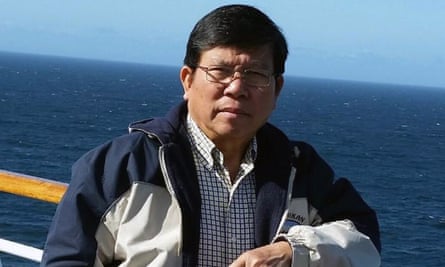
Chau Van Kham

Vietnamese-born Australian, Chau Van Kham, was arrested in January 2019 and sentenced to 12 years imprisonment on ‘financing terrorism’ charges. Photograph: HRW/HANDOUT/EPA

Ben Doherty reports that the 70-year-old Australian Vietnamese-born Chau has “disappeared” inside Vietnam’s prison system and that no one from his family or the Australian government has been allowed to see or speak with him for nearly four months. Human rights advocates, lawyers and Chau Van Kham’s family said the charges against him are baseless and politically motivated, his single-day multiple-defendant trial was grossly unfair, and his failing health means his 12-year prison sentence is “effectively a death sentence”.

Chau’s son Dennis told the Guardian his family feared his failing health will be exacerbated by his isolation.  Chau’s sister, who lives in Vietnam, had previously been allowed to visit once a month to give her brother money, medicine and letters from home. But she has been refused access and phone calls to him since 10 February. Consular visits scheduled for February, March, April and May were all cancelled out of concerns over the spread of Covid-19. Permission for a visit in June is pending.

He has literally disappeared,” Australian lawyer Dan Phuong Nguyen, who is acting pro bono for the Chau family, told the Guardian.

[Chau, an Australian citizen, was born in Vietnam and served in the army of the Republic of Vietnam before 1975. After the war, he was sent to a re-education camp for three years before he fled Vietnam by boat, arriving in Australia in 1983. In Sydney, he worked as a baker for decades, rising before dawn to work at a modest suburban bakery. In 2010, he became a member of the Viet Tan pro-democracy organisation, and became a key Australian organiser of pro-reform rallies and an outspoken advocate for democratisation in Vietnam. The United Nations describes Viet Tan as “a peaceful organisation advocating for democratic reform”, but it was formally proscribed as a terrorist organisation by the Vietnamese government in 2016, which said it was “a reactionary and terrorist organisation, always silently carrying out activities against Vietnam.]

Chau sought to return to Vietnam in 2019 to meet fellow pro-democracy advocates but was refused a visa. He crossed into Vietnam via a land border with Cambodia in January, carrying a false identity document. He was arrested after meeting a democracy activist who, it is believed, was under surveillance, along with Vietnamese nationals Nguyen Van Vien and Tran Van Quyen, who were sentenced to 11 and 10 years prison respectively.

Chau was convicted and sentenced at his first appearance in the people’s court of Ho Chi Minh City after more than 10 months in detention.

The single-day judge-only trial, held simultaneously with four other people, saw him tried and convicted on charges of “financing terrorism”, and sentenced to 12 years in jail, all within four hours.

The court was effectively closed – open only for approved people, his family was excluded – for the entirety of the trial. Viet Tan condemned Chau’s hearing as a “sham trial” and said it would “continue to support human rights defenders on the ground”.  Chau’s appeal was dismissed in March.

Dennis Chau told a human rights summit in Geneva this year: “With a 12-year sentence, [my father will] be 82 when he is released … I don’t believe I’ll ever see him alive, a free man. It’s effectively a death sentence.”

https://www.theguardian.com/world/2020/jun/07/jailed-australian-democracy-activist-has-disappeared-inside-vietnams-prison-system

Abuse of nature and people: Environmental and Justice Activists Need to Join Forces

June 7, 2020

Image: Stournsaeh/Shutterstock

Cayte Bosler wrote on 3 June 2020 for the General Earth Institute a blog repeating the often heard warning that “Environmental and Justice Activists Need to Join Forces“. (https://blogs.ei.columbia.edu/2020/06/03/environmental-justice-activists/). It also relates this to the recent upheavals in the USA started by the killing of George Floyd:

Resistance inspires. Defiance in the face of a violent, oppressive culture can inspire another person’s defiance. Even when an uprising is only beginning, when the path forward is unclear, it is essential to resist. All together. The goal: to defeat a system fundamentally, historically, and intentionally based on mass exploitation in the interest of profit for a privileged few.

The environmental movement can learn from those who come from a tradition of resistance and have organized their struggle in movements like Black Lives Matter and Idle No More, founded by First Nations. The protests enveloping our country today are seeded by centuries of injustice and violence, by underlying power imbalances and inequalities that have never been truly addressed. The founders of these social movements knew then and now that they cannot combat violent oppressors through pure persuasion. So they resist.……….

Environmentalists and justice activists cannot stay isolated in their movements. To be effective at combating climate change and countless other social and environmental injustices, we must acknowledge the links between the abuse of nature and people, and devise strategies to protect the planet, to resist its demise – even when doing so is frightening. Especially then. Ultimately, resisting mass exploitation on all fronts is the only thing that will make us safer.

For many — especially people of color — the impacts of climate change and the degradation of environmental harm are not a future concern. It is life or death, and it’s happening now. If we want to reverse the losses, we need to begin to speak honestly to each other about the long history of abuse that has led to the unrest, rage, and grief that we feel today. We need to confront how power works in society, including in regions where exploitation of indigenous people and the ecosystems they call home go unnoticed by mainstream media….

In addition to poverty, lack of clean air, safe drinking water, health care, and more—all of which lead to “preexisting conditions”—many communities of color are confronted with the threat of coronavirus and are more vulnerable to the pandemic. Reports estimate that people of color are twice as likely to die from COVID-19…….

The author provides several examples from her own field work and experience……

How can we endeavor to protect the planet when its frontline defenders are being killed or intimidated by state-sanctioned violence? How can we expect to solve the climate crisis if our strategies do not include protecting life above corporate, government, and elite interests? Again, environmental advocates can learn from movements born from violent exploitation who are organizing to resist that violence.

Viable movements need supportive cultures to sustain them. They require healthy norms of behavior, processes to handle conflict, and ways to defeat destructive internal divisions and competition that stymie even the best-intentioned efforts toward progress. Horizontal hostility—a concept defined by Florynce Rae Kennedy, an African American lawyer, feminist, civil rights advocate, lecturer, and activist—occurs when activists fight against each other over differences rather than vertically against the oppressor. This behavior leaves relationships, activist networks, and movements in shreds.

A livable planet for all requires solidarity, using our shared principles and humanity to rise together to protect nature and banish injustice.

Cayte Bosler is a student in Columbia’s Sustainability Management masters program.

see also: https://humanrightsdefenders.blog/2019/08/06/environmental-human-rights-defenders-more-deadly-than-being-a-soldier-in-a-war-zone/

https://humanrightsdefenders.blog/2020/04/24/land-rights-defenders-are-the-main-target-of-those-destroying-the-environment/

19 of the Most Influential Civil Rights Leaders of the 21st Century in the USA

June 6, 2020

The killing of George Floyd has brought a renewed focus on racial injustices in the American criminal justice system, which include mass incarcerations and excessive  punishment. [see also: https://humanrightsdefenders.blog/2020/06/06/civicus-expresses-solidarity-with-us-protesters-in-their-struggle-for-justice/ ]

Today’s civil rights leaders have picked up the mantle once held by Martin Luther King Jr., Malcolm X, Roy Wilkins, and Dorothy Height. ……

Hristina Byrnes and John Harrington in 24/7 Tempo of 4 June 2020 have compiled a list of the most important civil rights leaders of the 21st century. They created the list after reviewing biographies and news stories from resource material, websites of organizations such as the National Association for the Advancement of Colored People, the Nobel Prize website, and media sites.

Click here to see the most important civil rights leaders of the 21st century

Click here to read the detailed findings and methodology

EU human rights committee condemns India’s arrest of human rights defenders

June 1, 2020
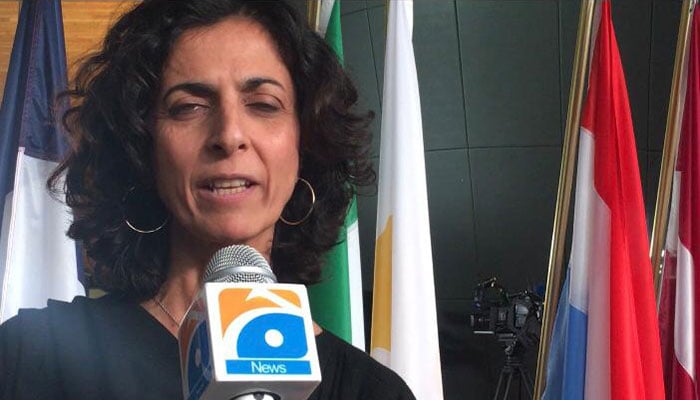
Maria Arena is the chairperson of the Subcommittee of Human Rights of the European Parliament member of Socialist and Democrats parliamentary group. Photo: Reporter

20 May 2020 the chairperson of the Subcommittee of Human Rights of the European Parliament sent a letter to Indian Home Minister Amit Shah, condemning the arrest of human rights defenders under the Unlawful Activities (Prevention) Act.

In her letter, Maria Arena said the European body has been closely following the arrests of human rights defenders Anand Teltumbde and Gautam Navlakha by the National Investigative Agency in India.

Academic and Dalit author Teltumbde and human rights defender Navlakha had surrendered to the police last month after exhausting their possible legal remedies.

Nine other defenders have been in jail since 2018 in the Bhima Koregaon case, where the charges relate to caste violence around an Ambedkarite event and an alleged Maoist plot to foment armed revolution and possibly assassinate Prime Minister Narendra Modi.

In 2018, the United Nations’ Office of the High Commissioner for Human Rights had issued a statement against terror charges being invoked against the activists.

It is particularly alarming to note that human rights defenders cannot conduct advocacy activities, notably in favor of India’s poorest and most marginalised communities, without becoming subject to intimidation and harassment,” Arena said in her letter.

Equally worrying is the fact that terrorism charges, including under the Unlawful Activities Prevention Act (UAPA) have been used to silence them,” she noted pointing out that by United Nations Special Procedures, this clearly represents a violation of international human rights standards.

The letter further stated that to date, the European Parliament had noted that various forms of legitimate peaceful protests against laws, policies and governmental actions, including the Citizenship Amendment Act, had been portrayed as terrorist activities under this legislation, resulting in a number of arrests. [see also: https://humanrightsdefenders.blog/2018/10/07/india-attacks-on-human-rights-defenders-abound-under-unlawful-activities-prevention-act/]

This is notably the case for human rights activists such as Safoora Zargar, Gulfisha Fatima, Khalid Saifi, Meeran Haider, Shifa-Ur-Rehman, Dr Kafeel Khan, Asif Iqbal and Sharjeel Imam, who were recently arrested by the police,” the letter noted.

Against this background, there are also increased fears that the legislation might confer discretionary powers upon state agencies. India, she said, should do much more to ensure a safe and conducive environment for civil society working in the country and consider enacting a law on the protection and promotion of human rights defenders.

In a similar vein, ProtectDefenders on May 26 2020 reports “Increasing attacks against human rights defenders in India and Guatemala”. …..

Over the past month, ProtectDefenders.eu has received a considerable and growing number of reports regarding attacks, threats, and alerts affecting human rights defenders in India. This information alerts to the numerous acts of police and judicial harassment in the repression of legitimate activities in favor of human rights. Among other incidents, police harassment and arbitrary detention of human rights defenders were reported in Manipur State, in relation to statements made to criticise the management of the current COVID-19 pandemic by local authorities.

Safoora Zargar, a 27-years old student and woman human rights defender unjustly detained since 10 April, is one of the OMCT’s campaign #FacesOfHope

For the OMCT campaign see: https://humanrightsdefenders.blog/2020/05/25/faces-of-hope-campaign-human-rights-defenders-imprisoned-worldwide/

Moreover, the Paris-based International Federation for Human Rights has written to Prime Minister Narendra Modi and home minister Amit Shah terming the detentions of several Indian human rights activists ‘arbitrary’. It says the activists have been arrested for “their participation in peaceful protests against the Citizenship Amendment Act 2019 (CAA)” in the last few months.

The letter highlights the cases of Devangana Kalita and Natasha Narwal, student activists who have been associated with the anti-CAA protests in Delhi and were arrested recently by the Delhi police.

https://www.geo.tv/latest/290529-eu-human-rights-subcommittee-condemns-indias-arrest-of-human-rights-activists

https://www.telegraphindia.com/india/europe-flags-rights-concern/cid/1777254

https://thewire.in/rights/ifhr-anti-caa-activists-arrests-release

4 June: Virtual Discussion with Human Rights Defenders During COVID-19

May 29, 2020

Live discussion with 3 human rights defenders from across the globe

This event is part of the ‘Mural of Change’ campaign by Justice and Peace. 

Today, more than ever before, we need to bring awareness to human rights, justice and environmental action. For this reason, we from Justice and Peace Netherlands have brought to you the ‘Mural of Change’ – a vibrant graffiti mural in The Hague representing known and unknown human rights defenders from around the world. The mural created by the graffiti-art duo Karski & Beyond is a visual statement and a call to action, as it comes in the unprecedented times of COVID-19 pandemic.  [see: https://humanrightsdefenders.blog/2020/05/19/mural-of-human-rights-defenders-vitaly-safarov-greta-thunberg-and-berta-caceres-unveiled-at-hague-university/]

As part of our campaign to spread the message of change and action for human rights, we invite you to join our virtual event ‘Standing Side By Side With Human Rights Defenders’. During this event you will have the opportunity to meet three human rights defenders that took part in Shelter City. They will share with you the challenges they have been facing due to the COVID-19 pandemic; how their countries and the countries in their regions have responded to the spread of the virus; and how we can support them in their work. You will also have the chance to get in a conversation with them and ask your own questions.

SPEAKERS:

  • Genesis Davila, Human rights lawyer from Venezuela
  • Shibolo Awali, Lawyer and LGBTI rights defender from Uganda
  • Asha Kowtal, Dalit women’s rights defender from India

This discussion will be moderated by Tessa de Ryck, Security Training Coordinator for HRDs at Justice and Peace. The event will be in English.

https://www.crowdcast.io/e/xd56xkt9/register

Internet of things (IoT) connectivity for Natalia

May 28, 2020

Swedish operator Tele2 is to provide IoT connectivity to the Civil Rights Defenders’ Natalia Project, allowing those in the program who feel under threat to use a specially issued wearable device to send a distress signal with a GPS location to nearby local contacts, as well as to the Civil Rights Defenders headquarters in Stockholm. [The Internet of things (IoT) is a system of interrelated computing devices, mechanical and digital machines provided with unique identifiers (UIDs) and the ability to transfer data over a network without requiring human-to-human or human-to-computer interaction]. In the future, Tele2 will provide IoT connectivity to every unit in the Natalia Project, including roaming on more than 450 networks worldwide

https://humanrightsdefenders.blog/2014/04/24/the-natalia-gps-alarm-bracelet-wins-golden-egg-awards-in-stockholm/

The Natalia Bracelet is named in honor of Natalia Estemirova, a human rights activist who was abducted and murdered in Chechnya in 2009.

Phyllis Omido, a Kenyan environmental human rights defender who participates in the Natalia Project, said the scheme has freed her from fear as she knows that someone is watching over her, adding that no tangible change can be achieved when one constantly lives in fear of retribution. 

https://www.telecompaper.com/news/tele2-provides-iot-connectivity-for-civil-rights-defenders-security-alarms–1340142

Zimbabwean Human rights defender sets up torture fund

May 28, 2020

On 28 May 2020 Bulawayo News reported that Kwekwe-based human rights defender Nkosilathi Moyo said he was putting together a war chest to assist victims of State-sponsored violence.

Moyo launched his fight for democracy in 2015 when he travelled to the Netherlands and met European Union’s human rights ambassadors lobbying them to support human rights defenders in Zimbabwe. During the visit he also met Queen Maxima of the Netherlands and lobbied her to support efforts to improve democracy back home.

Speaking to Southern Eye on Monday, Moyo said the recent events that saw MDC Alliance’s Harare West MP Joanah Mamombe, youth leaders Cecilia Chimbiri and Netsai Marova, and Amalgamated Rural Teachers’ Union of Zimbabwe gender secretary Moreblessing Nyambara tortured at the hands of suspected State security agents, had motivated him to set up the fund.

Prior to the COVID-19 crisis, I established the community human rights defenders academy which trained more than 80 defenders in Midlands province, empowering them with skills to enhance human rights and democracy in Zimbabwe.”

Now in light of the upsurge in violations against activists with the height of that madness being abduction of an MP Joanah Mamombe and others, I have been jolted to act. So far I have written to foreign embassies in Harare, international donors and other development partners to solicit for a financial facility that would support victims of human rights violations. We have also started putting together resources with local partners for the same cause,” Moyo said.

In the past, Moyo through his organisation Zimbabwe Youths in Politics, raised awareness on good governance and tenets of democracy mostly among rural dwellers.

[see also: https://humanrightsdefenders.blog/2013/02/04/zimbabwe-death-threats-against-human-rights-defenders-nkosilathi-moyo-and-jasper-maposa/]

What we are realising is that autocratic regimes take advantage of poverty among political activists to suppress them and violate their rights at will. But with the kind of funding we are putting together, that will not be the case. Activists need to be supported to meet medical bills, legal representation costs, programming of their activities and compensation to their families in extreme cases. So that is the motivation of our current efforts. We should not wait for the worst to happen, then we start running around to look for resources. A ready fund must be there,” Moyo said.

https://bulawayo24.com/index-id-news-sc-national-byo-186130.html

4 June 2020 Webinar on business and human rights in the context of COVID-19

May 27, 2020

Having just posted a report on the prolifiration of intergovernmental responses to the Corona virus pandemic [https://wp.me/pQKto-4ob], it perhaps good to point to the webinar that Business & human rights is organising on 4 June 2020 on Risks and Protection of Human Rights Defenders.

This webinar will have a focus on the risks and protection of HRDs, particularly labour rights and land/environmental defenders and ensuring their participation in the post-pandemic recovery.

Date & Time: 4 June, 4.15 – 5.15 (ICT) / 10.15 – 11.15 (BST)

It will have two parts: a closed and an open session. The closed session – happening on Jitsi – will be a safe space for civil society organisations, human rights defenders, including labour rights and land and environmental defenders, labour unions, and journalists to jointly define practical recommendations on what governments and companies can do to address human rights situation, particularly of labour, land, environmental defenders and civic freedoms, in the context of COVID-19. This part of the webinar is invite-only.

The second part – happening on Zoom – will be an open session, will be an opportunity for civil society, defenders, and journalists to interact with government and business representatives and discuss how companies, governments and civil society can work together to ensure all stakeholders are able to shape recovery efforts, and make sure they are human rights compliant. Anyone is free to join us in the public session by RSVP-ing below.

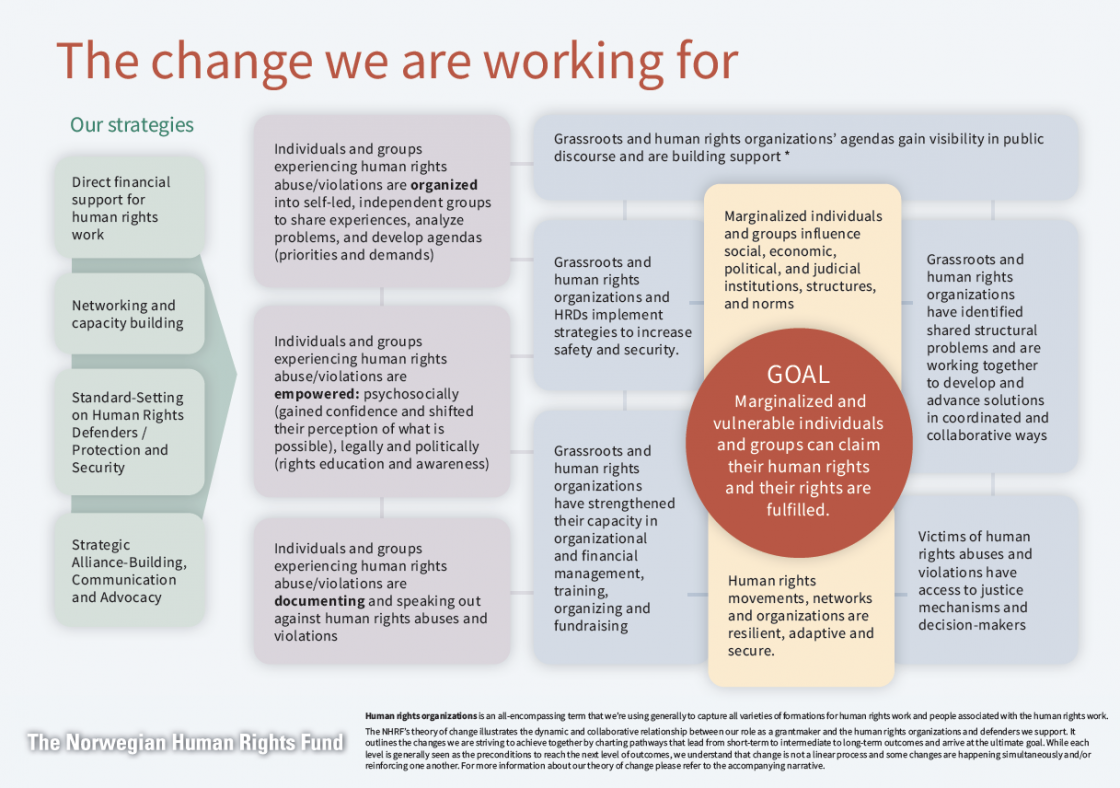
Norwegian Human Rights Fund publishes its theory of change

May 20, 2020

Perhaps the home-bound period of the pandemic is a good time to reflect more deeply on the way we work. The Norwegain Human Rights Fund has done this [see also: https://humanrightsdefenders.blog/2019/07/29/nhrf-seeks-a-theory-of-change-consultant/] and now reports the first result:

The development of the theory of changewas a participatory process involving the NHRF Secretariat, its Board, NHRF local consultants, and a selection of grantee partners. It is a living document that represents our theory of how change is created and driven forward. It articulates expected outcomes and their preconditions that, together, form pathways of change that lead to the overall goal. We understand these processes to be non-linear, interconnected, interdependent, mutually reinforcing, and occurring simultaneously or separately. The theory of change will guide our work as a partner and grantmaker by informing the support we provide to human rights work to achieve the defined outcomes and overall goal. It is one of the key elements used in our monitoring, evaluation, and learning processes. We will regularly review and refine the theory of change as we assess if our interventions are bringing about change and if the pathways of change are accurate and realistic.

Download our Theory of Change

https://nhrf.no/what-we-are/theory-of-change

Calls for Nominations for Roger Baldwin Award

May 19, 2020

The winner will be selected by a distinguished jury, and will receive a trip to the United States to engage in advocacy, subject to Covid-19-related travel restrictions, as well as a $30,000 prize. Nominations can be made by an individual or an organization. Nominees will be judged based on the following criteria:

  • The nominee’s work is unique or particularly distinctive;
  • The nominee’s work has been effective in advancing human rights in a country other than the United States;
  • The nominee faces risk or insecurity as a result of their work; and
  • The nominee would benefit significantly from receiving the Baldwin Award, in the form of enhanced protection, or in any other way.

For further information about the award or the nomination process, please contact Emilee Cutright at CutrightE@humanrightsfirst.org or (202) 370-3307.

https://www.humanrightsfirst.org/baldwin-award