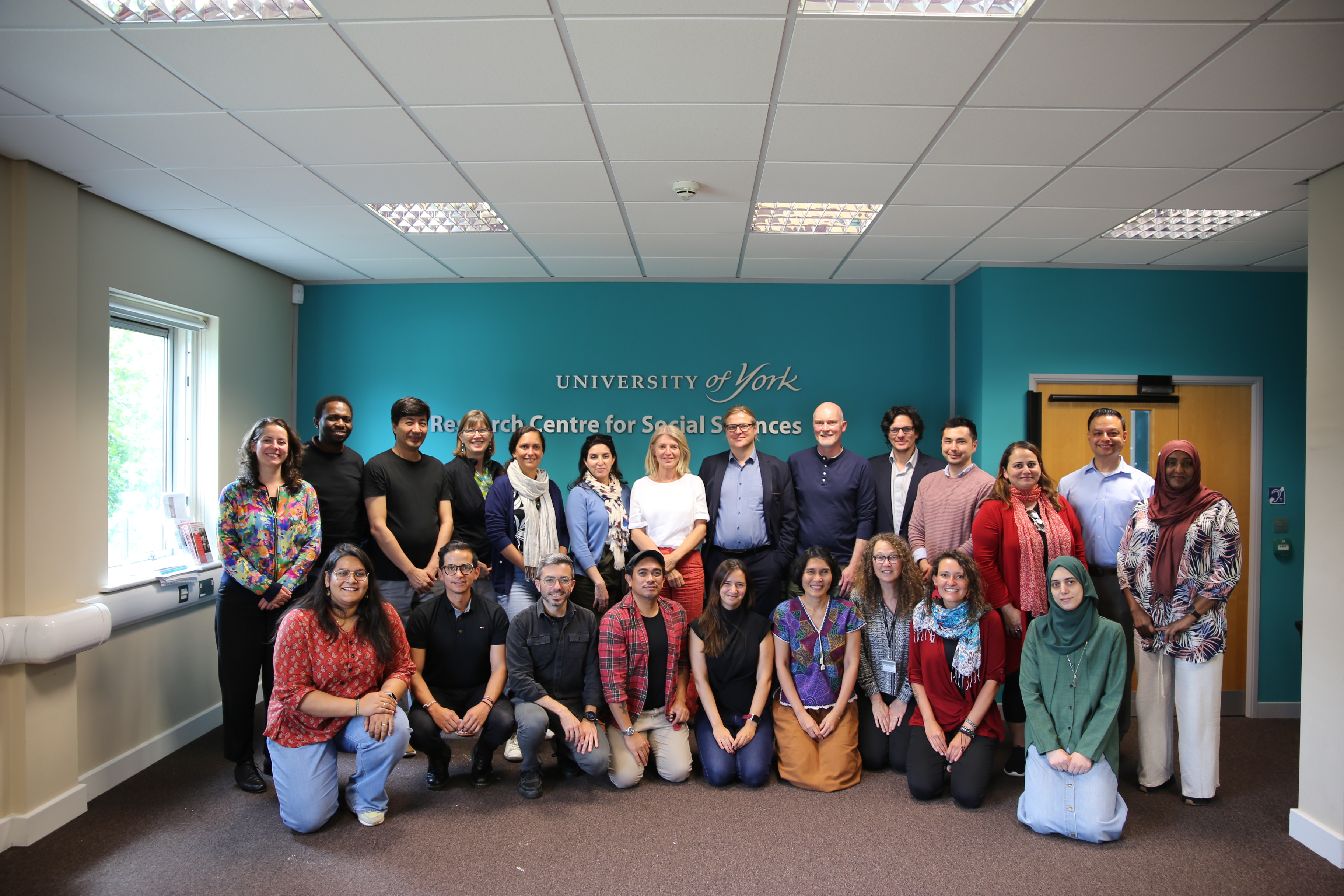
A landmark document for universities seeking to support HRDs, civil society and democracy was launched this February by York University
The Guidelines, co-produced through a year-long collaborative process, aim to support universities involved in human rights protection work and share best practice on hosting HRDs.
This initiative, led by the UNESCO Chair in the Protection of Human Rights Defenders and Expansion of Political Space, was facilitated by the Centre for Applied Human Rights (CAHR) at the University of York. Chairholder Professor Paul Gready highlighted the critical need for these guidelines:
“Civil society is under attack in many parts of the world as it faces legislative, administrative, financial, and physical threats. Universities are spaces that uphold academic freedom and democracy, and they have a crucial role to play in protecting these values everywhere.”
The Guidelines underscore the importance of universities in the human rights protection ecosystem, and their role in providing a platform for HRDs to continue their vital work in safer environments, and respite while rejuvenating HRDs for their future work.
At an event in July 2024 which discussed a draft of the Guidelines, Sharan Srinivas, Director, Protecting Rights Defenders, Open Society Foundations, emphasised the importance of building a community both within and outside of the university environment:
“The Guidelines address critical issues in human rights work, such as risk, trauma and psychosocial support. The process has built a strong community, and it’s crucial to continue building solidarity and links within the human rights ecosystem. I hope universities can scale up this work, and I wish you well in your efforts.”
Professor Charlie Jeffery, Vice-Chancellor of the University of York, attended the event, and provided his support for the initiative. He said “Reading the draft Guidelines, and seeing the depth, purpose and quality of the discussions at this stage shows great enterprise and ambition. For me, the question of how to align these Guidelines with university values, and bring universities along with you is key. At York, CAHR not only aligns with our values but continues to push us further in our mission for public good.”
Professor Gready thanked all the attendees for their generosity in sharing their experiences and expertise. He said “There is an enormous amount of work still to do to ensure these Guidelines have an impact. But these Guidelines will empower universities working with HRDs, who need our support in an increasingly volatile world.”
The UNESCO Chair is planning a series of regional “What Next?” events over the next 6-12 months to discuss how to implement the Guidelines as extensively as possible. To learn more about these events and the Chair’s work, please visit the UNESCO HRD Hub.
Natika Kantaria is a human rights advocate with nearly a decade of experience planning and implementing advocacy campaigns in human rights. She has worked with international organizations and watchdog NGOs and collaborated with the public and private sectors. For the ISHR she wrote a piece on 26 February 2025 about a worrying trend: ‘Foreign agent’ laws have been introduced in various countries, violating international human rights law and threatening to silence human rights defenders. This pattern is particularly evident in Eastern Europe, where NGOs courageously resist and need the support of the international community. See e.g. my earlier posts:
Societies thrive when everyone can work, speak out, and organise freely and safely to ensure justice and equality for all. Legislation requiring NGOs to register as ‘foreign agents’ is a barrier to this virtuous cycle. Despite the European Court of Human Rights’ 2022 ruling that Russia’s 2012 foreign agent law violated freedom of expression and association, the governments of Hungary, Georgia, Slovakia, Serbia, and Bosnia and Herzegovina have proceeded undeterred to introduce similar laws.
These laws specifically target NGOs and not-for-profits that receive foreign funds and require them to register as foreign agents, organisations serving the interests of a foreign power, or agents of foreign influence. By doing so, they restrict the capacity of human rights defenders to organise, participate and exercise their right to defend rights by:
imposing disproportionately high fines and heavy sanctions to NGOs refusing to comply, which may ultimately lead to the termination of their operations
using vague wording, that ultimately gives too much room and power for government interpretation. For instance, the requirement for NGOs to register in official records or identify themselves as ‘agents of foreign influence’ lacks clarity and specificity.
increasing the burden of NGOs by introducing heavy reporting and auditing requirements. The State’s alleged need for transparency as their primary purpose can, therefore, be effectively addressed through existing legislation regulating NGOs.
employing a negative narrative that stigmatises and delegitimises the work of the civil society organisations and human rights defenders. This rhetoric promotes hostility and distrust toward civil society and encourages attacks against defenders.
Furthermore, such laws contradict the commitments of these countries under international human rights law. Article 13 of the 1998 UN Declaration on human rights defenders recognises the right of defenders to solicit, receive and utilise resources.
Article 10 of the Declaration +25, a supplement to the UN Declaration put forward in 2024 by civil society, human rights defenders and legal experts, addresses States’ attempts to prohibit foreign contributions or impose unjustified national security limitations. It stipulates that States should not hinder financial resources for human rights defenders and outlines measures to prevent retaliation based on the source of their funding. These laws violate rights related to freedom of expression, association, and privacy, as outlined in the European Convention on Human Rights (ECHR) and International Covenant on Civil and Political Rights. Foreign agent laws also run counter to commitments made by countries at the regional level as members of the Council of Europe (CoE) and the Organization for Security and Co-operation in Europe (OSCE), including recommendation CM/Rec(2018)11, which emphasizes the protection and promotion of civil society space and OSCE guidelines for protecting human rights defenders.
NGOs are increasingly becoming a primary target for repressive governments. According to the CIVICUS Monitor 2024 report, the countries mentioned above that have introduced ‘foreign agent’ laws have either ‘closed’ or ‘obstructed’ civil society space. In addition, the Trump administration’s rhetoric and its decision to freeze foreign aid have contributed to strengthening hostile narratives already present in ‘foreign agent laws’ in Eastern Europe and have emboldened governments in their efforts to publicly undermine these organisations.
While the silencing of NGOs has become part of the agenda for many governments, and the rise of ‘foreign agent’ laws serves as a step towards establishing authoritarian regimes, civil society actors continue to mobilise in response. Strengthening engagement with international human rights mechanisms, fostering joint global advocacy, and providing support to targeted organisations and groups are essential steps that international NGOs and the international community should take to build resistance, reinforce coalition efforts, and protect the work of human rights defenders.
International and regional human rights mechanisms have called for governments to either repeal these laws, or not to adopt them in their current forms. On 7 February 2025, three UN independent experts issued a statement in relation to Bosnia and Herzegovina, where the government reintroduced the ‘Law on the Special Registry and Publicity of the Work of Non-Profit Organisations’ after its initial withdrawal in May 2024. The statement stressed that creating a register of non-profit organisations receiving foreign funding in one of the entities of Bosnia and Herzegovina will impose severe restrictions on NGOs and would grant government control over their operation, including the introduction of an annual inspection, with further reviews of legality of CSOs receiving foreign funding possible upon requests from citizens or relevant authorities.
In this unsupportive environment, donors have a fundamental role to play. ‘As civil society actors devise strategies to push back against these repressive tactics, private philanthropy and bilateral and multilateral donors have vital support roles to play,’ writes James Savage, who leads the Fund for Global Human Rights’ (FGHR) programme on the Enabling Environment for Human Rights Defenders. ‘They can help civil society prepare for future challenges, so that it is organised not only to respond to evolving forms of repression but also to get ahead of them by tackling their root causes,’ Savage concludes.
Amnesty International invites applications for an 18-month part-time fellowship to explore the global phenomenon of shrinking civic space and document grassroots resistance strategies from marginalized and overlooked voices. Fellows will analyze current trends in civic space restrictions, investigate emerging resistance and human rights movements, and convene activists to co-create a practical toolkit for defending civic space worldwide. The fellowship aims to ensure that Amnesty’s work remains innovative, grounded in lived experience, and contributes to new knowledge on resistance strategies.
Deadline for all applications: 06/03/2024
Rate: Fixed Rate of USD 25,000 for the duration of the fellowship
Location: This fellowship does not include relocation. The consultant must work from their preferred location and possess the necessary work authorization.
OBJECTIVES AND DELIVERABLES
The Fellowship project aims to:
Support human rights defenders, academics, and practitioners with lived experience to document and analyze grassroots resistance strategies against authoritarianism and civic space restrictions in their regions.
Use this research to develop concrete recommendations and practical tools that can inform Amnesty’s global civic space advocacy.
Produce regular short written outputs, including blog posts and opinion pieces, to be independently published.
Convene activists and thought leaders in the region through virtual, in-person, or hybrid meetings to share ideas, incubate new strategies, and foster collective learning.
Deliver a final in-depth think-piece for Amnesty International’s internal strategy and advocacy, with external publication at Amnesty’s discretion.
ESSENTIAL REQUIREMENTS
Fluency in written and spoken English; fluency in a relevant regional language is desirable.
Demonstrated experience working on civic space resistance—either formally (academia, NGOs, journalism, law, policy) or through grassroots activism.
Strong writing and research skills, with experience producing publications related to civic space and human rights activism.
No formal academic qualifications or certifications are required to apply.
To apply, please submit:
A short bio (maximum one page) outlining your recent experience.
Relevant case studies or descriptions of past work on civic space issues.
Your proposed approach to this fellowship opportunity, including how you would structure your research and engagement.
Applications must be in PDF, Word, PowerPoint or Excel format.
New and emerging technologies have become a fundamental tool for human rights defenders to conduct their activities, boost solidarity among movements and reach different audiences. Unfortunately, these positive aspects have been overshadowed by negative impacts on the enjoyment of human rights, including increased threats and risks for human rights defenders. While we see the increased negative impacts of new technologies, we do not see that governments are addressing these impacts comprehensively.
Furthermore, States and their law enforcement agencies (often through the help of non-State actors, including business enterprises) often take down or censor the information shared by defenders on social media and other platforms. In other cases, we have seen that businesses are also complicit in attacks and violations against human right defenders.
Conversely, lack of access to the internet and the digital gaps in many countries and regions, or affecting specific groups, limits the potential of digital technologies for activism and movement building, as well as access to information.
The Declaration on Human Rights Defenders, adopted in 1998, does not consider these challenges, which have largely arisen with the rapid evolution of technology. In this context, and, as part of activities to mark the 25th anniversary of the UN Declaration on human rights defenders, a coalition of NGOs launched a consultative initiative to identify the key issues faced by human rights defenders that are insufficiently addressed by the UN Declaration, including on the area of digital and new technologies. These issues are also reflected in the open letter to States on the draft resolution on human rights defenders that will be considered during HRC58.
This side event will be an opportunity to continue discussing the reality and the challenges that human rights defenders face in the context of new and emerging technologies. It will also be an opportunity to hear directly from those who, on a daily basis, work with defenders in the field of digital rights while highlighting their specific protection needs. Finally, the event will also help remind States about the range of obligations in this field that can contribute to inform the consultations on the HRC58 resolution on human rights defenders.
Panelists:
Opening remarks: Permanent Mission of Norway
Speakers:
Carla Vitoria – Association for Progressive Communications
Human rights defender from Kenya regarding the Safaricom case (via video message)
Woman human rights defender from Colombia regarding use of new technologies during peaceful protests
Human rights defender from Myanmar regarding online incitement to violence against Rohingya people
Video montage of civil society priorities for the human rights defender resolution at HRC58
Moderator: Ulises Quero, Programme Manager, Land, Environment and Business & Human Rights (ISHR)
This event is co-sponsored by Access Now, Asian Forum for Human Rights & Development (FORUM-ASIA), Association for Progressive Communications (APC), Business and Human Rights Resource Centre (BHRRC), DefendDefenders (East and Horn of Africa HRD Project), Huridocs, Gulf Centre for Human Rights (GCHR), International Lesbian, Gay, Bisexual, Trans and Intersex Association (ILGA World), International Service for Human Rights (ISHR), Peace Brigades International, Privacy International, Protection International, Regional Coalition of WHRDs in Southwest Asia and North Africa (WHRD MENA Coalition).
The Free Expression Legal Network, a new initiative dedicated to strengthening legal protections for free expression and media freedom, was launched at Webber Wentzel’s Sandton office on 18 February 2025, with more than 50 People in attendance. Developed by the SA National Editors’ Forum (Sanef), the Press Council, the Campaign for Free Expression (CFE), and other organisations and legal experts, the network aims to ensure that individuals and organisations facing legal threats can access the support they need.
Among those that this new initiative aims to support are journalists, smaller media outlets, community-based organisations and businesses that lack access to corporate or external legal representation. It aims to ensure co-ordination with several other international efforts of this kind to provide a stronger framework for defending free expression,
The network will focus on several key areas to strengthen legal protections for free expression and media freedom. Media freedom is critical – ensuring that individuals and media organisations can report and impart information freely and hold power to account without fear of legal repercussions. Additionally, the network will support media viability by providing legal guidance to help media outlets navigate financial and operational challenges, ensuring their long-term sustainability. Another critical area is policy advocacy, where the network will assist with legal challenges related to media regulation and press freedom policies, helping to create a more supportive legal environment for journalism. Lastly, the initiative will prioritise small and community media, offering essential legal resources to newsrooms and organisations that often lack adequate legal support, ensuring they have the protection needed to operate effectively.
But this initiative comes at a time of new and sinister threats to freedom of expression more generally. Unchecked and unprecedented powers to platform and platform certain voices and sources of information present pronounces threats to freedom of expression globally. It is intended that this network, enabling resources and expertise, is able to respond innovatively, nimbly and effectively in meeting these dangers.
The keynote address was delivered by Navi Pillay, former UN High Commissioner for Human Rights, Judge of the International Criminal Court, and President of the International Criminal Tribunal for Rwanda. Drawing from her extensive experience in international human rights law, she provided invaluable insight into the legal challenges surrounding free expression and the role of judicial systems in upholding these rights. Emphasising the power of collective action, she stated, “If you clap with a single hand, nobody yells for you. But if a lot of people form a network clap, they will be heard. So, I can only see success for an initiative like this, I encourage them to go for it here.
Anton Harber, Campaign for Free Expression Director, emphasised the importance of the new body in defending free speech, stating, “This new body will be a vital tool in preventing attacks on free speech and free media, bringing together a range of resources to respond quickly and strongly. It will help ensure that anyone whose free speech is threatened will be properly defended. It will also be proactive – pushing for change to laws that don’t defend free speech or the right to information. In the face of growing threats to free speech, we are building a strong defence“.
Echoing this urgency, Nicole Fritz, Executive Director of Campaign for Free Expression, highlighted the global nature of these challenges, adding, “I think that the threats to free expression are especially intense at this time, not only in our country but in the world generally. It is especially important that those who have their rights to expression violated and threatened are offered expert support and legal assistance in order to counter those threats”.
Dario Milo, a partner at Webber Wentzel and a leading expert in media law, emphasised the importance of this initiative, stating: “The Free Expression Legal Network is a significant step forward in ensuring that journalists, media organisations and other human rights defenders, particularly those with limited resources, have access to the legal guidance they need. At a time when media freedom is under increasing pressure, this initiative will play a crucial role in safeguarding free expression and upholding the public’s right to know.”
For more information on the Free Expression Legal Network and how to get involved, please contact Anton Harber, Director, CFE, anton@harber.co.za
In this interview, OMCT Secretary General Gerald Staberock shares his vision for 2025 and key priorities in the fight against torture. From the launch of the Global Torture Index to the SOS Defenders platform, he highlights the initiatives that will shape the movement and strengthen global human rights efforts, including the Global Week on Torture—an event not to be missed.
His message for 2025 is clear: “resilience and unity, not despair.”
What is your vision for 2025, and what priorities should we focus on to maximize our impact on human rights?
In my vision, 2025 is the year in which we rise to the challenge and stand up in the anti-torture movement and uphold the absolute prohibition of torture. Today, in an increasingly dangerous world where states are turning away from human rights, fostering division and weakening protections, and some questioning universal norms altogether, the message must be resilience and unity, not despair. It is essential to protect all victims of torture and to defend the universality of human rights, which is under threat.
I am convinced that our SOS Torture Network must serve as an anchor for human rights and universality. As a movement, we stand united—to protect those at risk, to support our fellow human rights defenders under threat, and to ensure that the absolute prohibition of torture remains intact.
What impact do you hope the launch of the Global Torture Index will have?
The Global Index on Torture is the new flagship program of OMCT, with its launch anticipated in June 2025. I think it is the tool we have been lacking for years, and a tool all actors working against torture can benefit from. It combines reliable data with often-overlooked narratives to make the hidden reality of torture visible. This index will allow us to measure its scope, its impact on society, and advocate for political and legal reforms. It will help identify risks and develop effective anti-torture strategies. This index is not only an OMCT tool but a collective resource to support the efforts of network members towards concrete reforms and the prevention of torture.
Why is the Global Week on Torture important and what can people expect?
Four years ago, we held the first ever Global Week Against Torture, and we saw the power and energy that such a week can create. Many of us, especially those of our members working in very complicated dire situation, often feel alone. It offers a unique opportunity to share experiences, best practices and to learn from each other and to stand in solidarity across countries and regions. The Global Week all makes us feel and understand that we are united in a struggle and reflect that the real force of the OMCT is in its SOS Torture Network.
How will the SOS Defenders platform and the SOS Database help serve human rights defenders?
One of the most important achievements in 2024 has been the launch of the SOS Defenders platform. The platform gives a face to more than 400 human rights defenders that are currently imprisoned because they stood up for human rights. We don’t forget them. We want to demonstrate to governments that the detention of these defenders is an attack on democracy and freedom, and we need to make states who support human rights understand that this is the moment to step up in their actions. OMCT, along with its SOS Torture Network must raise the alarm bells and act to protect from torture and ill-treatment in detention.
Emile Dirks, Noura Aljizawi, Siena Anstis and Ron Deibert wrote in the The Globe and Mail of 10 February 2025 about the problem of transnational repression.
The final report of the public inquiry into foreign interference (the Hogue Commission) offers a measure of reassurance to Canadians; there is no evidence that Canadian MPs worked with foreign states to undermine the 2019 or 2021 federal elections. Justice Marie-Josée Hogue’s findings, however, are cold comfort to people at risk. While the commission’s work has ended, distant autocrats continue to target Canadians and Canadian residents with transnational repression, the most coercive form of foreign interference.
Commissioner Justice Marie-Josee Hogue Patrick Doyle/Reuters
Through digital harassment, assault and even assassination, authoritarians reach across borders to silence their foes abroad. Victims include activists, human-rights defenders, exiled critics and asylum seekers tied by citizenship or ancestry to repressive states like China, Russia, India or Saudi Arabia. For authoritarians, these people are not citizens, but disloyal subjects to silence.
The danger that transnational repression poses is not new. A 2020 report by the Canadian Coalition on Human Rights in China demanded the Canadian government address threats against pro-democracy activists, while a 2022 report by the Citizen Lab highlighted the lack of support to victims of digital transnational repression. Prior to the 2024 election, the Biden-Harris administration adopted a whole-of-government approach to ensure government agencies like the State Department, Department of Homeland Security, Department of Justice, and the FBI worked together to provide recommendations to victims on how to better protect themselves.
Researchers and civil society have long worried that Canadian authorities are overlooking transnational repression as a unique challenge that requires tailored responses. Considering the seriousness of the threat and the stark absence of action by the government, many researchers anticipated the commission’s final report would explore transnational repression as a distinct form of foreign interference. Yet, while Justice Hogue wrote that “it would be challenging to overstate the seriousness of transnational repression,” she ultimately reasoned the issue lay outside her mandate.
This was a mistake. The final report was a missed opportunity to fully explore the corrosive impact of transnational repression on Canadian democracy. A recent report by the Citizen Lab highlights the profound toll transnational repression takes on vulnerable people, especially women, in Canada and beyond. Intimidation, surveillance and physical attacks prevent victims from participating fully in civic life and create a climate of persistent fear.
Transnational repression harms victims in more subtle ways, too. Our research shows that the mere threat of an online or offline attack is enough to frighten many diaspora members into silence. Victims become wary of participating in social media or even using digital devices. They report being afraid to engage with members of their communities, leaving them increasingly isolated. It has an insidious, chilling effect on targeted communities.
Unfortunately, the future looks bleak. Democratic backsliding in the United States threatens to deprive Canada of an ally in the fight and reverse whatever measures U.S. agencies might have taken on the issue. Our research shows that suspicion of law enforcement discourages victims from contacting authorities. Proposed moves by the Trump administration – including halting asylum hearings, ending resettlement programs, and sending “criminal” migrants to Guantanamo Bay – will further erode victims’ confidence in the U.S.’s willingness to protect them.
Big Tech is also worsening the problem. Across social-media platforms, state-backed harassment of vulnerable diaspora members is rife. Elon Musk’s X tolerates and even promotes hate-mongering accounts, while Mark Zuckerberg’s announcement that Meta will stop using “politically biased” fact-checkers signals a worrying disinterest in robust content moderation. We should expect a tsunami of digital transnational repression targeting vulnerable Canadians now that tech CEOs are loosening the restraints.
Canada cannot rely on outside leadership or corporate actors to tackle this problem. What is needed is a commission on transnational repression. On Jan. 24, the British parliament’s Joint Committee on Human Rights launched such an inquiry. Once our House of Commons sits again we can follow our British counterparts and resume the Subcommittee on International Human Rights’s work on transnational repression. The new Parliament should launch a multiparty inquiry into the crisis, with a mandate to examine repression outside of federal elections. Crucially, it must earn the trust of victims, something the Hogue Commission lacked. The Uyghur Rights Advocacy Project and the Canadian Friends of Hong Kong both pulled out of the inquiry, citing the participation of three legislators with alleged links to the Chinese government.
This is not a partisan issue. Whoever wins the next federal election will have a duty to contend with the continuing threat transnational repression poses to Canada. With global authoritarianism on the rise, the problem is only likely to worsen in the years to come.
Cândida Schaedler on 12 February 2025 asks whether anything can be done to protect them.
In 2023, 196 land and environmental defenders were murdered around the world – the vast majority of them in Latin America. In fact, just four countries – Brazil, Colombia, Honduras and Mexico – accounted for over 70 percent of those killings. Colombia was by far the deadliest country, with 79 murders, followed by Brazil, with 25.
We spoke with some of these brave activists to learn more about the threats they face, how they stay safe and how Colombia and Brazil are working to keep them alive.
Quilombolas in the Jequitinhonha Valley in Minas Gerais, Brazil. Photo: Mídia NINJA, Flickr
“When we recognized ourselves and declared ourselves a quilombo, our peace was over”, recalls Elza,* a Brazilian Quilombola leader in her late 50s.
In December 2008, she was shot and injured in an attack that killed her brother and sister. Since then, she hasn’t left her home alone – not even for a walk in her own territory, one of the 11 urban quilombos in Porto Alegre, the capital of Rio Grande do Sul in southern Brazil.
Quilombos are Afro-Brazilian communities that were originally founded by escaped slaves in colonial times.
Today, they are officially defined as “ethno-racial groups that, by self-definition, have their own historical trajectory, maintain specific territorial relations and are presumed to have Black ancestry related to resistance against historical oppression.” Brazil has recognized quilombos in its constitution since 1988, but the process of gaining legal recognition is time-consuming and often fraught with obstacles. Elza’s community was officially designated a quilombo in 2005, but only after its residents agreed to give up half their territory. Ever since, they’ve been battling gangs and real estate speculators who want control of the same 58 hectares of land they call home.
In 2022, they once again came under attack. Armed men showed up at their door in an attempt to take over a housing project under construction in the quilombo, which had been put on hold due to a dispute with the bank financing it….
Elza and her daughter, Carolina,* live under the protection of the Brazilian government, which has a program to safeguard human rights defenders, environmentalists and communicators.
Jesus Pinilla leads a workshop for the Network of Young Guardians of the Atrato. Photo courtesy of Jesus Pinilla
Jesus Pinilla is a 26-year-old Afro-Colombian activist from a small community in the Chocó Department in western Colombia. He is a member of the Network of Young Guardians of the Atrato, a group composed of 36 young people defending the Atrato River – considered the mightiest river in Colombia.
Back in 2016, the Atrato was the first Colombian river to be given legal rights. Enforcing those rights are a group of 10 guardians, along with the Young Guardians, who are embroiled in a constant battle against mining companies exploiting the river’s waters.
Pinilla works as an environmental educator. He first became an environmental activist at the age of 14, but he fears that the risks often drive young people away from climate and environmental movements in Colombia.
“My community is located by the river, so we are constantly dealing with it on a daily basis,” he says. “We depend on it for our basic needs.”
Policing is not enough to tackle the threats facing land and environmental defenders in Latin America. Photo: Agência Brasília, Flickr
“When combined with the interests of communities, the internal armed conflict becomes even more dangerous,” says Leonardo González Perafán, director of the Institute for Development and Peace Studies (Indepaz) in the capital, Bogotá.
“That’s when actions against environmental defenders and communities come into play,” he explains, adding that environmental conflicts often occur in countries with abundant mineral resources.
In most cases, communities are forced to self-organize to ensure their own safety due to the absence of the state.
“They provide self-protection through Indigenous or campesino [farmer] guards,” he explains.
The communities have also developed communication strategies to share information with each other, as well as with the authorities and other organizations.
But as long as the armed conflict persists, it will be very difficult for the government to tackle systemic threats against environmental defenders, especially in areas where it has little authority, says Franklin Castañeda, director of human rights at Colombia’s Ministry of the Interior.
Castañeda explains that more than 15,000 people are currently protected under the National Protection Unit (UNP), which aims to ensure the safety of members of Congress, mayors, journalists, human rights defenders, community leaders and other individuals facing threats due to their work.
The majority – around 9,000 – of these people are social leaders, including environmental defenders. The UNP provides them with security measures such as bulletproof vests, private escorts, armored vehicles or other measures as deemed necessary on a case-by-case basis.
Still, Castañeda emphasizes that individual measures are a last resort. The government has also invested in prevention, such as ensuring that the military and police are not involved in illegal activities.
Despite these efforts, Castañeda concedes that there is still plenty of work to be done to address the structural drivers of conflict, such as high levels of socioeconomic inequality.
“Most of the territories where social conflicts arise are the least developed ones that the government still cannot reach.”
He says these areas will need internet access, highways and other infrastructure to improve the government’s ability to ensure safety and the rule of law.
A quilombo in southern Brazil. Photo: Cândida Schaedler
In Brazil, the main drivers of conflict are deforestation, illegal mining, real estate speculation and the expansion of agriculture.
The program’s coordinator, Igo Martini, emphasizes the importance of listening to the communities to respond quickly to their protection needs. Last year, it carried out 54 public consultations to devise a National Plan to address threats to these communities. But Martini also points out the need to address the root causes rather than merely deploying the police.
“If we don’t solve the underlying causes, the program will continue for another 20 or 40 years just responding to emergencies,” he warns. “A movement from the states is also necessary, not just from the federal government.”
“We need to strengthen agencies, monitoring systems and prevention systems, like the Brazilian Institute of the Environment and Renewable Natural Resources (Ibama), for example.”
The PPDDH operates in three areas: state protection, justice protection and collective protection.
While state and justice protection are offered by the police and courts respectively, collective protection involves strengthening communities and providing them with the tools to communicate with each other and report threats to the authorities to safeguard their territory.
You can save a draft of your work if you would like to finish filling out the form at a later date.
We will follow-up with nominators about their submission by email. Please be sure the email address used to create your Submittable Account is one that you check regularly.
Please note: Each individual may only submit one nomination per year. Organisations may submit multiple nominations.
Please reach out to Submittable’s Customer Support team with any technical questions at support@submittable.com
For further information, please visit our website and for any questions directly relating to process or information required, please contact our research team by email at research@rightlivelihood.org.
The International Bar Association’s Human Rights Institute (IBAHRI) is offering a free online training course for human rights defenders working on cases relating to freedom of religion or belief (FoRB).
Taking place from 17–27 February, the programme is divided into 16 sessions covering all the theoretical and practical knowledge required to promote and protect the fundamental right to FoRB.
The programme will be delivered by leading experts in the field of human rights and/or FoRB, including Dr Nazila Ghanea, United Nations Special Rapporteur on FoRB; Professor Fernand de Varennes, former UN Special Rapporteur on minority issues; the Honourable Hina Jilani, IBAHRI co-chair, member of The Elders and advocate of the Supreme Court of Pakistan; and Rangita de Silva de Alwis, IBAHRI vice chair and a member of the treaty body to the UN Convention on the Elimination of All Forms of Discrimination against Women.
The IBAHRI is delivering the training in collaboration with the Rule of Law Expertise UK (ROLE UK). ROLE UK is a programme of the Advocates for International Development (A4ID), funded by the Foreign, Commonwealth & Development Office. A4ID is a global charity working to strengthen the rule of law in developing countries by supporting partnerships to provide high-quality pro bono legal and judicial expertise.