Posts Tagged ‘Egypt’
May 14, 2014
On 14 May the blogger A Paper Bird posted an interesting set of slides that can be used in training human rights defenders. The author also sets a good example by letting them be shared freely:
“One thing I do with some frequency is trainings. These powerpoints reflect a session I worked on recently with the Egyptian LGBT group Bedayaa. The first (download the English version here) deals with issues in human rights documentation in general terms. The second (download English here) deals more specifically with strategies for interviews. I’m posting them here in the hope that they may be useful to activists who weren’t able to attend the workshop, and to people elsewhere as well. Some of the material is specific to Egypt, some is not….. [the slides also exist in Arabic – see original post)
These aren’t copyrighted; I’m not sure how you would copyright a basic skills set. (Actually, late capitalism can copyright anything. What I mean is, I don’t want to know.) However, if you find them interesting enough to adapt or reuse, I ask that you let me know, and cite me as the author.”
via Documenting human rights violations through interviews: training materials English and Arabic | a paper bird.
Posted in human rights, Human Rights Defenders | Leave a Comment »
Tags: A Paper Bird, Bedayaa, documentation, Egypt, human rights documentation, human rights violations, interviewing, LGBT, monitoring, powerpoint, Sexual orientation, training, victims
May 5, 2014
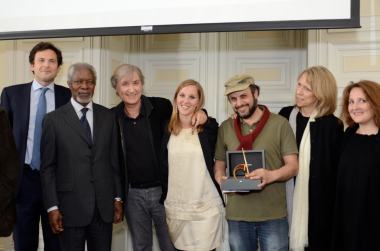
3 May 2014 Cartooning for Peace award, Geneva (c) THF
In case you noticed, my post of yesterday about the Cartooning for Peace Award came a day late; sorry. The award ceremony took place on Saturday 3 May, International Day for Press Freedom. To make up for the error here are the winners (Palestinian-Syrian Hani Abbasi, and Egyptian Doaa Eladl), in company of inter alia Kofi Annan and municipal councillor Guillaume Barazzone. The exhibit remains to be visited along the Quai Wilson in Geneva until 3 July 2014. Also present were the well-known cartoonists Chappatte, Plantu et Liza Donnelly. More information and links in my post of yesterday:
https://thoolen.wordpress.com/2014/05/04/cartooning-for-peace-international-award-and-exhibit-in-geneva-as-from-today/
Posted in awards, Human Rights Defenders | 1 Comment »
Tags: art, awards, Cartooning for Peace, Cartooning for Peace Award, cartoons, Chappatte, City of Geneva, Doaa Eladl, Egypt, Guillaume Barazzone, Hani Abbasi, human rights awards, Kofi Annan, Liza Donnelly, Palestinian, peace, Plantu, Press Freedom
April 16, 2014
There are many international NGOs doing excellent work for human rights defenders, but I want to highlight one here in particular: the International Service for Human Rights. It has a clear mandate and niche, based in Geneva for 30 years (with a small office in New York) is the main advocate for human rights defenders in the UN. The Director, Phil Lynch, sent out an overview in April 2014 of its activities covering the recent months, especially the latest session of the UN Human Rights Council. Please read the statement in full and – if you want regular updates – subscribe to the ISHR Newsletter: Read the rest of this entry »
Posted in human rights, Human Rights Defenders, ISHR | Leave a Comment »
Tags: Cao Shunli, China, Egypt, freedom to demonstrate, Human Rights Council, Human Rights Defenders, International Service for Human Rights, ISHR, Michael Ineichen, North Korea, Phil Lynch, reprisals, Shin Dong Hyuk, training
April 10, 2014
On Monday 7 April, an appeals court in Cairo, Egypt, upheld the 3-year prison sentences for three pro-democracy activists on charges of unlawfully organizing a protest and assaulting security officers outside a court on November 30, 2013. The verdict against Ahmed Maher, Ahmed Douma, and Mohamed Adel marks the first usage of the new restrictive law. [None of the three activists were involved in any violence that took place when clashes broke out during the protests. Maher and Douma were inside the courthouse when scuffles ensued, and a police officer attested to the fact that Adel was attempting to pacify protesters.]
for background see:
Posted in Human Rights Defenders | Leave a Comment »
Tags: Ahmed Douma, Ahmed Maher, Egypt, freedom of demonstration, Human Rights Defenders, illegal detention, independence of the judiciary, Mohamed Adel, Mona Seif, prison sentence, pro-democracy activists
March 9, 2014
Yesterday, 7 March 2014, saw many expressions of solidarity with women human rights defenders at the occasion of International Women’s Day.
The ISHR picked the following cases as examples that stand out:
You can find many more cases via the Women Human Rights Defenders International Coalition [http://www.defendingwomen-defendingrights.org/] which brings together women activists and those committed to the advancement of women human rights and those working on gender issues, to advocate for better protection of women human rights defenders.
via Honouring women human rights defenders on International Women’s Day! | ISHR.
Posted in Al-Hassani, films, human rights, Human Rights Defenders, ISHR | Leave a Comment »
Tags: Brazil, Conectas, Egypt, Egyptian women human rights, Human rights defender, Human Rights Defenders, Huy Luong, Ilwad Elman, international women's day, ISHR, LGBT rights, Lucia Nader, Masa Amir, Somalia, Viet Nam, Women Human Rights, women human rights defenders, Women Human Rights Defenders International Coalition
February 28, 2014
Regular readers of this blog know that I like the idea of holding celebrities accountable (most recently: https://thoolen.wordpress.com/2014/02/10/star-power-and-human-rights-a-difficult-but-doable-mix/). The reason is that there is a mutually reinforcing (and for many profitable) interaction between the stars and the media (which in turn feed on the interest of the public). Celebrities’ views on all kind of issues – including human rights – can hardly be called private. Their social media are virtual industries and influence millions globally. So it seems a good idea to have an annual look at which celebrities have advanced and which have harmed the cause of human rights around the world. Halvorssen and Leigh Hancock ( of the Human Rights Foundation) have done exactly that in the Atlantic on 27 February 2004 and linked it to the upcoming Oscars night on Sunday.

(Gary Hershorn/Reuters)
The list of celebrities deserving recognition for their accomplishments in the field of human rights or those who should be ashamed for supporting human-rights violators, is long and contains many video links. Like the real Oscars, the list is slanted in terms of geopolitical interest and I think that if all major international human rights organisations would get together to agree on a list if would be more balanced, but that is probably wishful thinking. Still, the Human Rights Foundation deserves credit for this creative initiative. and here is the summary:
The Nominees for Outstanding Work in the Field of Human Rights Read the rest of this entry »
Posted in awards, films, human rights, Human Rights Defenders, Human Rights Foundation | 5 Comments »
Tags: Africa, Angola, Arnold Schwarzenegger, Bahrain, Bassem Youssef, Ben Kingsley, Bono, celebrities, China, Colin Firth, Cui Jian, democratic republic of the congo, Dennis Rodman, Egypt, Emma Thompson, Equatorial Guinea, Fat Joe, Gabriela Montero, George Clooney, Gustavo Dudamel, Halvorssen, hollywood, human rights, Human Rights Foundation, human trafficking, Jennifer Lopez, Jon Stewart, Julio Iglesias, Kanye West, Kazakhstan, Khalid Abdalla, Kim Kardashian, Leigh Hancock, LGBT rights, Libya, Madonna, major star power, Mariah Carey, Muammar Gaddafi, North Korea, oscar night, Oscars, Russia, Susan Sarandon, the Atlantic, The Square, Turkey, Turkmenistan, Ukraine, Venezuela
February 13, 2014
Here two recent examples of non-cooperation in relation to requests for access by international human rights mechanisms:
- On 11 February 2014 five international human rights organisations issued a statement decrying Algeria’s lack of cooperation in allowing UN human rights experts and international human rights organizations to visit the country. Algeria may have joined the UN Human Rights Council in January 2014, but it has not agreed to visits by the UN Special Rapporteur on Torture and the Working Group on Enforced or Involuntary Disappearances, despite their repeated requests. Similarly the Algerian authorities have refused to grant visas to nongovernmental human rights organizations for several years. “Algeria remains the only country among its neighbors that generally restricts access to human rights organizations,” said Eric Goldstein, of Human Rights Watch. [The 5 NGOs making the appeal are Amnesty International, Euro-Mediterranean Human Rights Network, Human Rights Watch and the Observatory for the Protection of Human Rights Defenders, a joint program of the International Federation for Human Rights FIDH, and the World Organization Against Torture OMCT].
- Today, 14 February it became known that the European Union Special Representative for Human Rights, Stavros Lambrinidis, was denied a request to visit prisoners during his visit to Egypt [he announced this on Twitter after meeting with Prosecutor General Hisham Barakat.] Lambrinidis described the refusal as a “direct contradiction” to the Ministry of Interior’s “press release promising greater openness to such visits”. Only two days earlier – amid mounting allegations of torture inside places of detention – the Ministry of Interior had issued a statement welcoming requests from NGOs wishing to visit prisons. [Lambrinidis held an open discussion with 30 human rights defenders from local and international NGOs earlier this week, stating that the Egyptian government must respect peaceful free expression and human rights communities.]
via:
http://www.dailynewsegypt.com/2014/02/13/eu-human-rights-envoy-denied-access-prisoners/#sthash.hEciHx9r.dpuf
Algeria: Allow Rights Groups to Visit – No Response from Algiers to Requests from UN Bodies / February 11, 2014 / Urgent Interventions / Human rights defenders / OMCT.
Posted in AI, EMHRN, FIDH, HRW, human rights, Human Rights Council, Human Rights Defenders, Observatory for the Protection of Human Rights Defenders, OMCT, UN | Leave a Comment »
Tags: access, AI, Algeria, Egypt, EU, EU Special Representative for Human Rights, Euro-Mediterranean Human Rights Network, FIDH, HRW, human rights, human rights mechanisms, human rights organizations, Lambrinidis, NGOs, non-cooperation, OMCT, prison visits, special rapporteurs, UN Human Rights Council
February 12, 2014
Howe complex the situation in post-Morsi Egypt is can be illustrated by the letter sent to Al-Monitor by Neil Hicks, one of the most experienced international human rights workers to be found today. As a member of the independent US-based Working Group on Egypt he responds to Wael Nawara’s criticism of the this Working Group’s recommendations on US policy toward Egypt, published on 4 February. Neil Hicks – who works for Human Rights First – in his reply of 7 February neatly outlines the views from an international human rights perspective, under the title: “The US Working Group is right on Egypt”: “One of the most perplexing aspects of the months of instability in Egypt that have followed the removal of President Mohammed Morsi from office on July 3, 2013, is the number of prominent Egyptian liberals who have shown themselves to have a somewhat selective commitment to liberal principles, Read the rest of this entry »
Posted in HRF, human rights, Human Rights Defenders | Leave a Comment »
Tags: Al-Monitor, Constitution, Egypt, fair trial, Foreign Policy of the USA, freedom of expression, human rights, Human rights defender, liberal, Neil Hicks, peaceful protest, Wael Nawara, Working Group on Egypt
January 24, 2014
On 23 January Human Rights First released a report that describes how the Egyptian government is increasingly targeting non-violent human rights defenders and activists through widespread repression, stifling basic freedoms and exacerbating the chronic instability that has plagued the country for the past three years. The new report titled, “Back to Square One: The U.S. Government and Political Change in Egypt,” outlines recommendations for the U.S. government to take a new course of action to advance human rights and the rule of law in order to achieve greater stability in this vital country. “The U.S. must overhaul its approach to Egypt if it’s to really get on the right side of history” said Brian Dooley of HRF.
The report calls on the U.S. government to:
- Provide clear, sustained and consistent public statements from Washington on its assessment of the situation in Egypt and the ramifications for U.S. interests, including human rights and democracy;
- Work with its donor partners to establish sizeable, sustained economic incentives for Egypt’s leaders that should be conditioned on Egypt adhering to democratic norms and international human rights standards;
- Use its vote and influence at the IMF to withhold loans to Egypt until sound economic policies are in place and meaningful progress is made on human rights and the rule of law;
- Use targeted funding to support civil society efforts to combat human rights abuses and promote an enabling environment that advances religious pluralism and tolerance;
- Promote clear, uniform conditions for the registration and operation of political parties that agree to be bound by the rules of peaceful, democratic contestation;
- Push the Egyptian authorities to investigate all incidents of violence against Christians, assaults on their property and institutions, and hold accountable those responsible; and
- Make available through the Justice Department, resources for prosecutions and police trainings.
For more information about today’s report or to speak with Dooley, please contact Mary Elizabeth Margolis at margolisme[at]humanrightsfirst.org.
Posted in books, HRF, human rights, Human Rights Defenders | Leave a Comment »
Tags: Brian Dooley, diplomatic pressure, Egypt, Foreign Policy of the USA, freedom of assembly, freedom of expression, HRF, human rights, Human Rights Defenders, Human Rights First, IMF, minority rights, police violence, special report, USA
January 16, 2014
Index on Censorship is basing a series of articles on its larger report by Mike Harris, Time to Step Up: The EU and freedom of expression.
On 14 January 2014 came the one the ‘southern neighbourhood’ arguing that the credibility of the EU’s swing in focus from economic development towards human rights (after the outbreak of the Arab spring) is low.
The EU’s communication “A partnership for democracy and shared prosperity with the southern Mediterranean“ (published on 8 May 2011) addresses the EU’s commitment to financially support transition to democracy and civil society and heralds the creation of the Civil Society Facility for the neighbourhood (covering both the southern and eastern neighbourhoods), while the European Instrument for Democracy and Human Rights (EIDHR) deployed a number of operations in the region to protect and promote freedom of expression, often without the consent of the host country. Still, the article argues, european countries are often still seen as former allies of repressive regimes.
http://www.indexoncensorship.org/2014/01/eu-freedom-expression-southern-neighbourhood/
The one of 15 January, entitled ‘The EU and free expression: Human rights dialogues’, looks at the situation that the EU runs 30 human rights dialogues across the globe, with the key dialogues taking place in China, Kazakhstan, Kyrgyzstan, Tajikistan, Turkmenistan, Uzbekistan, Georgia and Belarus. It also has a dialogues with the African Union. The article is more detailed on China
The article concludes: “With criticism of the effectiveness and openness of the dialogues, the EU should look again at how the dialogues fit into the overall strategy of the Union and its member states in the promotion of human rights with third countries and assess whether the dialogues can be improved.“
The EU and free expression: Human rights dialogues – Index on Censorship | Index on Censorship.
Posted in EU, human rights, Human Rights Defenders, Index on Censorship | 1 Comment »
Tags: Arab spring, Asia, Catherine Ashton, censorship, Central Asia, China, Civil society, Democracy, diplomacy, diplomatic action, Egypt, EIDHR, EU, free expression, freedom of expression, funding, human rights, human rights dialogue, Index on Censorship, Mediterranean, Mike Harris, north africa, Tunisia


 Hans Thoolen on Human Rights Defenders and their awards