Posts Tagged ‘Palestinian’

France reverses decision and grants visa to Palestinian human rights defender Shawan Jabarin

April 21, 2026

France has reversed its earlier decision and granted a national visa to Palestinian human rights activist Shawan Jabarin, following criticism from European lawmakers, a French MP said on Monday. Jabarin, director of the West Bank-based rights group Al-Haq, had previously been denied entry by French authorities despite being invited to attend a session of the European Parliament’s Human Rights Subcommittee in Strasbourg.

“I take note that France has finally reversed its decision by granting a national visa to Shawan Jabarin,” French Green MEP Mounir Satouri said on the US social media company X Satouri called for full transparency over the initial refusal, urging authorities to clarify the reasons behind the blockage and to lift all remaining obstacles to issuing a Schengen visa.

See https://en.wikipedia.org/wiki/Shawan_Jabarin and also https://www.trueheroesfilms.org/thedigest/laureates/dc85d276-1bd7-4914-92f0-2d98f14fb05b

The initial refusal drew strong criticism from seven international NGOs, including Amnesty International, HRW and the International Federation for Human Rights, which described the move as “a clear attack” on human rights and a “worrying setback.” https://www.amnesty.org.au/france-decision-to-deny-entry-to-veteran-palestinian-human-rights-defender-a-blatant-assault-on-human-rights/

In a joint statement, the groups said the last-minute visa denial prevented Jabarin from attending meetings with the French Parliament, civil society organizations, and the Foreign Ministry, restricting his work as a human rights defender.

Al-Haq had earlier said the rejection undermined efforts to advocate for Palestinian rights and accountability, particularly amid ongoing Israeli attacks in Gaza, warning that restricting access for rights defenders contributes to impunity.

https://aa.com.tr/en/europe/france-reverses-decision-grants-visa-to-palestinian-activist-after-criticism-says-french-mp/3912391

https://www.hrw.org/news/2026/04/17/france-denial-of-entry-to-palestinian-activist-blocks-advocacy

Palestinian Human Rights Defender Awdah Hathaleen killed by Israeli Settler

August 4, 2025

“Despite it all, I hold onto a small hope—that the future might bring justice, that our voices will eventually be heard, and that one day I can celebrate my birthday again, in peace, with the people I love, free from fear and loss.”  – Awdah Hathaleen, April 2025 Photo by: Emily Glick

An Israeli settler shot dead a Palestinian teacher who helped film Oscar-winning documentary No Other Land, according to the Palestinian education ministry and an Israeli-American activist who was at the scene of the shooting.

No Other Land co-director Yuval Abraham said on X that a settler shot Odeh (also Awdah) Hathaleen in the lungs in Umm Al-Khair village in the occupied West Bank. Residents allege the shooter was Yinon Levy, who is sanctioned by the UK.

Attorney Avichai Hajbi said he was representing a resident “who felt his life was in danger, was forced to fire his weapon into the air” after residents were “attacked by an Arab mob, along with foreign activists, with stones and violence”. Mattan Berner-Kadish, an Israeli-American activist at the scene, told the BBC that at about 17:20 local time (15:20 BST) on Monday, a bulldozer from a nearby Israeli settlement was driven through private Palestinian land, crushing a sewage pipe, multiple olive trees and two fences.

Berner-Kadish and other activists, including Hathaleen’s cousin Ahmad, ran to block the bulldozer. The activist said the driver hit Ahmad in the neck and shoulder with a drill that extended from the bulldozer, with his footage capturing Ahmad falling to the ground. Berner-Kadish did not believe Levy was driving.

While attending to Ahmad’s injuries, Berner-Kadish heard a pop. Running back to the village to get water, he saw Hathaleen lying bleeding from a gunshot wound and Levy, the only settler he saw, holding a gun.

In a video believed to be filmed by a relative of Hathaleen and posted on social media, a man identified as Levy is seen holding a pistol with a bulldozer behind him, as men yell at him. Levy pushes at one man, who pushes back. Levy then raises his pistol and shoots ahead of him, then again into the air.

The clip cuts off when the person filming turns around to run away as women are heard screaming. The footage does not show what or who the shots hit, if anything, and whether anyone else was shooting. There are no other settlers visible. Israeli police said it was investigating the incident in the area of Carmel, an Israeli settlement near Umm Al-Khair.

“As a result of the incident, a Palestinian man was pronounced deceased. His exact involvement is under investigation,” police told the BBC. Police said on Tuesday morning they had detained an Israeli citizen for questioning. Israeli media later reported Levy was released on house arrest.

The Israel Defense Forces (IDF) also detained five Palestinians on suspicion of involvement in the incident, along with two foreign tourists who were present. Berner-Kadish said on Tuesday evening they were still detained. The activist, who began visiting the village in 2021, said Hathaleen was “one of my best friends in the world” and the two were days away from constructing a football field in the village. He added that Hathaleen was a “warm and loving” father of three young children.

The Palestinian education ministry said Hathaleen was a teacher at a local secondary school. US congresswoman Lateefah Simon, a Democrat from California, said she was “heartbroken” over the killing of Hathaleen. He and his cousin, “both holding valid visas”, were detained and deported from San Francisco airport last month while travelling for a multicultural faith dialogue, she said.

Abraham said Hathaleen had helped film No Other Land, the 2025 Oscar winner for best documentary feature that follows the legal fight between the Israeli government and Palestinians over Masafer Yatta, a West Bank community of about 20 villages.

..Levy, a leader of an outpost farm, was sanctioned by the UK in 2024, along with others, because he “used physical aggression, threatened families at gunpoint, and destroyed property as part of a targeted and calculated effort to displace Palestinian communities”.

He was also sanctioned by the US under the Biden administration, along with others, last year, but President Donald Trump lifted those sanctions.

Gilad Kariv, a member of Israel’s Knesset from the Democrats party, said on X in response to the video that “in the territories, armed Jewish militias operate unchecked”.

Settler violence, which has also been on the rise for years, has surged since the outbreak of the war in Gaza. The UN documented at least 27 attacks by settlers against Palestinians that resulted in property damage, casualties or both, between 15 and 21 July, in the West Bank.

see also: https://www.frontlinedefenders.org/en/statement-report/optisrael-statement-solidarity-palestinian-human-rights-defenders-risk-occupied

https://www.bbc.com/news/articles/c776x78517po

https://www.amnesty.org/en/latest/news/2025/

https://en.wikipedia.org/wiki/Killing_of_Awdah_Hathaleen

https://mailchi.mp/2a4342b25255/hrdf-10982507?e=51113b9c0e Read here the words of chairperson of the board, Sahar Vardi.

Israeli continues to target human rights defenders in the West Bank

July 29, 2024

The Israeli authorities continue to target human rights defenders in the Occupied West Bank, including East Jerusalem, through prolonged administrative detention without charge, humiliation and ill treatment, an independent expert said calling for an end to such treatment.

UN Special Procedures experts, including myself, have raised similar concerns multiple times, and this time I want to bring to the attention of the Israeli government the recent cases of Mr. Bassem Tamimi, Mr. Omar al-Khatib, Ms. Baraa Odeh, Ms. Sumoud Mtair and Ms. Diala Ayesh,” said Mary Lawlor, UN Special Rapporteur on the situation of human rights defenders.

The five human rights defenders were arrested between October 2023 and March 2024, either from their home or as they returned from abroad. They were ordered to be held in administrative detention for periods ranging from four to six months, subject to unlimited renewal. Two of them have yet to be released.

Bassem Tamimi, from Ramallah, is an organiser of peaceful protests against the illegal occupation of Palestinian lands; Omar al-Khatib, from Jerusalem, campaigns against the forced eviction of Palestinian families from the Jerusalem neighbourhood of Sheikh Jarrah; Baraa Odeh, from Bethlehem promotes youth rights; Sumoud Mtair, from Hebron, is active in the Palestinian Anti-Apartheid Wall Campaign; and Diala Ayesh is a human rights lawyer who documents the detention conditions of Palestinian prisoners detained in Israel. All but al-Khatib and Ayesh were released at the end of their administrative detention periods.

“All five human rights defenders were arrested without warrant. They were not given any reason as to why there were being detained. They were all interrogated without the presence of a lawyer. They were not allowed contact with their families,” Lawlor said.

“Four of them were reportedly slapped, beaten, humiliated, sent from one prison to another in the space of one or two days, and made to sign documents in Hebrew they could not understand. The three women detainees have been held in deplorable conditions, in dirty cells and given insufficient and poor-quality meals.”

https://www.miragenews.com/un-expert-israel-must-halt-targeting-1282213/

https://thepeninsulaqatar.com/article/24/07/2024/un-official-calls-on-israeli-authorities-to-stop-targeting-palestinian-human-rights-defenders

Human rights defenders working in war zones such as Ukraine and Israel

July 1, 2024

On 20 June 2024 Swissinfo spoke with human rights defenders from Ukraine and Israel about how they operate in tough contexts. The main tasks of human rights defenders include investigating, collecting information about, and reporting rights violations. They raise public awareness to ensure that human rights are respected. But how do they work in a war zone or in an environment where a large part of public opinion is against them? SWI swissinfo met activists from Ukraine and Israel in Geneva’s Palais des Nations, where they had come to meet delegations and attend side-events during a session of the Human Rights CouncilExternal link .

We are documenting testimonies from victims of the war in Ukraine,” says Lyubov Smachylo, an analyst with the Ukrainian organisation Media Initiative for Human Rights (MIHR).

MIHR’s main office is in Kyiv. It has direct access to victims and witnesses of rights violations, such as Ukrainians living in the north of the country – formerly under Russian occupation and now back under Ukrainian rule – or former prisoners in Russian jails. Smachylo, who lives between Kyiv and Paris, analyses documented testimonies of human rights violations committed by Russia. These include Russian armed forces acting with generalised impunity, the arbitrary detention of civilians – often accompanied by torture and ill-treatment – and in some cases enforced disappearances.
Lyubov Smachylo from the Ukrainian Media Initiative for Human Rights. Courtesy of Lyubov Smachlyo

MIHR is one of the few NGOs able to gather information on the ground. Virtually no international organisation can go into the occupied Ukrainian regions, not even the Office of the UN High Commissioner for Human Rights (OHCHR). The International Committee of the Red Cross (ICRC), for example, has only limited access to Ukrainian prisoners of war. This absence of accountability and the underreporting of abuses mean there is an increased risk of mistreatment and of perpetrators going unpunished.

Among other things, the MIHR deals with prisoners of war and civilians who have been arrested in the Russian-occupied regions of Ukraine or who are being detained in unknown places. Beatings and torture are rife, and some have died because of the poor detention conditions, says Smachylo.

“We know of 55 places of detention in the occupied regions of Ukraine and 40 in Russia, where a total of at least 1,550 Ukrainian civilians are being held,” says Smachylo. Contacted by SWI, the ICRC did not comment on whether it has access to the occupied regions. More More Human Rights Council: Fundamental or fundamentally flawed?

This content was published on Jun 30, 2021 The Human Rights Council, convening in Geneva, is mired in US-China rivalry, while the Council also faces criticism from developing countries. Read more: Human Rights Council: Fundamental or fundamentally flawed Increasingly hostile environment

Tal Steiner is meanwhile a human rights lawyer and director of the Public Committee Against Torture in Israel (PCATI). The NGO holds Israel accountable on its use of torture, which is not illegal in the country, although there is an absolute prohibition on torture enshrined in international human rights instruments such as the Universal Declaration of Human Rights. Steiner says her NGO’s work has become particularly difficult since the Hamas attacks of October 7 and the Israeli-Palestinian war. Israel has restricted access to political prisoners, while rights defenders find themselves in an increasingly hostile environment where they are regularly branded as“defending terrorists”.

The political prisoners to which Steiner has access include Palestinians living in Israel and in the West Bank as well as Jewish Israeli citizens.

“Working on the issue of torture – or on any issue in Israel that affects human rights in terms of security – has never been easy,” she says.
Tal Steiner, right, pictured with Miriam Azem, advocacy associate at the Legal Center for Arab Minority Rights in Israel (ADALAH). Keystone/AFP/Coffrini

Compassion for Palestinian prisoners and the view that human rights apply to everyone have been greatly diminished since the war, Steiner explains.“This means that the circle that supports our work has become smaller.”

According to her, many Israelis have opted for security above human rights. Many also harbour feelings of vengeance towards Palestinians.“We saw this, for example, at the Israeli Prison Service (IPS),” Steiner says. There, extreme overcrowding since October 7 has led to a severe deterioration in conditions, including limited access to basic needs like water, electricity, food, and medical care. Human rights groups have also noted cases of severe beating of detainees and prisoners, sexual harassment and intimidation.

Miriam Azem also took part in the SWI interview with Steiner. The international advocacy expert works for Palestinian organisation Adalah, which defends Palestinians living in Israel and the occupied territories in Israeli courts. “Since October 7, the attitude towards our lawyers has changed a lot,” she says. This has become apparent in disciplinary committees, which handle disputes in universities.“Since the beginning of the war, over 120 disciplinary proceedings have been initiated against Palestinian students – citizens of Israel – for statements made on their private social media accounts” she says.

She cites the example of Palestinian students with Israeli citizenship who have been accused of inciting terrorism on the basis of unfounded arguments. Adalah attorneys, who have represented 95 Palestinian students facing this charge,“were questioned regarding their loyalty to Israel”, Azem says.

According to Azem, there has been an increase in arrests and interrogations due to posts on social media. “The vast majority of these posts do not meet any criminal threshold. Nevertheless, the accusations against activists were grounded in Israel’s Counter-Terror Law, which carries severe imprisonment penalties,” she says. More More Is Geneva still the capital of peace?

In February, PCATI and Adalah, together with two other Israeli organisations, sent an urgent appeal to the UN Special Rapporteur on Torture, Alice Jill Edwards. They called on Edwards to intervene immediately to stop torture and the systematic mistreatment of Palestinian prisoners in Israeli detention facilities. Apart from private lawyers, these are the only four organisations that can currently visit Israeli prisons – Israel has denied the ICRC access.

“We are therefore the only ones who can report what we have seen there,” says Steiner. Around 10,000 Palestinian prisoners are currently in Israeli custody, many of them detained without trial. However, no one is allowed to visit the Israeli military camps for prisoners from the Gaza Strip. PCATI fears a“new Guantanamo” is being established there, in reference to the US facility in Cuba where prisoners were held indefinitely without trial in the aftermath of the terrorist attacks on September 11, 2001.

In their appeal to the UN rapporteur, the four organisations also expressed concern about the dehumanising rhetoric being used by some members of the Israeli government. The Minister of National Security, Itamar Ben-Gvir, in charge of the IPS, has repeatedly spoken out in favour of subjecting Palestinians to degrading and inhumane treatment.

In the meantime, UN rapporteur Edwards has called on Israel to investigate the numerous allegations of torture against detained Palestinians. Since the attacks of October 7, it is estimated that thousands of Palestinians including children have been detained, she has written. Edwards says she received allegations of individuals being beaten, kept blindfolded in cells, handcuffed for excessive periods, deprived of sleep, and threatened with physical and sexual violence. Burnouts and death threats

Burnout and death threats are also part of the job. Smachylo says the war which stretches through the whole of Ukraine is an added strain on a very stressful job. Activists and staff members of her organisation spend hours writing reports detailing torture and mistreatment of Ukrainian citizens by the Russian authorities. She particularly highlights the risk of burnout for those who regularly carry out missions in the field.

The Geneva-based World Organization against Torture (OMCT), which cooperates with the NGO, provides financial support for their psychological and therapeutic retreats.

Steiner, for her part, draws particular attention to the huge amount of work involved.“In view of the grief over the tragedies of October 7 and the war in the Gaza Strip, cooperation between Israelis and Palestinians is proving to be a challenge right now,” she says. For her, it is fundamental that every detainee has the right to defense.

Smear campaigns have also targeted her work. For example, the Israeli TV station Channel14, the equivalent of the rightwing US station Fox News, made a derogatory programme about PCATI and other organisations campaigning for Palestinian rights. The title:“Disgrace: the Israeli activists who take care of the treatment of Hamas terrorists”. The program led to harassment and threatening phone calls. Some of the emails Steiner received were about rape and death threats, others targeted her family.

“We are aware that we are operating in an environment that is very hostile to our work,” says Azem.“As an NGO registered in Israel, we are extremely cautious.” Steiner adds that the persecution of NGOs in Israel and Palestine has a long history. Six Palestinian human rights organisations have been classified as terrorist by Israel. And several bills currently envisage a higher taxation rate for Israeli NGOs in order to block their work.

https://menafn.com/1108388272/Silence-Threats-Burnout-Challenges-For-Human-Rights-Defenders-In-Times-Of-War

Palestinian and Israeli peace defenders share hope for peace

December 5, 2023

On 4 December 2023 he Middle East Monitor published this rare event: Palestinian and Israeli peace activists share hope for peace and better future

Speaking at an interfaith peace vigil organised by Together for Humanity at Downing Street in London, UK, Palestinian peace activist Hamza Awad and Israeli peace activist Magen Inon emphasised the crucial importance of promoting peace and mourning the lives lost. In an interview with BBC News, they shared the success of the event in bringing people together during challenging times, and said they hope for a better future where their children could grow up not hating or fearing anyone.

No end to NSO’s Pegasus trouble

April 5, 2022

TechCrunch of 5 April 2022 reports that Investigators say they have found evidence that a Jordanian journalist and human rights defender’s iPhone was hacked with the Pegasus spyware just weeks after Apple sued the spyware’s maker NSO Group to stop it from targeting Apple’s customers.

Award-winning journalist Suhair Jaradat’s phone was hacked with the notorious spyware as recently as December 5, 2021, according to an analysis of her phone by Front Line Defenders and Citizen Lab that was shared with TechCrunch ahead of its publication. Jaradat was sent a WhatsApp message from someone impersonating a popular anti-government critic with links to the Pegasus spyware, compromising her phone. According to the forensic analysis, Jaradat’s iPhone was hacked several times in the preceding months and as far back as February 2021.

Apple had filed a lawsuit against Israeli spyware maker NSO Group in November 2021, seeking a court-issued injunction aimed at banning NSO from using Apple’s products and services to develop and deploy hacks against its customers. See also: https://humanrightsdefenders.blog/2021/07/21/nsos-pegasus-spyware-now-really-in-the-firing-line/…But so far the case has gotten off to a slow start after the first judge assigned to the case recused herself, with no decision on the case likely to be made any time before June.

Jaradat is one of several Jordanians, including human rights defenders, lawyers and fellow journalists whose phones were compromised likely by agencies of the Jordanian government, according to Front Line Defenders and Citizen Lab’s findings out Tuesday.

Among the others targeted include Malik Abu Orabi, a human rights lawyer whose work has included defending the teachers’ union, which in 2019 led the longest public sector strike in the country’s history. Abu Orabi’s phone was targeted as early as August 2019 until June 2021. Also, the phone of Ahmed Al-Neimat, a human rights defender and anti-corruption activist, was targeted by the ForcedEntry exploit in February 2021. The researchers said the hacking of Al-Neimat’s phone is believed to be the earliest suspected use of ForcedEntry.

Another Jordanian journalist and human rights defender’s phone was targeted, according to the researchers, but who asked for her identity not to be disclosed.

Meanwhile, on 5 April 2022, AFP reported that Palestinian lawyer Salah Hamouri, who is in Israeli detention, filed a complaint in France Tuesday against surveillance firm NSO Group for having “illegally infiltrated” his mobile phone with the spyware Pegasus.

Hamouri, who also holds French citizenship, is serving a four-month term of administrative detention ordered by an Israeli military court in March on the claim he is a “threat to security”.

He is one of several Palestinian activists whose phones were hacked using the Pegasus malware made by the Israeli company NSO, according to a report in November by human rights groups. See: https://humanrightsdefenders.blog/2021/11/10/palestinian-ngos-dubbed-terrorist-were-hacked-with-pegasus-spyware/

On Tuesday, the International Federation for Human Rights (FIDH), the Human Rights League (LDH) and Hamouri filed a complaint with the Paris prosecutor.  It accused NSO of “having illegally infiltrated the telephone of rights defender Salah Hamouri,” they said in a statement sent to the AFP bureau in Jerusalem. 

Obviously, this is an operation that is part of a largely political framework given the harassment Hamouri has been subjected to for years and the attacks on human rights defenders in Israel,” attorney Patrick Baudouin, honorary president of the FIDH, told AFP.

https://www.securityweek.com/palestinian-lawyer-sues-pegasus-spyware-maker-france

https://citizenlab.ca/2022/04/peace-through-pegasus-jordanian-human-rights-defenders-and-journalists-hacked-with-pegasus-spyware/

then

https://cybersecuritynews.com/whatsapp-wins-nso-pegasus-spyware-hacking-case/

2021 Reporters Without Borders (RSF) Press Freedom Awards

November 21, 2021

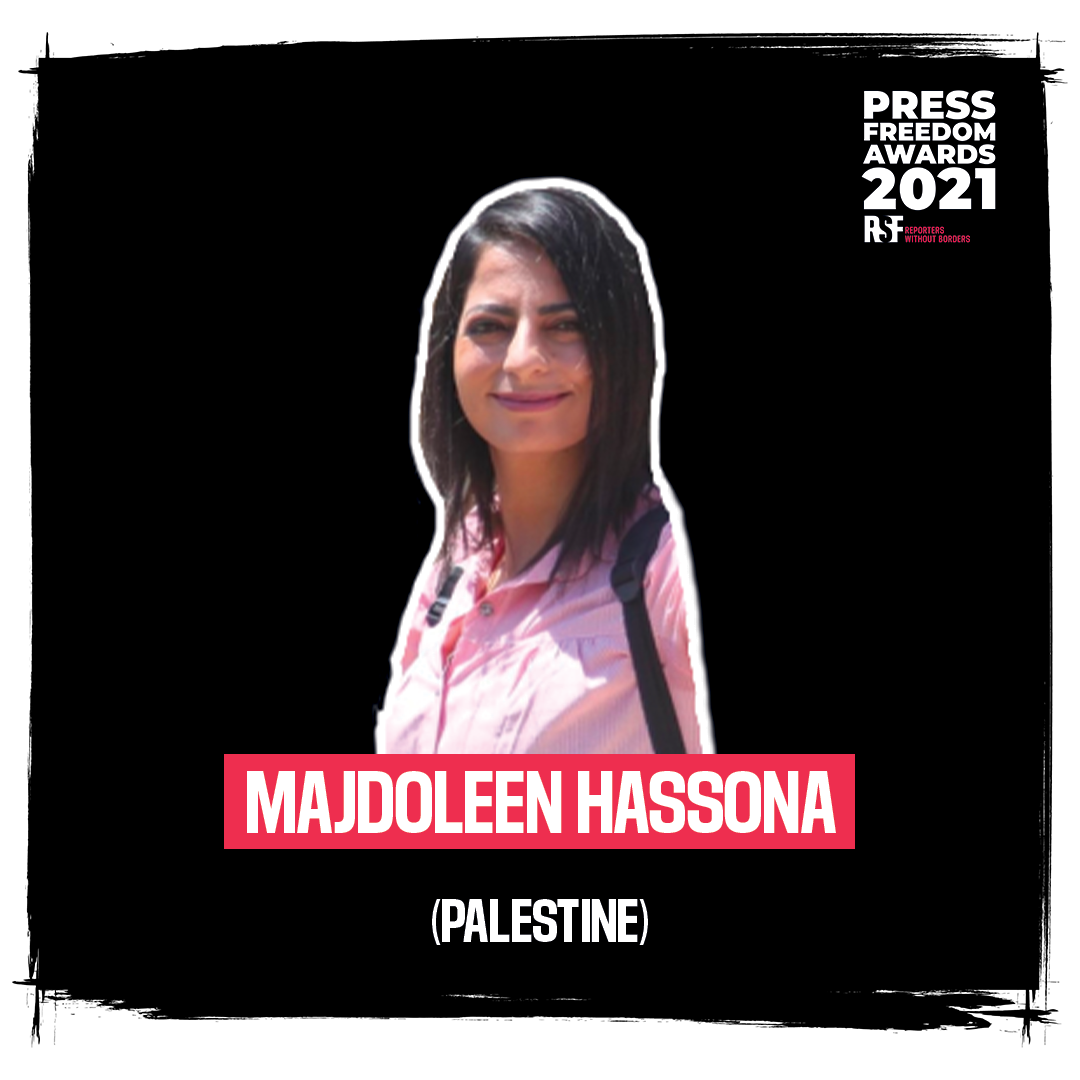
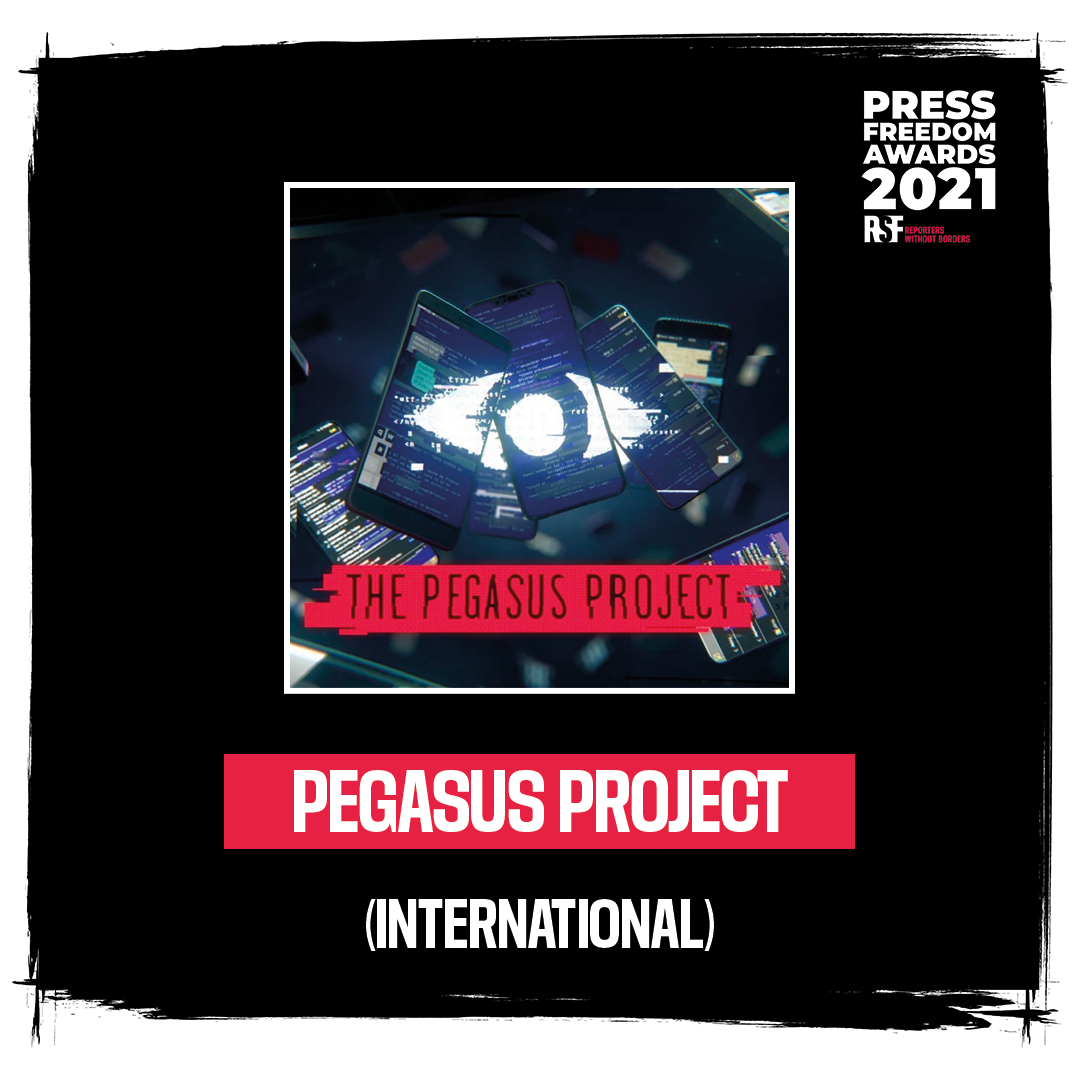
On 20 November 2021 Pacific Media Watch reported that the 2021 Reporters Without Borders (RSF) Press Freedom Awards have been given to Chinese journalist Zhang Zhan in the courage category, Palestinian journalist Majdoleen Hassona in the independence category, and the Pegasus Project in the impact category.

RSF president Pierre Haski announces the 29th RSF Press Freedom Awards in Paris. Video: RSF

RSF’s press freedom prizes are awarded every year to journalists or media that have made a notable contribution to the defence or promotion of freedom of the press in the world. This is the 29th year they have been awarded. The 2021 awards have been given in three categories — journalistic courage, impact and independence.

Courage Prize
The 2021 Prize for Courage, which aims to support and salute journalists, media outlets or NGOs that have displayed courage in the practice, defence or promotion of journalism, has been awarded to Chinese journalist Zhang Zhan.

Zhang Zhan

Despite constant threats, this lawyer-turned-journalist covered the covid-19 outbreak in the city of Wuhan in February 2020, live-streaming video reports on social media that showed the city’s streets and hospitals, and the families of the sick. Her reporting from the heart of the pandemic’s initial epicentre was one of the main sources of independent information about the health situation in Wuhan at the time.

After being arrested in May 2020 and held incommunicado for several months without any official reason being provided, Zhang Zhan was sentenced on 28 December 2020 to four years in prison for “picking quarrels and provoking trouble”. In protest against this injustice and the mistreatment to which she was subjected, she went on a hunger strike that resulted in her being shackled and force-fed. Her friends and family now fear for her life, and her health has worsened dramatically in recent weeks. See also: https://humanrightsdefenders.blog/2021/11/06/chinese-journalist-zhang-zhan-at-imminent-risk-of-death/

Independence Prize
The 2021 Prize for Independence, which rewards journalists, media outlets or NGOs that have resisted financial, political, economic or religious pressure in a noteworthy manner, has been awarded to Palestinian journalist Majdoleen Hassona.

Majdoleen Hassona
Majdoleen Hassona

Before joining the Turkish TV channel TRT and relocating to Istanbul, this Palestinian journalist was often harassed and prosecuted by both Israeli and Palestinian authorities for her critical reporting. While on a return visit to the West Bank in August 2019 with her fiancé (also a TRT journalist based in Turkey), she was stopped at an Israeli checkpoint and was told that she was subject to a ban on leaving the territory that had been issued by Israeli intelligence “for security reasons”. She has been stranded in the West Bank ever since but decided to resume reporting there and covered the anti-government protests in June 2021 following the death of the activist Nizar Banat.

Impact Prize
The 2021 Prize for Impact, which rewards journalists, media outlets or NGOS that have contributed to clear improvements in journalistic freedom, independence and pluralism, or increased awareness of these issues, has been awarded to the Pegasus Project.

The Pegasus Project
The Pegasus Project

The Pegasus Project is an investigation by an international consortium of more than 80 journalists from 17 media outlets* in 11 different countries that was coordinated by the NGO Forbidden Stories with technical support from experts at Amnesty International’s Security Lab. Based on a leak of more than 50,000 phone numbers targeted by Pegasus, spyware made by the Israeli company NSO Group, the Pegasus Project revealed that nearly 200 journalists were targeted for spying by 11 governments — both autocratic and democratic — which had acquired licences to use Pegasus. This investigation has made people aware of the extent of the surveillance to which journalists are exposed and has led many media outlets and RSF to file complaints and demand a moratorium on surveillance technology sales. See also: https://humanrightsdefenders.blog/2021/11/10/palestinian-ngos-dubbed-terrorist-were-hacked-with-pegasus-spyware/

“For defying censorship and alerting the world to the reality of the nascent pandemic, the laureate in the ‘courage’ category is now in prison and her state of health is extremely worrying,” said RSF secretary-general Christophe Deloire.

“For displaying a critical attitude and perseverance, the laureate in the ‘independence category has been unable to leave Israeli-controlled territory for the past two years. “For having revealed the scale of the surveillance to which journalists can be subjected, some of the journalists who are laureates in the ‘impact’ category are now being prosecuted by governments.

https://rsf.org/en/news/chinese-journalist-palestinian-journalist-and-pegasus-project-receive-2021-rsf-press-freedom-awards

Palestinian human rights activist Nizar Banat dead after arrest and ill-treatment

June 26, 2021
Male relatives of Palestinian human rights activist Nizar Banat gather at the family home to mourn his death in Palestinian Authority custody
Male relatives of Palestinian human rights activist Nizar Banat gather at the family home to mourn his death in Palestinian Authority custody Mosab SHAWER AFP

On 24 June 2021, France24 reported that a Palestinian human rights activist Nizar Banat, 43, a PA critic from the city of Hebron, was arrested in a dawn raid Thursday by Palestinian security forces, Hebron governor Jibrin al-Bakri said. He died Thursday shortly after being arrested. His family reported that he was beaten to death.

Following… a summons from the public prosecution to arrest citizen Nizar Khalil Muhammad Banat, a force from the security services arrested him at dawn,” Bakri said in a statement carried by the official WAFA news agency.

No reason was given for his arrest.

Banat’s family accused security forces of “hitting him on the head with wooden sticks and bits of iron” and “deliberately murdering” him, they told the Palestinian news site Quds.

The governor only said that during Banat’s arrest, “his health deteriorated”.

Banat was known for his videos posted on Facebook, in which he denounced alleged corruption in the PA. He had registered as a candidate in the Palestinian parliamentary election which had been due to be held in May before president Mahmud Abbas postponed it indefinitely.

Bakri gave no indication of the cause of death, but both he and prime minister Mohammad Shtayyeh said an investigation had been launched.

The European Union delegation to the Palestinians said it was “shocked and saddened” by Banat’s death, adding that a “full, independent and transparent investigation should be conducted immediately”. The EU had voiced concern last November after Banat spent four days in custody in Jericho, and again expressed concern in May after Palestinian security forces raided Banat’s home.

On Tuesday, another Hebron-based Palestinian human rights activist, Issa Amro, said he was briefly detained after posting criticism of political detentions on Facebook.

https://www.france24.com/en/live-news/20210624-activist-dies-in-palestinian-authority-custody-governor

https://www.middleeastmonitor.com/20210724-pa-apologises-for-murder-of-activist-nizar-banat/

Palestinian human rights defender Amro Issa convicted for speaking out

January 7, 2021

On Wednesday morning 6 January 2021 an Israeli military court convicted Palestinian Human Rights Defender Issa Amro for peacefully protesting and civil disobedience. The Israeli military judge announced the verdict in a hearing attended by representatives of British, European, EU and Canadian consulates. Amnesty International issued a statement calling to drop all the “politically motivated” charges.

Today Israel announced that Palestinians are not allowed to peacefully protest the Israeli occupation without a permit from the occupier,” Amro stated. “This conviction is the military system against the Palestinian nonviolent resistance. It aims to suppress my voice and end all activism against the Israeli occupation.” Amro’s Israeli lawyer Gaby Lasky added that “The military court is just an organ of occupation. The [indictment for nonviolent protest] is an example of how the courts are used in order to deter the important voices of human rights defenders.”

Amro is a founder of the Youth Against Settlements group in Hebron, which organises non-violent activism against the illegal Israeli settlements in Hebron and the discriminatory restrictions placed on Palestinians by the Israeli authorities in the city. Amro first appeared in an Israeli military court in 2016 on 18 charges, ranging from “insulting a soldier” to “participating in a march without a permit”. Some of the charges dated back to 2010.

The indictment, first presented in 2016, included 18 charges related to Amro’s community organizing deemed “baseless,” “politically motivated” or “physically impossible” by Amnesty. The military judge convicted Amro on six counts: three counts of “participating in a rally without a permit,” two counts of “obstructing a soldier,” and one count of “assault.” These surround Amro’s participation in the peaceful “Open Shuhada Street” demonstration in 2016; Amro’s participation in the nonviolent “I Have a Dream” demonstration from 2013 in which participants wore masks of Obama and Martin Luther King; one count of obstruction relates to a nonviolent sit-in protest in 2012 calling to re-open the old Hebron municipality building; one count of “assault” by “shoving someone” related to a previously-closed case from 2010, an incident for which the indictment had included an obstruction charge (acquitted) for Amro yelling “I am being assaulted” in the Israeli police station prior to Amro being carried out to an ambulance on a stretcher.

In 2019, UN Special Rapporteurs called for Amro’s protection and expressed “concern” over the charges. In 2017[see: https://humanrightsdefenders.blog/2019/04/11/un-rapporteurs-intervene-again-for-palestinian-human-rights-defender-issa-amro/]; thirty-five U.S. House Representatives and four Senators including Bernie Sanders sent letters highlighting that some charges were not internationally recognizable offenses and that Amnesty would consider Amro a “prisoner of conscience” if convicted. Issa Amro is the co-founder and former coordinator of the Hebron-based Youth Against Settlements initiative. In 2010, he was declared “Human Rights Defender of the year in Palestine” by the UN OHCHR and he is formally recognized by the European Union. He won the One World Media Award in 2009 for his involvement in B’Tselem’s camera distribution project. He was a guest of the U.S. State Department in 2011 and has spoken at the UN Human Rights Council on numerous occasions. The sentencing is scheduled for 8 February.

See also: https://humanrightsdefenders.blog/2016/12/21/palestinian-human-rights-defenders-continue-to-be-persecuted/

Saleh Higazi, Amnesty International’s Middle East and North Africa Deputy Director, said: “The Israeli authorities must end their campaign of persecution against Palestinian activist Issa Amro, who is a prominent voice against Israel’s regime of discrimination and systematic human rights violations against Palestinians in the Occupied Palestinian Territories, particularly in Hebron.”

https://www.scoop.co.nz/stories/WO2101/S00025/israeli-military-court-convicts-un-recognized-palestinian-human-rights-defender-for-protesting-without-a-permit.htm

http://www.ekklesia.co.uk/node/30290

https://www.amnesty.org.uk/

https://mailchi.mp/3fff66fe2a8b/military-court-convicts-human-rights-defender-issa-amro?e=51113b9c0e

Second issue of Cypher Comics is out

August 25, 2020

In July 2020, Front Line Defenders launched Cypher (@cypher_comics on Instagram), a digital comics magazine that advances the organization’s storytelling and narrative framing work in collaboration with and in support of HRDs. Working with artists from around the world, including the award-winning visual storyteller, Beldan Sezen, as creative director, the ’zine is a monthly publication featuring stories of HRDs, their work and the challenges they face. [see: https://humanrightsdefenders.blog/2020/07/23/new-cypher-comics-for-human-rights-defenders/]

If you are interested in an annual subscription to receive printed editions of Cypher, please email campaigns@frontlinedefenders.org, with ‘Subscription’ in the subject line, and you will be sent more information about options.

Cypher 02 (published on 18 July 2020) features an audio interview with Palestinian HRD and artist Hafez Omar – listen to the interview by clicking on the ‘Hafez Talks’ buttons when viewing the comcis in the ‘zine viewer below (the PDF file does not support the audio files).

Download Cypher Edition 02 PDF (no audio)