Archive for the 'human rights' Category
May 28, 2020
On 28 May 2020 Bulawayo News reported that Kwekwe-based human rights defender Nkosilathi Moyo said he was putting together a war chest to assist victims of State-sponsored violence.
Moyo launched his fight for democracy in 2015 when he travelled to the Netherlands and met European Union’s human rights ambassadors lobbying them to support human rights defenders in Zimbabwe. During the visit he also met Queen Maxima of the Netherlands and lobbied her to support efforts to improve democracy back home.
Speaking to Southern Eye on Monday, Moyo said the recent events that saw MDC Alliance’s Harare West MP Joanah Mamombe, youth leaders Cecilia Chimbiri and Netsai Marova, and Amalgamated Rural Teachers’ Union of Zimbabwe gender secretary Moreblessing Nyambara tortured at the hands of suspected State security agents, had motivated him to set up the fund.
Prior to the COVID-19 crisis, I established the community human rights defenders academy which trained more than 80 defenders in Midlands province, empowering them with skills to enhance human rights and democracy in Zimbabwe.”
“Now in light of the upsurge in violations against activists with the height of that madness being abduction of an MP Joanah Mamombe and others, I have been jolted to act. So far I have written to foreign embassies in Harare, international donors and other development partners to solicit for a financial facility that would support victims of human rights violations. We have also started putting together resources with local partners for the same cause,” Moyo said.
In the past, Moyo through his organisation Zimbabwe Youths in Politics, raised awareness on good governance and tenets of democracy mostly among rural dwellers.
[see also: https://humanrightsdefenders.blog/2013/02/04/zimbabwe-death-threats-against-human-rights-defenders-nkosilathi-moyo-and-jasper-maposa/]
“What we are realising is that autocratic regimes take advantage of poverty among political activists to suppress them and violate their rights at will. But with the kind of funding we are putting together, that will not be the case. Activists need to be supported to meet medical bills, legal representation costs, programming of their activities and compensation to their families in extreme cases. So that is the motivation of our current efforts. We should not wait for the worst to happen, then we start running around to look for resources. A ready fund must be there,” Moyo said.
https://bulawayo24.com/index-id-news-sc-national-byo-186130.html
Posted in human rights, Human Rights Defenders | Leave a Comment »
Tags: anti-torture campaign, fund, Human Rights Defenders, Joanah Mamombe, Netherlands, Nkosilathi Moyo, Southern Eye, Zimbabwe, Zimbabwe Youths in Politics
May 27, 2020
Having just posted a report on the prolifiration of intergovernmental responses to the Corona virus pandemic [https://wp.me/pQKto-4ob], it perhaps good to point to the webinar that Business & human rights is organising on 4 June 2020 on Risks and Protection of Human Rights Defenders.

Date & Time: 4 June, 4.15 – 5.15 (ICT) / 10.15 – 11.15 (BST)
It will have two parts: a closed and an open session. The closed session – happening on Jitsi – will be a safe space for civil society organisations, human rights defenders, including labour rights and land and environmental defenders, labour unions, and journalists to jointly define practical recommendations on what governments and companies can do to address human rights situation, particularly of labour, land, environmental defenders and civic freedoms, in the context of COVID-19. This part of the webinar is invite-only.
The second part – happening on Zoom – will be an open session, will be an opportunity for civil society, defenders, and journalists to interact with government and business representatives and discuss how companies, governments and civil society can work together to ensure all stakeholders are able to shape recovery efforts, and make sure they are human rights compliant. Anyone is free to join us in the public session by RSVP-ing below.
Posted in human rights, Human Rights Defenders, OHCHR | Leave a Comment »
Tags: Business and human rights, Business and Human Rights Resource Centre, Covid-19, Human Rights Defenders, Mary Lawlor, meeting, on line conversation, pandemic, Policy response from Human Rights NGOs to COVID, UN Special Rapporteurs, webinar
May 26, 2020
Amnesty International will soon (31 May 2020) challenge in a Jerusalem court a travel ban that the Israeli government imposed on its campaigner for Israel and Palestine, Laith Abu Zeyad.
On 26 May 2020 a group of local NGOs (Adalah – The Legal Center for Arab Minority Rights in Israel, B’Tselem, Bimkom – Planners for Planning Rights, Breaking the Silence, Gisha, HaMoked: Center for the Defence of the Individual, Ir Amim, Haqel – In Defense of Human Rights, Human Rights Defenders Fund, Physicians for Human Rights – Israel, The Association for Civil Rights in Israel, The Public Committee Against Torture in Israel Torat Tzedek, Yesh Din, Zazim – Community Action) issued a joint statement against the restrictionon movement of Laith Abu Zeyad, AI’s campaigner for Israel and Palestine: We stand in solidarity with our colleague from Amnesty International, Laith Abu Zeyad, and demand that Israel lift the movement restrictions barring him from leaving the Occupied Territories. His petition against the restrictions imposed upon him will be heard on 31 May 2020. Targeting Abu Zeyad is yet another example of Israel’s increased persecution and punishment of human rights organizations in recent years. This includes preventing international activists and human rights workers from entering the country and forming a ministry that creates blacklists and engages in censorship. Imposing draconian restrictions and denying millions of Palestinians freedom of movement have been a routine part of Israel’s occupation policy for 53 years. Israel comprehensively violates Palestinians’ right to travel abroad, while regarding its citizens’ rights to do so as fundamental. If it looks like political persecution and sounds like political persecution – it is political persecution, and it must stop.
In remarkable solidarity Omar Shakir, Human Rights Watch’ Israel and Palestine Director, wrote about the case in detail:
Six months ago today, the Israeli government deported me over my human rights advocacy. [see: https://humanrightsdefenders.blog/2019/11/06/human-rights-watch-omar-shakir-loses-his-appeal-in-israeli-supreme-court/].
As a Palestinian from the West Bank, Abu Zeyad must obtain an Israeli-issued permit to enter significant parts of the West Bank under Israeli control, including East Jerusalem, and Israel itself. Yet Palestinians applying for permits face what the Israeli rights group B’Tselem describes as an “arbitrary, entirely non-transparent bureaucratic system.” Most can travel abroad only by land via Jordan through the Israeli-controlled Allenby Crossing. Israeli authorities denied Abu Zeyad a permit in September 2019 to enter occupied East Jerusalem, where he had hoped to accompany his mother, who needed cancer treatment, to a hospital just three kilometers from his home but on the other side of the separation barrier. She died there in December without her son by her side.
In October 2019, Israeli authorities at the Allenby Crossing barred Abu Zeyad from traveling to Jordan to attend a relative’s funeral, citing undisclosed “security reasons,” despite his never having been convicted for a security offense. Authorities provided no further information and designated the evidence as “secret,” meaning even his attorney will not be able to see it in court. And of course, without a permit to enter Jerusalem, Abu Zeyad cannot attend his own court hearing.
Israel’s efforts to muzzle human rights work provide plenty of reason to be skeptical about the basis for the ban. Authorities in recent years imposed travel bans on, raided the offices of, and arrested Palestinian rights defenders. They also denied entry to international human rights activists, and have made it more difficult for Israeli advocacy groups to operate, with senior officials even branding them as “traitors” and “collaborators.”
New Defense Minister and Alternate Prime Minister Benny Gantz, who warned in his campaign that the previous government’s attacks on independent institutions jeopardized the country’s future, can signal a new direction by lifting Abu Zeyad’s travel ban. He is empowered to do so as he holds the defense portfolio. Israel’s international friends should also find their voice. A government that kicks out a Human Rights Watch director and bans an Amnesty International campaigner from traveling without disclosing the reasons will not hesitate to go after others, much less end systematic rights abuse, unless there is greater global pressure.
https://www.btselem.org/press_releases/20200525_let_laith_go
https://www.hrw.org/news/2020/05/25/amnesty-international-staffer-challenges-israels-travel-ban
Posted in AI, Amnesty international, HRW, human rights, Human Rights Defenders | Leave a Comment »
Tags: Amnesty International, B’Tselem, court, fair trial, freedom of movement, Human rights defender, Human Rights Watch, Israel, Israeli–Palestinian conflict, Laith Abu Zeyad, Omar Shakir, Palestinian
May 26, 2020
Azerbaijani Human Rights Defender Elchin Mammad is one the cases in the #FacesOfHope campaign by OMCT to which I referred yesterday [see: https://humanrightsdefenders.blog/2020/05/25/faces-of-hope-campaign-human-rights-defenders-imprisoned-worldwide/].
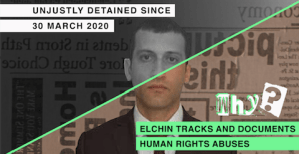 As a human rights lawyer and journalist, Elchin Mammad is used to speaking his mind. The 42-year old attorney presides over the Social Union of Legal Education of Sumgait Youth (SULESY), a non-governmental organisation that provides free legal assistance to low income families and non-profits. His busy schedule also includesda job as the editor in chief of Yukselish Namine, a newspaper specializing in human rights concerns. On 30 March 2020, a few days after he had published online a critical report on the human rights situation in Azerbaijan, police officers arrested Elchin at his home in Sumgait, a town north of the capital Baku. The police claimed to have found stolen jewellery at his office.
The next day, Sumgait City Court remanded Elchin Mammad in custody for three months as a criminal suspect. The father of two young children remains detained under trumped-up charges at Shuvalan pre-trial detention centre no. 3. This latest twist is nothing new to Elchin. He has faced harassment from the authorities in connection with his human rights work since 2015, when his organisation was investigated. He was subjected to arbitrary detention, repeatedly summoned and questioned by the police. He was also placed under travel restrictions in connection with the investigation.
On 15 May, the government officially stated that there are 46 COVID-19 infected inmates in the country. This puts Elchin’s life at risk, particularly as he suffers from hepatitis C. Azerbaijan’s prison system is plagued by severe overcrowding, while food, medication, sanitation, and even drinking water are substandard. This has led to the European Court of Human Rights repeatedly ruling that detention conditions in the country amount to inhuman and degrading treatment. In times of pandemic, such an environment risks becoming an incubator for the novel coronavirus.
Elchin’s case is particularly emblematic of the Azerbaijani authorities’ abusive and arbitrary methods used to silence critical voices. In 2014, the government launched an unprecedented crackdown on civil society. Prominent human rights defenders joined other political prisoners in Azerbaijan’s jails, on fabricated criminal charges of financial irregularities. Although most were released after spending years in prison, as a result of international pressure, the situation of defenders remains precarious
The authorities have seized the coronavirus outbreak as an opportunity to intensify the crackdown on civil society. On 19 March, President Ilham Aliyev used his yearly address to the nation on the Novruz Bayrami holiday to promise “new rules” for the duration of the pandemic, threatening to clear the country of “traitors” and “enemies” and to “isolate the fifth column”. To people like Elchin, who has dedicated his life to the defence of the downtrodden, these ominous words might now ring like a death sentence.
See also: https://humanrightsdefenders.blog/2020/04/26/azerbaijan-finally-full-acquittal-of-ilqar-mammadov-and-rasul-jafarov/
https://www.omct.org/human-rights-defenders/statements/azerbaijan/2020/05/d25855/
Posted in human rights, Human Rights Defenders, OMCT | Leave a Comment »
Tags: #FacesOfHope, detention, Elchin Mammad, freedom of expression, medical care, OMCT, prison conditions
May 20, 2020
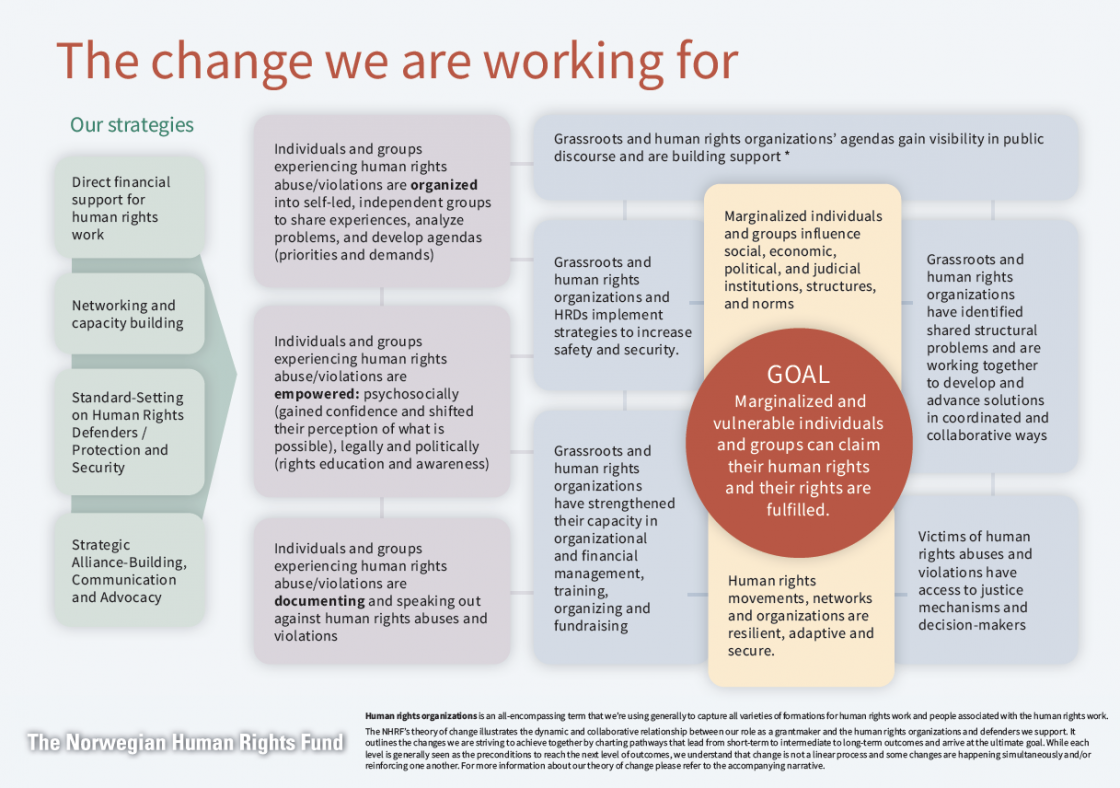
Perhaps the home-bound period of the pandemic is a good time to reflect more deeply on the way we work. The Norwegain Human Rights Fund has done this [see also: https://humanrightsdefenders.blog/2019/07/29/nhrf-seeks-a-theory-of-change-consultant/] and now reports the first result:
The development of the theory of changewas a participatory process involving the NHRF Secretariat, its Board, NHRF local consultants, and a selection of grantee partners. It is a living document that represents our theory of how change is created and driven forward. It articulates expected outcomes and their preconditions that, together, form pathways of change that lead to the overall goal. We understand these processes to be non-linear, interconnected, interdependent, mutually reinforcing, and occurring simultaneously or separately. The theory of change will guide our work as a partner and grantmaker by informing the support we provide to human rights work to achieve the defined outcomes and overall goal. It is one of the key elements used in our monitoring, evaluation, and learning processes. We will regularly review and refine the theory of change as we assess if our interventions are bringing about change and if the pathways of change are accurate and realistic.
Download our Theory of Change
Posted in human rights, Human Rights Defenders | Leave a Comment »
Tags: Human Rights Defenders, human rights movement, management, NHRF, Norway, Norwegian Human Rights Fund, social change, theory of change, vulnerable
May 19, 2020
Started in an initiative by Justice & Peace Netherlands to commemorate the 70th anniversary of the declaration of universal human rights, the creative project pays tribute to the activists for their commitment to “climate, freedom and equality”, the university said.
“The mural] is a tribute to three people who show that it is really possible to make a difference” – Hague University of Applied Sciences
—
https://agenda.ge/en/news/2020/1530
Posted in awards, human rights, Human Rights Defenders | 1 Comment »
Tags: 70th anniversary UDHR, Berta Cáceres, Georgia, Greta Thunberg, Honduras, Justice and Peace Netherlands, mural, painting, portraits, Sweden, the Hague, Vitali Safarov
May 18, 2020
It is a matter of extreme urgency that Burundi’s presidential, legislative, and local elections, scheduled for May 20, be postponed. Admittedly, it’s the eleventh hour, but the contagion of violence, and the viral contagion of COVID-19, make rescheduling imperative. Three events of the past several days make an incontrovertible argument:
- On May 14, the United Nations Commission of Inquiry (COI) on Burundi—investigating alleged crimes against humanity committed by Burundian government forces since September 2016 —released an urgent statement in light of the “numerous acts of violence and human rights violations” occurring during the election campaign. The Commission made clear that accelerating violence and the “shrinking of democratic space” put the electoral process at serious risk.
- On May 13, the Burundian government expelled the World Health Organization (WHO) team just as the pandemic inexorably spreads in Burundi. The government has done little to address the COVID-19 crisis. Massive campaign events are being held—making a mockery of physical distancing — in blatant defiance of WHO recommendations. And now the government, in a spasm of defensive irrationality, declares the WHO persona non grata.
- And, on May 8, the Burundian government informed the East African Community that election monitors would be required to quarantine for 14 days, effectively preventing them from entering Burundi before the May 20 vote. The election will thus be held without any international monitoring to ensure that the vote is free and fair.
Pierre Nkurunziza, granted the title of “Supreme Guide of Patriotism,” heads an authoritarian regime. Nkurunziza, who is not standing for re-election, has chosen as his successor a man who is complicit in the alleged crimes against humanity now being investigated by the UN’s COI and the International Criminal Court. His name is Evariste Ndayishimiye, a retired army general who has served as minister of the interior and security. “Do not be afraid,” General Ndayishimiye said of COVID-19 during the campaign. “God loves Burundi, and if there are people who have tested positive, it is so that God may manifest his power in Burundi.”
New reports from Human Rights Watch and Amnesty International amply testify that the crisis in Burundi has been worsening as the election nears. Government forces are launching attacks against real and perceived regime opponents. The few remaining independent media outlets are being threatened and harassed. Human rights defenders have either fled the country or been intimidated into silence…………..
[see: https://humanrightsdefenders.blog/tag/burundi/]
https://www.indepthnews.net/index.php/the-world/africa/3544-burundi-threatens-to-deal-a-severe-blow-to-un-reputation
Posted in Al-Hassani, human rights, Human Rights Defenders, UN | Leave a Comment »
Tags: Burundi, Covid-19, election monitoring, elections, Evariste Ndayishimiye, IDN - InDepthNews, Paula Donovan, postponement, Stephen Lewis, UN
May 13, 2020

Further to the announcement of Mary Lawlor as Special Rapporteur on HRDs [see:
https://humanrightsdefenders.blog/2020/05/07/mary-lawlor-takes-up-post-as-un-special-rapporteur-for-human-rights-defenders/].
Human Rights First on 12 May 2020 proudly announced that
Brian Dooley, its senior advisor on human rights movements and the risk of persecution and reprisal they face, will also serve as an advisor to Mary Lawlor. Dooley will advise the special rapporteur on a range of issues facing human rights defenders while continuing his work at Human Rights First.
“We are incredibly proud Brian was chosen for such a distinguished and important role,” said Mike Breen, president and CEO of Human Rights First. “Brian has been critical to the success of numerous campaigns to support human rights defenders in Bahrain, Egypt and Hong Kong over the last ten years. He will be an asset to the UN Special Rapporteur’s team and his work will undoubtedly increase the visibility of the threats that human rights defenders face, and hopefully, lead to better protections for those doing the vital work of advancing human rights.” For some of my older posts referring to Brian Dooley: https://humanrightsdefenders.blog/tag/brian-dooley/.
See also: https://en.wikipedia.org/wiki/Brian_J._Dooley
Posted in HRF, human rights, Human Rights Council, Human Rights Defenders | 1 Comment »
Tags: appointment, Brian Dooley, Human Rights First, Mary Lawlor, Mike Breen, UN Special Rapporteur on Human Rights Defenders
May 13, 2020

Nobel Peace Prize laureate Yemeni Tawakkol Karman (AFP)
On 10 May 2020 AlBawaba reported that Facebook had appointed Yemeni Nobel Peace Prize laureate Tawakkol Karman as a member of its newly-launched Oversight Board, an independent committee which will have the final say in whether Facebook and Instagram should allow or remove specific content. [ see also: https://humanrightsdefenders.blog/2020/04/11/algorithms-designed-to-suppress-isis-content-may-also-suppress-evidence-of-human-rights-violations/]
Twenty (out of 40) board members have been announced so far including Denmark’s former prime minister Helle Thorning-Schmidt, former Guardian editor-in-chief Alan Rusbridger and Internet Without Borders executive director Julie Owono. “The board uses its independent judgment to support people’s right to free expression and ensure that those rights are being adequately respected,” the company said. Facebook added the board’s judgments on the social network’s content moderation decisions are “binding”. The company will have to implement them, unless they are in violation of the law.
Karman, a human rights activist, journalist and politician, won the Nobel Peace Prize in 2011 for her role in Yemen’s Arab Spring uprising. Her appointment to the Facebook body has led to sharp reaction in the Saudi social media. She said that she has been subjected to a campaign of online harassment by Saudi media ever since she was appointed to Facebook’s Oversight Board. In a Twitter post on Monday she said, “I am subjected to widespread bullying & a smear campaign by #Saudi media & its allies.” Karman referred to the 2018 killing of Jamal Khashoggi indicating fears that she could be the target of physical violence.
However,
previous Saudi Twitter campaigns have been proven by social media analysts to be manufactured and unrepresentative of public opinion, with thousands of suspicious Twitter accounts churning out near-identical tweets in support of the Saudi government line. The Yemeni human rights organization SAM for Rights and Liberties condemned the campaign against Karman, saying in a statement that “
personalities close to the rulers of Saudi Arabia and the Emirates, as well as newspapers and satellite channels financed by these two regimes had joined a campaign of hate, and this was not a normal manifestation of responsible expression of opinion“.
Posted in human rights, Human Rights Defenders | 1 Comment »
Tags: content moderation, cyber attacks, facebook, on-line harassment, SAM for Rights and Liberties, Saudi Arabia, smear campaign, social media, Tawakkol Karman, twitter, Yemen
May 12, 2020
 Front Line’s current Deputy Director Andrea Rocca is sadly leaving and Front Line Defenders is now seeking candidates for the position of Deputy Director, reporting to and working together with the Executive Director, Andrew Anderson. The post is based in the organization’s headquarters in Dublin. The division of responsibilities between the Executive Director and the Deputy Director may be revised based on needs and relevant expertise.
The Deputy Director has particular responsibility for the following areas of work:
➢ Research & Policy regarding security& protection of human rights defenders;
➢ Office security, mission security, security and well-being of staff;
➢ Advocacy/lobbying;
➢ Capacity Building;
➢ Digital security;
➢ Strategy & Planning;
➢ The Dublin Platform;
The role includes regular international travel and representation of the organization.
Applications
Applications should be sent by email to recruit@frontlinedefenders.org with the job title “Deputy Director” in the subject heading. Applications should contain a CV and cover letter with two references in one pdf format document that should not be more than five pages. Please do not include additional attachments. The deadline for applications is 25th May 2020. We expect to organize a first round of interviews online in early June.
Required Competencies
- She/he should have at least five years of working at a senior level for the protection of human rights defenders /or equivalent experience in a human rights based activity/organisation in a leadership role and have experience of management, budgeting, planning and evaluation. The Deputy Director will have strong communication and analytical skills. She/he will have a very good understanding of the political environment for human rights defenders and an understanding of international human rights law and the relevant parts of the UN system. She/ he will have a high level of interpersonal skills and will lead by example to motivate staff and ensure the values and culture of the organisation are maintained.
- Experience of working in an international context for the protection of human rights/human rights defenders, ideally experience of working in an international or regional human rights/human rights defenders NGO.
- Experience of working with gender-focused initiatives, including but not limited to gender policies and gender-sensitive programming. Proven understanding of how gender intersects with race, disability, class and sexuality in human rights defenders’ lived experiences and their protection needs.
- Excellent political judgement, including the ability to make strategic choices based on sound analysis of potential costs and benefits.
- Management experience in a relevant field that includes financial management, people management, staff well-being, strategic planning and evaluation.
- Experience of building and working successfully with teams of people with different professional or cultural backgrounds.
- A third level qualification, ideally in the area of human rights, law, politics, international relations or other relevant discipline.
- Personal leadership, initiative and proactivity. Capable of identifying and resolving potential problems before they arise. Sound decision making, extremely well organised and structured in approach.
- Excellent written and verbal communication and presentation skills in English is essential and working knowledge of one of Front Line Defenders other working languages (Arabic, French, Russian and Spanish) is desirable.
—————-
Download the Deputy Director Job Advert
Posted in human rights | Leave a Comment »
Tags: Andrea Rocca, Andrew Anderson, career, deputy director, Dublin, Front Line Defenders, job opportunity, post, recruitment, vacancy



 Hans Thoolen on Human Rights Defenders and their awards