Posts Tagged ‘news’

ISHR Executive Director Phil Lynch called on States to support the work of defenders and to pay their UN due

June 24, 2025

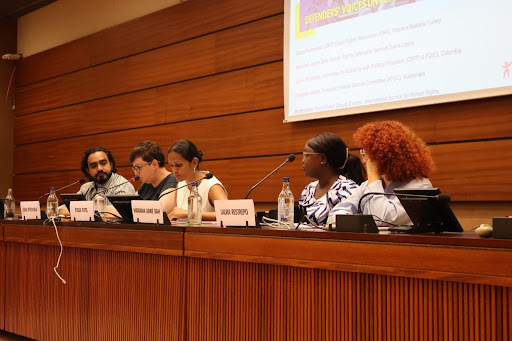
Watch a recording of the statement at an interactive dialogue on the annual report of the High Commissioner by ISHR Executive Director Phil Lynch

High Commissioner, this statement addresses four themes from your update.

First, the work of human rights defenders is essential for the realisation of all human rights. We deplore the criminalisation and arbitrary detention of defenders in all regions. We call for the release of Eduardo Torres in Venezuela, Ibrahim Metwally in Egypt, Mahmoud Khalil in the US, and Sophia Huang Xueqin in China, among thousands of defenders imprisoned globally for their work for freedom and justice.

Second, principled respect for international law protects us from tyranny. The failure of States with influence to end Israel’s genocide against Palestinians, and the double standards of States which fail to condemn Russia’s atrocity crimes in Ukraine, erode the foundations of peace, security and development everywhere.

Third, impunity for atrocity crimes denies justice to victims and fuels violations. This Council should mandate investigative mechanisms on Afghanistan and China. All States should respect international courts and sanction authorities – including US officials – who seek to pervert international justice.

Finally, no business, however efficient, can survive when customers don’t pay their bills. States which don’t pay their UN dues in full or on time, especially the US and China, benefit from the system while causing a liquidity crisis, with devastating human rights impacts. They should lose the right to vote at the General Assembly and the Security Council until they pay their dues. Humanity’s future depends on all States increasing their human rights investment.

Thank you.

https://ishr.ch/latest-updates/hrc59-humanitys-future-depends-on-all-states-increasing-their-human-rights-investment

ICJ demands that Russia immediately release lawyer Maria Bontsler

June 23, 2025
International Commission of Jurists

photo_2025-06-10_07-29-51

On 10 June 2025 The International Commission of Jurists (ICJ) condemned the arrest and detention of prominent Kaliningrad lawyer and human rights defender Maria Bontsler and called on the Russian authorities to release her immediately.

The ICJ is concerned that the charges against Maria are spurious and likely to be related to Bontsler’s legitimate activities. Proceedings against her have been undertaken in a shroud of secrecy and the ICJ calls on the authorities to immediately clarify their legal and factual basis for the charges against her.

Maria Bontsler was arrested on 28 May 2025 under Article 275.1 of the Russian Criminal Code, which provides for criminal liability for “confidential cooperation with a foreign State” aimed at “undermining the security of the Russian Federation”.

Available information indicates that a court hearing concerning Maria Bontsler’s detention or the filing of charges was held behind closed doors, at the Prosecutor’s request, on grounds of State secrecy. However, no official justification has been provided to demonstrate that the secrecy of the proceedings was necessary and proportionate as required under international human rights law. The ICJ is concerned that this lack of transparency undermines Bontsler’s right to a fair hearing.

This prosecution reflects a broader campaign of retaliation against lawyers in Russia who engage in what the authorities see as politically sensitive cases. Such actions serve to intimidate and discourage other lawyers from vigorously defending their clients,” Temur Shakirov, Director (ad interim) of ICJ Europe and Central Asia Programme said.

Maria Bontsler has a long record of defending politically persecuted individuals, including critics of Russia’s unlawful military intervention in Ukraine.

Irrespective of any charges, the ICJ stresses that it is inappropriate to keep Maria Bontsler in pre-trial detention.

In a broader context of interference with the legal profession, searches were also carried out at the homes of her colleagues, Roman Morozov and Ekaterina Selizarova, with electronic devices and legal documents seized. According to available reports, Morozov was questioned in relation to his alleged connections to the human rights organisation Memorial.

The ICJ stresses that under international law and standards, including the UN Basic Principles on the Role of Lawyers, lawyers must be able to perform their professional activities without hindrance, including the collection and dissemination of information essential to protecting effectively their clients’ rights.

Maria Bontsler is a well-known human rights lawyer who represents individuals in politically charged cases and has been recognized by the Moscow Helsinki Group for her human rights defence work. Her clients include critics of the Russian Federation’s unlawful military intervention in Ukraine.

….Previously, Maria Bontsler was fined under administrative proceedings for courtroom statements made in defence of her clients, part of a systematic harassment faced by lawyers handling “political” cases in Russia

https://www.icj.org/russian-federation-authorities-must-immediately-release-lawyer-maria-bontsler/

see also: https://www.civicus.org/index.php/fr/medias-ressources/112-news/7777-key-highlights-civicus-at-59th-session-of-the-un-human-rights-council

Amnesty International Australia starts on-line course for Human Rights Defenders skills

June 4, 2025

👋 New to Activism? You’re in the Right Place. 

You don’t need experience to make a difference. You just need the belief that things can be better – and the courage to take that first step. At Amnesty, we’ll support you to get involved in a way that works for you. Whether you’ve got five minutes or a few hours a month, there’s a place for you in our movement. 

….

🌈 Ready to Take Action? Sign up Today. 

Once you sign up, we’ll guide you through a short online induction module that introduces you to who we are, what we do, and how you can help. From there, you’ll be connected with the right support to help you  

https://www.amnesty.org.au/skill-up-2/

NGOs address Pakistan on Afghan journalists and Baloch human rights defenders

May 30, 2025

On 29 May the Committee to Protect Journalists and fourteen other organisations have urged Pakistan to immediately halt deportation of Afghan journalists and other vulnerable Afghan migrants. The fifteen advocacy groups expressed deep concern over Pakistan’s ongoing deportation plan, first announced on 3 October 2023, which targets undocumented Afghan nationals. The joint statement highlights the heightened risks faced by Afghan journalists, writers, artists, human rights defenders, and others who fled Taliban persecution and are now at risk of being forcibly returned.

Among the signatories are prominent international organisations such as PEN Germany, CPJ, Unlimited Free Press, Front Line Defenders, International Cities of Refuge Network (ICORN), Nai – Supporting Open Media in Afghanistan, and Reporters Without Borders (RSF).

The organisations also called on the international community to provide safe resettlement opportunities for these individuals, recognising the dangers they face if returned to Taliban-controlled Afghanistan. Pakistan’s deportation policy has faced sharp criticism from local and international bodies, including the Pakistan Human Rights Commission, the United Nations High Commissioner for Refugees (UNHCR), and the International Organisation for Migration (IOM). These entities have urged Pakistan to uphold its international obligations and provide protection to those fleeing conflict and persecution.

Despite repeated calls for restraint, the Pakistani government has accelerated forced returns in recent months. In April alone, more than 300,000 Afghans were deported, drawing further condemnation from human rights organisations.

——

On 28 May Amnesty International along with four other human rights organizations wrote to the Pakistani prime minister, calling for an end to the “harassment and arbitrary detention” of Baloch human rights defenders (HRDs) exercising their rights to freedom of expression and peaceful assembly, particularly in Balochistan province. 

The letter comes in the wake of Dr. Mahrang Baloch, one of the leading campaigners for the Baloch minority and the leader of the Baloch Yakjehti Committee (BYC), and a number of other activists, being arrested in March on charges of terrorism, sedition and murder. ..

The five organizations — Amnesty International, Asian Forum for Human Rights and Development (FORUM-ASIA), Front Line Defenders, International Federation for Human Rights, World Organization Against Torture — appeal to Pakistan’s Prime Minister to release Baloch human rights defenders and end the crackdown on dissent in line with Pakistan’s international human rights obligations;

A dozen UN experts called on Pakistan in March to immediately release Baloch rights defenders, including Dr. Baloch, and to end the repression of their peaceful protests. UN special rapporteur for human rights defenders Mary Lawlor said she was “disturbed by reports of further mistreatment in prison.”

Balochistan is the site of a long-running separatist movement, with insurgent groups accusing the state of unfairly exploiting Balochistan’s rich gas and mineral resources. The federal and provincial governments deny this, saying they are spending billions of rupees on the uplift of the province’s people. 

see also: https://humanrightsdefenders.blog/2024/10/22/prominent-baluch-human-rights-defender-stopped-from-attending-time-event-in-us-and-then-assaulted/

https://www.afintl.com/en/202505291879

https://www.arabnews.com/node/2602563/amp

EU’s Annual Report on Human Rights and Democracy in the World 2024 is out

May 28, 2025
Low angle of children standing in a circle reaching out to join hands.

© UNFPA

In 2024, we have witnessed extraordinary levels of hostility towards democracy, from rampant disinformation and information manipulation by foreign actors, to the silencing of media and human rights defenders, and a strong pushback against gender equality and diversity, undoing years of progress in many countries across the globe. Today, only 29% of the world’s population live in liberal democracies. At the heart of these challenges lies peace. Peace is not simply the absence of war. It is the active cultivation of justice, the protection of the most vulnerable, the realisation of all human rights and the commitment to dialogue and reconciliation.’ 
– High Representative, Kaja Kallas 

The publication of the EU’s Annual Human Rights Report takes place in the context of multiple and cascading crises, including war on the European continent and the resurgence of conflict in many other areas of the world. These developments underscore the strong links between peace, human rights and democracy. Climate change, digital transformation, and rising inequalities add to the growing human rights challenges worldwide.

The report follows the structure of the EU’s Action Plan on Human Rights and Democracy, particularly the EU’s work on protecting and empowering individuals, building resilient, inclusive and democratic societies, promoting a global system for human rights and democracy, harnessing opportunities and addressing challenges, and ensuring that the EU delivers by working with our partners.

The EU continues to support the strengthening of inclusive, representative and accountable institutions, and promoted a collaborative approach to democracy through the Team Europe Democracy initiative. The fight against information manipulation and interference also continues to be a priority through initiatives such as EUvsDisinfo. Over the past year, the European Endowment for Democracy has kept up its work on fostering democracy and working with free media and civil society in challenging circumstances in Belarus, and Ukraine among others. The EU has carried on supporting and empowering people on the frontlines of human rights advocacy.

While the global outlook is challenging, the EU is steadfastly pursuing deeper international cooperation and stronger early warning and prevention mechanisms. Efforts to ensure accountability for violations and abuses of human rights continue to be a key priority. Together with its partners, the EU is determined to protect the multilateral human rights system and uphold the central role of human rights and democracy in fostering peace, security and sustainable development.

NGOs alarmed by draft law “TRANSPARENCY OF PUBLIC LIFE” in Hungary

May 27, 2025

Human Rights Watch, Civil Rights Defenders and many, many other NGOs are deeply alarmed by a new legislative proposal in Hungary that, if passed, would institutionalise sweeping, opaque, and politically motivated repression of independent civil society, the press, and private organisations that receive foreign support or have any kind of income that the Hungarian government feels would threaten the country’s sovereignty. 

The draft law, which is deceptively titled ‘On the Transparency of Public Life’, would give the authorities unchecked powers, allowing it to recommend the registration of organisations deemed to be ‘influencing public life’ with foreign funding in ways that ‘threaten Hungary’s sovereignty’. Because this phrasing is vague and ideologically loaded, it risks including any kind of criticism of government policy, including the promotion of human rights, press freedom, gender equality, and the rule of law. 

Potential disastrous consequences

  • No legal remedy: If the government demands an organisation register itself, the organisation in question would not be able to appeal this decision. Once listed, organisations would have no access to effective legal redress; 
  • Broad definitions: ‘Foreign support’ is defined as any financial input, no matter how small, from practically any international source (including EU institutions and dual citizens) as well as commercial revenue; 
  • Sweeping prohibitions and sanctions: Listed organisations would have to seek permission from the tax authorities to receive foreign support. Financial institutions would be required to report and block transfers, meaning NGOs would effectively be permanently monitored; 
  • Loss of domestic support: Listed organisations would lose access to Hungary’s 1% income tax donation scheme, which would prevent them from receiving support from regular Hungarian citizens; 
  • Political targeting: Leaders of registered organisations would be labelled ‘politically exposed persons’, which would expose their private financial transactions to invasive scrutiny; 
  • Severe penalties: Any violations could lead to fines of up to 25 times the amount received, suspension of the organisation’s advocacy activities, and even forced closure.

EU must speak out against proposed law

Hungary’s draft law is not about transparency: it is a calculated attempt to criminalise dissent, silence watchdogs, and entrench one-party control over the democratic public sphere and civic space. If passed, the law would violate multiple provisions of the EU Charter of Fundamental Rights and the European Convention on Human Rights, including freedom of expression and association and the right to an effective remedy. 

In an open letter to President Ursula von der Leyen and Commissioner Michael McGrath of 22 May 2025, the NGOs urge to take the following immediate steps:

  • Immediately request the Court of Justice of the European Union (CJEU) to grant interim measures in the ongoing infringement procedure on the Law on the Defence of National Sovereignty (Case C-829/24). The Sovereignty Protection Office is crucial to the new bill and therefore this is an imminent and effective way to halt the progress and impact of the bill. Cognizant of the impending danger, the European Parliament and civil society have been calling for this step since 2024. Interim measures are designed to prevent irreparable harm — in this case, the effective paralysis of civil society organisations, independent media and dissenting voices – and with this new development comprehensive interim measures should be requested immediately.
  • At the same time, call on the Hungarian government to withdraw the bill and if unsuccessful, open a new infringement procedure on new violations that are not linked to the ongoing case on the Defence of National Sovereignty.
  • With the forthcoming Article 7 hearing on Hungary on 27 May 2025 and recognising the escalation of a systematic breakdown of the rule of law, support the Council of the EU to move to a vote on Article 7(1).

This new bill represents a severe and existential threat to democratic principles, human rights and the rule of law in Hungary and in the EU as a whole. If the existing tools are not effectively deployed, we risk an unravelling of the rules on which the EU was founded and a clear step towards authoritarian practices. We call on you to stand in solidarity with Hungarian civil society and their counterparts across the region and remain available to provide additional information and support.

https://www.hrw.org/news/2025/05/23/open-letter-hungarian-bill-entitled-transparency-public-life

https://www.coe.int/nb/web/commissioner/-/commissioner-asks-hungary-s-parliament-not-to-adopt-law-that-stifles-civil-society

New report: Human rights defenders at risk in the renewable energy transition

May 27, 2025

A new report by the research organization Swedwatch of 29 April 2025 highlights critical human rights risks associated with the global transition to renewable energy. The report reveals that human rights and environmental defenders face serious threats and reprisals in countries where renewable energy projects are being rapidly developed.

More than half of the world’s total prospective wind farm capacity, and more than two thirds of the prospective solar farm capacity, is estimated to take place in countries with obstructed, repressed or closed civic space.

While scaling up wind, solar, and hydropower is essential to limiting global warming to 1.5°C, this growth must not come at the expense of human rights.

We cannot build a green future on the backs of those who are silenced or displaced. The renewable energy transition must not come at the cost of human rights. Defenders are not obstacles – they are essential allies in ensuring that this is just, equitable, and sustainable, says Alice Blondel, Director Swedwatch.

Renewable energy projects require large land areas, often affecting local communities, ecosystems, and livelihoods. Swedwatch’s analysis shows that the renewable energy transition will largely take place in countries with restricted civic space and poor human rights protections, where defenders who raise concerns often face harassment, legal persecution and at times even deadly violence.

The report Renewables and Reprisals – Defenders at risk in the green energy transition in Brazil, Honduras, Mozambique, and the Philippines is based on a global mapping of such high-risk areas for defenders, where civic space is restricted and where renewable energy expansion is projected to accelerate. Additionally, the report presents four case studies from Mozambique, Honduras, Brazil, and the Philippines, where defenders and affected community members describe restrictions and reprisals of defenders linked to renewable energy projects.

The report is authored by Swedwatch with input from Terramar Institute (Instituto Terramar), Network of Women Human Rights Lawyers and Defenders (Red de Abogadas Defensoras de Derechos Humanos) and Jalaur River for the People’s Movement (JRPM).

-The report underscores the urgent need for stronger protections for defenders, transparent consultation processes, and corporate accountability. Without immediate action, the rapid expansion of renewables risk repeating the same human rights abuses seen in industries such as mining and agribusiness, rather than fostering a truly just energy transition, says Alice Blondel.

Expansion of renewables in countries with high risks for defenders
Swedwatch’s findings indicate that a large share of the expansion of renewable energy is taking place in countries where civic space is restricted, and defenders are at significant risk.

Case studies: Defenders under threat
In the four case studies, defenders from Mozambique, Honduras, Brazil and the Philippines described restrictions of basic civic freedoms and risks of verbal, legal or violent physical attacks when reporting about impacts of renewable energy projects.

Mozambique: According to interviews in the report, the planning of the Mphanda Nkuwa hydropower project has been marred by inadequate social and environmental impact assessments, lack of transparency, and suppression of civic engagement. Defenders reported threats, violation of freedom of assembly, and an overall disregard for their right to participate in decision-making processes.

Honduras: Human rights defenders have faced legal intimidation through SLAPPs (Strategic Lawsuits Against Public Participation) for their criticism of the Los Prados solar power project, according to a group of women human rights lawyers. Community members involved in protests have allegedly been surveilled and subjected to repressive actions by security forces. Defenders also reported smear campaigns in the media, further restricting their ability to voice concerns.

Brazil: In Brazil, the wind power project Bons Ventos failed to properly include impacted communities, including marginalized groups, traditional fishing, and quilombola communities, in consultations, according to interviews. Defenders decided to remain anonymous in the interviews out of fear of reprisals, citing increasing threats and violence against defenders in the past years.

The Philippines: Indigenous defenders from the Tumandok communities were allegedly threatened, harassed, and killed when the national police and the armed forces raided their communities after community leaders criticized the Jalaur River Multipurpose project, according to a CSO operating in the area. Defenders reporting on the dam project outlined persecution, surveillance and red-tagging – terror-labelling by the government accusing defenders of being communist insurgents, creating an environment of fear and impunity.

Swedwatch´s recommendations
As the world races to meet climate targets, a just transition must include the voices of those most affected by energy projects, and defenders are essential in ensuring that renewable energy projects respect human rights and the environment.

-Governments, businesses, and financial institutions must work together to ensure that human rights are protected, and that defenders can operate without fear of repression or violence. Engaging with defenders as valuable partners rather than as adversaries can help governments and businesses ensure renewable energy projects’ alignment with international human rights obligations, mitigate conflicts, and promote sustainable development, says Jessica Johansson.

Detailed recommendations to different actors can be found in the report, below the main ones are summarized:

Recommendations for governments:

  • Adopt legislation on mandatory human rights due diligence (HRDD) for companies, highlighting risks to defenders and meaningful consultation with defenders.
  • Adopt laws on company transparency laws and access to information.
  • Establish and enforce protections for defenders, ensuring they can operate without fear of retaliation, and provide effective legal remedies for those affected by violations.

Recommendations for companies and investors:

  • Strengthening their HRDD processes by integrating civic space risks and ensuring meaningful stakeholder engagement with defenders.
  • Adopt and enforce a zero-tolerance policy against reprisals targeting defenders (and affected communities).
  • Take appropriate action when business partners or third parties commit violations in relation to their business activities.


https://www.mynewsdesk.com/swedwatch/pressreleases/new-report-from-swedwatch-human-rights-defenders-at-risk-in-the-renewable-energy-transition-3382176?utm_source=rss&utm_medium=rss&utm_campaign=Alert&utm_content=pressrelease

Business & Human Rights Resource Centre seeks Executive Director

May 25, 2025

The Business & Human Rights Resource Centre (the Resource Centre) seeks a creative, strategic and inspiring leader ready to drive the next generation of progress in strengthening human rights in business. For more than two decades the Resource Centre has sought to amplify the voices of rightsholders and work collaboratively with allies and partners to strengthen corporate practices and support smart regulation to deliver a just economy, address the climate crisis and counter abuse. The ideal candidate will bring energy and insights to the Resource Centre’s vision of transformational change, which is built on community-led action and enhanced by global partnership. The Executive Director will have a strong understanding of international human rights, labour, environmental and climate frameworks as they relate to business–and how to make change happen through those frameworks. They will be able to work effectively with people and organisations at many levels, including grassroots leaders, government representatives, funders, corporate executives and investors.

The Executive Director will lead our global team of 80 across 30 locations, operating with a budget of US$6 million and working in diverse alliances and partnerships worldwide.

KEY RESPONSIBILITIES

Strategic Leadership

Management and Organisational Culture

Thought and Field Leadership

Resource Mobilization, Budget Oversight and Finance:

LOCATION AND COMPENSATION

The successful candidate can work in our offices in London, New York, Berlin, or Bogota, or remotely (home-based) anywhere there is strong and continuous internet access. Our team members are based all over the world, and most of our meetings take place during GMT hours to cover Asia and Latin America. The candidate must be committed to working across time zones, be flexible with respect to participating in early and late calls as needed, and able to work at least four hours that overlap with 09:00 – 17:00 Greenwich Mean Time (GMT).

The role requires frequent travel to all regions of the world (~35%) in order to connect in-person with Global Team members, partners, local communities, board members and funders, and to represent the Resource Centre at global events.

HOW TO APPLY

This search is being led by consultant Jenna Capeci, in partnership with the board and staff of the Business and Human Rights Resource Centre.

Timeline

Applications are due by Friday, June 13th, 2025. Selected applicants will begin to be contacted for interviews by July 2025. Interviews will be conducted from July through early September. Tentative timing for rounds of interviews are: July 14 – 18, August 13 – 22 and September 3 – 16. Finalists will be asked to create and make a brief presentation.
Anticipated start date is October/November 2025. Applications may be reviewed over time, so please be patient if you do not hear from us immediately. Applicants not invited for interviews will be notified by the end of August.

How to apply

Please apply through this portal. Only applications received in this portal will be considered.

https://reliefweb.int/job/4153128/executive-director

Amnesty International declared “undesirable organization” in Russia

May 25, 2025

Reacting to the news that the Russian authorities have declared Amnesty International an “undesirable organization” thereby criminalizing its activities and any association with the organization in Russia, Agnès Callamard, Amnesty International’s Secretary General, said19 May 2025 

This decision is part of the Russian government’s broader effort to silence dissent and isolate civil society. In a country where scores of activists and dissidents have been imprisoned, killed or exiled, where independent media has been smeared, blocked or forced to self-censor, and where civil society organizations have been outlawed or liquidated, you must be doing something right if the Kremlin bans you.  

“The authorities are deeply mistaken if they believe that by labelling our organization “undesirable” we will stop our work documenting and exposing human rights violations – quite the opposite. We will not give in to the threats and will continue undeterred to work to ensure that people in Russia are able to enjoy their human rights without discrimination. We will keep documenting and speaking worldwide about the war crimes committed in Ukraine by Russia. We will redouble our efforts to expose Russia’s egregious human rights violations both at home and abroad.  

The authorities are deeply mistaken if they believe that by labelling our organization “undesirable” we will stop our work documenting and exposing human rights violations – quite the oppositeAgnès Callamard, Amnesty International’s Secretary General

“We will never stop fighting for the release of prisoners of conscience detained for standing up for human rights or for the repeal of repressive laws that prevent people in Russia from speaking up against injustice. We will continue to work relentlessly to ensure that all those who are responsible for committing grave human rights violations, whether in Russia, Ukraine, or elsewhere, face justice. Put simply, no authoritarian assault will silence our fight for justice. Amnesty will never give up or back down in its fight for upholding human rights in Russia and beyond.” 

Background 

On 19 May 2025, the Russian Prosecutor General’s Office declared Amnesty International an “undesirable organization” under repressive 2015 Russian legislation which allows the authorities to ban arbitrarily any foreign organization and criminalize its activities in Russia. The announcement accused Amnesty International of promoting “Russophobic projects” and indicated that it was prompted by the organization’s work on freedom of expression and association in Russia, and its documentation and exposition of crimes under international law committed by Russian forces in Ukraine. The decision is based on a Russian law which in itself violates international law, and the language of the decision goes against facts accusing Amnesty International of activities which, within its statutory documents and policies, it is prevented from undertaking.

The designation comes three years after the Russian authorities blocked access to Amnesty International’s websites in Russia and de-registered – effectively closed down – the organization’s office in Moscow. The designation puts at risk of prosecution in Russia partner organizations and individual supporters, journalists, other persons who now work with, or are seen by the authorities as supporting or promoting, the organization.

Under Russian legislation, participation in the activities of an “undesirable organization” is punishable by law. First-time “offenses” may result in administrative fines of up to 15,000 rubles (around US$185). Repeated violations as well as funding or managing such organizations carry criminal liability and can lead to prison sentences of up to six years. The law has previously been applied to the distribution or reposting of any materials from the designated organization, including publications and hyperlinks predating its designation as “undesirable”.

This designation places Amnesty International among dozens of independent NGOs and media outlets that have been targeted in recent years as part of a sweeping campaign to suppress dissent and dismantle civil society in Russia and prevent international watchdogs and partners from providing support or showing solidarity with them. These moves are the backbone of a pattern whereby the Russian authorities are using authoritarian practices to silence voices, undermine accountability and entrench power. [see also: https://humanrightsdefenders.blog/2019/01/22/in-russia-first-criminal-case-under-undesirable-organizations-law/]

https://www.fidh.org/en/issues/human-rights-defenders/russian-federation-designation-of-amnesty-international-as

Venezuela: Where is Eduardo Torres? 

May 13, 2025

ISHR, T

ISHR, the Observatory for the Protection of Human Rights Defenders, a partnership of the World Organisation Against Torture (OMCT) and the International Federation for Human Rights (FIDH), request your urgent intervention in the following situation in Venezuela.

The Observatory has been informed of the disappearance of Mr. Eduardo Torres, a labour lawyer who has been a member for over five years of the Venezuelan Education-Action Program on Human Rights (PROVEA), an FIDH member organisation.

According to witnesses, Eduardo Torres was last seen on Friday, 9 May 2025 at 4:00 p.m. in Parque Central in Caracas, after attending a meeting. At that moment, Mr. Torres contacted his family and informed them he was heading home, near Av. Fuerzas Armadas in Caracas, but he never arrived.

Seeking information about Eduardo Torres’ whereabouts, his wife, Ms. Emiselys Nuñez, accompanied by PROVEA members, have visited various detention centres in Caracas, including the Bolivarian National Intelligence Service (SEBIN) at El Helicoide, several National Bolivarian Police (PNB) stations in Maripérez, Boleíta and Petare, as well as the General Directorate of Military Counterintelligence (DGCIM) in Boleíta. As of the publication of this urgent appeal, his whereabouts remain unknown.

On 11 May 2025, Ms. Emiselys Nuñez and PROVEA’s legal team went to the Palace of Justice to submit a “Habeas Corpus” petition before the Judge of First Instance in Control Functions of the Criminal Judicial Circuit of the Metropolitan Area of Caracas, Specialised in protection matters, to request information on whether Eduardo Torres had been detained by the Venezuelan State. However, after more than seven hours of waiting, they were not “authorised” to receive the document, without providing details, and in clear violation of Article 27 of the National Constitution and Articles 2, 3, and 4 of the Organic Law of Personal Liberty and Security.

On 12 May 2025, the PROVEA team, along with Mr. Torres’ wife and mother, went to the Constitutional Chamber of the Supreme Court of Justice and handed the “Habeas Corpus” petition at 12:10 pm.

The Observatory highlights that Mr. Torres has been repeatedly been subjected to threats and acts of harassment by Venezuelan police officers. Like the rest of the PROVEA team, he is a beneficiary of precautionary protection measures granted by the Inter-American Commission on Human Rights (IACHR) due to repeated threats, criminalisation, and harassment in connection with his human rights work in Venezuela.

The Observatory recalls that on 7 January 2025, Mr. Carlos Correa, former PROVEA coordinator, was intercepted in the centre of the capital Caracas by hooded officials. His whereabouts remained unknown for several days before he was released on 16 January 2025.

The Observatory also recalls that on 15 October 2024, the passport of Mr. Torres, among other human rights defenders and/or persons identified as opponents, was cancelled in a selective and discretionary manner as a mechanism of repression and intimidation to prevent him from leaving the country and/or cooperating with international protection mechanisms, thus violating his rights to identity, free transit and mobility.

The Observatory expresses its deepest concern due to the high probability that Mr. Eduardo Torres is in a condition of arbitrary detention and enforced disappearance, due to his work as a human rights defender and given the constant threats against him. If confirmed, these acts would increase the risk of torture and ill-treatment against him.

The Observatory underlines that this disappearance occurs two weeks before the national and regional elections scheduled for 25 May 2025, again highlighting the risks against human rights defenders in Venezuela and exemplifying a systematic attempt to silence all critical voices committed to human rights and democracy in the country.

The Observatory urges the Venezuelan authorities to guarantee the physical and psychological security of Mr. Eduardo Torres, to disclose his whereabouts and to proceed to his immediate and unconditional release, in case he is indeed detained by State actors.

https://www.fidh.org/en/issues/human-rights-defenders/venezuela-disappearance-of-eduardo-torres-member-of-provea