Posts Tagged ‘Iran’

Iran cracks down on Nasrin Sotoudeh and other human rights defenders

March 12, 2019
Nasrin Sotoudeh

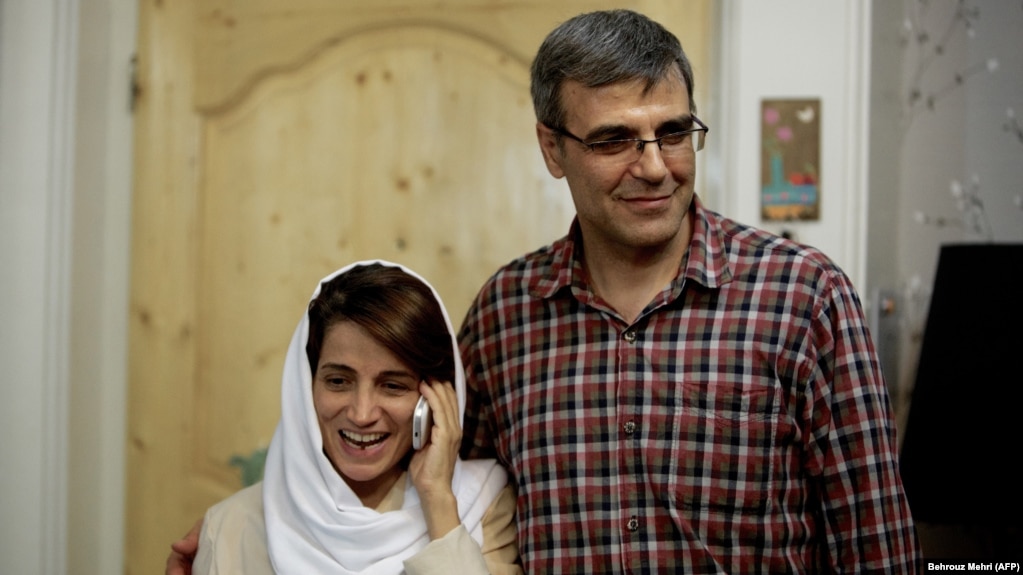
Sotoudeh was charged with spying, spreading propaganda and insulting Iran’s supreme leader. Photograph: Behrouz Mehri/AFP/Getty Images

Only yesterday I hoped that Nasrin Sotoudeh‘s invitation to the G7 would set a good precedent [https://humanrightsdefenders.blog/2019/03/11/does-g7-set-a-precedent-with-sotoudeh-for-inviting-human-rights-defenders/], now Reuters reports that she has been handed a new sentence that her husband said was 38 years in prison and 148 lashes! The news comes days after Iran appointed a hardline new head of the judiciary, Ebrahim Raisi, who is a protege of Ali Khamenei. The appointment is seen as weakening the political influence of the Iranian president, Hassan Rouhani. (NOTE: Her husband clarified later that she will be serving 10 years of the 33 he had announced on his Facebook page and in an interview with Radio Farda)

In the meantime AI reports that a series of videos shared on social media in recent weeks have shed light on the daily harassment and violent attacks women in Iran face at the hands of morality police and pro-government vigilantes seeking to enforce the country’s forced hijab (veiling) laws. The videos show members of the public or plain-clothes morality police aggressively confronting or attacking women for defying Iran’s degrading forced hijab laws, in the name of defending “public decency”. Perpetrators of such attacks appear to be getting bolder in their assaults in response to efforts by women to film the violence they face and share the videos on social media. “The video footage that has emerged in recent weeks demonstrates the shocking levels of abuse women in Iran face on a daily basis from morality police or pro-government thugs simply for daring to defy the country’s abusive forced hijab laws,” said Philip Luther of Amnesty International.  Iranian women’s rights defenders have courageously filmed these incidents as part of the My Camera My Weapon campaign, which aims to raise awareness of the constant harassment and assault that women and girls face in Iran’s streets as a result of forced hijab laws.

Amnesty added:…..The charges on which Nasrin Sotoudeh was convicted include “inciting corruption and prostitution” and “openly committing a sinful act… by appearing in public without a hijab”. Some of the activities that the authorities have cited as “evidence” against her include: opposing forced hijab; removing her headscarf during prison visits; defending women who peacefully protested against forced hijab; giving media interviews about the violent arrest and detention of women protesting against forced hijab; and placing flowers at the scene where a woman protester was violently arrested.

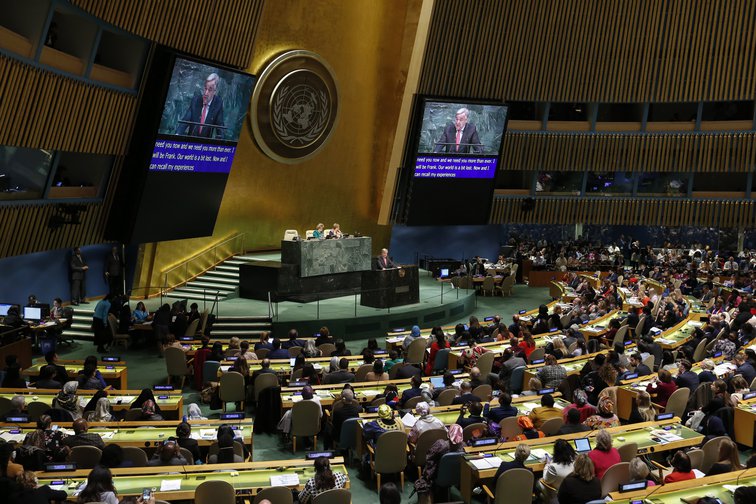
The UN Human Rights Council also was dealing with Iran this week: Worrying patterns of intimidation, arrest, prosecution, and ill-treatment of human rights defenders, lawyers, and labour rights activists in Iran signal an increasingly severe State response to protests and strikes in the country, Javaid Rehman, the Special Rapporteur on human rights in Iran, said on 12 March 2019. “Today, the people of Iran face a myriad of challenges,” he told the Human Rights Council in Geneva. “Many have voiced their concern through protests, demonstrations, and strikes. People from diverse sections of society – from truck drivers to teachers to factory workers – across the country have protested.” “It is in this context of increased challenges that concerns are mounting about human rights, including the rights to freedom of peaceful assembly and to association in Iran,” he said, calling on the Government to release all those detained for exercising such rights. Presenting his first report to the Council, Rehman said the re-imposition of secondary sanctions by the United States of America had further increased concerns for the welfare of ordinary Iranians.

The Special Rapporteur also highlighted the alarming health situations of numerous imprisoned individuals such as human rights defender Arash Sadeghi [see also: https://humanrightsdefenders.blog/2016/09/30/iran-shameful-sentences-for-narges-mohammadi-issa-saharkhiz-arash-sadeghi-no-detente-in-human-rights/]. Rehman also highlighted the situation of prominent woman human rights lawyer Nasrin Sotoudeh who was reportedly convicted last week of charges related to her work and could face a lengthy prison sentence. Other issues raised in his report include concerns regarding the right to life and to fair trial, the situation of detained foreign and dual nationals, and the treatment of religious and ethnic minorities.

Human Rights Watch commented that the Iranian judiciary’s draconian sentence for a prominent human rights lawyer Nasrin Sotoudeh was an “appalling travesty of justice“.

https://www.theguardian.com/world/2019/mar/11/human-rights-lawyer-nasrin-sotoudeh-jailed-for-38-years-in-iran

https://www.amnesty.org/en/latest/news/2019/03/iran-pro-government-vigilantes-attack-women-for-standing-up-against-forced-hijab-laws/

http://www.scoop.co.nz/stories/WO1903/S00091/iran-un-expert-concerned-by-crackdown-on-protests.htm

https://www.hrw.org/news/2019/03/12/iran-decades-long-sentence-womens-rights-defender

https://en.radiofarda.com/a/jail-term-ambiguity-clarified-for-iran-rights-defender—eu-protests/29817359.html

Does G7 set a precedent with Sotoudeh for inviting human rights defenders?

March 11, 2019
Radio Farda on 8 March 2019 reported that France’s President Macron has decided to invite jailed Iranian Human Rights Defender Nasrin Sotoudeh to the G7 Council. This is an excellent idea that deserves follow-up in other such forums. There are quite a few laureates of human rights awards who are in detention or subject to a travel ban. An invitation from a group of important world leaders is hard to ignore!

My first suggestions are:

https://humanrightsdefenders.blog/2019/01/29/eren-keskin-mea-nominee-2019-speaks-out-fearlessly-turkey-more-oppressive-today-than-ever/

https://humanrightsdefenders.blog/2017/10/10/breaking-news-egyptian-defender-mohammed-zaree-laureate-of-the-martin-ennals-award-2017/

https://humanrightsdefenders.blog/2015/09/15/fly-emirates-if-the-emirs-let-you/


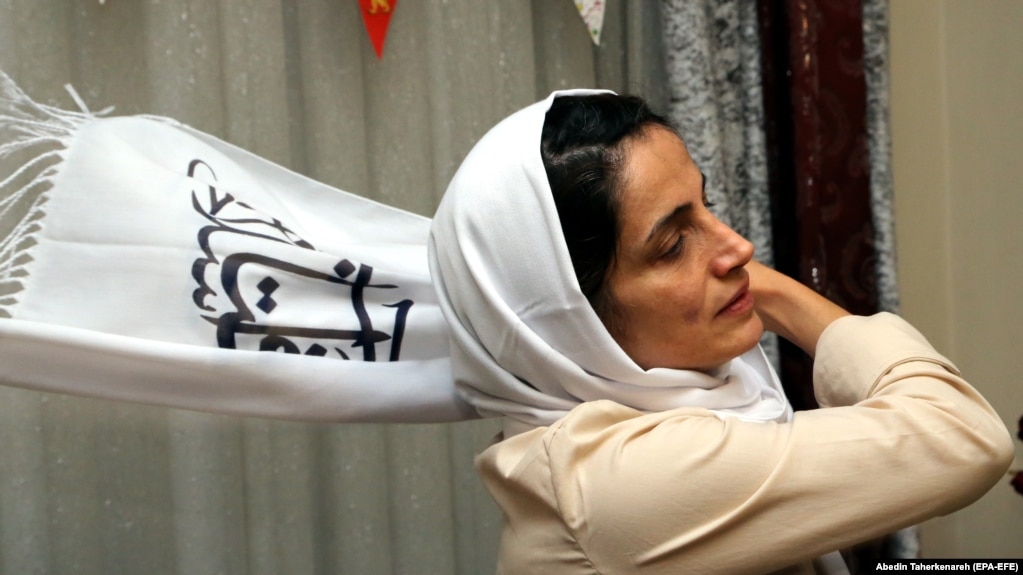
Imprisoned Iranian lawyer and human rights activist Nasrin Sotoudeh adjusts her scarf at her house in Tehran, September 18, 2013

French President Emmanuel Macron has invited jailed Iranian human rights lawyer Nasrin Sotoudeh to take part in the G7 gender equality forum. Sotoudeh’s husband Reza Khandan told Radio Farda on Friday that Macron’s invitation has been given to him in Tehran on Thursday March 7, one day before the International Women’s Day.[see also: https://humanrightsdefenders.blog/2018/06/16/iranian-human-rights-lawyer-nasrin-sotoudeh-arrested-again/]

Ms. Sotoudeh is to be a member of the consultative council for gender equality in Group 7. Khandan said Iranian women should be proud of Soutoudeh’s membership in the G7 council. Copies of the invitation have been handed to the Iranian Foreign Ministry and Bar Association.

Nasrin Sotoudeh has been in Jail since June 2018 with a five-year imprisonment sentence and is facing more charges for defending human rights activists in Iran. She is an outspoken opponent of the death penalty and compulsory hijab.  Sotoudeh, 55, is the winner of numerous international awards, including PEN/Barbara Goldsmith Freedom to Write (2011), Southern Illinois University School of Law Rule of Law Citation (2011) and Sakharov Prize (2012). On 21 September 2018, she was awarded the 23rd Ludovic-Trarieux International Human Rights Prize.

https://en.radiofarda.com/a/france-s-macron-invites-jailed-iranian-human-rights-lawyer-to-g7-council-/29811115.html

UN Panel debated death penalty with focus on human rights

February 26, 2019

Today, 26 February 2019, the UN Human Rights Council held its biennial high-level panel discussion on the question of the death penalty, with a focus on human rights violations in the context of the death penalty, in particular with respect to the rights to non-discrimination and equality.  A report was distributed by the APO Group on behalf of Office of the UN High Commissioner for Human Rights (OHCHR). Here some highlights:

..In her opening statement, Michelle Bachelet, United Nations High Commissioner for Human Rights, reminded that death rows were disproportionately populated by the poor and economically vulnerable; members of ethnic minorities; people with psychosocial or intellectual disabilities; foreign nationals; indigenous persons; and other marginalized members of society.  Condemning people to death for conduct that should not be criminalized in the first place was never compatible with a State’s human rights obligations.  The High Commissioner encouraged all States to take a stand on the right side of history and join the international trend towards abolition.  

The panellists were Pradeep Kumar Gyawali, Minister of Foreign Affairs of Nepal; Melinda Janki, Director of the Justice Institute Guyana; and Fatimata M’Baye, Lawyer and Co-Founder of the Mauritanian Human Rights Association.  Yuval Shany, Chair of the Human Rights Committee, acted as the discussion moderator.

Mr. Shany drew attention to the adoption by the Human Rights Committee of the General Comment No. 36 on the right to life, according to which the death penalty could not be “reconciled with full respect for the right to life.”  The General Comment made particular reference to the problem of inequality in the application of the death penalty.  

….

FATIMATA M’BAYE, Lawyer and Co-Founder of the Mauritanian Human Rights Association, said that there had been a moratorium on the death penalty in Mauritania since 1987, though there were still death penalty rulings handed down.  She drew attention to the case of Mohamed Ould Mkheitir, a blogger who had posted an article about social discrimination in Mauritania, which meant he was accused of blasphemy.  When he was arrested, he was asked to repent and quickly withdraw the article, but unfortunately, he was still prosecuted quickly by the police.  This case had given rise to a great deal of violence and hatred within the local community.  Mohamed was sentenced to death in 2015 by the penal court of the country, which was confirmed in 2016.  There was an appeal launched, and a two-year sentence was later handed down.  Ms. M’Baye said that the blogger was currently being held in a secret location.  The source of law in Mauritania was Islamic law, and women were often sentenced to the death penalty, many times accused of infanticide.  The death penalty was an egregious practice that was humiliating and degrading.  The United Nations could play a role in ending the death penalty by asking those States that still practiced it to abandon this punishment in the name of the right to life. [see also: https://humanrightsdefenders.blog/2016/04/08/us-state-department-international-women-of-courage-awards-2016-yulan/]

In the ensuing discussion, speakers expressed belief that the abolition of the death penalty and torture had elevated human dignity and advanced human rights.  The death penalty was a human right violation.  They hailed the adoption in the United Nations General Assembly of a resolution on a moratorium on the death penalty in December 2018, but noted that around the world capital punishment continued to be imposed in violation of major international standards.  Speakers expressed deep concern that the death penalty was imposed in a disproportionate and discriminatory manner to juvenile offenders, women victims of domestic violence, minorities, foreign nationals, persons with disabilities, and poor and economically vulnerable populations.  Some, however, noted that every State had the right to choose its legal and criminal justice systems, without external interference, and that the rights of defendants always had to be weighed against the rights of victims and their families, and the broader rights of the community and society.    

Speaking were Iceland on behalf of a group of countries, Montenegro, Luxembourg, Italy, Mexico, Singapore on behalf of a group of countries, Chile on behalf of a group of countries, Brazil on behalf of a group of countries, European Union, New Zealand, Pakistan, Australia, Malaysia, Fiji, Slovenia, Ecuador, France, Iraq, Iran, Bangladesh, Argentina, India, Saudi Arabia, and Greece. 

Also taking the floor were the following civil society organizations: Friends World Committee for Consultation, Centre for Global Nonkilling, International Lesbian and Gay Association, Together against the death penalty, and International Federation of ACAT (Action by Christians for the Abolition of Torture), and the National Human Rights Institution: Commission on Human Rights of the Philippines. ….. 

Iran respected those who had abolished the death penalty, but it could not accept any universal prescription to that effect.  Iran remained committed to observing the rule of law and due process in the criminal justice system, while continuing to study the best ways to serve justice.  Bangladesh stressed that its application of the death penalty was restricted to very selective cases of the most heinous crimes.  No child or pregnant woman could be sentenced to death.  Argentina believed that the abolition of the death penalty and torture had elevated human dignity and advanced human rights.  The death penalty was a human rights violation.

India reiterated its stance that it was a simplistic approach to characterize the death penalty as a human rights issue in the context of the right to life of the convicted prisoner.  This approach was deeply flawed and controversial.  There should be no external interference in the criminal justice system of any sovereign State. ….  Saudi Arabia stated that it used the death penalty for only for most serious crimes and in the most serious circumstances, after a fair trial had been guaranteed.  All procedures were in accordance with international standards as Islamic Sharia lay down the provisions of the punishments to guarantee the supreme rights of the people.  All States had the sovereign right to bring justice through their own procedures.  Greece opposed the death penalty in all cases and circumstances and highlighted the death penalty’s negation of the reformative function that any punishment should bare.  It was particularly concerned that the death penalty disproportionately affected women, lesbian, gay, bisexual, transgender and intersex persons, and human rights defenders and therefore urged States to do their utmost to ensure a fair trial. ..

YUVAL SHANY, Chair of the Human Rights Committee, noted that many delegates had commended the trend towards the abolition of the death penalty.  However, a concern around what some had termed as a backlash against abolition in this field was also noted.  A number of representatives had also noted the irreversibility of the death penalty.  It was also noted that there was an increasing consensus that the death penalty if applied should only be applied for the most serious crimes.  There was also a strong concern from all corners of the room about the problem of discrimination in regard to poverty, sexual orientation, women, psychosocial disability and other issues.  The panel was asked: how could all address biases, racial biases, gender biases and other biases in the application of the death penalty, and identify good practices so the death penalty was applied in a non-discriminatory fashion? 

…..

Manus Island detainee Behrouz Boochani wins major literary prize putting more pressure on detention policy

February 4, 2019
Behrouz Boochani in November, 2017. Picture: Jason Garman/Amnesty International

With one of the MEA 2019 final nominees being detained on Manus island in the same way [see: https://humanrightsdefenders.blog/2018/10/24/breaking-news-ennals-award-announces-its-3-finalists-for-2019/ ] it is relevant to note that another such detainee has won literary awards in Australia! Iranian-Kurdish journalist and poet Behrouz Boochani won the richest Australian Victorian Prize for Literature ($100,000) for his hellish first-hand account of life as a detainee on the island. His book, No Friend But The Mountains: Writing From Manus Prison, also won the $25,000 prize for nonfiction at Victorian Premier’s Literary Awards on 31 January 2019. (The eligibility criteria requiring that the authors be Australian citizens or permanent residents was overlooked to award the prize.

Mr Boochani told the Herald Sun from Manus Island, where he has been detained for more than five years, that the award was a victory for literature, resistance and humanity. But, he added: “I don’t want to celebrate this achievement while I still see many innocent people suffering around me.

No Friend But The Mountains.

If I could be there to accept the award I would explain how this award is a morality failure for Australia,” Mr Boochani said. “It is not just a failure on the part of the Australian government but a historical and moral defeat for those parts of the society who have been silent in the face of a barbaric policy over these years…It’s a huge cause of shame for a government that did not recognise us as human beings and did not recognise our human rights. It’s a challenge against a system that has lied to the public over the past years.”.


On 1 February University of Melbourne, followed up with a thoughtful piece on why “Behrouz Boochani’s literary prize cements his status as an Australian writer”

Other Australian authors have also used their voices to bring attention to the plight of asylum seekers. During her acceptance speech for her second Miles Franklin Award in August 2018, Michelle de Kretser chastised politicians for their treatment of refugees on Nauru and Manus Island. To illustrate her point, she read a list of names of asylum seekers who have died there in the past five years. It is tempting to dismiss such actions as gesture politics by an urban elite. But each individual action has served to raise awareness of the Australian government’s policy of “offshore processing” for asylum seekers, and to fuse artistic expression with political activism in a particularly forceful manner.

The author has been awarded the Anna Politkovskaya Award (for investigative journalism), the Amnesty International Award (Australian section) and Liberty Victoria’s Empty Chair Award. These humanitarian awards have confirmed Boochani’s rapidly acquired high profile in the literary field. Last night’s news topped all of that to make Boochani the first “non-Australian” author to win the Victorian Premier’s Literary Awards. The Victorian government established these awards in 1985 to honour Australian writing. The specific challenge this poses to the definition of “Australian writing” can be seen as an intervention by the literary community into the field of politics. If a non-citizen who has never set foot on mainland Australia can win, who counts as an Australian author?…

With no clear solution to the indefinite detention of asylum seekers on Manus and Nauru in sight, the paradox of Boochani’s award success can only contribute further to public debate over the tangled logic of indefinite detention. It shows how cultural practices and political activism can be reconfigured to correspond with the newly created literary currency associated with refugee writing. For now, at least, Boochani is an “Australian writer” because Australia is morally implicated in what he wrote and how he wrote it.

Also won in 2019: https://www.aljazeera.com/news/2019/08/kurdish-iranian-behrouz-boochani-wins-australian-biography-prize-190812071100746.html

See also: https://humanrightsdefenders.blog/2018/12/04/mea-nominee-aziz-abdul-muhamat-suffers-under-australias-endless-detention-policy/

https://www.heraldsun.com.au/news/victoria/manus-island-detainee-behrouz-boochani-wins-literary-prize/news-story/b57918c19d7f4c9a88ef532001b4f164

https://theconversation.com/behrouz-boochanis-literary-prize-cements-his-status-as-an-australian-writer-110986

2018 will go down in history as a year of shame for Iran

January 24, 2019

On 23 January 2019 RFE/RL reported that Iranian human rights defender Reza Khandan got a six-tear prison sentence. The next day Amnesty International issued a damning overview of the situation of human rights defenders in that country: Iran arrested more than 7,000 people in a sweeping crackdown against protesters and dissidents in the past year. See more below:

Rez Khandan with his wife, Nasrin Sotoudeh, in Tehran in 2013

Read the rest of this entry »

Bloggers and technologists who were forced “offline” in 2018

January 8, 2019

Read the rest of this entry »

The human rights defenders in AI’s 2018 Write For Rights Campaign

November 25, 2018

Iranian human rights defender Abdolfattah Soltani released from jail

November 22, 2018

Prominent human rights lawyer Abdolfattah Soltani in Iran was granted conditional release after serving more than seven years, reports the Guardian on 21 November 2018.

Abdolfattah Soltani
Abdolfattah Soltani. Photograph: Behrouz Mehri/AFP

The authorities agreed yesterday to my client’s conditional parole and he was released today,” Soltani’s lawyer Saeed Dehghan said on Wednesday, according to IRNA.

Soltani was jailed in 2011 over charges of “spreading propaganda against the system” and “setting up an illegal opposition group”, Amnesty International said at the time. He was granted conditional release after serving more than half a 10-year term, IRNA said. A previous parole request on 8 July had been denied, according to his lawyer. Soltani was a co-founder of the now outlawed Defenders of Human Rights Centre alongside Nobel peace prize laureate Shirin Ebadi and others. The human rights lawyer’s release could not be immediately confirmed with his family. Soltani was briefly released from prison in August to attend the funeral of his 30-year-old daughter, Homa, who died of a heart attack.

see also: https://humanrightsdefenders.blog/2012/10/10/abdolfattah-soltani-awarded-iba-human-rights-award-lawyers-for-lawyers/

https://www.theguardian.com/world/2018/nov/21/iranian-human-rights-lawyer-abdolfattah-soltani-released-from-jail

Iranian Human Rights Defenders in trouble

September 27, 2018
On 21 September 2018 the Observatory for the Protection of Human Rights Defenders (FIDH/ OMCT) petitioned the United Nations Working Group on Arbitrary Detention (WGAD) to seek the release of Iranian human rights lawyer Ms. Nasrin Sotoudeh. Ms. Nasrin Sotoudeh, a prominent defender and 2012 laureate of the European Parliament’s Sakharov Prize, was arrested on June 13, 2018 at her home in Tehran. [see: https://humanrightsdefenders.blog/2018/08/30/human-rights-defender-nasrin-sotoudeh-on-hunger-strike-in-iran/ ].. On September 16, 2018, Ms. Sotoudeh was informed that she would be denied her family visitation rights if she and her female visitors – including her daughter – did not wear a full hijab. Ms Sotoudeh has refused the condition and was denied the right to see her daughter on September 17, 2018.
The Observatory urges the Iranian authorities to immediately and unconditionally release Ms. Sotoudeh and to cease all acts of harassment and other abuses against her and all human rights defenders in Iran, in accordance with the provisions of the United Nations Declaration on Human Rights Defenders and with international human rights standards and international instruments to which Iran is a State party.

The semi-official ISNA news agency reported on Thursday 27 September that another human rights defender, Narges Mohammadi, has been granted a three-day leave from prison to visit her ailing father.

However, the recent terror attack in Iran may be expected to prompt the Guards to compensate by cracking down on domestic detractors and perceived opponents of their mission of defending and principles of the Islamic revolution. Certainly, some prominent figures within the Iranian activist and expatriate communities have been quick to raise alarms about the likelihood of this outcome. For instance, the Center for Human Rights in Iran quoted the Iranian human rights activist and Nobel Peace laureate Shirin Ebadi as saying of last Saturday’s attack, “Such actions lead to the justification of state violence and the arrest of many opponents in the name of fighting terrorism.” Meanwhile activists echoed the sentiment, saying, “Terrorism and violence in any form should be condemned in the strongest terms [but] such acts of violence should not become an excuse for state violence to suppress peaceful opposition.

Human rights defender Nasrin Sotoudeh on hunger strike in Iran

August 30, 2018

One of the most admirable human rights defenders in the world, Iranian Nasrin Sotoudeh, has gone on hunger strike, Front Line Defenders reports on 25 August 2018. This time in protest against her judicial harassment and the continuing pressure which is being exerted on her family, relatives and friends. The defender was arrested in June and has been in the women’s ward of Evin Prison since.

Nasrin Sotoudeh  is a human rights defender and lawyer who in recent months has represented a number of women’s rights defenders who have faced charges as a result of their protests against compulsory veiling in Iran. The defender has also actively criticised the new limit which has been imposed by the Iranian judicial system on the number of state-approved lawyers which are permitted to defend political and security based cases. [see https://www.frontlinedefenders.org/en/profile/nasrin-sotoudeh  and https://humanrightsdefenders.blog/2018/06/16/iranian-human-rights-lawyer-nasrin-sotoudeh-arrested-again/]

On 25 August 2018, human rights defender Nasrin Sotoudeh began a hunger strike in protest against her judicial harassment and the continuing pressure which is being exerted on her family, relatives and friends. The next day, the Assistant Prosecutor and two other judicial authorities filed three new charges against her for “urging a referendum,” “assisting in the formation of house churches” and “organising protest rallies”. The human rights defender believes that these charges have been filed as a result of her failure to attend a court hearing on 15 August 2018, when she was sentenced to five years in prison in absentia for “propaganda against the state”, “assembly against national security” and “espionage”. The defender has lodged an appeal against these convictions. On 18 August 2018, at approximately 8 a.m., three agents of Iran’s Intelligence Ministry, holding  a warrant from Branch 7 of the Revolutionary Court in Evin Prison, raided Nasrin Sotoudeh’s house while her children were asleep. The agents also raided the house of her sister-in-law. It is believed that the agents were searching for objects related to the defender’s human rights work, such as badges reading “I oppose the compulsory Hijab”. 

——–

https://www.frontlinedefenders.org/en/case/nasrin-sotoudeh-arrested 

https://www.theguardian.com/world/2018/aug/26/no-choice-jailed-iranian-lawyer-nasrin-sotoudeh-goes-on-hunger-strike

https://www.iranhumanrights.org/2017/11/previously-imprisoned-human-rights-lawyer-nasrin-sotoudeh-refuses-to-appear-in-court/?utm_content=buffer11e53&utm_medium=social&utm_source=twitter.com&utm_campaign=buffer