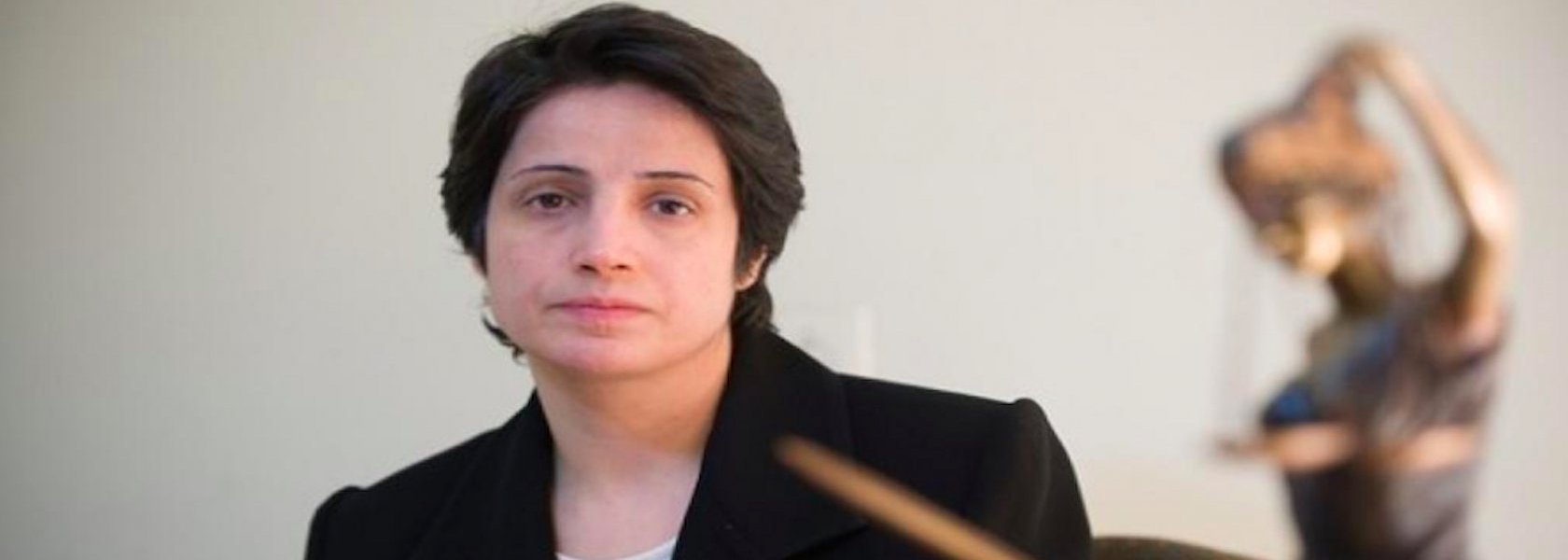
On 23 January 2019 RFE/RL reported that Iranian human rights defender Reza Khandan got a six-tear prison sentence. The next day Amnesty International issued a damning overview of the situation of human rights defenders in that country: Iran arrested more than 7,000 people in a sweeping crackdown against protesters and dissidents in the past year. See more below:
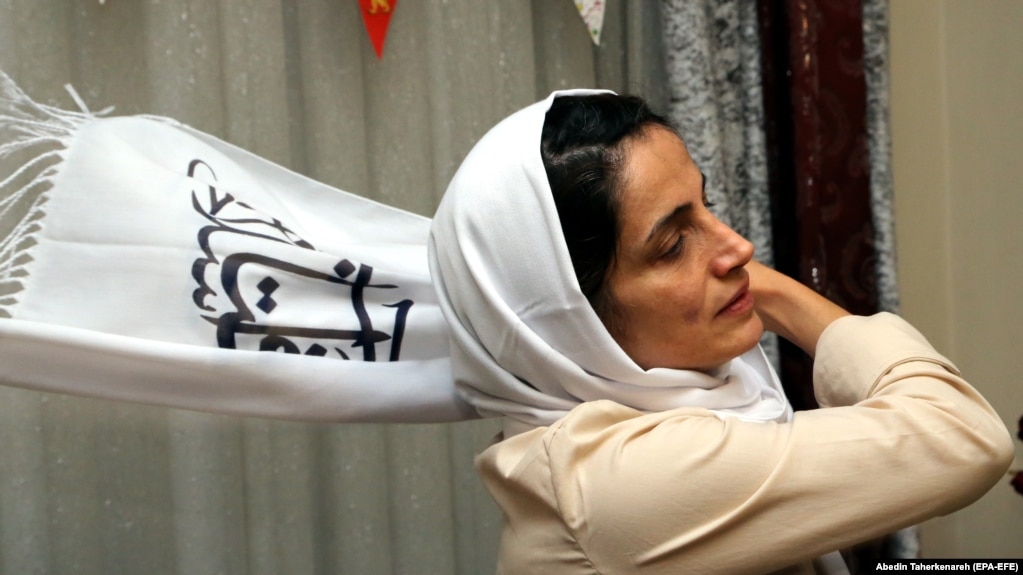
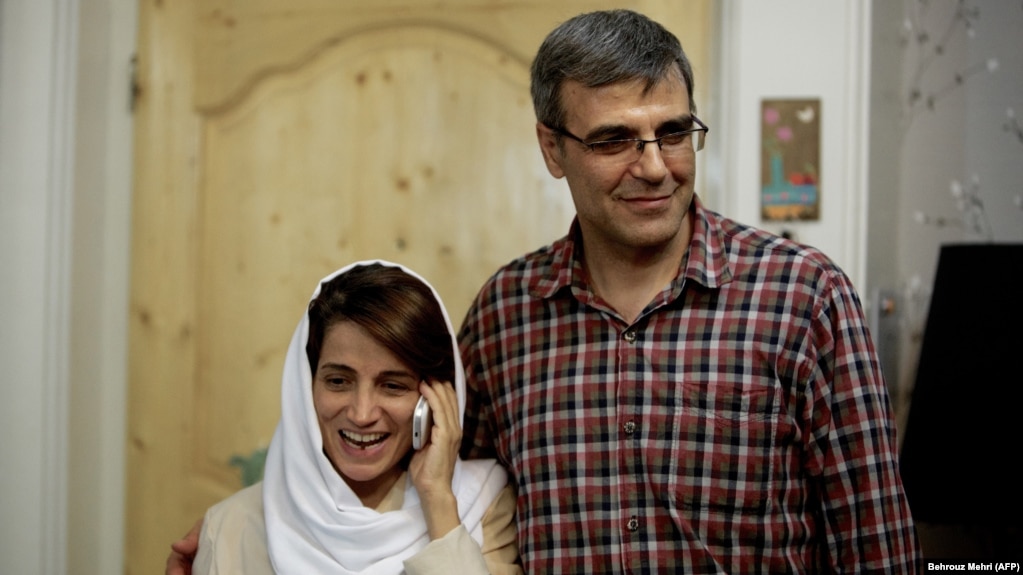
Rez Khandan with his wife, Nasrin Sotoudeh, in Tehran in 2013
In 2015 the Electronic Frontier Foundation (EFF)launched its Offlineproject that seeks to raise awareness of and provide actions readers can take to support imprisoned bloggers, digital activists, and technologists [see https://humanrightsdefenders.blog/2017/12/29/2017-was-a-grim-year-for-imprisoned-technologists/]. Its 2018 campaign focused on six individuals from four countries whose critical voices have been silenced by their governments:
Prominent human rights lawyer Abdolfattah Soltani in Iran was granted conditional release after serving more than seven years, reports the Guardian on 21 November 2018.
“The authorities agreed yesterday to my client’s conditional parole and he was released today,” Soltani’s lawyer Saeed Dehghan said on Wednesday, according to IRNA.
Soltani was jailed in 2011 over charges of “spreading propaganda against the system” and “setting up an illegal opposition group”, Amnesty International said at the time. He was granted conditional release after serving more than half a 10-year term, IRNA said. A previous parole request on 8 July had been denied, according to his lawyer. Soltani was a co-founder of the now outlawed Defenders of Human Rights Centre alongside Nobel peace prize laureate Shirin Ebadi and others. The human rights lawyer’s release could not be immediately confirmed with his family. Soltani was briefly released from prison in August to attend the funeral of his 30-year-old daughter, Homa, who died of a heart attack.
On 21 September 2018 the Observatory for the Protection of Human Rights Defenders (FIDH/ OMCT) petitioned the United Nations Working Group on Arbitrary Detention (WGAD) to seek the release of Iranian human rights lawyer Ms. Nasrin Sotoudeh. Ms. Nasrin Sotoudeh, a prominent defender and 2012 laureate of the European Parliament’s Sakharov Prize, was arrested on June 13, 2018 at her home in Tehran. [see: https://humanrightsdefenders.blog/2018/08/30/human-rights-defender-nasrin-sotoudeh-on-hunger-strike-in-iran/ ].. On September 16, 2018, Ms. Sotoudeh was informed that she would be denied her family visitation rights if she and her female visitors – including her daughter – did not wear a full hijab. Ms Sotoudeh has refused the condition and was denied the right to see her daughter on September 17, 2018.The Observatory urges the Iranian authorities to immediately and unconditionally release Ms. Sotoudeh and to cease all acts of harassment and other abuses against her and all human rights defenders in Iran, in accordance with the provisions of the United Nations Declaration on Human Rights Defenders and with international human rights standards and international instruments to which Iran is a State party.
The semi-official ISNA news agency reported on Thursday 27 September that another human rights defender, Narges Mohammadi, has been granted a three-day leave from prison to visit her ailing father.
However, the recent terror attack in Iran may be expected to prompt the Guards to compensate by cracking down on domestic detractors and perceived opponents of their mission of defending and principles of the Islamic revolution. Certainly, some prominent figures within the Iranian activist and expatriate communities have been quick to raise alarms about the likelihood of this outcome. For instance, the Center for Human Rights in Iran quoted the Iranian human rights activist and Nobel Peace laureate Shirin Ebadi as saying of last Saturday’s attack, “Such actions lead to the justification of state violence and the arrest of many opponents in the name of fighting terrorism.” Meanwhile activists echoed the sentiment, saying, “Terrorism and violence in any form should be condemned in the strongest terms [but] such acts of violence should not become an excuse for state violence to suppress peaceful opposition.”
One of the most admirable human rights defenders in the world, IranianNasrin Sotoudeh, has gone on hunger strike, Front Line Defenders reports on 25 August 2018. This time in protest against her judicial harassment and the continuing pressure which is being exerted on her family, relatives and friends. The defender was arrested in June and has been in the women’s ward of Evin Prison since.
On 25 August 2018, human rights defender Nasrin Sotoudeh began a hunger strike in protest against her judicial harassment and the continuing pressure which is being exerted on her family, relatives and friends. The next day, the Assistant Prosecutor and two other judicial authorities filed three new charges against her for “urging a referendum,” “assisting in the formation of house churches” and “organising protest rallies”. The human rights defender believes that these charges have been filed as a result of her failure to attend a court hearing on 15 August 2018, when she was sentenced to five years in prison in absentia for “propaganda against the state”, “assembly against national security” and “espionage”. The defender has lodged an appeal against these convictions. On 18 August 2018, at approximately 8 a.m., three agents of Iran’s Intelligence Ministry, holding a warrant from Branch 7 of the Revolutionary Court in Evin Prison, raided Nasrin Sotoudeh’s house while her children were asleep. The agents also raided the house of her sister-in-law. It is believed that the agents were searching for objects related to the defender’s human rights work, such as badges reading “I oppose the compulsory Hijab”.
Iranian lawyer Nasrin Sotoudeh next to her husband Reza Khandan | Behrouz Mehri/AFP via Getty Images
On 13 June 2018, Nasrin Sotoudeh, the human rights defender was arrested at her home in Tehran, Iran. She was transferred to prosecutor’s office of Evin prison.Nasrin Sotoudeh https://www.frontlinedefenders.org/en/profile/nasrin-sotoudehis a prominent human rights lawyer who in recent months has acted as the lawyer for women’s rights activists who protested against the compulsory veiling in Iran and were subsequently prosecuted. According to her husband, Reza Khandan, Nasrin Sotoudeh was informed that she will be imprisoned for five years, however neither of them are aware of the charges against her.
In 2010, Nasrin Sotoudeh was given a prison sentence of eleven years and banned from working as a lawyer or leaving the country for twenty years. Nasrin Sotoudeh remained in prison for three years under charges of ‘spreading propaganda’ and ‘conspiring to harm state security’, designed to force her to stop her legitimate and peaceful human rights activities. Nasrin Sotoudeh was finally released in September 2013after receiving a pardon. Prior to her detention, Nasrin Sotoudeh represented many human rights defenders opposed to the current regime in Iran, and worked extensively with young prisoners who had been sentenced to death for crimes they committed when they were under 18. In 2012 she won the EU’s Sakharov award {http://thedigestapp.trueheroesfilms.org/publicpage#/awards/BDE3E41A-8706-42F1-A6C5-ECBBC4CDB449/Sakharov-Prize-for-Freedom-of-Thought]
There is no doubt that Europe is doing more than other regions to support individual human rights defenders and their organisations. The statement issued on 27 February 2018 to mark World NGO Day by EU High Representative Fedrica Mogherini says all the right things: “Civil society organisations are a voice for those who are too often not heard. They have the courage to stand up against injustices, even if sometimes with risks for themselves”. She noted that the EU’s annual support worth two billion Euros represents 73 percent of the world’s support to local civil society organisations. “The European Union will never leave human rights defenders and civil society organisations alone; it’s the most invaluable partnership we can rely on to protect rights and build opportunities.”
Moreover, there is growing disappointment over the region’s unwillingness to stand up for human rights in its foreign policy, especially from those who had hoped that Europe would be able step up when the USA is no longer leading. Two lengthy pieces attest to this:
The firstis byJudy Dempsey on 21 March 2018 under the title “The European Union has decided that it’s time to cuddle up to dictators’ in the Washington Post
European Commission President Jean-Claude Juncker (in green tie) meets with other officials in Brussels on Wednesday. (Olivier Hoslet/EPA-EFE/Shutterstock)
Jean-Claude Juncker, the president of the European Commission, has just set a new low for Europe’s standing in the world. In the wake of Russia’s sham presidential election on Sunday, Juncker sent the victorious Vladimir Putin a message of unctuous praise. “Congratulations on your re-election,” Juncker tweeted. ……..Just like the United States’ President Trump, who was widely criticized this week for congratulating Putin on the Russian election’s outcome while failing to mention its flagrantly undemocratic character, Juncker had nothing to say about the brazen ballot stuffing, the intimidation of independent candidates, the unexplained deaths of activists, the role of state media, or a host of other irregularities leading up to the poll.
This latest failure of moral courage once again shows the growing indifference of European leaders and governments to the defense of human rights. At a time when the Trump administration seems uninterested in advancing the cause of democracy overseas and has just chosen Gina Haspel, who is closely linked with the George W. Bush administration’s policies on torture, to lead the Central Intelligence Agency, Europe should be at the forefront in taking a united stand against the flagrant abuse of human rights. But it isn’t. Dissidents and activists pushing for civil rights and democracy outside the E.U., and who once looked to Europe as a beacon for the values of freedom, can count on little support from Brussels these days. Authoritarian regimes have every cause to be overjoyed.
…When Iran’s foreign minister, Mohammad Javad Zarif, took the floor at last month’s annual Munich Security Conference, he was, once again, treated with kid gloves. Forget about the torture, the executions, the flogging, the deaths during detention.
…French President Emmanuel Macron and German Chancellor Angela Merkel have rolled out the red carpet for Egyptian president Abdel Fatah al-Sissi — despite a crackdown on opposition that in its harshness has left the Hosni Mubarak regime far behind. Disappearances, torture, police brutality, detentions without trial: None of this seems to bother the French or German leaders. “Disgraceful policies of indulgence” was the term human rights activists used in connection with Sissi’s visit to Paris in October.
On China, the E.U. has completely discredited itself in the eyes of reformers and those struggling for human rights. It has criticized neither the Communist Party’s state-of-the art mass surveillance of its citizens nor the constant harassment and imprisonment of dissidents. Indeed, in June the E.U. failed, for the first time ever, to make a statement about China’s crackdown on dissidents and activists at the United Nation’s Human Rights Council in Geneva. The 28 member states couldn’t agree. (Greece blocked the statement. ..Athens didn’t want to offend Beijing). Hungary, which has also benefited from Chinese investments, has repeatedly blocked E.U. statements criticizing China’s rights record under Communist President Xi Jinping, according to diplomats.
….But there can be no hiding the shameful reality. Europe has lost its moral compass. Its current enthusiasm for interests and “stability” will one day come back to haunt it.
The secondpiece is by FLORIAN IRMINGER on 22 March 2018 in Open Democracy under the title “Council of Europe: don’t compromise on human rights in Russia!”
After congratulating Vladimir Putin on re-election, the COE must hold Russia accountable and require the same respect for fundamental freedoms as it does from other countries. In the past year, Russia has seen numerous violations of freedom of assembly, as well as politically motivated criminal investigations dogged by poor evidence and procedure. While Vladimir Putin won the recent presidential election, he made his country fail a much more important test: the test of human rights, freedoms, and space for civil society and independent voices. So why has Thorbjørn Jagland and the Council of Europe welcomed him as a winner? …This came shortly after the OSCE election observation mission concluded that the presidential election took place in an “overly controlled legal and political environment marked by continued pressure on critical voices.”
…Instead of abiding by his mission to defend the Convention and therefore highlighting the shortcomings during election day and the generally repressive climate, the Secretary General “hoped” for active engagement with Russia. He spoke of “our common duty to work together in order to consolidate and strengthen our common European legal and human rights space.”
The Council of Europe must hold Russia accountable and require the same respect for fundamental freedoms as it does from other countries
In light of President Putin’s internal policies, we need a Council of Europe that stands firm on its values and upholds the human rights obligations enriched in the European Convention for Human Rights. What we see instead is a Secretary General “touring European capitals [since November 2017] warning of a serious risk that Moscow could withdraw… unless its demands are met.”
..Russia has now said it will stop contributing financially to the Council of Europe. At the Council of Europe, just like at the United Nations with President Trump’s administration, we see that governments are willing to defund the structures with which they disagree. In other words, they institute a relativism in such mechanisms and threaten their ability to continue working independently and serve the purpose they were set up for: holding governments accountable to their own commitments.
Yes, we must fight for the European Convention to apply to as many citizens as possible in Europe. However, we must not shy away from saying that the cost of withdrawing from the Council of Europe is high for the Russian state, for its credibility at home and abroad. The Council of Europe is worth something. If states can be members at no cost – not even the cost of showing respect and cooperation to the organisation – it will soon be worth nothing….
On 6 March, 2018 Scholars at Risk (SAR) reported the death in custody of Professor Kavous Seyed-Emami, a scholar of sociology and an environmentalist in Iran who was arrested in January 2018 on charges of espionage.
Professor Seyed-Emami was a professor of sociology at Imam Sadiq University and a co-founder of the Persian Wildlife Heritage Foundation. A dual Canadian-Iranian national, he was an environmentalist who led camping trips for Iranian youth in his spare time. SAR understands that, on January 24, 2018, Iranian authorities arrested Professor Seyed-Emami, along with at least seven others, who Iranian authorities claimed were “collecting classified information about the country’s strategic areas under the guise of carrying out scientific and environmental projects.” The information released by authorities does not make clear what classified information Professor Seyed-Emami and others were alleged to have collected, who they were allegedly working for, or what evidence supports these allegations.
On February 9, authorities reportedly notified Professor Seyed-Emami’s wife of her husband’s death. The following day, authorities announced the arrests and Professor Seyed-Emami’s death, claiming it was a suicide. SAR understands that Professor Seyed-Emami’s family was pressured to bury him quickly. Human rights groups have called for an autopsy and investigation, pointing to the suspicious circumstances of his death. Professor Seyed-Emami’s death follows two other recent incidents in Evin Prison in which activists died and authorities later ruled their deaths suicides.
SAR demands an investigation of Professor Seyed-Emami’s deeply troubling death and generally that the ability of intellectuals in Iran to exercise their right to academic freedom be guaranteed. To join the action, follow the link below:
on 13 February, 2018 carries an article: “Calls in Iran for UN-Sponsored Referendum”
Nobel Peace Prize-winning Iranian lawyer Shirin Ebadi. (AFP)
Following calls by Iran’s President Hassan Rouhani to hold a popular referendum to end political gridlock within the country, 15 prominent human rights defenders and activists from several groups issued Monday a statement demanding that a referendum indeed be held in the country , but adding that it should be done under the sponsorship of the United Nations. [Rouhani had originally made the proposal to hold a popular referendum during a speech marking the 39th anniversary of the Islamic Revolution on Sunday.]
One of the signatories, Nobel Peace Prize laureate Shirin Ebadi told Asharq Al-Awsat that the activists’ statement is an answer to the popular demands and calls voiced by demonstrators in the last protests that erupted across Iran against the dire internal situation “Iranians want to peacefully transfer authority from a Wilayet el-Faqih regime to a secular parliamentary democratic system,” she said. The activists’ statement had accused the authority of exploiting religion, hiding behind religious concepts, ignoring public opinion, violating people’s rights and freedoms and being greatly incapable of solving the political, social and economic crises in the country. However, Ebadi said that the activists’ statement was “independent” from the president’s speech.
She said that the 15 activists who signed the statement include Iranian film directors Jafar Panahi and Mohsen Makhmalbaf, lawyer Nisreen Stouda, of Iran’s Human Rights Defenders Center in Tehran, lawyer Narges Mohammadi, political activist Hassan Shariatmadari, political figure Abulfadl Qadiani and human rights activist Mohammad Nourizad.
—–
Interesting to note is that at the same time there was a conference in Tehran (as reported by the Tehran Times) in which Mohammad Javad Larijani, secretary of the High Council for Human Rights in Iran, has said that Iran is seeking close cooperation with the United Nations on issues related to human rights. “Islamic Republic is willing to work with international HR bodies, especially Human Rights Council,” Larijani told the conference attended by a number of foreign diplomats based in Tehran.
According to the newspaper ..”Double standards and selective approaches should be avoided in the area of the human rights. The special rapporteurs are obliged to be professional and neutral and avoid their political motivations affect their mission. Unfortunately, the special rapporteurs to Iran have mostly refrained to respect these principles and made claims far from realities. The special rapporteurs should have methodology and should not simply publish what they receive from unreliable sources. There are impediments to hold a constructive talks on the issue of human rights at the international level. The first impediment is double standards which are destructive. The second is using the human rights as tool to reach political motivations and the third is terrorism and supporting terrorists as defenders of human rights.