Justice and Peace NL with support from the City of the Hague and the Ministry of Foreign Affairs is organizing “The Hague Defenders Days” from 5 to 10 December 2016. A wide range of activities (debates, films and even a ball) are planned culminating in the ceremony of the Tulip Award on Human Rights Day 10 December. Most activities are open to the public (but not the Tulip ceremony):
Let’s celebrate the International Human Rights – and Human Rights Defenders Days in the city of peace and justice! Take the opportunity to learn from their experiences and share your own. Meet human rights defenders, debate about your rights, think out of the box and dance at the Human Rights Ball. Discover the defender or rebel in you! Download the flyer.
PROGRAMME
Portraits of Dutch and international human rights defenders by photographers Anette Brolenius and Daniella van Bergen.
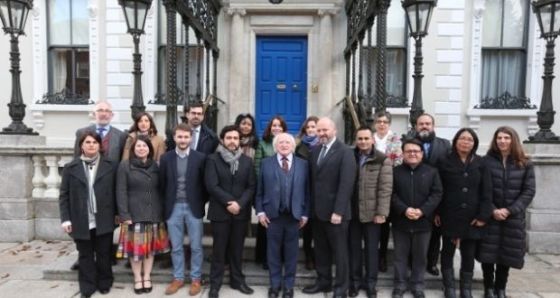
Irish President Michael D Higgins with international activists and NGO representatives in Dublin at the launch of the Human Rights Defenders Memorial. Photograph: Conor McCabe
Rachel Flaherty reports in the Irish Times of 24 November on the launch of an on-line Memorial o honour human rights defenders who have been killed The online memorial would be a tool to track investigations and advance the struggle for justice for human rights defenders. The Human Rights Defenders Memorial (HRD Memorial) has been set up by Dublin-based Front Line Defenders as an online international and interactive database. It will detail all the human rights defenders who have been murdered around the world since 1998. The Front Line Defenders organisation has estimated 3,500 have been murdered since then.
A coalition of 20 national and international human rights organisations jointly coordinated the project. Contributors included human rights groups from Colombia, Honduras and the Philippines, which Front Line Defenders said are ranked among three of the deadliest countries in the world for human rights defenders. The organisation said other countries included among the worst in terms of killing and physical attacks against human rights defenders included North Korea, China, Russia, Egypt, Saudi Arabia and Zimbabwe.
Andrew Anderson, executive director of Front Line Defenders, said the memorial sent a message the human rights community was stronger than any one person. “It will not be deterred, and its leaders will not be forgotten,” he said. “This is not random violence. This is the calculated elimination of those who speak out to defend the rights of the most vulnerable. Autocrats and powerful economic interests think that if they kill an activist, they kill a movement. The goal of the HRD Memorial is to prove them wrong.”
The International Service for Human Rights (ISHR) is calling for applications for its flagship Human Rights Defenders Advocacy Program in 2017 – the extensive training programme for human rights defenders. The training will take place in Geneva between 29 May and 9 June 2017 and provides defenders with opportunities to put their advocacy skills directly into action at the 35th session of the UN Human Rights Council.
ISHR’s Human Rights Defender Advocacy Programme (HRDAP) equips defenders with the knowledge and skills to make strategic use of the international human rights system. It also provides an opportunity for participants to directly engage in lobbying and advocacy activities at the UN level to effect change on the ground back home. As well as receiving training modules on all the UN human rights mechanisms from a range of experts, participants will also have the opportunity to build networks in Geneva and around the world, carry out lobbying of UN member States and UN staff, and learn from peers from a range of regions working on a range of human rights issues.
Participants will take part in:
A short online learning component, prior to face-to-face training, to enable you to consolidate your existing knowledge and develop your advocacy objectives;
Intensive training in Geneva during June, to coincide with the 35th session of the Human Rights Council. The training will focus on ways to effectively use international human rights mechanisms and to influence outcomes;
Specific advocacy at Human Rights Council sessions and other relevant meetings, with regular feedback and peer education to learn from the experiences, including expert input from leading human rights advocates.
This programme is directed at experienced human rights defenders in non governmental organisations and national human rights institutions, with existing advocacy experience at the national level and some prior knowledge of the international human rights system. If you are interested in applying for ISHR’s training programme, please read the call for applications to check that you comply with the requirements. The link to the online application form can be found under point 5 of the call for applications.
The call for applicants can be found here. For more information, write to hrdap2017@ishr.ch.
Travel bans on human rights defenders are popular with all kind of autocratic regimes but seem to enjoy special status in the Middle East. The video clip above (part of a joint campaign by AI and HRW) focuses on Egypt and so does the statement by 6 other NGOs issued on 9 November. They strongly condemn the travel ban against Malek Adly, prominent Egyptian human rights lawyer and director of the Lawyers Network of the Egyptian Center for Economic and Social Rights (ECESR). But there is more: Read the rest of this entry »
On 7 November 2016, the BBC, Reuters and other media reported that labour rights defender Andy Hall has left Thailand after a three-and-a-half year legal battle with a pineapple processing company accused, in a report he contributed to, of abusing its workforce. The dismissal of one set of charges against the British activist was confirmed by Thailand’s Supreme Court last week. But he was convicted in September on two other counts under sweeping criminal defamation and computer crimes laws and was given a three-year suspended prison sentence. He also faces civil complaints by the pineapple company, Natural Fruit, which is demanding around $12m in damages.
But it was mostly the prospect of further criminal charges over another group of workers he is supporting that persuaded Mr Hall that he should leave Thailand and not returner the time being. He and the 14 migrant workers from Myanmar – who have alleged abusive treatment at the hands of a farm which supplied the big Thai poultry processor, Betagro, with chickens – recently had defamation lawsuits filed against them. [see also: https://thoolen.wordpress.com/tag/andy-hall/]
Before he left Thailand Mr Hall told the BBC that he felt that the prospect of having to contest continuous lawsuits filed against him would make it impossible for him to defend migrant workers’ rights effectively. The situation for human rights defenders, he said in a statement made as he prepared to depart, has rapidly deteriorated in Thailand, with significantly increased risks.
The challenge confronting Mr Hall is one faced by many Thai activists as well. Defamation is a criminal charge that can carry a two-year prison sentence, often used alongside the even tougher Computer Crimes Act, which mandates a sentence of up to five years in prison.
Two years ago, the editors of a small newsletter, Phuketwan, were prosecuted by the Thai navy for an article in which they quoted a Reuters news agency report alleging Thai military involvement in human trafficking. They were finally acquitted last year, but the effort of defending themselves contributed to the newsletter being shut down.
In June this year three prominent human rights defenders were prosecuted under the same two laws by a unit of the Thai military over a report they took part in which alleged the use of torture against military detainees in southern Thailand.
On Thursday 3 November, the U.N. Human Rights office in Bangkok issued a statement praising the Supreme Court’s decision. But it also called on the Thai government “to drop charges against all human rights defenders who have been charged with criminal offenses for reporting human rights violations in accordance with its obligations under international human rights law.“
On 6 October EU Trade Commissioner Cecilie Malmström had strongly backed the British labour rights activist who helped expose labour abuses in Thailand, for which he received a three-year suspended jail sentence. Andy Hall met Malmström in Strasbourg, where MEPs also passed a strong resolution condemning Hall’s treatment under the military junta now running the country.
The Asian Forum for Human Rights and Development (FORUM-ASIA), together with the Martin Ennals Award and the Right Livelihood Award, will host a panel discussion on the 25th Anniversary of its founding and 10th Anniversary of its presence in Geneva, entitled ‘50 Years of the International Bill of Human Rights and 10 Years of the UN Human Rights Council – What does this mean for Asia?’, on 16 November 2016 at 18:30 at the Ivan Pictet Auditorium, Maison de la Paix, in Geneva, Switzerland.
As the Geneva-based International Service for Human Rights (ISHR) is one of the most important sources of information on HRDs and the UN, I hope that many of you will be able to give them feedback on their various communications and digital publications by filling our the on-line survey in the link below. It indeed takes not more than 5 minutes to complete.
Every December, Amnesty supporters across the globe will write millions of letters for people whose basic human rights are being attacked. It’s all part of Write for Rights, AI’s global letter-writing marathon. The video clip includes MEA laureate 2016 Ilham Tohti. It’s one of the world’s biggest human rights events and carries on a long tradition of people writing letters to right some of the world’s biggest wrongs.
The Philippines seems to get most of its attention nowadays because of the ranting of its President rather than the human rights situation on the ground. That is why John Nery wrote a reply in the Philippine Daily Inquirer of 1 November 2016 under the title “Human rights defenders are beautiful“.
The intruiging title is linked to a recent episode in which President Duterte complimented the Filipino beauty queen, Kylie Verzosa, on her international recognition by saying “You see, Filipinas are beautiful”, and then added gratuitously “Pero kayong lahat diyan sa human rights commission, mga pangit (But all of you there at the Commission on Human Rights, you are all ugly)”. It would be a mistake to think that this was just another jest. Since the CHR, under then chair Leila de Lima, investigated him in 2009 for possible human rights violations in relation to the killings attributed to the so-called Davao Death Squad, he has harbored a sense of resentment against the constitutional agency which has dared question the rising casualty toll in his so-called war on drugs..
The writer then says: But we should all ask: What have human rights advocates done to deserve such hostility, such cavalier treatment, from the President? Human rights advocates, including those identified with the National Democratic Front, including those who have served and are serving in the CHR, were among those who tried to hold the Marcos regime accountable during the dictatorship itself, and are among those leading the fight to bring the Marcos family to justice. Mr. Duterte’s own mother, who was a leader of the anti-Marcos movement in Davao City, would have recognized them as kindred spirits……….A devout and disciplined Catholic, she would have understood the sacrifice these advocates made, in choosing the less lucrative, much more dangerous career of human rights work. I daresay she would have recognized in them the dignity, the beauty, of the saints: They are doing not only the right, but the beautiful, thing.
Joshua Oliver on 14 October, 2016 interviewed for NY City Lens, Kim Burton of Access Now about the digital security dangers faced by human rights defenders. A recent example is what happened to Ahmed Mansoor [https://thoolen.wordpress.com/2016/08/29/apple-tackles-iphone-one-tap-spyware-flaws-after-mea-laureate-discovers-hacking-attempt/] but there are many other cases. The staff of the Digital Security Helpline offers free, 24/7 technical support and advice on digital security to activists, journalists, and human rights defenders around the world. It is a project of Access Now, an NGO that promotes human rights online. The interview ends with 3 simple practical steps that any person can do to improve their security.
Kim Burton, security education coordinator at Access Now, works on the digital security helpline.
What makes the kind of targeted digital threat that a human rights defender or an activist might experience different from the threats that ordinary users might face?
The goal is different. When you’re targeting the average individual often these campaigns are really large. They’ll be interested in getting a lot of cash. When someone’s trying to compromise a human rights defender or activist or journalist, it’s usually because they want that person’s information. They want that person’s contacts. They want to be able to intimidate that person so they stop doing the work that they’re doing.
What type of things might prompt someone to contact the helpline?
They could receive an unfriendly email that scares them, and so they’ll bring that email to us. With journalists it’ll be more about protecting information that they’re trying to move out of the country, or it can just be protecting their publishing while they’re online. Often when we get contacted it’s for people who have had their accounts actually hacked. Where the account is posting information that the owner did not post, or it’s completely defaced.
Can you describe the difference between the support that’s typically available for someone in a corporate or government environment with a digital security problem as compared to someone in a non-governmental organization working on human rights or activism?
I think one of the major things is just having someone to call. In a corporate environment they have either an IT group or a person or systems administrator. So you already know who to call. In NGOs [non-governmental organizations], often times, there isn’t an IT person at all. There’s not a systems administrator. The tech support is not available. And part of that is funding. Corporate environments are able to spend a lot more money on salaries, so they’re able to pay the tech people a lot more than they would get in the NGO space.
What can be the direct consequences to the people who are targeted by this kind of threat?
Unfortunately people can die. That’s one of the things that we have to be aware of every day on the helpline. People do get killed for the information that they have out there. The other consequences are: people’s lives can be ruined, people can be imprisoned, people can have to leave countries, their families can be hurt. The stakes are very high.
Can you define what phishing is?
It’s those emails that say something like “You’ve won a million dollars, click here to receive.” Or something that is a little bit more scary, like “This is your co-worker, I need the password to this account.” It can get more targeted. But everyone receives these — this isn’t unique to the people that we work with. It’s just that the people that we work with might have a higher chance of receiving a more targeted phishing campaign.
What are three easy things people can do to improve their own digital security?
Number one, always install software updates. Updates are often released to address security vulnerabilities; updating is your first line of defense.
Two, use unique, long, and strong passwords. If your password is leaked in one place, and you have used the same password somewhere else, that other account can be compromised as well. Avoid remembering each of these unique passwords with a password manager, like KeePassX or LastPass. Password managers keep your credentials in an encrypted database and assist you in generating unpredictable strings to use as sturdy logins.
Three, use two-factor authentication when available. Instead of only using a password to protect your account, two-factor requires another “factor” to log in. Like a bank that needs your card and PIN to withdraw from an ATM, you’ll need your password and something else (like a SMS text, generated code, or fingerprint) to access your account. All of the major email providers provide multi-factor authentication, as do many other accounts, like Amazon, Twitter and Facebook; look for it in your security settings.