On 6 January 2017 the International Secretariat of the World Organisation Against Torture (OMCT) requested urgent intervention in the following situation in Greece.

share information on human rights defenders, with special focus on human rights awards and laureates
On 6 January 2017 the International Secretariat of the World Organisation Against Torture (OMCT) requested urgent intervention in the following situation in Greece.
After a short break, this blog resumes its job of selecting and summarizing events related to Human Rights Defenders. 2016 was a horrible year for HRDs and the launch of the annual report of Front Line Defenders confirms this by reporting that “more than 1000 human rights defenders were killed, harassed, detained, or subjected to smear campaigns and other violations in 2016″.
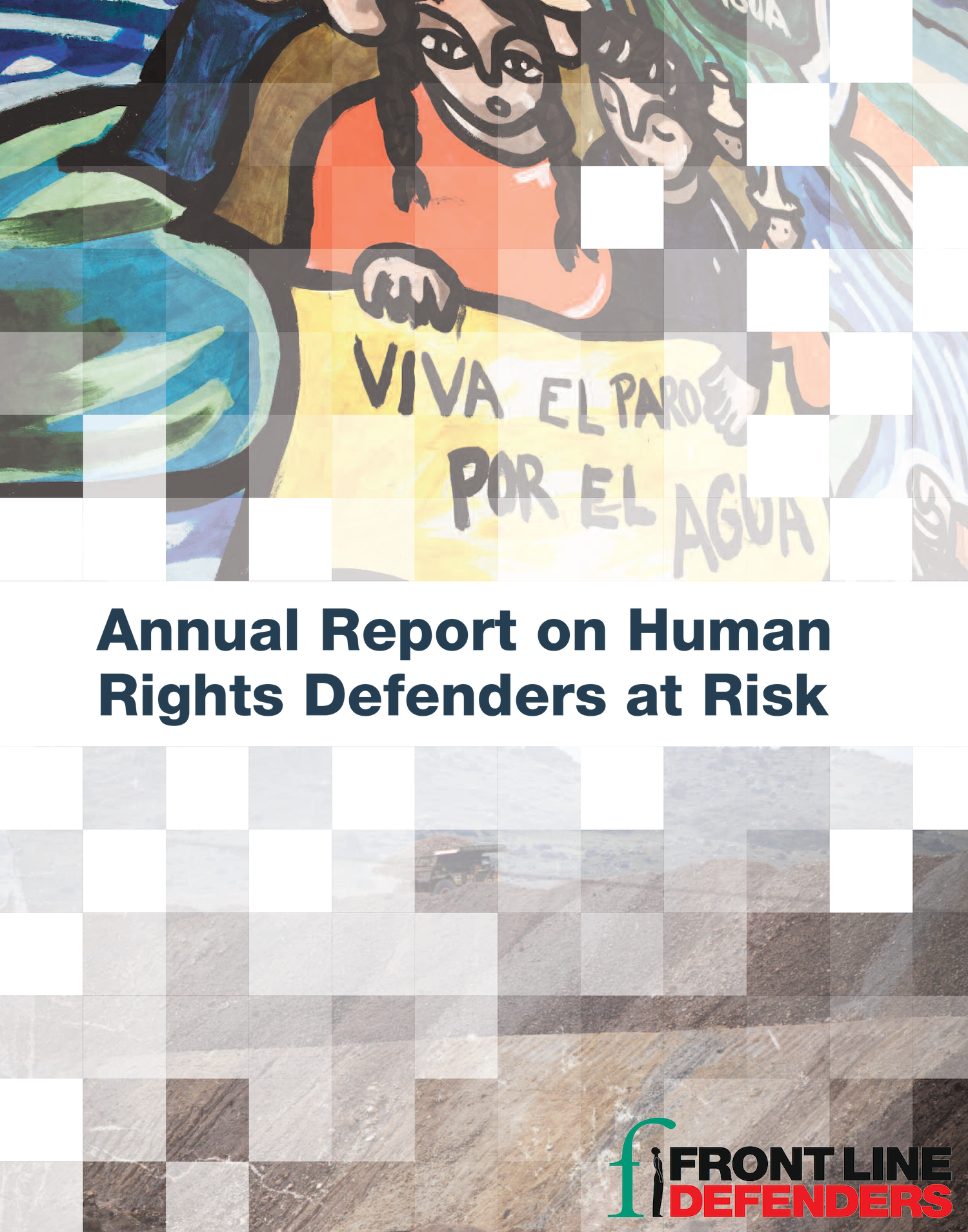
According to the report, 281 human rights defenders were murdered in 25 countries, 49 percent of whom were defending land, indigenous and environmental rights. Front Line Defenders found that in the vast majority of cases, killings were preceded by warnings, death threats and intimidation which, when reported to police, were routinely ignored. In addition to killings, over half of the cases reported by Front Line Defenders in 2016 concerned criminalisation, a tactic which the organisation calls “the first choice of governments to silence defenders and to dissuade others”.
For other post on Front Line last year, see: https://humanrightsdefenders.blog/category/front-line/page/4/
Meanwhile, Israeli authorities handed Amro 18 charges, ranging from “insulting a soldier” to “assault,” and “participation in a rally without a permit,” with some of the charges dating back to 2010. … “This relatively unusual practice of bringing up stale charges, which were not pursued many years ago, strongly suggests that Mr. Amro is being unfairly targeted due to his legitimate and peaceful human rights work,” the UN experts noted in Saturday’s statement. The UN experts said Amro’s current trial was part of a “concerted pattern of harassment and intimidation by the Israeli authorities aimed at inhibiting his work as a human rights defender.” Amro faces up to three years in prison. His attorney, Gabby Lasky, has submitted a motion to have 14 of the 18 charged dismissed on the grounds that those charges are several years old and in some cases the charges were already investigated and closed without indictment. Issa Amro’s arrest has garnered international attention—many see it as one of the most serious examples of Israel’s intent to clamp down on all forms of resistance—violent or non-violent. The hearings promise to be a landmark legal battle over what Israel will permit in terms of peaceful protest and the consequences that face those who engage in it. In 2010 he was named Human Rights Defender of the Year for Palestine by the Office of the United Nations High Commissioner for Human Rights (OHCHR), in 2011 he was a guest of the US State Department as part of their International Visitor Leadership Program. In a 2015 op-ed he wrote for The Guardian, Amro explained how he became involved in activism:“I read books by Martin Luther King, Mahatma Gandhi and Nelson Mandela. I became convinced that their non-violent method was the best strategy for community resistance.” Magdalena Mugrabi, Amnesty International’s Deputy Regional Director for the Middle East and North Africa says “Issa Amro has faced a sustained campaign of harassment and assault at the hands of the Israeli military and settlers because of his activism. His case is emblematic of the climate of increasing hostility towards activists who protest the settlements, which are illegal under international law.” She added, “The deluge of charges against Issa Amro does not stand up to any scrutiny. In their determination to silence him and stifle his human rights work, the Israeli authorities have apparently even reopened a closed case file. If he is convicted we will consider Issa Amro a prisoner of conscience.”

The UN statement 0f 16 December went on to mention the case of Salah Khawaja, a member of the Stop the Wall Campaign, who was arrested in October and remains in detention without charges.
Sources:
Amnesty slams Israel’s detention of Palestinian human rights defender – Middle East Monitor
http://www.huffingtonpost.com/david-palumboliu/israel-puts-celebrated-_b_13590812.html
http://ohchr.org/EN/NewsEvents/Pages/DisplayNews.aspx?NewsID=21041&LangID=E
http://www.ohchr.org/EN/NewsEvents/Pages/DisplayNews.aspx?NewsID=16906&LangID=E
 publishes a series of 10 profiles human rights defenders to commemorate International Human Rights Day, 10 December 2016. Here two women HRDs from Mexico: Olga Guzmán and Stephanie Brewer: Read the rest of this entry »
Rafto Prize.
This Bergen-based award (established in 1987) is seeking candidates for its 2017 award. Candidates should be active in the struggle for the ideals and principles underlying the United Nations Universal Declaration of Human Rights and should represent a non-violent perspective. Nominations for the Rafto Prize are received and evaluated by the Rafto Prize Committee. Recipient(s) are selected by the Board of Directors in August. For questions regarding nominations, please contact the Secretary of the Committee, Liv Unni Stuhaug, e-mail: livunni.stuhaug(at)rafto.no. For 2016 award see: https://humanrightsdefenders.blog/2016/10/01/iraqi-human-rights-defender-yanar-mohammed-laureate-of-2016-rafto-prize/
Deadline for nominations: 1 February 2017
———–
Front Line Defenders Award for Human Rights Defenders at Risk.
Established in 2005 the award is to honour the work of a human rights defender who, through non-violent work, is courageously making an outstanding contribution to the promotion and protection of the human rights of others, often at great personal risk to themselves. A cash prize of €15,000 is awarded to recipient and his/her organisation in an effort to support the continuation of this important work. Individual nominees may not play a prominent role in a political party and must be currently active in human rights work (no posthumous contribution). Nominees must not be living in exile. For 2016 award see: https://humanrightsdefenders.blog/2016/06/10/ana-mirian-romero-environmental-activist-from-honduras-wins-2016-front-line-award/
Deadline: Friday, 3 February 2017
https://www.frontlinedefenders.org/secure/nomination.php (English)
On 7 December 2016 the Government of Canada published Guidelines on Human Rights Defenders. It joins a limited number of Governments with a specific policy on human rights defenders (not just human rights in general) such as Norway, the Netherlands, Ireland, Switzerland and Austria, although they differ a bit in the degree of detail. And there are of course the EU Guidelines.[https://humanrightsdefenders.blog/2012/01/13/quick-reminder-of-the-eu-guidelines-on-human-rights-defenders/] and those of the OSCE: Read the rest of this entry »
“Almost 20 years ago the UN adopted the Declaration on Human Rights Defenders, but they face more danger than ever“, say Iva Dobichina and James Savage (resp. of the Open Society Foundations and the Fund for Global Human Rights) in a post on 10 December 2016 in the Guardian. “We must find new ways to protect human rights defenders” say the authors in an excellent article so rich and – in my view correct – in its analysis of the current climate that I reproduce it below in full. What is perhaps missing from the piece is a call for more sustained action by the worldwide human rights movement to improve its ‘performance’ in the battle for public opinion. A lot of the regression in the situation of human rights defenders seems to go hand-in-hand with an increase in public support for rights-averse policies (“Around the globe, a tectonic shift towards autocratic and semi-authoritarian rule by law, and the pernicious influence of corporate, criminal and fundamentalist non-state actors, has put human rights activists on the defensive and let rights violators go on the offence” state the authors correctly). To counter this we have to come up with equally convincing use of the modern media, especially through professional-level visualisation and ideas for campaigns that can broaden and galvanize the human rights movement. Read the rest of this entry »
In 2012 – in the run up to the London Olympics – the Playfair 2012 Campaign (supported by War on Want and others) highlighted the appalling experiences of workers making Adidas official Olympic and Team GB goods in China, Sri Lanka and the Philippines. “Around the world 775,000 workers, mainly women, in 1,200 factories across 65 countries make Adidas products. Almost all of the jobs are outsourced to factories in poorer countries, yet through Adidas’ buying practices the company has enormous influence over their working conditions, and ultimately their lives. In the run up the London 2012 Olympics research has exposed the harsh reality of life for these workers.” The campaign demanded Adidas to end worker exploitation. playfair2012.org
In a report of 11 March 2015 on Labor Rights Abuses in Cambodia’s Garment Industry Human Rights Watch noted that brands can do more and said “For example, Adidas wrote to Human Rights Watch that it first started privately disclosing its supplier list to academics and nongovernmental organizations (NGOs) in 2001 and moved to a public disclosure system in 2007.”
In an article in Open Democracy of 17 June 2015 Mauricio Lazala and Joe Bardwell under the title: “What human rights?” Why some companies speak out while others don’t.” state that: “More recently, civil society has called on FIFA sponsors to respond to human rights concerns at construction sites for the Qatar 2022 World Cup. So far, Adidas, Coca-Cola and Visa have issued statements supporting workers’ rights in the country”
In an article published on 16 November 2015, ISHR Director Phil Lynch explored the role, responsibility and interest of business when it comes to supporting human rights defenders and protecting civil society space. He mentions Adidas in the following context: The fourth and final category of actions, perhaps the most important but also the least common, involves business actively advocating and seeking remedy for human rights defenders and against laws and policies which restrict them. Such action could be private, as I understand to be the predominant approach of Adidas. It could also be public, such as the open letters and press statements issued by Tiffany & Co and others for the release of Angolan defender and journalist Rafael Marques
On 31 December 2015, the Business and Human Rights Resource Centre listed in its “KnowTheChain” (a ranking of 20 apparel and footwear companies on efforts to address forced labour in the supply chain) Germany-based Adidas as number one out of 20.
On 21 June 2016 Adidas published its policy on HRDs: “The Adidas Group and Human Rights Defenders“. As there is such a dearth of corporate policies specifically on human rights defenders, here follows the key part in quote:
The threats faced by human rights defenders come in many forms – physical, psychological, economic, and social – and involve the interaction of many factors (poor governance, the absence of the rule of law, intolerance, tensions over development issues, etc.) and can be triggered by different actors, both private and State.
In his report to the General Assembly in 2015, the UN Special Rapporteur on the situation of human rights defenders recommended that both States and businesses should play an active role in supporting and promoting the role of HRDs working in their sectors. This should include, for example, speaking out when human right defenders are targeted for their corporate accountability work. Businesses must also cease and abstain from supporting any actions, directly or indirectly, which impinge upon defenders’ rights to freedom of expression, association and assembly.
The adidas Group has a longstanding policy of non-interference with the activities of human rights defenders, including those who actively campaign on issues that may be linked to our business operations. We expect our business partners to follow the same policy; they should not inhibit the lawful actions of a human rights defender or restrict their freedom of expression, freedom of association, or right to peaceful assembly.
We value the input and views of all stakeholders and we are willing, and open, to engage on any issue, be this related to our own operations or our supply chain. Often, our engagement with human rights defenders is constructive, especially where we identify areas of shared concern. For example, with respect to transparency and fair play in sports, or environmental sustainability, or the protection of worker rights in our global supply chain. In these instances, we may actively support the work of the HRD and derive shared value from our joint endeavours in, say, improving working conditions, safety, or the environment.
This blog follows with special attention developments in the area of human rights awards. The announcement of a new award on 1 December 2016, the Franco-German Prize for Human Rights and the Rule of Law, came as a surprise. Some aspects remain unclear (is there a monetary component?; what will be the frequency?) but judging from the text of the press release as well as the choice of recipients of the inaugural prize, it is mostly an award for human rights defenders. Read the rest of this entry »

