Posts Tagged ‘Egypt’
August 29, 2014
On 21 August I reported on the travails of an Egyptian family of human rights defenders [
https://thoolen.wordpress.com/2014/08/21/an-exceptional-egyptian-family-of-human-rights-defenders/], a week later
Mona Seif’s father has died.
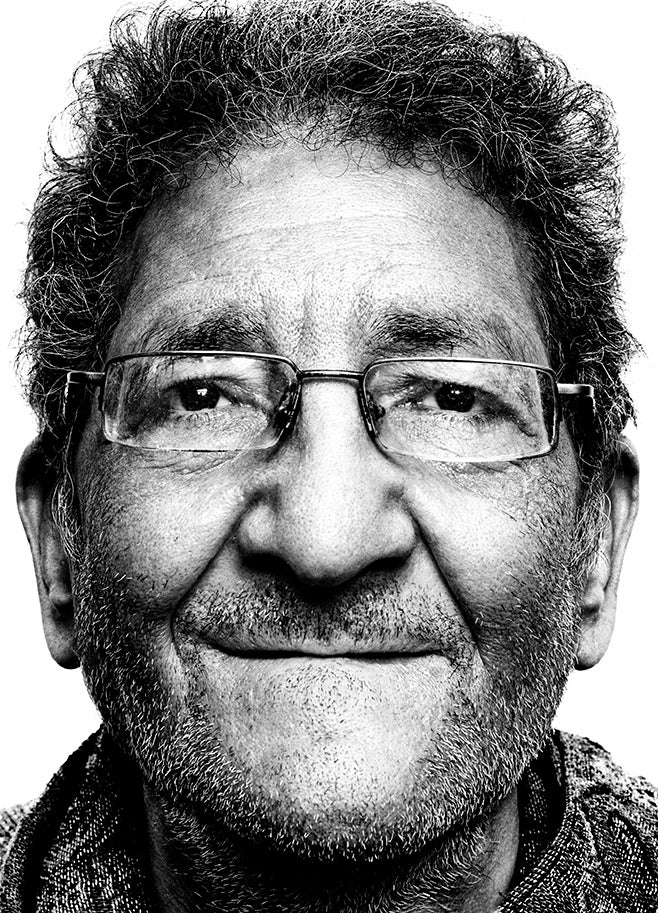
Ahmed Seif Al Islam was a veteran
Egyptian lawyer, activist and former political prisoner. Arrested and tortured by State Security Investigations officers in 1983 for his political activity, he served five years in prison. Founder of the Hisham Mubarak Law Centre, which since 2008 has been providing legal assistance to protesters. The Hisham Mubarak Law Centre (HMLC ) monitored state violence during the 2011 protests, and became a gathering place for human rights activists during the revolution. Ahmed Seif was arrested by Military Intelligence with his staff at the height of the protests.
Seif, a human rights lawyer, was on the legal defense team in numerous high-profile trials of human rights, labor, and more broadly political activists in the Hosni Mubarak years, but he was above all an activist himself. The was more often than not the coordinating center for planning peaceful demonstrations and then, invariably, for deploying lawyers to various detention centers in response to the usual mass arrests that followed such events.In a conversation I had with Seif several years ago, in February 2007, he told me how he became engaged in human rights activism and lawyering:
Read the rest of this entry »
Posted in HRW, human rights, Human Rights Defenders | Leave a Comment »
Tags: Ahmed Seif Al Islam, detention, Egypt, Hisham Mubarak Law Centre (HMLC), Human rights defender, Human Rights Watch, in memoriam, legal assistance, military trials, Mona Seif, Seif Al Islam
August 21, 2014
The family of MEA 2013 Final Nominee, Mona Seif, continues to be under the greatest strain in Egypt. Front Line Defenders reports that on 18 August 2014, her brother, human rights defender Mr Alaa Abd El Fattah, began a hunger strike to protest his detention [http://www.frontlinedefenders.org/AlaaAbdElFattah] and said that he will remain on hunger strike until he is released. Her sister human rights defender Ms Sanaa Seif also continues to be imprisoned. [https://www.frontlinedefenders.org/node/26336]. Her father, human rights defender Ahmed Seif El-Islam is in the Intensive Care Unit of Qasr el-Eini hospital. Her family had tried several times to visit the father, but in vain.
Posted in Front Line, Human Rights Defenders | 4 Comments »
Tags: Ahmed Seif Al Islam, Ahmed Seif El-Islam, Alaa Abd El Fattah, Egypt, family, freedom of expression, freedom to demonstrate, Front Line (NGO), Human Rights Defenders, Hunger strike, illegal detention, MEA final nominee 2013, Mona Seif, prison, repression, Sanaa Seif, woman human rights defender
July 9, 2014
Even this blog cannot keep up with all the news on individual human rights defenders. For those who want to see more, there is also: “HRDs in the News“. It is a regular news round-up in which Front Line draws together news about human rights defenders who have been appearing in the world media. In the latest edition, you can find amongst others:
- The Independent report on the detention of Egyptian HRD Yara Sallam;
- Al-Ahram Online report on the assassination of Salwa Bugaighis in Libya;
- The Guardian and The Independent report on the threats faced by environmental rights defenders in Peru
via HRDs in the News | Front Line.
Posted in Front Line, human rights, Human Rights Defenders | Leave a Comment »
Tags: Egypt, Front Line (NGO), Human Rights Defenders, Libya, media, news, Peru, Salwa Bugaighis, women human rights defenders, Yara Sallam
July 7, 2014
On Wednesday June 25, it was announced that the “Ludovic Trarieux” human rights award was granted to Maheinour El-Massry, Egyptian lawyer and human rights defender. She currently serves two years in prison for violating the Protest Law. The defender was imprisoned under three consecutive presidents in Egypt: Mubarak, Mohamed Morsi and Abdel-Fattah Al-Sisi. The Arabic Network for Human Rights Information (ANHRI) expresses its pleasure and reiterates its demand to release Maheinour El-Massry along with all those who are being imprisoned under the notorious Protest Law. For more on the award see: http://www.trueheroesfilms.org/thedigest/award/ludovic-trarieux-international-human-rights-prize
via allAfrica.com: Egypt: ANHRI Welcomes the News of Granting Prisoner of Conscience, “El-Massry”, Ludovic Trarieux Award.
Posted in awards, human rights, Human Rights Defenders | 1 Comment »
Tags: allafrica com, Arabic Network for Human Rights Information, award, digest of human rights awards, Egypt, Egyptian lawyer, freedom to demonstrate, human rights award, Human rights defender, human rights lawyer, Ludovic Trarieux, Maheinour El-Massry, Mohamed Morsi, Protest law (Egypt), woman human rights defender
June 24, 2014
 reports that 0n 23 June 2014, the Public Prosecutor in Egypt ordered that the detention of human rights defenders Ms Yara Sallam and Ms Sanaa Seif be extended by four days. The day before, the human rights defenders were accused of breaching the ‘Protests Law’ by demonstrating without a permit, committing acts of violence, possession of inflammable material and Molotov cocktails, blocking a road, sabotaging public and private property, and belonging to the banned group ‘April 6’. The human rights defenders were among 24 persons arrested on 21 June 2014 during a demonstration against the ‘Protests Law’.
Yara Sallam is a human rights researcher who currently works with the NGO Egyptian Initiative for Personal Rights (EIPR). She is also the winner of the African Shield Human Rights Defenders in 2013. Sanaa Seif is a student who has participated in previous protests in the defence of human rights. The human rights defender was arbitrarily detained during Magles El Wuzara events on 16 December 2011, and was released on the same day. Sanaa Seif is also the sister of human rights defender Mr Alaa Abd El Fattah, who was sentenced in absentia on 11 June 2014 http://www.frontlinedefenders.org/node/26164 and of Mona Seif, MEA Nominee of 2013 (https://thoolen.wordpress.com/2013/05/03/egyptian-hrd-and-mea-nominee-mona-seif-under-attack/)
Twenty-three of the individuals arrested at the protest have had their detention extended by four days and one was released on bail. A decision on whether to charge the human rights defenders is expected shortly. The human rights defenders’ lawyer, Mr Mohamed Khedr, has highlighted inconsistencies in the testimonies of witnesses for the prosecution, as well as within the police’s own statements. In particular, the police secretary accused the protesters of damaging a police vehicle at 9:30pm on 21 June 2014, despite the demonstrators having been arrested at 5:30pm that day outside a kiosk when they were not present at the protest, and a police report having been filed against them at 9:30pm. The police found no inflammable objects within the possession of the demonstrators.
The human rights defenders are two of several Egyptian human rights defenders, such as Maheinour Al Masry <http://www.frontlinedefenders.org/node/25996> , who have been targeted through the ‘Protests Law’ (Law no 107 of 2013 on the Right to Public Meetings, Processions and Peaceful Demonstrations). The law was approved on 24 November 2013 by interim Egyptian President Adly Mansour and has been condemned by the United Nations High Commissioner for Human Rights, Navi Pillay, as well as the UN Special Rapporteur on the rights to freedom of peaceful assembly and association, Maina Kiai.
Posted in Front Line, Human Rights Defenders | 1 Comment »
Tags: Alaa Abd El Fattah, arrest, Egypt, freedom to demonstrate, Human Rights Defenders, illegal detention, Maheinour Al Masry, MEA final nominee 2013, Mona Seif, protests law, Sanaa Seif, UN High Commissioner for Human Rights, Yara Sallam
May 14, 2014
On 14 May the blogger A Paper Bird posted an interesting set of slides that can be used in training human rights defenders. The author also sets a good example by letting them be shared freely:
“One thing I do with some frequency is trainings. These powerpoints reflect a session I worked on recently with the Egyptian LGBT group Bedayaa. The first (download the English version here) deals with issues in human rights documentation in general terms. The second (download English here) deals more specifically with strategies for interviews. I’m posting them here in the hope that they may be useful to activists who weren’t able to attend the workshop, and to people elsewhere as well. Some of the material is specific to Egypt, some is not….. [the slides also exist in Arabic – see original post)
These aren’t copyrighted; I’m not sure how you would copyright a basic skills set. (Actually, late capitalism can copyright anything. What I mean is, I don’t want to know.) However, if you find them interesting enough to adapt or reuse, I ask that you let me know, and cite me as the author.”
via Documenting human rights violations through interviews: training materials English and Arabic | a paper bird.
Posted in human rights, Human Rights Defenders | Leave a Comment »
Tags: A Paper Bird, Bedayaa, documentation, Egypt, human rights documentation, human rights violations, interviewing, LGBT, monitoring, powerpoint, Sexual orientation, training, victims
May 5, 2014
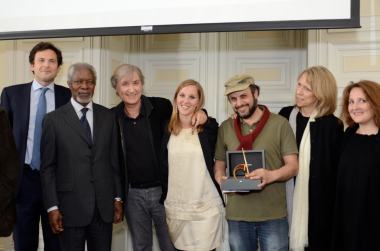
3 May 2014 Cartooning for Peace award, Geneva (c) THF
In case you noticed, my post of yesterday about the Cartooning for Peace Award came a day late; sorry. The award ceremony took place on Saturday 3 May, International Day for Press Freedom. To make up for the error here are the winners (Palestinian-Syrian Hani Abbasi, and Egyptian Doaa Eladl), in company of inter alia Kofi Annan and municipal councillor Guillaume Barazzone. The exhibit remains to be visited along the Quai Wilson in Geneva until 3 July 2014. Also present were the well-known cartoonists Chappatte, Plantu et Liza Donnelly. More information and links in my post of yesterday:
https://thoolen.wordpress.com/2014/05/04/cartooning-for-peace-international-award-and-exhibit-in-geneva-as-from-today/
Posted in awards, Human Rights Defenders | 1 Comment »
Tags: art, awards, Cartooning for Peace, Cartooning for Peace Award, cartoons, Chappatte, City of Geneva, Doaa Eladl, Egypt, Guillaume Barazzone, Hani Abbasi, human rights awards, Kofi Annan, Liza Donnelly, Palestinian, peace, Plantu, Press Freedom
April 16, 2014
There are many international NGOs doing excellent work for human rights defenders, but I want to highlight one here in particular: the International Service for Human Rights. It has a clear mandate and niche, based in Geneva for 30 years (with a small office in New York) is the main advocate for human rights defenders in the UN. The Director, Phil Lynch, sent out an overview in April 2014 of its activities covering the recent months, especially the latest session of the UN Human Rights Council. Please read the statement in full and – if you want regular updates – subscribe to the ISHR Newsletter: Read the rest of this entry »
Posted in human rights, Human Rights Defenders, ISHR | Leave a Comment »
Tags: Cao Shunli, China, Egypt, freedom to demonstrate, Human Rights Council, Human Rights Defenders, International Service for Human Rights, ISHR, Michael Ineichen, North Korea, Phil Lynch, reprisals, Shin Dong Hyuk, training
April 10, 2014
On Monday 7 April, an appeals court in Cairo, Egypt, upheld the 3-year prison sentences for three pro-democracy activists on charges of unlawfully organizing a protest and assaulting security officers outside a court on November 30, 2013. The verdict against Ahmed Maher, Ahmed Douma, and Mohamed Adel marks the first usage of the new restrictive law. [None of the three activists were involved in any violence that took place when clashes broke out during the protests. Maher and Douma were inside the courthouse when scuffles ensued, and a police officer attested to the fact that Adel was attempting to pacify protesters.]
for background see:
Posted in Human Rights Defenders | Leave a Comment »
Tags: Ahmed Douma, Ahmed Maher, Egypt, freedom of demonstration, Human Rights Defenders, illegal detention, independence of the judiciary, Mohamed Adel, Mona Seif, prison sentence, pro-democracy activists
March 9, 2014
Yesterday, 7 March 2014, saw many expressions of solidarity with women human rights defenders at the occasion of International Women’s Day.
The ISHR picked the following cases as examples that stand out:
You can find many more cases via the Women Human Rights Defenders International Coalition [http://www.defendingwomen-defendingrights.org/] which brings together women activists and those committed to the advancement of women human rights and those working on gender issues, to advocate for better protection of women human rights defenders.
via Honouring women human rights defenders on International Women’s Day! | ISHR.
Posted in Al-Hassani, films, human rights, Human Rights Defenders, ISHR | Leave a Comment »
Tags: Brazil, Conectas, Egypt, Egyptian women human rights, Human rights defender, Human Rights Defenders, Huy Luong, Ilwad Elman, international women's day, ISHR, LGBT rights, Lucia Nader, Masa Amir, Somalia, Viet Nam, Women Human Rights, women human rights defenders, Women Human Rights Defenders International Coalition
 © 2011 Platon for Human Rights Watch