ISHR launched a new report that summarises and assesses progress and challenges over the past decade in relation to initiatives to protect human rights defenders in the context of business frameworks, guidance, initiatives and tools that have emerged at local, national and regional levels. The protection of human rights defenders in relation to business activities is vital.
Defenders play a crucial role in safeguarding human rights and environmental standards against adverse impacts of business operations globally. Despite their essential work, defenders frequently face severe risks, including threats, surveillance, legal and judicial harassment, and violence.
According to the Business and Human Rights Resource Centre (BHRRC), more than 6,400 attacks on defenders linked to business activities have been documented over the past decade, emphasising the urgency of addressing these challenges. While this situation is not new, and civil society organisations have constantly pushed for accountability for and prevention of these attacks, public awareness of the issue increased with early efforts to raise the visibility of defenders at the Human Rights Council and the adoption of key thematic resolutions, as well as raising defenders’ voices at other foras like the UN Forum on Business and Human Rights.
The report‘Business Frameworks and Actions to Support Human Rights Defenders: a Retrospective and Recommendations’ takes stock of the frameworks, tools, and advocacy developed over the last decade to protect and support human rights defenders in the context of business activities and operations.
The report examines how various standards have been operationalised through company policies, investor guidance, multi-stakeholder initiatives, legal reforms, and sector-specific commitments. At the same time, it highlights how despite these advancements, the actual implementation by businesses remains inadequate. Effective corporate action remains insufficient, highlighting a critical gap that must be urgently addressed to ensure defenders can safely carry out their vital work protecting human rights and environmental justice. In order to address this, drawing on case studies, civil society tracking tools, and policy analysis, the report identifies key barriers to effective protection and proposes targeted recommendations.
Gladys Mbuya is a lawyer by profession, a human rights defender, and a peace crusader. She is the founder of the Liberal Law Office in Cameroon and serves as the president of the International Federation of Women Lawyers for Cameroon. She also holds a role as a traditional leader.
Her work centres on promoting the recognition and respect of human rights, particularly the rights of women and girls. She represents women and girls in court who cannot afford legal fees and actively advocates for the revision of laws that discriminate against them.
Gladys faced intimidation, threats, and even attempts at arrest for her activism, yet remains steadfast in her mission. She has defended numerous individuals – including prominent activists – in cases involving arbitrary detention and violations of free expression and assembly. She was part of the legal team that defended Mimi Mefo, Ndoki Michèle, and Agbor Balla, which led to their cases being dropped at the court.
‘Human rights defence work is a noble cause. The international community should continue standing by human rights defenders. They should increase the volume of political pressure on our governments for them to fulfil their obligations under all the international conventions they have ratified.’
“Despite it all, I hold onto a small hope—that the future might bring justice, that our voices will eventually be heard, and that one day I can celebrate my birthday again, in peace, with the people I love, free from fear and loss.” – Awdah Hathaleen, April 2025 Photo by: Emily Glick
An Israeli settler shot dead a Palestinian teacher who helped film Oscar-winning documentary No Other Land, according to the Palestinian education ministry and an Israeli-American activist who was at the scene of the shooting.
No Other Land co-director Yuval Abraham said on X that a settler shot Odeh (also Awdah) Hathaleen in the lungs in Umm Al-Khair village in the occupied West Bank. Residents allege the shooter was Yinon Levy, who is sanctioned by the UK.
Attorney Avichai Hajbi said he was representing a resident “who felt his life was in danger, was forced to fire his weapon into the air” after residents were “attacked by an Arab mob, along with foreign activists, with stones and violence”. Mattan Berner-Kadish, an Israeli-American activist at the scene, told the BBC that at about 17:20 local time (15:20 BST) on Monday, a bulldozer from a nearby Israeli settlement was driven through private Palestinian land, crushing a sewage pipe, multiple olive trees and two fences.
Berner-Kadish and other activists, including Hathaleen’s cousin Ahmad, ran to block the bulldozer. The activist said the driver hit Ahmad in the neck and shoulder with a drill that extended from the bulldozer, with his footage capturing Ahmad falling to the ground. Berner-Kadish did not believe Levy was driving.
While attending to Ahmad’s injuries, Berner-Kadish heard a pop. Running back to the village to get water, he saw Hathaleen lying bleeding from a gunshot wound and Levy, the only settler he saw, holding a gun.
In a video believed to be filmed by a relative of Hathaleen and posted on social media, a man identified as Levy is seen holding a pistol with a bulldozer behind him, as men yell at him. Levy pushes at one man, who pushes back. Levy then raises his pistol and shoots ahead of him, then again into the air.
The clip cuts off when the person filming turns around to run away as women are heard screaming. The footage does not show what or who the shots hit, if anything, and whether anyone else was shooting. There are no other settlers visible. Israeli police said it was investigating the incident in the area of Carmel, an Israeli settlement near Umm Al-Khair.
“As a result of the incident, a Palestinian man was pronounced deceased. His exact involvement is under investigation,” police told the BBC. Police said on Tuesday morning they had detained an Israeli citizen for questioning. Israeli media later reported Levy was released on house arrest.
The Israel Defense Forces (IDF) also detained five Palestinians on suspicion of involvement in the incident, along with two foreign tourists who were present. Berner-Kadish said on Tuesday evening they were still detained. The activist, who began visiting the village in 2021, said Hathaleen was “one of my best friends in the world” and the two were days away from constructing a football field in the village. He added that Hathaleen was a “warm and loving” father of three young children.
The Palestinian education ministry said Hathaleen was a teacher at a local secondary school. US congresswoman Lateefah Simon, a Democrat from California, said she was “heartbroken” over the killing of Hathaleen. He and his cousin, “both holding valid visas”, were detained and deported from San Francisco airport last month while travelling for a multicultural faith dialogue, she said.
Abraham said Hathaleen had helped film No Other Land, the 2025 Oscar winner for best documentary feature that follows the legal fight between the Israeli government and Palestinians over Masafer Yatta, a West Bank community of about 20 villages.
..Levy, a leader of an outpost farm, was sanctioned by the UK in 2024, along with others, because he “used physical aggression, threatened families at gunpoint, and destroyed property as part of a targeted and calculated effort to displace Palestinian communities”.
He was also sanctioned by the US under the Biden administration, along with others, last year, but President Donald Trump lifted those sanctions.
Gilad Kariv, a member of Israel’s Knesset from the Democrats party, said on X in response to the video that “in the territories, armed Jewish militias operate unchecked”.
Settler violence, which has also been on the rise for years, has surged since the outbreak of the war in Gaza. The UN documented at least 27 attacks by settlers against Palestinians that resulted in property damage, casualties or both, between 15 and 21 July, in the West Bank.
Sixteen activists completed the 2025 Human Rights Defender Advocacy Programme in Geneva to strengthen their advocacy skills. During the programme, they called for reforms to the UN human rights system, and helped secure the renewal of the expert mandate on sexual orientation and gender identity.
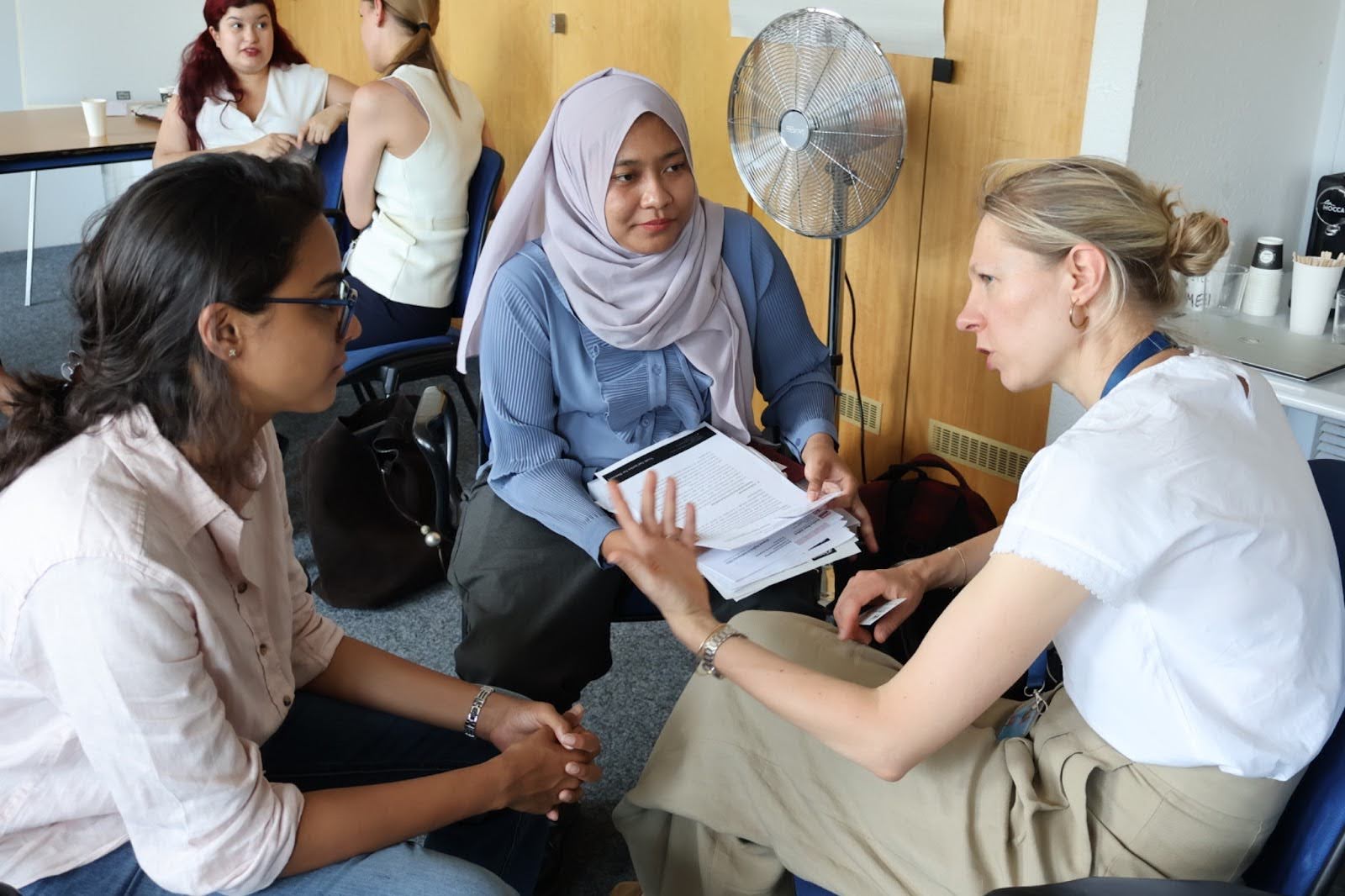
Held from 9 to 20 June 2025, the on-site part of HRDAP25 took place during the 59th session of the UN Human Rights Council. The programme blended online learning with face-to-face sessions in Geneva. Defenders explored UN human rights mechanisms such as the Human Rights Council, Special Procedures, Universal Periodic Review, and Treaty Bodies. They practiced advocacy techniques, developed strategic roadmaps, and engaged directly with mechanisms to push for real change at home.
It was intensive but very good. The platform is so user friendly, everyone can learn and take time to revisit, consult, see examples, and ask questions. The possibility to have online sessions and work in groups was very useful for me. Elena Petrovska, LGBTI Equal Rights Association for Western Balkans and Turkey, North Macedonia
Participants came from a wide range of regions and contexts, including Colombia, Guatemala, Nigeria, Indonesia, Tunisia, Lebanon, Nepal, India, Uganda, Cameroon, Syria, North Macedonia, Tibet and Sierra Leone. Their work focuses on LGBTIQ+ rights, environmental justice, transitional justice, gender equality, protection of migrants, business and human rights, and the protection of communities at risk.
Each day was filled with learning opportunities, advocacy and reflection. In April and May, the group enjoyed online training and coaching sessions which were then built upon with a packed in-person programme that gave participants the background preparation needed to engage with the various mechanisms and relevant stakeholders while in Geneva. They applied and practiced the knowledge and skills gained in a few different ways, which included: an NGO breakfast with the High Commissioner for Human Rights, where participants could ask very detailed and pertinent questions about the current situation; a brown bag lunch with experts from the Committee on Civil and Political Rights, where the group received first person tips on how to submit information and engage with Treaty Bodies; and meetings with UN Special Procedures (Business and human rights, Climate Change, Enforced Disappearances, Extreme Poverty) and their staff, were participants could start personal relationships with those experts and share their advocacy journey and plans.
Photo: ISHR
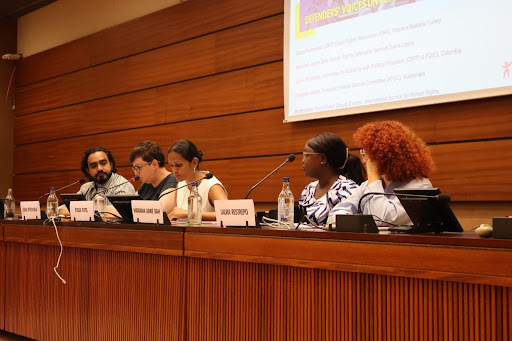
Defenders also participated in a powerful public side event about the reform of the UN human rights system. They shared lived experiences and challenges with over 30 States, calling for deeper access, stronger accountability, and genuine inclusion in the ongoing UN80 reform process. Laura Restrepo from Colombia reflected: ‘The UN must look inward and acknowledge its own colonial legacies — in who speaks, who decides, and whose knowledge counts. It must shift power toward grassroots and frontline communities.’
Throughout the programme, defenders stood up for key causes. Several participants joined the global campaign to #RenewIESOGI, advocating for the continuation of the UN mandate on Sexual Orientation and Gender Identity. Their voices contributed to a successful outcome: the Human Rights Council renewed the mandate for three more years, reaffirming its importance as a tool to combat discrimination and protect LGBTIQ+ communities.
Photo: ISHR
The sense of care and community ran deep. HRDAP helped participants’ work grounded in the values of solidarity and justice, and built their confidence to keep advocating at all levels. HRDAP25 not only provided skills and relevant exposure but also created a space for collaboration and resilience. Speaking during the public side event on UN reform, Pooja Patel, ISHR’s Deputy Executive Director, reminded States: ‘Human rights defenders are not only on the front lines of crises, they are on the front lines of solutions.’
Angélique is a Malagasy environmental and community rights defender who founded the Razany Vohibola Association in 2016. She represents over 3,000 villagers from four communities near the Vohibola Forest and leads efforts to preserve one of Madagascar’s last remaining primary forests.
Under her leadership, and in collaboration with the Ministry of the Environment, villagers have formed patrols to monitor and protect the forest against illegal logging, poaching, and the growing impacts of climate change. Angélique and her community face ongoing threats, including direct intimidation and violence from the authorities. One of her colleagues, patrol officer Mick, was killed for speaking out against illegal land grabbing, yet his death remains unpunished by local authorities.
Despite these grave risks, Angélique continues to advocate for justice and environmental protection. She also calls for structural change, urging the Malagasy government to pass a law that protects human rights defenders and holds public officials accountable.
There is currently no law to protect human rights defenders in Madagascar. We need this law to pass. The army and the gendarmes must be trained to understand who we are so they can become our allies.
‘What we need first is peace. (…) The international community, the UN, has the ability to end what’s happening in eastern RDC – what is happening today in the East is truly alarming.’
Judith Maroy is a Congolese journalist and human rights defender from Bukavu, in the South Kivu province of the Democratic Republic of the Congo.
Judith began her advocacy work through LUCHA, a youth-led citizen movement demanding social justice, democratic governance, and equality. She later became a journalist with La Prunelle RDC and co-founded a local organisation advocating for the rights of women, youth, and Indigenous communities.
She is calling for a just, peaceful Congo where young people have opportunities, women’s voices are heard, and no one is displaced in their own country.
On 30 June 2025, ISHR launched its updated Reprisals Handbook in four languages (English, Simplified Chinese, Uyghur and Tibetan), an essential resource for all stakeholders concerned about intimidation and reprisals against those cooperating with international or regional human rights systems.
The UN as well as regional human rights bodies are often the last space where human rights defenders, rights holders, victims and witnesses can denounce violations and abuses. They must be free and safe to cooperate with and give evidence and testimony to these human rights bodies. They must be protected against any form of intimidation or reprisal in association with this engagement.
This handbook is aimed first and foremost at human rights defenders who engage with regional and international human rights systems. The focus is in particular on the United Nations (UN) human rights system, the African Commission on Human and Peoples’ Rights (ACHPR) and the Inter-American Commission on Human Rights (IACHR).
The handbook highlights the risks that defenders can face from interacting with those systems, and suggests ways in which defenders can leverage the weight of the UN and regional human rights mechanisms to provide some degree of protection against those risks. In doing so, it does not aim to provide a fully comprehensive protection solution. In all cases, defenders should consider which option might be best, based on the context and particulars of a case.
ISHR also aims at diversifying the formats available for defenders to access relevant content, including by publishing a Reprisals Toolkit and a video in the languages mentioned above.
The International Service for Human Rights (ISHR) seeks to ensure that national, international and regional human rights systems have the policies, mechanisms and protocols in place to prevent reprisals and ensure accountability where they occur. ISHR also brings cases of alleged intimidation and reprisals to the attention of relevant officials to press for effective preventative measures and responses, including through our #EndReprisals campaigns. ISHR also maintains the #EndReprisals database, which documents cases of reprisals reported by the UN Secretary-General.
For more information on how to use the UN bodies and mechanisms referred to throughout this handbook, visit the ISHR Academy, which provides free courses in English, Spanish and French.
In 2024, HURIDOCS continued strengthening partnerships, evolving tools, and expanding its reach.
“I see our contribution not just as code, but as something living—like the root bridges of Northeast India, grown with care and shaped by community. This is how I envision HURIDOCS: building human rights infrastructure that is resilient, collaborative, and deeply rooted in justice.” — Danna Ingleton, HURIDOCS Executive Director
Supporting the global community
This year, HURIDOCS partnered with 73 organisations across 38 countries, helping develop documentation strategies, launch new platforms, and provide targeted support. This means 73 documentation projects were reimagined and refined through bespoke customisation through our flagship tool, Uwazi. From databases mapping attacks on environmental defenders to resources preserving collective memory, our work continues to be shaped by those on the frontlines of human rights struggles.
Uwazi: Built with and for civil society
In 2024, our open-source platform, Uwazi, continued to grow with new machine learning tools for translation and metadata extraction, tighter security, and full integration with the Tella mobile app, making it more responsive, secure, and aligned with the needs of human rights defenders worldwide.
Convening global conversations
In 2024, HURIDOCS engaged in key global events, including a side event at the 56th Human Rights Council, the Geneva Human Rights Platform, the first Google Impact Summit, and a Human Rights Day webinar highlighting four global initiatives powered by Uwazi.
Through these events, we advanced vital discussions on the ethical use of AI, digital monitoring technologies, and the future of technology infrastructure in support of human rights.
Navigating fundraising challenges while building resilience and sustainability
HURIDOCS continued to navigate a complex funding landscape in 2024, strengthening our financial foundations to ensure long-term resilience.
We remain committed to aligning our resource strategies with our mission, providing steadfast support, insight, and partnership to those advancing human rights globally
Strengthening our foundations
2024 marked the second year of Danna Ingleton’s leadership as Executive Director. It was a year of growth and transition, including the appointment of Grace Kwak Danciu as Chair of the HURIDOCS Board, and a heartfelt farewell to Lisa Reinsberg, whose contributions shaped the organisation for more than five years.
To ensure the long-term sustainability of our mission, we launched a new Development and Communications team under the leadership of Yolanda Booyzen. We also welcomed new staff across programmes, tech, and product, each one contributing to a stronger, more agile HURIDOCS.
As our team grows and our documentation tools evolve, we strive to build a fit-for-purpose civil society equipped to achieve justice, accountability, and the protection of human rights.
Looking ahead, we hold hope that the years to come will bring renewed compassion as we work towards a world where human rights are upheld for all.
ISHR and the Colectivo 46/2 condemn the assassination of opposition leader Samcam Ruìz by the Nicaraguan Government.
In the joint letter published on 23 June 2025 The 46/2 Collective denounces to the international community the assassination of retired Nicaraguan Army Major Roberto Samcam Ruíz, which took place on 19 June in his home in San José, Costa Rica.
Samcam Ruíz was a strong voice of denunciation against the Ortega-Murillo dictatorship, denouncing the Nicaraguan army and pointing it out as a participant in the repression and extrajudicial executions committed since 2018. He had also denounced an espionage network against opposition refugees in Costa Rica.
The retired major was one of the 94 Nicaraguans denationalised in February 2023 by the dictatorship and since 11 July 2018 had been a refugee in Costa Rica due to persecution and criminalisation by the dictatorship of Daniel Ortega and Rosario Murillo. He obtained Spanish nationality on 26 July 2023.
The assassination of the former retired military officer is not the first attack against opponents on Costa Rican soil. In 2023, opposition member Joao Maldonado and his wife were shot at with the clear intention of killing them. Maldonado had already suffered another attack in 2021, also in San José, Costa Rica. In 2022, the Nicaraguan opposition leader Rodolfo Rojas was found dead in Honduras. According to relatives, he had been lured to Honduras from Costa Rica, where he had gone into exile. To the list must be added the murder of another refugee, Jaime Luis Ortega, in 2024, in Upala, a canton on the border with Nicaragua. Following these events, Roberto Samcam had spoken to the press, pointing out the direct involvement of the Ortega Murillo regime and indicating that he knew that his life was at risk.
Although the investigations into Samcam’s murder are ongoing, the circumstances of the murder and the profile of the victim raise strong suspicions that it may be a political crime with possible transnational links. This murder takes place in a context in which various human rights organisations have been documenting a sustained pattern of surveillance, threats, harassment and acts of intimidation directed against Nicaraguans in exile in the region, especially in Costa Rica.
We consider that this crime should be analysed and investigated as part of a broader strategy of transnational repression promoted by the Nicaraguan regime to persecute and silence dissent outside its borders, in open violation of the human rights of refugees and exiles. This transnational repression has been documented by the Group of Experts on Human Rights in Nicaragua (GHREN), who have pointed out that ‘The Government’s repressive actions transcend the country’s borders and affect people who are opponents or perceived as such abroad. The government has also continued to target family members of opponents inside Nicaragua, including children, by mere association, as a way of punishing opponents and/or deterring them from speaking out wherever they are’.
Given the gravity of this crime and the sustained pattern of transnational repression against exiled Nicaraguans, we urgently call on the international community to demand that the Nicaraguan State immediately cease all forms of persecution, surveillance and violence against dissidents in exile. We also request that the international community strengthen political, technical and financial support for the protection mechanisms for human rights defenders in exile. We also urge the establishment of bilateral or multilateral channels of communication with the host countries of Nicaraguans in order to assess the security situation and articulate preventive responses to possible acts of transnational persecution. Finally, we call on international human rights bodies to urgently follow up on these cases as part of a systematic pattern of cross-border repression, and to ensure justice and truth for the victims.
Signatories:
Collective Nicaragua Never Again
Centre for International Law and Justice – CEJIL
International Federation for Human Rights – FIDH
International Institute on Race, Equality and Human Rights
Autonomous Women’s Movement – MAM
World Organisation Against Torture (OMCT)
Peace Brigades International – PBI
International Network on Human Rights Europe – RIDHE
Legal Defence, Registry and Memory Unit – UDJUDR
Open ballot boxes
International Service for Human Rights – ISHR
Additional information:
The 46/2 Collective is a coalition of 19 international, regional and Nicaraguan human rights organisations that regularly informs the international community about the lack of action by the Nicaraguan regime to meet its international human rights obligations.
Human Rights activist Henry Tiphagne at the press meetInstagram/peopleswatch
On 25 June 2025 Azeefa Fathima wrote how – at the release of the Global Index on Torture in Geneva, human rights defender Henri Tiphagne of India’s People’s Watch slammed India for failing to ratify the UN Convention Against Torture and for allowing systemic impunity in custodial deaths.
India’s human rights record on custodial torture came under sharp international criticism at the launch of the Global Index on Torture in Geneva on Tuesday, June 25, with prominent rights advocate Henri Tiphagne accusing the country of “zero accountability” in cases of police brutality and deaths in custody.
Drawing attention to the fifth anniversary of the custodial deaths of Jeyaraj and Benix in Tamil Nadu, Henri said, “The father and son were tortured and died in judicial custody. They were produced before a judicial magistrate after medical examination, having already changed clothes three times due to bleeding. The trial has gone on for five years, across 262 hearings, and is still ongoing, while the family continues to face reprisals.”
Henri, who is the Executive Director of People’s Watch, criticised India for being among eight countries listed in the Global Index for ongoing torture and reprisals against victims and human rights defenders. “We are yet to ratify the Convention Against Torture, despite over 41 countries having recommended it. The National Human Rights Commission (NHRC) has existed for 32 years and has not prosecuted even one police officer responsible for extrajudicial killings or torture,” he said…
He said that India must “bow down in shame” for its continued failure to ratify the UN convention and for its “zero accountability” in cases of custodial torture and deaths.
The National Human Rights Commission (NHRC), established 32 years ago, has never successfully prosecuted a single police officer involved in torture or extrajudicial killings, Henri noted, and said, “We are the only country with so many human rights institutions, and yet they are not functioning. The NHRC has even been downgraded in Geneva, and this speaks volumes”.




 Hans Thoolen on Human Rights Defenders and their awards