Nathalia Bonilla is an environmental human rights defender from Ecuador who works in the protection of the rights of Nature. She told ISHR about her country’s sharp policy turn in favour of extractive activities and spoke about the ‘utopia’ she and her peers would like to see in its place. ‘A revolution where you can’t dance is not my revolution,’ Nathalia said, in arguing for an ‘environmentalism for the people’.
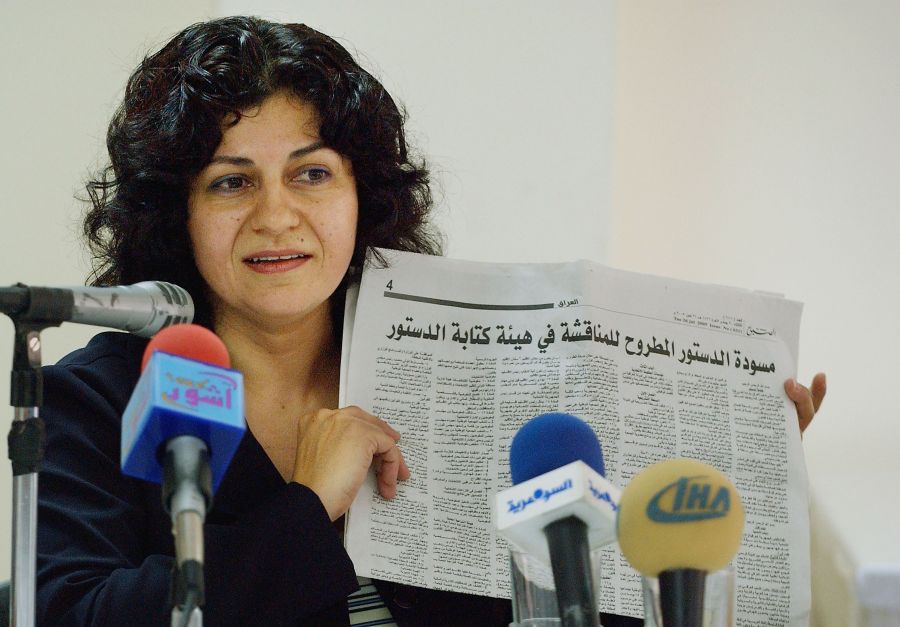
On 2 March 2026, woman human rights defender and feminist Yanar Mohammed was killed in an armed attack in front of her residence in northern Baghdad.
Yanar Mohammed was a prominent Iraqi woman human rights defender and feminist, and the co-founder and director of the Organisation of Women’s Freedom in Iraq (OWFI). Since 2003, she had worked to protect women facing gender-based violence, including domestic abuse, trafficking, and so-called ‘honour killings.’ Under her leadership, OWFI established a network of safe houses across several Iraqi cities, providing protection and support to hundreds of women. Yanar Mohammed led these efforts despite all the ongoing impediments and risks. She was a strong advocate for secularism and women’s equality. Throughout her activism, Yanar Mohammed faced death threats and, at times, was forced to restrict her movement. {see also: https://humanrightsdefenders.blog/2019/01/07/women-human-rights-defenders-in-iraq-have-to-live-dangerously/]
According to an offical statement from OWFI, on 2 March 2026 at 9:00, two unidentified gunmen on motorcycles opened fire on Yanar Mohammed as she stood outside her home. She was quickly transported to the hospital, however, despite the effort of medical personnel, she succumbed to her injuries.
Reportedly, Yanar Mohammed had returned to Baghdad from Canada just a few days prior to her assassination, raising concerns about the potential surveillance and monitoring of her movements.
The event “Tackling the protection gap: Host States’ responsibility to prevent and respond to transnational repression” will bring together defenders and UN experts to discuss the international human rights law obligations of States in respect of transnational repression against individuals and groups within their territory, as well as the strengthening of international standards, and gaps arising from shortcomings in their implementation domestically.
Location: Geneva, Switzerland. Date: 09 March 2026. Palais des Nations, Room VIII. Time: 2:00PM – 3:00PM CET and livestreamed on ISHR’s YouTube channel.!
Research from international organisations, NGOs and academics shows that transnational repression (TNR) – acts by States and their proxies to deter, silence or punish dissent, criticism or advocacy outside their territory – is affecting a growing array of individuals and groups worldwide.[1] With the emergence of new surveillance and communication technologies, many actors have found new avenues to silence and punish critics and opponents. The most common targets have been exiled human rights defenders and political activists, but today broader groups such as journalists, lawyers, artists, academics and ordinary members of diaspora communities are frequently targeted. See e.g.
The immediate effect of TNR is the violation of, or constraint on the exercise of, fundamental human rights. States have obligations towards those subject to such violations taking effect within their territory. These obligations have long been recognised, but have not yet been the subject of focused discussion in relation to TNR, leaving the scope and nature of the duties of host States unclear.
This event will bring together defenders and UN experts to discuss the international human rights law obligations of States in respect of transnational repression against individuals and groups within their territory, as well as the strengthening of international standards, and gaps arising from shortcomings in their implementation domestically.
Speakers:
Sayed Ahmed al-Wadaei, Director of Advocacy, Bahrain Institute for Rights and Democracy (BIRD)
Birgit Kainz-Labbe, Coordinator of Civic Space Unit, Office of the UN High Commissioner for Human Rights
Ben Saul, UN Special Rapporteur on counter-terrorism and human rights
Hélène Tigroudja, Human Rights Committee, Vice-Chair
Moderator: Raphael Viana David, International Service for Human Rights
This event is organised by ISHR and co-hosted with Human Rights Watch, Human Rights House Foundation and the International Federation for Human Rights (FIDH).
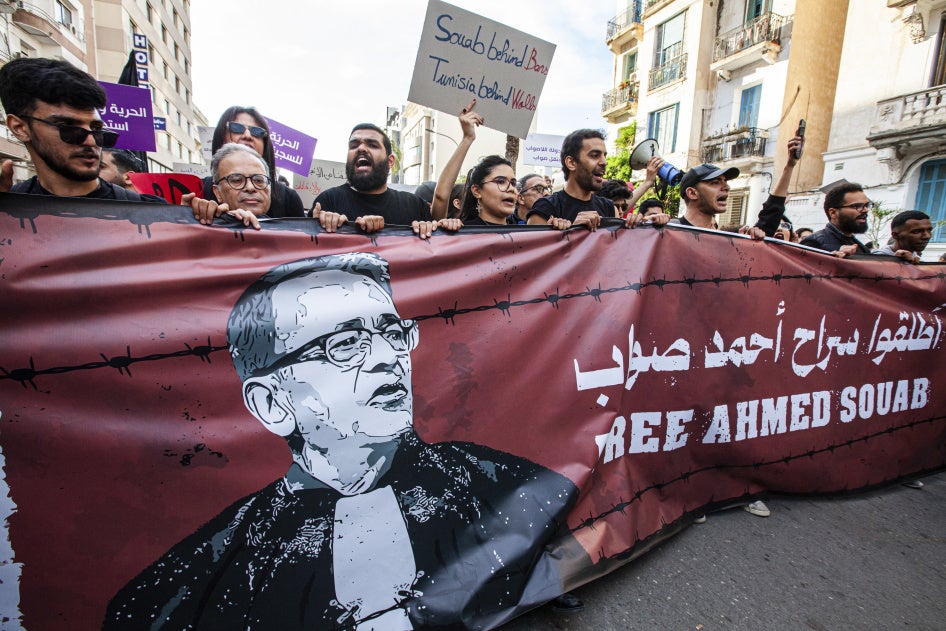
A Tunisian lawyer and human rights defender, Ahmed Souab, who was sentenced to prison on terrorism-related charges, will face a new trial on appeal on February 12, 2026, Human Rights Watch said. The Tunisian authorities should immediately drop the unfounded charges and release him, and stop retaliating against critics and the lawyers defending them.
Tunisian authorities prosecuted Souab, 69, for statements he made outside of court while representing defendants in a notorious case of “conspiracy against state security.” On October 31, 2025, a Tunis anti-terrorism court sentenced him to five years in prison and three years of administrative supervision. His trial lasted just minutes; Souab was not present, and journalists were reportedly barred from attending.
“Ahmed Souab, a lawyer, former administrative judge, and fierce advocate for judicial independence, is behind bars simply for his defense work and outspoken views,” said Bassam Khawaja, deputy Middle East and North Africa director at Human Rights Watch. “His abusive prosecution for defending others from abusive prosecution shows the sheer extent of the Tunisian authorities’ crackdown on any dissent.”
Anti-terrorism agents arrested Souab in his home on April 21, following comments he made after the “conspiracy case” verdict on April 19. That day, 37 people, including lawyers, activists, and opponents, were sentenced after a sham trial for terrorism and security-related offenses to prison terms ranging from 4 to 66 years.
Standing outside the headquarters of Tunis Bar Association, Souab reportedly said: “It seems that it is not the detainees who have a knife turned on them, but rather, it’s the president of the chamber who has a knife [at his throat].” Video excerpts of his statement circulated widely on social media. Souab’s defense committee explained that he was referring to pressure exerted on judges.
Human Rights Watch has documented the authorities’ repeated attacks on the judiciary in Tunisia, including President Kais Saied’s dismantling of the High Judicial Council in February 2022. The attacks have severely undermined the rule of law, allowed the executive to weaponize the judiciary for political ends, and jeopardized Tunisians’ right to a fair trial, Human Rights Watch said.
The Tunisian authorities are increasingly relying on remote trials for terrorism cases, especially for politically motivated trials against dissidents. The practice of remote trial by video is inherently abusive, including by undermining detainees’ right to be brought physically before a judge to assess their well-being and the legality and conditions of their detention.
On October 31, Souab was convicted of “endangering the lives of people entitled to protection by deliberately disclosing information that could reveal their identities” and of “making threats in connection with a terrorist offense,” his family told Human Rights Watch.
Souab’s family said he has a history of cardiac conditions and experienced a deterioration in his health in prison. He has suffered several nosebleeds, the cause of which was not determined, they said.
Over the past three years, the authorities have increasingly relied on an aggressive legal toolbox, including unfounded security and terrorism charges under the penal code and 2015 Counterterrorism Law, to target critics and lawyers with judicial harassment, abusive criminal prosecution, arbitrary detention, and travel bans for the legitimate exercise of their profession. see also: https://humanrightsdefenders.blog/tag/tunisia/
Aziza Abdirasulova has displayed great courage and determination in defending human rights
Aziza Abdirasulova, a prominent human-rights defender and a pioneering independent civil society activist from Kyrgyzstan, has been awarded the 2026 Council of Europe Raoul Wallenberg prize in recognition of her efforts to protect fundamental rights with a particular focus on prisoners’ rights, freedom from torture, and the right to peaceful assembly.
At the award ceremony in Strasbourg, on 21 January 2026, Council of Europe Secretary GeneralAlain Berset recognised the great courage and determination of Ms Abdirasulova making an outstanding contribution to fundamental rights in Kyrgyzstan, often at great personal and physical risk.
“As one of the first independent human-rights defenders in Kyrgyzstan to document torture and arbitrary detention systematically, Aziza Abdirasulova has kept facts on the record when silence would have been easier. At a time when attention is drawn to geopolitical shifts and crises at the top, she reminds us that the Raoul Wallenberg prize brings the focus back to human-rights defenders.”
In the spirit of Raoul Wallenberg’s work, notably his single-minded determination and extraordinary courage in standing up to protect fundamental rights, the jury emphasised that Aziza Abdirasulova refused to be silenced by intimidation and harassment. Underlining the essential role of human-rights defenders in challenging times, including backsliding on human rights, the jury stressed that “her organisation Kylym Shamy has played a key role in exposing systemic human-rights violations providing legal support to victims and mobilising public opinion nationally and internationally. It has also been a vital source of credible information for the international community on human-rights issues in Central Asia. She has worked indefatigably to promote and protect freedom of assembly and the right to peaceful protest in the face of severe official restrictions on protests and public gatherings.”
Receiving the prize, Aziza Abdirasulova said: “For me, like for Raoul Wallenberg, every human life saved had and has the ultimate value. Over the years of my work, I have consistently defended fundamental human rights: freedom of peaceful assembly, freedom from torture and cruel treatment, freedom of speech and opinion. This work required not only professional knowledge but also great personal courage. I happened to witness hundreds of cases of torture, and in each case, I have tried to provide whatever support I could to the victims.”
On 26 February 2026 the Human Rights Foundation (HRF) launched its research project, the Tyranny Tracker, a qualitative index that classifies the world’s countries and territories as democratic, hybrid authoritarian, or fully authoritarian. This political regime assessment tool is now available to the public at a moment when tyranny is on the rise worldwide.
According to HRF’s Tyranny Tracker, 75% of the world’s population lives under authoritarianism despite representing only 92 countries, or less than half of all countries in the world — a number that is partly explained by the hybrid authoritarian regimes of India, Indonesia, Pakistan, and the Philippines, and by the fully authoritarian regimes of China, Ethiopia, Nigeria, Russia, and Vietnam, which rule over some of the world’s most populous countries. The Tyranny Tracker classifies countries using a methodology consisting of 45 indicators categorized into three thematic pillars: electoral competition, freedom of dissent, and institutional accountability. The methodology is informed by academic literature and HRF’s 20 years of experience advocating on behalf of dissidents from countries ruled by authoritarian regimes. The research draws on a range of sources, including media, data collected by HRF’s in-house research team, an extensive human rights network, and expert advice. Published today in the Journal of Democracy, a piece from HRF’s lead researchers Javier El-Hage, Malaak Jamal, and Alvaro Piaggio, explores what sets the Tyranny Tracker apart from other indexes, and how readers can use the tool to inform their work.
“The Tyranny Tracker is a culmination of years of HRF’s internal research to identify patterns of authoritarianism worldwide and decide which regimes to prioritize as targets of our advocacy work,” said Malaak Jamal, HRF’s director of policy and research. The Tyranny Tracker uses three classifications for the governments ruling countries around the world: Democratic governments are characterized by largely free and fair elections, freedom to criticize the government, and an independent judiciary capable of being an effective check on government abuse. While many of these governments currently face real challenges in resisting the autocratic tendencies of democratically elected leaders emboldened by increased political polarization globally, they continue to maintain the mechanisms of self-correction that allow democracies to survive and evolve, as opposing political parties regularly and peacefully transfer power. Hybrid authoritarian regimes are typically the result of the severe erosion of institutions by an initially democratically elected government, and represent a step in the process of authoritarian consolidation. While these authoritarian regimes maintain a façade of democracy through regular elections, their autocratic actions heavily skew elections in favor of the incumbent to the point that an opposition victory and peaceful transfer of power are highly unlikely. Fully authoritarian regimes systematically stifle meaningful electoral competition and the basic freedom to dissent, all the while tightly controlling a judicial branch, which lacks any ability to serve as a check on government abuse. These authoritarian regimes regularly rig elections (when they hold them at all), shut down critical media outlets and organizations, and target political opponents and dissenters with arrests and killings, making the chance of a nonviolent transition to democracy as a result of elections little more than a theoretical possibility.
“HRF’s new tool aims to contribute to the healthy competition and complementarity among existing democracy indexes by great institutions, such as Freedom House, V-Dem, International IDEA, or the Economist Intelligence Unit, that already do a great job documenting the situation of authoritarianism worldwide in a quantitative way. The Tyranny Tracker, on its part, is methodologically different as it follows a simple yet structurally cohesive and qualitative analysis process, carried out by HRF’s regional policy and advocacy researchers and experts, resulting in limited yet materially significant differences in country classifications,” said Javier El-Hage, HRF’s chief legal and policy officer.
Jawad Fairooz is a Bahraini human rights defender, Founder of OMCT’s SOS-Torture Network member organisation SALAM for Democracy and Human Rights. He is also a former Member of the Bahraini Council of Representatives, currently living in exile after years of persecution by the authorities, including detention, torture, and the revocation of his nationality. In Bahrain, severe restrictions on civic space persist alongside widespread impunity and ongoing allegations of torture. As the UN Committee Against Torture reviews Bahrain’s record, Jawad Fairooz reflects on the human rights climate in the country, the personal cost of his advocacy, and the urgent need for accountability, drawing on his experience and the findings highlighted by OMCT and partners’ Global Torture Index.Since the crackdown on the Arab Spring protests in 2011, Bahrain has been marked by grave human rights violations. .. More than 435 people have had their nationality revoked [see also: https://humanrightsdefenders.blog/2018/02/25/i-am-bahraini-website-launched-in-effort-to-stop-denationalizations/], and over 300 prisoners of conscience remain behind bars, including opposition leaders. Freedom of speech and assembly are criminalised, torture has not been systematically banned, and political and civil rights continue to be restricted. The core violations that began years ago are still continuing today.
What has been the cost of your advocacy in Bahrain?
From the moment I became active in public life, I knew there would be a high price to pay. In 2004, while leading a large protest against the US invasion of Iraq, I was shot in the head with a live bullet. Since then, I have been targeted repeatedly through detention, torture, and eventually the revocation of my nationality.
The Global Torture Index classifies Bahrain as facing a “very high risk” of torture. Why?
Torture is not taken seriously by the authorities. There are no accountability and no clear mechanism to hold senior officials responsible. Victims are denied remedies, redress, and rehabilitation. Even after release, former detainees struggle to regain basic civil and political rights. They face obstacles in obtaining employment, housing, and other services. International recommendations from bodies such as the UN Committee Against Torture have not been implemented. There have been no meaningful legal amendments to fully prohibit torture or establish independent investigations. Semi-government institutions lack independence and cannot be trusted to address these abuses. All of this shows a clear lack of political will.
What are the main obstacles facing survivors of torture when seeking justice?
The government focuses on public relations rather than real reform. Institutions like the National Institution for Human Rights, the Special Investigation Unit, and other bodies exist, but they are not independent. Cases referred to them rarely result in accountability or fair trials. Victims consistently report that justice is denied. Torture has evolved from overt physical abuse to psychological and “soft” methods, including deprivation of rights, travel bans, revocation of nationality, deportation, and denial of documents and services. These practices show that torture continues in different forms, and the authorities are not serious about ending it at its roots…
You have been in exile. How do defenders continue their work despite reprisals?
Human rights defenders in exile pay a heavy price. Many are banned from entering Bahrain or face fabricated cases, Interpol notices, travel restrictions, and harassment of their families. Smear campaigns label activists as terrorists or foreign agents. Despite this, defenders continue out of belief in the cause and responsibility toward victims. It is extremely difficult, but repression cannot last forever, especially under international scrutiny.
What gives you hope to continue your work?
Silence only strengthens repression. The resilience of victims and their families gives me hope. Standing with them is a moral and spiritual duty. I believe oppression has a short life, and that by continuing this work, we help ensure that future generations do not inherit a reality of torture, executions, statelessness, and detention.
Repressive regimes throughout the world deploy the machinery of the state to silence criticism and dissent. It is therefore hardly surprising that artists—whose creative work can expose, ridicule, and condemn in emotive and powerful ways—are common targets of political persecution. Over the past few years, there have been crackdowns on artists and performers in Russia, Belarus, Cuba, Azerbaijan, Egypt, China, and Venezuela, among other countries. The following artists dared to use their creative expression to challenge powerful systems, and have been punished with political imprisonment. From: Political Prisoners Watch February 19, 2026
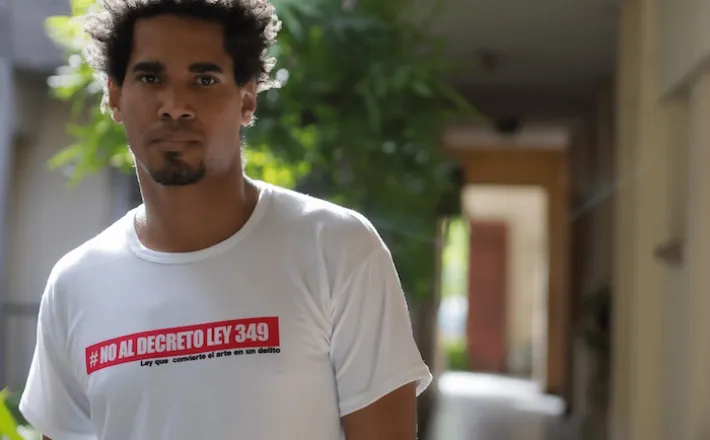
Luis Manuel Otero Alcántara is a Cuban artist and activist whose evocative performance art led to government harassment and numerous periods of detention. After the Cuban government enacted Decree 348 in 2018, which required artists to obtain advance approval for even private performances, he cofounded the San Isidro Movement to protest the increasing censorship of free expression. On July 11, 2021—the start of the historic J11 protests—he was arrested and has been detained ever since. In June 2022, he was sentenced to five years in prison for contempt, public disorder, and insulting symbols of the homeland, and remains in prison in Cuba. [https://humanrightsdefenders.blog/2024/09/19/the-rafto-prize-2024-to-cuban-artivist-luis-manuel-otero-alcantara/]
Maykel Osorbo Castillo Pérez is a Cuban musician who cofounded the San Isidro Movement with Luis Manuel Otero Alcántara. Due to his activism and vocal opposition to the Cuban regime, he was subjected to systemic harassment, including being arrested 121 times in a five-month period. He cowrote the 2021 song Patria y Vida(Homeland and Life), which inspired thousands to demonstrate against Cuba’s repressive regime and won two Latin Grammys. He was not able to accept the awards, however—in May 2021, he was arrested, forcibly disappeared for 14 days, and eventually sentenced to nine years in prison on charges of contempt, public disorder, and defamation of institutions and organizations, heroes, and martyrs.
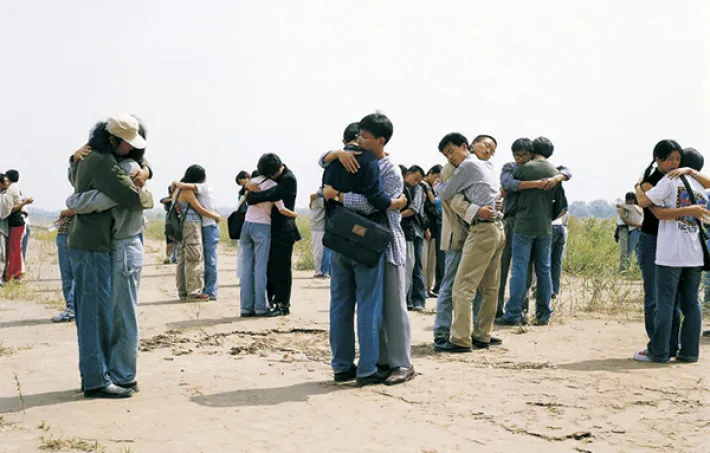
Gao Brothers, The Utopia of the 20 Minute Embrace (2000), modified image via Wikimedia Commons, used under CC BY-SA 3.0.
Gao Zhen is a Chinese artist and US permanent resident who was detained while visiting family in China in August 2024. Avant-garde works by Gao and his brother Gao Qiang—known together as the Gao Brothers—include huge, mirror-like sculptures and other works critiquing Mao Zedong and China’s Cultural Revolution. Authorities allege that Gao committed the offense of “insulting or defaming heroes and martyrs,” though the art in question had been created years before the Law on the Protection of Heroes and Martyrs was enacted. Gao’s wife Zhao Yaliang has been prohibited from leaving China, and she and their young son have remained there since his detention.
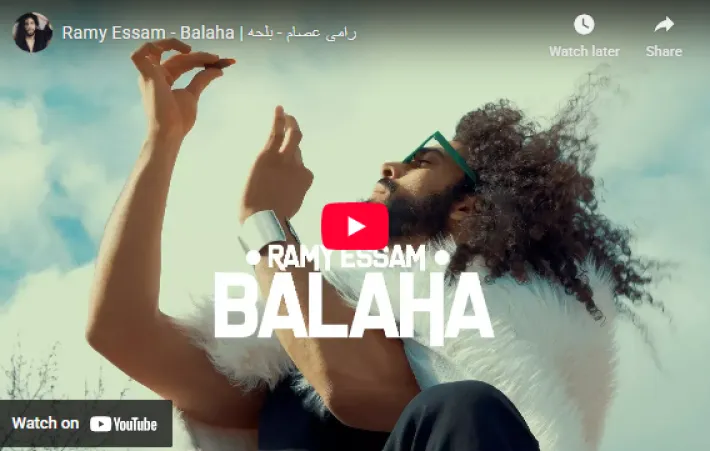
Galal El-Behairy is an Egyptian poet and singer/songwriter who has faced severe retaliation for his artistic work. He wrote the lyrics for the guitar-driven protest song Balaha, which mocked Egyptian President Abdel Fattah al-Sisi and the country’s corrupt establishment. Five days after its release in February 2018, he was arrested by the National Security Police and disappeared for a week. In July 2018, he was sentenced to three years in prison by a military court for allegedly spreading false news and rumors and insulting the Egyptian army in his poetry book The Finest Women on Earth. Although his sentence expired in 2021, he was not released, and he is now facing additional charges including disseminating fake news and joining and aiding a terrorist organization.
HURIDOCS is recruiting a 👉 Global Repository Coordinator 👈 , a fixed-term role focused on a project that’s been in the works here for a long time. This Global Repository is where so many threads finally come together. Years of work on machine learning, documentation, and human rights data, all coming into one shared “playground” to help unlock judgments, decisions, and human rights information at scale.
Because this is such an exciting and ambitious role, we’re looking for someone who’s dynamic, independent, and a great problem-solver. Someone who knows how to push things forward and also when to when to slow down and consult, with communities, partners, donors, and more. Someone comfortable with the international human rights ecosystem and committed to leveraging technology for justice.
Often when we’re recruiting for roles like this we talk about looking for a unicorn, but this time that doesn’t quite work. I think we’re really looking for a tiger. Someone who can help us actually make this thing real. 🐯
Freedom House announced the appointment of Jamie Fly as its Chief Executive Officer, effective 2 February, 2026.
“Jamie Fly is a transformational leader ready to advance Freedom House’s vision of a world where all are free. He has stepped forward at a consequential moment as Freedom House pivots toward a private- and public-sector funding model, while growing existing and attracting new investors in freedom and democracy. This is particularly important as our flagship Freedom in the World report has documented nearly 20 years of democratic decline and as authoritarian leaders threaten fundamental freedoms and security around the world. Jamie brings deep global experience, bipartisan credibility, and a demonstrated ability to lead complex organizations under pressure. His leadership marks the start of a new chapter in Freedom House’s fight to expand and defend freedom around the world and to champion democratic values,” said Norman Willox, chair of the Freedom House Board of Trustees.
Fly has decades of experience in government, civil society, and the private sector. He has served as President and CEO of Radio Free Europe/Radio Liberty (RFE/RL) and held senior positions on the US National Security Council staff, at the Department of Defense, on Capitol Hill, and at the German Marshall Fund of the United States. Most recently, he served as Senior Counselor at Palantir Technologies, where he supported efforts to defend Ukrainian democracy from Moscow’s illegal, full-scale military invasion. He is a recipient of the Office of the Secretary of Defense Medal for Exceptional Public Service and the Czech Foreign Ministry’s Medal for Distinguished Contribution to Diplomacy.
“I am excited and honored to join Freedom House at this critical moment for democracy and global freedom as the organization celebrates its 85th anniversary this year in the midst of significant change. Additionally, I would like to thank Norm Willox, Freedom House’s board, and its talented leadership team and staff for their tremendous efforts, resilience, and accomplishments in the face of great challenges and opportunities,” said Fly.
Freedom House is the oldest American organization devoted to the support and defense of democracy and freedom around the world. It was formally established in 1941 to promote American involvement in World War II and the fight against fascism. Lauded for its nonpartisan approach, it has grown into the world’s premier institution for supporting the democratic aspirations of societies around the world through its globally recognized convening power, coalition building, advocacy, independent research, and emergency support to human rights defenders.



 Hans Thoolen on Human Rights Defenders and their awards
