Archive for the 'organisations' Category

European Parliament’s Sakharov prize awarded to Venezuela opposition

October 27, 2017

Only a week ago I mentioned the curiously collective award given to the South-Korean people [https://humanrightsdefenders.blog/2017/10/18/korean-people-win-friedrich-ebert-human-rights-award-for-candlelight-rallies/], and now the European Parliament has awarded its Sakharov Prize for Freedom of Thought to Venezuela‘s opposition-dominated National Assembly, as well as to political prisoners in the country.

Opposition MP Freddy Guevara in Caracas (picture-alliance/dpa/A. Cubillos)

The National Assembly in Venezuela was nominated for the award by the center-right European People’s Party (EPP) parliamentary grouping along with the Alliance of Liberals and Democrats for Europe (ALDE group). MEP Jose Ignacio Salafranca said “they are brave people who, despite being beaten or imprisoned, are not afraid and do not give up, but fight for their freedom and for their dignity.” Fellow MEP Guy Verhofstadt said the award supported “the fight of democratic forces in favor of a democratic Venezuela and against the Maduro regime.”

For more on the Sakharov Prize for Freedom of Thought: http://thedigestapp.trueheroesfilms.org/publicpage#/awards/BDE3E41A-8706-42F1-A6C5-ECBBC4CDB449/Sakharov-Prize-for-Freedom-of-Thought, where you can also learn more about the other two awards named after Sakharov.

Previous winners of the Sakharov Prize include Yazidi women [https://humanrightsdefenders.blog/2016/11/01/sakharov-prize-2016-went-ultimately-to-two-yazidi-women/] and Saudi blogger Raif Badawi [https://humanrightsdefenders.blog/2015/10/29/saudi-blogger-raif-badawi-awarded-europes-sakharov-prize/].

Source: Sakharov prize awarded to Venezuela opposition | News

World Health Organization reconsidering Mugabe as “goodwill ambassador”

October 22, 2017

he head of the World Health Organization, Tedros Adhanom Ghebreyesus, is rethinking his decision to name Zimbabwe’s president, Robert Mugabe, as a goodwill ambassador.  The move provoked global outrage. WHO member states and activists alike noted that Zimbabwe’s health care system, like many of its public services, has collapsed under Mugabe’s regime. I’m listening. I hear your concerns. Rethinking the approach in light of WHO values. I will issue a statement as soon as possible,” Tedros, a former Ethiopian health minister, tweeted on Saturday night.

The Canadian prime minister, Justin Trudeau, came closest when he said he thought Mugabe’s appointment “was a bad April Fool’s joke”. [see: https://humanrightsdefenders.blog/2015/10/23/mugabe-wins-chinese-peace-prize-this-time-for-real/]

Human Rights Watch (HRW) said it was an embarrassment to give the ambassador role to Mr Mugabe, because his “utter mismanagement of the economy has devastated health services”. The main opposition party in Zimbabwe, MDC, described the appointment as “laughable”…“Mugabe trashed our health delivery system. He and his family go outside of the country for treatment in Singapore after he allowed our public hospitals to collapse.”

The Human Rights Foundation (HRF) also condemned the decision by the World Health Organization (WHO): “The irony of the World Health Organization’s decision to praise Robert Mugabe is staggering. This a strongman infamous for seeking medical attention for himself abroad. His recent visits to Singapore for medical treatment have cost Zimbabwean taxpayers tens of millions of dollars. Mugabe can’t get adequate treatment in his own country because his kleptocratic regime has left Zimbabwe’s hospitals and health industry in a state of ruin,” said HRF president Thor Halvorssen. “Dr. Tedros should nullify Mugabe’s appointment immediately and also issue a strong public condemnation of his repressive rule”.

Sources:

https://www.theguardian.com/world/2017/oct/21/un-lambasted-after-naming-mugabe-goodwill-ambassador

HRF condemns World Health Organization for appointing Robert Mugabe as “goodwill ambassador”

Martin Ennals Ceremony 2017 was very moving

October 19, 2017

For those who missed it, here the link to the FULL version of the ceremony for the 2017 Martin Ennals ward of Human Rights Defenders.

Repressive governments and Ophelia compete to prevent HRDs to travel to Dublin

October 18, 2017

Andrew Anderson, the executive director of Front Line Defenders, published a piece at the beginning of the Dublin Platform for Human Rights hosted by Front Line Defenders in Ireland

Thwe Thwe Win working on her land near the copper mine in Myanmar. 25 May 2016. Photo: Lauren DeCicca / Front Line Defenders

Thwe Thwe Win working on her land near the copper mine in Myanmar. 25 May 2016. Photo: Lauren DeCicca / Front Line Defenders
Thwe Thwe Win is one of the 117 at-risk activists invited to the 2017 Dublin Platform for Human Rights Defenders who actually made it to the bi-anual gathering of global activists. ….

Like thousands of people trying to get into Ireland on Monday, dozens of our international guests had flights canceled or postponed. Another 11, however, were prevented from attending long before Ophelia hit, banned from leaving home by their governments…..It is an opportunity for defenders typically preoccupied with defending their communities – and surviving the threats that ensure – to spend 72 hours not being physically surveilled by a totalitarian state, threatened at work by an extremist group, or receiving menacing phone calls demanding their stop their activism. It is an opportunity to relax, something activists tend to forget to do. It is also a chance for defenders to learn from their peers around the world. Feminists from Nigeria strategise with Colombians about how to peacefully defend indigenous land from paramilitaries. Emirati human rights defenders chat to Moroccans about the high-tech spying software both their governments recently purchased. Bahrainis lament with Bangladeshis the unrelenting influence of Saudi Arabia in each oppressive state’s policies. Rights activists from most of the former Soviet block tend to tease the Russian about their own governments’ adopting a “copy and paste” approach to many of Russia’s anti-NGO laws.

This year there will be a noticeable gap in our Dublin Castle crowd. Last week, we learned that our Kuwaiti invitee was threatened by state officials not to travel. The Bahraini invited is currently in detention; last time she was there, they sexually assaulted her. The second young Bahraini woman we invited in her place – who boldly took to Twitter to speak out for the former – now has a travel ban. The Saudi activist learned he was on an intelligence surveillance list last week; he rang our Blackrock office to say he was too scared to leave home. The Gulf has been a blackhole of restrictions of freedom of movement for human rights defenders for some time now, but unfortunately that’s not the end of it. Our Syrian colleague has had his passport confiscated by state security in Turkey, and a Ukrainian lawyer has yet to be granted permission to travel.

An activist in Cameroon was arrested for his peaceful activism a few weeks ago – he won’t be joining us this week; he’s in prison. A Cuban human rights defender planned to leave home in Guantanamo City extra early, knowing he’d be stopped at the town’s many American-run military checkpoints – security in Guantanamo is tight. Ultimately, he was never granted the “exit permit” required to leave Cuba. In Colombia, David Rabelo Crespo was recently released from prison after 7 years for a crime he did not commit, but has still been forbidden from travel to Dublin.

Governments world-over know that it is not laws, conventions, or UN resolutions that bring human rights reform to a country – it’s people. They know that activists are only as powerful as their communities, both local and international, and are working harder than ever to ensure that networks of solidarity cannot flourish.

Radical social change – the kind that undermines dictatorships, dismembers racist populist tides, secures indigenous peoples’ rights to their land – has always been born out of collective struggle. It is clear that in preventing our human rights defender colleagues from Bahrain, Kuwait, Colombia, Saudi Arabia, Cameroon, Syria, and Bolivia from traveling, the respective authorities are not only vindictive, they are terrified of activists. Authoritarians think that if they lock human rights defenders away – behind bars or travel bans or physical attacks – that we will stop listening, that we will forget them. Authoritarians are wrong……….When governments work hard to silence activists, we must work harder to hear them.” [see alsohttps://humanrightsdefenders.blog/2015/11/30/closing-civil-society-space-a-euphemism-for-killing-human-rights-defenders/#more-7208]

Andrew Gilmour, UN Assistant Secretary-General for Human Rights,made statement on 17 October 2017 which is worth reading in its totality but I copy here only the part on reprisals:

At times – as some of you have experienced or witnessed – engagement with the UN on human rights can lead to reprisals and intimidation. This has been a long-standing concern to the Organization, and we are distressed at the increasing number of such acts. These range from travel bans, threats and harassment, smear campaigns, surveillance, restrictive legislation, physical attacks, arbitrary arrest and detention, torture and ill-treatment, including sexual violence, denial of access to medical attention, and even killings. Intimidation of human rights defenders is happening all the time. The purpose is to penalize individuals who have already spoken out, thereby also sending a signal to many others from speaking out in future.

Recognising the gravity of this issue, last October the Secretary-General announced that he had asked me to lead efforts to strengthen UN-wide action for prevention of, protection against, investigation into and accountability for reprisals. Many Governments are very supportive, and have offered resources for this endeavor. Our host country Ireland is very strong in this regard. We are trying to get as much information about what is going on, and for this we need your input, and will circulate our email address to help us get it.… I recount a few lines of what I said in my speech to the Human Rights Council three weeks ago as I presented the Secretary-General’s report on reprisals:

We believe the significance of this report goes far beyond the individual cases contained in it. I think we should see these individuals as the canary in the coal mine, bravely singing until they are silenced by this toxic backlash against people, rights and dignity – as a dark warning to us all. (…)

It is frankly nothing short of abhorrent that, year after year, we are compelled to present cases to you, the UN membership, of intimidation and reprisals carried out against people whose crime – in the eyes of their respective Governments – was to cooperate with the UN institutions and mechanisms whose mandate of course derives from you, the UN membership. (…)

I salute the extraordinary courage that it sometimes takes for the victims and their families to come forward and share their stories with us, and also the dedication of the civil society organizations who act on behalf of those affected.

[see also: https://humanrightsdefenders.blog/2017/06/21/assistant-secretary-general-for-human-rights-andrew-gilmour-speaks-very-freely-at-the-united-nations-association-of-the-usa/]

Sources:

Its people and not laws that bring human rights reform to a country

http://www.ohchr.org/SP/NewsEvents/Pages/DisplayNews.aspx?NewsID=22251&LangID=E

Antoine Bernard has left FIDH after 26 years

October 12, 2017

For those of you (like me) who missed the rather sudden departure of Antoine Bernard as head of the FIDH (International Federation for Human Rights), here is the 12 September statement called “Farewell Antoine” as seen on the FIDH website:

“Antoine Bernard is stepping down as Chief Executive Officer of the FIDH International Secretariat on September 15 after serving the organisation for 26 years. Antoine established and steered the International Secretariat, playing a fundamental role in the development and expansion of FIDH. Under his guidance, the organisation engaged in innovative and pioneering operations in the world of defending human rights. 
The numerous victories he contributed to include the 1998 adoption of the United Nations Declaration on Human Rights Defenders; the 2002 establishment of the International Criminal Court (ICC) and the mobilisation that led to the ICC sentencing of Jean-Pierre Bemba in 2016, which was the first verdict to recognise rape as a crime against humanity and to hold those effectively in command responsible; the identifying of corporate responsibility on the part of economic players and their criminal prosecution as well as dialogue with some companies to encourage them to develop and assume their social responsibility; lastly, his work at FIDH, including in recent months, to usher in digital communication, to counter attacks aimed at delegitimising human rights, to organise the decentralisation of our organisation and to create transparent and faithful partnerships. FIDH is immensely grateful to Antoine for his tireless optimism, his audacity and tenacity, and the passion that he has for our organisation, serving and supporting FIDH member organisations and their defenders. 
He is an iconic figure in the worldwide human rights movement. He embodies the patience that is needed for universal, steadfast commitment to practical and concrete progress, as well as a single-minded pursuit of justice and the audacity that this requires. 
Following the departure of Antoine, a transition management team is being set up headed by Juliane Falloux, FIDH Executive Director.”

Source: Farewell Antoine

Many birthday parties for jailed human rights defender in Turkey

October 12, 2017
human rights defenders in Turkey, still in jail after 100 days

Ten activists, including İdil Eser, the Director of Amnesty International Turkey, were arrested on 5 July. İdil’s 54th birthday is on 14 October, which she will spend imprisoned on baseless and trumped-up charges. [https://humanrightsdefenders.blog/2017/07/12/turkey-detention-of-human-rights-defenders-further-extended/] (Amnesty International Turkey’s Chair, Taner Kılıç, was also arrested a month earlier. On 4 October a prosecutor filed an indictment calling for jail terms of up to 15 years for all 11 human rights defenders on absurd terrorism charges.)

After three months the investigation has unsurprisingly failed to provide any incriminating evidence to substantiate the prosecutor’s fantastical charges. .. The activists are accused of assisting a variety of “armed terrorist organisations” with diametrically opposing ideologies. They face maximum sentences of 15 years. The charges against them include outlandish claims that standard human rights activities – such as appealing to stop the sale of tear gas, making a grant application or campaigning for the release of hunger striking teachers – were carried out on behalf of terrorist organizations. Some of the claims against İdil are based on Amnesty International documents and public communications that predate her appointment at the organisation.

To mark İdil’s 54th birthday, Amnesty International will hold more than 200 parties and actions globally, starting with a public, pop-up, Turkish-themed birthday party on 13 October in Auckland. Elsewhere around the world there will be a birthday party in the European Parliament and a press conference in a makeshift prison in Madrid. The parties will feature full-size paper cutouts of Idil to highlight her absence, along with Turkish food, music, decorations and more.

I am ready to pay the price for my choice to work on human rights and I am not scared. My time in jail has made me even more committed to standing up for my values. I will not compromise them.” Idil Eser (8/19/17).


breaking news: Egyptian defender Mohammed Zaree laureate of the Martin Ennals Award 2017

October 10, 2017

Martin Ennals Award for Human Rights Defenders

The Jury of the Martin Ennals Award for Human Rights Defenders, the highest accolade in the international human rights moment, has just announced that Mohamed Zaree, a human rights lawyer from Egypt, has been selected as the 2017 Laureate. The announcement was made on 10 October at 18h30, during the annual ceremony in Geneva. You can still follow it through live streaming at this very moment: via: https://www.facebook.com/villegeneve.ch/.

Mohamed Zaree is a human rights activist and legal scholar whose work focuses on human rights advocacy around freedom of expression and association. He is also known for his role as the Egypt Country Director of the Cairo Institute for Human Rights Studies (CIHRS), which works throughout the Arabic speaking world. He assumed this role after government pressure on CIHRS prompted them to relocate their headquarters to Tunis in 2014.

The Egyptian government has been escalating its pressure on the human rights movement. Human rights NGOs and defenders are confronted with a growing wave of threats, harassment, and intimidation, legal and otherwise. Despite this, Zaree continues to lead CIHRS’ research, human rights education, and national advocacy initiatives in Egypt and is shaping the media debate on human rights issues. During this critical period for civil society, he is also leading the Forum of Independent Egyptian Human Rights NGOs, a network aiming to unify human rights groups in advocacy. Zaree’s initiatives have helped NGOs to develop common approaches to human rights issues in Egypt. Within the context of the renewed crackdown on Egyptian human rights organizations, he has become a leading figure in Egypt’s human rights movement. Zaree is currently facing investigation under the “Foreign Funding Case” and is at high risk of prosecution and life imprisonment. The “Foreign Funding Case” highly restricts NGO activities. Despite this, Zaree continues to engage the authorities in dialogue wherever possible, arguing that respect for human rights will increase stability in Egypt. Zaree has been under a travel ban since May 2016.

Martin Ennals Foundation Chair Dick Oosting stated: “Severe restriction of civil society’s space to express itself is what led Mohamed Zaree to advocate for human rights and fight for the freedom of association. He is still paying the price for his courageous acts, and we urge his government to lift the travel ban.”

The unique composition of the Jury of the MEA [a coöperation by 10 global human rights organizations, see www.martinennalsaward.org for more detail] makes this award the most important prize in the human rights world. It is supported by the City of Geneva.

The two other finalists also received Martin Ennals prizes:

Karla Avelar (El Salvador)

FreeThe5KH (Cambodia)                                                            

For more on the award see also: https://humanrightsdefenders.blog/2017/09/18/ceremony-of-the-24th-martin-ennals-award-coming-up-on-10-october.  and

http://www.trueheroesfilms.org/thedigest/awards/martin-ennals-award-for-human-rights-defenders

Job opportunities at the International Service for Human Rights

October 4, 2017

International Service for Human Rights (ISHR) announces two vacancies:

Read the rest of this entry »

Documenting human rights: standards and practice – side event

September 27, 2017

This side event is announced too late, but still good to know and find out more from the organizing NGOs:


Philippines shows the weakness of the UPR system: spinning only on one side

September 23, 2017

On 23 September 2017 quite a number of observers and some media responded to the ill-deserved claim by the Philippines Government that it has scored a “big victory” in the UN’s UPR (Universal Periodic Review).  The problem remains that the UN itself does not have the outreach and ‘spinning’ capacity to counter the propaganda spread, especially at the national level in the Philippines.

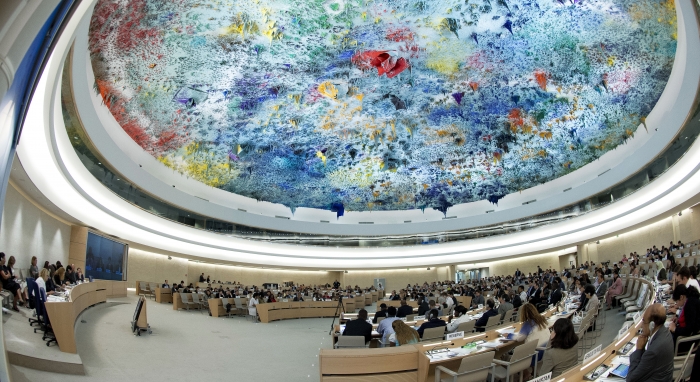
Seat of the United Nations Human Rights Council in Geneva. UN Brief photo

In reality it was ignoring important issues raised and rejected key recommendations made by other States. The Philippine delegation on Friday at the session in Geneva accepted only 103 out of 257 recommendations made by member-states. On Saturday, the Department of Foreign Affairs claimed the country “scored a big victory in Geneva” when the UN body “overwhelmingly adopted Manila’s human rights report card.” (Foreign Affairs Secretary Alan Peter Cayetano claimed the “adoption” of Manila’s report means that the country “has nothing to hide with its human rights record.“)  [see also: https://humanrightsdefenders.blog/2016/11/02/duterte-is-wrong-human-rights-defenders-are-beautiful/]

Adoption of the UPR outcome report, however, cover both the report by the Philippines’ and also the other states’ positions on its human rights record, which included calls to investigate killings (the final document “consists of the questions, comments and recommendations made by States to the country under review, as well as the responses by the reviewed State,” according to a UN human rights office’s brief on its website.)

While member-states welcomed the Philippines’ acceptance of some of the recommendations such as on poverty and education, many expressed concern over its decision not to take action on most of the points raised. Key recommendations merely “noted” by the Philippines—a move interpreted as a rejection by observers—include 44 related to extrajudicial killings in the Duterte government’s campaign against illegal drugs. The Philippines also snubbed recommendations relating to the protection of journalists and human rights defenders, as well as those urging it to lift conditions to allow access of the UN special rapporteur on extrajudicial killings.

A farce”. This was how human-rights group Karapatan described the Philippine government’s supposed “victory”. Karapatan secretary general Tinay Palabay said on Saturday the Philippine government delegation to Geneva “conveniently glosses over” the fact that it did not accept a number recommendation that aimed to resolve pressing issues on human rights. The Philippine delegation, however, practically denied before the UN body the existence of extrajudicial killings in the drug war despite the increasing number of deaths of suspects without trial.

International watchdog Human Rights Watch also reminded the Philippines to cooperate as a member of the council in all of its mechanisms, such as in allowing the special rapporteur without conditions to look into cases in the Philippines.

Sources: Ignoring issues raised, Philippines claims ‘victory’ in UN review | Headlines, News, The Philippine Star | philstar.com

http://www.interaksyon.com/dedma-blues-human-rights-watch-dismayed-at-ph-rejection-of-review-recommendations/

http://globalnation.inquirer.net/160441/karapatan-downplays-ph-delegates-victory-unhrc-united-nations-unhrc-dfa-cayetano-karapatan-human-rights-group#ixzz4tUkOfpcR