During the 58th regular session of the Human Rights Council, ISHR delivered a statement during the Interactive Dialogue with the Special Rapporteur on Human Rights Defenders affirming that human rights, peace and security are deeply interconnected, and the importance of the international system to human rights defenders.
The international system – to which many human rights defenders turn for justice, solidarity and accountability – is under attack.
Already weakened by double standards by States from all regions, human rights and the rule of law are being destroyed by a cabal of authoritarian leaders and unaccountable corporations. We thank the Special Rapporteur and other experts for their 27 February statement on this issue.
It was gratifying to see the rapid solidarity of many States with Ukraine following Friday’s White House confrontation with one such authoritarian. It is disheartening that the shortsighted response of many of those same States to the existential human rights funding crisis is to increase security spending by reducing development assistance. Human rights, peace and security are deeply interconnected.
Of course, no single State can fill the US gap or counter its influence, but a diverse group of States with a shared interest in universal rights and the rule of law must do so. Human rights defenders globally need your increased political and financial support, now. Our common interests are not served by lawlessness and raw power.
Madame Rapporteur, thank you for endorsing the Declaration on Human Rights Defenders +25. Read with the 1998 Declaration, it elaborates authoritative standards on the rights of defenders, and State and non-State actors’ obligations to respect and protect them.
Finally, alongside 196 organisations, ISHR calls on States to support a strong Norway-led resolution on human rights defenders and technology at this session.
Natika Kantaria is a human rights advocate with nearly a decade of experience planning and implementing advocacy campaigns in human rights. She has worked with international organizations and watchdog NGOs and collaborated with the public and private sectors. For the ISHR she wrote a piece on 26 February 2025 about a worrying trend: ‘Foreign agent’ laws have been introduced in various countries, violating international human rights law and threatening to silence human rights defenders. This pattern is particularly evident in Eastern Europe, where NGOs courageously resist and need the support of the international community. See e.g. my earlier posts:
Societies thrive when everyone can work, speak out, and organise freely and safely to ensure justice and equality for all. Legislation requiring NGOs to register as ‘foreign agents’ is a barrier to this virtuous cycle. Despite the European Court of Human Rights’ 2022 ruling that Russia’s 2012 foreign agent law violated freedom of expression and association, the governments of Hungary, Georgia, Slovakia, Serbia, and Bosnia and Herzegovina have proceeded undeterred to introduce similar laws.
These laws specifically target NGOs and not-for-profits that receive foreign funds and require them to register as foreign agents, organisations serving the interests of a foreign power, or agents of foreign influence. By doing so, they restrict the capacity of human rights defenders to organise, participate and exercise their right to defend rights by:
imposing disproportionately high fines and heavy sanctions to NGOs refusing to comply, which may ultimately lead to the termination of their operations
using vague wording, that ultimately gives too much room and power for government interpretation. For instance, the requirement for NGOs to register in official records or identify themselves as ‘agents of foreign influence’ lacks clarity and specificity.
increasing the burden of NGOs by introducing heavy reporting and auditing requirements. The State’s alleged need for transparency as their primary purpose can, therefore, be effectively addressed through existing legislation regulating NGOs.
employing a negative narrative that stigmatises and delegitimises the work of the civil society organisations and human rights defenders. This rhetoric promotes hostility and distrust toward civil society and encourages attacks against defenders.
Furthermore, such laws contradict the commitments of these countries under international human rights law. Article 13 of the 1998 UN Declaration on human rights defenders recognises the right of defenders to solicit, receive and utilise resources.
Article 10 of the Declaration +25, a supplement to the UN Declaration put forward in 2024 by civil society, human rights defenders and legal experts, addresses States’ attempts to prohibit foreign contributions or impose unjustified national security limitations. It stipulates that States should not hinder financial resources for human rights defenders and outlines measures to prevent retaliation based on the source of their funding. These laws violate rights related to freedom of expression, association, and privacy, as outlined in the European Convention on Human Rights (ECHR) and International Covenant on Civil and Political Rights. Foreign agent laws also run counter to commitments made by countries at the regional level as members of the Council of Europe (CoE) and the Organization for Security and Co-operation in Europe (OSCE), including recommendation CM/Rec(2018)11, which emphasizes the protection and promotion of civil society space and OSCE guidelines for protecting human rights defenders.
NGOs are increasingly becoming a primary target for repressive governments. According to the CIVICUS Monitor 2024 report, the countries mentioned above that have introduced ‘foreign agent’ laws have either ‘closed’ or ‘obstructed’ civil society space. In addition, the Trump administration’s rhetoric and its decision to freeze foreign aid have contributed to strengthening hostile narratives already present in ‘foreign agent laws’ in Eastern Europe and have emboldened governments in their efforts to publicly undermine these organisations.
While the silencing of NGOs has become part of the agenda for many governments, and the rise of ‘foreign agent’ laws serves as a step towards establishing authoritarian regimes, civil society actors continue to mobilise in response. Strengthening engagement with international human rights mechanisms, fostering joint global advocacy, and providing support to targeted organisations and groups are essential steps that international NGOs and the international community should take to build resistance, reinforce coalition efforts, and protect the work of human rights defenders.
International and regional human rights mechanisms have called for governments to either repeal these laws, or not to adopt them in their current forms. On 7 February 2025, three UN independent experts issued a statement in relation to Bosnia and Herzegovina, where the government reintroduced the ‘Law on the Special Registry and Publicity of the Work of Non-Profit Organisations’ after its initial withdrawal in May 2024. The statement stressed that creating a register of non-profit organisations receiving foreign funding in one of the entities of Bosnia and Herzegovina will impose severe restrictions on NGOs and would grant government control over their operation, including the introduction of an annual inspection, with further reviews of legality of CSOs receiving foreign funding possible upon requests from citizens or relevant authorities.
In this unsupportive environment, donors have a fundamental role to play. ‘As civil society actors devise strategies to push back against these repressive tactics, private philanthropy and bilateral and multilateral donors have vital support roles to play,’ writes James Savage, who leads the Fund for Global Human Rights’ (FGHR) programme on the Enabling Environment for Human Rights Defenders. ‘They can help civil society prepare for future challenges, so that it is organised not only to respond to evolving forms of repression but also to get ahead of them by tackling their root causes,’ Savage concludes.
New and emerging technologies have become a fundamental tool for human rights defenders to conduct their activities, boost solidarity among movements and reach different audiences. Unfortunately, these positive aspects have been overshadowed by negative impacts on the enjoyment of human rights, including increased threats and risks for human rights defenders. While we see the increased negative impacts of new technologies, we do not see that governments are addressing these impacts comprehensively.
Furthermore, States and their law enforcement agencies (often through the help of non-State actors, including business enterprises) often take down or censor the information shared by defenders on social media and other platforms. In other cases, we have seen that businesses are also complicit in attacks and violations against human right defenders.
Conversely, lack of access to the internet and the digital gaps in many countries and regions, or affecting specific groups, limits the potential of digital technologies for activism and movement building, as well as access to information.
The Declaration on Human Rights Defenders, adopted in 1998, does not consider these challenges, which have largely arisen with the rapid evolution of technology. In this context, and, as part of activities to mark the 25th anniversary of the UN Declaration on human rights defenders, a coalition of NGOs launched a consultative initiative to identify the key issues faced by human rights defenders that are insufficiently addressed by the UN Declaration, including on the area of digital and new technologies. These issues are also reflected in the open letter to States on the draft resolution on human rights defenders that will be considered during HRC58.
This side event will be an opportunity to continue discussing the reality and the challenges that human rights defenders face in the context of new and emerging technologies. It will also be an opportunity to hear directly from those who, on a daily basis, work with defenders in the field of digital rights while highlighting their specific protection needs. Finally, the event will also help remind States about the range of obligations in this field that can contribute to inform the consultations on the HRC58 resolution on human rights defenders.
Panelists:
Opening remarks: Permanent Mission of Norway
Speakers:
Carla Vitoria – Association for Progressive Communications
Human rights defender from Kenya regarding the Safaricom case (via video message)
Woman human rights defender from Colombia regarding use of new technologies during peaceful protests
Human rights defender from Myanmar regarding online incitement to violence against Rohingya people
Video montage of civil society priorities for the human rights defender resolution at HRC58
Moderator: Ulises Quero, Programme Manager, Land, Environment and Business & Human Rights (ISHR)
This event is co-sponsored by Access Now, Asian Forum for Human Rights & Development (FORUM-ASIA), Association for Progressive Communications (APC), Business and Human Rights Resource Centre (BHRRC), DefendDefenders (East and Horn of Africa HRD Project), Huridocs, Gulf Centre for Human Rights (GCHR), International Lesbian, Gay, Bisexual, Trans and Intersex Association (ILGA World), International Service for Human Rights (ISHR), Peace Brigades International, Privacy International, Protection International, Regional Coalition of WHRDs in Southwest Asia and North Africa (WHRD MENA Coalition).
On the fifth anniversary of the “Xiamen Gathering” crackdown, 34 civil society organisations (on 10 February 2025) across the world reaffirm their solidarity with Chinese human rights defenders and lawyers persecuted for advocating for human rights:
26 December 2024 marked the fifth anniversary of the crackdown on the “Xiamen gathering”, a private gathering that about 20 Chinese human rights defenders and lawyers convened in Xiamen, China in December 2019 to discuss the situation of human rights and civil society in China. In the weeks after, Chinese authorities interrogated, harassed, detained and imprisoned every participant who was not able to leave China then and subjected almost all of them, including some families and friends, to travel bans, up to the present day, under the pretext of national security.
Among those detained were legal scholar Xu Zhiyong and human rights lawyer Ding Jiaxi. Both are leading human rights defenders who spearheaded the “New Citizens’ Movement”, empowering citizens as rights-bearers to advocate for a more equal, rights-respecting and free society, and to combat corruption, wealth inequality and discrimination in access to education. In 2014, Xu and Ding were both sentenced to four years and three and a half years in prison, respectively, for participating in the New Citizens’ Movement and charged with “gathering a crowd to disturb public order”.
From 26 December 2019, and over the weeks that followed, the Chinese authorities forcibly disappeared both under Residential Surveillance at a Designated Location (RSDL), a criminal procedure allowing secret detention for up to six months without access to legal counsel or family. RSDL is considered by UN Special Procedures experts to constitute secret detention and a form of enforced disappearance, and may amount to torture or other ill-treatment. While held under RSDL, both men were subjected to torture and other ill-treatment, before being charged with the national security crime of “subversion of State power”. They were subsequently convicted in a secret trial and handed severe prison sentences of 14 and 12 years, respectively, in April 2023. Despite multiple calls from the UN High Commissioner for Human Rights Volker Türk and from UN Special Procedures’ experts as recently as November 2024, China has failed to address these grave violations.
These cases are emblematic of a broader and alarming trend of persecution of human rights defenders and lawyers in China. Authorities systematically employ RSDL, harsh national security charges, torture and other ill-treatment, prolonged detention, travel bans and harassment to silence dissent and dismantle independent civil society. The use of vague charges such as “subversion of State power” or “picking quarrels and provoking trouble” has become a routine tactic to criminalise human rights work, despite UN human rights experts’ repeated call for them to be repealed. Victims often face prolonged pre-trial detention, lack of due process, restricted access to lawyer and adequate healthcare, and torture or other ill-treatment aimed at extracting forced ‘confessions’.
This systematic repression is further reflected in the cases of human rights lawyers Xie Yang and Lu Siwei, feminist activist Huang Xueqin, labour activist Wang Jianbing, and citizen journalist Zhang Zhan, all of whom are currently subjected to arbitrary detention or imprisonment . UN Special Procedures’ experts have recently described these cases as part of “recurring patterns of repression, including incommunicado detention and enforced disappearance aimed at […] silencing human rights defenders and dissenting or opposing views critical of the Government”.
As we commemorate the fifth anniversary of the crackdown, we, organisations and activists from all over the world, continue to stand in solidarity with all human rights defenders and lawyers in China who courageously advocate for justice despite knowing the risks of doing so.
We urge the Chinese government to:
Immediately and unconditionally release all human rights defenders and lawyers arbitrarily detained or imprisoned for their human rights work, including Xu Zhiyong and Ding Jiaxi;
End the systematic crackdown on civil society, including harassment, unjustified detention, enforced disappearance, and imprisonment of human rights defenders and lawyers;
Amend laws and regulations, including national security legislation, the Criminal Law and the Criminal Procedure Law, to bring them fully in line with international human rights standards;
Rescind the travel bans imposed on the gathering participants as well as their friends and families immediately.
Signatories:
Alliance for Citizens Rights
Amnesty International
Asian Lawyers Network (ALN) (Japan)
CIVICUS: World Alliance for Citizen Participation
Free Tibet (United Kingdom)
Human Rights in China
India Tibet Friendship Society Nagpur Maharashtra (India)
International Bar Association’s Human Rights Institute (IBAHRI)
International Campaign for Tibet
International Federation for Human Rights (FIDH), within the framework of the Observatory for the Protection of Human Rights Defenders
International Service for Human Rights (ISHR)
International Tibet Network
Judicial Reform Foundation (Taiwan)
Lawyers for Lawyers (Netherlands)
LUNGTA – Active for Tibet (Belgium)
PEN America (United States)
Safeguard Defenders (Spain)
Swiss Tibetan Friendship Association (Switzerland)
Taiwan Association for Human Rights (Taiwan)
The 29 Principles (United Kingdom)
The Network of Chinese Human Rights Defenders
The Rights Practice (United Kingdom)
Tibet Justice Center (United States)
Tibet Solidarity (United Kingdom)
Voluntary Tibet Advocacy Group (V-TAG) (Netherlands)
World Organisation Against Torture (OMCT), within the framework of the Observatory for the Protection of Human Rights Defenders
Acción Solidaria (Venezuela)
Amnistía Internacional Chile (Chile)
CADAL (Argentina)
Centro de Derechos Humanos Fray Francisco de Vitoria OP, A.C. (Mexico)
CONTIOCAP – Coordinadora Nacional de Defensa de Territorios Indígenas Originarios Campesinos y Áreas Protegidas en Bolivia (Bolivia)
Movimiento Autónomo de Mujeres (Nicaragua)
Red Nacional de Organismos Civiles de Derechos Humanos Todos los Derechos para todas, todos y todes (Mexico)
The suspension and, in some cases the termination, of US foreign aid is having profound and adverse human rights impacts, threatening the very existence says Phil Lynch of ISHR in his Director’s update: “Impact of US funding freeze on human rights defenders and ISHRe of many human rights defenders, organisations and institutions“.
ISHR is directly affected by the US funding freeze. The suspension of US government funds means we’ve already had to terminate, defer or reduce activities to support human rights defenders working in highly restrictive contexts.
Together with announced and anticipated reductions in support for human rights organisations from some other governments and institutional philanthropy, it has also required that we take a number of significant anticipatory cost-saving measures, reducing our capacity to support human rights defenders globally.
The US funding freeze is also very adversely affecting a number of our national NGO partners, including those supporting human rights defenders in countries such as Afghanistan, China and Venezuela, among others. If you are in any position to support these organisations we would be delighted to connect you.
As I have recently written together with incoming and outgoing ISHR Board Chairs Taaka Awori and Vrinda Grover, we simply can’t afford to give up hope in our shared work for freedom, equality and justice. But we will not win and cannot survive on starvation rations.
We need investors – governments, foundations, corporations and individuals – to join us and create the resources that enable us to be sustainable, innovative and impactful. We particularly need medium and small States to step up investment, not only because it is the right thing to do, but also because their interests are not served by the law of the jungle where might is right.
This investment needs to be made in civil society at the national, regional and international levels, as well as in the international human rights system to which frontline defenders increasingly turn when justice and accountability are denied at the national level. The realisation of human rights will provide an unmatched return on investment.
At the upcoming 58th session of the UN Human Rights Council, Norway will present a draft resolution on human rights defenders and new and emerging technologies.
ISHR has prepared the attached letter urging States to actively support the adoption of a resolution that recognises updated frameworks to protect human rights defenders in the digital era, addresses the growing risks of cybercrimes, online harassment, surveillance, and the suppression of free expression through censorship and disinformation.
ISHR will be collecting NGO signatories until 7 February 2025. Please sign the letter using this link. Please feel free to circulate the link to sign on the letter to your civil society networks. We will be circulating the final version with signatories for publishing and sending it to Geneva missions on 10 February .
Please note that ISHR is not able to take on comments/edits on this letter. We invite interested NGOs to send their inputs directly to the drafters of the resolution – the Permanent Mission of Norway in Geneva.
Jalal Abukhater works as an advocacy manager for 7amleh, a digital rights and human rights organisation based in Palestine.
He spoke to ISHR about what drove him to take action for the digital rights of his fellow Palestinians and about the responsibility of big technology companies and online platforms in the suppression of Palestinian rights and voices.
‘There is a responsibility for big tech companies to uphold human rights to make sure that they are not complicit in the violation of human rights, especially in the context of genocide.’
In her latest report to the UN General Assembly, the Special Rapporteur on the rights to freedom of peaceful assembly and of association , Gina Romero, underscored the effects of a growing negative rhetoric directed at civil society and activists.
The Special Rapporteur presented her report ‘Protecting the Rights to Freedom of Peaceful Assembly and of Association from Stigmatization’ in an interactive dialogue with States at the UN General Assembly’s Third Committee.
The report highlights the growing number of harmful narratives that stigmatise civil society groups and activists engaged in association and peaceful assemblies, labeling them as ‘enemies or threats to security and values.’
The Special Rapporteur highlighted an alarming trend of harmful narratives that undermine the legitimacy of peaceful activism and target human rights defenders and the public for exercising their rights to freedom of assembly and association. She discussed how activists and organisations face stigmatising labels and accusations for organising peaceful protests, forming associations, and bringing urgent issues to the attention of authorities and the international community. Her report listed specific narratives and language used in various countries to stigmatise the work of civil society organisations and activists.
Particularly vulnerable to these harmful attacks are advocates for ethnic and religious minorities, women, children, young activists, LGBTIQ+ people, environmental and Indigenous activists, and defenders of democracy, transparency, and fair elections, with trade unions and labor rights groups also being targeted frequently.
These narratives result in the restriction of human rights. While most States participating in the interactive dialogue welcomed the report, some rejected the references to their country in the report, including China, India, Iran, and Russia. Several States asked the Rapporteur about best practices and concrete examples to support and protect the right to peaceful assembly and association.
Gina Romero responded that States should avoid stigmatising protesters and civil society, facilitate peaceful assembly and association, and ensure any restrictions are evidence-based and meet the requirements of legality, necessity and proportionality. She also responded to criticism from China, India, Iran and Russia by emphasising the challenges faced when there are no responses from States to inquiries, denial of requests for country visits, or lack of clear information about state actions and called on states to engage more openly with her mandate.
The Special Rapporteur also noted that harmful narratives from both State and non-State actors restrict access to freedoms of assembly and association, leading to rights violations and shrinking civic space. She called on States to detect, monitor, and counter such cases to ‘prevent undue legal restrictions and repression of these freedoms, which create a cycle of repression and stigmatization’ and implement legal and policy reforms.
Are you a human rights defender keen to use the UN to push for change at home? If so, apply for the 2025 edition of ISHR’s flagship training, the Human Rights Defender Advocacy Programme (HRDAP)!
Learn more about why you should apply for HRDAP by watching this video!
What is the Human Rights Defender Advocacy Programme 2025 (HRDAP25)?
The course equips human rights defenders with the knowledge and skills to integrate the UN human rights system into their existing work at the national level in a strategic manner and provides an opportunity for participants to prepare for and engage in advocacy activities at the UN with the aim to effect change back home.
Online course topics – ISHR
Defenders will complete a 10-week hybrid learning programme, online and offline, which will include:
Accessing the HRDAP Platform, where they can complete e-learning courses on each key UN human rights mechanism and on advocacy strategies, and access interactive learning materials and case studies on the ISHR Academy
Taking part in live Q&A sessions with human rights experts
Receiving a continuous personalised advocacy support and coaching in order to develop concrete advocacy objectives to make strategic use of the international human rights system taking into account the local context
Building networks around the world, and learning from peers from a range of regions working on a range of human rights issues
Applying their knowledge to case-studies scenarios and enhancing their advocacy toolbox according to their specific needs (elevator pitch, SMART recommendations…)
Receiving support and advocacy accompaniment to conduct activities during the 59th and 60th Human Rights Council sessions and other relevant opportunities.
Participants will have the unique opportunity to apply their knowledge and skills while being in Geneva as well as to meet and share with their peers and experts (UN staff, diplomats, supporting NGOs…). The blended format of the course allows defenders to continue their vital work on the ground, while diving into the inner workings of each key UN human rights mechanism and gaining first-hand experience from advocates and UN staff on how civil society can strategically engage in the international human rights space. The methodology we use is interactive and learner-centred and encourage participation of everyone.
By participating in HRDAP, defenders:
Gain knowledge and tools, which they can use to ensure their voice is central in international human rights decision-making
Explore and compare the benefits of engagement with the Human Rights Council, the Special Procedures, the OHCHR, the Universal Periodic Review and the Treaty Bodies, and examine how they can use them to bolster their work at the national level
Develop strategies and advocacy techniques to increase the potential of their national and regional advocacy work
This programme is directed at experienced human rights defenders working in non-governmental organisations, with existing advocacy experience at the national level and some prior knowledge of the international human rights system.
ISHR supports, and promotes solidarity with and between, defenders working in the following areas or contexts, which we recognise as intersectional and interdependent:
Equality, dignity and non-discrimination
Environmental justice and sustainability
International accountability for the repression of human rights defenders
Transparency and rule of law
The hybrid programme will bring together around 16 committed human rights defenders from different backgrounds, who work on a wide range of areas that are linked with our programmes to ensure a sustainable collaboration. This can include, but is not limited to, defenders working on the following thematics: women rights; Indigenous people’s rights; the human rights of LGBTIQ+ persons; anti-racism; reclaiming civil society space and increasing protection of human rights defenders.
What do former HRDAPers say?
16 human rights defenders from 15 countries took part in the last edition, HRDAP24. At the end of the training, 98% of the participants were either extremely satisfied or very satisfied with the programme and felt that they would be able to apply what they learnt to their own day-to-day work. Find out more about the outcomes of HRDAP24 here.
First, download and read carefully the HRDAP 2025 Programme Description to find out more about modalities, requirements and funding. If you meet the criteria, take some time to apply using this online form before midnight Geneva time on Friday 10 January 2025!
As only a limited number of human rights defenders are able to participate in HRDAP each year, in addition to our range of guides and handbooks, ISHR has developed an e-learning space in English, French and Spanish to help human rights defenders strengthen their advocacy skills with the UN for greater impact on the ground: the ISHR Academy. The learning modules demystify the UN human rights system and build capacity to push for change. Discover new tools, insider tips, defender stories, and more!
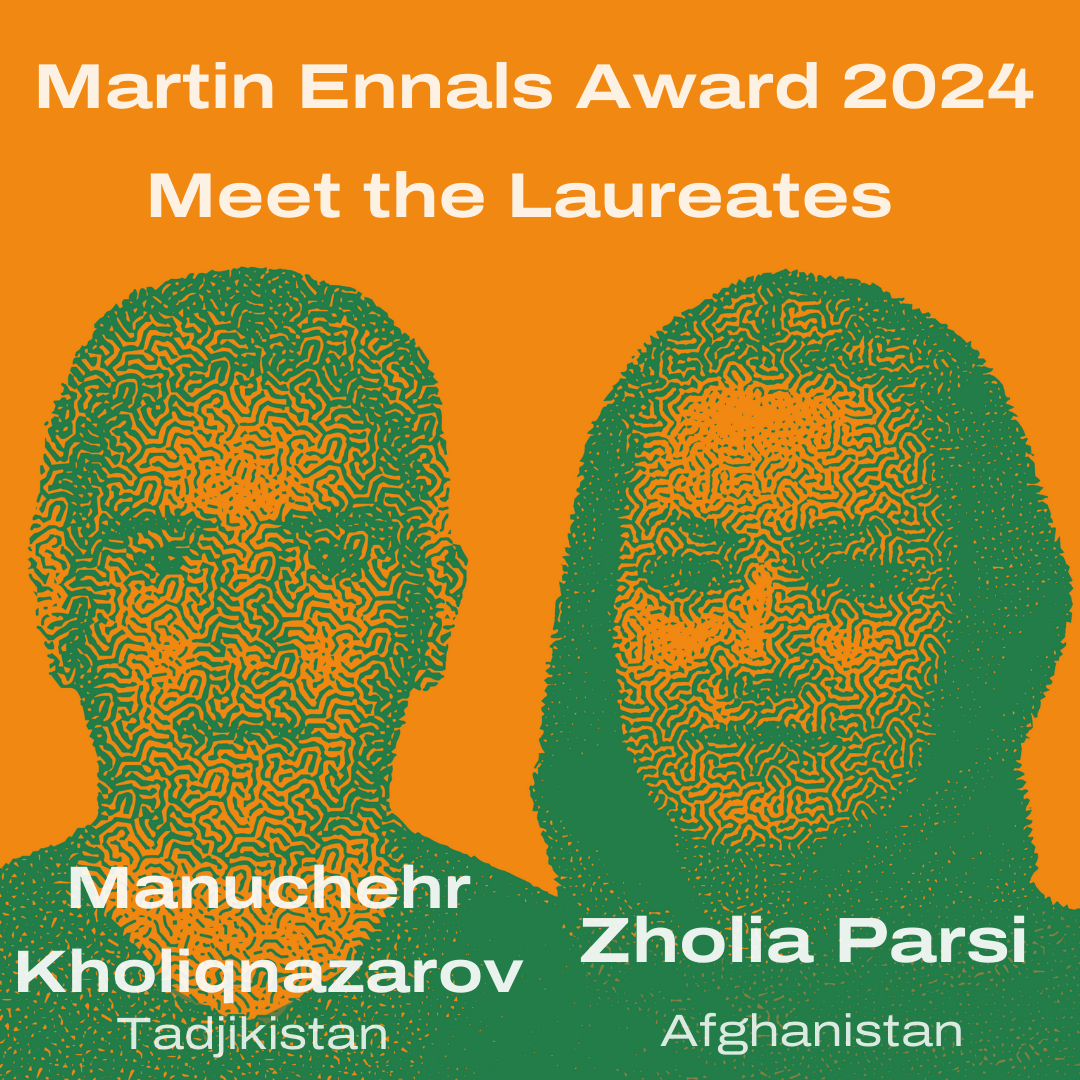
Two outstanding human rights defenders who have made it their life mission to protect human rights in Afghanistan and in Tajikistan will receive the Martin Ennals Award 2024 on November 21th, 2024, in Geneva, Switzerland, on the occasion of the 30th anniversary of the Martin Ennals Award.
The Jury of ten of the world’s leading human rights NGOs – Amnesty International, Human Rights Watch, FIDH, HURIDOCS, Bread for the World, Human Rights First, World Organisation Against Torture, International Commission of Jurists (ICJ), International Service for Human Rights (ISHR), and Front Line Defenders – has selected, after much deliberation, the two human rights defenders whom it strongly believes deserve to be recognized and honored in 2024, on the 30th anniversary of the Martin Ennals Award. [see also: https://www.trueheroesfilms.org/thedigest/awards/043F9D13-640A-412C-90E8-99952CA56DCE]
The two 2024 Laureates, Zholia Parsi (Afghanistan) and Manuchehr Kholiqnazarov (Tadjikistan) have shown exceptional courage and determination to bring human rights at the forefront despite evolving in deeply repressive environments.
“We are very proud to honor these two exceptional Laureates. They have paid too big a price for justice and equality to be respected in Afghanistan and Tajikistan and the international community must support their efforts instead of battling geostrategic interests in the region“. – Hans Thoolen, Chair of the Martin Ennals Award Jury
The two Laureates 2024:
Zholia Parsi: is a teacher from Kabul, Afghanistan. Having lost her career and seeing her daughters deprived of their education with Taliban takeover in August 2021, she founded the Spontaneous Movement of Afghan Women (SMAW) to protest the return of policies and practices against women rights and fundamental freedoms. She displayed remarkable leadership and resilience in organizing numerous public protests despite the risks involved. The grassroots movement that is the SMAW quickly grew momentum in Kabul and other provinces, now counting 180 members and having mobilized communities to resist the Taliban’s policies and practices. She was arrested in the street by armed Taliban in September 2023, and detained along with her son. She was released after three months of torture and ill-treatment under their custody, which further strengthened her resolve to resist Taliban oppression and repression.
Manuchehr Kholiqnazarov: is a Pamiri human rights lawyer from the Gorno-Badakhshan Autonomous Oblast (GBAO), Tajikistan. He is serving a 16 year-long prison sentence after what is widely considered an unfair trial in retaliation for his human rights work. As Director of the Lawyers’ Association of Pamir (LAP), he led strategic advocacy efforts in the GBAO, a region marked by its ethnic minority and historical tensions with the central government, including by lobbying for the incorporation of international human rights standards into domestic law and practice, and by providing legal support to residents of the GBAO. Through the human rights initiatives Commission 44 and Group 6, he played a key role in investigating the death of youth leader Gulbiddin Ziyobekov in November 2021, and the violent repression of subsequent mass protest in the regional capital Khorog. The investigation resulted in critical evidence of an unlawful killing, possibly an extrajudicial execution of the young man, and the unlawful use of force of security forces against protesters, resulting in two deaths, seventeen injured and hundreds detained. He was arrested on 28 May 2022 together with two other members of Commission 44 amid a widespread crackdown on local informal leadership and residents of the GBAO.
The Martin Ennals Award (MEA): 30 years alongside human rights defenders
The Martin Ennals Award (MEA) was given for the first time in 1994 to recognize, promote and protect human rights defenders at risk or from under-reported contexts. Over the years, the MEA has offered defenders a platform to issues that are of global concern and the means to steer the movement for human rights and larger freedoms. The MEA culminates every year in a public ceremony in Geneva, co-hosted with the City of Geneva (Ville de Genève). The 2024 MEA Ceremony will take place on November 21th, 2024 at the Salle communale de Plainpalais. The Ceremony, which is also livestreamed, draws many local and international human rights supporters to an inspiring event which celebrates the achievements and commitment of exceptional human rights defenders. “Geneva has a long tradition of hosting international diplomacy and promoting human rights and fundamental freedoms. The City of Geneva is proud to co-host the Martin Ennals Award and shed light, on this 30th anniversary, on the impressive resilience of two human rights defenders and the hope they bring for peace and equality” concludes Alfonso Gomez, Administrative Counselor of the City of Geneva.



 Hans Thoolen on Human Rights Defenders and their awards