This week, United Nations Human Rights bids farewell to Deputy High Commissioner Nada Al-Nashif. Al-Nashif began her UN career at United Nations Development Programme, where she worked from 1991 to 2006.[She was Assistant Director-General/Regional Director of the International Labour Organization’s Regional Office for Arab States from 2007 to 2014.
Nada Al-Nashif performed her job with great gusto and I was personally deeply impressed by her commitment to make the OCHCR work better with less means. She will be missed in Geneva.
UN High Commissioner for Human Right Volker Turk posted:
Dear Nada, my heartfelt thanks for your dedication, leadership, and generosity over the past six years. You helped ensure that we could continue to offer support and protection to people in need at a very challenging time. You will be greatly missed, and I wish you success and happiness in the next chapter.
“Art was my existence, my life. Without it, maybe I wouldn’t have survived,” said Kheder Abdulkarim, a Kurdish-Syrian artist based in Germany and former political prisoner, whose work is inspired by his experience of persecution and erasure. He received an honourable mention at the 4th edition of the International Contest for Minority Artists.
The Contest is an initiative organized jointly by UN Human Rights, Freemuse, Minority Rights Group and the City of Geneva. Since 2024, the contest is also supported by the Centre des Arts of the International School of Geneva, the Loterie Romande, as well as by other donors who prefer to remain anonymous.
Each year, the Contest celebrates minority artists whose work bears witness to struggles for dignity, justice and visibility, forming a cornerstone of UN Human Rights’ efforts to uplift artists as human rights defenders.
The 2025 theme — Belonging, Place and Loss — resonated profoundly with artists around the world whose identities have been shaped by displacement, environmental devastation, structural racism, and generational trauma, generating more than 240 submissions this year.
At the award ceremony, UN Deputy High Commissioner for Human Rights, Nada Al-Nashif, reminded the audience of what minority artists reveal to societies.
“Tonight, we celebrate eight minority artists honoured in this edition, the power of art and the vital contribution that minority artists make as they shine a light on human rights struggles across the globe, stories and images that unite and anchor us in a shared humanity,” she said.
Art can be a human rights language, and a catalyst for positive change in societies which may seek to silence minority voices. Claude Cahn, human rights officer at UN Human Rights’ Indigenous Peoples and Minorities Section
For many laureates, art is the only archive that survives war, the only place where memory can remain intact.
Alia Al-Saadi is a Palestinian Syrian dancer and choreographer born a third-generation refugee in Yarmouk Camp, and one of the laureates of the contest’s 4th edition.
Her performances turn the body into an “archive of destruction,” she said, and “a state of psychological numbness, where prolonged exposure to violence renders shock ineffective.”
Abubakar Moaz, a Sudanese visual artist based in Kenya, won honourable mention and said his visual language emerged from conflict in the Blue Nile and exile in Nairobi.
Abdulkarim, imprisoned for nearly six years in the infamous Saydnaya Prison in Damascus, began sculpting there with scraps of vegetable crates. “I lost seven years of my life,” he said. “But I try to produce something from those years, to rebuild them and more.”
Emanoel Saravá, an Afro-Indigenous Brazilian visual and photo-performance artist, winner of an honourable mention, treats water as an archive of Black and peripheral suffering through their project Águas Marginais.
“The waters carry the memory of Black and peripheral communities, but they also bear the scars of environmental racism, climate change and neglect,” Saravá said.
Sead Kazanxhiu, a Roma political artist from Albania and laureate of the 4th edition, rejects narratives that reduce Roma communities to victimhood.
“Today, I want to recognise the many human rights defenders who risk their lives around the world, and the courage and dedication of all my UN Human Rights staff,” said UN Human Rights Chief Volker Türk in his video message for World Humanitarian Day. “The sacrifice of our colleagues strengthens our resolve to continue their essential work.”
Twenty-two years ago, a devastating attack struck the United Nations headquarters at the Canal Hotel in Baghdad, Iraq. The bombing claimed the lives of 22 UN staff members and left more than a hundred others injured. It was a day that profoundly shook the humanitarian community and continues to resonate decades later.
In Geneva, Switzerland, colleagues, families, and friends gathered at the UN Human Rights headquarters to pay tribute — not only to those killed in Baghdad but to all humanitarian workers who have lost their lives in service across the globe.
Each year, 19 August is observed as World Humanitarian Day, a moment to recognize those who dedicate themselves to alleviating human suffering, and to remember the victims of humanitarian crises worldwide.
This year’s ceremony included a reading of the names of the 22 UN staff members who perished in the 2003 Baghdad attack, along with colleagues killed in Afghanistan, Haiti, and Rwanda, followed by a minute of silence. Flowers were later placed at the memorial to Sergio Vieira de Mello, the Secretary-General’s Special Representative for Iraq at the time, who also died in the bombing.
Nada Al-Nashif, the UN Deputy High Commissioner for Human Rights and a survivor of the Canal Hotel bombing, reflected on her experience when she was UNDP Country Director in Iraq during the commemoration in Geneva.
“We were caught up in a feverish excitement at the thought of what could be achieved, the endless possibilities of support, advice, assistance,” she said. “Even as we took daily risks and coped with the unrelenting pressure of delivering, we were sustained by a certain innocence — the belief that the big blue UN flag was our protection, its folds sufficiently strong to make us untouchable.”…
“Over two decades later, it is a humbling story of recovery that I am proud to tell; a journey of individual and collective resilience, a re-dedication to our cause, the cause of global justice and dignity, guided by an extraordinary commitment to service and the deep awareness that as humans, we are one.”
The event also highlighted the grave risks humanitarian workers face today, including targeted attacks that have led to deaths, injuries, abductions, and detentions. With 2024 marking the deadliest year on record for humanitarian personnel, concerns are growing that 2025 could prove even worse.
From Afghanistan to Sudan, from Gaza to Venezuela, humanitarian and human rights workers continue their missions under severe risks and limited access. With nearly 60 armed conflicts ongoing around the globe, the scale and complexity of crises are growing, and so are their human rights implications.
At the ceremony through prerecorded videos, staff from Haiti and Sudan remarked on the importance of humanitarian work.
Abdelgadir Mohammed, a Human Rights Analyst with UN Human Rights in Sudan, highlighted that the escalation of conflict in March and April 2025 has triggered a sharp rise in human rights violations, including ethnically targeted attacks and widespread sexual and gender-based violence, particularly in Darfur.
“I believe that human rights save lives,” he said. “I believe that human rights monitoring and reporting plays a critical role in protecting affected populations.”
Marie Sancia Dossier, a Protection Officer for UN Human Rights in Haiti, noted that as of 2025, nearly 85 percent of the capital’s metropolitan area is under the control of armed gangs, whose influence continues to expand across the country.
“Our motivation is an act of rebuilding and strengthening social cohesion, the rule of law and respect for human rights,” she said. “We are not only implementers. Together with institutions and civil society, we are co-builders of resilience, justice and social transformation. Our aim is to see a country where rights are respected, where institutions serve citizens, and where every person, regardless of their situation, can live in safety and dignity.”
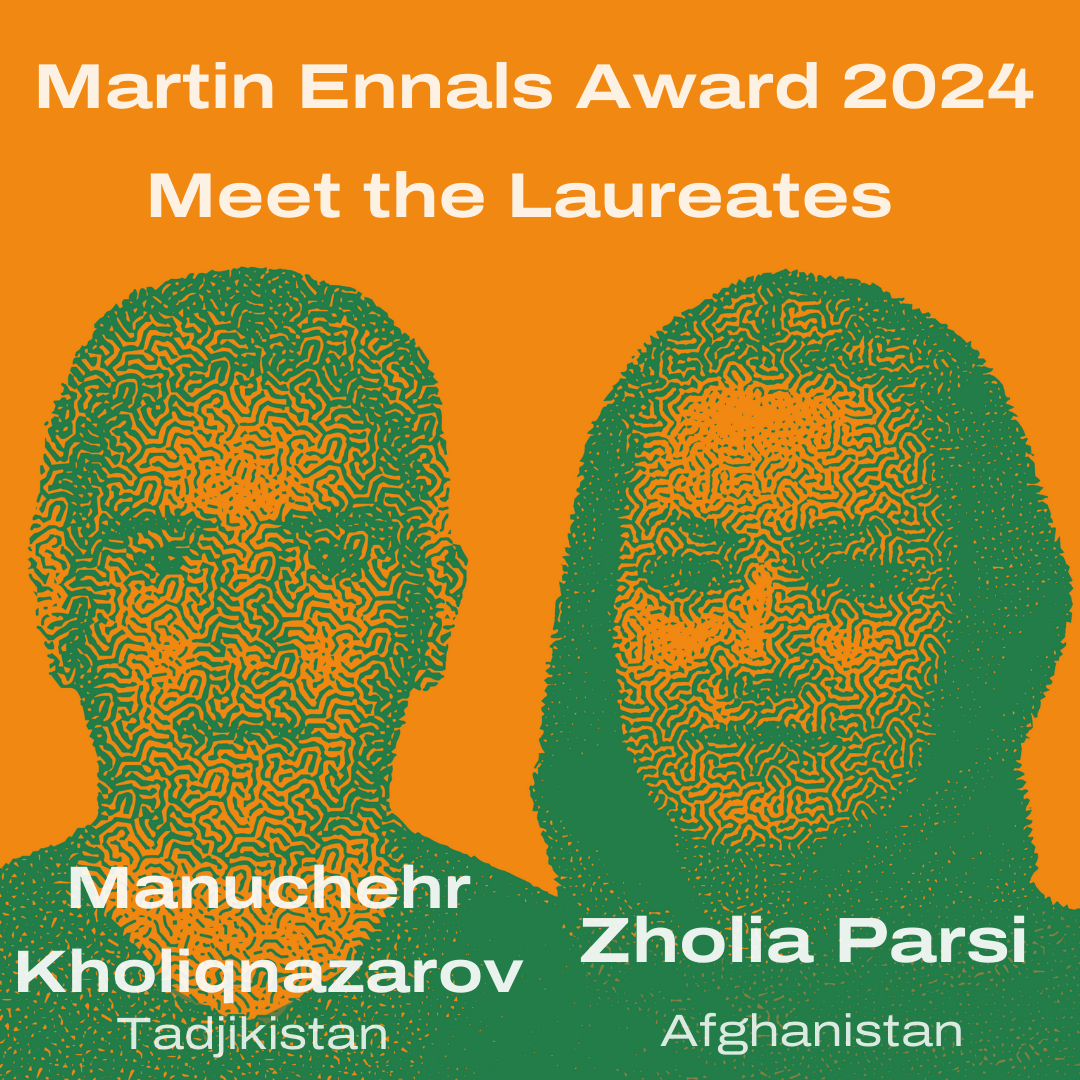
Two outstanding human rights defenders who have made it their life mission to protect human rights in Afghanistan and in Tajikistan will receive the Martin Ennals Award 2024 on November 21th, 2024, in Geneva, Switzerland, on the occasion of the 30th anniversary of the Martin Ennals Award.
The Jury of ten of the world’s leading human rights NGOs – Amnesty International, Human Rights Watch, FIDH, HURIDOCS, Bread for the World, Human Rights First, World Organisation Against Torture, International Commission of Jurists (ICJ), International Service for Human Rights (ISHR), and Front Line Defenders – has selected, after much deliberation, the two human rights defenders whom it strongly believes deserve to be recognized and honored in 2024, on the 30th anniversary of the Martin Ennals Award. [see also: https://www.trueheroesfilms.org/thedigest/awards/043F9D13-640A-412C-90E8-99952CA56DCE]
The two 2024 Laureates, Zholia Parsi (Afghanistan) and Manuchehr Kholiqnazarov (Tadjikistan) have shown exceptional courage and determination to bring human rights at the forefront despite evolving in deeply repressive environments.
“We are very proud to honor these two exceptional Laureates. They have paid too big a price for justice and equality to be respected in Afghanistan and Tajikistan and the international community must support their efforts instead of battling geostrategic interests in the region“. – Hans Thoolen, Chair of the Martin Ennals Award Jury
The two Laureates 2024:
Zholia Parsi: is a teacher from Kabul, Afghanistan. Having lost her career and seeing her daughters deprived of their education with Taliban takeover in August 2021, she founded the Spontaneous Movement of Afghan Women (SMAW) to protest the return of policies and practices against women rights and fundamental freedoms. She displayed remarkable leadership and resilience in organizing numerous public protests despite the risks involved. The grassroots movement that is the SMAW quickly grew momentum in Kabul and other provinces, now counting 180 members and having mobilized communities to resist the Taliban’s policies and practices. She was arrested in the street by armed Taliban in September 2023, and detained along with her son. She was released after three months of torture and ill-treatment under their custody, which further strengthened her resolve to resist Taliban oppression and repression.
Manuchehr Kholiqnazarov: is a Pamiri human rights lawyer from the Gorno-Badakhshan Autonomous Oblast (GBAO), Tajikistan. He is serving a 16 year-long prison sentence after what is widely considered an unfair trial in retaliation for his human rights work. As Director of the Lawyers’ Association of Pamir (LAP), he led strategic advocacy efforts in the GBAO, a region marked by its ethnic minority and historical tensions with the central government, including by lobbying for the incorporation of international human rights standards into domestic law and practice, and by providing legal support to residents of the GBAO. Through the human rights initiatives Commission 44 and Group 6, he played a key role in investigating the death of youth leader Gulbiddin Ziyobekov in November 2021, and the violent repression of subsequent mass protest in the regional capital Khorog. The investigation resulted in critical evidence of an unlawful killing, possibly an extrajudicial execution of the young man, and the unlawful use of force of security forces against protesters, resulting in two deaths, seventeen injured and hundreds detained. He was arrested on 28 May 2022 together with two other members of Commission 44 amid a widespread crackdown on local informal leadership and residents of the GBAO.
The Martin Ennals Award (MEA): 30 years alongside human rights defenders
The Martin Ennals Award (MEA) was given for the first time in 1994 to recognize, promote and protect human rights defenders at risk or from under-reported contexts. Over the years, the MEA has offered defenders a platform to issues that are of global concern and the means to steer the movement for human rights and larger freedoms. The MEA culminates every year in a public ceremony in Geneva, co-hosted with the City of Geneva (Ville de Genève). The 2024 MEA Ceremony will take place on November 21th, 2024 at the Salle communale de Plainpalais. The Ceremony, which is also livestreamed, draws many local and international human rights supporters to an inspiring event which celebrates the achievements and commitment of exceptional human rights defenders. “Geneva has a long tradition of hosting international diplomacy and promoting human rights and fundamental freedoms. The City of Geneva is proud to co-host the Martin Ennals Award and shed light, on this 30th anniversary, on the impressive resilience of two human rights defenders and the hope they bring for peace and equality” concludes Alfonso Gomez, Administrative Counselor of the City of Geneva.
On 30 November, 2020 DC Velocity reported that with $1.2 million in funding (with support from Laudes Foundation, Stardust Fund, The Ray and Dagmar Dolby Family Fund, UBS Optimus Foundation and Lisa Wolverton, President, Wolverton Foundation), the Freedom Fund has launched “Freedom Rising“, a program to identify, equip, empower and support women and survivors of modern slavery to become leaders of anti-slavery organizations in their communities and in the global movement.
Of the groups working to liberate people and end the conditions that lead to modern slavery, very few are led by women and survivors of slavery. The Freedom Fund, the largest global funder of frontline, anti-slavery organizations, believes that women and survivors should be at the center of the work to end modern slavery. Today,
“We know from our experience supporting frontline organizations that the most effective and sustained way to end modern slavery is to incorporate the experiences and the leadership of women and survivors,” said Nick Grono, CEO of The Freedom Fund. “Gender bias and systemic discrimination are factors that make women and girls particularly vulnerable to modern slavery in the first place. We must center our work around the leadership of women and survivors in order to address these underlying causes. We believe we can transform the face of the movement one leader at a time, and we must start now.”
The program is designed to support leaders through a personal learning journey that provides the skills and space for participants to experience, analyze and apply their learning. Not only must women and survivors work through their experiences of trauma and bias, they must also learn new approaches to leadership in a culture where their voices are chronically undervalued or dismissed.
Each cohort of 50 leaders will receive a minimum of 12 months of mentorship, leadership and technical skills training, before graduating to join the Freedom Rising alumni network. Due to COVID-19, the program has been adapted to provide online learning until the in-person training can be safely delivered.
“We invested in Freedom Rising because we believe that transformational change comes only when women are in leadership positions and in influential roles sharing power and exerting influence,” said Natasha Dolby, founder of Freedom Forward and board member of the Freedom Fund. “These women are the best positioned to understand, analyze and shape what needs to happen in their organizations and communities, and with the anti-slavery movement at-large. We’re aware that changing norms takes time, but we’re behind the Freedom Fund’s vision that we must start now, when multiple pandemics that impact women worldwide have converged.”
Freedom Rising differs from many other leadership programs in its explicit focus on building a stronger, more strategic, and more representative anti-slavery movement. After completing the year-long leadership training, participants will be formally introduced to the program’s alumni network, enabling them to continue to build and strengthen connections at the local, regional and international levels. The program will be piloted in Tamil Nadu in Southern India throughout 2021. Learnings from the pilot will be used to adapt and improve the program before its rollout. The curriculum will then be tailored to the specific needs and contexts of each training location, and delivered in local languages.
“Initiatives to support women’s leadership like this one are crucial, especially at this critical moment, as the world battles a global pandemic,” said Nada Al-Nashif, UN Deputy High Commissioner for Human Rights. “We know that putting women at the center, indeed ensuring women are at the helm, will help.
AFP reports from Geneva on 19 September how Belarus and several allies tried Friday to block a video message from opposition leader Svetlana Tikhanovskaya at the UN Human Rights Council, where she urged “the strongest” international response to Minsk’s abuses. Her short video message, in a rare urgent debate at the council, had barely begun before Belarus Ambassador Yuri Ambrazevich demanded it be switched off. He repeatedly interrupted the screening, raising procedural objections and insisting her words had “no relevance on the substance… on the events that are taking place today.”
Lukashenko, who has ruled the ex-Soviet state for 26 years and on Thursday warned of a possible “war” with some neighbouring countries, has turned to Russia for support.
“We have witnessed a brutal crackdown on peaceful protests,” said German ambassador Michael Freiherr von Ungern-Sternberg on behalf of the EU. He raised concerns at “reports of attacks on — and torture and cruel, inhumane or degrading treatment of — peaceful protesters as well as harassment, intimidation and detentions of opposition leaders.”
Minsk’s envoy Ambrazevich meanwhile slammed the “lopsided picture of reality presented by the losers in the election,” rejecting allegations of abuse by authorities. He insisted that protesters had been violent and had injured numerous police officers. Ambrazevich and his counterparts from Russia, Venezuela and China also voiced multiple objections to statements by the UN deputy rights chief Nada Al-Nashif and Anais Marin, the UN special rapporteur on the rights situation in Belarus, saying they had no place in the debate.
Marin told the council that more than 10,000 people had been “abusively arrested for taking part in peaceful protests”, and lamented that “over 500 cases of torture, committed by state agents, have been reported to us.” “I have been informed of allegations of rape, electrocution, and other forms of physical and psychological torture,” she told the council via video link, adding that the perpetrators appeared to be acting with “impunity“.
Friday’s debate ended with a vote approving a resolution submitted by the EU insisting that the vast array of serious abuses urgently require “independent investigation.”
The voting process was slowed down by Russia, which proposed 17 amendments to the text, all of which were rejected, and in the end the resolution was adopted unchanged by the 47-member council, with 23 in favour, 22 abstentions and only Venezuela and Eritrea voting against. The text calls on Belarusian authorities to “enable independent, transparent and impartial investigations into all allegations of human rights violations in the context of the election.” It also calls on Minsk to “guarantee access to justice and redress for victims as well as full accountability of the perpetrators.” And it calls on the office of UN rights chief Michelle Bachelet to closely monitor the situation in the country and to present her conclusions in a report during the next council session in March 2021.
The discussions mark only the sixth time in the council’s 14-year history that it has agreed to hold an “urgent debate” — a special debate within a regular session of the council.