“I’m the only girl of six siblings. And suddenly I lost five brothers between 2012 and 2014,” said Yasmine Al-Mashaan, a Syrian human rights defender and victim. “Before they were taken, they were around to love and protect me. I think it’s my duty to give them a little bit of their love and to fight for truth and justice for them and for everyone,” said Al-Mashaan, a former pharmaceutical assistant.
She spoke during an enhanced interactive dialogue on transitional justice at the 58th session of the Human Rights Council in Geneva, Switzerland, where UN Human Rights Chief Volker Türk presented a report on lessons learned and good practices related to transitional justice in the context of sustaining peace and sustainable development.
“In 2018, I co-founded, along with other families of forcibly disappeared persons, the Caesar Families Association, which brings together families who identified their loved ones among the victims in the photos smuggled out of Syria in 2013, known as the Caesar Photos,” Al-Mashaan said.
Her brother Oqba, one of her two disappeared brothers, was among the photos.
Türk emphasized that transitional justice tackles the demons of the past to build a better future.
“It grapples with difficult questions about truth and memory. It looks for justice, in all its complex and myriad forms,” he said. “And it helps to repair the institutional and social fabric of fractured societies. Above all, transitional justice is about victims, dignity and healing.”
According to the Office’s report, in the aftermath of a conflict or large-scale and serious human rights violations and abuses, States have an obligation to provide truth, justice, reparation and guarantees of non-repetition. The report showcases some 36 victim-centred, inclusive, and gender-responsive transitional justice efforts led by victim associations and grass-roots organizations from dozens of countries, from Colombia to Syria, and Chad to Timor Leste.
However, Türk said, the path to peace is never easy.
“Transitional justice is often held up and slowed down by political instrumentalization, discriminatory or selective design and focus, insufficient buy-in of affected populations, and weak State institutions,” he said.
Women and youth as a driving force
Türk said that civil society, including grass-roots organizations often led by women and youth, play a crucial role in overcoming these challenges.
Sofija Todorovic, Programme Director of Youth Initiative for Human Rights in Serbia, who also participated in the dialogue, believes the role of youth organizations in transitional justice is indispensable.
“These organizations ensure that the voices and perspectives of young people are integrated into the policies and strategies shaping their future,” she said. “In many cases, their mission extends to educating youth about the history that has been deliberately concealed from them.”
Todorovic’s determination was fuelled by the realization that her country had hidden the truth from her.
“My State and the institutions within my State didn’t give me the right to truth and to make informed conclusion about the past, but rather they forced only one side of the story of the past,” she said. “And I think that that it’s unfair.”
She emphasized the need to address intergenerational trauma in transitional justice efforts.
“Only people who have space to heal can be able to build functional democracy,” she said. “We need a political climate that will resolve the trauma, not exploit it.”
Both Todorovic and Al-Mashaan’s organizations exemplify the power of women’s leadership, resilience, and strategic action in advancing transitional justice despite significant obstacles.
Justice and peace
Leyner Palacios Asprilla, a Colombian human rights defender and former Truth Commission member currently leading the Unit for Victims of the Chocó Region, participated in the dialogue via video message. The situation in his region remains so critical that he couldn’t leave the victims he works with alone.
For Palacios Asprilla, UN Human Rights in Colombia has been instrumental in navigating the challenges of consolidating peace, protecting victims, and defending human rights.
“Today, the world cannot forget our country because we have not yet crossed the finish line or overcome the obstacles to reach a point of tranquillity,” he said. “Colombia is an example to the world in its commitment to consolidating peace. But the world must not forget that this task is not yet complete.”
Türk said that in this fragmented world, transitional justice is an essential and creative problem-solving approach. It must be grasped, nurtured and used to build durable peace.
Many countries, including Nepal, Syria, and Bangladesh, have enormous opportunity to move towards justice and peace, he said.
Key takeaways
In preparing the report, UN Human Rights organized consultations with 70 women and 70 men from more than 77 countries, including representatives of national entities implementing transitional justice measures, victims’ associations and civil society organizations, regional and international human rights protection systems, and transitional justice experts and practitioners.
The report identifies seven key lessons in advancing transitional justice:
Documenting human rights violations is essential for accountability and future justice.
Marginalized victims must be included, ensuring their experiences are recognized.
Victims’ associations play a crucial role in advocacy and justice efforts.
Immediate legal, medical, and psychological support helps victims navigate trauma.
International human rights mechanisms provide accountability when national justice fails.
Universal jurisdiction and international courts offer alternatives when domestic options are blocked.
Grassroots memory and memorialization preserve historical truth and prevent future atrocities.
The Council of Europe has adopted on 12 March 2025 the first-ever international treaty aiming to protect theprofession of lawyer. This is to respond to increasing reports of attacks on the practice of the profession, whether in the form of harassment, threats or attacks, or interference with the exercise of professional duties (for example, obstacles to access to clients).
Lawyers play a key role in upholding the rule of law and securing access to justice for all, including to vindicate possible human rights violations. Therefore, public confidence in justice systems also depends on the role played by lawyers.
The Council of Europe Convention for the Protection of the Profession of Lawyer covers lawyers and their professional associations, whose role is vital in defending lawyers’ rights and interests as a profession. The Convention addresses entitlement to practise, professional rights, freedom of expression, professional discipline and specific protective measures for lawyers and professional associations.
Under the Convention, states must ensure that lawyers can carry out their professional duties without being the target of any form of physical attack, threat, harassment or intimidation or any improper hindrance or interference. Where such circumstances could amount to a criminal offence, parties must conduct an effective investigation. Parties must also ensure that professional associations can operate as independent, self-governing bodies.
The Convention will be opened for signature on 13 May, on the occasion of the Council of Europe Foreign Affairs ministers’ meeting in Luxembourg.At least eight countries, including six member states of the Council of Europe, must ratify it for it to enter into force. Compliance with the Convention will be monitored by an expert group and a committee of the parties.
‘New technology provides human rights defenders with tools to organize, spread information, and reach people. At the same time, many experience digital surveillance, online violence, and harassment. It is important that these issues are discussed in the UN, and therefore, Norway is presenting a resolution in the UN Human Rights Council this spring’, says Foreign Minister Espen Barth Eide.
The resolution emphasizes that human rights are universal and apply in the same manner online as offline. It advocates for increased protection against digital threats and surveillance and ensures that new technology is not used to restrict freedom of expression, freedom of assembly, or the right to privacy. The resolution also highlights the need for dialogue with tech companies to discuss the challenges faced by human rights defenders in the digital space.
‘We want to gather broad support for the resolution and secure clear commitments from the international community to protect those who fight for our shared rights – also in the digital sphere’, says Eide.
Norway has a long tradition of advocating for the protection of human rights defenders. The new resolution is the result of close dialogue with civil society actors, technology experts, and other countries. The resolution will be presented and adopted at the UN this spring. Moving forward, Norway will work to gain as much international support as possible for the resolution’s important message.
CAHR announces details of the Sam Pegram Scholarship for the 2025/26 academic year
The Sam Pegram Scholarship provides one international student with full funding to pursue an LLM in International Human Rights Law and Practice offered by the York Law School and the Centre for Applied Human Rights.
Funding: Full tuition fee waiver, travel and visa costs, accommodation and living costs, and overseas placement.
Academic year: 2025/26
Open to: International (including EU) students
Qualification level: Postgraduate taught
Number available: 1
This is a full scholarship that covers tuition fees, accommodation, travel and visa costs, including an overseas placement to South Africa, and a monthly living stipend for one individual student.
The scholarship is generously provided by The Sam Pegram Humanitarian Foundation in memory of Sam Pegram, a caring, kind and talented young man who tragically died in the Ethiopian Airlines’ Boeing 737 Max crash, in 2019, en route to Nairobi.
After spending two years volunteering and working for humanitarian NGOs in Jordan, Sam came to the University of York to study the LLM in International Human Rights Law and Practice. After graduating, he secured a role as a research policy assistant for the Norwegian Refugee Council in Geneva, where he was working when he died.
Sam was a wonderful presence in the classroom. He was committed, thoughtful and reflexive in his fieldwork. He was deeply committed to humanitarianism, the rights of people on the move, and social justice in a broad sense. He remains deeply missed by his friends and family here at York, in Lancashire where he was from, and around the world.
Through this scholarship, others will have the opportunity to study on this course and make a positive difference for the rights of people on the move and human rights more generally.
Eligibility
Open to International (including EU) students only.
have applied to study on the LLM in International Human Rights Law and Practice at the University of York on a full-time basis
demonstrate that you have limited financial resources and that you need the scholarship to pursue your postgraduate studies
demonstrate a passion for human rights, either through your previous academic studies, professional work, or volunteer activities
have a demonstrable specific interest in migration issues, and that you wish to pursue or consolidate a career working on issues affecting people on the move, including generally and in relation to their social exclusion
have some lived experience of human rights challenges or migration issues.
How to apply
Apply online before the deadline on Saturday, 31st May 2025, 11.59pm BST
On 14 March 2025, IDRC announced that it is funding research to uphold fundamental democratic freedoms and address rising threats to peoples’ rights. The CAD4.13 million investment supports six projects across five regions:
Demonstrators in Kampala, Uganda, march in 2018 to draw attention to the murders, kidnappings and, activists claim, a lack of action by the police in response. Frederic Noy/Panos Pictures
The freedom to associate, participate in decision-making and express views is fundamental to democracy. Yet, in many countries around the world, these hard-won political and civil rights are being questioned and eroded through physical attacks, online intimidation, smear campaigns, digital surveillance and the lack of response from authorities when attacks occur. Legal and policy restrictions limit individual rights such as same-sex unions and reproductive health services while, increasingly, obstacles like funding bans and censorship are reducing the ability of people and organizations to contest these measures.
Research is needed to inform the strategies and actions of organizations, groups and movements that advocate for the respect for human rights. Research institutions, networks, and women’s rights and LGBTI+ organizations are leading IDRC-supported research to:
understand what drives the erosion of rights in each context
analyze the strategies used to counter these trends
explore how to strengthen rights defenders, for example through alliance-building and cross-movement solidarity
generate policy recommendations to safeguard rights
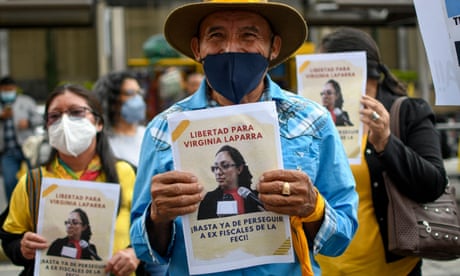
On 5 March 2025 Haroon Siddique in the Guardian wrote about Virginia Laparra, a Guatemalan anti-corruption prosecutor, who spent two years in prison after reporting her suspicion that a judge leaked sealed details of a case. She was forced into exile after being pursued by the country’s conservative elite.
Facing the prospect of going back to prison and further charges, Laparra left her two daughters behind to seek asylum across the border in Mexico.
In an interview with the Guardian in London after receiving the Alliance for Lawyers at Risk’s Sir Henry Brooke award honouring human rights defenders, Laparra said: “Nobody goes into exile voluntarily. Exile is the only thing left when nothing else has worked, it’s the only thing you’ve got left to defend your life and your freedom.
“Exile is just little bit different, a little bit less than death. [Your persecutors] take everything from you, take away your family, your children, your parents, your house, your way of life, your friends.’
Laparra headed a special prosecutor’s office working alongside the International Commission Against Impunity in Guatemala (Cicig), a UN anti-corruption mission that was controversially expelled in September 2019 by the then president, Jimmy Morales. Widespread reprisals followed against those who had worked with Cicig.
When Laparra was taken taken into preventive detention, she said it was as “if I were the worst drugs trafficker in Guatemala. When we drove out of the underground parking in my building there were soldiers, the police, hooded, with heavy weapons on both sides of the street. It was like in a film.”
She spent her first five months in solitary confinement in a windowless 2.5 sq meter cell in a high security jail in Guatemala City, 200 miles away from her Quetzaltenango home, and allowed out for only one hour a day.
She also endured bleeding to the womb in prison but waited months for treatment. Laparra eventually had a hysterectomy and four subsequent operations, during which she said police surrounded “the hospital, the gynaecology area, the operation room, and I had on each side of my bed a member of the police”.
She was later transferred to Matamoros prison, another notorious facility where drug traffickers and gang leaders are held, after she angered the authorities by speaking to a journalist. “My idea was that at least if I’m going to die [in jail], let’s make sure the world knows what happened,” said Laparra.
She considered pleading guilty in the hope that she might be released as both her sentences were commutable, which in Guatemala usually means no jail time is served, but her daughters told her: “Don’t do that, you’ve been here too long to give up now.”
When things reached their lowest ebb, Laparra said she decided to kill herself before remembering the promise she made to her daughters each time they visited – that she would be there the next time they came.
After her release on house arrest last year, she received an award from Guatemala’s current progressive president, Bernardo Arévalo, a surprise victor in the 2023 election. But Laparra believes the award only inflamed the pursuit of her by the public prosecutor’s office led by the attorney general, María Consuelo Porras, who had also tried to stop Arévalo from taking office.
Porras, who has pursued many other anti-corruption prosecutors and judges, also forced into exile her predecessor as attorney general and has been sanctioned by the US for corruption and the Council of the European Union for undermining democracy.
The Fund for Global Human Rights, which nominated Laparra for the Sir Henry Brooke award, and Amnesty International, which named her as a prisoner of conscience in 2022, said they were “deeply concerned about the systematic pattern of criminalisation imposed by the Guatemalan judiciary and the public prosecutor’s office against former judges, prosecutors, human rights defenders and journalists who have worked tirelessly for years to fight impunity and corruption in the country”.
Laparra says she feels proud to have received the award but adds that her persecutors reacted to the news with anger online. “I thought that it wasn’t possible to keep hate burning for so long,” she said. “Surely, two years in prison would have been enough for them, I thought, but it wasn’t.”
During the 58th regular session of the Human Rights Council, ISHR delivered a statement during the Interactive Dialogue with the Special Rapporteur on Human Rights Defenders affirming that human rights, peace and security are deeply interconnected, and the importance of the international system to human rights defenders.
The international system – to which many human rights defenders turn for justice, solidarity and accountability – is under attack.
Already weakened by double standards by States from all regions, human rights and the rule of law are being destroyed by a cabal of authoritarian leaders and unaccountable corporations. We thank the Special Rapporteur and other experts for their 27 February statement on this issue.
It was gratifying to see the rapid solidarity of many States with Ukraine following Friday’s White House confrontation with one such authoritarian. It is disheartening that the shortsighted response of many of those same States to the existential human rights funding crisis is to increase security spending by reducing development assistance. Human rights, peace and security are deeply interconnected.
Of course, no single State can fill the US gap or counter its influence, but a diverse group of States with a shared interest in universal rights and the rule of law must do so. Human rights defenders globally need your increased political and financial support, now. Our common interests are not served by lawlessness and raw power.
Madame Rapporteur, thank you for endorsing the Declaration on Human Rights Defenders +25. Read with the 1998 Declaration, it elaborates authoritative standards on the rights of defenders, and State and non-State actors’ obligations to respect and protect them.
Finally, alongside 196 organisations, ISHR calls on States to support a strong Norway-led resolution on human rights defenders and technology at this session.
Alan Lu for RFA on 5 March 2025 refers to a a new report which shows the extent of Beijing’s arbitrary detentions, with severe sentences for prisoners of conscience.
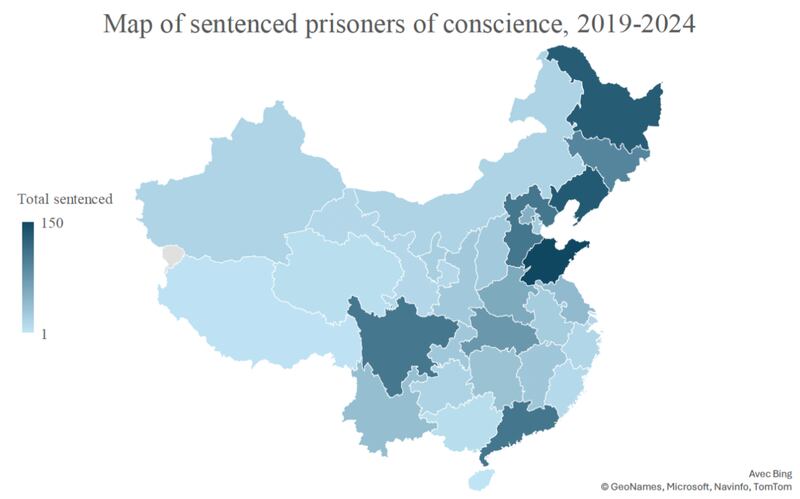
Chinese authorities have arbitrarily detained thousands of people for peacefully defending or exercising their rights over the past six years and convicted 1,545 prisoners of conscience, a rights group said on Wednesday.
Chinese Human Rights Defenders, or CHRD, a non-government organization of domestic and overseas Chinese rights activists, said the scope and scale of wrongful detention by Chinese authorities may constitute crimes against humanity.
“They were sentenced and imprisoned on charges that stem from laws that are not in conformity with the Chinese government’s domestic and international human rights obligations,” the group said in a report.
“Their cases proceeded through the full criminal justice system, with police, prosecutors, and courts arbitrarily depriving them of their liberty in violation of their human rights.”
Prisoners of conscience have faced severe penalties, with an average sentence of six years, increasing to seven for national security charges.
Three people, identified as Tashpolat Tiyip, Sattar Sawut and Yang Hengjun, were sentenced to death, while two, Rahile Dawut and Abdurazaq Sayim, received life sentences, the group said, adding that 48 were jailed for at least a decade.
Map of sentenced prisoners of conscience in mainland China, excluding Hong Kong and Macao. (CHRD)
Among the convicted, women activists and marginalized groups, including ethnic Tibetans and Uyghurs, were disproportionately represented among those wrongfully detained, the group said.
Out of all the prisoners of conscience aged 60 or older, two-thirds were women, it added.
“Human rights experts and international experts have raised that people over the age of 60 should generally not be held in custody due to the effects on their physical and mental health,” Angeli Datt, research consultant with CHRD, told journalists in a press briefing Wednesday.
“That two-thirds of them are women was really shocking to me,” she said.
“Worse still, the impunity Chinese government officials enjoy at home emboldens them to commit abuses abroad,” the group said.
China dismissed a Swiss report last month alleging that it pressures Tibetans and Uyghurs in Switzerland to spy on their communities.
‘Endangering national security’
The CHRD said that under Chinese leader Xi Jinping, the scope and scale of the use of arbitrary detention to silence critics and punish human rights personnel had grown.
The organization documented a total of 58 individuals known to have been convicted of “endangering national security.”
“The overall average prison sentence for a national security crime is 6.72 years, though this figure excludes those sentenced to death with a two-year reprieve or life imprisonment,” it said.
In Hong Kong, more people were convicted of “subversion” and “inciting subversion” — terms that the U.N. describes as “broad and imprecise, making them prone to misapplication and misuse.”
In one 2024 case, authorities convicted 45 people for participating in a primary election, an act fully protected under both domestic and international law. Subversion charges accounted for 37% of all prisoners of conscience sentenced in Hong Kong during this period.
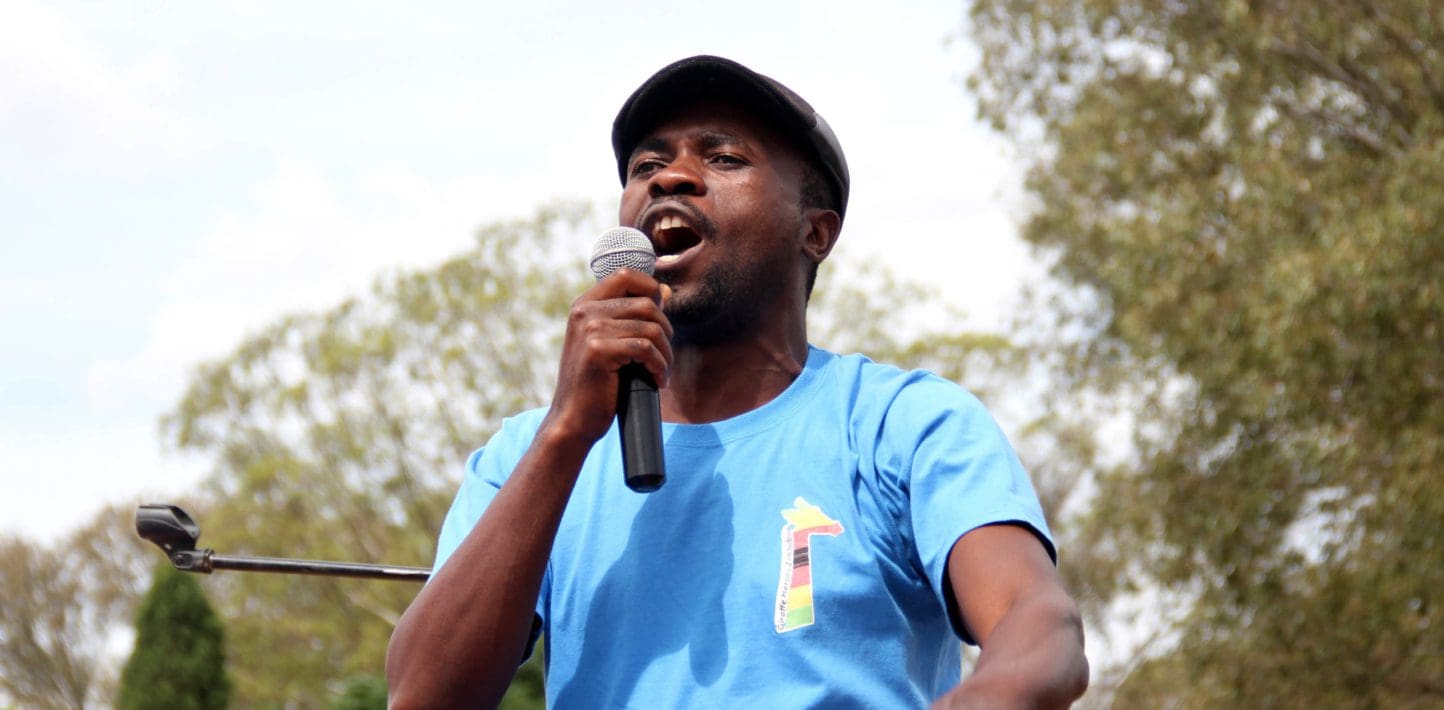
Ahead of the 10-year anniversary of the enforced disappearance of Zimbabwean journalist and pro-democracy activist Itai Peace Dzamara, Amnesty International 7 March 2025 called on authorities to urgently establish an independent, impartial and transparent investigation into his whereabouts.
Dzamara was a leader of the Occupy Africa Unity Square, a pro-democracy protest group. Two days before his enforced disappearance, Dzamara addressed an opposition rally where he called for mass action against Zimbabwe’s deteriorating economic conditions.
Immediately after Dzamara’s abduction, his wife filed a missing person report at Glen Norah Police Station in Harare. The next day, Zimbabwe Lawyers for Human Rights approached the High Court to try to force the state to expend all available resources to investigate and locate Dzamara.
The High Court of Zimbabwe ordered police and state security agents to search for Dzamara and report on their progress every two weeks. However, according to his lawyer, none of the security services have fully complied with the order. Police have reportedly not given any substantial information on the details of their supposed investigation when they submitted reports to the court, and have stopped submitting reports.
“Authorities have yet to conduct any credible inquiry into Itai Dzamara’s fate or whereabouts,” said Tigere Chagutah. “It is time for the authorities to stop pretending and get serious about finding Itai Dzamara and holding accountable whoever is suspected of responsibility for his enforced disappearance.” ..
Since Dzamara’s enforced disappearance, many other activists and human rights defenders in Zimbabwe have suffered harassment, intimidation or torture. In the last two years alone, at least ten opposition activists have been abducted.
Six people were abducted after disputed elections in 2023, including opposition activist and church leader Tapfumaneyi Masaya whose body was later found dumped on a farm. Others were allegedly tortured, some reported being injected with an unknown substance.
Last year, amid a massive crackdown on dissent opens in a new tab before a regional summit held in Harare, security agents pulled four activists off a plane and reportedly tortured them for up to eight hours.
Authorities have not conducted investigations into any of these cases.
“With the perpetrators of Itai Dzamara’s enforced disappearance enjoying complete impunity, it should be no surprise that similar human rights violations continue in Zimbabwe,” said Tigere Chagutah. “Zimbabwe’s government must protect human rights defenders, activists and opposition political parties to ensure they are able to do their work.”
One in four countries report backlash on women’s rights in 2024
Women’s and girls’ rights are facing unprecedented growing threats worldwide, from higher levels of discrimination to weaker legal protections, and less funding for programmes and institutions that support and protect women.
Despite important progress, only 87 countries have ever been led by a woman, and a woman or girl is killed every 10 minutes by a partner or member of her own family. Digital technology and artificial intelligence spread harmful stereotypes, while the digital gender gap limits women’s opportunities.
In the past decade, the world registered a disturbing 50 percent increase in the number of women and girls living in conflict, and women’s rights defenders confront daily harassment, personal attacks and even death. Recent global crises—like COVID-19, the climate emergency, soaring food and fuel prices—are only increasing the urgency to respond.
“UN Women is committed to ensuring that ALL Women and Girls, everywhere, can fully enjoy their rights and freedoms,” affirmed UN Women Executive Director Sima Bahous. “Complex challenges stand in the way of gender equality and women’s empowerment, but we remain steadfast, pushing forward with ambition and resolve. Women and girls are demanding change—and they deserve nothing less.”…
Today’s report also features the new Beijing+30 Action Agenda, a courageous roadmap to complete our unfinished business by focusing on:
A digital revolution for all women and girls: We must ensure equal access to technology, equip women and girls to lead in AI and digital innovation, and guarantee their online safety and privacy.
Freedom from poverty: Investments in comprehensive social protection, universal health coverage, education, and robust care services are needed for women and girls to thrive and can create millions of green and decent jobs.
Zero violence: Countries must adopt and implement legislation to end violence against women and girls, in all its forms, with well-resourced plans that include support for community-based organizations on the front lines of response and prevention.
Full and equal decision-making power: Temporary special measures like gender quotas have proven their effectiveness in rapidly increasing women’s participation.
Peace and security: Fully finance national plans on women, peace and security and gender-responsive humanitarian aid are essential. Frontline women’s organizations, so often the first responders to crisis, must receive dedicated, sustained funding to build lasting peace.
Climate justice: We must prioritize women’s and girls’ rights in climate adaptation, center their leadership and knowledge, and ensure they benefit from new green jobs.
Across these six Actions, putting young women and girls at the heart of our efforts is the best way to guarantee success, both today and tomorrow. These six plus one actions have the potential to unleash progress on women’s rights and put us back on track for 2030.
The Beijing+30 commemoration and the forthcoming UN Commission on the Status of Women (CSW69) are clear opportunities to enshrine this Action Agenda into national policies, regional strategies, and global agreements.
In a pivotal year for women and girls, that is also a year of pushback and crises like no other, let us push women’s rights forward to create a world where all women and girls enjoy equal rights and equal opportunities. We can be the first generation that can live in an equal world.
Ahead of International Women’s Day, Amnesty International’s Secretary General, Agnès Callamard, said:
“The significance of International Women’s Day 2025 cannot be overstated. It is no longer a case of addressing unfinished business on the gender justice front, but one of bracing ourselves to resist active regression and a mounting assault on our rights.
“Thirty years ago, 189 governments came together at the Fourth World Conference on Women to adopt the Beijing Declaration and Platform for Action, a groundbreaking blueprint for strengthening women’s rights endorsed by thousands of activists. Despite significant progress since then, the world has failed to fully deliver on all the promises. From rape and femicide to coercion, control and assaults on our reproductive rights, violence against women and girls still threatens their safety, happiness and very existence in a multitude of ways.
“And crucially, we are now going backwards. The aggressive patriarchal crusade led by President Trump and other powerful leaders against the rights and bodily autonomy of women and gender-diverse people has already had devasting consequences not just in the United States but all over the world. By dismantling domestic efforts to tackle gender-based, racial and other forms of discrimination, erasing recognition of transgender identity, and ending international funding for abortion counselling or referrals, the US administration is shamefully erasing years of hard-fought gains.
“Let us be clear, this trend has deeper roots than President Trump’s recent election. For several years now, brazen anti-rights movements have conspired to turn back the clock to an age when patriarchal oppression was the norm. We cannot afford to be complacent in the face of this gathering storm, for women, girls and LGBTQI+ people are under attack the world over.
“Amnesty International calls on states and non-state actors who believe in universal values and a rule-based international order to resist this accelerated and well-resourced attack against women’s rights. We call on them to strengthen protections of women, girls, LGBTQI+ people and other marginalized groups against gender-based violence. We urge them to recognize and support the vital work of all women human rights defenders and all those on the frontlines of the fight for sexual and reproductive rights, and to implement concrete measures to protect and empower them.
“We appeal to all to respect sexual and reproductive rights and prevent rollbacks, including by revoking any laws that criminalize or punish people for exercising these rights, as well as fully decriminalizing, providing and funding universal access to abortion.
“Finally, this International Women’s Day, Amnesty International reiterates its call on states to recognize gender apartheid under international law as a crime against humanity. Doing so would fill a major gap in the global legal framework and help to combat institutionalized and systematic domination and oppression on the basis of gender, no matter where it occurs.
“Despite suffering setbacks and facing countless attempts to block, divide and undermine us throughout history, feminist, LGBTI+ and grassroots movements keep marching forward. We may be walking a rocky path, but we will never stop fighting for a world where women, girls and gender-diverse people are free to enjoy the full range of human rights without discrimination or fear of reprisal.”
On 7 March 2025 SaferWorld carried a post “Still standing: The resilience of women peacebuilders in a time of crisis”
As we mark International Women’s Day 2025, women’s rights organisations (WROs) and frontline activists in crisis and conflict settings are standing strong despite immense challenges. ..Yet, while their work is more critical than ever, the harsh reality is that many are being forced to operate with dwindling resources, due to global funding cuts and shifting donor priorities towards militarisation, over a genuine investment in long-term peace, security and gender justice.
At a time when conflict, displacement and violence against women are escalating, and misogyny is a core pillar of the far-right agenda, these cuts will only deepen existing inequalities and undermine efforts to build sustainable peace and security globally. The reduction in funding for gender equality and Women, Peace and Security (WPS) initiatives threatens to reverse decades of progress and compounds the global rollback on women’s equality, safety and security. For example, cuts to the UK official development assistance (ODA) budget in 2021 led to a 30 per cent reduction in funding to programming with a focus on gender equality and to a 66% reduction in funding to WROs compared to 2017. WROs and women-led organisations – many of which are small community groups – often struggle to access direct, flexible and long-term funding, despite being the first responders in humanitarian crises and leading conflict prevention and peace efforts. When funding disappears, so do vital services, safe spaces for survivors of gender-based violence and conflict-related sexual violence, safe spaces for women peacebuilders to re-mobilise, legal aid for women and girls who have been displaced, and advocacy that ensures women’s voices are central in peace processes. But despite these constraints, WROs and women peacebuilders are still standing. Their resilience is evident in their ability to adapt, mobilise local resources and continue working in the most difficult circumstances. But resilience alone is not enough – they need meaningful and sustained support.
As the world commemorates International Women’s Day and gathers at the United Nations Commission on the Status of Women (CSW) to discuss gender equality and sustainable development, we reaffirm our commitment to ensuring that women and girls play a central role in peacebuilding and conflict prevention efforts around the world.
The international community, donors, funders and philanthropists will need to act urgently to ensure that WROs are not just surviving but thriving. This means:
Increasing direct, flexible and long-term funding and shifting power to local women-led organisations, women activists and women’s groups – we have seen the value in our work of providing sustained core funding to WROs, moving beyond short-term, project-based grants to ensure continuity of their critical efforts in conflict prevention, peacebuilding and humanitarian response. To make this shift meaningful, international organisations and donors should prioritise direct and flexible funding to frontline WROs rather than channelling resources through large intermediaries. This will ensure that funding reaches those who are best placed to drive lasting change within their communities.
Ensuring women’s leadership in conflict prevention, peace and humanitarian processes – women from all backgrounds and marginalised communities must have a seat at decision-making tables, not just as implementers but as equal partners in shaping policies and solutions that affect their lives.
Standing up for gender equality and women’s rights – urgently pushing back against reversals in women’s rights and gender equality, especially in fragile and conflict-affected contexts, where regressive policies and shrinking civic space are eroding hard-won gains. Women peacebuilders, human rights defenders and frontline activists are already standing up to these challenges, demanding that women’s voices remain central. Their leadership must be protected, amplified and meaningfully supported to sustain progress and counteract the global rollback on gender equality.
Protecting and supporting women human rights defenders and peacebuilding organisations – governments and international actors must recognise and safeguard the work of women human rights defenders and peacebuilding organisations in conflict zones, ensuring they can operate without fear of reprisals.
Strengthening accountability mechanisms – governments and multilateral bodies must hold themselves accountable to their commitments to the WPS agenda and support localisation of the UN Security Council Resolution 1325 on WPS.
Women’s rights organisations are the backbone of peace and resilience in crisis and conflict settings. This International Women’s Day, we celebrate their unwavering commitment – but celebration is not enough. The global community must act with urgency to fund, support and protect these organisations so they can continue to drive meaningful change.





 Hans Thoolen on Human Rights Defenders and their awards