Posts Tagged ‘women human rights defenders’

Front Line Defenders’ Global Analysis 2024/25

May 13, 2025

Resilience of Human Rights Defenders a Source of Hope Amid Global Rollback on Rights – At least 324 defenders killed in 32 countries for their peaceful work in 2024

Frontline Defenders

On 6 May 2025 Front Line Defenders Global Analysis 2024/25 was published giving a detailed panorama of the violations against HRDs at risk in 105 countries in all regions. Despite an increasingly hostile world with expanded threats to their work, human rights defenders (HRDs) everywhere demonstrated a remarkable level of resilience and determination as they resisted a global rollback on human rights, Front Line Defenders said as it launched its flagship report.

The report also reveals statistics gathered and verified by the HRD Memorial – which Front Line Defenders coordinates – documenting the killings of at least 324 HRDs in 32 countries in 2024. HRDs working on land rights, citizen’s rights and Indigenous peoples’ rights each made up almost a fifth of the total, and the countries with the highest number of killings documented were Colombia (157), Mexico (32), Guatemala (29), Palestine (22) and Brazil (15). (See pp. 6-13 for complete data.)

Year on year, hundreds of human rights defenders pay the ultimate price when they are killed for their work, having a devastating impact on their families and communities. It is a grim reflection of the immense danger faced by those who work peacefully to defend human rights,” said Alan Glasgow, Executive Director of Front Line Defenders.“Other threats and risks are manifold. Front Line Defenders’ analysis shows that women’s rights defenders globally and HRDs working in situations of conflict were among those most targeted for their work. It is a remarkable sign of these defenders’ courage that they continue their struggle despite such immense danger. They are the best among us, who fervently believe a better world is worth fighting for.”

Arbitrary arrest/detention was the most commonly reported violation against HRDs around the world, followed by threats/other harassment, legal action, death threats and surveillance. Women HRDs reported slightly higher levels of threats/other harassment compared to their male counterparts, while trans and non gender-conforming HRDs reported this as the most common violation they faced overall.

Criminalisation of HRDs remained rife with 107 charges filed in 75 cases. The most commonly cited charges were linked to defamation (23.4%); national security (19.6%); other criminal charges (12.1%); public order offences (11.2%); and terrorism-related charges (11.2%). In every region, governments and non-state actors turned to the judicial system to disrupt, stymie, stigmatise, bankrupt and imprison HRDs, regardless of the human rights they were defending. Counter-terrorism legislation and “Foreign Agent” laws were among those weaponised for use against HRDs.

According to Front Line Defenders data, defenders working on women’s rights were among the most targeted globally in 2024, ranking in the top three for all regions except one. This trend played out in numerous ways, with women human rights defenders (WHRDs) subjected to smear campaigns, criminalisation, arbitrary arrest and detention, as well as targeted with threats – including threats of sexual and gender-based violence.

WHRDs played key roles in protest movements seeking more just societies – for example in Bangladesh – faced stark discrimination in countries like Afghanistan and Iran, and shouldered heavy burdens in conflict and crisis situations, ranging from Gaza to Colombia, DRC, Myanmar, Sudan and Ukraine.

Dr. Mahrang Baloch, an outspoken WHRD from Pakistan’s Balochistan region, faced ongoing risks throughout the year, including travel bans, smear campaigns and arbitrary detention. At the time of publication she remains jailed in Quetta after being arbitrarily arrested for leading a peaceful protest. In a foreword provided to Front Line Defenders, she described why HRDs persist in their struggle:

We must continue to resist. Because human rights defenders are the ones standing on the frontlines, risking everything so that others may find their missing loved ones, so that everyone can go to school, so that the silenced can speak, so that women raped in refugee camps can find justice, so that those fighting alone in their homes, their villages, their cities can know they are not alone. We must stand with them, and we must stand together. Not for a nation. Not for a religion. Not for a race. But for humanity. Because if we do not, who will?

For last year’s, CF: https://humanrightsdefenders.blog/2024/05/22/front-line-defenders-launches-global-analysis-2023-24-on-human-rights-defenders/

For more information or to receive a full copy of the report, please contact:

Conor Fortune
Frontline Defenders
+353 85 802 0895
cfortune@frontlinedefenders.org

https://www.frontlinedefenders.org/en/resource-publication/global-analysis-202425
https://www.wric.com/business/press-releases/ein-presswire/808917521/remarkable-resilience-of-human-rights-defenders-a-source-of-hope-amid-global-rollback-on-rights/

Iran reform and the role of Human Rights Defenders

January 20, 2025

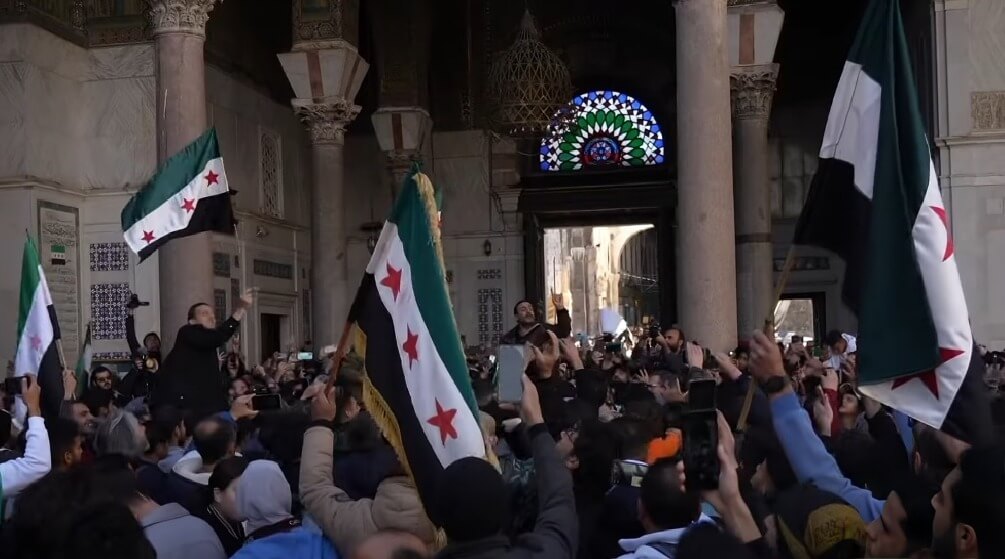
Historic examples in countries such as Portugal and Greece show how military defeats can catalyze democratic transitions by exposing the incompetence of authoritarian regimes. After the recent change in Syria, I thought that this piece with its focus on HRDs deserves wider attention:

The Stimson Center published this anonymously on January 9, 2025 as the author is a Tehran-based analyst who has requested anonymity out of legitimate concern. The writer is known to appropriate staff, has a track record of reliable analysis, and is in a position to provide an otherwise unavailable perspective.

While the world focuses on regional turmoil, Iran is undergoing significant transformation domestically, albeit at a slow pace.

At the heart of this evolution is a surprisingly robust society-based reform movement that is actively challenging the existing power structure, leading to a noticeable weakening of the regime. This emerging dynamic holds the potential to produce a system more representative of wishes of the Iranian population than the theocracy/flawed democracy in place for the past 46 years.

Fundamental reform of the existing constitution, along with empowering civil society, can lead to more democracy provided that Iranians do not get caught up in radical movements and wars. The implications of such changes could extend beyond Iran’s borders to neighboring Arab states. Historian Robert D. Kaplan has argued that Iran serves as the Middle East’s geopolitical pivot point, and that nothing could change the region as profoundly as the emergence of a more liberal regime in Iran.

Iranian people have paid a high price in pursuit of democracy. One metric is the number of political prisoners. While it is difficult to give an accurate estimate,  human rights organizations have estimated that hundreds of Iranians are being held on vague national security charges and denied due process. Conditions in Iranian prisons are abysmal, with reports of poor healthcare, abuse, and medical neglect. High-profile cases have drawn international condemnation, but the government shows little willingness to address these systematic abuses. The continued detention and mistreatment of political prisoners remains a major concern, reflecting the Islamic Republic’s intolerance of dissent and disregard for fundamental civil liberties.

Yet despite the repression, protests continue and at an accelerated pace. They include the “Bloody November” 2019 protests sparked by fuel price increases, the popular reaction to the U.S. assassination of Gen. Qassem Soleimani in January 2020 and the accidental Iranian downing of a Ukrainian passenger plane that followed, and the “Women, Life, Freedom” movement of 2022 against enforced veiling These developments, coupled with recent military defeats of Iran and its non-state partners, have dampened the Islamic Republic’s regional power while undercutting its domestic legitimacy, which had rested on electoral and ideological pillars.

Since the Hamas attack on Israel on October 7, 2023, and the devastating Israel response, the region has witnessed repeated and dramatic setbacks for Iran and its partners in Gaza, Lebanon and most recently in Syria.  Historic examples in countries such as Portugal and Greece show how military defeats can catalyze democratic transitions by exposing the incompetence of authoritarian regimes. In Iran, the ongoing erosion of both electoral and ideological legitimacy may compel the regime to seek a more democratic approach to governance.

The path toward society-based reform in Iran is centered on strengthening civil society. Other strategies – such as seeking change through foreign intervention as advocated by some in the diaspora – would not produce a better outcome.

The society-based reform movement in Iran encompasses various grassroots efforts aimed at addressing social, political, and economic issues. Reformists emphasize grassroots engagement and building connections with the public. Key aspects include empowering local communities, promoting decentralized decision-making, rebuilding trust between citizens and political entities, and encouraging participatory decision-making. The movement prioritizes social issues and adopts a long-term vision for sustainable development.

The challenges to change remain significant. The regime continues to arrest and otherwise repress activists and economic constraints limit participation. Many Iranians are disillusioned and society is fragmented by cultural barriers. Despite these obstacles, society-based reform aims to facilitate meaningful change by leveraging the strengths and voices of local communities.

The reform movement in Iran has deep historical roots, predating the Constitutional Revolution of 1905-1911, which created the first elected parliament in the Middle East. The oil nationalization movement in the early 1950s was another significant turning point, leading to widespread social mobilization and civil society involvement, including the emergence of political organizations, intellectual activism, popular protests, and women’s participation. While then Prime Minister Mohammad Mossadegh is often credited with initiating nationalization, his true achievement lay in strengthening civil society, establishing an independent Bar Association, labor unions, and implementing reforms that favored peasants and small businesses.

Mossadegh was deposed in 1953 in a CIA-led coup which restored the monarchy and led to severe repression of civil society. The Shah’s regime viewed civil society organizations as threats, leading to political repression, media censorship, and the targeting of student and labor movements. This suppression dismantled the civil society infrastructure, contributing to widespread discontent and ultimately the Iranian Revolution of 1979.

The theocracy ushered in a new era of repression but that eased following the election of reformist President Mohammad Khatami in 1997. Iran’s reform movement split at the time into two factions: society-centered intellectuals and a power-centered left within the regime. Differences in approach emerged during 2001 presidential elections as well as the 2009 Green Movement against the fraud-tainted re-election of then President Mahmoud Ahmadinejad.

Since the 2022 protests, however, reformists who once favored participating in elections and government have shifted toward embracing society-based efforts. Azar Mansouri of the Iran Reform Front noted this change, emphasizing the need for unity among reformists and the importance of community-centered reforms given government-imposed limits on reformist participation in officially sanctioned politics.  Former president Khatami and theorist Mahmoud Mir-Lohi have also highlighted that the movement is transitioning from an “election-centered” to a “society-centered” focus, aiming to reconnect with citizens and address societal needs.

This movement is characterized by a range of actors who include those working on:

  • Human Rights. Numerous organizations and activists, some with external links,are dedicated to promoting freedom of speech, press freedom, and the rights of minorities and marginalized groups as well as opposing arbitrary detention, torture, and the death penalty. The groups include HRANA, the Center for Human Rights in Iran and Defenders of Human Rights in Iran.
  • Women’s Rights. Women’s rights activists are at the forefront of the reform movement, challenging discriminatory laws and advocating for gender equality. Activists such as Nasrin Sotoudeh, Narges Mohammadi, Parvin Ardalan and Sepideh Gholian promote the right of women to choose whether to wear the hijab and have garnered significant attention and support both domestically and internationally. These activists have paid a high price for their beliefs and many are in prison serving long terms although Mohammadi, a 2023 Nobel peace prize laureate, was recently allowed home for a brief period after undergoing medical treatment.
  • Student Activism. Iranian students have a long history of political activism, often taking a leading role in protests and reform movements. Student organizations suchas the Independent Student Union advocate for educational reform, political freedom, and social justice.
  • Labor Movements. Workers’ rights groups have organized to demand better working conditions, fair wages, and labor protections. During the 2022 Women, Life, Freedom movement, 14 unions formed a coalition to push for new labor laws as part of a broader reform agenda. The Haft-Tappeh Sugar Cane Company union succeeded in ousting the director of the company, returning laid-off workers and encouraging formation of more independent unions.
  • Environmental Activism. Civil society groups are increasingly focused on environmental issues, advocating for sustainable development and government accountability regarding natural resource management and combating water scarcity and pollution.
  • Social Media and Digital Activism. Social media has empowered activists to organize, share information, and mobilize more effectively despite government attempts to suppress or filter access to the internet.

Various other initiatives promote civic awareness and participation. One such entity, www.karzar.net has initiated hundreds of big and small campaigns on a wide range of issues, most recently opposing a new law meant to enforce veiling.  In reaction to widespread public rejection of the law, the government of President Masoud Pezeshkian paused its implementation in December.

Despite facing significant challenges, the society-based reform movement remains a vital factor in Iran’s political landscape. The example set by the fall of the repressive Assad regime in Syria may embolden the Iranian public to demand reforms and increase international pressure on Iran to embrace democratic changes.

PACE’s Petra Bayr on ensuring protection of women human rights defenders

June 28, 2024

On 25 june 2024, when adopting a resolution today based on the report by Petra Bayr (Austria, SOC), PACE strongly condemned the frequent attacks perpetrated against women human rights defenders, and called for an end to impunity for perpetrators of violence.

The resolution emphasises that women human rights defenders – which include activists, NGO members, health workers, private sector actors, researchers, lawyers, students, teachers, artists, trade unionists, bloggers and journalists – act “in a peaceful and legal way to promote and protect human rights”. The Assembly deplores that they face attacks and specific threats, both on and offline, and are often victims of intersecting forms of discrimination

In this context, PACE called on member States to “repeal laws, policies and practices that affect women human rights defenders, in all their diversity, and unduly restrict their activities”. It also recommended guaranteeing their protection, by ensuring a secure and enabling environment in which to carry out their activities, and prosecuting the perpetrators of attacks and threats, including members of police forces.

Finally, PACE called on national parliaments to support women human rights defenders through practical actions and the introduction of new policies.

https://pace.coe.int/en/news/9529/ensuring-protection-of-women-human-rights-defenders

Report of the Special Rapporteur on the situation of women human rights defenders in conflict, post-conflict and crisis-affected settings

August 17, 2023

In the present report to the General Assembly [A/78/131, dated 7 July 2023], the Special Rapporteur on the situation of human rights defenders, Mary Lawlor, analyses the situation of women human rights defenders working in conflict, post-conflict and crisis-affected settings and highlights their contributions to peace and security, despite the often difficult and even hostile environments in which they work. The report contains examples of individual cases of women human rights defenders working in these contexts, as well as recommendations to States and other relevant stakeholders on providing a safe and enabling environment in which to carry out their legitimate human rights work.

In a submission for the present report, April Dyan Gumanao of Alliance of Concerned Teachers in the Philippines noted that “we work on the premise that, to achieve sustainable peace, there should be food on tables, decent work and opportunities, equality, respect for human rights and justice”.

Front Line Defenders just published its global analysis 2022: new record of over 400 killings in one year

April 4, 2023

Front Line Defenders launched its Global Analysis 2022 on the situation of human rights defenders (HRDs) at risk around the world, an in-depth annual publication detailing the variety of risks, threats and attacks faced by HRDs around the world. Front Line Defenders’ Global Analysis 2022 gives a panorama of the threats faced by HRDs in all regions of the world. Despite an assault on human rights and the rule of law in many countries, human rights defenders (HRDs) showed remarkable courage and persistence in advocating for more democratic, just and inclusive societies in 2022. [see also https://humanrightsdefenders.blog/2022/01/17/at-least-78-human-rights-defenders-killed-in-colombia-in-2021/]

The report also names 401 HRDs killed in 26 countries in 2022 compared to 358 HRDs killed in 35 countries in 2021 – based on statistics by the HRD Memorial, a collective initiative of human rights organisations working to collect and verify data on the killings of HRDs each year.

“In a grim milestone, for the first time we saw more than 400 targeted killings of human rights defenders in 2022. While Latin America remained the deadliest region in the world for human rights defenders, we also saw a more dangerous landscape for defenders in the context of Russia’s full-scale invasion of Ukraine,” said Olive Moore, Interim Director of Front Line Defenders. ”These human rights defenders were deliberately targeted and killed because of their human rights work. Because they choose to speak out and challenge injustice, they paid for it with their lives.”

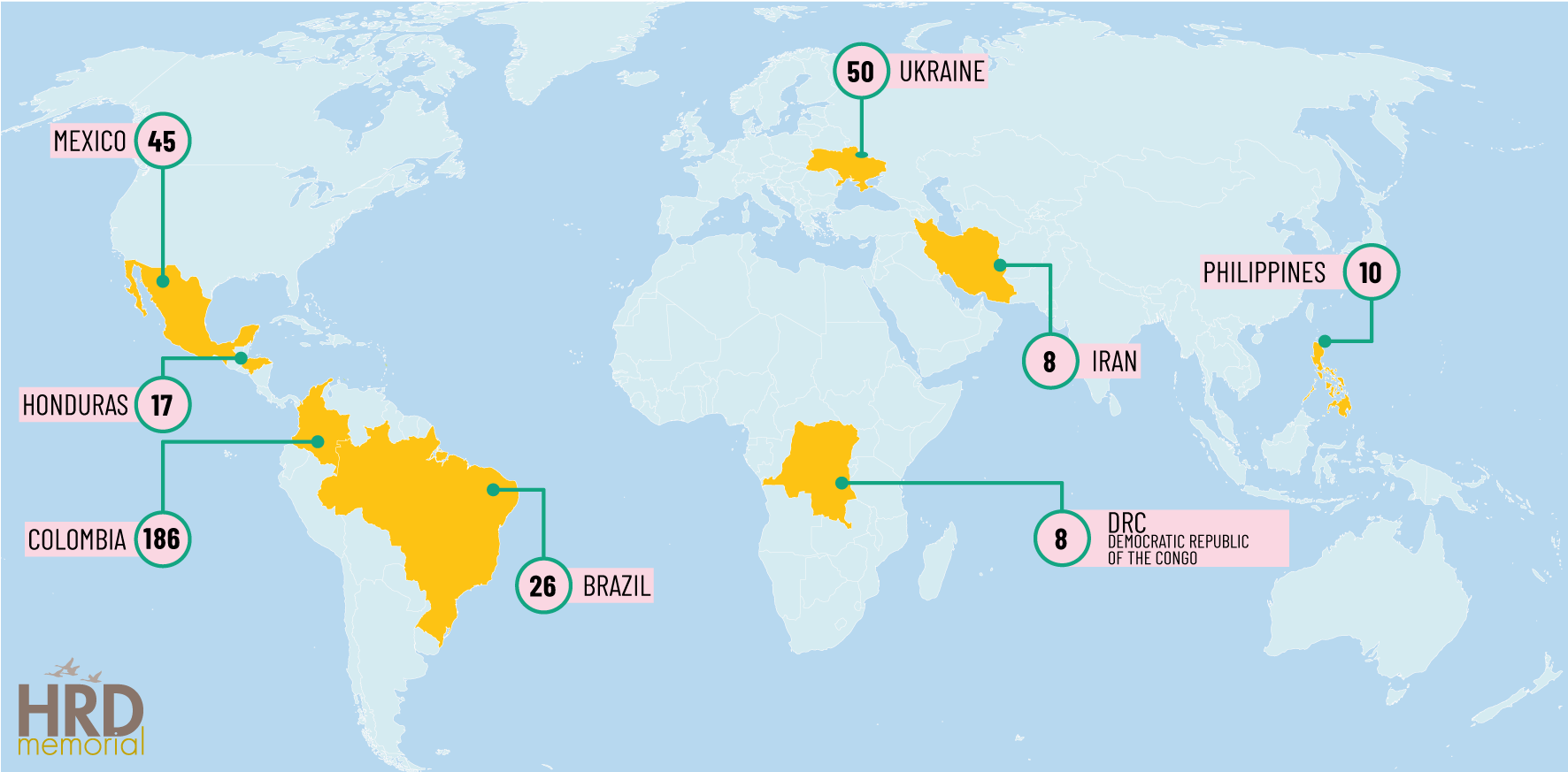
Five countries – Colombia, Ukraine, Mexico, Brazil and Honduras – accounted for over 80% of killings, according to HRD Memorial data. Colombia alone accounted for 46% of the total, with at least 186 killings documented and verified by HRD Memorial partner Somos Defensores to date. Defenders working on land, indigenous peoples’ and environmental rights were the most frequently targeted sector, accounting for almost half (48%) of the total killings.

In the context of Russia’s full-scale invasion of Ukraine, defenders engaged on humanitarian response and human rights journalists were also specifically targeted, with at least 50 documented killings by Russian military forces.

Wide array of threats

Global Analysis 2022 data is based on more than 1,500 threats and violations reported to Front Line Defenders, and is disaggregated by region, type of threat, sector of human rights work and gender.

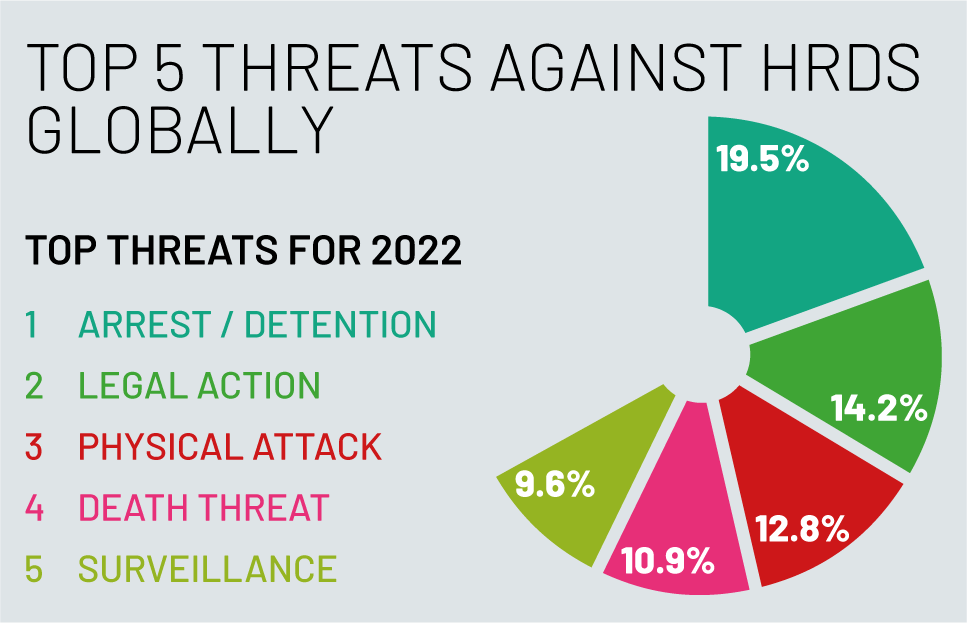
The main threats HRDs reported to Front Line Defenders in 2022 included: arrest or detention (19.5%); legal action (14.2%); physical attack (12.8%); death threats (10.9%); and surveillance (9.6%). In Asia and the Americas, death threats were the most frequent violation against defenders; in Africa it was arrest and detention; while in ECA and MENA it was legal action against HRDs.

Women HRDs (WHRDs) were frequently targeted with death threats, which accounted for the third most common violation against them. Physical violence was the most prevalent violation reported by trans and gender variant/gender nonconforming HRDs.

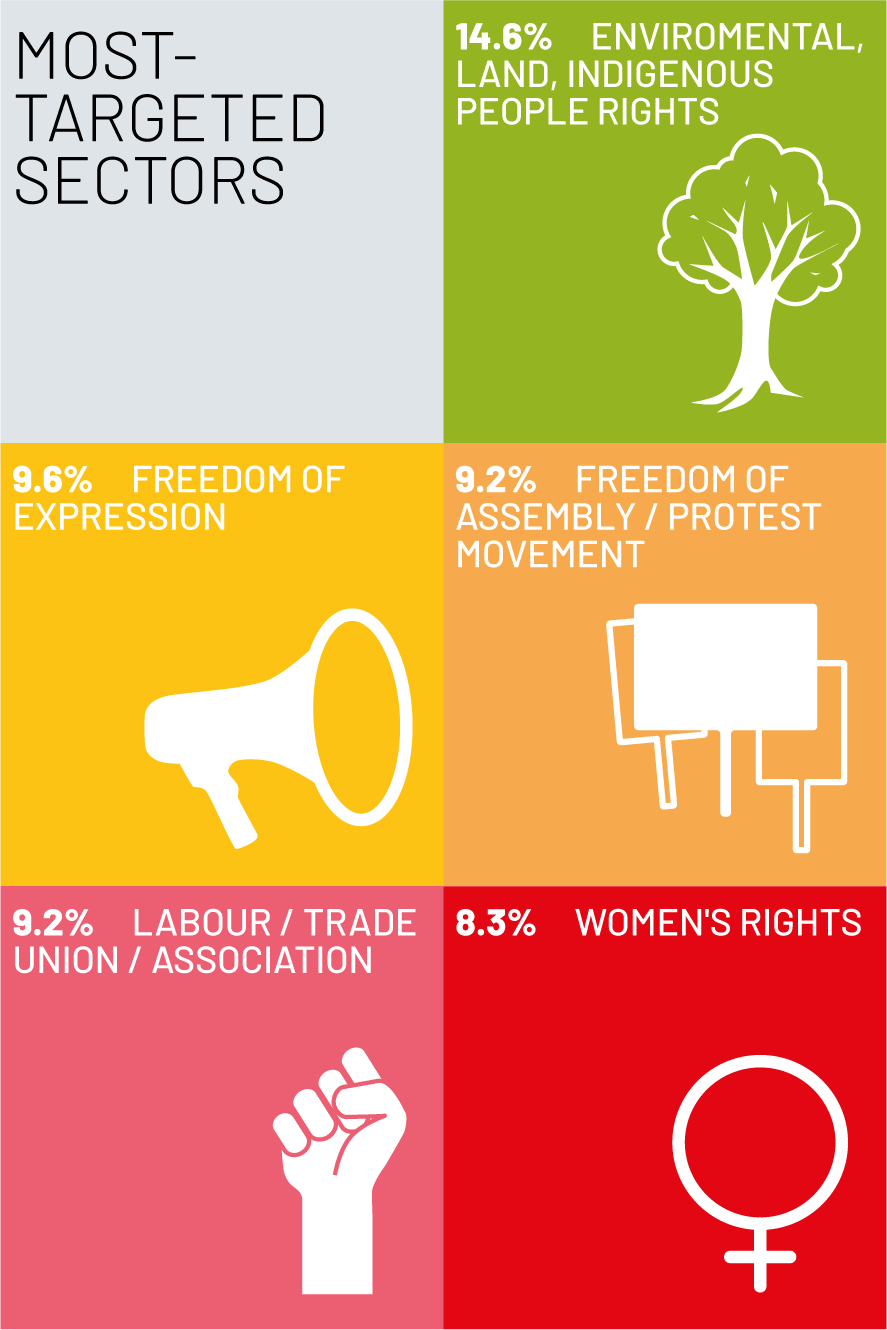
The five most targeted sectors of human rights defence were: environmental, land and indigenous peoples’ rights (11%); freedom of expression (10%); protest movement/ freedom of assembly (9%); women’s rights (7%); and impunity and access to justice (6%).

________________________________________________________________________________________________________________________________

About the data on killings: Front Line Defenders manages the collection of partner-verified data-sets under the HRD Memorial umbrella. The partners in the HRD Memorial are: ACI-Participa (Honduras); Amnesty International; Comité Cerezo (Mexico); FIDH; Front Line Defenders; Global Witness; Human Rights Defenders’ Alert – India; Karapatan (the Philippines); OMCT; El Programa Somos Defensores (Colombia); Red TDT (Mexico); and UDEFEGUA (Guatemala).

About the data on other violations against HRDs: This is derived from 1,583 reported threats and violations, based on Front Line Defenders’ urgent actions and approved grants between 1 January and 31 December 2022. For more details, see the Methodology section of the report.

for last year’s report, see: https://www.frontlinedefenders.org/en/resource-publication/global-analysis-2021-0

Download the Global Analysis 2022

https://www.theguardian.com/world/2023/apr/04/colombia-human-rights-defenders-killings-2022

Women human rights defenders from Iran and Pakistan explain why women resisting are a force to be reckoned with.

March 13, 2023

Azin Mohajerin and Hina Jilal at OMCT’s offices on International Women’s Day, 8 March 2023. (Geneva Solutions/Michelle Langrand)

Michelle Langrand in Geneva Solutions of 10 March 2023 speaks with two human rights defenders, from Iran and Pakistan.

Iran’s crackdown on women’s rights protests that erupted in September and the Taliban recently banning women from working in NGOs or from attending university have served as a reminder of how fast women’s rights are sliding back in the region and other parts of the world. But despite widespread arrests, allegations of torture and the execution of four protesters in Iran, the women-led movement refuses to back down. For Azin Mohajerin, 36, it means that change is a little more within grasp. Mohajerin left Iran in 2010, following the wave of post-electoral protests that swept the country.

This time around she is supporting rights campaigners in the country, specifically from minority groups, through Miaan, an NGO in Texas she co-founded in 2019 and where she works as senior human rights officer.

Hina Jilani, an advocate of Pakistan’s Supreme Court and president of the World Organisation Against Torture (OMCT), who fought against sharia laws in Pakistan back in the 80s, views it as another illustration of women’s resistance on the path to obtaining change.

Mohajerin and Jilani were in Geneva for international women’s day for an event organised by OMCT. Geneva Solutions spoke to the activists about the challenges women face in their countries and the lessons they can draw from each other.

Born in Lahore, the capital of Pakistan’s Punjab region, Hina Jilani grew up hearing about courtrooms and prisons. At that time, Pakistan was under martial law and her father’s political opposition would often land him into trouble. Rather than being traumatised, Jilani was empowered by the environment in which she was raised. Later in life as a lawyer, her work would also land her in those same courtrooms and prisons. Jilani passed the bar exam in 1977, the same year Sharia law was imposed on Pakistan. One of the new laws made adultery a crime against the state. See also: https://www.trueheroesfilms.org/thedigest/laureates/705AB196-BD5E-4EC2-B6C1-96AC5DDB353E .“While now Pakistan has a fit and reasonably good, protective legal framework for women, we have not gotten rid of the notorious practices like child marriage or honour killings. Gender-based violence is one of our biggest issues in Pakistan,” she pointed out. Pakistan reported around 63,000 cases of gender-based violence in the past three years according to Pakistan’s National Commission of Human Rights.

In Iran, the women-led movement for the freedom to choose what they wear and what to do with their bodies has been shaking the country for the past few months. But observers are cautious about the chances of the current uprising spurring real change in Iran as previous ones have failed to do so. Mohajerin, who cannot return to her country because of the sensitive nature of her work, sees it as one more step in the long path towards the respect of human rights.

The protests in Iran have brought out Iran’s ethnic minorities to march along with the Persian majority. Mahsa Amini, whose death in custody of the morality police last September triggered mass unrest, was a 22-year-old Kurdish woman from Saqqez, in the Kurdistan province of Iran.

Mohajerin, who works with minority groups in Iran, sees that cultural change has seeped into some of the most conservative communities. “Women in Balochistan bravely went to the street in one of the rare moments that they have spoken up about their rights,” said Mohajerin.“There is a recognition that there is a gap that needs to be filled in terms of ethnic equality and gender equality.”

But Iran has also come down hard on these groups. “After Tehran, the top places in terms of arrests were minority populated areas: the Kurdish area, the Turkic and then Balochistan,” said Mohajerin. Many of them remain behind bars, she said.

Culture can help people to break the chains,” said Jilani. “Not everything is because of what the leadership or the ruling elite do. Unfortunately, the ruling elite act in a certain manner because that is the national psyche.”

Mohajerin noted that Iranians have been fighting for their freedom for a long time now. “It’s not a new movement, it is not something that started in September or even last year. It has been a long-lasting fight,” said Mohajerin.

She recalled when women first marched against the mandatory hijab after it was introduced by the Islamic revolution in Iran 44 years ago. “In Iran, the woman cannot have custody of the child after a certain age and they don’t have the right to divorce. But they do not just give up and say okay, this is how we should live. They’ve been fighting to get their rights and finding loopholes in the system,” she said.

“The cultural change that has been achieved during the past decades is way more significant than the law that exists,” said Mohajerin.

The situation in Iran has drawn international outcry, with western powers condemning Iran’s violent response to the protests. Like many activists, Jilani and Mohajerin see international solidarity as essential to their causes.

Voices from the outside can help when the environment inside the country is very difficult,” said Jilani. “I’m alive today because of international public opinion and the pressure of the international community,” said Jilani. She recalls former US president Jimmy Carter and former president of Ireland Mary Robinson pleading for her release from prison at one time. So many world leaders sent letters to Pakistan, protesting against my incarceration, that when they released me they showed me this thick file and said we don’t know why people around the world are so worried about you.”

When Iranian foreign minister Hossein Amir-Abdollahian was in Geneva last week to speak before the Human Rights Council, campaigners called for diplomats to stage a walkout during his speech. Mohajerin recognised it as a “significant symbolic gesture to condemn the human rights abuses in Iran”. “However, it is crucial for the international community to engage in dialogue with the Iranian government regarding human rights violations, particularly in cases of executions, at the highest level,” she added.

But both Jilani and Mohajerin are adamant about something: change has to come from within. “The voice should come from the people inside the country. They are the ones who live in the country, and they are the ones who have to decide for their future,” said Mohajerin, noting that views within her country are not a monolith.

https://genevasolutions.news/human-rights/one-step-forward-is-more-important-than-two-steps-back-pushing-for-women-s-rights-in-iran-and-pakistan

2022 Women of Courage awards announced by USA State Department

March 18, 2022

On Monday, 14 March, 2022 Secretary of State, Antony J. Blinken, hosted the annual International Women of Courage (IWOC) Awards in a virtual ceremony at the U.S. Department of State. The 2022 IWOC Award ceremony honours a group of twelve extraordinary women from around the world.  The First Lady of the United States, Dr. Jill Biden, delivered remarks in recognition of the courageous accomplishments of this year’s IWOC awardees. For more on this award and its laureates, see: https://www.trueheroesfilms.org/thedigest/awards/A386E593-5BB7-12E8-0528-AAF11BE46695

Out of an abundance of caution due to the COVID-19 pandemic, and in order to practice safe social distancing, the ceremony was live streamed on www.state.gov.

Now in its 16th year, the Secretary of State’s IWOC Award recognizes women from around the globe who have demonstrated exceptional courage, strength, and leadership in advocating for peace, justice, human rights, gender equity and equality, and the empowerment of women and girls, in all their diversity – often at great personal risk and sacrifice.  U.S. diplomatic missions overseas nominate one woman of courage from their respective host countries and finalists are selected and approved by senior Department officials.  Following the virtual IWOC ceremony, the awardees will participate in an International Visitor Leadership Program (IVLP) Virtual exchange to connect with their American counterparts and strengthen the global network of women leaders.  The 2022 awardees are:

Rizwana Hasan – Bangladesh [see: https://www.trueheroesfilms.org/thedigest/laureates/48B5C07A-458C-4771-97F9-FAD0CA89F478]

Simone Sibilio do Nascimento – Brazil

Ei Thinzar Maung – Burma

Josefina Klinger Zúñiga – Colombia

Taif Sami Mohammed – Iraq

Facia Boyenoh Harris – Liberia

Najla Mangoush – Libya

Doina Gherman – Moldova

Bhumika Shrestha – Nepal

Carmen Gheorghe – Romania

Roegchanda Pascoe – South Africa

Phạm Đoan Trang – Vietnam Vietnam’s official reaction: https://www.reuters.com/world/asia-pacific/vietnam-irked-by-unsuitable-us-prize-jailed-dissident-2022-03-17/

See also: https://humanrightsdefenders.blog/2021/03/09/state-department-hands-out-21-international-women-of-courage-awards-2021/

https://www.state.gov/2022-international-women-of-courage-award-recipients-announced/

Women human rights defenders in conflict and post-conflict situations; side event 8 March

March 2, 2022

Women human rights defenders are crucial agents and leaders of change. However, due to their gender, they face particular obstacles and security risks. What are these gendered obstacles and risks? How can women human rights defenders best be supported and protected by States and other actors?
ISHR, the Ministry for Foreign Affairs of Finland and the Permanent Mission of Norway invite you to join a virtual event on the side of the Human Rights Council’s 49th session: 
Supporting women human rights defenders in conflict and post-conflict situations” takes place on Tuesday 8 March 2022 11:30am – 12:30pm (CET)
See also: https://humanrightsdefenders.blog/2020/08/03/roadmap-to-women-peace-and-security-wps-agenda-2020/

Opening statement:  Pekka Haavisto, Minister for Foreign Affairs, Finland

Panellists: 

Mary Lawlor, UN Special Rapporteur on the Situation of Human Rights Defenders

Ilwad Elman, Director of Program & Development, Elman Peace & Human Rights Centre [see also: https://humanrightsdefenders.blog/2020/09/17/fartuun-adan-and-ilwad-elman-from-somalia-named-2020-aurora-prize-winners/]

Horia Mosadiq, Human rights activist and Executive Director, Conflict Analysis Network (CAN)

Pooja Patel, Programme Director, International Service for Human Rights

Moderation:  Heidi Hautala, Vice-President, Member of Parliament, European Parliament.

Download the flyer here and click here to join the event.

More about the contributions of women human rights defenders to peace and security: ISHR report.

See also: https://www.trueheroesfilms.com/themes/

https://mailchi.mp/ishr/749qlxejj6-33413?e=d1945ebb90

FIFDH dedicates its 20th edition to Pham Doan Trang and Ida Leblanc

February 15, 2022

The Geneva Human Rights Film Festival of 2020 (FIFDH – The Festival) dedicates its 20th edition to human rights defenders Pham Doan Trang and Ida Leblanc

Journalist and blogger Pham Doan Trang has been in detention since October 2020 and was recently sentenced to 9 years in prison for “propaganda against the state”. The 43-year-old was accused by the Hanoi regime of “defaming the Vietnamese government and inventing fake news“. In one of the world’s most repressive countries towards civil society, where freedom of the press is non-existent, Pham Doan Trang – RSF 2019 Prize – has founded numerous independent media and publishing houses – including Nha Xuat Ban Tu Do or Law Magazine – and the NGO Green Trees, making her the target of a government that does not tolerate dissent. Despite intimidation, torture and repeated arrests, Pham Doan Trang is fighting to end systematic abuse of both human rights and freedom of the press in Vietnam. She won several awards including recently the Martin Ennals Award 2022. See: https://www.trueheroesfilms.org/thedigest/laureates/fe8bf320-1d78-11e8-aacf-35c4dd34b7ba

Trinidad and Tobago is home to more than 10,000 domestic workers, most of them without any social protection. Ida Leblanc fights daily for them to obtain rights similar to those of all workers, notably as General Secretary of the National Union of Domestic Employees (NUDE), which she founded. In 2011, the International Labour Organisation adopted the Convention on Domestic Workers thanks to Ida Leblanc’s active campaigning. Though the government of Trinidad and Tobago has never implemented the Convention, tireless Ida Leblanc remains undeterred.

She successfully campaigned for the decriminalisation of the Minimum Wage Act, giving unions the right to hear cases of non-compliance with the Act in the Labour Court. She has spearheaded many victories on behalf of low-income workers in cases of unfair dismissal, lay-offs and breaches of the Maternity Protection and Minimum Wage Acts.

She is the winner of this year’s Martine Anstett 2022 Prize, [see https://www.trueheroesfilms.org/thedigest/laureates/696be661-30ac-4c6a-84d1-989aab323b65]

https://fifdh.org/en/the-festival/news/article/the-fifdh-dedicates-its-20th-edition-to-pham-doan-trang-and-ida-leblanc

For this year’s programme see: https://genevasolutions.news/peace-humanitarian/geneva-s-human-rights-film-festival-poised-for-emotional-return-to-the-big-screen
 

The nominees for the EU’s Sakharov Prize 2021

September 29, 2021
Sakharov Prize for Freedom of Thought Award Ceremony 2020
Last year’s Sakharov Prize ceremony  

This year’s nominations for the European Parliament’s Sakharov Prize for Freedom of Thought were presented in a joint meeting of the foreign affairs and development committees and the human rights subcommittee in Brussels on 27 September 2021. They are:

Alexei Navalny, nominated by the EPP and Renew Europe for his courage in fighting for freedom, democracy and human rights, is a Russian opposition politician, anti-corruption activist and major political opponent of the country’s president Vladimir Putin. Known through his LiveJournal blog, YouTube and Twitter, where he has millions of followers he came to international prominence by organising demonstrations, running for office and advocating reforms against corruption in Russia, Putin and his government. In August 2020, while on a trip to Siberia, he was poisoned. He spent months recovering in Berlin, but returned to Moscow in January 2021 where he was arrested. In February he was sentenced to 2½ years in prison. Now incarcerated in a high-security penal colony, he went on a 23-day hunger strike in April to protest the lack of medical care. In June 2021, a Russian court banned Navalny’s regional offices and his Anti-Corruption Foundation.

Afghan women, nominated by S&D and the Greens/EFA for their brave fight for equality and human rights. Under the previous Taliban regime, women experienced forced marriage, high maternity mortality, low literacy, forced virginity tests and couldn’t travel without a male. Following the Taliban’s return to power, women are again excluded from government and education and their rights and freedoms are threatened. The women included in the nomination are:

  • Shaharzad Akbar – chair of the Afghan Independent Human Rights Commission (AIHRC)
  • Mary Akrami – head of the Afghan Women’s Network [see: https://www.trueheroesfilms.org/thedigest/laureates/C78046E0-F42F-8A60-205C-CC55E54281CD]
  • Zarifa Ghafari – mayor of Maidan Shar since 2018
  • Palwasha Hassan – activist and the director of the Afghan Women Educational Centre (AWEC)
  • Freshta Karim – founder of a mobile library and advocate for education and learning
  • Sahraa Karimi – first female president of the Afghan state film company
  • Metra Mehran – women empowerment and education advocate and co-founder of the Feminine Perspectives Movement
  • Horia Mosadiq – human and women’s rights activist
  • Sima Samar – human rights advocate, former Minister of Women’s Affairs and former chair of the Afghan Independent Human Rights Commission [see: https://www.trueheroesfilms.org/thedigest/laureates/4AEEBC97-C788-49F5-8DE1-33F7855D2192]
  • Habiba Sarabi – member of the negotiating team of the Islamic Republic of Afghanistan
  • Anisa Shaheed – political reporter


Jeanine Áñez,
nominated by the ECR, is a Bolivian politician and symbol of repression against dissidents and deprivation of due process and rule of law in Latin America. She became interim president in November 2019, after alleged electoral fraud by incumbent Evo Morales. In November 2020, after free and fair elections there was a peaceful transfer of power. However, on 13 March 2021 she was arrested on charges of “terrorism, sedition and conspiracy”. Accused of plotting a coup d’état against Morales, she has been imprisoned ever since.

Sultana Khaya, nominated by The Left, is a Sahrawi activist and human rights defender based in the Western Sahara, promoting the right to self-determination for the Sahrawi people. She is the president of the organisation League for the Defence of Human Rights and against Plunder of Natural Resources in Boujdour/Western Sahara and member of the Saharawi Organ against the Moroccan Occupation (ISACOM). She has been under de facto house arrest without a warrant since 19 November 2020. Since 2005, she has suffered physical attacks, death threats, torture and sexual assaults. Over the last year, the Moroccan authorities have intensified repression against Saharawi activists and journalists, who are subjected to ill-treatment, arbitrary arrests and harassment in order to silence or punish them for non-violent action against the occupation of Western Sahara. On 1 July 2021, the UN Special Rapporteur on Human Rights Defenders Mary Lawlor strongly condemned the reprisals against Sultana Khaya.

Global Witness, nominated by Marie Toussaint and other 42 MEPs, is a UK-based NGO, which for more than 25 years has investigated and exposed environmental and human rights abuses in the oil, gas, mining and timber sectors, tracking money and influence through the global financial and political system. Nowadays, it also focuses on the issue of the climate emergency, attacks on public space and civic freedoms and the protection of environmental defenders throughout the world. Since 2011, Global Witness and its 22 local partners have addressed abuses of power to protect human rights, verifying and publishing each year the number of defenders killed worldwide. Sewe also: https://humanrightsdefenders.blog/2021/09/13/global-witness-2020-the-worst-year-on-record-for-environmental-human-rights-defenders/

For more on the Sakharov Prize for Freedom of Thought see: https://www.trueheroesfilms.org/thedigest/awards/BDE3E41A-8706-42F1-A6C5-ECBBC4CDB449 

https://www.europarl.europa.eu/news/en/headlines/eu-affairs/20210916STO12702/sakharov-prize-2021-the-nominees

https://www.aninews.in/news/world/asia/european-group-nominates-11-afghan-women-for-human-rights-award20210928181723/

https://www.reuters.com/world/russias-navalny-nominated-eu-rights-prize-2021-09-27/