Posts Tagged ‘monitoring’

Amnesty’s Detekt: a new tool against government spying launched today

November 20, 2014

Screen Shot 2014-11-20 at 10.24.35

On 20 November 2014 Amnesty International launched a new tool that human rights defenders can use in their struggle against surveillance. It is calledDETEKT. As I have often expressed concern about digital security in this blog (see: https://thoolen.wordpress.com/tag/digital-security/\) here ARE major excerpts from the Questions and Answers that were provided in the press release:

What is Detekt and how does it work?

Detekt is a free tool that scans your computer for traces of known surveillance spyware used by governments to target and monitor human rights defenders and journalists around the world. By alerting them to the fact that they are being spied on, they will have the opportunity to take precautions.

It was developed by security researchers and has been used to assist in Citizen Lab’s investigations into government use of spyware against human rights defenders, journalists and activists as well as by security trainers to educate on the nature of targeted surveillance. Amnesty International is partnering with Privacy International, Digitale Gesellschaft and the Electronic Frontier Foundation.

Why are you launching Detekt now?

The latest technologies enable governments to track, monitor and spy on people’s activities like never before. Through the use of these technologies, governments can read private correspondence and even turn on the camera and microphone of a computer without its owner knowing it. Our ultimate aim is for human rights defenders, journalists and civil society groups to be able to carry out their legitimate work without fear of surveillance, harassment, intimidation, arrest or torture.

Has anyone used Detekt successfully to know if they were being spied on? 

Detekt was developed by researchers affiliated with the Citizen Lab, who used a preliminary version of the tool during the course of their investigations into the use of unlawful surveillance equipment against human rights defenders in various countries around the world.

For example, according to research carried out by Citizen Lab and information published by Wikileaks, FinSpy – a spyware developed by FinFisher, a German firm that used to be part of UK-based Gamma International– was used to spy on prominent human rights lawyers and activists in Bahrain.

How effective is this tool against technologies developed by powerful companies? 

Detekt is a very useful tool that can uncover the presence of some commonly used spyware on a computer, however it cannot detect all surveillance software. In addition, companies that develop the spyware will probably react fast to update their products to ensure they avoid detection. This is why we are encouraging security researchers in the open-source community to help the organizations behind this project to identify additional spyware or new versions to help Detekt keep up to date.

It is important to underline that if Detekt does not find trace of spyware on a computer, it does not necessarily mean that none is present. Rather than provide a conclusive guarantee to activists that their computer is infected, our hope is that Detekt will help raise awareness of the use of such spyware by governments and will make activists more vigilant to this threat.

In addition, by raising awareness with governments and the public, we will be increasing pressure for more stringent export controls to ensure that such spyware is not sold to governments who are known to use these technologies to commit human rights violations.

How widely do governments use surveillance technology?

Governments are increasingly using surveillance technology, and targeted surveillance in particular, to monitor the legitimate activities of human rights activists and journalists. Powerful software developed by companies allows governments and intelligence agencies to read personal emails, listen-in on Skype conversations or even remotely turn on a computers camera and microphone without its owner knowing about it. In many cases, the information they gather through those means is used to detain, imprison and even torture activists into confessing to crimes.

How big is the unregulated trade in surveillance equipment? What are the main companies and countries involved? 

The global surveillance industry is estimated to be worth approximately US$5 billion a year – with profits growing 20 per cent every year. European and American companies have been quietly selling surveillance equipment and software to countries across the world that persistently commit serious human rights violations. Industry self-regulation has failed, and government oversight has now become an urgent necessity.

Privacy International has extensively documented the development, sale and export of surveillance technologies by private companies to regimes around the world. Recipient countries include: Bahrain, Bangladesh, Egypt, Ethiopia, Libya, Morocco, South Africa, Syria and Turkmenistan.

Isn’t publicizing the existence of this tool giving governments a heads up about how they can avoid being caught (by adapting new equipment which avoids detection)?

The technologies that allow governments to efficiently and covertly monitor the digital communications of their citizens are continuously improving. This is happening across the world. The growing trend in indiscriminate mass surveillance on a global scale was laid bare by the Edward Snowden disclosures. In addition to mass surveillance technologies, many governments are using sophisticated tools to target specific human rights defenders and journalists who work to uncover abuses and injustice. The new spyware being developed and used is powerful and dangerous and putting many human rights activists and journalists at risk of abuse.

As surveillance technologies develop in sophistication, it is vital that civil society groups learn how to protect their digital communications. No one tool or intervention will be enough to do this. We hope Detekt will become a new approach for investigating surveillance while sensitizing people to the threats.

However, long term we must also demand that governments live up to their existing commitments to human rights and that they and companies put in place stronger protections to ensure that new technologies are not used to violate human rights.

Surveillance is also used to carry out legitimate criminal investigations, why are you against it? 

Targeted surveillance is only justifiable when it occurs based on reasonable suspicion, in accordance with the law, is strictly necessary to meet a legitimate aim (such as protecting national security or combatting serious crime and is conducted in a manner that is proportionate to that aim and non-discriminatory.

Indiscriminate mass surveillance – the widespread and bulk interception of communication data that is not targeted or based on reasonable suspicion – is never justifiable. It interferes with a range of human rights, particularly the rights to privacy and freedom of expression.

The Detekt tool can be downloaded from: Github page.

http://www.amnesty.org/en/news/detekt-new-tool-against-government-surveillance-questions-and-answers-2014-11-20

 http://gadgets.ndtv.com/internet/news/human-rights-group-amnesty-international-releases-anti-surveillance-tool-623484

Amnestys Detekt tool wants to help you thwart government spying | ZDNet.

Sudan HRD Ryan Boyette to Receive Human Rights First Award

October 12, 2014

HRF logo will honor Ryan Boyette, a human rights advocate based in Sudan, with its 2014 Human Rights First Award. Boyette is recognized for his courageous work documenting and drawing international attention to the ongoing attacks against civilians by the Sudanese government in conflicts largely hidden from worldview. The organization will present the Award at its annual gala on 22 October in New York. Human Rights First’s CEO Elisa Massimino stated: “We are inspired by Ryan’s commitment to keep the eyes of the world on the human rights crisis in southern Sudan.” Read the rest of this entry »

Internet guru Bruce Schneier will lecture on: Is it Possible to be Safe Online?

September 30, 2014

On 6 October 2014 Front Line Defenders will be hosting US computer privacy expert and “digital security guru” Bruce Schneier as the key-note speaker for their second Annual Lecture [for those in Ireland: at 6.30 pm in the Trinity Biomedical Science Institute – tickets are available at: https://bruceschneierdublin2014.eventbrite.ie].

This talk, entitled “Is it Possible to be Safe Online? Human Rights Defenders and the Internet”, will explore the issues faced by human rights defenders and everyday people on the ground as the use of computers and the Internet in their work is becoming increasingly commonplace and the threats posed by governments manipulating, monitoring and subverting electronic information, increased surveillance and censorship and the lack of security for digitally communicated and stored information is on the rise. Called a “security guru” by The Economist, Schneier has authored 12 books – including Liars and Outliers: Enabling the Trust Society Needs to Thrive – as well as hundred of article, essays and academic papers. His influential newsletter  Crypto-Gram and his blog Schneier on Security are read by over 250,000 worldwide.

via Is it Possible to be Safe Online? Human Rights Defenders & the Internet – lecture by Bruce Schneier – 06/10.

Kidnappings of human rights defenders in DRC continue unabated

September 16, 2014

Frontline NEWlogos-1 condensed version - croppedjust published two recent reports on kidnappings in DRC. The first is that on 13 September 2014, the corpse of human rights defender Mr Mutebwa Kaboko was found in a forest, eight days after he was kidnapped by an armed group. Mutebwa Kaboko was a training facilitator for the organisation Aide Rapide aux Victimes des Catastrophes – ARVC, created in 2008 to help disaster victims, especially women and vulnerable children. Now operating in the territories of Uvira and Fizi Walungu, the association has led a campaign against the phenomenon of forced marriage.  He was abducted by men suspected of belonging to an armed group known as Mayi Mayi Yakutumba. [On 20 June 2014, Mutebwa Kaboko was abducted in a similar way by elements of Mayi Mayi Yakutumba. He had apparently denounced their presence in the locality of Katete. They had held Mutebwa Kaboko in the open forest for five days before releasing him.]

On 14 September two other human rights defenders, Ms Neema Bitu and Mr Jacques Muganga, were found back after being kidnapped and held for two days by members of a rebel group. The two defenders are investigators of l’Action des Femmes Contre la Torture – AFCT (Action for Women Against Torture), an organisation defending the rights of women based in the village of Mwaba Kangando/Kiliba, tens of kilometers from the town of Uvira near the border between Burundi and the DRC. The perpetrators are this time  suspected of belonging to Forces Nationales de Libération du Burundi, a rebel group composed mostly of Burundian combatants and operating in parts of South Kivu in the DRC. On the night of 13 September 2014, the two defenders were able to escape from their captors while they were firing on the government army. Their colleagues found them at dawn on 14 September 2014 at approximately. During their captivity, they reportedly suffered terrible beatings and now require emergency medical treatment.

This follows the abduction and detention on 1 September 2014, of human rights defenders Mr Célestin Bambone, Ms Marie Amnazo and Ms Kongwa Tulinabo [from the Action Paysanne pour le Développement et la Promotion des Droits de l’Homme (Peasant Action for the Development and Promotion of Human Rights – APDPDH), a human rights organisation based in Mugutu, in the South Kivu province and specialising in the monitoring of human rights violations in Mugutu and surrounding villages].


British human rights investigators held in Qatar freed

September 9, 2014

The Guardian reported today that Krishna Upadhyaya and Gundev Ghimire, the two British human rights investigators detained in Qatar for almost nine days, have been released from custody (but have not yet left the country).

via UK human rights researchers held in Qatar freed | World news | theguardian.com.

https://thoolen.wordpress.com/2014/09/08/human-rights-investigators-in-qatar-are-now-confirmed-as-detained/

Human rights investigators in Qatar are now confirmed as detained

September 8, 2014

On 6 September 2014, the Foreign Ministry of Qatar finally confirmed the arrest and detention of Krishna Upadhyaya and Ghimire Gundev, who were at first feared disappeared: https://thoolen.wordpress.com/2014/09/04/human-rights-investigators-in-qatar-being-followed-by-the-police-here-looks-like-they-will-give-me-troubles-now/

[Krishna Upadhyaya and Ghimire Gundev are British citizens working to investigate the conditions of migrant labourers who are constructing facilities for the 2022 World Cup in Qatar.]

Philippines activist deported from India for working on disappearances

August 20, 2014
MARY AILEEN DIEZ BACALSO
The Kashmir Reader on 20 August 2014 reported that Mary Aileen Diez Bacalso, the Secretary General of Manila-based Asian Federation Against Involuntary Disappearances (AFAD), was deported after her arrival at the Mumbai International Airport, India. “I’m sure that I was prevented from entering the country because of my work for the AFAD,  and for the Association of Parents of Disappeared Persons (APDP) on the issue of enforced disappearances, on the mass graves, and  on the persecution of human rights defenders in Kashmir,” Bacalso told over phone from Manila.Bacalso said it was not the first time that India denied a visa to an AFAD official from visiting the country. She said that the matter was reported to the United Nations Working Group on Enforced Disappearances and to the UN Committee on Enforced Disappearances.
“And India ironically signed the International Convention for the Protection of all the persons from enforced disappearance. And in that convention it states that the families of the disappeared have the right to organize themselves and also to work for truth and justice…” she added.

The AFAD Secretary General explained that she was not on an official but a personal visit to Mumbai on her friend’s invitation.  “I was going to stay in Mumbai as a tourist for only four days. …I was not planning to go to Kashmir.”
Upon her arrival at the Mumbai airport on August 17 the officials told her that she had done something ‘bad’ during her five-day visit to India in November 2009. [Prior to her visit, the Indian embassy in Philippines told her travel agent that Philippine nationals can obtain a 20-day visa upon arrival

via HR activist says barred from India for working on Kashmir disappearances | Kashmir Reader.

Russian human rights defender Andrei Mironov meets his death in Ukraine

May 27, 2014
Picture taken May 25 shows the domestic and foreign passports of Russian rights defender Andrei Mironov, who was reportedly killed with Italian journalist, Andrea Rocchelli, near the eastern Ukrainian town of Slavyansk. AFP

(Picture taken May 25 shows the domestic and foreign passports of Russian rights defender Andrei Mironov, reportedly killed near Ukrainian town of Slavyansk. AFP POOL-/AFP/GETTY IMAGES)

“It’s hard for me to believe that Andrei Mironov is dead” writes  Olivia Ward, Foreign Affairs Reporter of the Toronto Star on 25 May 2014. Indeed a terrible shock. I met him for the first time in 2004 when he accompanied the MEA Laureate Lida Yusupova of Memorial to the ceremony in Geneva. According to an Agence France- Presse report from Slavyansk, Ukraine, the veteran Russian human rights defender and sometime war zone fixer, used up the last of his nine lives on Sunday. He was acting as a translator for Italian photojournalist Andrea Rocchelli, who was also killed. According to a French photographer who escaped with leg wounds, the two men were hit by shrapnel from mortar shells as government troops and pro-Russian separatists continued to battle for territory in eastern Ukraine.

Olivia Ward describes Andrei as a “slight, self-effacing man of 60, with a puckish sense of humour, he belied his frail appearance with an iron will to do good in the world. In 1986, that got him a year in a Soviet labour camp as an “anti Soviet dissident” – a time he used to channel his talent for languages, including French and Italian. Nor did he let up on government abuses after the fall of the Soviet Union. As a human rights campaigner linked with the venerable rights organization Memorial , he snapped at the heels of Boris Yeltsin’s and Vladimir Putin’s governments, especially during the two bloody wars when Russian troops battled Chechen separatist fighters…..“You don’t understand,” he rasped. “I have to go and witness what is happening. If I don’t, who will?

Andrei dodged so many bullets in his decades of battling impunity that it is hard to believe he is gone. It would be harder still if the truth were buried along with him” concludes Olivia Ward, who covered the former Soviet Union as bureau chief and correspondent from 1992 to 2002. For the full story see:  Death in Ukraine: bitter end for Russian human rights hero | Toronto Star.


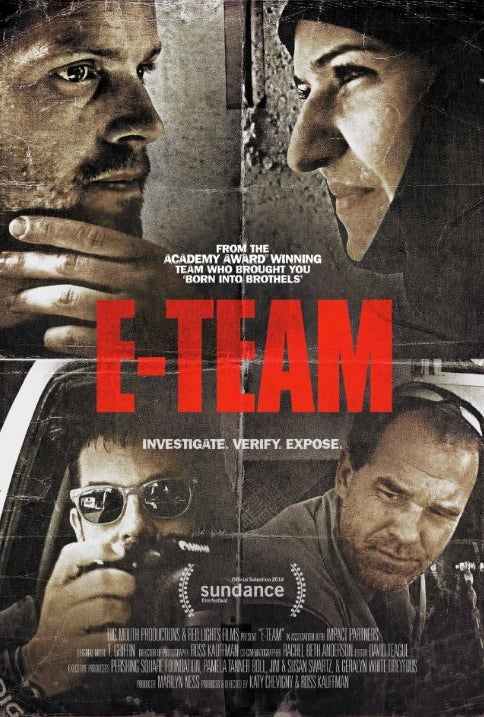
The documentary “E-TEAM” goes really public via Netflix

May 14, 2014
Yesterday I referred to the upcoming Human Rights Watch Film Festival in June. One of the films shown there will also appear on Netflix and therefore be able to reach a much larger audience. Interesting development for human rights films!!


Documenting human rights violations through interviews: shared training materials

May 14, 2014

"Everyone is Different": campaign for the International Day Against Homophobia and Transphobia, 2014

On 14 May the blogger A Paper Bird posted an interesting set of slides that can be used in training human rights defenders. The author also sets a good example by letting them be shared freely:

“One thing I do with some frequency is trainings. These powerpoints reflect a session I worked on recently with the Egyptian LGBT group Bedayaa. The first (download the English version here) deals with issues in human rights documentation in general terms. The second (download English here) deals more specifically with strategies for interviews.  I’m posting them here in the hope that they may be useful to activists who weren’t able to attend the workshop, and to people elsewhere as well. Some of the material is specific to Egypt, some is not….. [the slides also exist in Arabic – see original post)

These aren’t copyrighted; I’m not sure how you would copyright a basic skills set. (Actually, late capitalism can copyright anything. What I mean is, I don’t want to know.) However, if you find them interesting enough to adapt or reuse, I ask that you let me know, and cite me as the author.”

via Documenting human rights violations through interviews: training materials English and Arabic | a paper bird.