The purpose of Front Line Defenders Rest & Respite Programme is to enable human rights defenders to take some time out and to recharge their batteries in a safe environment while at the same time enhancing their skills so that they can work more effectively when they return home.
The programme has a flexible approach and tries to respond to the needs of the HRD. Some human rights defenders are hosted in Ireland, others choose a destination closer to home, where they have a particular interest or existing contacts. It is generally for short stays ranging from one week to three months.
Human rights defenders can take some well-earned rest and escape the stressful and difficult circumstances in which they work for a short time. They can focus exclusively on their health and well-being or spend some quality time with their family. They can also choose to work on a specific project, learn about digital security or improve other skills relevant to their work.
Rest & Respite opportunities are offered on an invitation-only basis.
“This programme is great for women human rights activists who have been subjected to stressful, tense and often dangerous and threatening situations in their work.“ – HRD, Afghanistan, Rest & Respite Programme
“Before the support, I had serious burnout caused by the stress from my work, especially from a domestic violence case I was working on when I was attacked and my computer and phones taken. I had a constant headache and was very stressed, but I’m feeling well again and am back to work.“ – HRD, Cameroon, Rest & Respite Programme
Doja Cat would be headlining a concert organized by Global Citizen in partnership with the regime of Rwanda’s warmongering dictator Paul Kagame, just two weeks after the US imposed sanctions on Rwanda’s army and senior Rwandan officials for their continued fuelling of a bloody war and humanitarian catastrophe in eastern DRC, in violation of a peace agreement brokered in December 2025.
Doja Cat’s appearance would offer Kagame an opportunity to grandstand and project a deceptive image of unity, progress and normalcy. It would be the perfect distraction from the sanctions, the prisons filled with Rwandan dissidents like opposition leader Victoire Ingabire, or Rwanda’s role in causing tremendous human suffering in DRC through its deployment of troops and support for the M23 militia — which is linked to massacres and rapes, forced recruitment and exploitation of civilians, and the use of child soldiers.
Doja Cat would follow John Legend, who headlined the 2025 #MoveAfrika Kigali concert amid public outcry. Legend performed after Nigerian Grammy-winning artist Tems canceled her concert over concerns after Rwandan troops and M23 seized eastern DRC’s two largest cities and imposed a reign of terror, exploitation, and plunder of strategic minerals.
Doja Cat has previously used her platform to advocate for vulnerable populations and has encouraged her audience to support civilians, women, and children fleeing violence, including in DRC. High-profile cultural events risk being used by Kagame’s regime to project an image of openness and legitimacy while political freedoms remain tightly restricted. In our letter, we urge Doja Cat to reconsider performing and to avoid allowing her platform to be used to legitimize a dictatorship which persecutes artists, crushes dissent, and continues to cause grave human suffering beyond its borders.
My ordeal started at about 2am one morning in February 2018, when I was arrested by the Greek police. People were fleeing conflicts at home and coming to Europe seeking safety in unseaworthy boats and I was helping the Emergency Response Center International to conduct search and rescue activities.
I was detained without understanding what exactly was happening; we were provided neither a lawyer nor an interpreter. After two nights, we were released “pending further investigation.” We continued to do search and rescue. After all, we had done nothing wrong. In fact, we continued to cooperate with the very authorities that had arrested us.
Then, in August 2018, six months after our initial arrest, my colleague and I were detained again. This time, we were charged with serious crimes, including forgery, the illegal use of radio frequencies, espionage, money laundering, being members of a criminal organization, and facilitating illegal entry….Finally, on 15 January this year, I was acquitted. The prosecutor at trial stated there was no evidence of criminality, and the panel of judges unanimously agreed that my 23 co-defendants and I were motivated by, and engaged in, legal humanitarianism.
Whilst I am delighted not to be returning to prison, it has taken far too long for this absurd prosecution to collapse. In the interim, the damage has already been done. EU states’ authorities have obstructed civilian rescue efforts, and over 32,000 lives have been lost at Europe’s borders since 2014. Meanwhile, dozens of humanitarians across Europe face similar prosecutions, obstruction, intimidation and harassment. Sadly, my case was not the exception but part of a wider pattern of states criminalizing humanitarian work.
The current effort to reform EU anti-smuggling legislation, the so-called “Facilitators Package” offers an opportunity to address some of the issues that have led to our baseless prosecution. However, the proposed revisions to the legislation might inadvertently increase the risk of criminalizing rescue workers – meaning future prosecutions will still be possible and may not end in acquittals like mine. They will also impact migrants, people of migrant origin and racialized people who all too often suffer from these policies.
As Amnesty International has highlighted, the proposal’s broad and vague provisions risk perpetuating the criminalization of refugees, migrants and human rights defenders. Any reform should clarify explicitly and in a binding manner that acts of humanitarian assistance or solidarity should be exempted from prosecution or punishment. Migrants who may have been smuggled themselves, or people assisting their family members should also be protected from criminal liability.
Through this reform, the EU has an opportunity to align with the EU Charter, UN Conventions and Smuggling Protocols, and treaties on maritime search and rescue, and to explicitly protect the right to life, the right to seek asylum, and the duty to render assistance.
As it stands, the proposal tries to expand the avenues to pursue humanitarian workers by introducing the crime of “public instigation” of irregular migration. This vague new provision could be misconstrued to harm refugees and migrants, advocates and activists protesting unjust migration laws or professionals providing legal information or assistance.
Prosecutors should focus on exploitation and violence, including by authorities summarily force people across land or sea borders.
Last year, the European Court of Human Rights found “serious evidence” of systematic pushbacks in Greece. Evidence of similar practices has been mounting across European borders. Without border monitoring, this already opaque crime becomes ever more obscure. Finally, trafficking, another cross-border crime, is arguably exacerbated by EU policy. A UN report published in 2018 found that asylum seekers in Libya face “unlawful killings, torture, arbitrary detention, gang rape, slavery, forced labour and extortion,” with apparent complicity by State actors. Nevertheless, the EU has for years financed the so-called Libyan Coast Guard.
Whether in the Facilitators Package or in its wider border policies, the EU must respect the rule of law and human rights.
The way to stop people taking dangerous journeys is providing safe and legal pathways for protection, commensurate in scale with the need for protection, and channels for regular migration for those seeking a better life. By denying safe routes, the EU pushes people into the arms and boats of smugglers and traffickers.
All the while, EU laws and narratives on stopping smugglers continue being used to criminalize migrants and people doing what they can to save lives or offer assistance. Unless the reform of the Facilitators package takes serious steps to uphold the duty to rescue and defend humanitarians, people will continue to risk jail for doing what is normal, human behaviour: helping others at risk.
Watch Seán as he discusses his case, his reflections and hopes for the future.
Listen to Séan’s full story in the first season of Amnesty’s podcast ‘On the Side of Humanity’.
On 13 the Havana Times follows up on Amnesty International’s international campaign for Indigenous Leader Brooklyn Rivera of Nicaragua.
Brooklyn Rivera, former deputy of the indigenous YATAMA political party. File photo: Confidencial
The Mechanism for the Recognition of Political Prisoners is demanding that the regime of Daniel Ortega and Rosario Murillo provide “proof of life” in the case of Brooklyn Rivera, the Miskito indigenous leader. Rivera was abducted by police on September 29, 2023, and has been in a state of “forced disappearance” ever since.
Sources linked to the Nicaraguan Army told CONFIDENCIAL that the indigenous leader, who until his arrest served as National Assembly representative for the indigenous YATAMA party, is in “dangerously poor health.” According to these sources, Rivera is currently “in police custody at a state-run hospital in Managua.”
On Thursday, March 12, 2026, the Mechanism reported that since his detention, his family members “haven’t heard anything from him. They have not been able to see him or obtain information on his whereabouts.” To date, his family has gone “895 days without knowing where he is,” and, according to that organization, concern is “even greater due to his delicate state of health.”
The 73-year-old indigenous leader was arrested at his home in Bilwi (Puerto Cabezas), on Nicaragua’s North Caribbean Coast. Since then, there has been no official information regarding his whereabouts, and his family has been unable to see him or communicate with him. “Rivera reportedly suffers from high blood pressure and, following his arrest, was reportedly transported by ambulance due to his medical condition,” the Mechanism noted.
The lack of official information has left his condition unclear. Since his arrest, his family has been subjected to threats, harassment, and persecution by the National Police and prison authorities.
For decades, Rivera was one of the most prominent voices in the defense of the territorial, political, and cultural rights of the Miskito people and other indigenous communities in the region. In July 2025, Tininiska Rivera, daughter of the Miskito indigenous leader, denounced the repression against indigenous leaders to the UN Expert Mechanism on the Rights of Indigenous Peoples. “As a daughter, I have been forced into exile after receiving threats and living under a constant atmosphere of persecution,” she reported.
The human rights organization Amnesty International included Rivera in an international campaign calling for the release of three prisoners of conscience worldwide, including lawyer Sonia Dahamani of Tunisia and photojournalist Sai Azael Thaike of Myanmar.
Front Line, Amnesty International, Forum Asia and several newspapers reported on this shocking event: On the evening of 12 March 2026, human rights defender Andrie Yunus became the victim of a targeted acid attack by two unidentified perpetrators in Central Jakarta. The human rights defender sustained severe chemical burns, including on his hands, face, chest, and eyes. The attack occurred immediately after Andrie Yunus participated in a podcast on ‘Remilitarism and Judicial Review in Indonesia’, a central topic of his human rights work. The human rights defender fell from his motorcycle, experiencing severe pain. He was immediately brought to the nearest hospital for emergency treatment. Medical examination confirmed burns on approximately 24% of his body.
Andrie Yunus is a human rights defender and the Deputy Coordinator for External Affairs of KontraS, the Commission for the Disappeared and Victims of Violence (Komisi untuk Orang Hilang dan Korban Tindak Kekerasan). Founded in 1998, it is one of Indonesia’s leading human rights organisations. KontraS monitors human rights situation in Indonesia and documents cases of enforced disappearances and state violence. Andrie Yunus was among the human rights defenders and activists who participated in the Fairmont Protest in March 2025. Since then, he has repeatedly been targeted with intimidation and harassment in connection with his human rights work. At the Fairmont Protest, Andrie Yunus was part of the efforts to oppose the revision of Indonesia’s Military Law (RUU TNI), which allows active-duty military officers to hold positions in 14 state institutions without needing to resign. The ratification of this law in March 2025 led to a significant expansion of the military into civilian and political affairs.
According to KontraS, none of Andrie Yunus’s belongings were stolen during or after the attack, indicating that robbery was not the motive. The organisation affirms that the attack was premeditated as the perpetrators selected the specific time and location immediately after Andrie Yunus’s public engagement on militarism in Indonesia. This attack has been the most severe incident in the series of intimidation attempts and violations against KontraS and its staff members. Since March 2025, KontraS’s office in Jakarta has been surveiled by unidentified persons and on multiple occasions in March and April 2025, army vehicles were observed stopping outside the office and photographing the premises.
Front Line Defenders strongly condemns the acid attack against human rights defender Andrie Yunus and asserts that it was a reprisal for his legitimate and peaceful work in the promotion and protection of human rights in Indonesia. Front Line Defenders is gravely concerned that this attack forms part of a broader and escalating pattern of intimidation targeting KontraS and other human rights defenders in the country.
Moreover: Unidentified assailants ambushed Veronika Lumban Tobing in Jakarta, beating her and warning her to halt activism on corruption and indigenous land rights. This violence directly ties to her exposés on elite-driven encroachments in North Sumatra, mirroring patterns where Human Rights advocates face retaliation for public interest work.
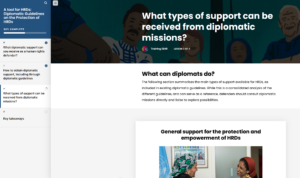
ISHR is launching two new interactive tools to strengthen diplomatic initiatives to support human rights defenders.
one tool designed for diplomats and
the other for defenders;
The resources provide practical guidance on how to enhance diplomatic support for defenders to prevent risks, respond to threats and better protect those working to promote and defend human rights. The tools will be available in English, French and Spanish.
Human rights defenders (HRDs) play a vital role in promoting accountability and advancing justice. Yet defenders around the world increasingly face harassment, criminalisation, surveillance, detention and reprisals because of their work. Diplomatic missions can play an important role in the overall protection strategy for defenders, including by addressing risks, monitoring cases, engaging authorities, or providing emergency support when defenders face serious threats. Some countries or region have adopted specific ‘Diplomatic Guidelines’ on the protection of human rights defenders (HRDs), including Switzerland, Canada, the European Union, Norway, Finland, and the UK.
To help strengthen the effective use of diplomatic protection measures, ISHR has developed two new interactive tools aimed at two complementary audiences: diplomats and human rights defenders themselves.
The first tool provides practical guidance for diplomatic and permanent missions on how to better provide quality, consistent and targeted support and protection to defenders including through the implementation of existing ‘diplomatic guidelines’ (40 minutes to complete). It outlines key principles for diplomatic engagement, including applying a “do no harm” approach, consulting closely with defenders, and adopting flexible and context-specific responses. It also highlights forms of diplomatic support, from regular engagement with defenders to trial observation, public advocacy, and emergency measures such as facilitating visas or temporary relocation.
The second tool is designed for human rights defenders and civil society organisations (20 minutes to complete). It is intended to help defenders better leverage diplomatic support by developing understanding of diplomatic guidelines, how they work, and what defenders should consider to safely engage with embassies and diplomatic missions. It also outlines the types of support that may be available, from meetings with diplomats and public advocacy to targeted or emergency assistance in situations of risk.
The content is grounded in the needs and lived experiences of HRDs, as documented by ISHR and other international organisations, and is informed by international human rights norms and standards. It draws in particular from the UN Declaration on Human Rights Defenders and its recent supplement, the Declaration+25.
By enhancing understanding of diplomatic initiatives and making them more accessible, ISHR aims to strengthen collaboration between diplomats and defenders and help ensure that defenders can continue their essential work in safer conditions. We also hope these tools may serve to catalyse action by States that have not yet adopted specific diplomatic guidelines.
The two interactive tools are available on the ISHR Academy in English, French and Spanish.
If you want more information or provide feedback on those initiatives, please contact us at: training@ishr.ch
On 5 March 2026, Front Line Defenders expressed deep concern over the escalating hostilities across the Middle East and their devastating impact on civilians following US and Israeli air strikes on Iran and subsequent retaliatory strikes by Iran against Israel and several Gulf states. In line with our mandate, we are particularly alarmed by the heightened risks faced by human rights defenders across the region, including those arbitrarily detained for their peaceful human rights work…
Human rights defenders deprived of liberty are particularly vulnerable in such contexts. During periods of conflict, detained defenders may face increased risks of ill-treatment while access to medical care, family contact, legal representation, and independent monitoring may become further restricted. The risk of such violations increases if hostilities occur in close proximity to detention facilities.
Human rights groups are expressing concern over the deteriorating situation in Evin prison in Iran, where many human rights defenders are currently detained. Based on reports these groups have received from prisoners “the Security Ward 209 has been evacuated” and “anti-riot forces are stationed in the surrounding buildings.” Food distribution has reportedly also been disrupted. On the evening of 2 March 2026, the Israeli military forces reportedly issued an urgent evacuation order to people in the Evin neighbourhood. On 23 June 2025, during the twelve-day Israel-Iran conflict, Israeli forces attacked the Evin compound and Evin prison. Prisoners, including human rights defenders, were evacuated from the prison following the attacks. Iranian officials reported over 70 people killed from this attack on the Evin compound..
In Bahrain, there have been reports of strikes only kilometres from Jau prison where human rights defender Abdulhadi Al-Khawaja continues to serve a life sentence for his peaceful human rights work alongside fellow human rights defender Dr Abduljalil Al-Singace. Front Line Defenders is also concerned over reports of arrests of defenders linked to anti-war protests in Bahrain and calls on the authorities to respect the rights to freedom of expression and peaceful assembly.
All parties to the conflict must uphold their obligations under international human rights and humanitarian law, including the protection of civilians and those deprived of liberty. Hospitals, schools, and other sites protected under international humanitarian law, where human rights defenders and other civilians carry out essential work and provide humanitarian assistance, must not be targeted. Authorities should also immediately release detained human rights defenders and ensure they have access to adequate healthcare, contact with family members and legal counsel, and independent monitoring.
Front Line Defenders call on the international community, states, and multilateral organisations to remain attentive to the situation of human rights defenders in the region, raise protection concerns with the relevant authorities and provide concrete support and protection measures for human rights defenders at risk, if necessary through support with temporary relocation and emergency visa support.
Front Line Defenders stands in solidarity with human rights defenders across the region who continue their work under extremely difficult and dangerous circumstances.
For over 40 years ISHR has worked with human rights defenders to promote freedom, dignity, equality and justice. We have partnered with them to strengthen human rights laws, systems, networks and narratives. Over the next decade the work of defenders, supported by ISHR, will be critical to reverse rising authoritarianism, combat the accelerating climate crisis, prevent regress in the areas of women’s rights and the rights of LGBTIQ+ people, address systemic racism and discrimination, adequately regulate new and emerging technologies, and promote accountability for widespread atrocity crimes, among other challenges.
This Strategic Framework is designed to ensure that human rights defenders and the international human rights movement and system are equipped to respond to these challenges. It will ensure that ISHR’s work is relevant, responsive, effective, efficient, impactful and sustainable, and that our partnerships are equitable, powerful and influential.
In developing this Framework, we consulted more than 800 human rights defenders working in diverse contexts and on diverse issues. The strategy is also informed by key intelligence and insights gathered over the period 2021-25 from 5 staff strategy retreats, 9 Board and expert panel discussions, over 10 programme and campaign evaluations, a 40th anniversary survey with key stakeholders, and an intensive 3-month process of internal and external reflection on 12 key strategic questions.
On 29 April 2025 (last year) Amnesty International Indonesia raised concerns over the persistent violence and intimidation targeting human rights defenders in the country, recording at least 123 cases involving physical assaults, digital attacks, threats, and other retaliatory actions against 288 individuals throughout 2024.
Usman Hamid, Executive Director of Amnesty International Indonesia, attributed the frequency of such incidents to a lack of strong legal safeguards. “This makes human rights defenders vulnerable to threats and intimidation,” Usman said.
He added that the absence of robust legal frameworks also results in weak law enforcement, with only a few perpetrators of violence against human rights defenders in 2024 being brought to justice. Among the cases highlighted was the shooting of lawyer and human rights advocate Yan Christian Warinussy in Manokwari, West Papua, on July 17, 2024, after attending a corruption trial. [see https://www.hrw.org/news/2024/07/25/prominent-rights-lawyer-shot-west-papua-indonesia] “As of the end of the year, there has been no progress known in the police investigation,” Usman stated.
It was not until February 2025 that police arrested a suspect, ZT, in connection with the shooting. The arrest took place at a residence in Manokwari Regency and was carried out by the Manokwari City Police Special Team. ZT’s testimony led investigators to identify four additional suspects, including the alleged mastermind, OU, who is still at large. According to Manokwari City Police Chief Commissioner Rivadin B. Simangunsong, the attack on Yan was linked to a separate legal case: the murder of Yahya Sayori, for which Yan had been providing legal assistance. “It is motivated by another issue currently being processed in court, namely the murder case of the late Yahya Sayori, who was accompanied by lawyer Yan Christian Warinussy,” said Rivadin.
Then on 6 March 2026 came the good news that an Indonesian court acquitted four other activists after judges find no link to protest violence, prompting renewed scrutiny of policing and restrictions on civic space.
Responding to the acquittal of four activists – Delpedro Marhaen, Muzaffar Salim, Syahdan Husein and dan Khariq Anhar – accused by the authorities of inciting people to commit violent acts during the August 2025 protests, Usman Hamid, Amnesty International Indonesia’s Executive Director, said: “This brings new hope amid an creasingly shrinking civic space in Indonesia. The acquittal sends a clear message to law enforcement authorities that they should stop criminalising human rights defenders and anyone who peacefully exercises their right to protest. This is a significant victory for justice and human rights in Indonesia.
So maybe there will be progress also on the case of Yan Christian Warinussy ?
After 16 years of leadership, Gerald Staberock is stepping down from his role as Secretary General of the OMCT. The Executive Council has accepted his resignation and will oversee a smooth transition to new leadership to continue advancing the organization’s mission to combat torture and support human rights defenders worldwide.
A good friend and colleague has taken the thoughtful decision to start a managed transition of his own position at the helm of a key international NGO. Forgive me for being biased but he is a remarkable and exceptional person.
Under his leadership, OMCT gained renewed energy, reinforcing its footprint across regions through dynamic regional offices and in country-presence and further expanding the reach and impact of its global network. This was no small accomplishment. With staff, members and partners around the globe, Gerald also aided in “opening roads, working through landslides and filling gaps” so that OMCT could respond more effectively to the needs of people who were subject to torture and serious human rights violations or abuse. He has fostered a model of work that is lean and fitting for purpose in some of the toughest places in the world and has put our network of human rights defenders at the heart of our identity. He has maintained time after time that our true reserves are human – the trust, commitment and courage of our members, partners and staff.
The Executive Council of the OMCT extends special thanks to Gerald for his unwavering commitment to OMCT’s values and philosophy. After 16 years of dedicated service, Gerald has made the personal decision to step down to embrace new challenges and devote more time to his family, and the Executive Council fully supports and respects this decision, sharing his conviction that a leadership transition can be healthy for both him and the organization. We are committed to ensuring that this transition is safe, orderly and well-timed, and that OMCT remains firmly anchored in its values and strategic vision. Gerald has promised in the past that he’s committed to OMCT and the challenge of torture and, in any case, a smooth handover to the next Secretary General.
In this vein, the Executive Council is eager to start the recruitment process for the OMCT’s next Secretary General. You can access here the call for applications. Timing of the new Secretary General will depend on the availability of the candidate selected, and a dedicated transition process will be co-defined between the Executive Council working group, the incoming Secretary General and Gerald.
Gerald’s own Message to the SOS Torture Network and partners is a demonstration of his modesty and foresightedness:
I am writing you today to tell you that I informed our executive board early this year that it is time for leadership transition after 16 years at the OMCT. I can assure you that we will ensure that this is a safe, orderly and well-timed transition so that there will be no gaps. I am also addressing this to all our supporters; this is the time we need you to stay course with us more than ever. The relationship with many of you has been enriching, marked by a shared commitment that has helped us shape our vision. I would particularly like to thank our support committee in Geneva for their support.
For the past years, every time I came back from one of the many trips that are part of this job, I was intrigued by a watch making advertisement at the Geneva Airport. It basically says, ‘you never own this watch, your task is to keep it safe to hand over to a next generation’. Not being the owner of any luxury watches the advert always touched me, and each time I would think about OMCT. And when my decision nourished that after 16 years of leadership, it is time to accept that change is good, I had to look back at this advert.
My task was to take on an incredible gift from the founding fathers (yes, they were male) and a charismatic preceding director whom I call a friend. An organization built around a network, built around people that work in their countries to make them better places, more just, safer – and who sadly often don’t get the recognition for the good they do.
I cannot tell you how much I enjoyed and continue to enjoy working with amazing staff and members in our network. Human rights are really about people, people we help, serve, support, torture survivors and human rights defenders that make the difference. Our reserves are not financial but these relationships – they are our most important currency. In this, OMCT being able to provide tangible support is a is a meaningful achievement. Human rights work is also collective, it is about a movement, an eco-system. I appreciate our joint work in the Human Rights Defenders mechanism – Protect Defenders – stimulating and effective. I believe that our collective work within United Against Torture Consortium will be crucially important for the future. OMCT will remain about being united because it makes us better and stronger.
…I feel after 16 years it is the right moment to making sure that this incredible gift – not a watch – but an organization called OMCT – is given into the safe hands of a new generation…..






 Hans Thoolen on Human Rights Defenders and their awards