True Heroes Films (THF) has published a timely portrait of Ales Bialiatski, winner of the Nobel Peace Prize 2022, drawn from an in-depth interview with him at the Paris Summit for Human Rights Defenders in Paris, October 2018.
Archive for the 'films' Category
Meet Ales Bialiatski, Nobel Peace Prize 2022
October 8, 2022The Swimmers: Netflix film about Syrian refugee swimmers
September 15, 2022UNHCR announced on 9 September 2022 that a new Netflix film, The Swimmers, tells the remarkable tale of Yusra Mardini, a young Syrian refugee and UNHCR Goodwill Ambassador, who escaped conflict and went on to compete in two Olympics.
“This is a movie that any person in the world can relate to,” the 24-year-old said shortly before the film’s world premiere on Thursday at the prestigious opening night of the Toronto International Film Festival (TIFF). “We want the movie to make a difference.” UNHCR Goodwill Ambassador Yusra Mardini hopes the dramatic new film of her and her sister’s escape from conflict to new lives in Europe will challenge attitudes towards refugees.
Directed by acclaimed Egyptian-Welsh filmmaker Sally El Hosaini of My Brother the Devil, the film stars Lebanese actors and real-life sisters Nathalie and Manal Issa, as Yusra and her older sibling Sara.
It tells the story of their childhood in Damascus, their focus on swimming from a young age, and their dramatic journey to Europe in 2015 that saw them help save the lives of fellow refugees by jumping into the water and steering their stricken dinghy to shore through the Aegean Sea’s dark waters.
While the public will have to wait until 23 November for the film’s general release, Mardini has already seen it twice and says it is impossible for her to pick the best moments. “Honestly, the whole movie is my favourite scene!” she says.
She hopes it will prove much more than simple entertainment. “This movie is going to put the conversation on the table of what a refugee is, of what we want to change,” says Yusra.
El Hosaini, the director, echoes this ambition. “My greatest hope for the film is that it subverts the tired stereotypes of both refugees and young Arab women.
“I want the film to remind us that refugees are regular people with full, regular lives, with hopes and dreams. Ordinary people who’ve had to make unimaginable choices, leaving their homes and risking everything in search of a safer, better life.”
Since becoming the youngest ever UNHCR Goodwill Ambassador in 2017, and competing as a swimmer in both the Rio 2016 and Tokyo 2020 Olympics, Yusra has emerged as a leading voice for refugees, one that The Swimmers will amplify still further.e
To change perceptions of refugees, understanding must come first, she says. “The education systems have to change: they have to be more open, they have to teach the stories of migrants and refugees,” says Yusra, who hopes sharing her story far and wide, through her 2018 memoir Butterfly and now The Swimmers, will help educate people about the potential, and the value, that all refugees have. “We have to treat everyone the same,” she says.
“The Olympic Games changed the way I think about being a refugee. I walked into the stadium in Rio and I realised that I can inspire so many people. I realised that ‘refugee’ is just a word, and what you would do with it is the most important thing.”
Despite being in the Hollywood spotlight, Yusra has not lost sight of her calling. “A lot still has to change for refugees,” she says. “This is not the end. This is just the beginning.”
Video game launched to experience a refugee’s journey
July 14, 2022Ruth Schöffl reported from Vienna, on 08 July 2022 how a Syrian refugee game developer, an Austrian company and UNHCR teamed up to create a video game that reveals the life-or-death decisions that refugees face.
Jack Gutmann was never one of those children whose parents badgered him to limit his screen time and go outside and play. On the contrary, they encouraged Jack and his four brothers to spend as much time as possible absorbed in computer games so they would stay indoors, safe from the conflict raging on the streets outside their home.
“I was scared, and I tried to escape reality,” says Jack, named Abdullah at birth and brought up in Hama, Syria’s fourth-largest city. “I didn’t want to see the war and I did not want to hear it.” When there was electricity, he played video games. When the electricity went out, he played on his laptop. When the laptop battery died, he designed on paper.
He never dreamed that years later – safe in Austria – his passion for computer design would equip him to produce an award-winning video game. A teaching edition of Path Out was re-launched by UNHCR for World Refugee Day (20 June 2022) this year to help schoolchildren in Austria and elsewhere stand in the shoes of a refugee, making life-and-death decisions along a hazardous journey to safety.
Jack, who took a new name when he forged a new life in Austria, began drawing and colouring digitally as a child and mastered the graphics programme Photoshop by the time he was fourteen.
“Digital art and computer games were the window to the world for me, out of my room in Syria, away from the war into a diverse world with very different people,” he says, reflecting on the crisis that broke out in March 2011, the same month he turned 15.
Since the start of the crisis in 2011, millions of Syrians have been forced to flee their homes. Today some 6.8 million Syrians have fled abroad as refugees, and almost as many – 6.9 million – are displaced within the country.
At 18, facing the danger of being drafted into the army, Jack fled his homeland – a dangerous and circuitous journey to Turkey and then across a number of countries until he reached Austria in the heart of Europe. This was the first place he truly felt safe.
“I didn’t plan to stay in Austria,” he freely admits. “But when I arrived here with my brother, we were really shocked because so many people helped us – positively shocked.”
Shortly after arriving, Jack met Georg Hobmeier, head of Causa Creations, a Vienna-based game-design company that sees video games not only as entertainment but, in the words of its website, as “meaningful, enriching experiences that can connect us, challenge our perceptions, and give insights into the world around us.” They’ve worked on issues such as migration, climate change and nuclear energy.
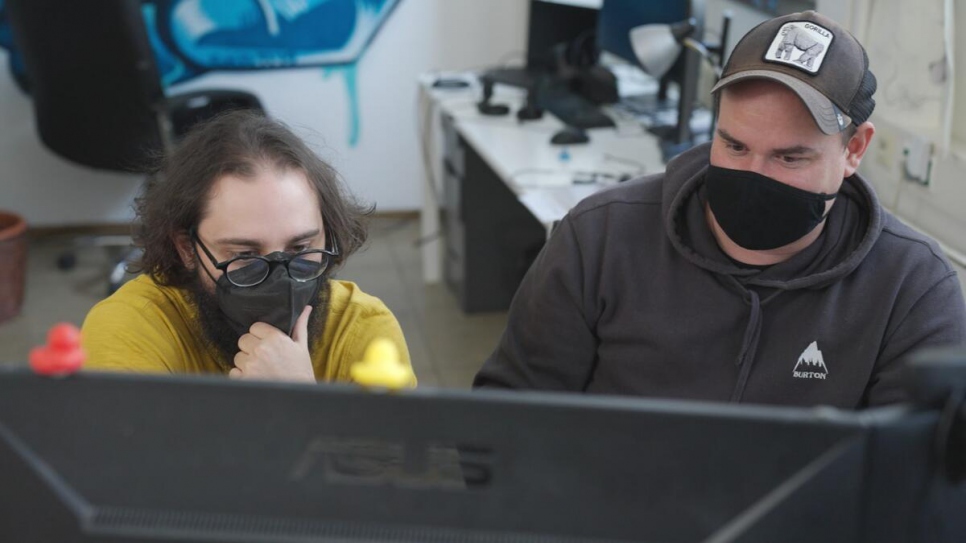
Game designer Jack Gutmann (left) sits alongside Georg Hobmeier, head of Causa Creations, at their offices in Vienna, Austria. © UNHCR/Simon Casetti
Jack, eager to turn his passion into a profession, teamed up with Causa Creations on a joint project. The result was Path Out, in which the player replicates Jack’s surreptitious trek from Syria, sometimes in the hands of people smugglers.
“We decided that Jack himself would be the main character of the game,” says Georg, adding that it was particularly important to show that behind every refugee statistic there are complex stories and complex personalities.
In the Japanese game style they chose, the cute characters contrast with the harsh reality of the journey. Jack – the designer and the character – are dressed throughout in the yellow shirt he actually wore on his odyssey, which now has sentimental value to him.
From a box in the corner of the screen, real Jack comments on the players’ moves in Youtuber style, often with humour. “You just killed me, man,” he exclaims when the player makes the wrong move. “In reality I wasn’t as clumsy as you.”
Originally released as a two-hour game in 2017, Path Out has won international and Austrian awards for “its effort to shed light on a serious issue.”
The new version Causa and UNHCR developed for schools takes no longer than one lesson and helps pupils who might never meet real refugees learn that Jack led a life much like theirs until his world was turned upside down and he had to leave everything behind. It was rolled out in German and English for World Refugee Day; other language versions are to follow.
Jack the designer is still writing his own happy ending. He felt safe as soon as he reached Austria, but it took time for the country to become his true artistic and emotional home.
“It took five years until I felt my journey was over, until I really felt relieved,” he says. Now 26, he speaks nearly flawless German and English. He completed vocational training, worked for a few years in a game development company, and now is training further in 3D modelling and animation to become an even better game developer and designer.
He met an Austrian woman who also plays video games – though not by profession – and they married last year.
And he maintains his sense of humour, a trait he considers essential both in real life and in his game, Path Out. “The story of flight and war is bad enough; one needs humour to be able to cope with it,” he says. Since the game reflects his reality, “it’s funny at the same time. After all, computer games are supposed to be fun.”
Who are human rights defenders?
July 2, 2022On 30 June 2022 the Office of the UN High Commissioner for Human Rights uploaded this video clip outlining the basic issue of human rights defenders:
In crisis, civic space is the ‘most crucial – and valuable’ element of building resilience. @ High Commissioner for Human Rights, Michelle Bachelet says, “a vibrant civic space is a lever of a stable, secure society. Yet, we continue documenting attacks against defenders and journalists, off-line and online, worldwide.”
Film “THE STORY WON’T DIE” about Syrian protest art
June 18, 2022
THE STORY WON’T DIE is an inspiring, timely look at a young generation of Syrian artists who use their work to protest and process what is currently the world’s largest and longest ongoing displacement of people since World War II. The film is produced by Sundance Award-winning producer Odessa Rae (Navalny). Rapper Abu Hajar, together with other celebrated creative personalities of the Syrian uprising, including post-rock musician Anas Maghrebi, members of the first all female Syrian rock band Bahila Hijazi and Lynn Mayya, breakdancer Bboy Shadow, choreographer Medhat Aldaabal, and visual artists Tammam Azzam, Omar Imam and Diala Brisly, use their art to rise in revolution and endure in exile in this new documentary reflecting on a battle for peace, justice, and freedom of expression. It is an uplifting and humanizing look at what it means to be a refugee in today’s world, and offers inspiring and hopeful vantages on a creative response to the chaos of war.
The Human Rights Foundation organised the New York Premiere of THE STORY WON’T DIE on Friday, June 17 at Cinema Village. The screening was followed by a Q&A with award-winning filmmaker David Henry Gerson and the film’s co-producer Abdalaziz Alhamza.
https://mailchi.mp/hrf.org/you-are-invited-june-15th-screening-of-the-dissident-288999?e=f80cec329e
Profile of Soun Yuthyia from Cambodia
May 11, 2022“I chose to be a human rights defender by, hopefully, protecting those who don’t know where to find a solution when there are human rights abuses happening to them.”
Soun Yuthyia is the advocacy director for The Cambodian Centre for Human Rights, an organisation that seeks to protect and promote respect for human rights throughout Cambodia. He shares his vision for the future of Cambodia and how his work has positively impacted the people of Cambodia.
Yuthyia also shares his experience with HRDAP and the ISHR Academy in the below video:
https://www.youtube-nocookie.com/embed/vAfHKFScArU
https://ishr.ch/defender-stories/human-rights-defenders-story-soun-yuthyia-from-cambodia/
New “Kofi Annan Courage in Cartooning Award” to Ukrainian and Hungarian press cartoonists
May 10, 2022Geneva Solutions of 3 May 2022 reported on the first issue of the Kofi Annan Courage in Cartooning Award. This is in fact a merger of two pre-existing awards for cartoonists [for more info, see: https://www.trueheroesfilms.org/thedigest/awards/f60cb3d4-c79a-43aa-9b5c-351c56c02ae1]
The conflict in Ukraine with all these absurd symbols (Vladimir Kazanevsky for Nebelspalter)
Ukrainian Vladimir Kazanevsky and Hungarian Gabor Papai were announced as the winners of the Kofi Annan Courage in Cartooning Award at a ceremony at the Maison de la Paix in Geneva and presented by the Freedom Cartoonists Foundation. Jury : Kenneth Roth, Human Rights Watch (president), Sami Kanaan, City of Geneva and cartoonists Ann Telnaes (USA), Kak (France) and Chappatte (Switzerland). The portraits below were done by True Heroes Films (THF)
Vladimir Kazanevsky
Vladimir Kazanevsky, Ukraine’s leading cartoonist, was working in his studio early in the morning of 24 February when he heard loud explosions near the airport in Kyiv. He and his wife fled to western Ukraine, along with a huge wave of families fleeing the bombings. From there they went to Presov, a town in Slovakia with a community of artists.
Deprived of his drawing materials, catalogues and books, which he had to leave behind in Kyiv, Kazanevsky continues to draw relentlessly: Putin in action, on a tank or on the bow of the Titanic. “Autocrats and dictators are afraid of our cartoons, and they are right, because our drawings are powerful weapons,” he says.
Fiercely determined to continue the fight against Russian aggression, the 71-year-old sees his work as an act of resistance. An act of defence of freedom of expression against war propaganda.
Gábor Pápai
For several years, Hungarian cartoonist Gàbor Pàpai and his newspaper Népszava – the only opposition daily still alive in Budapest – have been the subject of attacks and legal proceedings by the authorities – even though Hungary is part of the European Union.
This cartoon, “The Chronicle” by Gábor Pápai, published in Hungary’s daily newspaper Népszava on 28 April shows the Hungarian National Public Health Centre’s chief doctor looking at Jesus on the cross and suggesting that many people who had deceased from the coronavirus had already been likely to die because they had suffered from pre-existing conditions.
It was intended to ridicule Hungary’s chief health figure for having tried to minimise the number of deaths solely attributable to the coronavirus in Hungary and, by extension, to mock the government’s handling of the crisis.
“Its depiction and use of Jesus on a cross sparked an outcry from the representatives of the Christian Democrat Party, an ally of the ruling Fidesz, to the point that the Secretary of State for persecuted Christian communities, Tristan Azbej, accused Gábor Pápai of blasphemy and threatened to sue him or Népszava,” as Reporters Without Borders, who came to the defense of Papai, explains.
The Catholic religion, the fight against Covid or simply Hungarian history are all pretexts for prosecution in a country ranked 92nd in the world press freedom index by Reporters Without Borders (RSF). This shameful ranking has been deteriorating ever since Viktor Orbán became Prime Minister, putting all independent media in great difficulty. Some, like Népszava, are directly threatened with extinction. Gàbor Pàpai, far from being intimidated, continues to critically observe and draw all political actors in Hungary.
Read more about the 2022 laureates
https://www.kofiannanfoundation.org/articles/world-press-freedom-day-2022/
Karla Avelar speaks out in Diversity in Adversity campaign
April 28, 2022Episode 4: People who work to end violence and discrimination based on sexual orientation and gender identity (SOGI) face multiple forms of risk. They can be targeted for their actual or perceived sexual orientation or gender identity, and for being human rights defenders as well.
Karla Avelar is trans woman human rights defender from El Salvador who has been working since the 1990s to defend the rights of LGBTI persons, people with HIV and other marginalised groups. After being subjected to two and a half years in prison, where she was tortured, sexual assaulted and denied access to medical treatment, she began to work more intensely for the rights of LGBTI persons. She began by calling for appropriate provision of HIV medications and greater access to justice within El Salvador. In 2008 she founded COMCAVIS trans, El Salvador’s first organisation for trans women with HIV. In 2013, she was the first trans woman to appear before the Inter-American Commission on Human Rights. After multiple threats to her own life and that of her mother, she applied for asylum in Switzerland in 2017, where she now lives and continues her work. She was a finalist of the MEA in 2017 [see: https://humanrightsdefenders.blog/2017/05/16/trans-defenders-karla-avelars-life-is-under-constant-threat/]
Diversity in Adversity is a joint campaign by Mary Lawlor, UN Special Rapporteur on Human Rights Defenders, and Victor Madrigal-Borloz, UN Independent Expert on sexual orientation and gender identity. It will feature interviews with 10 SOGI rights defenders from all over the world; ordinary people engaged in extraordinary work. For more on this campaign, visit: https://www.ohchr.org/en/special-proc…
Winners of the 2022 Geneva international film festival
March 16, 2022
Over ten days, the 20th International Film Festival and Forum on Human Rights brought together artists, activists, journalists, and the public in Geneva for film and debate. After two pandemic-enforced digital editions, this year was also a chance for the festival to finally get back to some form of normality by meeting in person and welcoming back live audiences. The Grand Prize for Fiction was awarded to two films – Freda, by Haitian director Gessica Généus, and Vera Dreams of the Sea by Kosovan filmmaker Kaltrina Krasniqi.
“Freda” Devastated by earthquakes, Haiti is a country buried under corruption, violence and colonial legacy. Freda lives with her mother and sister in Port-au-Prince and, at the age of 20, she refuses to give up and wants to believe in the future. But how can she stay when everything compels her to leave? Spotted in 2017 with The Sun Will Rise, Gessica Généus directs her debut feature film, shot in Creole and carried by extraordinary actresses. She tells the story of her country with love, sings its courage and celebrates the deep joy that persists despite the heartbreaking reality.
“Vera Dreams of the Sea” tells the tale of a widow, forced to take on a ruthless rural patriarchy to claim an inheritance, for her, and her daughter and granddaughter. The film also won the Festival’s Youth Prize, an award Krasniqi told Euronews has particular significance. “You know, when you make a movie you think about audiences, of course, and then you think that people of a certain generation who resonate with issues but then getting a prize from youth meant quite a lot to me because that means the story resonates with other generations as well.”
White Torture directed by Iranian lawyer and human rights activist Narges Mohammadi won the festival’s Grand Reportages category. It focuses on psychological torture and its destructive effect on victims. Mohammadi is currently imprisoned in Iran. Her friend, Nobel Peace Prize winner Shirin Ebadi, is the film’s ambassador. Sitting down with Euronews, she said: “In my opinion, this film represents the state’s repression of prisoners of conscience and political prisoners in Iran. But at the same time, it represents resistance, because the repression continues, but the resistance of the people also continues.“