Archive for the 'films' Category

New report: You Tube also needs scrutiny

June 22, 2022

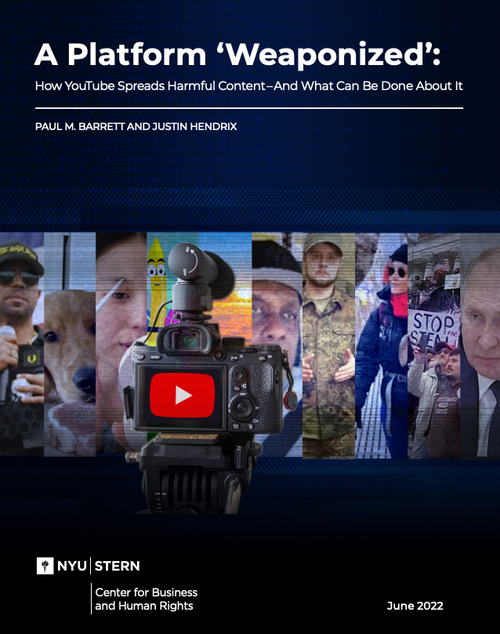
In June 2022, Paul M. Barrett and Justin Hendrix of NYU’s STERN Centre for Business and Human Rights came with a very timely report: “A Platform ‘Weaponized’: How YouTube Spreads Harmful Content— And What Can Be Done About It“. We know less about YouTube than the other major social media platforms. YouTube, with more than 2 billion users, is the most popular social media site not just in the United States, but in India and Russia as well. But because of the relative difficulty of analyzing long-form videos, as compared to text or still images, YouTube has received less scrutiny from researchers and policymakers. This in-depth report addresses the knowledge gap.

Like other major platforms, You Tube has a dual nature: It provides two billion users access to news, entertainment, and do-it-yourself videos, but it also serves as a venue for political disinformation, public health myths, and incitement of violence.

——————————————————————-

YouTube’s role in Russia illustrates this duality. Since Russia launched its invasion of Ukraine in February 2022, YouTube has offered ordinary Russians factual information about the war, even as the Kremlin has blocked or restricted other Western-based social media platforms and pressured foreign journalists in the country to silence themselves. But for years before the brutal incursion, YouTube served as a megaphone for Vladimir Putin’s disinformation about Ukraine and its relations with the West. Despite its heft and influence, less is known about YouTube than other major social media sites.

Does YouTube send unwitting users down a ‘rabbit hole’ of extremism?

In response to reports that the platform’s own recommendations were “radicalizing” impressionable individuals, YouTube and its parent, Google, altered its recommendation algorithm, apparently reducing the volume of recommendations of misinformation and conspiratorial content. But platform recommendations aren’t the only way people find potentially harmful material. Some, like the white 18-year-old accused of shooting and killing 10 Black people in a Buffalo, N.Y., grocery store, seek out videos depicting violence and bigotry. These self-motivated extremists can find affirmation and encouragement to turn their resentments into dangerous action.

A social media venue with global reach

Roughly 80% of YouTube traffic comes from outside the United States, and because of language and cultural barriers, the platform’s content moderation efforts are less successful abroad than at home. The report explores how YouTube is exploited by Hindu nationalists persecuting Muslims in India, right-wing anti-vaccine advocates in Brazil, and supporters of the military junta in Myanmar.


In Part 2, we examine YouTube’s role as the internet’s vast video library, one which has contributed to the spread of misinformation and other harmful content. In 2019, for example, YouTube reacted to com-
plaints that its recommendations were pushing impressionable users toward extremist right-wing views.
The company made a series of changes to its algorithms, resulting in a decline in recommendations of conspiratorial and false content. But recommendations are not the only way that people find videos on YouTube. A troubling amount of extremist content remains available for users who search for it. Moreover, YouTube’s extensive program for sharing advertising revenue with popular creators means that purveyors of misinformation can make a living while amplifying the grievances and resentments that foment partisan hatred, particularly on the political right.

In Part 3, we turn our attention to YouTube’s role in countries outside of the U.S., where more than 80%
of the platform’s traffic originates and where a profusion of languages, ethnic tensions, and cultural variations make the company’s challenges more complicated than in its home market. Organized misogynists in South Korea, far-right ideologues in Brazil, anti-Muslim Hindu nationalists, and supporters of Myanmar’s oppressive military regime have all exploited YouTube’s extraordinary reach to
spread pernicious messages and rally like minded users. [see also: https://humanrightsdefenders.blog/2020/11/02/bbc-podcast-on-the-framing-of-video-monk-luon-sovath/]


Recommendations to the U.S. government

Allocate political capital to reduce the malign side effects of social media: President Biden’s off-the-
cuff expressions of impatience with the industry aren’t sufficient. He ought to make a carefully considered statement and lend his authority to legislative efforts to extend federal oversight authority. Former President Obama’s recent speech at Stanford about disinformation provided a helpful foundation.
Enhance the FTC’s authority to oversee social media: Some of the issues raised in this report could
be addressed by a proposal we made in a February 2022 white paper—namely, that Congress should
authorize the Federal Trade Commission to use its consumer protection authority to require social media companies to disclose more data about their business models and operations, as well as provide procedurally adequate content moderation.

To YouTube:
Disclose more information about how the platform works: A place to start is explaining the criteria
algorithms use to rank, recommend, and remove content—as well as how the criteria are weighted relative to one another.
Facilitate greater access to data that researchers need to study YouTube: The platform should ease
its resistance to providing social scientists with information for empirical studies, including random samples of videos.
Expand and improve human review of potential harmful content: YouTube’s parent company, Google,
says that it has more than 20,000 people around the world working on content moderation, but it declines to specify how many do hands-on review of YouTube videos. Whatever that number is, it needs to grow, and outsourced moderators should be brought in-house.
Invest more in relationships with civil society and news organizations: In light of their contribution to the
collapse of the advertising-based business model of many U.S. news-gathering organizations, the platforms should step up current efforts to ensure the viability of the journalism business, especially at the local level.

The NYU Center for Business and Human Rights began publishing reports on the effects of social media on democracy in the wake of Russia’s exploitation of Facebook, Twitter, and YouTube during the 2016 U.S. presidential campaign. We initially advocated for heightened industry self-regulation, in part to forestall government intervention that could lead to First Amendment complications. As the inadequacy of industry reforms has become clear, we have supplemented our calls for self-regulation with a proposal for enhancement of the Federal Trade Commission’s consumer protection
authority to oversee the industry.

In Part 4, we offer a concise version of the FTC proposal, as well as a series of recommendations to YouTube itself. The report does not address the problem of YouTube hosting potentially harmful videos aimed at children and teenagers. This persistent phenomenon deserves continued scrutiny but is beyond the scope of our analysis.

VIEW FULL REPORT

https://bhr.stern.nyu.edu/blogs/2022/6/10/report-a-platform-weaponized-how-youtube-spreads-harmful-content-and-what-can-be-done-about-it

Film “THE STORY WON’T DIE” about Syrian protest art

June 18, 2022

THE STORY WON’T DIE is an inspiring, timely look at a young generation of Syrian artists who use their work to protest and process what is currently the world’s largest and longest ongoing displacement of people since World War II. The film is produced by Sundance Award-winning producer Odessa Rae (Navalny). Rapper Abu Hajar, together with other celebrated creative personalities of the Syrian uprising, including post-rock musician Anas Maghrebi, members of the first all female Syrian rock band Bahila Hijazi and Lynn Mayya, breakdancer Bboy Shadow, choreographer Medhat Aldaabal, and visual artists Tammam Azzam, Omar Imam and Diala Brisly, use their art to rise in revolution and endure in exile in this new documentary reflecting on a battle for peace, justice, and freedom of expression. It is an uplifting and humanizing look at what it means to be a refugee in today’s world, and offers inspiring and hopeful vantages on a creative response to the chaos of war.

The Human Rights Foundation organised the New York Premiere of THE STORY WON’T DIE on Friday, June 17 at Cinema VillageThe screening was followed by a Q&A with award-winning filmmaker David Henry Gerson and the film’s co-producer Abdalaziz Alhamza.

https://mailchi.mp/hrf.org/you-are-invited-june-15th-screening-of-the-dissident-288999?e=f80cec329e

Profile of Soun Yuthyia from Cambodia

May 11, 2022

I chose to be a human rights defender by, hopefully, protecting those who don’t know where to find a solution when there are human rights abuses happening to them.”

Soun Yuthyia is the advocacy director for The Cambodian Centre for Human Rights, an organisation that seeks to protect and promote respect for human rights throughout Cambodia. He shares his vision for the future of Cambodia and how his work has positively impacted the people of Cambodia.

Yuthyia also shares his experience with HRDAP and the ISHR Academy in the below video:

https://www.youtube-nocookie.com/embed/vAfHKFScArU

https://ishr.ch/defender-stories/human-rights-defenders-story-soun-yuthyia-from-cambodia/

New “Kofi Annan Courage in Cartooning Award” to Ukrainian and Hungarian press cartoonists

May 10, 2022

Geneva Solutions of 3 May 2022 reported on the first issue of the Kofi Annan Courage in Cartooning Award. This is in fact a merger of two pre-existing awards for cartoonists [for more info, see: https://www.trueheroesfilms.org/thedigest/awards/f60cb3d4-c79a-43aa-9b5c-351c56c02ae1]

The conflict in Ukraine with all these absurd symbols (Vladimir Kazanevsky for Nebelspalter)

Ukrainian Vladimir Kazanevsky and Hungarian Gabor Papai were announced as the winners of the Kofi Annan Courage in Cartooning Award at a ceremony at the Maison de la Paix in Geneva and presented by the Freedom Cartoonists Foundation. Jury : Kenneth Roth, Human Rights Watch (president), Sami Kanaan, City of Geneva and cartoonists Ann Telnaes (USA), Kak (France) and Chappatte (Switzerland). The portraits below were done by True Heroes Films (THF)

Vladimir Kazanevsky

Vladimir Kazanevsky, Ukraine’s leading cartoonist, was working in his studio early in the morning of 24 February when he heard loud explosions near the airport in Kyiv. He and his wife fled to western Ukraine, along with a huge wave of families fleeing the bombings. From there they went to Presov, a town in Slovakia with a community of artists.

Deprived of his drawing materials, catalogues and books, which he had to leave behind in Kyiv, Kazanevsky continues to draw relentlessly: Putin in action, on a tank or on the bow of the Titanic. “Autocrats and dictators are afraid of our cartoons, and they are right, because our drawings are powerful weapons,” he says.

Fiercely determined to continue the fight against Russian aggression, the 71-year-old sees his work as an act of resistance. An act of defence of freedom of expression against war propaganda.

Gábor Pápai

For several years, Hungarian cartoonist Gàbor Pàpai and his newspaper Népszava – the only opposition daily still alive in Budapest – have been the subject of attacks and legal proceedings by the authorities – even though Hungary is part of the European Union.

This cartoon, “The Chronicle” by Gábor Pápai, published in Hungary’s daily newspaper Népszava on 28 April shows the Hungarian National Public Health Centre’s chief doctor looking at Jesus on the cross and suggesting that many people who had deceased from the coronavirus had already been likely to die because they had suffered from pre-existing conditions.

It was intended to ridicule Hungary’s chief health figure for having tried to minimise the number of deaths solely attributable to the coronavirus in Hungary and, by extension, to mock the government’s handling of the crisis.

“Its depiction and use of Jesus on a cross sparked an outcry from the representatives of the Christian Democrat Party, an ally of the ruling Fidesz, to the point that the Secretary of State for persecuted Christian communities, Tristan Azbej, accused Gábor Pápai of blasphemy and threatened to sue him or Népszava,” as Reporters Without Borders, who came to the defense of Papai, explains.

The Catholic religion, the fight against Covid or simply Hungarian history are all pretexts for prosecution in a country ranked 92nd in the world press freedom index by Reporters Without Borders (RSF). This shameful ranking has been deteriorating ever since Viktor Orbán became Prime Minister, putting all independent media in great difficulty. Some, like Népszava, are directly threatened with extinction. Gàbor Pàpai, far from being intimidated, continues to critically observe and draw all political actors in Hungary.

Read more about the 2022 laureates

https://genevasolutions.news/global-news/ukrainian-and-hungarian-press-cartoonists-collect-award-in-geneva-view-a-gallery-of-their-wo

https://www.kofiannanfoundation.org/articles/world-press-freedom-day-2022/

Karla Avelar speaks out in Diversity in Adversity campaign

April 28, 2022

Episode 4: People who work to end violence and discrimination based on sexual orientation and gender identity (SOGI) face multiple forms of risk. They can be targeted for their actual or perceived sexual orientation or gender identity, and for being human rights defenders as well.

Karla Avelar is trans woman human rights defender from El Salvador who has been working since the 1990s to defend the rights of LGBTI persons, people with HIV and other marginalised groups. After being subjected to two and a half years in prison, where she was tortured, sexual assaulted and denied access to medical treatment, she began to work more intensely for the rights of LGBTI persons. She began by calling for appropriate provision of HIV medications and greater access to justice within El Salvador. In 2008 she founded COMCAVIS trans, El Salvador’s first organisation for trans women with HIV. In 2013, she was the first trans woman to appear before the Inter-American Commission on Human Rights. After multiple threats to her own life and that of her mother, she applied for asylum in Switzerland in 2017, where she now lives and continues her work. She was a finalist of the MEA in 2017 [see: https://humanrightsdefenders.blog/2017/05/16/trans-defenders-karla-avelars-life-is-under-constant-threat/]

Diversity in Adversity is a joint campaign by Mary Lawlor, UN Special Rapporteur on Human Rights Defenders, and Victor Madrigal-Borloz, UN Independent Expert on sexual orientation and gender identity. It will feature interviews with 10 SOGI rights defenders from all over the world; ordinary people engaged in extraordinary work. For more on this campaign, visit: https://www.ohchr.org/en/special-proc…

Winners of the 2022 Geneva international film festival

March 16, 2022
Women's rights, ecology and torture scoop top FIFDH 2022 awards

Over ten days, the 20th International Film Festival and Forum on Human Rights brought together artists, activists, journalists, and the public in Geneva for film and debate. After two pandemic-enforced digital editions, this year was also a chance for the festival to finally get back to some form of normality by meeting in person and welcoming back live audiences. The Grand Prize for Fiction was awarded to two films – Freda, by Haitian director Gessica Généus, and Vera Dreams of the Sea by Kosovan filmmaker Kaltrina Krasniqi.

Freda” Devastated by earthquakes, Haiti is a country buried under corruption, violence and colonial legacy. Freda lives with her mother and sister in Port-au-Prince and, at the age of 20, she refuses to give up and wants to believe in the future. But how can she stay when everything compels her to leave? Spotted in 2017 with The Sun Will Rise, Gessica Généus directs her debut feature film, shot in Creole and carried by extraordinary actresses. She tells the story of her country with love, sings its courage and celebrates the deep joy that persists despite the heartbreaking reality.

Vera Dreams of the Seatells the tale of a widow, forced to take on a ruthless rural patriarchy to claim an inheritance, for her, and her daughter and granddaughter. The film also won the Festival’s Youth Prize, an award Krasniqi told Euronews has particular significance. “You know, when you make a movie you think about audiences, of course, and then you think that people of a certain generation who resonate with issues but then getting a prize from youth meant quite a lot to me because that means the story resonates with other generations as well.”

See also: https://humanrightsdefenders.blog/2022/02/15/fifdh-dedicates-its-20th-edition-to-pham-doan-trang-and-ida-leblanc/

White Torture directed by Iranian lawyer and human rights activist Narges Mohammadi won the festival’s Grand Reportages category. It focuses on psychological torture and its destructive effect on victims. Mohammadi is currently imprisoned in Iran. Her friend, Nobel Peace Prize winner Shirin Ebadi, is the film’s ambassador. Sitting down with Euronews, she said: “In my opinion, this film represents the state’s repression of prisoners of conscience and political prisoners in Iran. But at the same time, it represents resistance, because the repression continues, but the resistance of the people also continues.

https://fifdh.org/en/2022/film/157-freda

https://www.euronews.com/culture/2022/03/15/women-s-rights-ecology-and-torture-scoop-top-fifdh-2022-awards

see also: https://medyanews.net/two-awards-for-the-movie-about-yazidi-genocide-angels-of-sinjar-at-the-20th-genevas-international-film-festival/

International Women’s Day 2022

March 8, 2022

International Women’s Day is today 8 March and celebratory events are being held around the world. This year’s theme is #BreakTheBias, aimed at imagining “a world free of bias, stereotypes, and discrimination.” While this special day offers hope for gender equity, it is also a reminder of the omnipresent phenomenon of violence against women, which exists regardless of the day, and needs to be addressed in a fundamental way.

See also: https://www.humanrightscareers.com/issues/why-international-womens-day-is-important/

There is too much to choose from (as usual); for last year’s see: https://humanrightsdefenders.blog/2021/03/08/celebrating-international-womens-day-in-2021/]

Still, here some concrete samples:

Upasana Rana reports Global Voices of 7 March on Nepal [https://globalvoices.org/2022/03/07/this-international-womens-day-lets-come-together-against-violence/]

On the same site Njeri Wangari tells us about how Feminist music icons from around Africa to celebrate this International Women’s Day. See her Spotify playlist with hits from artists like Fatoumata Diawara, Cesária Évora, Shishani Vranckx, Thandiswa Mazwai, and more.

Amnesty International issued a statement “International Women’s Day: Dramatic deterioration in respect for women’s rights and gender equality must be decisively reversed

  • Alarming assaults on women’s rights around the world in 2021/22. 
  • Legal protections dismantled, and women human rights defenders now at unprecedented risk.
  • Protection and promotion of women’s and girls’ rights and support for women human rights defenders crucial, including for Covid-19 recovery. 
  • Governments must act decisively to reverse regressions and uphold human rights for women and girls. 

Catastrophic attacks on human rights and gender equality over the past twelve months have lowered protection for and upped threats against women and girls across the globe.  On International Women’s Day, the organization called for bold action to reverse erosions of human rights for women and girls.   

 “Events in 2021 and in the early months of 2022 have conspired to crush the rights and dignity of millions of women and girls.  The world’s crises do not impact equally, let alone fairly. The disproportionate impacts on women’s and girls’ rights are well-documented yet still neglected, when not ignored outright.  But the facts are clear. The Covid-19 pandemic, the overwhelming rollback on women’s rights in Afghanistan, the widespread sexual violence characterizing the conflict in Ethiopia, attacks on abortion access in the US and Turkey’s withdrawal from the landmark Istanbul Convention on Gender Based Violence: each is a grave erosion of rights in its own terms but taken together? We must stand up to and stare down this global assault on women’s and girls’ dignity,” said Amnesty’s Secretary General, Agnès Callamard. [see https://www.amnesty.org/en/latest/news/2022/03/international-womens-day-dramatic-deterioration-in-respect-for-womens-rights-and-gender-equality-must-be-decisively-reversed/]

Human Rights Watch focuses on Afghanistan: On International Women’s Day, we should remember Afghanistan, and consider what the state of women’s rights there means for the struggle for gender equality worldwide. The Taliban were notorious for violating women’s rights when they ruled Afghanistan from 1996 to 2001. So, when the Taliban took control of Afghanistan again on August 15 last year, Afghan women’s rights defenders were deeply skeptical that the new rulers would be any different from the Taliban that controlled the country before, despite their pledges to respect women’s rights. They were right.

In less than seven months since taking over, the Taliban have:

  • closed most girls’ secondary schools;
  • created barriers to women and girls pursuing higher education;
  • banned women from most paid employment;
  • abolished the Ministry of Women’s Affairs;
  • restricted women’s movement including blocking them from leaving the country alone;
  • dismantled Afghanistan’s system that provided protection from gender-based violence;
  • created barriers to women and girls accessing health care;
  • beaten and abducted women’s rights protesters;
  • silenced female journalists;
  • banned women’s sports; and
  • appointed a men-only administration.

Afghanistan is not the only country where women’s rights are under attack this International Women’s Day. But the speed and extent of the obliteration of women’s rights in Afghanistan is a warning to women around the world about the fragility of progress toward equality, how quickly it can vanish, and how few will defend it. We should all be in solidarity with Afghan women; their fight is a fight for women’s rights everywhere. [See: https://www.hrw.org/news/2022/03/08/standing-afghan-women-and-girls-international-womens-day]

Caitlin Fitzsimmons in the Sydney Morning Herald of 6 March argues that “International Women’s Day highlights climate justice as a feminist issue”. Women are on the front lines of the global climate crisis, making up 80 per cent of the 21.5 million people displaced every year by climate-related events. [See: https://www.smh.com.au/environment/climate-change/international-women-s-day-highlights-climate-justice-as-a-feminist-issue-20220303-p5a1ba.html]

On International Women’s Day, UN Human Rights stands with women and girls human rights defenders of all ages, backgrounds & identities leading our collective struggle to protect our climate and environment. See.g.:

Meet Brianna Frueran, a Pacific climate change activist fighting for her native Samoan islands’ survival.

Meet Mya Pol, a content creator from the United States who advocates for disability rights and educates people about environmentalism on her social media platform.

https://news.un.org/en/story/2022/03/1113872

Profile of Woman Human Rights Defender Maria Luisa Acosta

March 8, 2022

Dr. Maria Luisa Acosta is the coordinator of the Centro de Asistencia Legal a Pueblos Indígenas (CALPI), an organisation that supports and seeks to realise the rights of Indigenous and Afrodescendant peoples and communities in Nicaragua. She shares her vision for the future and how, despite the personal toll of her work, she remains steadfast in her convictions.

States have the obligation to respect defenders, to provide them with security, to heed their calls and to consider that we are people who support the most vulnerable sectors of society, and that this is a contribution to democratic life.

https://ishr.ch/defender-stories/human-rights-defenders-story-maria-luisa-acosta-nicaragua/

Ukraine: visually documenting violations

March 1, 2022

Witness stands with the victims of Russia’s unlawful attacks. In a conflict that is rife with disinformation, false narratives, and manipulated media, the importance of capturing and preserving trusted, authentic accounts of human rights crimes cannot be underestimated.   They are sharing resources for those on the ground in Ukraine and Russia – who are navigating immense risks as they capture and share video documentation of potential human rights violations and war crimes. And, they are sharing resources for those of us witnessing from a distance, so that we amplify grassroots truths and decrease the spread of mis/disinformation. 

Guidance for Frontline Documenters working with and learning from activists documenting and preserving visual evidence of war crimes and human rights violations from Syria and Yemen to Brazil, it developed its peer-reviewed and field tested Video As Evidence Field Guide. Earlier they also worked with Ukrainian civil society and human rights groups during the 2014-15 conflict to prepare versions in Ukrainian and Russian

In Ukrainian: ПОЛЬОВИЙ ПОСІБНИК “ВІДЕО ЯК ДОКАЗ” Field Guide: Video as Evidence wit.to/VAE-UA  

In Russian: ПОЛЕВОЕ ПОСОБИЕ «ВИДЕО КАК ДОКАЗАТЕЛЬСТВО» Field Guide: Video as Evidence wit.to/VAE-RU  

https://www.witness.org/


Human Rights Films in the struggle for Myanmar

February 28, 2022

EngageMedia posted on 28 February 2022 an anthology of films which highlight Myanmar’s long struggle for democracy

A small portrait of EngageMedia

This movie playlist is from Cinemata, a platform for social and environmental films about the Asia-Pacific. It is a project of EngageMedia, a nonprofit that promotes digital rights, open and secure technology, and social issue documentary. This is edited and republished as part of a content-sharing agreement with Global Voices.

EngageMedia has curated a playlist of films that shows the extent of rights abuses in the country, as well as courageous forms of resistance against the continuing infringement on people’s rights. Marking the one-year anniversary of the coup, “A Year of Resistance” turns the spotlight on the long-standing struggle of the people of Myanmar for democracy.

This film collection is curated in solidarity with the people of Myanmar. In bringing the stories of unrest and atrocities to light, these films hope to inspire action and advocacy towards justice and freedom.

“Burma Rebel Artist: Moe Thandar Aung”

After the Myanmar military coup in February 2021, Moe Thandar Aung, a graphic designer whose work touched on themes on feminism, began making protest art in support of calls to defend and uphold democracy in the country.

“Black out”

In the aftermath of the 2021 Myanmar coup, the country is faced with state-mandated internet and information blackouts. Hnin, a single mother, and Mon, her daughter and an anti-coup protester, are among those who can no longer access the internet at home. In their pursuit of news on what is happening on the ground, they find only fabricated stories and unreliable information.

https://cinemata.org/embed?m=HMOXS1p4c

“Myanmar activists denounce selling of their data to military”

Telenor — Myanmar’s second-largest telecoms business — departs the country, selling 100 percent of the company to a Lebanese investment group. This move made activists concerned that their data could end up in the hands of the military as a result of the sale. Thus, they created an online petition and have organized cyber protests to stop this so-called “betrayal.” See also`: https://humanrightsdefenders.blog/2021/10/26/norways-telenor-in-myanmar-should-do-more-than-pull-out-it-should-not-hand-sensitive-data-to-the-regime/

https://cinemata.org/embed?m=7eAXglqBM

“Names and Faces of Myanmar’s Bloody Days”

During the six months of the junta coup, at least 950 civilians have been violently killed. A total of 90 children under the age of 18 have been murdered, while at least 48 children were arrested.

https://cinemata.org/embed?m=HiwepmPNo

“Wave”

An independent female humanitarian activist from Shan State describes the trauma she experiences in working in an environment pervaded by despair but also her commitment to helping those forced to flee armed conflict. This film was directed by Sai Naw Kham, Mon Mon Thet Khin, and Soe Yu Maw.

https://cinemata.org/embed?m=vGWueswhd

“Digital Rights in Myanmar” 

In this video, Myanmar activists talk about the digital rights and digital security challenges they face, arguing that freedom of expression, freedom to organize, and freedom to associate should be kept, protected elements of digital rights.

https://cinemata.org/embed?m=eJkgRd74h

“Wake Up Myanmar”

This song was made by 24 Youth from six different corners from Myanmar that participated in Turning Tables Myanmar’s yearlong social cohesion project “The Voice of the Youth.” Together they produced and recorded the song “Wake Up” which calls for democracy, youth participation, and sustainable development to replace corruption and injustice.

https://cinemata.org/embed?m=VVvs1Mgn6

“Striving for Democracy: Burma’s Road to Freedom”

This 2009 film shows powerful footage from the Saffron Revolution, a series of economic and political protests led by students and Buddhist monks that swept Myanmar from August to September 2007. It also highlights the continuing need for international solidarity amongst Southeast Asians in times of political upheavals as in the current situation in Myanmar.

https://cinemata.org/embed?m=gJdAhwD2a