Archive for the 'books' Category

Andrew Clapham: master and futurologist of human rights

December 4, 2015

At the occasion of the publication of the second (revised and updated) edition of Human Rights: A Very Short Introduction by Andrew Clapham, Professor of Public International Law (Oxford University Press), the Graduate Institute interviewed him, on 2 December,  about the climate and long-term outlook for human rights. Andrew Clapham will be teaching a Spring 2016 course on The International Framework for the Protection of Human Rights as part of the Graduate Institute’s Master and PhD programmes in International Law. The book has an accompanying website which links to the main texts discussed.

How should we understand the concept of “human rights”?

Andrew Clapham: I have heard serious people in Geneva refer to human rights as ‘aspirations’ and I have heard it said that human rights are a ‘soft subject’. Both these misconceptions should be knocked on their heads. Human rights belong to all individuals and not to some future utopia. If those rights are violated, it represents a violation of the law, not the disruption of a dream. Human rights treaties and customary law are as ‘hard’ as trade or investment law. There are courts and prosecutors. Those convicted of genocide or torture go to prison. States found in violation of human right pay out millions in compensation. Of course there are violations of the law but that does not make the rights themselves imaginary.

Andrew-Clapham.png

Where are the main failures in the protection of human rights in 2015, and what can be done about them?

Clearly there are egregious violations of human rights today. The right to life is being viciously violated in Syria; torture remains widespread in multiple countries; discrimination is everywhere; rights to food, education, health care and adequate housing are being denied around the world; but the human rights framework is used to frame the complaints about such issues and to design policies which prevent future violations. The failure to end the suffering in Syria sits with leaders who have the capacity to change things. The enforcement of human rights can play a role in prosecuting those who have committed crimes under human rights law and ensuring that everyone has the right to seek asylum.  The human rights framework can also be used to try to build a more stable and respectful society after the conflict

When is it justifiable for states to curtail or limit human rights?

Some rights, such as the right not to be tortured or the right not to be held in slavery can never be curtailed or limited; other rights related, say, to freedom of expression may have to be limited to protect the rights of others. Inciting racial violence is not protected by an absolute right to freedom of expression. Today, it is obvious that the right to privacy in one’s email correspondence is not absolute; it may have to be limited to protect others from threats to their lives through terrorist attacks. The discussion is over what procedures are necessary to limit such a right; should it be authorized by a judge, by the police, by a government minister?

Will we have a very different conception of human rights in 2065?

I doubt that any of the rights now included in the international texts will disappear, but their scope may be reduced or expanded. For example, there may be different expectations of privacy in 2065 – the right to be forgotten on the internet is only just emerging. In recent years we have seen new catalogues of rights for persons with disabilities and for indigenous peoples. I am confident that new rights for the elderly will be developed by 2065, and there will surely be developments along the lines of the right to a healthy environment. I suppose that eventually, some of the rights reasoning will be applied to sentient animals and the concept of animal rights will be more commonplace and less ‘aspirational’, but that is perhaps still quite a long way away.


Source: What will our “human rights” be in 2065?

A Documentation Manual for and about Women Human Rights Defenders

December 3, 2015

A new publication “Gendering Documentation: A Manual for and about Women Human Rights Defenders” (http://www.omct.org/files/2015/12/23505/gen_doc_manual_final.pdf) has come out to mark International Women Human Rights Defender Day (29 November) and International Human Rights Day (10 December). It has been produced by the Women Human Rights Defenders International Coalition. The manual will be posted in pdf format in coming days on the website of the Women Human Rights Defenders International Coalition: www.defendingwomen-defendingrights.orgwomen human rights defenders

Gendering Documentation: A Manual For and About Women Human Rights Defenders is designed for use by those who document Read the rest of this entry »

New Tactics in Human Rights follows up on the protection regime of HRDs

November 11, 2015

In November 2013 OUP’s Journal of Human Rights Practice published a special issue on human rights defenders [https://thoolen.wordpress.com/2013/11/28/special-issue-on-human-rights-defenders-of-the-oup-journal-of-human-rights-practice/].

This is followed by another Special Issue in the International Journal of Human Rights on ‘Critical Perspectives on the Security and Protection of Human Rights Defenders’, in which scholars and practitioners critically appraise the construction and functioning of this protection regime, examining:

  1. the definition and use of the term ‘human rights defender’;
  2. the effectiveness of protection mechanisms; and,
  3. the complex relationship between repression, activism and risk.

    New Tactics is organizing a conversation ‘Evaluating the Human Rights Defender Protection Regime’ exploring these areas, asking: How do we define who is and who is not a ‘human rights defender’? What are the effects of these decisions? How effective are current protection mechanisms for defenders? How do defenders manage their security as they face risks? How should ‘protection’ work in practice?

    Join New Tactics and the authors of the papers in this Special Issue from 16 – 20 November, 2015.

    Copies of these papers are available for free here: http://explore.tandfonline.com/page/pgas/ijhr-volume19-issue7 but only until 31 December 2015!

    Join the Conversation beginning Monday

Is there ANY way to engage people with human rights communication?

November 10, 2015

Yes there is!” according to True Heroes Films (THF)THF_SIMPLE

A recent assessment of the communication practice of Geneva-based human rights organisations carried out by THF showed that many of them face the same challenges.

In a newsletter (see link at the bottom of this post) and in the below guidelines, THF summarizes these challenges and the solutions identified together with communicators from the organisations assessed. There are some nice cartoons by © Hani Abbas.

The guidelines are by necessity of a general nature and are based on the experience of NGOs in the Geneva area, but they they may help also others in thinking about their communications problems: Read the rest of this entry »

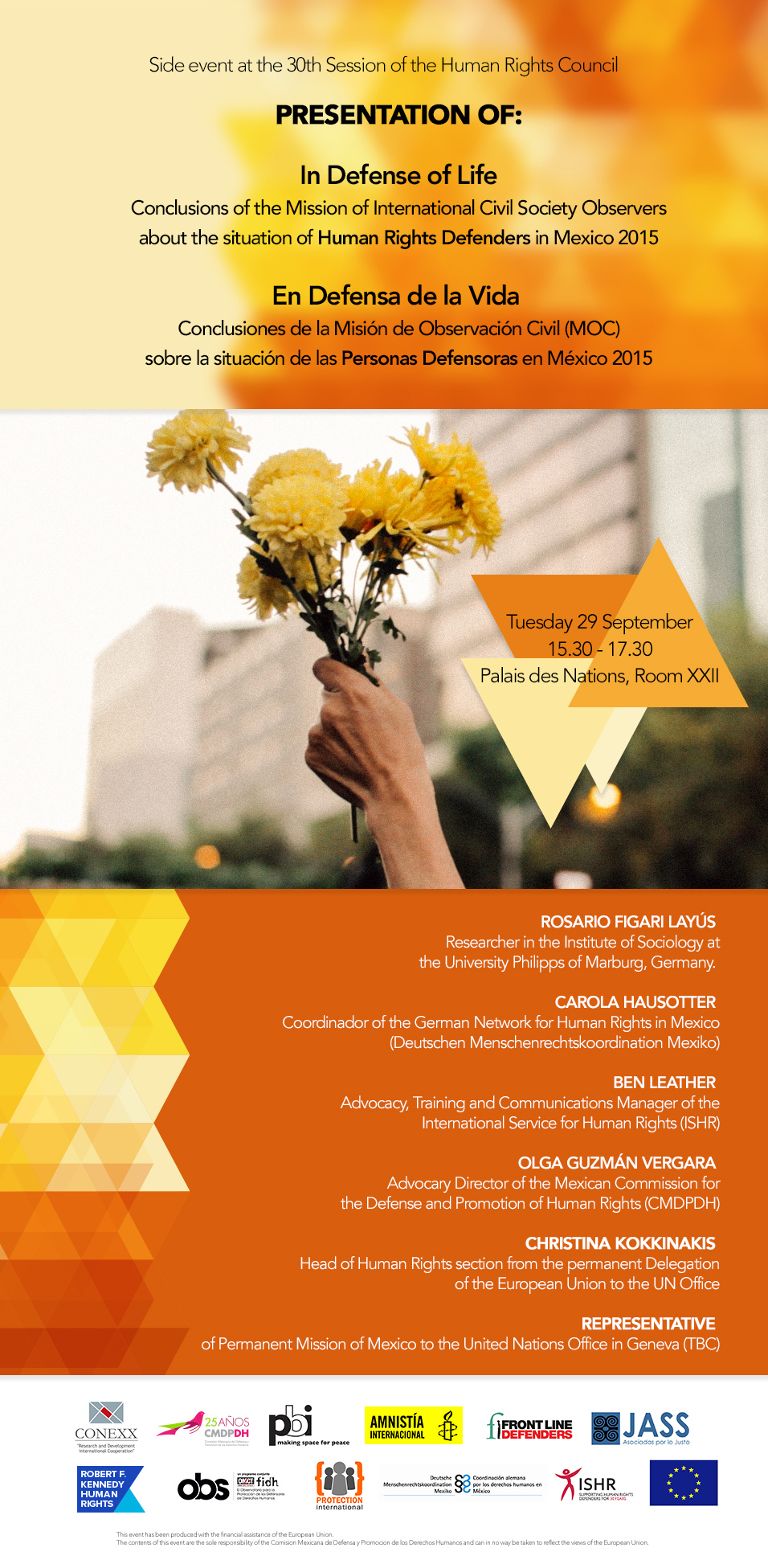
“In Defense of Life”: observer mission report to Mexico at side event Geneva

September 25, 2015

On Tuesday 29 September (15h30 – 17h30, Palais des Nations, Room XXII, Geneva), the CMDPDH,  Asociación Civil and ISHR organise a side event about the situation for human rights defenders in Mexico. [A Mission of International Observers visited Mexico in November 2015 and will present its conclusions – under the title “In Defense of Life” – to the Mexican Government within the framework of the 30th session of the Human Rights Council.]

Panelists in the event are::

  • Rosario Figari Layús – Researcher in the Institute for Interdisciplinary Research on Conflict and Violence (IKG) at the University of Bielefeld, Germany.
  • Carola Hausotter – Coordinador of the German Network for Human Rights in Mexico (Deutschen Menschenrechtskoordination Mexiko)
  • Ben Leather – Advocacy, Training and Communications Manager of the International Service for Human Rights (ISHR)
  • Olga Guzmán Vergara – Advocary Director of the Mexican Commission for the Defense and Promotion of Human Rights (CMDPDH)
  • Ambassador Jorge Lomónaco Tonda – Permanent Representative of Mexico to the UN in Geneva (TBC)
  • Christina Kokkinakis – Head of Human Rights section from the Permanent Delegation of the European Union to the UN in Geneva

Download the flyer: HUMAN RIGHTS IN MEXICO

see previous posts: https://thoolen.wordpress.com/tag/mexico/


Guidelines issued to protect human rights defenders in Sri Lanka

September 7, 2015

The Colombo Gazette of 17 July 2015 carried an article that is interesting in the light of efforts to create an enabling national environment for Human Rights Defenders in Sri Lanka:

The Human Rights Commission of Sri Lanka has issued guideline for state authorities to ensure the protection of Human Rights Defenders (HRD) including ensuring their freedom of association.

The Human Rights Commission noted that Human Rights defenders act as the voice of vulnerable person or group or community or society and engage to ensure universally recognized human rights and fundamental freedoms.

“They work very hard, for example; they document violations, reveal the human rights violations and help to redress these violations by peaceful means. HRDs are facing challenges in diverse political and social context at national, regional and international levels. Sometimes their activities are neglected or underestimated or seen as something negative by some of the authorities. Therefore they undergo severe risk when they carry out the activities to promote and protect human rights,” the Human Rights Commission said.

It said that the protection of HRDs is a corporate responsibility of the State, Civil societies and international communities. Although, State authorities have primary responsibility to protect the HRDs and ensure a conducive working environment where HRDs can operate free from hindrance and insecurity. All of them respect the rights of HRDs and support the activities of the HRDs to promote the overall enjoyment of human rights.

Human Rights Commission of Sri Lanka (HRCSL) as a National Human rights Institution (NHRI) has to perform as a defender of HRDs. HRCSL has serious concern for the Protection of HRDs. For this purpose the HRCSL has developed guideline for state authorities. These guidelines will assist the state authorities to protect the HRDs and ensure the internal dignity of the HRDs.

The guidelines call on State authorities to recognize the activities of the HRDs to protect and promote all human and fundamental freedoms which are guaranteed by the Sri Lankan laws including the Constitution of Sri Lanka and International human rights laws, be mindful of the fact that HRDs activities have the true intention to protect and promote human rights and fundamental freedom, are transparent, visible and accountable, are not a threat to state sovereignty, national unity and national security and are activate through peaceful means. 

The guidelines also note that all the human rights defenders or groups or organs of society shall be treated equally according to Article 12(2) of the Constitution which ensures “No citizen shall be discriminated against on the grounds of race, religion, language, caste, sex, political opinion, and place of birth or any one of such grounds”. Any special or unequal treatment or discrimination will be an express violation of Article 12 of the Constitution.

State authorities have also been told to recognize the freedom of association of human rights defenders or group or organs of society for a common purpose or joint action towards protecting and promoting human rights and fundamental freedom. Unreasonable restriction, suppression, dismissal, prohibition, negatively viewed or any such ways will be a sign of violation of the freedom of association which is guaranteed by Article 14 and 12 of the Constitution and other domestic laws.

State authorities should respect, protect and ensure the right of freedom of speech and expression of HRDs related to protect and promote human rights and fundamental freedom. Restrict, prohibit, show contempt, deform, criticize, comment negatively or any such ways will be an expression of violation of Article 14 and 12 of the Constitution.

HRCSL also notes that State authorities must ensure the right of movement of human rights defenders or groups or organs of society to meet the vulnerable groups particularly their rights violated or peaceful parade or travelling for peaceful gathering and seek, obtain and receive information for the purpose to facilitate the victim to seek appropriate remedies. If the movement of HRDs is unlawfully or unjustifiably restricted it violates article 14 of the Constitution.

https://thoolen.wordpress.com/2014/02/14/important-human-rights-council-side-event-on-11-march-to-be-followed-on-internet/

Guidelines issued to protect human rights defenders | Colombo Gazette.

Donors should work jointly against the wave of civil society repression

July 10, 2015

The Newsletter of the International Service for Human Rights of 5 June 2015 carried an interesting piece written by two representatives of donors that are very active in the area of protection human rights defenders.  Julie Broome, Director of Programmes with the Sigrid Rausing Trust, and Iva Dobichina, Programme Manager with the Open Society Foundation‘s Human Rights Initiative, wrote jointly about much-needed efforts to “turn the tide against the wave of civil society repression”.  The piece follows in toto below, but some of the key points are: Read the rest of this entry »

Further on Bahrain where the Judiciary is helping the State to repress Human Rights Defenders

July 8, 2015

Further to my post today on Nabeel Rajab [https://thoolen.wordpress.com/2015/07/08/bahrain-freenabeel-campaign-more-urgent-than-ever-in-view-of-resumption-usa-security-assistance/], I draw attention to the recent report by the Observatory for the Protection of Human Rights Defenders (FIDH/OMCT) “Bahrain: Publication of an International Mission Report: Imprisonment, torture and statelessness: The darkening reality of human rights defenders in Bahrain”.

Report OBS Bahrain_English
44 pages / 870 KB

Human rights defenders in Bahrain are operating in a shrinking space, says the Observatory in a report published on 25 June 2015. The report documents the judicial harassment of 11 human rights defenders including lawyers, teachers, doctors or bloggers. All have suffered or been threatened with imprisonment, torture or statelessness as a consequence of their activities in defense of human rights. Read the rest of this entry »

Scholars at Risk publishes first Academic Freedom Monitoring Report: Free2Think

June 23, 2015

SAR Free to Think report

“Attacks on higher education are at crisis levels”

Today, 23 June 2015, Scholars at Risk [SAR] released the first report of its Academic Freedom Monitoring Project at the United Nations in Geneva,: “Free to Think”. The culmination of four years of monitoring and analysis by SAR staff and researchers around the world, the report analyzes 333 attacks on higher education communities in 65 countries from January 2011 to May 2015, demonstrating the pressing need to raise awareness and document attacks on higher education: Read the rest of this entry »

3 July in Geneva: book launch “Conduct of Hostilities, the Practice, the Law and the Future”

June 23, 2015

The International Institute of Humanitarian Law (San Remo) is about to celebrate its 45th anniversary. In the context of its 15th Summer Course on International Humanitarian Law, it organizes a Book Launch to introduce the Proceedings of its last Round Table:  “Conduct of Hostilities, the Practice, the Law and the Future”. The launch is held on Friday 3 July 2015 at the United Nations Library in Geneva from 11 am to 1 pm.
In addition to the President if the IIHL, Professor, Fausto Pocar, and the Vice-President, Prof. Michel Veuthey, the following panelists will participate:

– Professor Marco Sassòli, Director, Department of International Law and International Organizations, University of Geneva (UNIGE)
– Mr. Laurent Gisel, Legal Adviser, International Committee of the Red Cross (ICRC)
– Dr. Nils Melzer, Senior Adviser, Security Policy Division of the Political Directorate, Swiss Federal Department of Foreign Affairs (FDFA).

The Institute’s next Round Table will focus on the important topic: The Distinction between International and Non-International Armed Conflicts:
Challenges for IHL? , to be held in San Remo between 3rd and 5th September 2015.

Please register for the UN Pass (required for this event) by Thursday 1 July at  http://bit.ly/1d3Mzth