On 27 May RIA Novosti picked up the press release by Human Rights Watch calling for four prominent human rights defenders allegedly in custody of an armed opposition group in Syria to be immediately released. HRW together with 45 co-signing organizations states that irregular armed opposition groups in Syria are threatening and harassing journalists and human rights defenders.“Abductions of human rights defenders by armed groups in Syria are an assault on the very freedoms the armed opposition groups claim to be fighting for”. Almost six months a group of armed men kidnapped human rights defenders Razan Zeitouneh [or Zaitouneh], Wael Hamada, Samira Khalil, and Nazem Hammadi in a city outside Damascus, then controlled by a number of armed opposition groups, but there has been no information on the status or whereabouts of Zeitouneh and her colleagues, and no group has claimed responsibility for their abduction.
(Picture taken May 25 shows the domestic and foreign passports of Russian rights defender Andrei Mironov, reportedly killed near Ukrainian town of Slavyansk. AFP POOL-/AFP/GETTY IMAGES)
“It’s hard for me to believe that Andrei Mironovis dead” writes Olivia Ward, Foreign Affairs Reporter of the Toronto Star on 25 May 2014. Indeed a terrible shock. I met him for the first time in 2004 when he accompanied the MEA Laureate Lida Yusupova of Memorial to the ceremony in Geneva. According to an Agence France- Presse report from Slavyansk, Ukraine, the veteran Russian human rights defender and sometime war zone fixer, used up the last of his nine lives on Sunday. He was acting as a translator for Italian photojournalist Andrea Rocchelli, who was also killed. According to a French photographer who escaped with leg wounds, the two men were hit by shrapnel from mortar shells as government troops and pro-Russian separatists continued to battle for territory in eastern Ukraine.
Olivia Ward describes Andrei as a “slight, self-effacing man of 60, with a puckish sense of humour, he belied his frail appearance with an iron will to do good in the world. In 1986, that got him a year in a Soviet labour camp as an “anti Soviet dissident” – a time he used to channel his talent for languages, including French and Italian. Nor did he let up on government abuses after the fall of the Soviet Union. As a human rights campaigner linked with the venerable rights organization Memorial , he snapped at the heels of Boris Yeltsin’s and Vladimir Putin’s governments, especially during the two bloody wars when Russian troops battled Chechen separatist fighters…..“You don’t understand,” he rasped. “I have to go and witness what is happening. If I don’t, who will?”
“Andrei dodged so many bullets in his decades of battling impunity that it is hard to believe he is gone. It would be harder still if the truth were buried along with him” concludes Olivia Ward, who covered the former Soviet Union as bureau chief and correspondent from 1992 to 2002. For the full story see: Death in Ukraine: bitter end for Russian human rights hero | Toronto Star.
Under the title “From threats to opportunities: Business and Human Rights Defenders” the International Service for Human Rights [ISHR] organises a side event on Friday 13 June 2014, 12h15 – 13h45 in Room IX of Palais des Nations, Geneva. Note that it will be the first public appearance of the new Rapporteur on Human Rights Defenders, Michael Forst. (https://thoolen.wordpress.com/2014/05/08/finally-it-is-final-michel-forst-the-new-rapporteur-on-human-rights-defenders/). For those unable to attend, a live webcast will be available at www.ishr.ch/webcast. You may also follow the event on Twitter @ISHRGlobal, using the hashtag #HRDs.
It is late in the weekend but perhaps you still find time for an interesting long read by Suzanne Nossel, the Executive Director of the PEN American Center. She wrote this for Foreign Policy and it was reprinted in the Pittsburgh Post of 25 May. The article is a good overview with what has gone wrong recently with an increasing number of world leaders showing not to care much about human rights (accusations), an attitude which she dubs “imperviousness”. I am personally not convinced that this is an unstoppable tendency but we seem indeed to be in quite a dip compared to say a decade ago when it comes to the restraining power of the human rights movement. So the depressive conclusion of this relatively long piece is not too unexpected: “The traditional tools of human rights activism — exposes, media attention and pressure from mostly credible Western governments — are falling short when it comes to some of the major challenges of the day. It is as if an expanding group of leaders has built up antibodies and these leaders can now resist where they previously would have succumbed. While it’s not time to give up on the traditional treatments, human-rights defenders need to get into the lab quickly and develop some new tactics before the virus of imperviousness spreads even further.” It would be interesting to get views from others on this question.
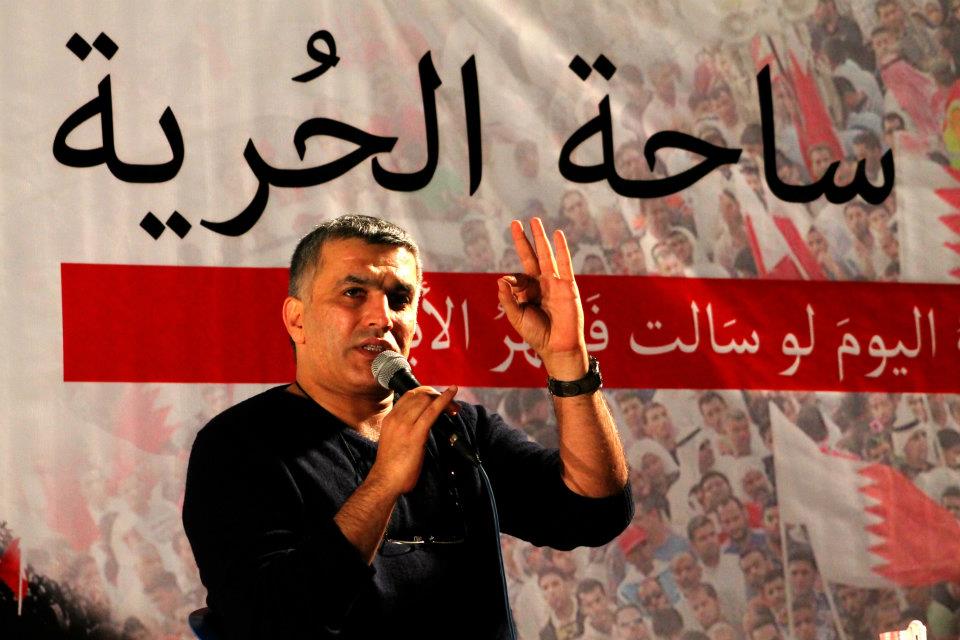
According to AhlulBayt News Agency prominent human rights defender Nabeel Rajab has been released in Bahrain today, 24 May 2014. The Bahrain Centre for Human Rights (BCHR) and the Gulf Centre for Human Rights (GCHR) welcome back their – respectively – President of the BCHR and General Secretary of the GCHR, free after a detention that lasted approximately two years. The two organisations warn that thousands of others continue to be imprisoned including BCHR and GCHR founder Abdulhadi Al-Khawaja and Naji Fateel. It is to be noted that Nabeel Rajab is being released because he served the full length of his arbitrary detention sentence.
Nabeel Rajab was initially sentenced on 16 August 2012, to three years in prison for advocating peaceful demonstrations to defend the civil and human rights of all the citizens in the country. On 11 December 2012, the Court of Appeal reduced the sentences to two years in prison. During his detention, he faced dire conditions and was subjected to ill-treatment and torture. The United Nations Working Group on Arbitrary Detention (WGAD) found that Nabeel’s detention was arbitrary as it resulted from the exercise of his universally recognized human rights. Despite this decision by the WGAD, all requests submitted to the authorities for an early release were summarily rejected.
With the introduction: “Human rights defenders are people like you – people who stand up for the right of others in the face of risk. In the U.S., human rights defenders face specific threats that impact their collective ability to work and seek justice“, five NGOs based in the USA and working for human rights in the US call on other human rights defenders to register for a training course on human rights education on Wednesday 28 May 2h00 pm to 3h00 pm (EDT). Dream Defenders, Maryland Legal Aid, the US Human Rights Network [USHRN], the Center for Constitutional Rights, and the Center for Reproductive Rights come together to teach about the work of U.S.-based human rights defenders and the special protections they have under international law; and to have the opportunity to hear from fellow human rights defenders about how they have successfully used these international protections and other forms of international advocacy to protect themselves and their ability to work. Speakers:
Ejim Dike, Executive Director of the US Human Rights Network
Sunita Patel, Staff Attorney at Center for Constitutional Rights
Karla Torres, Human Rights Fellow at Center for Reproductive Rights
Ahmad Abuznaid, Legal and Policy Director at Dream Defenders
Reena Shah, Director of Human Rights Project at Maryland Legal Aid
The foundation “Cartooning for Peace” went to Syria-Palestinian Hani Abbas and Egyptian Doaa Eladl for their work. Former Secretary General Kofi Annan handed them the international award for press cartoonists in Geneva, as part of World Press Day. French cartoonist Plantu gave Euronews his views on the significance of using cartoons as a form of expression: “We’re trying to show the level of resistance that exists today, from the perspective of the very people that allow us to understand the word “resistance”, the cartoonists that ultimately become the foot soldiers of democracy. In other words, they’re railing against different powers, not just the power of their editors but also against political and religious power.”
From Lake Geneva, euronews correspondent Wolfgang Spindler said: “Political cartoons can be subversive, provocative and amusing – they make us smile, they give us pause for thought. But we very often forget that the cartoonists behind them sometimes have to risk their lives daily for the sake of their work.” via: http://www.euronews.com/2014/05/05/drawing-for-peace
The cartoon exhibition on the banks of Lake Geneva runs until the beginning of July and then moves to Sarajevo.
On Tuesday 27 May 2014, will take place a Conference on the human rights situation in Belarus, from 14h00 –17h00 in the International Conference Centre in Geneva (room 3)
Speakers include:
Florian Irminger, Human Rights House Foundation
Tatsiana Reviaka, Human Rights Centre “Viasna” and Belarusian Human Rights House
Aleh Hulak, Belarusian Helsinki Committee
Anna Gerasimova, Belarusian Human Rights House
Volodymyr Yavorskyy, Working group on the development of the Guidelines on Definition of Political Prisoner
Andrzej Poczobut, journalist
Nicolas Agostini, International Federation for Human Rights (FIDH)
Andrei Paluda, Human Rights Centre “Viasna”
Pavel Levinau, Belarusian Helsinki Committee
Natallia Pinchuk, wife of Belarus political prisoner Ales Bialaitski
Marina Adamovich, wife of Belarus political prisoner Mikola Statkevich
For more information contact: anna.innocenti[at]humanrightshouse.org
The meeting is cosponsored by Amnesty International, Human Rights Watch, FIDH, Civicus, Belarusian Human Rights House and the Human Rights House Foundation.
From 20-21 May 2014 there was in Dushanbe, Tajikistan, a Regional Workshop on Implementing the Human Dimension Commitments and Enhancing the role of Civil Society. An important contribution was the joint statement by six NGOs containing recommendations to protect human rights defenders in Central Asia. The text in its totality follows below: Read the rest of this entry »



 Hans Thoolen on Human Rights Defenders and their awards