Posts Tagged ‘PEN American Center’

PEN: Number of Jailed Writers Tops 400 for First Time in 2025

May 14, 2026

On 12 May 2026 PEN America sounded the alarm on a deepening global crackdown on free expression, reporting in its Freedom to Write Index that more than 400 writers are behind bars for the first time since the Index launched in 2019.

In 2025, a total of 401 writers were jailed across 44 countries – up from 375 writers in 40 countries the year before. Over the past seven years, the number of jailed writers worldwide has risen by 68 percent, underscoring a steady and alarming escalation in the suppression of dissent.

China remains the world’s leading jailer of writers, with 119 cases – making it the only country to exceed 100 writers held behind bars. The sharpest increase came from Iran, where authorities carried out 17 new arrests, driving numbers back toward the peak levels seen during the 2022 ‘Woman, Life, Freedom’ protests. The spike signals a renewed and aggressive campaign to silence critical voices. The escalating suppression in Iran intensified in the aftermath of the June 2025 war with Israel, sweeping up both newly targeted writers and long-persecuted dissident voices. Among those arrested were online commentator Hossein Ronaghi, who was detained in June; a group of scholars and translators detained in November, including economists Parviz Sedaghat and Mohammad Maljoo, sociologist Mahsa Asadollanejad, and writer and translator Shirin Karimi; and human rights defenders and authors Narges Mohammadi and Sepideh Gholian, who were violently re-arrested while speaking at a memorial service in December.

Iran was one of three countries among the top 10 jailers of writers that were simultaneously engaged in armed conflict in 2025, along with Russia and Israel/Occupied Palestinian Territory. Authorities in these three countries repeatedly targeted writers who used anti-war language or themes in their poetry, music, scripts, commentaries, articles, or literary output, a key pattern that emerged in the 2025 data. 

In Israel/Occupied Palestinian Territory, six writers have been detained by the Israeli government over anti-war statements. Palestinian writers and commentators Mohamed Al-Atrash, Nawaf El-Amer, Radwan Qatanani, Rula Hassanein,and scholar Anwar Rostom were detained on charges of incitement or with no charges at all, in addition to Jewish-Israeli journalist and commentator Israel Frey who was investigated for terrorism, because of their commentary on the war, the genocide, and the occupation. 

In Russia the government held 18 writers in prison or detention in 2025, most targeted for their anti-war expression or suspected involvement in anti-war activity. In March, a Russian military court sentenced historian and columnist Alexander Skobov to 16 years in prison for his anti-war posts on social media. Other writers opposed to the war have fled into exile to avoid prosecution or jailing for their dissenting viewpoints.Overall, the top 10 top jailers of writers are China and its autonomous regions, including Xinjiang, Tibet, and Hong Kong (119); Iran (53); Saudi Arabia (27); Vietnam (24); Türkiye (22); Israel and the Occupied Palestinian Territory (21); Russia (18); Belarus (17); Egypt (13); and Myanmar (10).  [https://iranfocus.com/human-rights/57848-record-number-of-imprisoned-writers-worldwide-iran-ranks-second-with-53-jailed-writers/]

Several countries appeared in this year’s Index for the first time including Togo, Mozambique, and the United States. The U.S. case centers on the weeks-long detention of Sami Hamdi, a British opinion writer and columnist, who was detained in what PEN America views as part of the U.S. government’s weaponization of Immigration and Customs Enforcement (ICE). Hamdi, an outspoken critic of Israel, was on a speaking tour and had just attended a conference when ICE officers stopped him at San Francisco International Airport and held him in custody for two weeks.

The fact that the United States is in our Freedom to Write Index for the first time should be a sharp wake-up call for everyone in the country who claims to value free expression,” said Liesl Gerntholtz, managing director of the Freedom To Write Center. “No government can misuse its own detention and immigration systems to silence or intimidate independent voices and call itself a democracy.” 

For more information and to download the full report visit the 2025 Freedom to Write Index.
https://pen.org/press-release/2025-freedom-to-write-index

Writer Tran Duc Thach sentenced to 12 years in Vietnam

December 22, 2020

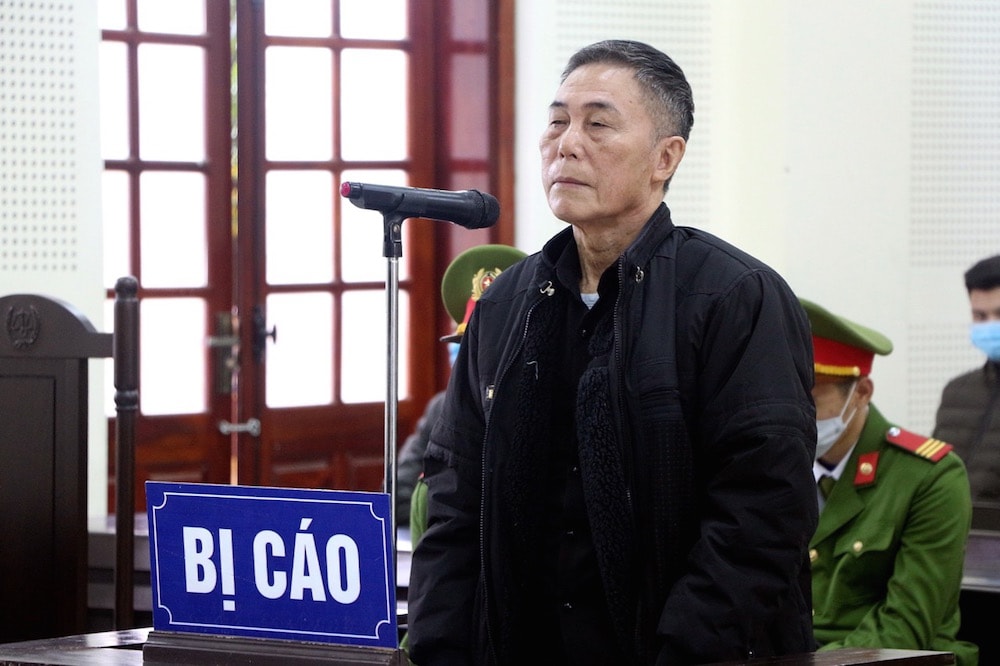
PEN America reported on 17 December 2020 that writer Tran Duc Thach was sentenced to 12 years in Vietnamese prison.

This picture taken and released by the Vietnam News Agency on 15 December 2020 shows Vietnamese writer Tran Duc Thach during his court trial in Nghe An province, as he was sentenced to 12 years in jail. -/Vietnam News Agency/AFP via Getty Images

Vietnamese writer Tran Duc Thach was convicted on charges of subversion under Article 109 of the country’s criminal code. He was arrested in April for Facebook posts criticizing corruption in government and human rights abuses in the country.

Poet, blogger, and human rights defender Tran Duc Thach was sentenced to 12 years in prison and three years probation. PEN America condemned the sentencing today as a repressive attack on free expression in the country. “This is a shocking and shameful outcome in a case that never should have been brought to trial in the first place. Thach should be celebrated for his civic engagement and advocacy, not subjected to mistreatment and imprisonment,” said James Tager, deputy director of free expression research and policy at PEN America. “This draconian sentence is another blatant violation of basic human rights and stifling of freedom of expression by the Vietnamese state in the name of national security. We call for his immediate and unconditional release.

Thach was initially arrested on April 23 for “activities against the people’s government.” Authorities reportedly used several Facebook posts he published criticizing government corruption and human rights violations as the primary implicating evidence. During the trial, provincial prosecutors claimed that Thach’s activism and writings “threatened social stability, encroached upon national independence and socialism, reduced people’s trust in the political institution of the state of Vietnam, and infringed upon national security and social safety and order.”

Thach is a prolific writer, whose work includes his 1988 novel Doi Ban Tu (Two Companions in Prison), his memoir Ho Chon Nguoi Am Anh (A Haunting Collective Grave), and his poetry collection Dieu Chua Thay (Things Still Untold). His writing commonly deals with human rights issues within Vietnam. Thach is also co-founder of the Brotherhood for Democracy, a civil society group that has been repeatedly targeted by authorities for their activism, with several members of the group apprehended in recent years. Thach has faced repeated harassment for his writing and his activism.

Thach is just one of those who has been targeted by the Vietnamese government’s heightened campaign against internet personalities, rights advocates, and independent journalists, a campaign that has become more pronounced in the run-up to the country’s 13th National Congress scheduled for January 2021. According to the NGO Vietnam Human Rights Defenders, there have been 17 subversion-based convictions this year alone while 31 individuals are currently held in pre-trial detention. Additionally, the government has leveraged the pandemic to arrest dissidents on the pretext of public security and stifling COVID-related disinformation.

PEN America has been active in advocating for other targeted or imprisoned Vietnamese writers, including Pham Doan TrangNguyen Ngoc Nhu Quynh (“Mother Mushroom”), and Nguyen Huu Vinh, and Nguyen Thi Minh Thuy. In PEN America’s 2019 Freedom to Write Index, released earlier this year, the organization noted that the lengthy imprisonment of bloggers Truong Duy Nhat and Ho Van Hai “demonstrate the longstanding risks associated with online expression in the country.”

See also: https://humanrightsdefenders.blog/2020/12/01/facebook-and-youtube-are-allowing-themselves-to-become-tools-of-the-vietnamese-authorities-censorship-and-harassment/

Charlie Hebdo and PEN: free speech deserves protection, not necessarily an award

May 6, 2015

Last night two members of Charlie Hebdo, the French satirical magazine, received – under thundering applause –  the “James C. Goodale Freedom of Expression Courage Award” from American PEN. It followed a raging 10-day debate over free speech, blasphemy and Islamophobia in the social media and op-ed pages worldwide. It started when six prominent writers, including Peter Carey, Michael Ondaatje and Francine Prose, pulled out from the gala dinner to protest what they saw as Charlie Hebdo’s racist and Islamophobic content.  Some 200 PEN members signed a letter of protest saying that the award crossed a line between “staunchly supporting expression that violates the acceptable, and enthusiastically rewarding such expression.” [“To the section of the French population that is already marginalized, embattled, and victimized,” they wrote, “Charlie Hebdo’s cartoons of the Prophet must be seen as being intended to cause further humiliation and suffering.”]

Others, such as Salman Rushdie,vigorously defended Charlie Hebdo and the prize. PEN quickly found new table hosts, including the cartoonist Art Spiegelman, and the writers Azar Nafisi and Neil Gaiman.

Even The Economist on 5 May stepped into the debate with a historical analysis of Charlie Hebdo [“Since it was founded in 1970, with its roots firmly on the political left, Charlie Hebdohas prided itself on a defiant spirit of irreverent provocation. This fits a long tradition of savage French satire, dating back to the bawdy anti-royalist pre-revolutionary cartoons mocking Marie-Antoinette and King Louis XVI. Many of Charlie Hebdo’s cartoons are tasteless, silly and offensive. So silly, in fact, that its circulation had dropped to just 45,000 or so before the terrorist attacks. Most of its targets are political. It gave Nicolas Sarkozy, a former centre-right president, a particularly hard time. These days, Marine Le Pen, leader of the far-right National Front, is a favourite figure of ridicule. Indeed, an analysis by Le Monde newspaper shows that, between 2005 and 2015, 336 of their 523 covers were political, and only 38 religious. Of the latter, 21 concerned Christianity, including an image of a toothy Virgin Mary, her legs apart, giving birth to baby Jesus. Just seven portrayed only Islam.”]

But I think that is not really the issue here. We all (well 99%) agree with the statement of Charlie Hebdo editor Gérard Biard: Being shocked is part of democratic debate ..Being shot is not. SoI stand by my ‘Je suis Charlie’ position [https://thoolen.wordpress.com/2015/01/08/charlie-hebdo-attack-intolerance-extreme/], but this does not mean that the magazine should get an award. Many (dead) journalists do not get awards. Awards normally have a bit of ‘role model’ function (in addition to recognizing courage and giving support). The lone protester in front of the building where the ceremony took place held a handwritten sign that in my view captures the issue well: “Free speech does not deserve death / Abusive speech does not deserve an award.”

It is pity that the controversy overshadowed the PEN’s Freedom to Write Award 2015, given to the Azerbaijani journalist Khadija Ismayilova, who has been imprisoned since early December after writing about corruption allegations against the family of Azerbaijan’s president, Ilham Aliyev. [http://www.brandsaviors.com/thedigest/award/freedom-write-award]

among the many sources:

http://www.nytimes.com/2015/05/06/nyregion/after-protests-charlie-hebdo-members-receive-standing-ovation-at-pen-gala.html?_r=0

The Economist explains: The new Charlie Hebdo controversy | The Economist.

http://www.nbcnews.com/storyline/paris-magazine-attack/award-french-magazine-charlie-hebdo-divides-prominent-writers-n353901

Have human rights defenders encountered the end of their shaming powers?

May 25, 2014

It is late in the weekend but perhaps you still find time for an interesting long read by Suzanne Nossel, the Executive Director of the PEN American Center. She wrote this for Foreign Policy and it was reprinted in the Pittsburgh Post of 25 May. The article is a good overview with what has gone wrong recently with an increasing number of world leaders showing not to care much about human rights (accusations), an attitude which she dubs “imperviousness”. I am personally not convinced that this is an unstoppable tendency but we seem indeed to be in quite a dip compared to say a decade ago when it comes to the restraining power of the human rights movement. So the depressive conclusion of this relatively long piece is not too unexpected:  “The traditional tools of human rights activism — exposes, media attention and pressure from mostly credible Western governments — are falling short when it comes to some of the major challenges of the day. It is as if an expanding group of leaders has built up antibodies and these leaders can now resist where they previously would have succumbed. While it’s not time to give up on the traditional treatments, human-rights defenders need to get into the lab quickly and develop some new tactics before the virus of imperviousness spreads even further.” It would be interesting to get views from others on this question.

Read more: http://www.post-gazette.com/opinion/2014/05/25/Impervious-to-shame/stories/201405250049#ixzz32l7PrPqD

Why so many rulers are impervious to shame – Pittsburgh Post-Gazette.

PEN Prize to Honor Jailed Turkish Translator Ayşe Berktay

May 21, 2013

(Ayşe Berktay in Bakırköy Women’s Prison – Photo courtesy Ali Berktay)

On 15 April 2013 PEN American Center  named Ayşe Berktay, a translator, writer, and activist in Turkey, as the recipient of its 2013 PEN/Barbara Goldsmith Freedom to Write Award. Berktay, a leading advocate for peace, women’s rights, and Kurdish rights in Turkey, was arrested on October 3, 2011, and is currently being tried for “membership in an illegal organization” for her pro-Kurdish cultural advocacy. One of at least 130 writers currently in prison or on trial in Turkey, many on false terrorism-related charges, she could face up to 15 years in prison if convicted. Read the rest of this entry »