Posts Tagged ‘freedom expression’

PEN: Number of Jailed Writers Tops 400 for First Time in 2025

May 14, 2026

On 12 May 2026 PEN America sounded the alarm on a deepening global crackdown on free expression, reporting in its Freedom to Write Index that more than 400 writers are behind bars for the first time since the Index launched in 2019.

In 2025, a total of 401 writers were jailed across 44 countries – up from 375 writers in 40 countries the year before. Over the past seven years, the number of jailed writers worldwide has risen by 68 percent, underscoring a steady and alarming escalation in the suppression of dissent.

China remains the world’s leading jailer of writers, with 119 cases – making it the only country to exceed 100 writers held behind bars. The sharpest increase came from Iran, where authorities carried out 17 new arrests, driving numbers back toward the peak levels seen during the 2022 ‘Woman, Life, Freedom’ protests. The spike signals a renewed and aggressive campaign to silence critical voices. The escalating suppression in Iran intensified in the aftermath of the June 2025 war with Israel, sweeping up both newly targeted writers and long-persecuted dissident voices. Among those arrested were online commentator Hossein Ronaghi, who was detained in June; a group of scholars and translators detained in November, including economists Parviz Sedaghat and Mohammad Maljoo, sociologist Mahsa Asadollanejad, and writer and translator Shirin Karimi; and human rights defenders and authors Narges Mohammadi and Sepideh Gholian, who were violently re-arrested while speaking at a memorial service in December.

Iran was one of three countries among the top 10 jailers of writers that were simultaneously engaged in armed conflict in 2025, along with Russia and Israel/Occupied Palestinian Territory. Authorities in these three countries repeatedly targeted writers who used anti-war language or themes in their poetry, music, scripts, commentaries, articles, or literary output, a key pattern that emerged in the 2025 data. 

In Israel/Occupied Palestinian Territory, six writers have been detained by the Israeli government over anti-war statements. Palestinian writers and commentators Mohamed Al-Atrash, Nawaf El-Amer, Radwan Qatanani, Rula Hassanein,and scholar Anwar Rostom were detained on charges of incitement or with no charges at all, in addition to Jewish-Israeli journalist and commentator Israel Frey who was investigated for terrorism, because of their commentary on the war, the genocide, and the occupation. 

In Russia the government held 18 writers in prison or detention in 2025, most targeted for their anti-war expression or suspected involvement in anti-war activity. In March, a Russian military court sentenced historian and columnist Alexander Skobov to 16 years in prison for his anti-war posts on social media. Other writers opposed to the war have fled into exile to avoid prosecution or jailing for their dissenting viewpoints.Overall, the top 10 top jailers of writers are China and its autonomous regions, including Xinjiang, Tibet, and Hong Kong (119); Iran (53); Saudi Arabia (27); Vietnam (24); Türkiye (22); Israel and the Occupied Palestinian Territory (21); Russia (18); Belarus (17); Egypt (13); and Myanmar (10).  [https://iranfocus.com/human-rights/57848-record-number-of-imprisoned-writers-worldwide-iran-ranks-second-with-53-jailed-writers/]

Several countries appeared in this year’s Index for the first time including Togo, Mozambique, and the United States. The U.S. case centers on the weeks-long detention of Sami Hamdi, a British opinion writer and columnist, who was detained in what PEN America views as part of the U.S. government’s weaponization of Immigration and Customs Enforcement (ICE). Hamdi, an outspoken critic of Israel, was on a speaking tour and had just attended a conference when ICE officers stopped him at San Francisco International Airport and held him in custody for two weeks.

The fact that the United States is in our Freedom to Write Index for the first time should be a sharp wake-up call for everyone in the country who claims to value free expression,” said Liesl Gerntholtz, managing director of the Freedom To Write Center. “No government can misuse its own detention and immigration systems to silence or intimidate independent voices and call itself a democracy.” 

For more information and to download the full report visit the 2025 Freedom to Write Index.

https://pen.org/press-release/2025-freedom-to-write-index

African Cartoonists work under pressure

March 30, 2026
Cartoonists under pressure

Laurent Soucaille wrote on 2 March 2026 for the New African Magazine that “African press cartoonists are making greater use of social media. While this allows them to escape certain forms of censorship, they are still subject to threats.

These are difficult times for cartoonists and press caricaturists concludes a report published on 2 March 2026 under the authority of UNESCO and compiled by various press freedom organisations, including Cartooning for Peace and Reporters Without Borders. The report highlights violations of the right to caricature, even in countries that were previously considered ‘free’, foremost among them the United States. Of course, the most serious violations are found in the Middle East, Russia and China, not to mention the specific cases of Gaza and Ukraine. The situation has deteriorated particularly badly in Turkey and India, the authors lament.

In Africa, the situation is more mixed: a multitude of online media outlets have emerged in recent years, opening up new space for cartoonists, while opportunities are becoming scarcer in the traditional press. ‘In addition, many cartoonists have been able to use social media as a means of dissemination, notably by creating memes,’ notes Kenyan journalist Patrick Gathara, himself a cartoonist.

However, he acknowledges that over the past two years, the situation for African cartoonists has become tense, particularly in East and Southern Africa. In Kenya, in December 2024, the mysterious disappearance of Kibet Bull, who was released a month later, ‘marked a dangerous escalation in the state’s response to online reaction’. The case of the cartoonist, who was admittedly not very complimentary towards President William Ruto, ‘fits into a broader context of abductions targeting online influencers during a period of heightened political tension’.

Other cases are symptomatic, such as that of Jimmy Spire, known as ‘Ssentongo’, in Uganda. The cartoonist echoed a campaign denouncing the deterioration of public services in Kampala, attracting both the hostility of the authorities and the support of human rights defenders in his country and in the West. The cartoonist became both an influential civil society actor and a journalist vulnerable to pressure and threats.

The report also mentions Congolese cartoonist Kayene, who died in Rwanda in 2024. ‘His case highlights the precarious situation of cartoonists working across borders in a region where protection frameworks for artists at risk remain weak, informal and unreliable,’ comments Patrick Gathara.

In South Africa, legal and institutional pressures are the main threat. In a country where freedom of expression is protected, cartoonists are less exposed to violence but remain vulnerable to defamation lawsuits, political intimidation, editorial caution or ‘fabricated public outrage’.

This phenomenon affects many countries around the world, where the intended effect of cartoons aimed at a select readership is exaggerated and distorted on social media. ‘It takes a lot of determination to be a satirical cartoonist today. It’s no longer enough to have talent and ideas, you also need the energy to defend them and endure being insulted and vilified by thousands of internet users,’ says Riss, editor-in-chief of Charlie Hebdo, the French satirical weekly magazine.

With regard to North Africa, it is not surprising that the report expresses concern about threats to press freedom, and therefore to cartoonists, in Egypt. ‘Pre-trial detention is becoming a new weapon for the regime to silence those who inform and debate, through the abuse of anti-terrorism laws,’ the report states indignantly.

Across the continent, the document – which does not claim to be exhaustive – summarises three major trends that characterise a ‘rapidly changing’ landscape. First, cartoonists are increasingly seen as political actors. From Kenya to Nigeria to Zimbabwe, ‘the majority of political elites view visual satire as a form of mobilisation rather than commentary’.

As online youth movements organise, cartoons often become ‘symbols of rallying, making cartoonists early and visible targets of repression,’ the report summarises.

Secondly, it notes that ‘soft censorship’ is developing more rapidly than open violence; while kidnappings and threats persist, governments and institutions are increasingly turning to bureaucratic or reputation-damaging tools. These threats relate to accreditations, take the form of investigations by professional bodies, bans and suspensions of newspapers, defamation lawsuits and online smear campaigns. Not to mention very broad interpretations of laws relating to ‘insults’ or ‘cybercrime’. As a result, “these more discreet control mechanisms create a climate of fear and self-censorship while avoiding the scrutiny of the rest of the world, which is more sensitive to physical repression.

Thirdly, the report points out, digital platforms have both increased the reach and the risks. Most African cartoonists now publish mainly on social media. While this allows them to bypass traditional editorial filters, it also exposes them to direct state surveillance, harassment by bots and political control. In this context, ‘virality promotes influence, but also vulnerability’ for press cartoonists.

By publishing mainly on social media, African cartoonists bypass traditional editorial filters, but are nonetheless exposed to direct state surveillance, harassment by bots and political control.

For earlier posts re cartoonists see: https://humanrightsdefenders.blog/tag/cartoons/

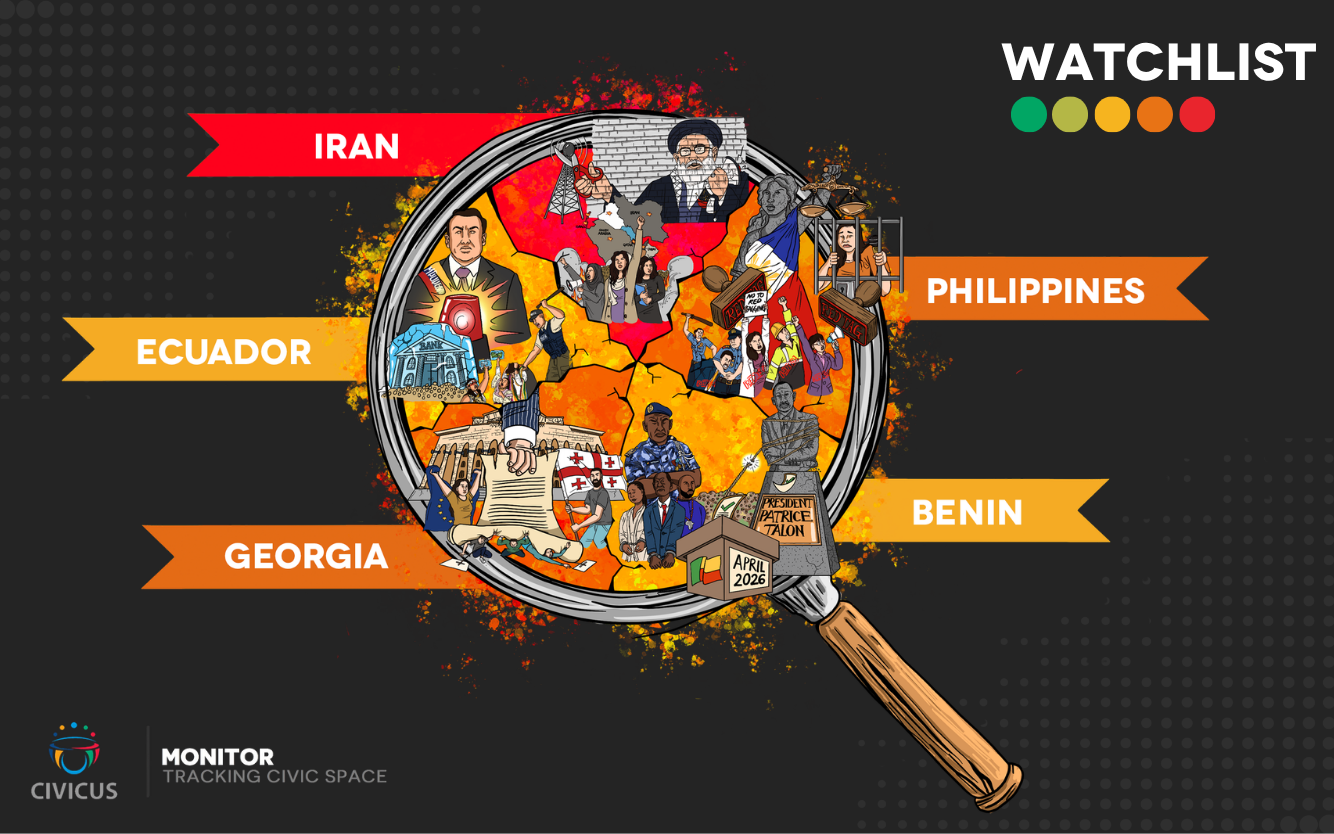
CIVICUS Monitor Watchlist of March 2026 is out

March 28, 2026
GlobalAnnouncement.March2026 1

The March 2026 Watchlist from the CIVICUS Monitor highlights five countries where civic freedoms are deteriorating at an alarming pace: Ecuador, Georgia, Iran, the Philippines and Benin. Each faces escalating restrictions on fundamental rights, including freedoms of expression, association and peaceful assembly. The Watchlist draws on research findings, partner input and testimony from activists on the ground, and signals where urgent international attention is needed.

CIVICUS MONITOR CIVIC SPACE RATINGS:

 OPENNARROWEDOBSTRUCTEDREPRESSEDCLOSED

Ecuador
Civic space rating: Obstructed 
Ecuador’s government has increasingly relied on militarised security measures, invoking an “internal armed conflict” to justify exceptional powers. Indigenous-led protests in 2025 were met with lethal force, arbitrary detentions and internet disruptions. Environmental and Indigenous leaders face criminalisation, with more than 200 social leaders investigated or prosecuted. A 2025 law has expanded state control over civil society organisations, enabling account freezes and burdensome reporting. Journalists face killings, attacks and suspensions of media outlets, all unfolding amid a broader erosion of judicial independence.

See full country announcement

Georgia
Civic space rating: Repressed
Georgia has seen a dramatic decline in civic space, marked by mass protests since late 2024 and heavy-handed police responses. Hundreds have been detained, tortured or investigated. New laws restrict protests, impose “foreign agent” requirements on civil society and media, and threaten criminal penalties for receiving foreign funding. Opposition parties and leaders face politically motivated charges, and new rules bar many civil society actors from political participation for years.

See full country announcement

Iran
Civic space rating: Closed
Iran’s civic space, already severely restricted, has worsened following mass protests over economic and political grievances. Security forces killed thousands of protesters in January 2026 during a nationwide internet blackout, and tens of thousands were arrested. After regional airstrikes in February 2026, authorities imposed another shutdown and intensified censorship. Journalists and activists face extreme risk, and some detainees now face the death penalty. Despite repression, demonstrations continue following the death of the Supreme Leader.

See full country announcement

The Philippines
Civic space rating: Repressed
Civic space in the Philippines remains under pressure, with police violence and mass arrests during anti-corruption protests in 2025. Dozens of protesters face sedition charges under cybercrime laws. Human rights defenders are frequently targeted, including through fabricated terrorism-financing cases. Red-tagging—accusing critics of communist links—remains widespread. Journalists also face prosecution, including the conviction of reporter Frenchie Mae Cumpio after years of pre-trial detention.

See full country announcement

Benin
Civic space rating: Obstructed 
Benin approaches its April 2026 presidential election with shrinking democratic space. Strict electoral rules have limited the field to two approved candidates, and the January 2026 legislative elections produced a parliament without opposition representation. Authorities increasingly use the Digital Code to prosecute journalists and critics, while media outlets face suspensions and mandatory government messaging. Protests are routinely banned or dispersed, and fear of reprisals has led to widespread self-censorship.

See full country announcement

https://www.civicus.org/index.php/media-resources/news/8201-civicus-monitor-watchlist-march-2026

Chinese court says human rights defender Xie Yang admits to crimes

May 8, 2017

Read the rest of this entry »