This 5 minute video of the ProtectDefenders.eu 2016 Annual Beneficiaries’ Meeting, held in Brussels on the 29 November 2016 is now available on Your Tube. The motto was “Defending Human Rights is not a crime – #DefendersNotCriminals”.
share information on human rights defenders, with special focus on human rights awards and laureates
This 5 minute video of the ProtectDefenders.eu 2016 Annual Beneficiaries’ Meeting, held in Brussels on the 29 November 2016 is now available on Your Tube. The motto was “Defending Human Rights is not a crime – #DefendersNotCriminals”.

The United States led on Tuesday 18 April what it (and not many others) dubbed a ‘historic‘ U.N. Security Council meeting on the link between rights abuses and conflict, but it had to drop a push for the broad issue of human rights to become a fixed item of the Security Council’s agenda when it appeared that at least six members would oppose it [Russia, China, Egypt, Ethiopia, Kazakhstan and Bolivia were against the move and Senegal’s support was uncertain]. The United States, council president for April, did not risk the measure being put to a rare procedural vote, which requires nine in favour, and vetoes cannot be used. The opposing council members say rights discussion should be confined to the Geneva-based Human Rights Council – which Washington accuses of being anti-Israel and has threatened to quit – and the 193-member U.N. General Assembly third committee. Here is some of the analysis:
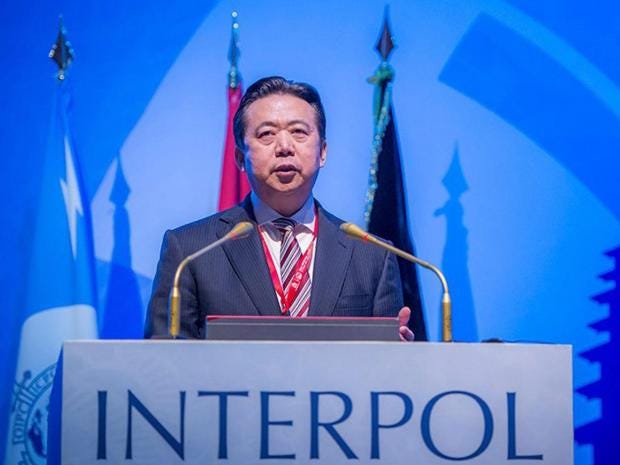
Sources:
http://www.france24.com/en/20170405-china-dissident-sees-threat-new-interpol-chief
On 4 April 2017 the European Court of Human Rights rendered a judgment1 in the case of Milisavljević v. Serbia (application no. 50123/06) in which it unanimously held that there had been a violation of Article 10 (freedom of expression) of the European Convention on Human Rights. What makes the case particularly interesting is that it concerns Natasa Kandic a well-known human rights defender who has won several awards including the Martin Ennals Award for Human Rights Defenders (MEA) in 1999. [see also : https://humanrightsdefenders.blog/2013/04/07/serbian-natasa-kandic-receives-first-civil-rights-defender-of-the-year-awar/] Nothing is simple when it comes to human rights……
A journalist, Ms Milisavljević, had published in September 2003 an article in Politika about Kandic in which this journalist quoted another journalist who said that Kandic had been called a witch and a prostitute. Natasha Kandic sued for libel and the Serbian courts held that by failing to put one particular sentence – “Ms Kandić [had] been called a witch and a prostitute” – in quotation marks the journalist had tacitly endorsed the words as her own.
The European Court found that it was evident, even without the quotation marks, that that sentence, written by another journalist and previously published in a different magazine, had not been Ms Milisavljević’s personal opinion of Ms Kandić, but that she had merely been transmitting how Ms Kandić was perceived by others. Moreover, the domestic courts, limiting their reasoning to the lack of quotation marks, had completely failed to balance Ms Kandić’s right to reputation against Ms Milisavljević’s freedom of expression and duty, as a journalist, to impart information of general interest.
CASE OF MILISAVLJEVIĆ v. SERBIA – Application no. 50123/06)
Living in Greece where the big feast of Orthodox Easter is preceded by various fasting habits, especially in the last week, the issue of tolerance of other religions or customs came up. Especially when the Greek Atheists Association organizes a Meat Supper event on Good Friday, the day when Greek Orthodox are supposed to keep a very strict Lent avoiding to consume even oil. They call the event “The Disclosed Supper” in opposition to the Last Supper which in Greek is “Secret Supper.” Although church representatives and several news outlets commented negatively on the ‘counter celebration’, I am not aware of any official sanction or threat of violence.
Then I read that human rights activist Bondita Acharya in India said she has been threatened by some Bajrang Dal activists and individuals ‘propagating Hindutva’ for expressing her opinion about eating beef on the social media.
Acharya said she has already lodged a complaint with the CID and Jorhat Police. As a resident of Jorhat district, Acharya said Bajrang Dal has also demanded a public apology from her for hurting the sentiments of the Hindus through her comments on the recent arrest of three persons in Jorhat for carrying beef. “After the incident, I spoke to some people from the minority community who were shocked. Many of us were sharing our views on beef and I expressed my opinion. The arrests were made to target the Muslims only and so I wrote that I am from Jorhat and I eat beef. Then all of us should be put in jail,” added Acharya, the northeast coordinator of Human Rights Defenders Alert (HRDA). She is also associated with rights organization Women in Governance (WinG)-India. WinG-India’s statement said, “She was criminally intimidated and defamed with threats of death, gang rape and acid attack.” Bajrang Dal, however, denied issuing such threats. But it said it strongly opposed Acharya’s comments on beef as cows are worshipped as ‘gau mata’ by the Hindus. “…. Through her comments, she wanted to divide society and also hurt the sentiments of 130 crore Hindus. We will keep opposing comments which hurt the Hindu sentiments,” said Assam Bajrang Dal assistant convener Dhrubajyoti Kalita.
Happy Easter….
The International Federation for Human Rights (FIDH) is seeking a Program Officer, covering West and South Asia (Iran, Afghanistan, Pakistan, India, and Bangladesh). Although based in Paris, working under the responsibility of the Director of Operations, the Programme Officer comes under the supervision of the Head of Asia Desk (who is based in Bangkok, Thailand). Reference: CP-ASIE-04-17
 Draft reports, press releases, open letters, briefing notes, op-eds and ensure that they are approved by board members and local partners. Organize fact-finding, judicial observation missions, seminars, and trainings. Organize advocacy activities within IGO and visits of human rights defenders to and from the region. Participate in fact-finding missions in the field and activities within IGO and represent occasionally FIDH in meetings with government representatives, media, and donors. Participate in meetings with local, regional, and international partners. Liaise and coordinate with other regional and thematic desks at the FIDH International Secretariat, as well as the press, web, and communication department. Liaise and coordinate with FIDH’s delegations in Geneva, Brussels, New York, and The Hague. Liaise with FIDH member and partner organizations for West and South Asia, with FIDH Board Members in charge of the region or in charge of thematic issues, as well as with other relevant organizations at national, regional and international levels to ensure synergy and complementarity. Contribute to the elaboration of the annual work plan for West and South Asia and propose changes when needed. Contribute to the formulation of funding applications for activities related to West and South Asia. Contribute to the design and implement communication activities, in consultation with the press, web and communication departments; Contribute to monitor, assess and report on activities carried out. Communicate on results achieved. Carry out administrative tasks as needed (hiring and training of interns, hiring and management of consultants, maintaining a database of contacts, printing & dissemination of materials, etc).
Minimum of 3 years work experience in the field of human rights (preferably for a national, regional and/or international NGO).
In-depth understanding of the human rights, political, social, and economic context in West and South Asia.
Familiarity with UN human rights standards and mechanisms.
A university degree in a relevant field, such as political science, international relations, or human rights law.
Excellent writing skills and attention to details.
Fluency in oral and written English; basic knowledge of French desirable.
Ability to work as part of a team and independently, be rigorous, able to prioritize, and work under pressure and multiple deadlines.
Gross monthly income: From EUR 2,500 per month (over 13 months), depending on experience. Possibility of recruitment at a different level based on a different job profile.
Source: Program Officer, covering West and South Asia (reference: CP-ASIE-04-17)
) wrote in the Huffington Post of 31 March 2017 under the title “The world’s human rights movement would look very different ‘if it weren’t for women’” a piece that highlights women human rights defenders in the context of the Movies That Matter Film Festival which took place in the Netherlands earlier this year [https://humanrightsdefenders.blog/2017/03/15/movies-that-matter-film-festival-in-the-hague-from-24-march-to-1-april-2017/]. Movies that Matter, the Amnesty International film festival celebrated nine human rights defenders and screened films that share their powerful stories. Here some of these defenders: Read the rest of this entry »

An archive of information and evidence on human rights abuses by the North Korean regime is to be established in Geneva. Quoting a report by the UN Office of Programme Planning, Budget and Accounts (OPPBA), VOA explained that the independent archive, to be created in accordance with a North Korean human resolution adopted by the 34th UN Human Rights Council (UNHRC), will be established in physically distant Geneva for the security and total confidentiality of sensitive information.The OPPBA was also quoted as saying a legal officer with at least seven years of experience would be needed to integrate and preserve information and evidence in connection with the archive’s establishment at the Office of the UN High Commissioner for Human Rights (OHCHR) in Geneva, along with another information management officer with at least five years of experience to conduct practical affairs. It also said its UN human rights office in Seoul would require three staffers: one international criminal system expert, one expert in South Korean criminal law, and one expert in interpreting for South Korean law. On 24 March 2017, the UNHRC adopted a North Korean resolution by non-voting agreement that recommends the international community’s cooperation in investigating responsibility in connection with the findings of a Commission of Inquiry (COI) report on crimes against humanity by the North Korean regime.The resolution suggested specific procedures and methods over the next two years for assigning responsibility for North Korea’s human rights abuses, including boosting the capabilities of the North Korean human rights office and OHCHR, establishing the archive, and appointing legal experts to collect and preserve information and evidence needed for procedures in investigating responsibility.
see also https://humanrightsdefenders.blog/2014/02/20/north-korea-the-un-report-in-images/
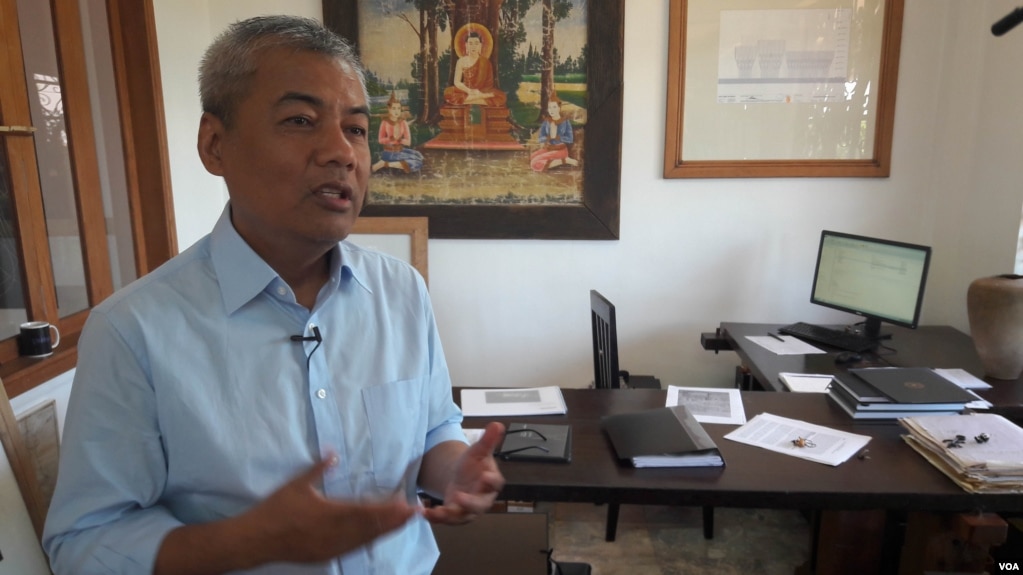
Chhang was a survivor of the Khmer Rouge regime. He fled to the United States as a refugee, but memories of the suffering he endured brought him back to his homeland in the early 1990s. He founded DC-Cam and has led the organization since 1995, creating a national genocide education program. Nushin Sarkarati, a senior attorney at CJA, said that without Chhang’s dedication there would be little justice for the victims and survivors.
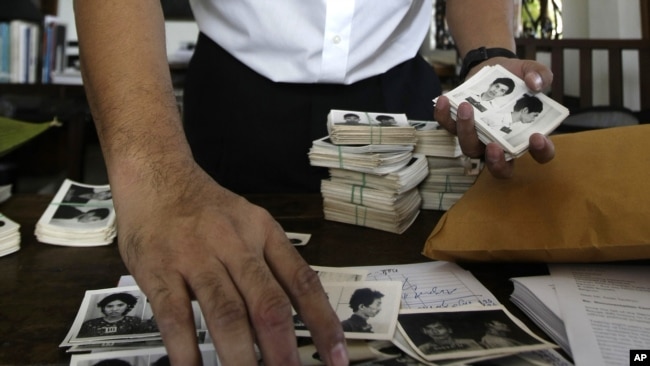
Beth Van Schaack, a Stanford law professor who advises DC-Cam, said the group’s orientation towards victims made Chhang a natural choice for the award. “What CJA really admires about DC-Cam is it also has a very victim centered approach, working-hard to help Cambodian victims, experience justice before the ECCC [Extraordinary Chambers in the Courts of Cambodia] and DC-Cam has become in many ways a model for other documentation centers around the world that are collecting information that can be submitted to justice processes where human rights are concerned,” she said.
Nate Thayer, a journalist who has reported on Cambodia for some three decades, said without Chhang’s work, the Khmer Rouge perpetrators would have gotten away with their crimes. “Youk Chhang was a one-man army fighting for justice for those who suffered in Cambodia and his personal passion and devotion bringing those who responsible for mass murder to justice, to face the music, to answer for their crime.”
Peter Maguire, a law professor and an author of “Facing Death in Cambodia,” called Chhang a “Cambodian national treasure” whose efforts bring more truth and reconciliation to the Cambodian people than the combined efforts of the United Nations and ECCC.
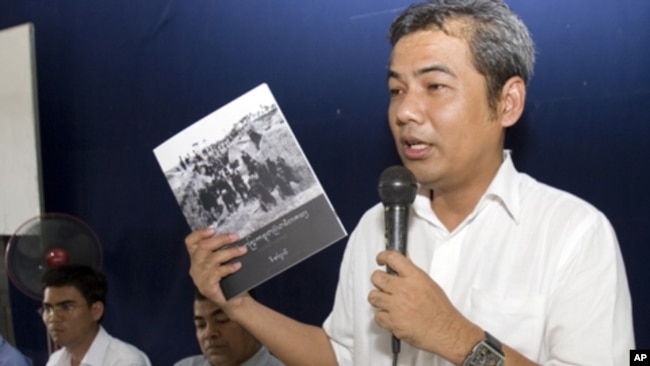
Neth Pheaktra, ECCC spokesman, told VOA Khmer that DC-Cam deserved the award as it had uncovered valuable evidence that could be used at the court. “The work that DC-Cam has done helps the ECCC save time in finding evidence by ourselves, and it shows us the way, brings us information as well as some historical documents we needed for the trials.”
Chhang is currently working on developing the Sleuk Rith Institute, a permanent hub for genocide studies in Asia based in Phnom Penh.
Source: Cataloger of Khmer Rouge Crimes Wins Prestigious Human Rights Award
 Hans Thoolen on Human Rights Defenders and their awards