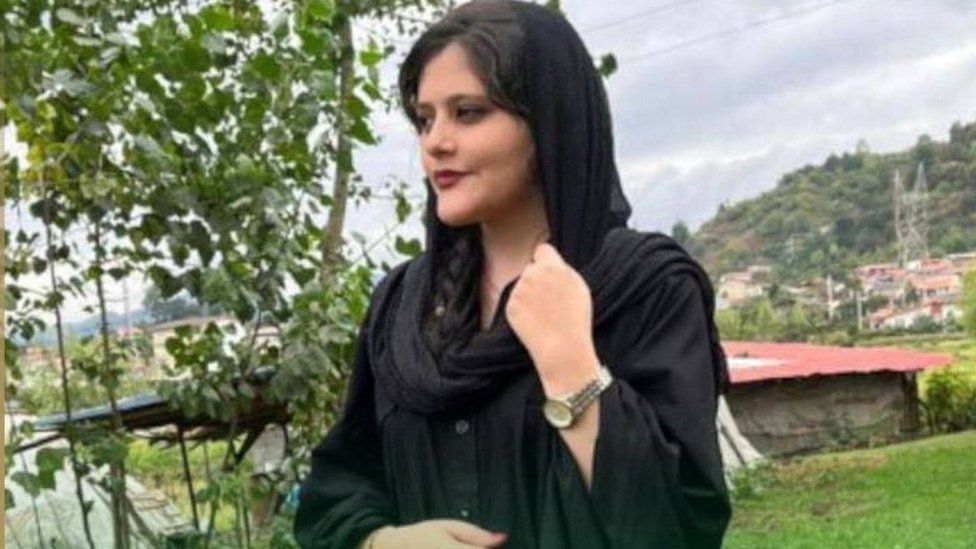
Ms Amini’s parents and brother were stopped from boarding their flight and had their passports confiscated, their lawyer said. They were banned from leaving despite having valid visas.
Speaking to the AFP news agency, the family’s lawyer, Chirinne Ardakani, said Ms Amini’s mother, father and brother had been “prohibited from boarding the flight that was to take them to France for the presentation of the Sakharov Prize”.
The president of the European Parliament, Roberta Metsola, called on Iran to “retract the decision” to ban the family from travelling. “Their place next Tuesday is at the European Parliament in Strasbourg to receive the Sakharov Prize, with the brave women of Iran,” she said on social media. “The truth cannot be silenced.”
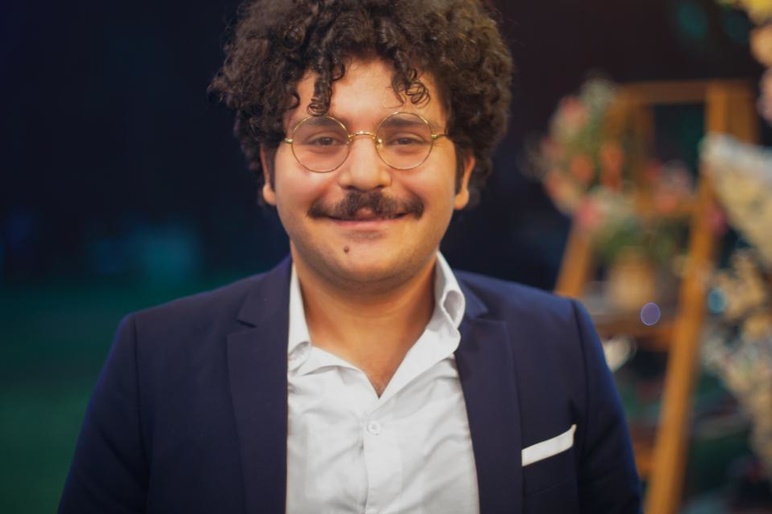
A large group of civil society organizations, condemn the three-year prison sentence handed down to human rights researcher at the Egyptian Initiative for Personal Rights (EIPR) and academic Patrick George Zaki for his writings highlighting the hardship and discrimination faced by Coptic Christians in Egypt, such as himself.
On July 18, 2023, following a trial rife with due process violations, an Egyptian emergency state security court handed down a three-year prison sentence to Patrick on trumped up charges of spreading false news. Patrick, who was a graduate student at the University of Bologna at the time, was arrested by Egyptian authorities on February 7, 2020, while at the Cairo Airport during a visit home to see his family. In custody, he was held incommunicado for a 24-hour period; he was beaten, stripped, electrocuted, verbally abused, and threatened. He was initially accused of joining a terrorist organization and spreading false news. In September 2021, lawyers learned that he had been referred to emergency state security court on false news charges for a 2019 article that he authored for independent digital media outlet Daraj on his experience as a Coptic Christian religious minority, titled, “Displacement, Killing & Harassment: A Week in the Diaries of Egypt’s Copts.” On December 7, 2021, following 22 months behind bars, he was ordered released from detention pending trial, and placed on travel ban. His trial continued until the July 2023 verdict, following which he was taken back into custody today.
Verdicts handed down by an emergency court are not subject to legal appeal, only to ratification by the President. The President also has the authority to commute the sentence or to quash the verdict. Furthermore, under Circular No. 10 of 2017 governing emergency state security courts, “If the accused is brought to trial while not in custody and sentenced to a prison penalty, he must be released immediately without executing the penalty pending the decision of the ratifying authority.” Per this provision, Patrick must legally be free while the President considers ratification; for Egyptian authorities to have taken him into custody constitutes a clear violation of this circular.
The targeting, arrest, prosecution, and sentencing of Patrick Zaki for writing about his experiences as a Coptic Christian is an egregious measure by Egyptian authorities that is indicative of a larger failure by the state to protect religious minorities. Instead, the authorities target Copts for merely expressing themselves and bringing attention to the discrimination they regularly endure. This sentence occurs in violation of Egypt’s domestic laws and international legal commitments, and sends a clear message that the Egyptian government is not serious about implementing its national human rights strategy or carrying out a meaningful national dialogue. At a time during which Egyptian authorities should be addressing the dire economic crisis, this step raises severe questions on the trajectory of the country.
The undersigned civil society organizations, call on Egyptian President Abdel Fattah El-Sisi not to ratify the verdict handed down to Patrick Zaki and instead to quash it in its entirety. We call on Egyptian authorities to immediately release Patrick Zaki from custody, to drop all charges and close all cases brought against him in their entirety, and to lift the travel ban brought against him. We urge all of Egypt’s international, multilateral, and government partners to press the Egyptian government to immediately release Patrick and cease persecuting him for his legally protected speech and vital human rights work.
The Iranian director Mohammad Rasoulof has been prevented from leaving his home country.
This comes shortly after fellow Iranian director Jafar Panahi could leave Iran after a travel ban against him was lifted.
Both have repeatedly gotten into conflict with the Iranian authorities, had their passports confiscated and been jailed. Last year, the Iranian authorities arrested Mohammad Rasoulof and Mostafa Al-Ahmad over an appeal they posted on social media speaking out against the disproportionate repression of civil protestors. Jafar Panahi was then arrested as he was protesting the detention of his colleagues. Now one can travel, the other not. The the International Coalition for Filmmakers at Risk was founded by the International Documentary Film Festival Amsterdam, International Film Festival Rotterdam and the European Film Academy. The ICFR’s mission is to advocate for and to act in solidarity with filmmakers at risk.
The ICFR calls on the Iranian authorities to drop the travel ban against Mohammad Rasoulof and we encourage all film and culture institutions around the world to do the same.
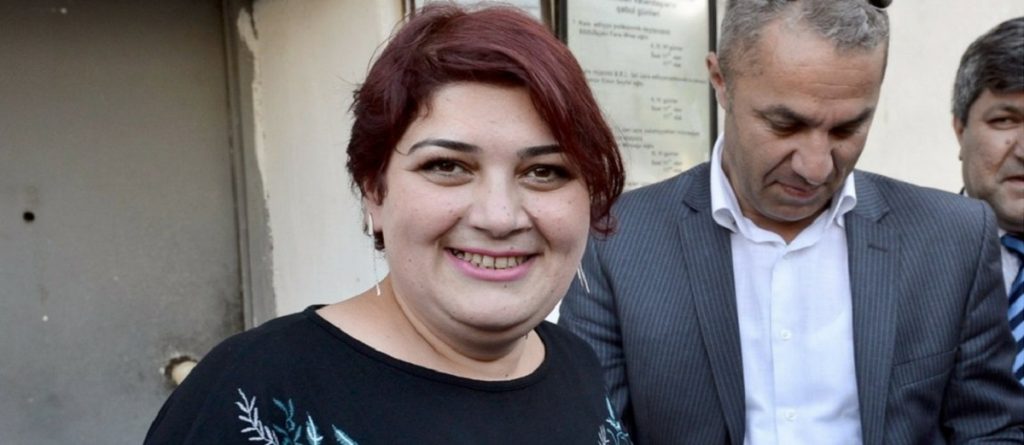
On 26.July 2020 Jam News comes the interesting news that the Azerbaijani investigative journalist Khadija ismayilovahas been offered a $250,000 cash award from Qatar’s Rule of Law and Anti-Corruption Centre. After looking into the activities of the centre and discovering the fund was created by the emir of Qatar, who had closed the center for investigative journalism in Qatar, Khadija Ismail declined the award.
Khadija Ismail
The journalist also added that the reason why the foundation wants to give her the prize is to keep famous journalists under its influence with this award: “Why me? They have been distributing the prize for three years, not a single famous person has yet agreed to receive the prize. It is the famous winners who legitimize such initiatives. I don’t want to sound immodest, but a friend explained to me that they need my name.
“I answered them. I said, thank you, I investigated the issue and do not believe in your sincerity, and I do not sell my reputation for money.”
By the decision of the European Court of Human Rights, in this case, the rights of the journalist, protected by Articles 5 (liberty and security of person), 6 (fair trial), 10 (freedom of expression) and 18 (limits on the use of restrictions on rights) of the European Convention were violated.For these violations, the Azerbaijani government as a whole must pay the journalist compensation to the amount of 25,000 euros, but the journalist says that she has not yet received this money.
Cuban human rights defenders who participated to the project of presenting a report on EU’s agreement with Cuba. [Civil Rights Defenders]
The EU needs to change strategy if it wishes to stand for democracy in Cuba by opening up to independent civil society, write Anders L. Petersson and Erik Jennische (of the NGO Civil Rights Defenders) on 4 February 2020. On Saturday 1 February. five Cuban democracy activists were stopped at the airport in Havana as they were on their way to Brussels to speak at the European Parliament today. They were banned from leaving the country by the Cuban authorities. Instead, the seminar at the European Parliament was held with Cuban activists based outside the country, and five empty chairs – a vivid reminder of the current strategy’s shortcomings. [Instituto Patmos has shown that at least 226 activists were banned from travelling abroad during 2019]. The five democracy activists were supposed to present their ideas on what the EU could do to promote respect for human rights and democratisation in the country. Their proposals form part of a report by Civil Rights Defenders – a total 30 letters from Cuban democracy activists and organisations – as a contribution to the EU’s policy development.
Although the EU and Cuba in their Agreement recall “their commitment to the recognised principles of democracy”, Civil Rights Defenders regrets that the EU remained silent on the sham elections and the transfer of power that followed. Apparently, it was all acceptable under the new Agreement…..When Federica Mogherini visited Cuba for the last time as High Representative for Foreign Affairs in September 2019, she rather perplexingly concluded that “after completing its generational transition and adopting a new Constitution, Cuba now faces major challenges in carrying out its economic modernization”.
….Reflecting on the stories of harassed and imprisoned activists in Cuba, we cannot afford to make such surrender again. The EU needs to change strategy if it wishes to stand for democracy in Cuba. It needs to build a formal and open dialogue with Cuba’s independent civil society. Since the negotiations began on the Agreement in the spring of 2014, the EU has not invited civil society to a single formal discussion on the content of the Agreement or its implementation. When the EU and Cuba held its human rights dialogue in October 2019, the Cuban government took the liberty to decide which European and Cuban organisations could participate. The papers in the report of CRD hold a great number of proposals and ideas – the two core messages being:
That both European and Cuban civil societies need to be recognised as formal partners to the EU in its relations to Cuba.
That the EU needs to speak out on the absence of democracy in Cuba and denounce all human rights violations.
The EU can never contribute to positive change in Cuba via a dialogue with the Cuban government. The only way is to give legitimacy and support to the civil society that openly and peacefully supports democratisation. It is time for the EU to include civil society in its relations with Cuba.
One of the award-winning Cuban dissident who was detained this week announced that he has been released without charge but barred from a planned trip to Europe for a meeting on human rights. Guillermo Farinas, a 58-year-old psychologist, is a leading voice in the opposition to Cuba’s communist government and won the European Parliament’s Sakharov human rights prize in 2010. Farinas was arrested Tuesday in the central city of Santa Clara, where he lives, as he planned to go to the Spanish Embassy in Havana to pick up travel documents. He had been due to take part in a meeting of the human rights commission of the European Parliament. “The main reason for my arrest was to keep me from traveling to Europe,” Farinas told AFP.
Rasha Younes Researcher, Lesbian, Gay, Bisexual, and Transgender Rights, describes how Lebanon is losing is status as a safe haven for human rights defedners in the Middle East.
Lebanon used to be known as a port in a storm for human rights defenders from the Arabic-speaking world – especially those working on gender and sexuality – to organize freely and without censorship. A major space for this was the annual NEDWA conference, hosted by the Arab Foundation for Freedoms and Equality (AFE).
Even as lesbian, gay, bisexual, and transgender (LGBT) people faced grave human rights violations over the years ranging from murders in Iraq, to jail time and forced anal examinations in Egypt, to rigid censorship of LGBT content in Qatar, Lebanon was a haven where embattled activists could meet at NEDWA to cultivate their movements’ resilience, tactics, and communal healing in the face of adversity. That safe haven in the Middle East no longer exists.
Amid a targeted crackdown against free expression and assembly around gender and sexuality in Lebanon, resulting in an unlawful raid by General Security on the 2018 NEDWA conference and a discriminatory entry ban imposed on non-Lebanese participants, AFE was forced to move its conference outside the Middle East and North Africa region for the first time.
The activists adapted. 200 human rights defenders, artists, and academics from the region gathered in another country. They discussed health, human rights, and movement building. Queer and trans artists from Palestine, Lebanon, and Egypt inspired the conference attendees with performances that reconfigured the meaning of resistance, embodying creative ways to combat state-sponsored repression. Instead of safeguarding much-needed platforms such as NEDWA and celebrating these activists, the Lebanese government chose to forego its international obligations by claiming that the conference “disrupts the security and stability of society,” and collectively sanctioning its participants.
Lebanon’s suppression of LGBT activism is part of a larger crackdown on free speech in the country. Hamed Sinno, the lead singer of the indie band Mashrou’ Leila, whom the Lebanese government censored in July, spoke at this year’s NEDWA conference, condemning Lebanon’s decline as a center for art and tolerance, while reassuring activists that the fight continues. Lebanon should take note: intimidation and threats will not silence the voices of resilient activists who will continue to fight for their right to live and love. By closing its doors on activism, Lebanon is divesting its image as the hub for freedom and diversity in the region.
The 3-day 2019 Dublin Platform for Human Rights Defenders at Risk was opened on 2 October by Irish Foreign Minister, Simon Coveney, and UN High Commissioner for Human Rights, Michelle Bachelet. Over 120 human rights defenders (HRDs) from more than 80 countries are attending. Front Line Defenders Executive Director, Andrew Anderson, said that five human rights defenders were prevented from traveling to Dublin – Khadija Ismayilova (Azerbaijan), Oyub Titiev (Russia), Said Boudour (Algeria), Michel Matos (Cuba) and Marivic Danyan (Philippines). See more below.
The opening ceremony featured a testimony by Bahraini woman human rights defender (WHRD) Ebtisam Alsaegh, who was finally able to leave Bahrain and attend Dublin Platform years after first being invited. Speaking in Dublin, she called for an immediate end to gendered and sexualized attacks against women human rights defenders around the world.
Over three days, human rights defenders will share tactics and strategies for their protection and security, while learning from each other about their struggles, protests, resistance movements and victories. On Thursday evening, the HRDs will march in a procession to Christchurch Cathedral as part of the “Set Them Free” campaign, calling for the release of HRDs facing multi-decade prison sentences around the world. The campaign includes former Front Line Defenders Protection Coordinator for the Middle East and North Africa, Bahraini HRD Abdulhadi Al-Khawaja, now serving a life sentence for his role in the peaceful pro-democracy uprising of 2011.
On 26 September, Cuban cultural rights defender Michel Matos was banned from travelling from José Martí International Airport in Havana while en route to attend the event in Ireland. Michel is an activist for cultural rights in Cuba. He, along with other artists, musicians and performers, has taken a stand against the controversial Decree 349, signed by Cuba’s President Miguel Díaz-Canel in April 2018, which grants the Ministry of Culture disproportionate power to control, cancel and sanction artistic expression, while containing vague and overly broad restrictions. While being processed at passport control, officials informed him he was not permitted to board the plane as he is on an automatic travel ban list. He was not shown any documents or given any further details on the ban, other than being told that the officials “were following orders”.
Due to his work advocating for the rights of political prisoners in Algeria, Said Boudour has been informed that he is currently being sought by the Algerian authorities. As he prepared to travel to Ireland to attend the Platform, he received advice from his lawyer that should he attempt to leave the country he would almost certainly be arrested at the airport. Said is a member of the Algerian League for Human Rights. He works on a range of civil and political rights in Algeria, with a particular focus on the rights of prisoners in the context of the ongoing anti-government demonstrations, and on democracy in Algeria. The human rights defender has been frequently harassed by the Algerian authorities; he has been previously detained three times and has been under regular police surveillance.
Khadija Ismayilova, a woman human rights defender and journalist from Azerbaijan, was also unable to accept her invite to the Dublin Platform due to a travel ban imposed against her following her release from prison in 2016. In 2018 the Baku Court of Appeal refused for the third time to lift the ban. Khadija is well known for her investigative reports on corruption in Azerbaijan, including the President’s family’s involvement.
Oyub Titiev, a human rights defender from Chechnya, was similarly prevented from travelling due to a travel ban stemming from his conditional release from prison in June 2019. He was detained in January 2018 on fabricated drug charges in retaliation for his work with Human Rights Center Memorial in Chechnya. Both Oyub and Front Line Defenders had written without success to the Russian authorities seeking permission for him to allowed travel to attend the Dublin Platform.
Radio Farda on 8 March 2019 reported that France’s President Macron has decided to invite jailed Iranian Human Rights Defender Nasrin Sotoudeh to the G7 Council. This is an excellent idea that deserves follow-up in other such forums. There are quite a few laureates of human rights awards who are in detention or subject to a travel ban. An invitation from a group of important world leaders is hard to ignore!
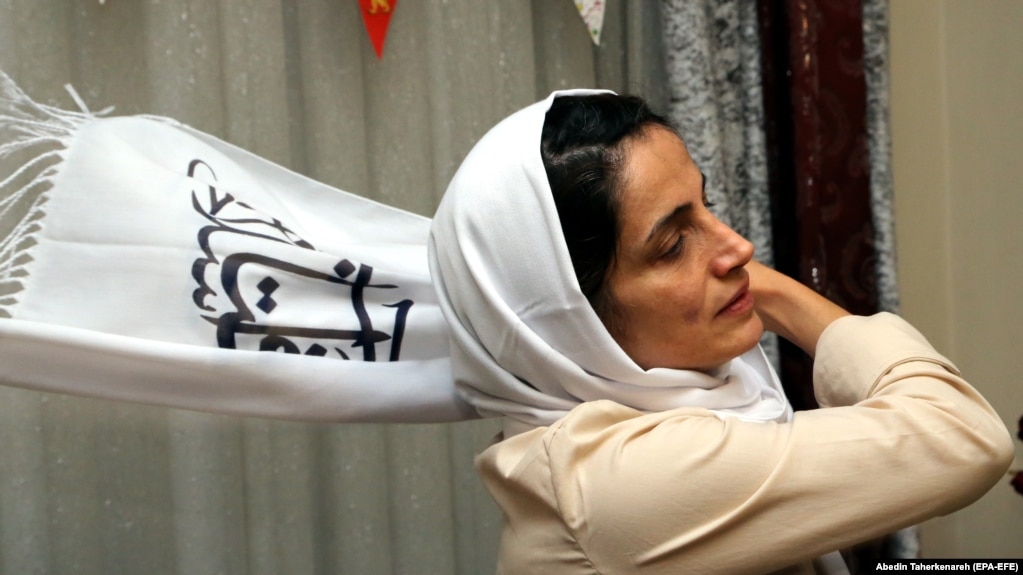
Imprisoned Iranian lawyer and human rights activist Nasrin Sotoudeh adjusts her scarf at her house in Tehran, September 18, 2013
French President Emmanuel Macron has invited jailed Iranian human rights lawyer Nasrin Sotoudeh to take part in the G7 gender equality forum. Sotoudeh’s husband Reza Khandan told Radio Farda on Friday that Macron’s invitation has been given to him in Tehran on Thursday March 7, one day before the International Women’s Day.[see also: https://humanrightsdefenders.blog/2018/06/16/iranian-human-rights-lawyer-nasrin-sotoudeh-arrested-again/]
Ms. Sotoudeh is to be a member of the consultative council for gender equality in Group 7. Khandan said Iranian women should be proud of Soutoudeh’s membership in the G7 council. Copies of the invitation have been handed to the Iranian Foreign Ministry and Bar Association.
Nasrin Sotoudeh has been in Jail since June 2018 with a five-year imprisonment sentence and is facing more charges for defending human rights activists in Iran. She is an outspoken opponent of the death penalty and compulsory hijab. Sotoudeh, 55, is the winner of numerous international awards, including PEN/Barbara Goldsmith Freedom to Write (2011), Southern Illinois University School of Law Rule of Law Citation (2011) and Sakharov Prize (2012). On 21 September 2018, she was awarded the 23rd Ludovic-Trarieux International Human Rights Prize.
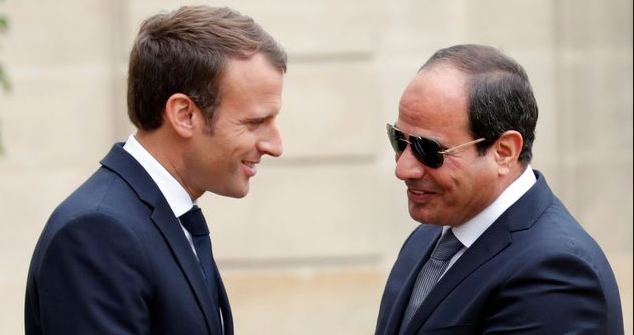
Emmanuel Macron lunched with Egyptianhuman rights defendersin Cairo on 29 January at the end of a three-day visit (for names see below). On Monday, the French president had visibly annoyed his Egyptian counterpart Abdul Fattah al-Sisi at a press conference, by saying that Sisi ought to restore civil rights and liberties for the good of his country. “Stability and lasting peace in Egypt go hand in hand with respecting individual rights and liberties within a state of law,” Macron said. “A dynamic, active, civil society remains the best rampart against extremism.” In response, President Sisi that “Egypt will not rise up with bloggers… Egypt will develop with efforts and patience.”
The French leader was even more forthright with French journalists in Cairo on Sunday night. He had given Sisi a list of political opponents including “journalists, homosexuals, men and women who have convictions” when Sisi visited Paris in October 2017. “Only two of them were freed,” Macron said. “That’s not enough. And things have got worse since.”
That the State does not have to do all the criminalisation of HRDs itself was shown a day after the meeting with the HRDs, when Egyptian lawyer Tarek Mahmoud filed a legal complaint against the heads of four of Egypt’s human rights organizations for “threatening national security”, according to local media reports. The complaint was filed on Wednesday against Mohamed Zaree, the director of the Cairo Institute for Human Rights Studies (CIHRS), Gamal Eid, the executive director of the Arabic Network for Human Rights Information, Mohamed Lotfy, the executive director of the Egyptian Commission for Rights and Freedoms, and Gasser Abdel-Razek, the executive director of the Egyptian Initiative for Personal Rights (EIPR). Tarek Mahmoud said in the complaint that the four men “provided French officials with false information on the political conditions in Egypt”. Mahmoud added that they were “insulting the Egyptian state and undermining the country’s national security, and collaborating with the terrorist Muslim Brotherhood group to achieve its goals of bringing down the Egyptian state.”
The Irish human rights group Frontline Defenders has presented a report on Egypt’s Attack on Labour Rights Defenders to French media in the run-up to Macron’s visit (with focus on the ill-treatment of workers at the Alexandria shipyard.).
Turkey‘s anti-democratic mentality has not changed since its foundation, but it has never been as oppressive as today, said Turkish human rights defender Eren Keskin. Over the years, Keskin played a vital role in strengthening civil society awareness in Turkey. She became involved with the Human Rights Association (IHD) three years after its 1986 founding and headed its Istanbul branch for years. She has been arrested and imprisoned numerous times, accused of terrorist ties for defending Kurdish rights, and won several awards including the Aachen Peace Award, the Theodore Haecker Prize, the 2018 Helsinki Civil Society Award, the 2018 Anna Lindh Prize, and the 2017 Hrant Dink Award. A new travel ban is likely to stop her from coming to the Martin Ennals Award ceremony on 13 February 2019.
“Turkey’s undemocratic mentality has not changed since its foundation,” said Keskin. “There is no change in the mind or understanding of the state. I have been part of the struggle for human rights for nearly 30 years. I have not experienced a period in which freedom of thought and freedom of expression have been contravened this much. Turkey is more oppressive today than ever.
Keskin said she had been brought before the courts more than 100 times and convicted on numerous occasions.
“I see the struggle for the defence of human rights as respect for those who have died. It is out of respect for them that I am part of the struggle for human rights,” she said. “We experienced a lot of pressure, but our friends were killed. They were killed fighting for human dignity. I am lucky to be alive…I was assaulted twice with firearms, imprisoned and threatened with death, but never gave up.”
…Keskin became the editor-in-chief of the Kurdish Özgür Gündem newspaper from 2013 to 2016 as part of a solidarity campaign after Turkish authorities arrested its journalists. She was prosecuted for a number of articles that appeared in the newspaper as, under Turkish law, editors-in-chief can be indicted when the authors cannot be held to account. Keskin said 143 criminal cases had been brought against her for her time working at Özgür Gündem. “I have already been sentenced to 12-and-a-half years in prison, a 450,000 lira ($85,000) fine and travel ban,” she said. A court in October lifted the ban on Keskin travelling abroad, but last week she realised she had been given another one when authorities refused to issue her a passport. She had been nominated for the Martin Ennals Award for Human Rights Defenders and was planning to attend the award ceremony in Switzerland. [see: https://humanrightsdefenders.blog/2018/10/24/breaking-news-ennals-award-announces-its-3-finalists-for-2019/]
“People ask, ‘How do you live? How do you endure it?’” Keskin said. “For me, the job we do is a way of life and I have never regretted it.”



 Hans Thoolen on Human Rights Defenders and their awards