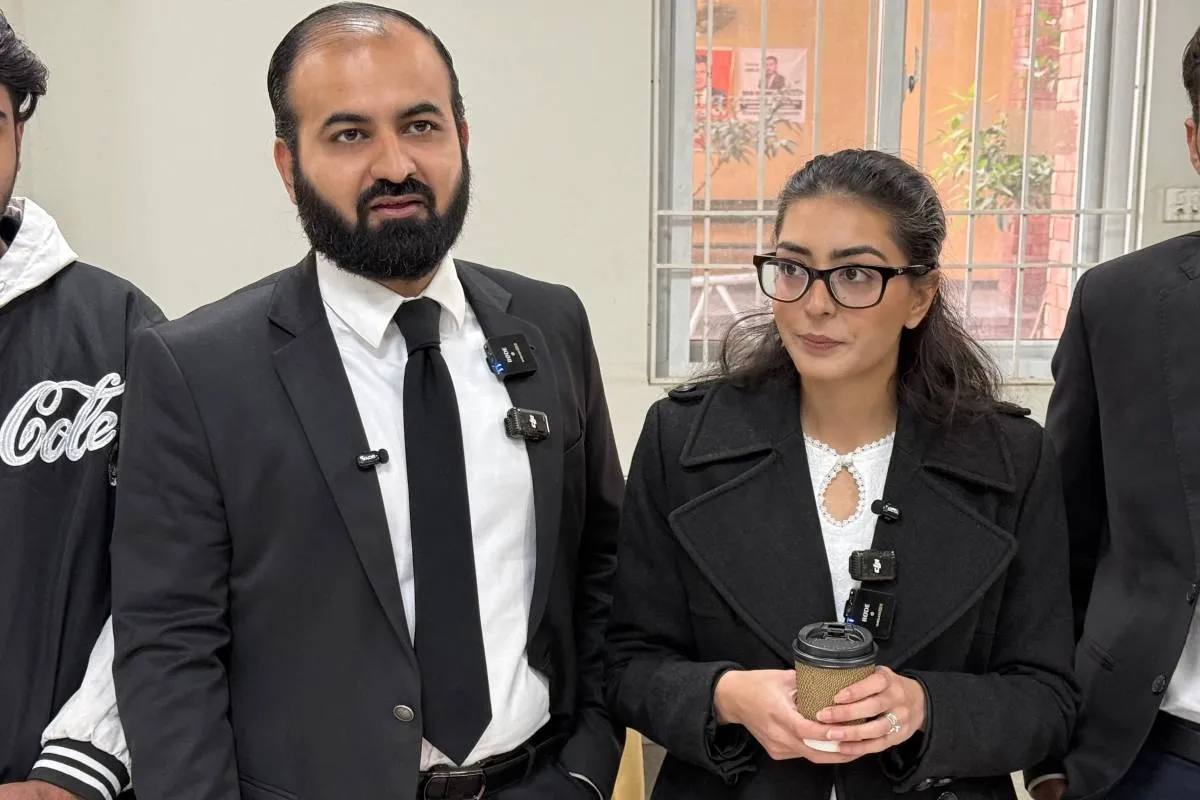
Several media (such as the CSR Journal and Barrons) and NGO (Frontline) talk about the case of human rights lawyer Imaan Mazari and her husband and fellow lawyer Hadi Ali Chattha who were sentenced 10-year-jail by an Islamabad court on 24 January 2026 over anti-state social media posts. However, the pressure and arrest haven’t been able to silence her voice. She said to media agencies, “We will not back down. Truth seems overwhelmingly difficult in this country. But we knew that when we got into this work, we’re ready to face that,”. Mazari noted that the prison term won’t dent her resolve.
Imaan Mazari is a 32-year-old human rights lawyer from Pakistan who rose to fame for fighting some of the most sensitive cases and she has been defending ethnic minorities, journalists facing defamation charges and some of her clients have been branded blasphemers. With Mazari’s coming to prominence, so did the charges by the Pakistani government for cyber terrorism and hate speech. As per a court document, Mazari has been disseminating highly offensive content.
Mazari comes from a well-known family, she is the daughter of former minister for human rights, Shireen Mazari, and her late father was one of the top paediatricians of South Asia. Because of her strong determination of fighting back despite all odds, she is being compared to Pakistan’s one of the popular human rights lawyers, late Asma Jahangir. [see: https://www.trueheroesfilms.org/thedigest/laureates/14CC52FE-5F1B-4EF8-B1F5-607ED173AACC]
Mazari is a pro bono lawyer, she has handled some of the most sensitive cases in Pakistan, e.g. enforced disappearances of ethnic Balochs, she defended Mahrang Baloch. She has also taken up blasphemy cases.
Last year, the UN special rapporteur for human rights defenders said, “Cases against her appear to reflect an arbitrary use of the legal system to harass and intimidate”. She was first targeted in a press conference held sometime in early January, where a military spokesman Lieutenant General Ahmed Sharif Chaudhry, shared Mazari’s post on X posts and filed a case against her, stating her as, “hidden elements committing subtle crimes. They operate under the guise of democracy and human rights to promote terrorism,”.
Josef Benedict and Rajavelu Karunanithi published a piece in the Diplomat of 18 July 2025 describing how from Hong Kong to India, governments are passing and weaponizing new laws to pursue and jail whoever speaks up for human rights.
Four years ago, on the 32nd anniversary of the 1989 Tiananmen Square massacre, plain clothes police arrested human rights lawyer and pro-democracy activist Chow Hang-tung outside her office in Hong Kong. Her alleged crime? Publishing two social media posts advertising a public vigil to remember the notorious crackdown in Tiananmen Square. At the time, Chow was the vice-chair of the now defunct Hong Kong Alliance in Support of the Patriotic Democratic Movement of China, the main organizer of annual Tiananmen vigils…
Sadly, such repression is not unique to Hong Kong. Across Asia, authoritarian and democratic governments alike are passing and weaponizing new laws – in clear violation of international law and standards – to pursue and jail whoever speaks up for human rights. Today, on Nelson Mandela International Day, we call for the release of Chow Hang-tang, who is part of CIVICUS’ Stand As My Witness campaign, as well as other human rights defenders unjustly locked up in Asia around the world.
The CIVICUS Monitor, which tracks civic space conditions across the world, now rates Hong Kong’s civic space as “closed,” the worst possible ranking. Hundreds remain behind bars as police systematically use the new laws to arrest and prosecute people on trumped-up charges. Often, the process itself becomes the punishment as activists spend years in detention before they are even tried…
Meanwhile, Hong Kong authorities are trying to take their repression international, by offering bounties for activists-in-exile charged under the National Security Law and by arresting the father of a prominent U.S.-based activist, Anna Kwok.
..Hong Kong’s National Security Laws have become something of a model for other Asian governments looking to stifle dissent.
Look no further than India, often called the world’s largest democracy, where Prime Minister Narendra Modi’s government resorts to similar laws to consolidate power and silence his critics. Dozens of activists have been jailed under the Unlawful Activities Prevention Act (UAPA), a draconian anti-terror law. Under the UAPA’s provisions, activists remain in pre-trial detention for long periods and are denied bail, including human rights defender Khurram Parvez, who was arrested in November 2021. His trial has yet to start, four years on. [see also: https://www.trueheroesfilms.org/thedigest/laureates/81468931-79AA-24FF-58F7-10351638AFE3]
Meanwhile, Cambodia’s Han Manet regime has used “incitement” laws as their weapon of choice to silence activists, journalists, and members of the opposition.
With legal repression spreading across Asia, the international community must do more to push back and stand with these brave activists. Foreign governments must not only speak out when activists are convicted, but step in much earlier when these human rights defenders are arrested. Diplomats should visit wrongly arrested activists in detention, monitor their trials, and engage with their families. Foreign governments must also use international platforms like the United Nations Human Rights Council and bilateral meetings to highlight their cases and call for their release.
Activists-in-exile also need support and assistance, especially when they face transnational repression. The recent G-7 Leaders’ Statement on Transnational Repression was a good start, but strong rhetoric must now turn into serious action. Failure to undertake such actions will see a further regression of democracy and repression of civic freedoms in Asia and elsewhere.
On 29 May the Committee to Protect Journalists and fourteen other organisations have urged Pakistan to immediately halt deportation of Afghan journalists and other vulnerable Afghan migrants. The fifteen advocacy groups expressed deep concern over Pakistan’s ongoing deportation plan, first announced on 3 October 2023, which targets undocumented Afghan nationals. The joint statement highlights the heightened risks faced by Afghan journalists, writers, artists, human rights defenders, and others who fled Taliban persecution and are now at risk of being forcibly returned.
Among the signatories are prominent international organisations such as PEN Germany, CPJ, Unlimited Free Press, Front Line Defenders, International Cities of Refuge Network (ICORN), Nai – Supporting Open Media in Afghanistan, and Reporters Without Borders (RSF).
The organisations also called on the international community to provide safe resettlement opportunities for these individuals, recognising the dangers they face if returned to Taliban-controlled Afghanistan. Pakistan’s deportation policy has faced sharp criticism from local and international bodies, including the Pakistan Human Rights Commission, the United Nations High Commissioner for Refugees (UNHCR), and the International Organisation for Migration (IOM). These entities have urged Pakistan to uphold its international obligations and provide protection to those fleeing conflict and persecution.
Despite repeated calls for restraint, the Pakistani government has accelerated forced returns in recent months. In April alone, more than 300,000 Afghans were deported, drawing further condemnation from human rights organisations.
——
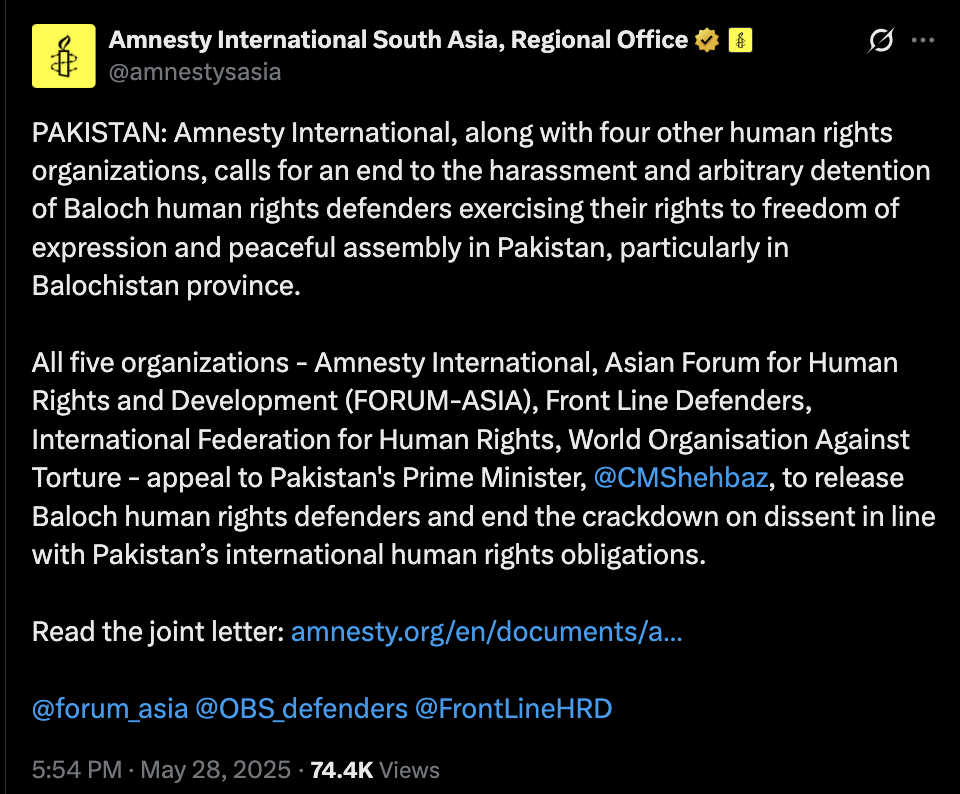
On 28 May Amnesty International along with four other human rights organizations wrote to the Pakistani prime minister, calling for an end to the “harassment and arbitrary detention” of Baloch human rights defenders (HRDs) exercising their rights to freedom of expression and peaceful assembly, particularly in Balochistan province.
The letter comes in the wake of Dr. Mahrang Baloch, one of the leading campaigners for the Baloch minority and the leader of the Baloch Yakjehti Committee (BYC), and a number of other activists, being arrested in March on charges of terrorism, sedition and murder. ..
The five organizations — Amnesty International, Asian Forum for Human Rights and Development (FORUM-ASIA), Front Line Defenders, International Federation for Human Rights, World Organization Against Torture — appeal to Pakistan’s Prime Minister to release Baloch human rights defenders and end the crackdown on dissent in line with Pakistan’s international human rights obligations;
A dozen UN experts called on Pakistan in March to immediately release Baloch rights defenders, including Dr. Baloch, and to end the repression of their peaceful protests. UN special rapporteur for human rights defenders Mary Lawlor said she was “disturbed by reports of further mistreatment in prison.”
Balochistan is the site of a long-running separatist movement, with insurgent groups accusing the state of unfairly exploiting Balochistan’s rich gas and mineral resources. The federal and provincial governments deny this, saying they are spending billions of rupees on the uplift of the province’s people.
Dr. Sabiha Baloch is a woman human rights defender and member of the Baloch Yakjehti Committee (BYC), a network focused on advocating for the human rights and interests of the Baloch people in Pakistan. Dr. Sabiha Baloch has faced reprisals due to her work, including attacks against her family. Notably, her work as a woman human rights defender has led to the abduction of her brother and relative, who were subsequently released after several months in detention. Dr. Sabiha Baloch has been an integral part of peaceful campaigns against extra judicial killings, enforced disappearances and arbitrary arrests in Balochistan. She was part of the Baloch Long March and the Baloch National Gathering in 2024, which faced severe State reprisals, including violence and arrests. Since March 2025, following the arrest of several leading human rights defenders and members of the BYC, Dr. Sabiha Baloch has continued to document and highlight violations, and demand the release of detained colleagues and protesters.
On 5 April 2025, Pakistani authorities arrested the father of Baloch woman human rights defender Beebow Baloch. He is currently detained at the Hudda District Prison in Balochistan under Section 3 of the Maintenance of Public Order Act (MPO). The woman human rights defender Beebow Baloch has also been held at the same prison under the MPO since her arrest on 22 March 2025.
On 7 April 2025, Pakistani authorities arrested woman human rights defender Gulzadi Baloch in Quetta, Balochistan, with disturbing reports of excessive violence being used during the arrest. For several hours following her arrest, there was no information about her fate or whereabouts, causing serious concerns for her physical and mental safety. She is presently held at the Hudda district prison under the regressive Maintenance of Public Order (MPO) Act, which severely restricts access to bail.
The NGO Frontline demands that Baloch human rights defenders in Pakistan are protected from reprisals, and end their ongoing persecution and punishment in the State, including for exercising their right to free expression and peaceful dissent, under the guise of national security.
Front Line Defenders call for the Pakistani authorities to be held accountable for their mistreatment and abuse of prominent Baloch woman human rights defender Dr. Mahrang Baloch and other human rights defenders accompanying her in Karachi, on 8 October 2024. The woman human rights defender was attacked by Sindh police while she was returning from the Karachi’s Jinnah international airport after immigration authorities denied her permission to leave the country.
Dr. Mahrang Baloch is a woman human rights defender and a staunch advocate for the rights of the ethnic Baloch community in Pakistan. She has campaigned peacefully against systemic violations including extra judicial killings, enforced disappearances, arbitrary detentions and custodial torture in Balochistan. Human rights defenders speaking out against state violence, especially seeking to hold the military and intelligence agencies accountable, undertake significant risks – against themselves and their families.
On 7 October 2024, Pakistani authorities prevented Dr. Mahrang Baloch from leaving the country. The woman human rights defender was to attend an event in New York organized by TIME which had named her in the TIME100 Next 2024 List recognizing her human rights work. Unfortunately immigration officers at the Karachi airport withheld her passport for several hours and denied her permission to board her flight without any legal basis or reasoning. Dr. Mahrang Baloch finally left the airport at around midnight after she recovered her passport. Shortly after, her vehicle was intercepted by a group of officers from the Sindh police on the old airport road in close proximity to the airport. Police brutally beat and abused Dr. Mahrang Baloch and several other human rights defenders including Sammi Deen Baloch. Police illegally seized Dr. Mahrang’s passport and mobile phone. They also took the vehicle keys, leaving the human rights defenders stranded on a deserted road at late hours in the night.
Reprisals including restrictions on travel are common in Pakistan, especially for those who speak out against state repression. In August 2024, Sammi Deen Baloch, the Front Line Defenders award winner for 2024 was prevented from traveling to Geneva for an advocacy mission to highlight human rights issues in Balochistan. The attack on Dr. Mahrang Baloch is not an isolated incident. It spotlights what many human rights defenders in Pakistan face as punishment for their work. Human rights defenders from oppressed communities such as the Baloch are especially targeted. State response to peaceful campaigns by the Baloch Yakjehti Committee (Baloch Solidarity Committee) has been to suppress protests and campaigns with brute force and repressive measures including criminalization.
On 31 May 2024, Front Line Defenders announced the five winners of its top distinction, the 2024 Award for Human Rights Defenders at Risk, at a special ceremony in Dublin this morning. Laureates from each of the major global regions travelled to Ireland to accept the Award, including:
Africa: Gamito dos Santos Carlos of AJOPAZ, the Youth Association for Peace (Mozambique)
Americas: The Trans women collective Muñecas de Arcoíris (Honduras), represented by Jennifer Bexara Córdova
Asia and the Pacific: Sammi Deen Baloch of the Voice for Baloch Missing Persons (Balochistan, Pakistan)
Europe and Central Asia: Doros Polykarpou of KISA (Cyprus)
Middle East and North Africa: We Are Not Numbers (Gaza, Palestine), represented by Ahmed Alnaouq
“Given the immensity of the challenges we face and the adverse forces working against human rights in many parts of the world, it might seem tempting to lose hope that a better world is even possible,” said Alan Glasgow, Executive Director of Front Line Defenders. “But these courageous human rights defenders have defied that temptation and inspire us to keep hope alive. They say ‘no’ to the perpetrators and ‘yes’ to optimism – they know a fairer, more equal, rights-respecting world is worth fighting for.
Gamito dos Santos Carlos, a human rights defender from Nampula, northern Mozambique, is the executive director of AJOPAZ, the Youth Association for Peace. His human rights work centres around social, civil and political rights and accountability. Gamito has been advocating for the protection of human rights activists and engaging with young people to advocate for significant social change in his community, to foster justice and sustainable decision-making by authorities. He is also a member of the Friends of Amurane Association for a Better Mozambique -KÓXUKHURO, as well as an analyst and Provincial Coordinatorof the Mozambican Network of Human Rights Defenders (RMDDH). He has faced ongoing intimidation for his human rights work, including repeated raids on his home and the loss of his job, and in March 2023 he was kidnapped and tortured after he organised a demonstration.
Muñecas de Arcoíris (Rainbow Dolls) is a collective of trans women from the city of Tegucigalpa and Comayagüela in Honduras, founded in 2008. Muñecas works under the LGTBI+ Arcoíris Association of Honduras with the aim of creating a safe space for trans sex worker women. The members of Muñecas started as volunteers of the Arcoíris Association, where they became more aware of the situation that trans people were facing in Honduras. With the support of the Arcoíris Association, Muñecas members received training related to their rights as LGTBI+ people. They then started to document human rights violations specifically against trans women in 2006 and two years later, on 31 October 2008, the collective was formally created as a trans women organisation. Most of its members are sex workers, informal workers, stylists, and housekeepers,among others.
Sammi Deen Baloch is a Baloch woman human rights defender from Mashkai, Awaran District of Balochistan province,Pakistan. She is the General Secretary of the Voice for Baloch Missing Persons (VBMP), a non-governmental organisation that represents and supports victims and relatives of enforced disappearances in Balochistan. In June 2009, at the age of 10, Sammi’s father, Dr Deen Mohammed Baloch, was forcibly disappeared in Khuzdar, Balochistan. She began persistently campaigning for the release of her father, which further led to her deeper, collective involvement in advocating against enforced disappearances in Balochistan by state forces.
Doros Polykarpou is a leading human rights defender and founding member of KISA (the Movement for Equality, Support, and Anti-Racism). He is an expert on migration, asylum, discrimination, racism, and trafficking in Cyprus. For over 27 years, he has dedicated himself to defending and advocating for the rights of people on the move and tackling discrimination and xenophobia in Cyprus, navigating the unique socio-political environment of the small island nation with strong conservative elements. This has exposed him and the organisation to a backlash, and earlier this year KISA’s office was targeted by a bomb attack. [see also: https://humanrightsdefenders.blog/2024/01/19/attack-against-cypriot-anti-racism-ngo-kisa/]
We Are Not Numbers (WANN) is a youth-led Palestinian nonprofit project established in the Gaza Strip in 2014, with the aim of telling the everyday, human stories of thousands of Palestinians. Their vision is to spread Palestinian voices and narratives, based on respect for human rights through the work of peaceful, non-violent, youth led Palestinians. When co-founder Ahmed Alnaouq lost his 23-year-old brother, Ayman, during an Israeli military attack on Palestinians in the summer of 2014, he was devastated, and sunk into a depression from which he thought he would never escape. During this time, he met American journalist Pam Bailey, who encouraged him to celebrate his brother’s legacy by writing a story about him. Like many young people in Gaza, Ahmed was majoring in English literature to improve his language skills. Pam published the story on a Western news website, which was well-received beyond expectation. Ahmed and Pam realised that writing the story had brought some healing to him and that this could be done on a much bigger platform.
Azin Mohajerin and Hina Jilal at OMCT’s offices on International Women’s Day, 8 March 2023. (Geneva Solutions/Michelle Langrand)
Michelle Langrand in Geneva Solutions of 10 March 2023 speaks with two human rights defenders, from Iran and Pakistan.
Iran’s crackdown on women’s rights protests that erupted in September and the Taliban recently banning women from working in NGOs or from attending university have served as a reminder of how fast women’s rights are sliding back in the region and other parts of the world. But despite widespread arrests, allegations of torture and the execution of four protesters in Iran, the women-led movement refuses to back down. For Azin Mohajerin, 36, it means that change is a little more within grasp. Mohajerin left Iran in 2010, following the wave of post-electoral protests that swept the country.
This time around she is supporting rights campaigners in the country, specifically from minority groups, through Miaan, an NGO in Texas she co-founded in 2019 and where she works as senior human rights officer.
Hina Jilani, an advocate of Pakistan’s Supreme Court and president of the World Organisation Against Torture (OMCT), who fought against sharia laws in Pakistan back in the 80s, views it as another illustration of women’s resistance on the path to obtaining change.
Mohajerin and Jilani were in Geneva for international women’s day for an event organised by OMCT. Geneva Solutions spoke to the activists about the challenges women face in their countries and the lessons they can draw from each other.
Born in Lahore, the capital of Pakistan’s Punjab region, Hina Jilani grew up hearing about courtrooms and prisons. At that time, Pakistan was under martial law and her father’s political opposition would often land him into trouble. Rather than being traumatised, Jilani was empowered by the environment in which she was raised. Later in life as a lawyer, her work would also land her in those same courtrooms and prisons. Jilani passed the bar exam in 1977, the same year Sharia law was imposed on Pakistan. One of the new laws made adultery a crime against the state. See also: https://www.trueheroesfilms.org/thedigest/laureates/705AB196-BD5E-4EC2-B6C1-96AC5DDB353E .“While now Pakistan has a fit and reasonably good, protective legal framework for women, we have not gotten rid of the notorious practices like child marriage or honour killings. Gender-based violence is one of our biggest issues in Pakistan,” she pointed out. Pakistan reported around 63,000 cases of gender-based violence in the past three years according to Pakistan’s National Commission of Human Rights.
In Iran, the women-led movement for the freedom to choose what they wear and what to do with their bodies has been shaking the country for the past few months. But observers are cautious about the chances of the current uprising spurring real change in Iran as previous ones have failed to do so. Mohajerin, who cannot return to her country because of the sensitive nature of her work, sees it as one more step in the long path towards the respect of human rights.
The protests in Iran have brought out Iran’s ethnic minorities to march along with the Persian majority. Mahsa Amini, whose death in custody of the morality police last September triggered mass unrest, was a 22-year-old Kurdish woman from Saqqez, in the Kurdistan province of Iran.
Mohajerin, who works with minority groups in Iran, sees that cultural change has seeped into some of the most conservative communities. “Women in Balochistan bravely went to the street in one of the rare moments that they have spoken up about their rights,” said Mohajerin.“There is a recognition that there is a gap that needs to be filled in terms of ethnic equality and gender equality.”
But Iran has also come down hard on these groups. “After Tehran, the top places in terms of arrests were minority populated areas: the Kurdish area, the Turkic and then Balochistan,” said Mohajerin. Many of them remain behind bars, she said.
“Culture can help people to break the chains,” said Jilani. “Not everything is because of what the leadership or the ruling elite do. Unfortunately, the ruling elite act in a certain manner because that is the national psyche.”
Mohajerin noted that Iranians have been fighting for their freedom for a long time now. “It’s not a new movement, it is not something that started in September or even last year. It has been a long-lasting fight,” said Mohajerin.
She recalled when women first marched against the mandatory hijab after it was introduced by the Islamic revolution in Iran 44 years ago. “In Iran, the woman cannot have custody of the child after a certain age and they don’t have the right to divorce. But they do not just give up and say okay, this is how we should live. They’ve been fighting to get their rights and finding loopholes in the system,” she said.
“The cultural change that has been achieved during the past decades is way more significant than the law that exists,” said Mohajerin.
The situation in Iran has drawn international outcry, with western powers condemning Iran’s violent response to the protests. Like many activists, Jilani and Mohajerin see international solidarity as essential to their causes.
“Voices from the outside can help when the environment inside the country is very difficult,” said Jilani. “I’m alive today because of international public opinion and the pressure of the international community,” said Jilani. She recalls former US president Jimmy Carter and former president of Ireland Mary Robinson pleading for her release from prison at one time.So many world leaders sent letters to Pakistan, protesting against my incarceration, that when they released me they showed me this thick file and said we don’t know why people around the world are so worried about you.”
When Iranian foreign minister Hossein Amir-Abdollahian was in Geneva last week to speak before the Human Rights Council, campaigners called for diplomats to stage a walkout during his speech. Mohajerin recognised it as a “significant symbolic gesture to condemn the human rights abuses in Iran”. “However, it is crucial for the international community to engage in dialogue with the Iranian government regarding human rights violations, particularly in cases of executions, at the highest level,” she added.
But both Jilani and Mohajerin are adamant about something: change has to come from within. “The voice should come from the people inside the country. They are the ones who live in the country, and they are the ones who have to decide for their future,” said Mohajerin, noting that views within her country are not a monolith.
On 2 May 2022 – for the 30th year – the Human Rights Commission of Pakistan has put forward its review of the state of human rights in the country and the measures that should be taken to reduce human rights violations in the country. The main takeaway from the report is that there were blatant and unrelenting attempts to crack down on dissent, with at least nine journalists having faced harassment in an attempt to silence them in their work. As happens every year, violence against women took every possible form: from rape to domestic abuse to horrific murders to honour killings. The report has noted that 478 honour killings were reported in the country in 2021, although the number is almost certainly much higher with many never reaching the press, and over 5000 cases of rapes were reported by the media. Overall, violence in the country appeared to have increased quite dramatically. The HRCP has especially noted the case of Nazim Jokhio, and the mob lynching of Sri Lankan national Priyantha Kumara in Sialkot. These are but just a few examples of the disturbing trend of increased violence in the country. Just a few months back, research had revealed how many of these cases of violence are perpetrated by young people. The past few years we have watched in horror as Pakistani society has increasingly grown more violent — bringing nightmare-inducing optics straight to our phones. This is a direct result of the extremist tendency prevalent in society, an inevitable consequence of consistent state policies.
The report has also noted the way the previous government used ordinances to push through laws, some of them highly detrimental to freedom of expression. The HRCP has also noted that religion was used multiple times over the years to try and stop various acts of legislation from being passed. One of the most difficult issues human rights defenders in Pakistan have faced over a number of years has been that of missing persons or enforced disappearances. In 2021, says the HRCP, the highest number of enforced disappearances was reported to have been in Balochistan, with the government having failed to resolve concerns of families of the missing despite sit-ins in Islamabad.
From missing persons to the Gujjar and Korangi nullah evictions to sectarian violence to violence against transgender persons — the HRCP’s State of Human Rights 2021 is a timely reminder to the current government that it must do better on all these counts and more. It is on the Shehbaz Sharif led government to ensure that media freedom is upheld, there are no more arbitrary anti-journalism laws, and journalists are not harassed for doing their jobs. The incumbent government must not make the mistake of taking human rights issues lightly during its tenure. This report card on human rights by the HRCP comes out every year but each successive government has failed to take suggestions from rights activists seriously. It is hoped that with a change in government there will finally be a change in how citizens’ rights are treated and that all citizens from all communities and regions in the country can feel safe and less vulnerable to injustice and state or non-state violence.
On 12 May 2021, Carleton University’s Department of Law and Legal Studies welcomed human rights advocate Rehana Hashmi as the inaugural Activist in Residence (AiR). Hashmi will teach students and provide them with access to her first-hand experience and an international perspective.
“Carleton is one of the first in Canada to start this type of program to help protect human rights defenders. They can come, rest, reflect, recharge and do their work without being silenced.”
Building on the department’s successful participation in the Scholars at Risk initiative, the new AiR program provides a home base for human rights activists within an academic setting, particularly for those at-risk. Students and faculty will have the opportunity to learn from someone with personal, lived experience fighting to protect human rights.
As part of the AiR program, Hashmi is working on a series of video interviews with human rights defenders from around the world. “When they are in exile, there should be mechanisms to protect them,” says Hashmi. “The Activist in Residence program is one way to do this.”
Hashmi also teaches a fourth-year seminar on patriarchy, human rights and informal justice. Students learn how traditional patriarchal attitudes operate towards women and minorities seeking legal justice.
“Students in the course get to learn from many human rights defenders,” says Hashmi. “Through online learning, we have been able to bring in experts from around the world. Recently, mothers from Palestine and Israel presented in a JurisTalk about how they lost their children, but are still doing reconciliation work.
“Activists bring knowledge from the field to help students get a firsthand experience on how advocacy works. This knowledge narrows the gap between the Global North and Global South. Faculty and students benefit from stories from the field, but it also helps activists at-risk.”
After being exiled from her home city for her activist work, Hashmi became even more involved with activism, giving shelter to women who were beaten or had acid thrown on them. Through Sisters Trust Pakistan, Hashmi helped victims of domestic violence and women and girls to break free of religious fundamentalism and forced marriages. This was just one step in her journey to support and protect the vulnerable.
The challenges in Pakistan are more difficult for women like Hashmi who are fighting to defend human rights. Offenders target women’s children and extended families. Women can’t always leave when they are at-risk. They may have many obstacles including limited mobility, family and societal restrictions to consider
Gulalai Ismail, one of Pakistan’s boldest human rights defenders and a stalwart critic of Pakistan’s security services, succeeded in escaping to the United States in 2019, humiliating the authorities who had been persecuting her. Now Pakistan has taken aim at her parents, accusing them of terrorism, and throwing her father, who was recovering from Covid-19, into jail.
A bail hearing ended with Mohammed Ismail being led away in handcuffs. He faces charges of sedition and terrorism financing, which human rights defenders say are bogus and thinly veiled revenge against the family for embarrassing the state security services.
Ms. Ismail, who now lives in New York and has applied for political asylum in the United States, said the charges against her and her parents were “malicious and false.” “This is about setting a precedent,” she said on Wednesday, by phone from Brooklyn. “If a woman raises her voice, the whole family will face consequences.”


 Hans Thoolen on Human Rights Defenders and their awards