In the NHRF Annual Report for 2023, you will find comprehensive information on the NHRF’s activities and the remarkable work carried out by its grantee partners throughout the year.
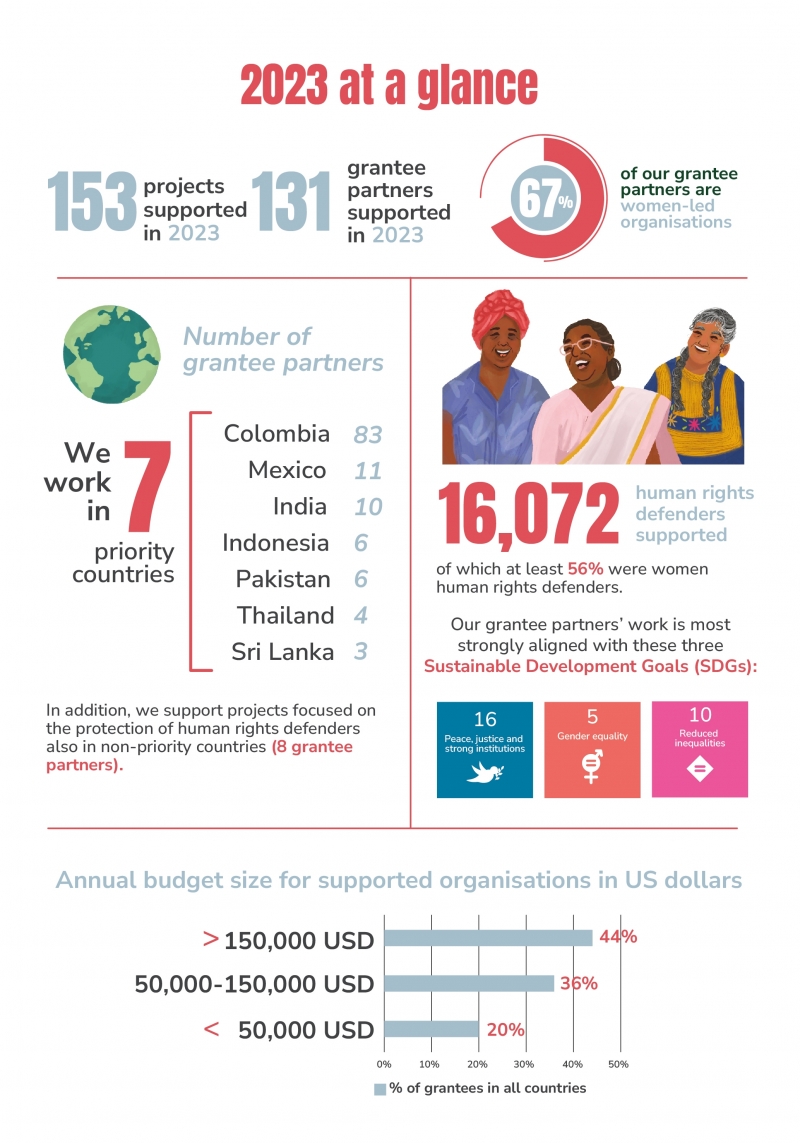
In 2023, NHRF supported 153 projects and 131 grantee partners in 7 priority countries. Through these projects, 16,072 human rights defenders were supported, of which at least 56% were women human rights defenders.
Scroll down this page to read the full annual report or open it here. You will find annual reports from previous years at the end of this page.
Today, 9 December, marks 25 years of the United Nations Declaration on Human Rights Defenders (HRDs). It provides for the support and protection of HRDs, and for many HRDs it’s been a useful marking in legitimizing and supporting their work.
The anniversary is a good time to reflect on what’s working and what isn’t for HRDs, and we discussed some of these issues on a Human Rights First webinar a couple of days ago.
In many ways it was a different world in 1998. Celine Dion and the Backstreet Boys were the big rock acts then. The internet, mobile phones, and digital surveillance of HRDs, were all in their infancy.
For HRDs, much has changed, and it’s possible to see 25 years of success as HRDs have achieved some great things. They’ve changed laws, won the release of people from prison, distributed humanitarian aid, exposed corruption, documented and publicized human rights violations.
For some HRDs just keeping going despite pressure and threats is success in itself. Hundreds are killed every year for their peaceful work on behalf of others, for embarrassing corrupt officials, for making good things happen.
But there is now a greater recognition of the value of the work of HRDs than there was in 1998, and a better understanding of who they are. The family of HRDs has expanded in the last 25 years – back then NGOs discussed whether those working on environmental rights, or those documenting corruption, or medics working in war zones, really counted as HRDs. Now we know they do.
We better understand too the responsibilities of businesses to protect HRDs, and that defenders working on certain issues face specific threats, that those working on land rights, indigenous rights or environmental rights away from big cities are most likely to be murdered. We know too that many defenders are targeted not just for what they do but for who they are.
Women Human Rights Defenders experience added layers of harassment. They’ve always lived with pressure from society in terms of what they should get engaged in and not, pressure from their families on what a woman should do or not, and since 1998 there’s now added pressures in the digital sphere. They are targeted more than other HRDs with digital harassment, which we see very often leads to physical attacks offline.
Our organizations share a similar approach to working with HRDs. The NHRF supports HRDs working for NGOs outside big cities, often formed by people from the community that they work in. It supports organizations where women are in leaderships roles, and provides resources over the long term. For instance, the NHRF works with an NGO in Thailand originally formed by young women to organize their community in the face of a mining company. Most of these women are now grandmothers, but still keep up their human rights work.
The NHRF also works with organizations of HRDs in Indonesia made up of family members of those killed and tortured in in the 1960s who are now seeking redress and working against impunity.
Human Rights First, meanwhile, continues its decades-long work on Northern Ireland, also working with bereaved families of those killed during the conflict in the 1970s, 1980s and 1990s who are also looking for redress and working against impunity.
For many HRDs achieving success is a long road, requiring perseverance and allies. International standards and rules aren’t protecting them enough. Their work needs to be better understood, and better funded.
The picture for HRDs since 1998 is mixed, and no doubt will be for the next 25 years. HRDs will achieve more successes, but unless governments find the political will to implement the protections of the HRD Declaration, more defenders will be attacked, jailed and murdered.
So, what do the next 25 years hold for HRDs? The future is hard to predict, but one thing we can say for sure is that HRDs will continue to be, as the UN Special Rapporteur for HRDs Mary Lawlor says, ordinary people doing extraordinary things.
In these times, when many people from Gaza to Ukraine question the power of the human rights framework to actually protect people’s rights, everyone with power must ensure that HRDs can be funded, protected and supported. We will all be better off for it.
The NHRF stated that 2021 has been another challenging year with numerous obstacles for human rights defenders, such as restrictive legislations, harassment, threats and attacks… Many of our grantee partners risk their wellbeing, their security and their lives for the important work they do. They are on the front line for all of us. We particularly remember those who lost their lives this year in the struggle for human rights. We promise to continue to work in their spirit. For more annual reports 2021, see: https://humanrightsdefenders.blog/tag/annual-report-2021/
In 2021, the NHRF has supported 106 organisations in 11 countries. We hope that this annual report will give you an inspiring insight into their work in 2021. In our new 2021-25 strategy, the three strategic areas are:
1) Fight against impunity and for access to justice,
2) Dismantling discrimination, inequality and marginalization and
3) Protecting human rights defenders and the right to defend rights.
To reach our goals we work through direct financial support to human rights work, networking and capacity building and through communications, advocacy and strategic alliance building.
Voices from the ground must be heard where decisions are made. People sometimes say that they want to be ‘the voice of the voiceless’. We do not see our job as being someone’s voice. We see our task as creating and facilitating the spaces for human rights defenders to use their own voices. Another world is not only possible, she is on her way. On a quiet day, I can hear her breathing.
We want to thank our donors, cooperation partners, the UN special rapporteurs we work with, our board, our advisory board and all our followers and supporters, for the solidarity and encouragement you have provided in 2021!..Together we will prove that another world is indeed possible.
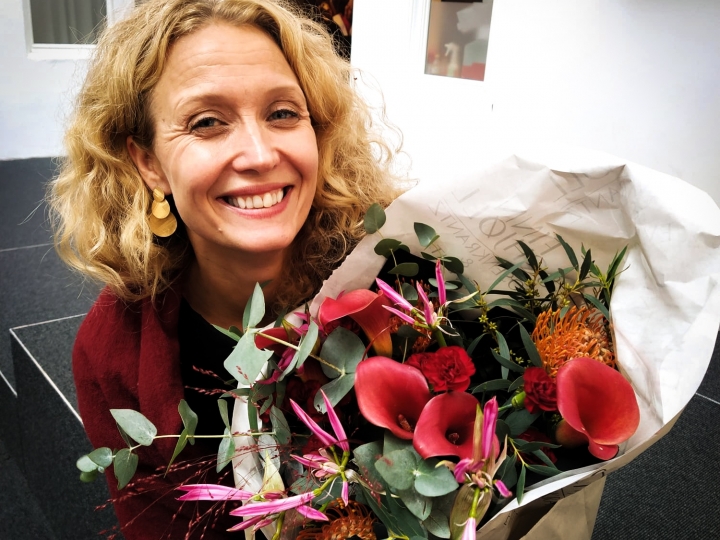
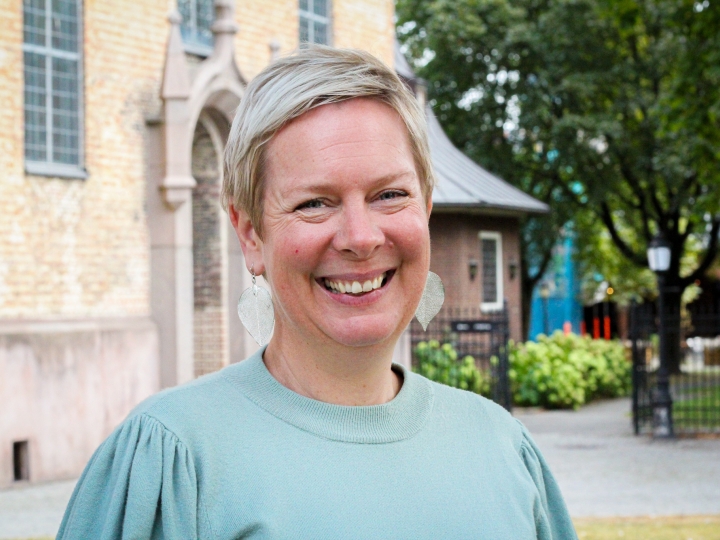
After 11 years as the NHRF’s Executive Director Sandra Petersen was succeeded by Ingeborg Moa on 15 October 2021.
sandraIngeborg
Ingeborg Moa comes to the NHRF from the position as Director of Activism and Organisational Development at Amnesty Norway, and has nearly two decades of international experience working with local organizations and human rights defenders around the world. She has ten years of working experience with the Norwegian People’s Aid (NPA), as well as having worked for Norwegian Refugee Council and the UN. Geographically, she has extensive work experience from the Middle East and Southeast Asia, having spent a number of years in Palestine and Myanmar, as well as in Cambodia, Thailand, Iraq and Turkey. She has also been working on Syria. “My own experiences after working with human rights defenders for nearly 20 years is that for situations of injustice to change, it is the affected communities and people on the ground who need to organize, mobilize and take the lead in the struggle for their own rights. At the same time, international solidarity is necessary both in order to ensure support for practical initiatives on the ground, and not least in order to ensure that local struggles are supported by policy initiatives on a multilateral level”, she says.
Sandra Petersen will during the next four years undertake a PHD research at the Norwegian Center for Human Rights, University of Oslo with a focus on International Support to Human Rights Defenders. Apart from her research, Sandra Petersen will continue to work with the NHRF as a special advisor on human rights defenders.
Sandra Petersen first started working in the NHRF in 2009 leading the work on Pakistan and India. In 2010 she moved into the role of the executive director and has for more than a decade been leading the organisation towards growth; both with strengthening NHRF’s financial muscles to support frontline grassroots human rights organisations and defenders, and by increasing the organisational capacity from a two-staffed office in Oslo in 2010 to 25 people divided between the Oslo and Colombia offices – including team members and consultants in the US, India, Pakistan, Indonesia, Thailand and Mexico. [see also: https://humanrightsdefenders.blog/2020/04/21/norwegian-human-rights-fund-annual-report-2019/]
In an interview (see link below) Sandra give her views on what was achieved and her hopes for the future. And tells a bit more about her research project: The project is partly funded by the NHRF and by the Norwegian Research Council, and will be undertaken at the Norwegian Center for Human Rights at the Law Faculty, University of Oslo. I will seek collaboration with international universities and hopefully contribute to new partnerships. The primary goal of this research is to make an important contribution to future policy outcomes by providing empirical knowledge and comparative analysis of international and in particular Norway’s role in efforts on human rights defender’s protection. This will be shared within institutional structures here in Norway as well as internationally. The Ph.D. seeks to highlight best practices, lessons learned, as well as to try pointing to areas for improvement. Importantly, it aims to understand how human rights defenders in a selection of countries perceive international efforts to support them. Central to this analysis will be to understand possible new needs including effects of COVID-19 and the rapidly evolving technology and digital developments that can affect defenders’ safety and security. I think this is immensely important for all of us that wish to support human rights work and defenders’ role in these efforts. I deeply believe in a combined practitioner and academic approach to our work. Our actions should be well founded in knowledge.
The NHRF is opening a specialised and limited call for concept notes for projects contributing to building resilience, adaptability and increased safety and security for human rights defenders and human rights movements. Projects focusing on digital security and new technological threats used against human rights defenders and projects that seek to give psychosocial and multifaceted support to human rights defenders will be prioritized. The applicant should explain how the initiative will lead to a positive change for human rights defenders in their local communities.
Geographical location: India, Indonesia, Pakistan, Sri Lanka, Thailand and Myanmar. Regional initiatives that include human rights defenders from one or more of the listed countries are also welcome to apply.
Thematic area and target groups: Protection of human rights defenders at risk, the right to defend rights, digital security, psychosocial support, pressure on and repression of civil society. Initiatives with a strong gender focus will be prioritized.
Amount: 15-25,000 USD. Please note that the proposed project budget must be proportionate to the applicant’s current annual budget and must not exceed an amount that is more than double the current annual budget.
Project timeline: One year (12 months)
Project start date: End of 2021/beginning of 2022*.
Deadline for registration and concept note: 18 April 2021
(NB: This call is part of the NHRF’s resource mobilisation, and grantmaking is dependent upon positive response from the NHRF’s network.)
Priority will be given to:
Organisations that are led by the target group or that have a strong link to the community and have special competence in the thematic area of focus
Organisations that adapt an inclusive approach, for example for gender, minorities and persons with disabilities
Organisations that work with women human rights defenders, LGBTIQ- defenders, environmental defenders and trade union activists
Organisations that have proven experience from working in networks, both nationally and regionally
Organisations focusing on digital security and psychosocial support
How to apply
Organisations working within the thematic area are invited to complete the eligibility quiz and concept note form in the NHRF application portal. You will also be asked to upload an overview of a one-year budget of the proposed project. Applicants must adhere to the word limits within the submission form.
The NHRF will review submissions and then make a shortlist of applicants that will be invited to submit a full application. This process could take time – up to 6 months – so we ask applicants to please be patient with our processes.
The Norwegian Center for Human Rights and the Norwegian Human Rights Fund invite you to a seminar addressing the Norwegian and international support to human rights defenders.
This seminar will focus on the role of human rights defenders in creating sustainable, peaceful and just societies, in accordance with the Sustainable Development Goal 16. It will look at the role and support of the Norwegian government, Oslo Municipality, the University of Oslo and Norwegian civil society in the protection of individuals and organisations working for human rights and peaceful and just societies. How can these institutions collectively – and individually – meet the needs of the day, both during and after COVID-19?
Program
13:00-13:10: Welcome by the Rector of the University of Oslo, Svein Stølen.
Welcome by the organizers: NHRF (Executive Director Sandra Petersen) and NCHR (Head of Department Gentian Zyberi).
Short introduction of the panels by the facilitators.
13:10-14:25: Panel 1: The current situation of Human Rights Defenders and protection work.
• Luciana Peri, Coordinator of Shelter Initiatives, ProtectDefenders.eu
• John Peder Egenæs, Director of Amnesty International Norway
Moderator:Nora Sveaass, Professor Emeritus (University of Oslo), member of the UN Subcommittee on Prevention of Torture (SPT) and member of NHRF’s Advisory Board.
14:25 – 14:45: BREAK.
14:45 – 16:00: Panel 2: The role of international, national and local support to Human Rights Defenders
Short video messages from human rights defenders from different countries with recommendations to Norwegian and international actors supporting human rights defenders.
Key note: Mary Lawlor, UN Special Rapporteur on the Situation of Human Rights Defenders (digital participation)
Panel:
• Ine Eriksen Søreide, Norway’s Minister of Foreign Affairs
• Raymond Johansen, Governing Mayor of Oslo
• Mary Lawlor, UN Special Rapporteur on the Situation of Human Rights Defenders
Moderator: Sandra Petersen, Executive Director of the NHRF.
“Human rights defenders reconnect us to what makes the essence of humanity” says Michel Forst, the former UN Special Rapporteur in his foreword to the updated Guidelines on security and protection for grantees by the Norwegian Human Rights Fund (NHRF).
Jalila, Mohamadou, Paulo and Lita are all human rights defenders who work in difficult areas. In forgotten places, where the State does not operate anymore or where conflicts rage on. They provide support to women victims of sexual violence; they advocate for transitional justice; they visit peaceful protesters who have been arbitrarily detained. They bring human rights to the darkest, most isolated places. They are the voices for those whose voices have been stolen. Each and every day these ordinary women and men brave countless risks to be close to those they defend. Because they defend human rights they are targeted by those who benefit from human rights violations. Each day they must reinvent themselves and their most trivial routines. Jalila turns her phone off while having discussions with other defenders; Lita makes sure she travels back home while the sun is still high; and Paulo frequently changes the passwords to his social media accounts. When traveling outside his village, Mohamadou leaves instructions for his family as preparation for the possibility of being arrested and taken to jail.
Each day these four defenders feel in their own minds and bodies what it means to defend human rights in complex settings and thousands of other human rights defenders face the same situation on the ground. They cannot depend on protection from the State or constant protection from their own communities, so they bear the heavy responsibility of protecting themselves, staying safe alone. Some are fortunate to have the support of their organizations and movements but must still practice self-protection. Sometimes this individual responsibility feels like a burden and can have lasting and severe consequences on their psychological, physical and social well-being.
Former Special Rapporteur on the situation of HRDs, Michel Forst, with human rights defenders during a consultation on the situation in the MENA region (Photo: NHRF’s grantee partner, Gulf Centre for Human Rights).
In recent years, a number of initiatives across the globe have contributed to support defenders and to provide them with a set of concrete tools to mitigate risks. Defenders have been building solidarity networks and strategic alliances, they have developed risks analysis and digital security trainings. Women human rights defenders and indigenous communities have helped understand the necessity to develop collective and holistic approaches to security. Some States have developed laws and mechanisms to better protect defenders as a response to the current deterioration of the situation of HRDs. Over the past five years, I have heard and learnt about many good practices on protection, and I am pleased with the efforts of the NHRF to provide these guidelines as a resource to help identify and navigate these initiatives.
….Defenders often represent the last remaining hopes for those whose are left behind, who are excluded and despised by their societies. … it is imperative that we strengthen our support to these heroes. It is not only a matter of justice, it is for the sake of our common future, for our humanity. We must defend and stand and act in solidarity with these selfless, indomitable people.
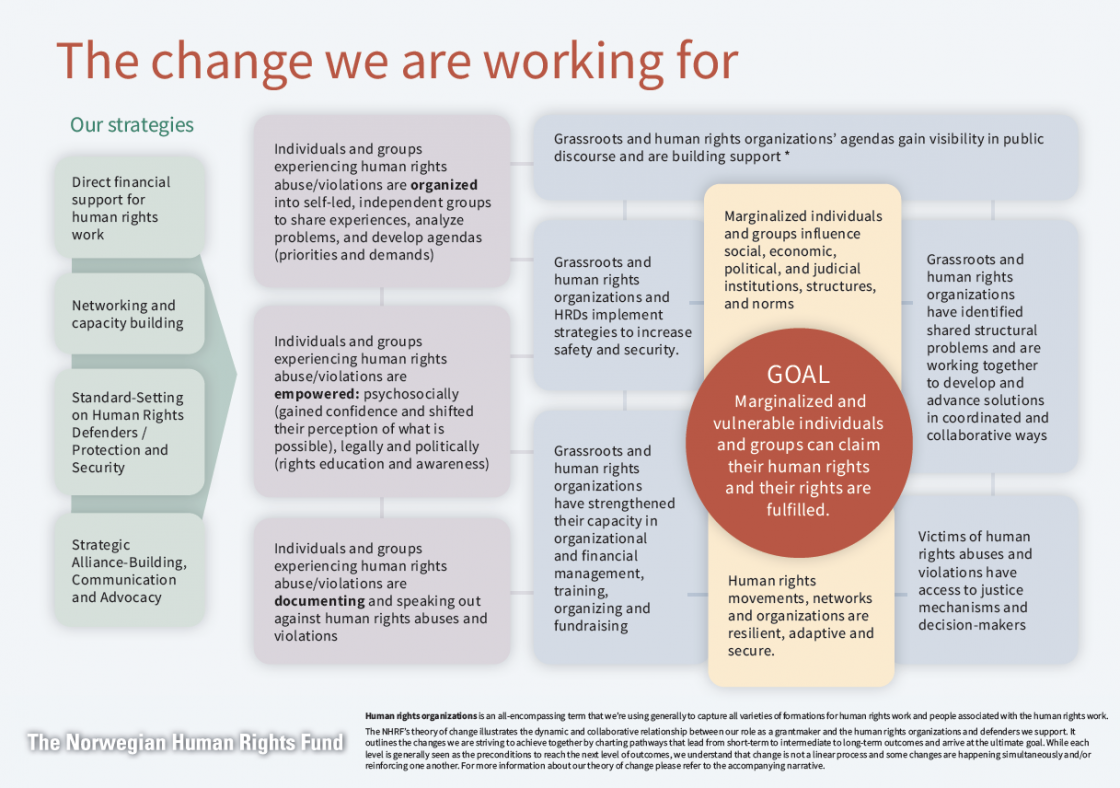
The development of the theory of changewas a participatory process involving the NHRF Secretariat, its Board, NHRF local consultants, and a selection of grantee partners. It is a living document that represents our theory of how change is created and driven forward. It articulates expected outcomes and their preconditions that, together, form pathways of change that lead to the overall goal. We understand these processes to be non-linear, interconnected, interdependent, mutually reinforcing, and occurring simultaneously or separately. The theory of change will guide our work as a partner and grantmaker by informing the support we provide to human rights work to achieve the defined outcomes and overall goal. It is one of the key elements used in our monitoring, evaluation, and learning processes. We will regularly review and refine the theory of change as we assess if our interventions are bringing about change and if the pathways of change are accurate and realistic.
From the Preface written John Peder Egenæs and Sandra Petersen of the Norwegian Human Rights Fund (NHRF):
…..2019 will stand out as an important year for the Norwegian Human Rights Fund (NHRF) in terms of growth and development. … We believe that the seeds of change planted by grantees every day will result in a robust and forceful defense for future generations. As this annual report demonstrates, our grantees and local human rights defenders are continuing to stand up and fight for a future of equality and dignity for all. For some, their work centers on ensuring that vulnerable workers have safe and dignified work environments, for others it’s providing psychosocial support for families of the disappeared and seeking justice for victims of torture and others are leading movements for gender equality. Establishing links, coordinating and collaborating on the local and national levels to create better working conditions for civil society and human rights defenders are crucial to strengthening the work and moving it forward. For this work, we support grantees who build networks and equip and empower defenders with the tools and skills needed for their work; who advocate for positive laws or the prevention of restrictive laws to protect or enable a thriving civil society; and others who provide relief, support and legal representation for human rights activists in cases of arbitrary arrests, detention or when they’re facing threats. Our grantees’ work is interlinked and reinforcing; success in one struggle impacts and can lead to success in another. Their work is driven by the needs on the ground and thus it comes in many forms, but the efforts to contribute to make positive and structural changes and the realization of human rights are shared by all. In 2019, the Norwegian government led an adoption of a new resolution on environmental human rights defenders – a critically important response during one of the most dangerous and even deadly points in recent history for human rights defenders, especially those who fight for natural resources, the rights of indigenous peoples and against environmentally detrimental megaprojects. …… Working together with our partners, we are able to see the reality of the dire situation for people on the front lines working for change, which leads us to seek to increase our support to and solidarity with their work. During 2019, the NHRF created strategic partnerships that increased the financial base for the years to come. We know this will be indispensable for local and front-line human rights defenders and for investing in the realization of human rights for the most vulnerable and marginalized. With these increased resources and with support from our partners, we will continue to invest and sow seeds that we believe will lead to long-term positive change…
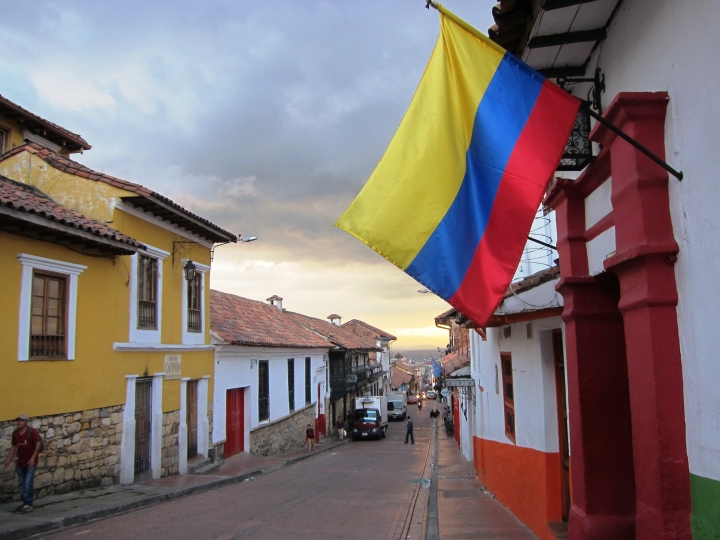
The Norwegian Human Rights Fund is looking for a country director in Colombia., which is a newly created post. Deadline for applications: September 17th, 2019.
Duration: 3 years with possibility of extension
Duty station: Bogota, Colombia. Travel inside the country and follow-up of grants/grantees will be an important part of the work. International travels will also be required.
The tasks include, but are not limited to
Lead the process of establishing a team in Colombia (initially 4-5 people) and set up an office.
Lead the strategy process for the NHRF for its Colombia work, including fundraising and communication work in line with the NHRF overall strategies.
Liaisons with and reporting to donors
Work dynamically with the grantees, and develop work, capacity building and follow-up based on needs and the situation on the ground.
Conduct risk assessments and risk reduction measures for the NHRF and its grantees.
Official qualifications (must have)
Master’s degree in social science, law, economics, or relevant field (can be compensated with long relevant leadership experience in funds mechanism).
Fluent in Spanish and Norwegian (might also be another Scandinavian language), good level of English needed.
Proven leadership experience, including leading a team/staff (min. 3-5 years)
Experience in working with civil society, grant making and funding mechanisms to civil society, including capacity building and networking.
Experience in handling donors and funds including from the Norwegian/Nordic governments.
Experience from Colombia, and possibly the region, when it comes to civil society and human rights defense/work.
Results-oriented and experience with Learning, monitoring and evaluation (LME) processes, previous work with Theories of Change is an advantage.


 Hans Thoolen on Human Rights Defenders and their awards