The Trump administration’s omission of key sections and manipulation of certain countries’ rights abuses degrade and politicize the 2025 US State Department human rights report, Human Rights Watch, Amnesty International, Human Rights First and many other NGOs concluded .
On August 12, 2025, the State Department released its “Country Reports on Human Rights Practices” covering the year 2024. The report omits several categories of rights violations that were standard in past editions, including women, LGBT people, persons with disabilities, corruption in government, and freedom of peaceful assembly. The administration has also grossly mischaracterized the human rights records of abusive governments with which it has or is currently seeking friendly relations.
By undermining the credibility of the report, the administration puts human rights defenders at risk, weakens protections for asylum seekers, and undercuts the global fight against authoritarianism.
This year’s human rights report may strictly keep with the minimum statutory requirements but does not acknowledge the reality of widespread human rights violations against whole groups of people in many locations. As a result, Congress now lacks a widely trusted, comprehensive tool from its own government to appropriately oversee US foreign policy and commit resources. Many of the sections and rights abuses that the report omits are extremely important to understanding the trends and developments of human rights globally, Human Rights Watch said.
On Israel, the State Department disregards the Israeli authorities’ mass forced displacement of Palestinians in Gaza, their use of starvation as a weapon of war, and their deliberate deprivation of water, electricity, medical aid, and other goods necessary for civilians’ survival, actions that amount to war crimes, crimes against humanity, and acts of genocide. The State Department also fails to mention vast damage and destruction to Gaza’s essential infrastructure and the majority of homes, schools, universities, and hospitals.
The report is dishonest about abuses in some third countries to which the US is deporting people, stating that the US found “no credible reports of significant human rights abuses” in El Salvador, although they cite “reports” of extrajudicial executions, enforced disappearance, and mistreatment by police. The administration has transferred to El Salvador’s prisons, despite evidence of torture and other abuses.
The State Department glosses over the Hungarian government’s escalating efforts to undermine democratic institutions and the rule of law, including severe curbs on civil society and independent media, and abuses against LGBT people and migrants. It also fails to acknowledge that Russian authorities have widely used politically motivated imprisonment as a tool in their crackdown on dissent, and its prosecutions of individuals for “extremism” for their alleged affiliation with the LGBT movement.
We, the undersigned organizations, express deep concern over the continued arbitrary detention of the Saudi human rights defender Mohammed al-Bejadi more than two years beyond his sentence. His continuing detention, along with countless others, demonstrates that despite a recent spate of prisoner releases, the Saudi authorities’ severe repression of rights activists and critics remains. We call for his immediate release, along with all others arbitrarily detained in the kingdom for peacefully exercising their fundamental freedoms.
Al-Bejadi, a founding member in 2009 of the now-banned Saudi Civil and Political Rights Association (ACPRA), has been arrested and imprisoned three times for his peaceful human rights activism, most recently on 24 May 2018 during a crackdown on women’s rights defenders. He was subsequently sentenced to an egregious 10-year prison term, with five years suspended, which expired in April 2023.
More than two years later, he remains in Buraydah Prison, where he has been denied access to legal representation. According to ALQST, an independent Saudi human rights group, he has also experienced torture and other ill-treatment, including physical abuse and prolonged incommunicado detention.
The UN Special Rapporteur on human rights defenders, Mary Lawlor, highlighted al-Bejadi’s case in April 2025 to draw attention to a worrying trend in Saudi Arabia, in which the authorities continue to hold prisoners past their completed sentences, in violation of basic international standards and Saudi Arabia’s own laws.
Two other prominent human rights defenders, Mohammed al-Qahtani – another ACPRA co-founder –and Essa al-Nukheifi, were held arbitrarily for more than two years beyond their prison terms before being conditionally released in January 2025.
In other instances, when political prisoners have neared the end of their prison terms Saudi authorities have retried them and increased their sentences. Besides inflicting further injustice on these people after years of arbitrary imprisonment, the failure to release prisoners whose sentences have concluded creates fear that they too may be retried.
Saudi authorities have released dozens of people imprisoned for peacefully exercising their rights in recent months, yet continue to arbitrarily hold many more. Released prisoners continue to face heavy restrictions, such as arbitrary travel bans and having to wear an ankle monitor.
Meanwhile, the Saudi authorities’ record of rights violations continues to deteriorate, notably with their escalating use of the death penalty, including the recent execution of a prominent Saudi journalist Turki al-Jasser, and a notable surge in executions of foreign nationals for non-violent drug-related offences.
Al-Bejadi is one of several people arbitrarily imprisoned whose activism stretches back for decades. He spent four months in prison without charge or trial from September 2007 to January 2008, and was again jailed for more than five years, from March 2011 to April 2016, after taking part in a protest outside the Ministry of Interior. During that protest he said: “I do not have a family member in detention, but we must defend not only our own family but our whole country and all those who are oppressed. All prisoners of conscience are my family.”
The undersigned organizations call on the Saudi authorities to immediately and unconditionally release Mohammed al-Bejadi, all others detained beyond the completion of their prison sentences, and all individuals who are imprisoned for the peaceful exercise of their fundamental rights and freedoms.
Signatories:
ALQST for Human Rights
DAWN
European Saudi Organisation for Human Rights (ESOHR)
FairSquare
Freedom House
Gulf Centre for Human Rights (GCHR)
Human Rights Watch
HuMENA for Human Rights and Civic Engagement
International Federation for Human Rights (FIDH), within the framework of the Observatory for the Protection of Human Rights Defenders
MENA Rights Group
Middle East Democracy Center (MEDC)
World Organisation Against Torture (OMCT), within the framework of the Observatory for the Protection of Human Rights Defenders
At the 59th Human Rights Council session, civil society organisations share reflections on key outcomes and highlight gaps in addressing crucial issues and situations. Full written version below.
We join others who have expressed grave concern about the UN’s financial situation throughout the session. We deplore that we are in this position primarily due to the failure of some States to pay their assessed contributions in full and on time. We regret that this crisis is currently affecting the Council’s ability to deliver its mandate. Today, UN Member States are sending a clear message that human rights and their implementation are optional and not inalienable. We call on all States to pay their dues to the UN in full and without delay, both now and in future years, and strengthen the human rights pillar of the UN by substantially increasing its regular budget. [see: https://humanrightsdefenders.blog/tag/united-nations/]
We welcome the Council’s decision to renew, once more, the Mandateof theIndependent Expert on protection against violence and discrimination based on sexual orientation and gender identity, following a call from more than 1,259 organisations from 157 countries and territories. While the mandate was supported by the overwhelming majority of Council members, we regret that a mandate focusing on core human rights issues such as freedom from violence and discrimination was once again put for a vote.
We welcome the adoption of the resolution on civil society space. The resolution acknowledges important civil society initiatives such as Declaration +25 and addresses key and emerging trends such as strategic lawsuits against public participation (SLAPPs), the phenomenon of transnational repression, and foreign funding legislation, as well as other restrictive legislation including counter-terrorism legislation. We regret, however, that language on transnational repression has been weakened throughout the negotiations and does not take a step forward in terms of defining the phenomenon and its patterns. ..
We welcome the adoption of the resolution on human rights and climate change in relation to climate finance. As acknowledged by the resolution, climate finance is a tool for addressing climate change and it is also important for the enjoyment of human rights when finance prioritises equity, climate justice, social justice, inclusion and just transition processes. … We also regret that, notwithstanding the support expressed by numerous delegations, this resolution is blatantly silent in recognising the positive, important, legitimate and vital role that environmental human rights defenders (EHRDs) play in the promotion and protection of human rights and the environment, particularly in the context of climate change. As recognised by the HRC resolution 40/11, EHRDs are one of the most exposed and at risk around the world. The Inter-American Court on Human Rights has recently ruled in its Advisory Opinion on “Climate Emergency and Human Rights” that EHRDs play a fundamental role due to the urgency, gravity and complexity to address the climate emergency. We will not have climate justice without consulting, listening and including EHRDs in climate actions and initiatives, including this annual resolution.
We express our support for a new strong resolution on the safety of journalists, adopted by consensus and co-sponsored by over 70 countries from all world regions, signalling a renewed international commitment to prevent, protect and remedy all human rights violations against journalists. The resolution becomes the first across the UN to recommend a range of concrete, specific measures to
It is concerning that the Council could not find consensus on the resolution on access to medicines, vaccines and other health products. States should acknowledge that intellectual property rights can be a barrier for access to health products, especially in public health emergencies and should act with a view to finding human-rights compliant solutions. States should further ensure that the benefits of scientific progress is available, accessible, acceptable and of good quality to all people, without discrimination.
We welcome the resolution on new and emerging digital technologies and human rights. The resolution reaffirms the need for human rights due diligence and impact assessments throughout the life cycle of new and emerging digital technologies, and crucially calls upon States to refrain from or cease the use of artificial intelligence applications that are impossible to operate in compliance with international human rights law. The resolution importantly mandates OHCHR to expand its work on UN system-wide promotion, coordination, and coherence on matters related to human rights in new and emerging digital technologies.
We welcome the rejection by the Council of an unprecedented, harmful draft resolution (L.1/Rev.1) presented in bad faith by Eritrea to discontinue the mandate of the Special Rapporteur. The voting result (25 against, 4 in favour) is clear and will deter similar initiatives to terminate mandates. The Pandora’s Box remains closed for now. We welcome the adoption of resolution L.7, which extends the mandate of the Special Rapporteur and enables continued scrutiny of Eritrea‘s dire human rights situation.
We welcome the adoption by consensus of the resolution on the situation of human rights of Rohingya Muslims and other minorities in Myanmar—a strong signal of the Council’s continued prioritization of their plight. As violence between the Myanmar military and Arakan Army escalates, Rohingya face renewed existential threats. We recognize the efforts made to align the resolution closer to the evolving situation on the ground, including its recognition of the role of Arakan Army along with the Myanmar military in perpetuating violence and targeting Rohingya. We also welcome the resolution’s acknowledgment of the worsening humanitarian crisis due to dwindling aid that is driving more Rohingya to risk dangerous journeys by sea. The call for protection of Rohingya across borders and respect for non-refoulement is vital. We support the resolution’s emphasis on accountability and reparations as prerequisites for safe, voluntary, and dignified return of Rohingya refugees. However, we regret its failure to call for an end to arms and jet fuel sale and transfers that continue to fuel ongoing violence.
We emphasize the vital role of investigative mechanisms and, in the context of the UN’s liquidity crisis, we urge all those involved, including the Secretary-General and the High Commissioner, to allocate sufficient resources for these mechanisms to operate. All UN Member States must pay their dues in full and on time. As the conflict in Sudan, now in its third year, shows no sign of abating, resulting in the world’s largest displacement crisis and egregious atrocities against civilians, the work of the Fact-Finding Mission (FFM) should continue. At HRC60, extending its mandate will be a priority.
We continue to deplore this Council’s exceptionalism towards serious human rights violations in China, including crimes against humanity. In his global update to this Council session, High Commissioner Türk indicated he remains ‘concerned about lack of progress on much-needed legal reform to ensure compliance with international human rights law’ and ‘regret[s] that there has not yet been a resolution to the individual cases [the OHCHR has] raised]’. It is imperative that the Council take action commensurate with the gravity of UN findings, by establishing a monitoring and reporting mechanism on China as repeatedly urged by over 40 UN experts since 2020. We urge China to genuinely engage with the UN human rights system to enact meaningful reform, and ensure all individuals and peoples enjoy their human rights, on the basis of recommendations from the OHCHR Xinjiang report, UN Treaty Bodies, and UN Special Procedures.
This Council’s continued silence on the human rights crisis in Egypt remains of major concern. The human rights situation in Egypt is worse than at any point in its modern history and continues to deteriorate. During its UPR process, Egypt rejected or dismissed as “already implemented” recommendations related to serious human rights violations 134 times. In particular, Egypt either rejected or dismissed recommendations to release political prisoners and end arbitrary arrests 12 times, to stop attacks against independent civil society and journalists 19 times, and to end torture and ill-treatment 6 times. The goverment also refused to ensure accountability for those who have committed torture and other human rights violations 7 times, and rejected or dismissed recommendations to halt violance and discrimination against women, minorities and members of the LGBT+ community 25 times, including repeatedly rejecting calls to criminalize marital rape, as well as forced virginity and anal exams. In this context, action by the HRC to address these violations is as important as ever.
Watch the video of the statement below:
Signatories:
African Centre for Democracy and Human Rights Studies (ACDHRS)
Asian Forum for Human Rights and Development (FORUM-ASIA)
On 3 July 2025, the undersigned 22 organizations, expressed their deep concern over the increasing use of criminal law without due process guarantees, the harassment, the stigmatization, and the persecution by Salvadoran authorities against human rights defenders, community leaders, environmental activists, university professors, lawyers, journalists, and other voices critical of the government.
Prominent journalists, activists, and lawyers, such as former prosecutor and defenderRuth López and professor and constitutional lawyerEnrique Anaya, have been arbitrarily detained in retaliation for their work documenting and denouncing corruption, human rights violations, and attacks on the rule of law in El Salvador. Both are in prolonged pretrial detention and face spurious and unfounded charges of embezzlement and money laundering, respectively. These detentions send an intimidating message to the rest of civil society and further erode public confidence in the impartiality and independence of the Salvadoran judicial system.
The Salvadoran state has intensified its attacks on civil society and the independent press through coordinated strategies in the legal, institutional, and media spheres to silence their work. It is extremely alarming that they are being persecuted under a prolonged state of exception that suspends fundamental rights and freedoms, a measure whose objective is to control organized crime gangs.
In a context of high concentration of power, the Foreign Agents Law was enacted, imposing severe restrictions on non-governmental organizations, including onerous registration requirements, a 30 percent tax on foreign funding, and broad powers to suspend their activities based on vague allegations of political activity. Together with the hostile rhetoric from senior officials led by President Bukele, these measures aim to delegitimize independent voices and restrict the legitimate activities of civil society organizations.
The persecution of defenders such as Ruth López and Enrique Anaya reflects a broader strategy to dismantle civic oversight and the rule of law, and to criminalize criticism and the defense of human rights. Other examples of criminalization include community leaders from La Floresta and the El Bosque cooperative, among them Fidel Zavala, Alejandro Henríquez, and Ángel Pérez, who have been detained during peaceful protests over land and evictions.
It is important to note that, throughout Nayib Bukele’s administration, dozens of human rights defenders, journalists, lawyers, former public officials, members of the political opposition, and businesspeople have been forced into exile outside the country. This trend, which is worrying in itself, has significantly increased in the last month, reflecting a growing climate of repression and persecution that severely restricts civic and democratic space in El Salvador.
The repression of civic space in El Salvador is taking place within a broader context of erosion of democratic institutions and the rule of law. As a result of the state of exception, more than 85,000 people have been detained without respect for basic due process guarantees, including the presumption of innocence and access to a fair and impartial trial, and in inhumane conditions of deprivation of liberty. Local organizations have documented at least 400 deaths of people in custody since the beginning of the exception regime.
We therefore call on the Salvadoran State to:
Immediately release lawyers Ruth López and Enrique Anaya, as well as all human rights defenders and community leaders who have been arbitrarily detained for political reasons; and respect due process guarantees, including the right to a public trial, in any proceedings against them.
Refrain from using pretrial detention as a form of advance punishment against human rights defenders and others detained for political reasons, in clear violation of due process guarantees and international human rights standards.
Protect human rights defenders from reprisals, harassment, torture, and threats, and ensure accountability for abuses committed.
Restore conditions that allow freedom of expression, association, and assembly, and harmonize national laws with El Salvador’s international obligations, including by repealing the Foreign Agents Law.
End the misuse and abuse of emergency measures and, in all cases, guarantee the right to a fair trial.
We also call on the international community, including the Organization of American States and the United Nations, to:
Urge the government of El Salvador to immediately cease the instrumentalization of the criminal justice system against human rights defenders or those who express criticism of the government.
Take urgent action, through diplomatic channels, assistance, and conditional cooperation, among other means, to protect civic space, the rule of law, democracy, and human rights in El Salvador.
Abogadas y Abogados para la Justicia y los Derechos Humanos (México)
Alianza Regional por la Libre Expresión e Información
Asociación Pro Derechos Humanos -APRODEH, Perú
Center for Gender & Refugee Studies (CGRS)
Centro de Documentación en Derechos Humanos “Segundo Montes Mozo SJ” (CSMM) / Ecuador
Centro por la Justicia y el Derecho Internacional (CEJIL)
Consultora Solidaria (Mexico)
Consultoría para los Derechos Humanos y el Desplazamiento – CODHES (Colombia).
Convergencia por los Derechos Humanos (CDH), Guatemala
Comité de Familiares de Víctimas de los Sucesos de Febrero y Marzo de 1989 (COFAVIC), Venezuela.
Due Process of Law Foundation (DPLF)
Equipo de Reflexión, Investigación y Comunicación (ERIC-SJ). Honduras
Global Strategic Litigation Council for Refugee Rights
Instituto de Defensa Legal (IDL), Peru
Latin America Working Group (LAWG)
Movimiento Autónomo de Mujeres
Robert F. Kennedy Human Rights
Synergía, iniciativas para los derechos humanos
Tejiendo Redes Infancia en América Latina y el Caribe
ISHR and the Colectivo 46/2 condemn the assassination of opposition leader Samcam Ruìz by the Nicaraguan Government.
In the joint letter published on 23 June 2025 The 46/2 Collective denounces to the international community the assassination of retired Nicaraguan Army Major Roberto Samcam Ruíz, which took place on 19 June in his home in San José, Costa Rica.
Samcam Ruíz was a strong voice of denunciation against the Ortega-Murillo dictatorship, denouncing the Nicaraguan army and pointing it out as a participant in the repression and extrajudicial executions committed since 2018. He had also denounced an espionage network against opposition refugees in Costa Rica.
The retired major was one of the 94 Nicaraguans denationalised in February 2023 by the dictatorship and since 11 July 2018 had been a refugee in Costa Rica due to persecution and criminalisation by the dictatorship of Daniel Ortega and Rosario Murillo. He obtained Spanish nationality on 26 July 2023.
The assassination of the former retired military officer is not the first attack against opponents on Costa Rican soil. In 2023, opposition member Joao Maldonado and his wife were shot at with the clear intention of killing them. Maldonado had already suffered another attack in 2021, also in San José, Costa Rica. In 2022, the Nicaraguan opposition leader Rodolfo Rojas was found dead in Honduras. According to relatives, he had been lured to Honduras from Costa Rica, where he had gone into exile. To the list must be added the murder of another refugee, Jaime Luis Ortega, in 2024, in Upala, a canton on the border with Nicaragua. Following these events, Roberto Samcam had spoken to the press, pointing out the direct involvement of the Ortega Murillo regime and indicating that he knew that his life was at risk.
Although the investigations into Samcam’s murder are ongoing, the circumstances of the murder and the profile of the victim raise strong suspicions that it may be a political crime with possible transnational links. This murder takes place in a context in which various human rights organisations have been documenting a sustained pattern of surveillance, threats, harassment and acts of intimidation directed against Nicaraguans in exile in the region, especially in Costa Rica.
We consider that this crime should be analysed and investigated as part of a broader strategy of transnational repression promoted by the Nicaraguan regime to persecute and silence dissent outside its borders, in open violation of the human rights of refugees and exiles. This transnational repression has been documented by the Group of Experts on Human Rights in Nicaragua (GHREN), who have pointed out that ‘The Government’s repressive actions transcend the country’s borders and affect people who are opponents or perceived as such abroad. The government has also continued to target family members of opponents inside Nicaragua, including children, by mere association, as a way of punishing opponents and/or deterring them from speaking out wherever they are’.
Given the gravity of this crime and the sustained pattern of transnational repression against exiled Nicaraguans, we urgently call on the international community to demand that the Nicaraguan State immediately cease all forms of persecution, surveillance and violence against dissidents in exile. We also request that the international community strengthen political, technical and financial support for the protection mechanisms for human rights defenders in exile. We also urge the establishment of bilateral or multilateral channels of communication with the host countries of Nicaraguans in order to assess the security situation and articulate preventive responses to possible acts of transnational persecution. Finally, we call on international human rights bodies to urgently follow up on these cases as part of a systematic pattern of cross-border repression, and to ensure justice and truth for the victims.
Signatories:
Collective Nicaragua Never Again
Centre for International Law and Justice – CEJIL
International Federation for Human Rights – FIDH
International Institute on Race, Equality and Human Rights
Autonomous Women’s Movement – MAM
World Organisation Against Torture (OMCT)
Peace Brigades International – PBI
International Network on Human Rights Europe – RIDHE
Legal Defence, Registry and Memory Unit – UDJUDR
Open ballot boxes
International Service for Human Rights – ISHR
Additional information:
The 46/2 Collective is a coalition of 19 international, regional and Nicaraguan human rights organisations that regularly informs the international community about the lack of action by the Nicaraguan regime to meet its international human rights obligations.
ARTICLE 19, and the undersigned human rights organistions, call on the Egyptian government to immediately end its campaign of transnational repression targeting exiled Egyptian journalists. We specifically urge the government to respond to the UN report detailing the harassment and surveillance of Egyptian investigative journalist Basma Mostafa, currently residing in Germany. We further urge German authorities to ensure her safety and uphold their international obligations to protect freedom of expression.
Despite seeking safety in exile, Mostafa continues to face threats, surveillance, harassment, and online gender-based violence across multiple countries—including Germany, Switzerland, Kenya, and Lebanon—simply for doing her work. These acts are detailed in a joint communication from UN Special Rapporteurs (AL EGY 6/2024), which documents a disturbing pattern of cross-border intimidation carried out by or with the acquiescence of Egyptian authorities.
Germany’s former Human Rights Commissioner, Luise Amtsberg, has publicly condemned Egypt’s transnational repression and urged the Egyptian government to address findings outlined in the UN report. The Egyptian authorities have yet to issue an official response. The silence is telling.
Her case is not isolated; Egypt is among the world’s top perpetrators of transnational repression, using tactics such as arresting journalists’ family members, blocking access to exile-based media, targeting journalists with spyware, and denying consular services and identity documents for those living abroad and their family members, including children. In another notable case, a Berlin court convicted a man for charges related to spying for the Egyptian regime, including on Egyptian exiles while working in the press office of former Chancellor Angela Merkel, where he had access to data on exiled Egyptian journalists accredited with the Federal Press Office.
We call on the Egyptian authorities to immediately respond to UN communication AL EGY 6/2024 and end all forms of transnational repression against Egyptian journalists and critics in exile. Egypt must stop targeting journalists abroad and ensure independent, transparent investigations to hold perpetrators accountable.
We also urge the German authorities to protect exiled journalists and critics from intimidation tactics by foreign governments and those working on their behalf, in line with their International Covenant on Civil and Political Rights (ICCPR) obligations and the 2023 Declaration of Principles to Combat Transnational Repression. Germany must provide full protection to Basma Mostafa, ensure accountability for her assault, investigate all attacks, harassment, and surveillance on its soil, and use its influence to demand that Egypt end its campaign of transnational repression.
Signed by:
Access Now
ARTICLE 19
Cairo Institute for Human Rights Studies (CIHRS)
Cartoonists Rights
Committee for Justice (CFJ)
Committee to Protect Journalists (CPJ)
Egyptian Commission for Rights and Freedoms (ECRF)
Egyptian Front for Human Rights (EFHR)
Egyptian Human Rights Forum (EHRF)
EuroMed Rights
EuroMed Rights Network
Gulf Centre for Human Rights (GCHR)
HuMENA for Human Rights and Civic Engagement
Human Rights Watch
International Federation for Human Rights (FIDH), within the framework of the Observatory for the Protection of Human Rights Defenders
International Service for Human Rights (ISHR)
Intersection Association for Rights and Freedoms
Law and Democracy Support Foundation (LDSF)
MENA Rights Group
Middle East Democracy Center (MEDC)
PEN America
PEN Berlin
Robert F. Kennedy Human Rights
Samir Kassir Foundation (SKF)
The Regional Coalition for Women Human Rights Defenders in South West Asia and North Africa (WHRDMENA)
World Organisation Against Torture (OMCT), within the framework of the Observatory for the Protection of Human Rights Defenders
On 29 May the Committee to Protect Journalists and fourteen other organisations have urged Pakistan to immediately halt deportation of Afghan journalists and other vulnerable Afghan migrants. The fifteen advocacy groups expressed deep concern over Pakistan’s ongoing deportation plan, first announced on 3 October 2023, which targets undocumented Afghan nationals. The joint statement highlights the heightened risks faced by Afghan journalists, writers, artists, human rights defenders, and others who fled Taliban persecution and are now at risk of being forcibly returned.
Among the signatories are prominent international organisations such as PEN Germany, CPJ, Unlimited Free Press, Front Line Defenders, International Cities of Refuge Network (ICORN), Nai – Supporting Open Media in Afghanistan, and Reporters Without Borders (RSF).
The organisations also called on the international community to provide safe resettlement opportunities for these individuals, recognising the dangers they face if returned to Taliban-controlled Afghanistan. Pakistan’s deportation policy has faced sharp criticism from local and international bodies, including the Pakistan Human Rights Commission, the United Nations High Commissioner for Refugees (UNHCR), and the International Organisation for Migration (IOM). These entities have urged Pakistan to uphold its international obligations and provide protection to those fleeing conflict and persecution.
Despite repeated calls for restraint, the Pakistani government has accelerated forced returns in recent months. In April alone, more than 300,000 Afghans were deported, drawing further condemnation from human rights organisations.
——
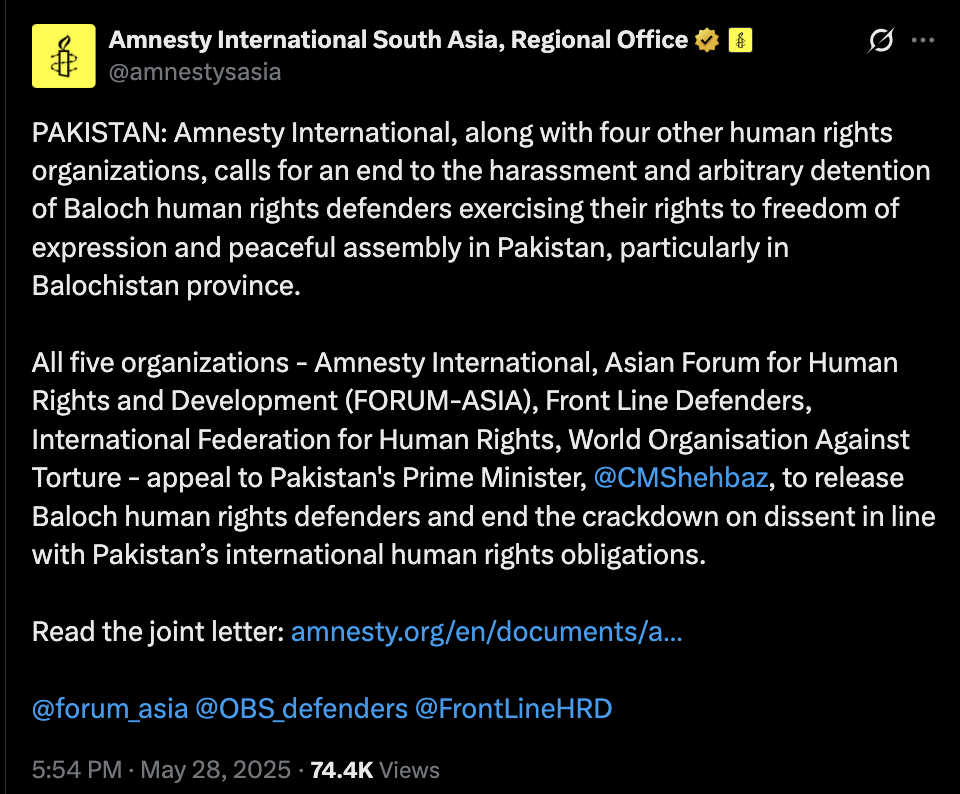
On 28 May Amnesty International along with four other human rights organizations wrote to the Pakistani prime minister, calling for an end to the “harassment and arbitrary detention” of Baloch human rights defenders (HRDs) exercising their rights to freedom of expression and peaceful assembly, particularly in Balochistan province.
The letter comes in the wake of Dr. Mahrang Baloch, one of the leading campaigners for the Baloch minority and the leader of the Baloch Yakjehti Committee (BYC), and a number of other activists, being arrested in March on charges of terrorism, sedition and murder. ..
The five organizations — Amnesty International, Asian Forum for Human Rights and Development (FORUM-ASIA), Front Line Defenders, International Federation for Human Rights, World Organization Against Torture — appeal to Pakistan’s Prime Minister to release Baloch human rights defenders and end the crackdown on dissent in line with Pakistan’s international human rights obligations;
A dozen UN experts called on Pakistan in March to immediately release Baloch rights defenders, including Dr. Baloch, and to end the repression of their peaceful protests. UN special rapporteur for human rights defenders Mary Lawlor said she was “disturbed by reports of further mistreatment in prison.”
Balochistan is the site of a long-running separatist movement, with insurgent groups accusing the state of unfairly exploiting Balochistan’s rich gas and mineral resources. The federal and provincial governments deny this, saying they are spending billions of rupees on the uplift of the province’s people.
Human Rights Watch, Civil Rights Defenders and many, many other NGOs are deeply alarmed by a new legislative proposal in Hungary that, if passed, would institutionalise sweeping, opaque, and politically motivated repression of independent civil society, the press, and private organisations that receive foreign support or have any kind of income that the Hungarian government feels would threaten the country’s sovereignty.
The draft law, which is deceptively titled ‘On the Transparency of Public Life’, would give the authorities unchecked powers, allowing it to recommend the registration of organisations deemed to be ‘influencing public life’ with foreign funding in ways that ‘threaten Hungary’s sovereignty’. Because this phrasing is vague and ideologically loaded, it risks including any kind of criticism of government policy, including the promotion of human rights, press freedom, gender equality, and the rule of law.
Potential disastrous consequences
No legal remedy: If the government demands an organisation register itself, the organisation in question would not be able to appeal this decision. Once listed, organisations would have no access to effective legal redress;
Broad definitions: ‘Foreign support’ is defined as any financial input, no matter how small, from practically any international source (including EU institutions and dual citizens) as well as commercial revenue;
Sweeping prohibitions and sanctions: Listed organisations would have to seek permission from the tax authorities to receive foreign support. Financial institutions would be required to report and block transfers, meaning NGOs would effectively be permanently monitored;
Loss of domestic support: Listed organisations would lose access to Hungary’s 1% income tax donation scheme, which would prevent them from receiving support from regular Hungarian citizens;
Political targeting: Leaders of registered organisations would be labelled ‘politically exposed persons’, which would expose their private financial transactions to invasive scrutiny;
Severe penalties: Any violations could lead to fines of up to 25 times the amount received, suspension of the organisation’s advocacy activities, and even forced closure.
EU must speak out against proposed law
Hungary’s draft law is not about transparency: it is a calculated attempt to criminalise dissent, silence watchdogs, and entrench one-party control over the democratic public sphere and civic space. If passed, the law would violate multiple provisions of the EU Charter of Fundamental Rights and the European Convention on Human Rights, including freedom of expression and association and the right to an effective remedy.
In an open letter to President Ursula von der Leyen and Commissioner Michael McGrath of 22 May 2025, the NGOs urge to take the following immediate steps:
Immediately request the Court of Justice of the European Union (CJEU) to grant interim measures in the ongoing infringement procedure on the Law on the Defence of National Sovereignty (Case C-829/24). The Sovereignty Protection Office is crucial to the new bill and therefore this is an imminent and effective way to halt the progress and impact of the bill. Cognizant of the impending danger, the European Parliament and civil society have been calling for this step since 2024. Interim measures are designed to prevent irreparable harm — in this case, the effective paralysis of civil society organisations, independent media and dissenting voices – and with this new development comprehensive interim measures should be requested immediately.
At the same time, call on the Hungarian government to withdraw the bill and if unsuccessful, open a new infringement procedure on new violations that are not linked to the ongoing case on the Defence of National Sovereignty.
With the forthcoming Article 7 hearing on Hungary on 27 May 2025 and recognising the escalation of a systematic breakdown of the rule of law, support the Council of the EU to move to a vote on Article 7(1).
This new bill represents a severe and existential threat to democratic principles, human rights and the rule of law in Hungary and in the EU as a whole. If the existing tools are not effectively deployed, we risk an unravelling of the rules on which the EU was founded and a clear step towards authoritarian practices. We call on you to stand in solidarity with Hungarian civil society and their counterparts across the region and remain available to provide additional information and support.
ISHR, the Observatory for the Protection of Human Rights Defenders, a partnership of the World Organisation Against Torture (OMCT) and the International Federation for Human Rights (FIDH), request your urgent intervention in the following situation in Venezuela.
The Observatory has been informed of the disappearance of Mr. Eduardo Torres, a labour lawyer who has been a member for over five years of the Venezuelan Education-Action Program on Human Rights (PROVEA), an FIDH member organisation.
According to witnesses, Eduardo Torres was last seen on Friday, 9 May 2025 at 4:00 p.m. in Parque Central in Caracas, after attending a meeting. At that moment, Mr. Torres contacted his family and informed them he was heading home, near Av. Fuerzas Armadas in Caracas, but he never arrived.
Seeking information about Eduardo Torres’ whereabouts, his wife, Ms. Emiselys Nuñez, accompanied by PROVEA members, have visited various detention centres in Caracas, including the Bolivarian National Intelligence Service (SEBIN) at El Helicoide, several National Bolivarian Police (PNB) stations in Maripérez, Boleíta and Petare, as well as the General Directorate of Military Counterintelligence (DGCIM) in Boleíta. As of the publication of this urgent appeal, his whereabouts remain unknown.
On 11 May 2025, Ms. Emiselys Nuñez and PROVEA’s legal team went to the Palace of Justice to submit a “Habeas Corpus” petition before the Judge of First Instance in Control Functions of the Criminal Judicial Circuit of the Metropolitan Area of Caracas, Specialised in protection matters, to request information on whether Eduardo Torres had been detained by the Venezuelan State. However, after more than seven hours of waiting, they were not “authorised” to receive the document, without providing details, and in clear violation of Article 27 of the National Constitution and Articles 2, 3, and 4 of the Organic Law of Personal Liberty and Security.
The Observatory highlights that Mr. Torres has been repeatedly been subjected to threats and acts of harassment by Venezuelan police officers. Like the rest of the PROVEA team, he is a beneficiary of precautionary protection measures granted by the Inter-American Commission on Human Rights (IACHR) due to repeated threats, criminalisation, and harassment in connection with his human rights work in Venezuela.
The Observatory expresses its deepest concern due to the high probability that Mr. Eduardo Torres is in a condition of arbitrary detention and enforced disappearance, due to his work as a human rights defender and given the constant threats against him. If confirmed, these acts would increase the risk of torture and ill-treatment against him.
The Observatory underlines that this disappearance occurs two weeks before the national and regional elections scheduled for 25 May 2025, again highlighting the risks against human rights defenders in Venezuela and exemplifying a systematic attempt to silence all critical voices committed to human rights and democracy in the country.
The Observatory urges the Venezuelan authorities to guarantee the physical and psychological security of Mr. Eduardo Torres, to disclose his whereabouts and to proceed to his immediate and unconditional release, in case he is indeed detained by State actors.
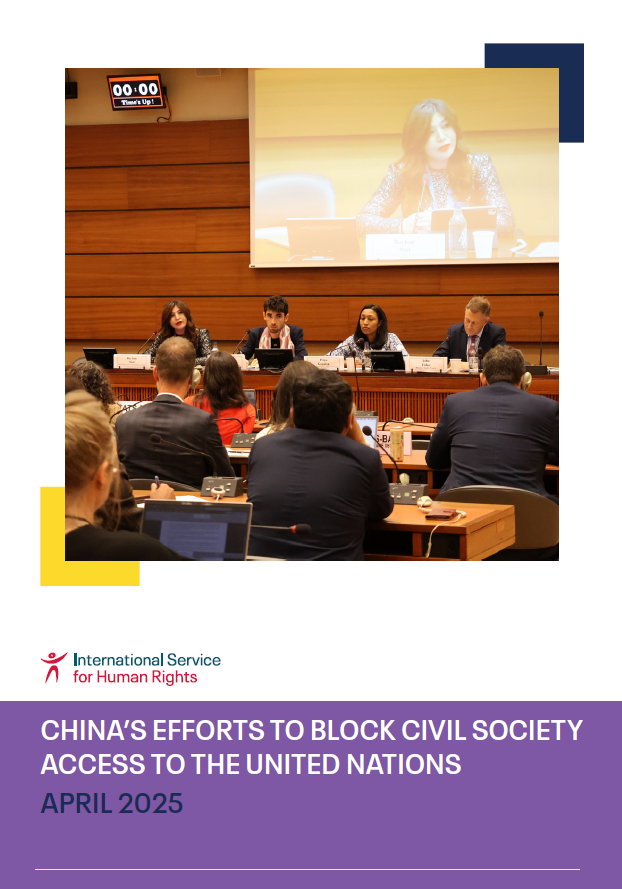
In a new report, ISHR analyses China’s tactics to restrict access for independent civil society actors in UN human rights bodies. The report provides an analysis of China’s membership of the UN Committee on NGOs, the growing presence of Chinese Government-Organised NGOs (GONGOs), and patterns of intimidation and reprisals by the Chinese government.
In the report, published on 28 April 2025 the International Service for Human Rights (ISHR) uncovers the tactics deployed by the Chinese government to restrict access to UN human rights bodies to independent civil society actors and human rights defenders, and intimidate and retaliate against those who do so.
These tactics include using its membership of the UN Committee on NGOs to systematically defer NGO applications, increasing the presence of GONGOs to limit space for independent NGOs and advance pro-government narratives, systematically committing acts of intimidation and reprisals against those seeking to cooperate with the UN, weaponising procedural tactics to silence NGO speakers and threatening diplomats not to meet with them, and opposing reform initiatives and efforts at norm-setting on safe and unhindered civil society participation at the Human Rights Council.
These tactics strongly contrast China’s stated commitment to being a reliable multilateral leader. They stem from the Chinese Party-State’s primary foreign policy objective of shielding itself from human rights criticism and enhancing its international image by restricting and deterring critical civil society voices, crowding out civil society space with GONGOs, and stalling and diverting reform initiatives.
While China is the focus of this report, the issues addressed are systemic. Based on this report’s findings, ISHR puts forward a set of targeted recommendations to UN bodies and Member States, aimed at protecting civil society space from interference and restrictions. The recommendations are designed to strengthen UN processes and prevent any State from manipulating international mechanisms to suppress independent voices. These include:
Reforming the Committee on NGOs to increase transparency, limit abuse of deferrals, and ensure fair access to UN bodies for independent NGOs;
Strengthening protection mechanisms against reprisals, including rapid response to incidents inside UN premises, public accountability for perpetrators, and consistent long-term follow-up on unresolved cases;
Curbing the influence of GONGOs by distinguishing clearly between independent and State-organised NGOs, and better documenting their presence and impact; and,
Strengthening measures at the Human Rights Council and other UN bodies to make civil society participation safer, more inclusive, and less vulnerable to obstruction
The report has been featured prominently in a global investigation by the International Consortium of Investigative Journalists (ICIJ) launched on 28 April 2025.