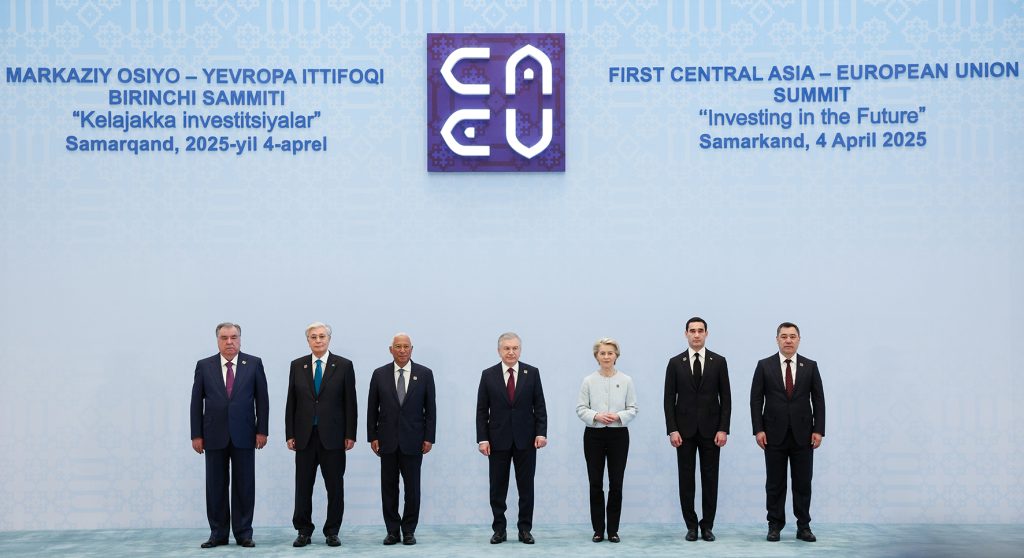
On 10 April 2025 Civil Rights Defenders, along with seven other international human rights organizations, commend the commitments made at the EU-Central Asia Summit in Samarkand. We urge Central Asian leaders to prioritize human rights and uphold the civil and political freedoms enshrined in their national constitutions and international treaties. The commitments to peace, security, democracy, and the elevation of relations to a strategic partnership must be matched by concrete actions to protect human rights.
On Friday, April 4, the Uzbek city of Samarkand hosted the first ever EU – Central Asia Summit where high-level officials – all five regional presidents and European Council President António Costa and European Commission President Ursula von der Leyen – discussed economic cooperation and agreed to bring their existing partnership to a new strategic level. At the end of the summit, participants issued a joint declaration that, among others, stated their commitment to freedom of expression and association, creating an enabling environment for civil society and independent media, protection of human rights defenders, as well as to respecting the rights of women and children. According to an official press release, the European Commission promised to invest €12 billion in the region to strengthen transport links and deepen cooperation on critical raw materials, digital connectivity, water, and energy.
Paragraph 3 of the joint declaration says: “We are committed to cooperate for peace, security, and democracy, to fully respect international law, including the UN Charter and the fundamental principles of respect for the independence, sovereignty and territorial integrity of all States, within their internationally recognised borders. We emphasised the importance of achieving as soon as possible, a comprehensive, just, and lasting peace in Ukraine in accordance with the principles of the Charter of the United Nations. We emphasized the need to uphold the principles of the OSCE by the participating States. We reconfirmed the obligation of all States to refrain in their international relations from the threat or use of force, to respect international humanitarian law and underlined the need for peaceful resolution of conflicts.”
In paragraph 16, the “EU and Central Asian leaders reiterated that the promotion and protection of rule of law, human rights and fundamental freedoms is a common fundamental value. Ensuring freedom of expression and association, an enabling environment for civil society and independent media, protection of human rights defenders as well as the respect for the rights of women, the rights of the child, and labor rights remain at the core of EU–Central Asia relations. The EU reiterated its readiness to support efforts in this regard at regional as well as at national level.”
Furthermore, in paragraph 15 the “Participants affirmed the need for their continued commitment to enhanced cooperation and the development of new approaches in the joint fight against organised crime, violent extremism, radicalisation, terrorism, drug trafficking, trafficking in human beings, migrant smuggling, cyber threats, including cybercrime and disinformationas well as addressing Chemical, Biological, Radiological and Nuclear risks whilst safeguarding human rights and media freedom [emphasis added].”
Civil Rights Defenders, International Partnership for Human Rights (IPHR), Araminta, Freedom Now, Norwegian Helsinki Committee, People in Need, International Federation for Human Rights (FIDH), and the World Organisation Against Torture (OMCT) welcome these declared commitments and urge the leaders of each Central Asian nation to take immediate steps to fulfill their promises. They should start by releasing from prison all journalists, bloggers, lawyers, human rights defenders, civil society activists, and political opponents who have been prosecuted and convicted on retaliatory and unsubstantiated charges. They should also repeal legislation containing provisions that directly contradict their declared commitment to human rights standards.
The Central Asian governments should also end–and establish safeguards to prevent–the misuse of anti-extremism and anti-disinformation policies and security tools to restrict, persecute, and/or criminalize legitimate civil society activity. While enhanced cooperation in the joint fight against organized crime, violent extremism and terrorism, and disinformation are a welcome development, these types of laws and cooperation initiatives have been instrumentalized by the Central Asian governments against legitimate civil society actors, media and political opposition activists, including for imprisonment on lengthy sentences and transnational repression extending to the territory of the European Union.
In particular:
- In Kazakhstan, President Kassym-Jomart Tokayev should order the release from custody of activist Aigerim Tleuzhanova, political opposition party leader Marat Zhylanbayev, satirist blogger Temirlan Ensebek, and labor rights activist Erzhan Elshibayev among others prosecuted on politically motivated charges, We believe that these individuals were targeted in direct retaliation for exercising their civil and political rights, and authorities have failed to provide any credible evidence to support the allegations levelled against them. Kazakh authorities should repeal or thoroughly revise broadly worded criminal code provisions penalising the involvement in ‘’extremist’’ activities, ‘’incitement’’ to discord and the spread of ‘’false’’ information, which are frequently misused to target critics, including in some of the cases mentioned above. Kazakh authorities should also drop their declared plans to adopt a so-called “foreign agents’” law, cease the public attacks on the LGBTIQ community, and end reprisals against NGOs-recipients of foreign grants.
- In Kyrgyzstan, it is welcome that President Sadyr Japarov pardoned Temirov Live associated journalist Azamat Ishenbekov this week, although he should not have been imprisoned in the first place. Authorities should also quash the charges against his colleagues convicted on similar charges, releasing Makhabat Tajibek Kyzy and lifting the probational sentences imposed on Aike Beishekeyeva and Aktilek Kaparov. We believe all four journalists were targeted in retaliation for their critical opinions and independent journalism. Authorities should also release independent journalist Kanyshay Mamyrkulova and drop the criminal charges initiated against her and others in apparent retaliation for social media posts critical of the government. In addition, they should reverse the court ruling that ordered the liquidation of independent news organization Kloop Media and stop pressuring other independent media. They should repeal the law on so-called “foreign representatives” and revoke vaguely worded provisions that prohibit the dissemination of “false’’, defamatory or insulting information, as well as content that ‘’promotes non-traditional sexual relations’’. This legislation severely violates the fundamental freedoms of expression, association, and assembly.
- In Tajikistan, President Emomali Rakhmon should take immediate steps to release from prison the eight independent journalists Rukhshona Hakimova, Abdusattor Pirmuhammadzoda, Ahmad Ibrohim, Abdullo Ghurbati, Daler Imomali, Khurshed Fozilov, Khushom Gulyam, and Zavqibek Saidamini. Human rights activists and lawyers Ulfatkhonim Mamadshoeva, Buzurgmehr Yorov, Manuchehr Kholiknazarov, and Faromuz Irgashov should also be freed without delay. By imprisoning these individuals the Tajik authorities have cemented a climate of fear among civil society actors – a record that must be reversed. Tajik authorities should also cease its continued crackdown in the Gorno-Badakshan Autonomous Region and its systematic use of transnational repression to target government opponents abroad, including in EU countries. Several individuals who were forcibly returned to Tajikistan in 2024 were tortured, arrested and handed lengthy prison sentences after closed trials.
- In Turkmenistan, President Serdar Berdimuhamedov should take concrete steps to rectify his government’s extremely poor human rights record, free political prisoners, and allow space for an independent civil society to develop. The government should publicly declare tolerance towards criticism in the media and end wide ranging internet censorship. Authorities should immediately end attacks and harassment of critics of the regime both inside the country and abroad, including veteran human rights defender and journalist Soltan Achilova, who has repeatedly been barred from leaving the country. They should also decriminalize homosexuality while adopting legislation to criminalize domestic violence.
- In Uzbekistan, President Shavkat Mirziyoyev should order to quash wrongful convictions and free from prison and retaliatory psychiatric ward lawyer Dauletmurat Tadzhimuratov, activists Nargiz Keldiyorova and Dildora Khakimova and blogger Valijon Kalonov. All these human rights defenders have been targeted with retaliatory prosecution and convicted on unsubstantiated charges for publicly expressing their opinions about the state of affairs in the country. The Uzbek government should also repeal the law on so-called “undesirable foreign persons,” decriminalize male homosexuality, and remove all legal provisions and bureaucratic obstructions that prevent independent civil society groups from engaging in legitimate human rights work.
We urge the leaders of each Central Asian nation to demonstrate that they have the political will to deliver on their declared commitments made at the Samarkand summit and to respect human rights and civil and political freedoms protected by their national constitutions and international treaties ratified by them. We call on the EU to ensure that the commitments expressed in the joint declaration are followed through and that Central Asian governments are held accountable for violations of their human rights obligations under EU cooperation instruments, including bilateral partnership and cooperation agreements and preferential trade schemes. In line with the EU’s value-based partnership with the Central Asian countries, advancing connectivity, trade, and investment should go hand in hand with efforts to promote concrete progress in human rights and rule of law in these countries. The steps listed above are merely a suggested choice of actions that we urge the Central Asia governments to implement without delay. Much more needs to be done for addressing past and ongoing abuses that respect and protect citizens’ rights and freedoms.
Signtures
Civil Rights Defenders
International Partnership for Human Rights (IPHR)
Araminta,
Freedom Now
Norwegian Helsinki Committee
People in Need
International Federation for Human Rights (FIDH)
World Organisation Against Torture (OMCT)


 Hans Thoolen on Human Rights Defenders and their awards