For over 40 years ISHR has worked with human rights defenders to promote freedom, dignity, equality and justice. We have partnered with them to strengthen human rights laws, systems, networks and narratives. Over the next decade the work of defenders, supported by ISHR, will be critical to reverse rising authoritarianism, combat the accelerating climate crisis, prevent regress in the areas of women’s rights and the rights of LGBTIQ+ people, address systemic racism and discrimination, adequately regulate new and emerging technologies, and promote accountability for widespread atrocity crimes, among other challenges.
This Strategic Framework is designed to ensure that human rights defenders and the international human rights movement and system are equipped to respond to these challenges. It will ensure that ISHR’s work is relevant, responsive, effective, efficient, impactful and sustainable, and that our partnerships are equitable, powerful and influential.
In developing this Framework, we consulted more than 800 human rights defenders working in diverse contexts and on diverse issues. The strategy is also informed by key intelligence and insights gathered over the period 2021-25 from 5 staff strategy retreats, 9 Board and expert panel discussions, over 10 programme and campaign evaluations, a 40th anniversary survey with key stakeholders, and an intensive 3-month process of internal and external reflection on 12 key strategic questions.
Are you a human rights defender working on democratic backsliding and/or racial justice, keen to use the UN to push for change at home? If so, apply for the 2026 edition of ISHR’s flagship training, the Human Rights Defender Advocacy Programme (HRDAP)!
After a successful edition in 2025, ISHR is pleased to launch the new call for applications for the 2026 Human Rights Defender Advocacy Programme (HRDAP26), which will take place both remotely and in Geneva and will be focused on thematic and context area! Below are some important dates to consider before applying:
Mandatory distance learning course: 13 April – 8 June 2026 (part time)
In-person course in Geneva: 10- 20 June 2026 (full time)
Deadline to apply: 15 January 2026, midnight CET (Geneva Time)
Programme description with all related information can be downloaded here.
For the last 10 years, this flagship training has equipped human rights defenders with the knowledge and skills to integrate the UN human rights system into their existing work at the national level in a strategic manner.
Following an external review of the programme in 2024, as well as to maximise impact and enhance follow-up, for 2026 the HRDAP selection criteria are evolving: they are based on 2 themes focused on context area and thematic advocacy, according to ISHR’ strategic priorities and opportunities at the UN: democratic backsliding and racial justice. The HRDAP themes will change annually (see the criteria below and the programme description for more details).[see: https://humanrightsdefenders.blog/2024/11/27/ishrs-training-for-human-rights-defenders-2025/]
12 participants will be selected for the 2026 edition of HRDAP.
What are HRDAP objectives?
By participating in the programme, defenders will:
gain knowledge and tools, which they can use to ensure their voice is central in international human rights decision-making
explore and compare the benefits of engagement with the Human Rights Council, the Special Procedures, the OHCHR, the Universal Periodic Review and the Treaty Bodies, and examine how they can use them to bolster their work at the national level
develop networks, strategies and advocacy techniques to increase the potential of their national and regional advocacy work.
How is HRDAP organised?
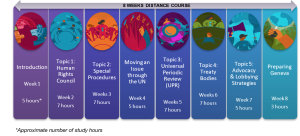
HRDAP topics
Defenders will complete a 10-week hybrid learning programme through a participatory approach, which will include:
accessing the HRDAP Platform, where they can complete e-learning courses on each key UN human rights mechanism and on advocacy strategies, and access interactive learning materials and case studies on the ISHR Academy
taking part in live Q&A sessions with human rights experts
receiving continuous advocacy support and personalised coaching in order to develop concrete advocacy objectives to make strategic use of the international human rights system
building networks around the world, and learning from peers from a range of regions working on a range of human rights issues
applying their knowledge to case-studies scenarios and enhancing their advocacy toolbox according to their specific needs
receiving support and advocacy accompaniment to conduct activities during the 62nd and 63rd Human Rights Council sessions and other relevant opportunities.
Participants will have the unique opportunity to apply their knowledge and skills while being in Geneva as well as to meet and share with their peers and experts. The blended format of the course allows defenders to continue their vital work on the ground, while diving into the inner workings of each key UN human rights mechanism and gaining first-hand experience from advocates and UN staff on how civil society can strategically engage in the international human rights space.
What are the criteria and themes for selection?
This programme is directed at experienced human rights defenders working in non-governmental organisations, with existing advocacy experience at the national level and some prior knowledge of the international human rights system. In 2026, we will select human rights defenders working on democratic backsliding and racial justice.
Defenders working in contexts of democratic backsliding
This theme is for human rights defenders working in democratic countries where authoritarian practices are gaining ground.
We particularly welcome applications from defenders who are:
pushing back against repressive laws, attacks on free expression, or restrictions on the freedom of peaceful assembly and association
documenting abuses linked to police and military violence, arbitrary arrests, surveillance, or harassment
fighting for justice, transparency, and the rule of law, and refusing to let democratic institutions be dismantled without accountability.
Defenders working on racial justice
This thematic is for defenders working to dismantle systemic racism and build societies rooted in equality and dignity. We will select applications from defenders focusing on anti-racism, exclusion and police violence, including anti-Black racism as experienced through legacies of colonialism and the Transatlantic Trade in Enslaved Africans, Indigenous (including Afro-Indigenous) communities working on historical injustice and reparations, as well as defenders of migrants and asylum seekers. We also welcome applications from mothers working for accountability for their children, victims of police violence.
On 18 September 2025, ISHR said that analysis of revised 2026 budget proposal for UN80 reform points to disproportionate cuts to the chronically-underfunded human rights pillar. Together with peace and development, human rights constitutes one of the three key areas of action for the UN and thus should be adequately funded.
On 16 September 2025, the UN Secretary-General published its report revising its earlier proposal for the UN’s 2026 budget (known as ‘Revised estimates’ report). The International Service for Human Rights (ISHR) has analysed the revised budget and is deeply concerned about proposed cuts to an already chronically under-resourced human rights pillar. While demands on the human rights system do not cease to grow to address mounting global conflicts and crises, further cuts will significantly reduce effectiveness and efficiency, and its capacity to deliver on human rights protection to individuals and populations on the ground.
‘The UN’s human rights pillar has historically received significantly less funds than development and peace and security, accounting for just 7% of the UN regular budget and less than 1% of UN’s total expenditure. Any cuts to it would result in minimal savings but have significant and disproportionate adverse consequences for the rights of people around the world – Phil Lynch, ISHR Executive Director
In recent years, a liquidity crisis fuelled by the late or non-payments of dues by the US and China had already prompted High Commissioner for Human Rights Volker Türk to suspend the delivery of reports, workshops and other activities mandated by the Human Rights Council (HRC). The HRC has also reduced the length of its sessions, limiting space for States, experts and civil society to address some of the world’s most pressing rights issues and crises.
Additional cuts to the human rights pillar would further undermine the ability of the UN’s human rights bodies to continue to investigate atrocity crimes such as in Gaza, Myanmar and the Democratic Republic of Congo, to support victims and human rights defenders, to assist States in improving their human rights policies, and to develop global human rights standards that protect us all.
UN Secretary-General Antonio Guterres stressed the cuts are ‘carefully calibrated’ and ensure balance between the UN’s three pillars (peace and security, development, and human rights). Yet, the proposed cuts to the budget of the Office of the High Commissioner for Human Rights (OHCHR) of around 15% run much deeper than the 2026 proposed budget on development (targeted for around 12% cut) and peace and security (targeted for a 13% cut, excluding peacekeeping operations).
Like a three-legged stool, if the human rights pillar is cut to the extent proposed then not only will it collapse, but the whole system will topple.
ISHR is campaigning for the UN80 Initiative to be more than a simple accounting overhaul for the UN, centred only on cost-cutting. On July 21, ISHR and 16 civil society organisations signed an open letter to the Secretary-General and High Commissioner Türk with concrete recommendations and proposals to ensure that the UN human rights system is streamlined, strengthened and sustainable, guided by the aim of support human rights defenders, providing justice to victims and ensuring accountability for rights abuses.
The cuts will next be reviewed by a UN budgetary committee traditionally hostile to human rights funding, whose conclusions will serve as a basis for States to negotiate.
For more information, please contact: Raphael Viana David, ISHR, Programme Manager r.vianadavid@ishr.ch
Listen to the stories of four human rights defenders who have been banned from travelling by their own governments simply for trying to cooperate with the United Nations. Can you guess which suitcase belongs to whom?
Location: Geneva, Switzerland Date: 16 September 2025, 10:00AM – 5:00PM CEST
Some States use travel bans as reprisals against human rights defenders who cooperate with the United Nations. These acts of retaliation are designed to isolate, intimidate, and silence them.
A travel ban may be less visible than a prison cell, but its impact is deeply damaging. It restricts defenders from attending UN meetings, carrying out their work, reuniting with family or seeking international protection.
Travel bans take many forms, including cancelling or confiscating passports, detaining defenders attempting to exit a country, denying defenders the right to leave or enter back into their own countries, and placing defenders on terrorist lists.
Through this exhibition, we unpack the stories of four human rights defenders who have been barred from entering or leaving in their own countries under arbitrary travel bans. These are not just about State reprisals against activists, they are stories of people whose lives have been disrupted, whose voices have been silenced, and whose basic freedoms have been trampled. They are also stories of resilience and perseverance in seeking positive social change.
Their voices defend human rights. Travel bans silence them: #EndReprisals!
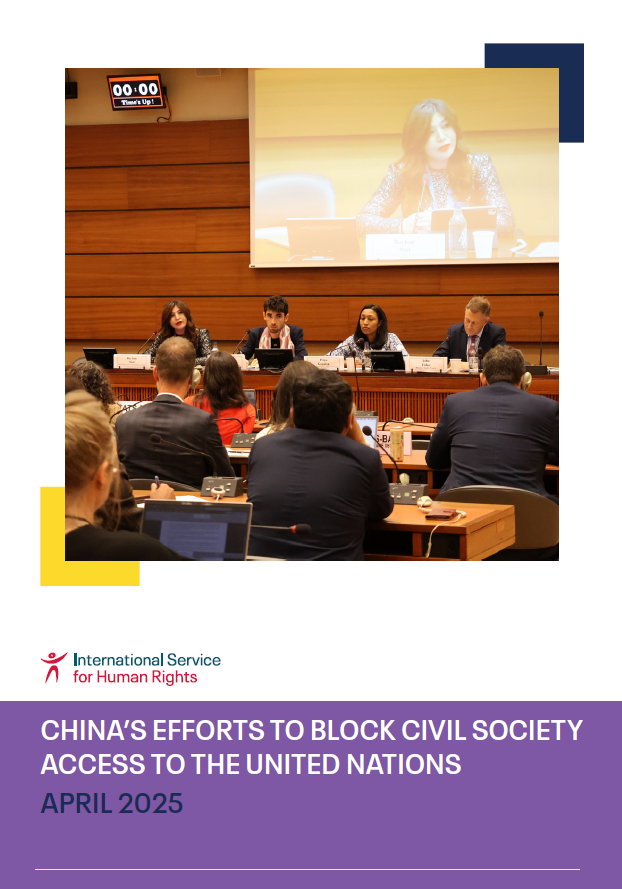
In a new report, ISHR analyses China’s tactics to restrict access for independent civil society actors in UN human rights bodies. The report provides an analysis of China’s membership of the UN Committee on NGOs, the growing presence of Chinese Government-Organised NGOs (GONGOs), and patterns of intimidation and reprisals by the Chinese government.
In the report, published on 28 April 2025 the International Service for Human Rights (ISHR) uncovers the tactics deployed by the Chinese government to restrict access to UN human rights bodies to independent civil society actors and human rights defenders, and intimidate and retaliate against those who do so.
These tactics include using its membership of the UN Committee on NGOs to systematically defer NGO applications, increasing the presence of GONGOs to limit space for independent NGOs and advance pro-government narratives, systematically committing acts of intimidation and reprisals against those seeking to cooperate with the UN, weaponising procedural tactics to silence NGO speakers and threatening diplomats not to meet with them, and opposing reform initiatives and efforts at norm-setting on safe and unhindered civil society participation at the Human Rights Council.
These tactics strongly contrast China’s stated commitment to being a reliable multilateral leader. They stem from the Chinese Party-State’s primary foreign policy objective of shielding itself from human rights criticism and enhancing its international image by restricting and deterring critical civil society voices, crowding out civil society space with GONGOs, and stalling and diverting reform initiatives.
While China is the focus of this report, the issues addressed are systemic. Based on this report’s findings, ISHR puts forward a set of targeted recommendations to UN bodies and Member States, aimed at protecting civil society space from interference and restrictions. The recommendations are designed to strengthen UN processes and prevent any State from manipulating international mechanisms to suppress independent voices. These include:
Reforming the Committee on NGOs to increase transparency, limit abuse of deferrals, and ensure fair access to UN bodies for independent NGOs;
Strengthening protection mechanisms against reprisals, including rapid response to incidents inside UN premises, public accountability for perpetrators, and consistent long-term follow-up on unresolved cases;
Curbing the influence of GONGOs by distinguishing clearly between independent and State-organised NGOs, and better documenting their presence and impact; and,
Strengthening measures at the Human Rights Council and other UN bodies to make civil society participation safer, more inclusive, and less vulnerable to obstruction
The report has been featured prominently in a global investigation by the International Consortium of Investigative Journalists (ICIJ) launched on 28 April 2025.
Natika Kantaria is a human rights advocate with nearly a decade of experience planning and implementing advocacy campaigns in human rights. She has worked with international organizations and watchdog NGOs and collaborated with the public and private sectors. For the ISHR she wrote a piece on 26 February 2025 about a worrying trend: ‘Foreign agent’ laws have been introduced in various countries, violating international human rights law and threatening to silence human rights defenders. This pattern is particularly evident in Eastern Europe, where NGOs courageously resist and need the support of the international community. See e.g. my earlier posts:
Societies thrive when everyone can work, speak out, and organise freely and safely to ensure justice and equality for all. Legislation requiring NGOs to register as ‘foreign agents’ is a barrier to this virtuous cycle. Despite the European Court of Human Rights’ 2022 ruling that Russia’s 2012 foreign agent law violated freedom of expression and association, the governments of Hungary, Georgia, Slovakia, Serbia, and Bosnia and Herzegovina have proceeded undeterred to introduce similar laws.
These laws specifically target NGOs and not-for-profits that receive foreign funds and require them to register as foreign agents, organisations serving the interests of a foreign power, or agents of foreign influence. By doing so, they restrict the capacity of human rights defenders to organise, participate and exercise their right to defend rights by:
imposing disproportionately high fines and heavy sanctions to NGOs refusing to comply, which may ultimately lead to the termination of their operations
using vague wording, that ultimately gives too much room and power for government interpretation. For instance, the requirement for NGOs to register in official records or identify themselves as ‘agents of foreign influence’ lacks clarity and specificity.
increasing the burden of NGOs by introducing heavy reporting and auditing requirements. The State’s alleged need for transparency as their primary purpose can, therefore, be effectively addressed through existing legislation regulating NGOs.
employing a negative narrative that stigmatises and delegitimises the work of the civil society organisations and human rights defenders. This rhetoric promotes hostility and distrust toward civil society and encourages attacks against defenders.
Furthermore, such laws contradict the commitments of these countries under international human rights law. Article 13 of the 1998 UN Declaration on human rights defenders recognises the right of defenders to solicit, receive and utilise resources.
Article 10 of the Declaration +25, a supplement to the UN Declaration put forward in 2024 by civil society, human rights defenders and legal experts, addresses States’ attempts to prohibit foreign contributions or impose unjustified national security limitations. It stipulates that States should not hinder financial resources for human rights defenders and outlines measures to prevent retaliation based on the source of their funding. These laws violate rights related to freedom of expression, association, and privacy, as outlined in the European Convention on Human Rights (ECHR) and International Covenant on Civil and Political Rights. Foreign agent laws also run counter to commitments made by countries at the regional level as members of the Council of Europe (CoE) and the Organization for Security and Co-operation in Europe (OSCE), including recommendation CM/Rec(2018)11, which emphasizes the protection and promotion of civil society space and OSCE guidelines for protecting human rights defenders.
NGOs are increasingly becoming a primary target for repressive governments. According to the CIVICUS Monitor 2024 report, the countries mentioned above that have introduced ‘foreign agent’ laws have either ‘closed’ or ‘obstructed’ civil society space. In addition, the Trump administration’s rhetoric and its decision to freeze foreign aid have contributed to strengthening hostile narratives already present in ‘foreign agent laws’ in Eastern Europe and have emboldened governments in their efforts to publicly undermine these organisations.
While the silencing of NGOs has become part of the agenda for many governments, and the rise of ‘foreign agent’ laws serves as a step towards establishing authoritarian regimes, civil society actors continue to mobilise in response. Strengthening engagement with international human rights mechanisms, fostering joint global advocacy, and providing support to targeted organisations and groups are essential steps that international NGOs and the international community should take to build resistance, reinforce coalition efforts, and protect the work of human rights defenders.
International and regional human rights mechanisms have called for governments to either repeal these laws, or not to adopt them in their current forms. On 7 February 2025, three UN independent experts issued a statement in relation to Bosnia and Herzegovina, where the government reintroduced the ‘Law on the Special Registry and Publicity of the Work of Non-Profit Organisations’ after its initial withdrawal in May 2024. The statement stressed that creating a register of non-profit organisations receiving foreign funding in one of the entities of Bosnia and Herzegovina will impose severe restrictions on NGOs and would grant government control over their operation, including the introduction of an annual inspection, with further reviews of legality of CSOs receiving foreign funding possible upon requests from citizens or relevant authorities.
In this unsupportive environment, donors have a fundamental role to play. ‘As civil society actors devise strategies to push back against these repressive tactics, private philanthropy and bilateral and multilateral donors have vital support roles to play,’ writes James Savage, who leads the Fund for Global Human Rights’ (FGHR) programme on the Enabling Environment for Human Rights Defenders. ‘They can help civil society prepare for future challenges, so that it is organised not only to respond to evolving forms of repression but also to get ahead of them by tackling their root causes,’ Savage concludes.
The suspension and, in some cases the termination, of US foreign aid is having profound and adverse human rights impacts, threatening the very existence says Phil Lynch of ISHR in his Director’s update: “Impact of US funding freeze on human rights defenders and ISHRe of many human rights defenders, organisations and institutions“.
ISHR is directly affected by the US funding freeze. The suspension of US government funds means we’ve already had to terminate, defer or reduce activities to support human rights defenders working in highly restrictive contexts.
Together with announced and anticipated reductions in support for human rights organisations from some other governments and institutional philanthropy, it has also required that we take a number of significant anticipatory cost-saving measures, reducing our capacity to support human rights defenders globally.
The US funding freeze is also very adversely affecting a number of our national NGO partners, including those supporting human rights defenders in countries such as Afghanistan, China and Venezuela, among others. If you are in any position to support these organisations we would be delighted to connect you.
As I have recently written together with incoming and outgoing ISHR Board Chairs Taaka Awori and Vrinda Grover, we simply can’t afford to give up hope in our shared work for freedom, equality and justice. But we will not win and cannot survive on starvation rations.
We need investors – governments, foundations, corporations and individuals – to join us and create the resources that enable us to be sustainable, innovative and impactful. We particularly need medium and small States to step up investment, not only because it is the right thing to do, but also because their interests are not served by the law of the jungle where might is right.
This investment needs to be made in civil society at the national, regional and international levels, as well as in the international human rights system to which frontline defenders increasingly turn when justice and accountability are denied at the national level. The realisation of human rights will provide an unmatched return on investment.
Are you a human rights defender keen to use the UN to push for change at home? If so, apply for the 2025 edition of ISHR’s flagship training, the Human Rights Defender Advocacy Programme (HRDAP)!
Learn more about why you should apply for HRDAP by watching this video!
What is the Human Rights Defender Advocacy Programme 2025 (HRDAP25)?
The course equips human rights defenders with the knowledge and skills to integrate the UN human rights system into their existing work at the national level in a strategic manner and provides an opportunity for participants to prepare for and engage in advocacy activities at the UN with the aim to effect change back home.
Online course topics – ISHR
Defenders will complete a 10-week hybrid learning programme, online and offline, which will include:
Accessing the HRDAP Platform, where they can complete e-learning courses on each key UN human rights mechanism and on advocacy strategies, and access interactive learning materials and case studies on the ISHR Academy
Taking part in live Q&A sessions with human rights experts
Receiving a continuous personalised advocacy support and coaching in order to develop concrete advocacy objectives to make strategic use of the international human rights system taking into account the local context
Building networks around the world, and learning from peers from a range of regions working on a range of human rights issues
Applying their knowledge to case-studies scenarios and enhancing their advocacy toolbox according to their specific needs (elevator pitch, SMART recommendations…)
Receiving support and advocacy accompaniment to conduct activities during the 59th and 60th Human Rights Council sessions and other relevant opportunities.
Participants will have the unique opportunity to apply their knowledge and skills while being in Geneva as well as to meet and share with their peers and experts (UN staff, diplomats, supporting NGOs…). The blended format of the course allows defenders to continue their vital work on the ground, while diving into the inner workings of each key UN human rights mechanism and gaining first-hand experience from advocates and UN staff on how civil society can strategically engage in the international human rights space. The methodology we use is interactive and learner-centred and encourage participation of everyone.
By participating in HRDAP, defenders:
Gain knowledge and tools, which they can use to ensure their voice is central in international human rights decision-making
Explore and compare the benefits of engagement with the Human Rights Council, the Special Procedures, the OHCHR, the Universal Periodic Review and the Treaty Bodies, and examine how they can use them to bolster their work at the national level
Develop strategies and advocacy techniques to increase the potential of their national and regional advocacy work
This programme is directed at experienced human rights defenders working in non-governmental organisations, with existing advocacy experience at the national level and some prior knowledge of the international human rights system.
ISHR supports, and promotes solidarity with and between, defenders working in the following areas or contexts, which we recognise as intersectional and interdependent:
Equality, dignity and non-discrimination
Environmental justice and sustainability
International accountability for the repression of human rights defenders
Transparency and rule of law
The hybrid programme will bring together around 16 committed human rights defenders from different backgrounds, who work on a wide range of areas that are linked with our programmes to ensure a sustainable collaboration. This can include, but is not limited to, defenders working on the following thematics: women rights; Indigenous people’s rights; the human rights of LGBTIQ+ persons; anti-racism; reclaiming civil society space and increasing protection of human rights defenders.
What do former HRDAPers say?
16 human rights defenders from 15 countries took part in the last edition, HRDAP24. At the end of the training, 98% of the participants were either extremely satisfied or very satisfied with the programme and felt that they would be able to apply what they learnt to their own day-to-day work. Find out more about the outcomes of HRDAP24 here.
First, download and read carefully the HRDAP 2025 Programme Description to find out more about modalities, requirements and funding. If you meet the criteria, take some time to apply using this online form before midnight Geneva time on Friday 10 January 2025!
As only a limited number of human rights defenders are able to participate in HRDAP each year, in addition to our range of guides and handbooks, ISHR has developed an e-learning space in English, French and Spanish to help human rights defenders strengthen their advocacy skills with the UN for greater impact on the ground: the ISHR Academy. The learning modules demystify the UN human rights system and build capacity to push for change. Discover new tools, insider tips, defender stories, and more!
ISHR are celebrating longstanding and collective efforts in supporting human rights defenders. Join and find out more! ISHR’s journey began in 1984, inspired by the courageous actions of human rights defenders who dared to challenge injustices and advocate for a fairer world.
We’ve created a list of 40 things you can do to shed light on our mission and the vital work of human rights defenders and advocates who tirelessly strive to make our world a better and more equal place for all.
Twice a week, we will suggest an action that you can do to support ISHR’s work until we reach 40 actions, representing our 40 years of engagement. These actions are designed to be simple yet impactful, allowing everyone to actively participate in the celebration and contribute to the advancement of human rights. Whether you are a long-time supporter or new to our mission, each action will provide a tangible way to support and promote human rights defenders and advocates around the world.
The actions will be published on this page as well as on our social media feeds. From sharing a resource that inspires you, to watching a defender story and sharing what you love about ISHR, every action counts and helps amplify the voices of those who are fighting for justice, equality and freedom.
Please share these links with your network. The success of our mobilisation relies on the collective effort of our community, so we encourage you to spread the word and invite others to join us. By participating, you are not only celebrating our anniversary but also reinforcing the importance of human rights and the tireless work of those who defend them. We are looking forward to your participation and can’t wait to see the creative ways in which you will engage!
On 4 January 2024 ISHR published a massive, complete compilation of all recommendations issued by UN human rights bodies – including the UN Special Rapporteurs and Working Groups, the UN Treaty Bodies, and the Office of the High Commissioner for Human Rights – on the human rights situation in China since 2018. Recommendations are sorted by topic and community affected.
This repository compiles all recommendations issued by UN human rights bodies to the Government of the People’s Republic of China since 2018, the year of its third Universal Periodic Review (UPR).
This includes recommendations in: Concluding Observations issued by UN Treaty Bodies following reviews of China in 2022 (Committee on the Rights of Persons with Disabilities (CRPD)) and 2023 (Committee on Economic, Social and Cultural Rights (CESCR), Committee on the Elimination of Discrimination Against Women (CEDAW)), as well as in Decision 1 (108) on the Xinjiang Uyghur Autonomous Region (XUAR) by the Committee on the Elimination of Racial Discrimination (CERD) under its Early Warning and Urgent Action Procedure; communications and press releases by UN Special Procedures (Special Rapporteurs and Working Groups), including Opinions by the Working Group on Arbitrary Detention; press releases by the Office of the High Commissioner for Human Rights (OHCHR) as well as the OHCHR’s assessment of human rights in the XUAR.
These UN bodies are composed of independent, impartial experts, from all geographic regions.
The recommendations are categorised by key topic or community affected. Yet, this repository does not cover all topics, nor does it include all recommendations issued by the above-mentioned UN bodies.
This repository maintains the original language of the recommendation issued by a given UN body, with minor formatting changes. For the appropriate links please go to the original document.
This repository does not include recommendations to the Governments of Hong Kong and of Macao. Please click here for the repository of recommendations on Hong Kong, and here for the repository of recommendations on Macao.
The topics include very useful ones such as:
Chinese human rights defenders, lawyers and civil society organisations in mainland China
Uyghur region
Tibet
National security legal framework, judicial independence and due process
Surveillance, censorship and free expression
Reprisals, meaningful cooperation with the UN, and unrestricted access to the country for UN experts
Transnational repression
LGBTI rights
Business and human rights, including business activities overseas



 Hans Thoolen on Human Rights Defenders and their awards