Yesterday I referred to the upcoming Human Rights Watch Film Festival in June. One of the films shown there will also appear on Netflix and therefore be able to reach a much larger audience. Interesting development for human rights films!!
The Associated Press reported on May 8 that Netflix Inc. had purchased E-TEAM as a high-profile “Netflix original,” and would distribute the film via its vast online platform as well as through a limited theatrical release in the United States. The film focuses on four researchers in the Human Rights Watch emergencies division, or E-Team, as they interview witnesses and gather other evidence of rights abuses and war crimes in Syria, Libya, and Kosovo. It highlights the personal commitment required to stop human rights violations over the long term. The filmmakers, Ross Kauffman and Katy Chevigny, operated with full creative control and had free rein from Human Rights Watch to produce a “warts and all” portrait of human rights activists in the field. It is the first time filmmakers have documented Human Rights Watch’s work so extensively.
[The film has won numerous awards on the festival circuit, including for best cinematography at Sundance. Variety called it “a documentary that’s devastating, entertaining and inspiring in equal measure.”]
This is a fundraising appeal which this blog normally would not relay but as (1) it is done jointly by two organisations, (2) comes with images, and (3) has such a clear focus on human rights defenders, I make an exception. It was published on 8 May 2014by the International Service for Human Rights and the East and Horn of Africa Human Rights Defenders Project, to ensure that human rights defenders have the skills and resources they need. To donate, go to www.ishr.ch/donate.
A few days ago Erykah Badu on Twitter remained obstinate over her scheduled performance in The Gambia. Other bloggers (e.g. http://yafri.ca/erykah-badu-faces-criticism-over-her-performance-for-gambian-president/) are adding to the noise by pointing out that President Jammeh’s regime consistently cracks down on the opposition and the media. In its submission to the Universal Periodic Review (UPR) of Gambia, the human rights organisation, Amnesty International, stated “Since Gambia’s first Universal Periodic Review (UPR) in 2010, the human rights situation in the country has deteriorated. The government continues to stifle freedom of expression and commit other human rights violations with impunity.” An online campaign has been put in place by web users to enlighten the singer about the Gambian dictator. See Facebook and twitter campaign of disapproval [@fatbellybella]. HOWEVER in the meantime it seems that Erykah Badu has decided NOT to attend Gambia’s much publicized Roots Homecoming Festival. Especially Gambian dissidents based in the United States have repeatedly prevailed on the Grammy winning artist not to attend the festival. ..Interestingly the singer’s likely absence has angered Gambian artist Gibou Balla Gaye, who goes with the street name Gee. Perhaps good to note here that Gee is the son of Balla Gaye, Gambia’s former Finance Minister.
Anyway it is nice to be able to point to better examples, such as Celina Jaitly in India who tackled the taboo of gay relations. The United Nations Free & Equal Campaign published on 29 April 2014 this first-ever Bollywood music video for gay rights, featuring Bollywood star Celina Jaitly: https://www.youtube.com/watch?v=lihVCIFamb0 [sorry you have CONTR/click as the embedding does not work – but worth a view!!].
Today, 3 May 2014, the Foundation Cartooning for Peace in Geneva hands out the 2nd International Prize for the best press cartoon (le Prix international du dessin de presse à Genève), followed by the exhibit “La guerre dans tous ses états”
This recent bi-annual award, given by Foundation in cooperation with the City of Geneva, will handed over by Kofi Annan, Honorary President of Cartooning for Peace. It rewards the creator for his or her courage, talent and engagement in favour of peace and human rights.
The work of the laureates form part of an exhibit of some hundred cartoons which are displayed in big format on the Quai Wilson for one month: from 3 May to 3 June.
We have a tendency to take for granted that there is a worldwide human rights movement to support all the actions and campaigns in favor of human rights defenders. But, this movement needs to be created and galvanised. One tool is the use of animated images with a simple message: that a loud voice can save lives. The example above (animated by Cesare Davolio) is a “commercial’ commissioned by Amnesty Netherlands for the “Use your power” campaign, explaining what the Amnesty urgent action network can accomplish. This short film – published on You Tube on 8 April – explains how the Urgent Action Network works, from receiving news of a human rights defender being arrested to news being sent out to AI activists and members all over the world via text messages (SMS), email etc to individuals taking action. Shows how effective these individual acts can be when coördinated to produce a ‘louder voice’.
Those who are planning to organise a film project with human rights films in Africa, Asia, Eastern Europe, Latin America, and Middle East could apply for (modest) funding from the Netherlands-based NGO “Movies that Matter”. The organisation also offers advice to initiate human rights film festivals and helps to circulate and exhibit human rights films. Its support covers projects like mobile cinema projects, human rights film festivals, travelling film festivals, outreach programmes, and educational activities at schools and universities, but it does notsupport film production! The deadline for applications is 15 April 2014.
The 24th Episode of the Human Rights Asia Weekly Roundup by the AHRC covers the encouraging peace agreement which has been signed in Mindanao, putting an end to a 40-year-old conflict between the Moro Islamic Liberation Front and the Philippine government.
In Qatar, hundreds of migrant workers have died in the slavery-like labour conditions on FIFA World Cup construction projects.
Indonesian, MP candidates for the upcoming elections met with Hong Kong’s domestic helpers to discuss improving protections and rights.
In India, the Supreme Court ordered for a time-bound adjudication of all trials involving legislators within a year. This is the first of a series of reports on court delays and what it means for justice in India.
India is the biggest importer of arms in the world while millions still lack basic health care. AHRC calls for the country to reconsider its priorities.
Voices of Survivors: this week hears from Hechin Haokip who was displaced from her mountain village in Manipur because of the on-going conflict but has managed to get back on her feet and help many vulnerable people in her community through human rights activism.
On 7 March 2014 UNHCR published a series of 6 videos on female genital mutilation (FGM), Too Much Pain, with stories of refugee women who have undergone FGM and have become human rights defenders engaged to end this practice. These women explain their experiences of flight, asylum and integration in the EU. These video clips deserve much wider recognition.
In Part 1, refugee women talk about why they had to flee because of their commitment to end the practice. The other videos explain that FGM is recognized internationally as a violation of the human rights of girls and women. The practice also violates a person’s rights to health and physical integrity; the right to be free from torture and other rights. FGM is harmful not cultural; it has life-long consequences and can be a ground for asylum. (See all videos: https://www.youtube.com/playlist?list=PLtPw-Y91GlmWvO9wxMUW-Ey3eMY2vwWYZ )
This video complements the UNHCR publication Too Much Pain: Female Genital Mutilation & Asylum in the European Union – A Statistical Overview, and updated in March 2014 (see here: http://goo.gl/lDnCRJ).
This blog wants keep you informed of what happens to human rights defenders and on what they do to protect the rights of others. I have also a special interest in the power of images in this area. So, I draw your attention to “Multiple Exposure” a monthly video magazine broadcast by Front Line Defenders, now in its 5th episode. Segments in the series will offer a behind-the-scenes peek at the difficulty of carrying out human rights work in different countries; more information about trends and political developments that directly impact human rights; and profiles of individual human rights defenders at risk.
Episode 5 covers the finalists of the 2014 Front Line Defenders Award for Human Rights Defenders
United Arab Emirates: Dr Mohamed Al Roken – Finalist of the 2014 Front Line Defenders Award
Dr Mohamed Al Roken is a leading lawyer and human rights defender in the United Arab Emirates. Despite official hostility and restrictive laws designed to curtail human rights activities, Mohamed has remained a champion of the rule of law and respect for universal human rights.
One of the most striking aspects of the controversy surrounding the Ugandan anti-gay bill is that the Ugandan government – and quite a few media – stress the ‘african’ aspect of resisting ‘western values”. The film “God Loves Uganda” (2013) should put that argument to rest. The documentary is a powerful exploration of the evangelical campaign to change African culture with values imported from America’s Christian Right. The film follows American and Ugandan religious leaders fighting “sexual immorality” and missionaries trying to convince Ugandans to follow Biblical law.
For those based in Washington there is a showing and debate on 8 April organized by Global Rights. Others will have to find it on the internet or rent it. It is worth it!
 The Associated Press reported on May 8 that Netflix Inc. had purchased E-TEAM as a high-profile “Netflix original,” and would distribute the film via its vast online platform as well as through a limited theatrical release in the United States. The film focuses on four researchers in the Human Rights Watch emergencies division, or E-Team, as they interview witnesses and gather other evidence of rights abuses and war crimes in Syria, Libya, and Kosovo. It highlights the personal commitment required to stop human rights violations over the long term. The filmmakers, Ross Kauffman and Katy Chevigny, operated with full creative control and had free rein from Human Rights Watch to produce a “warts and all” portrait of human rights activists in the field. It is the first time filmmakers have documented Human Rights Watch’s work so extensively.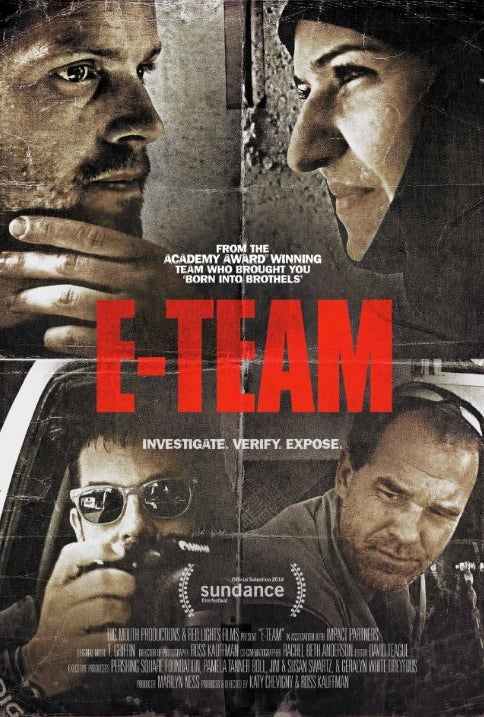




 Hans Thoolen on Human Rights Defenders and their awards